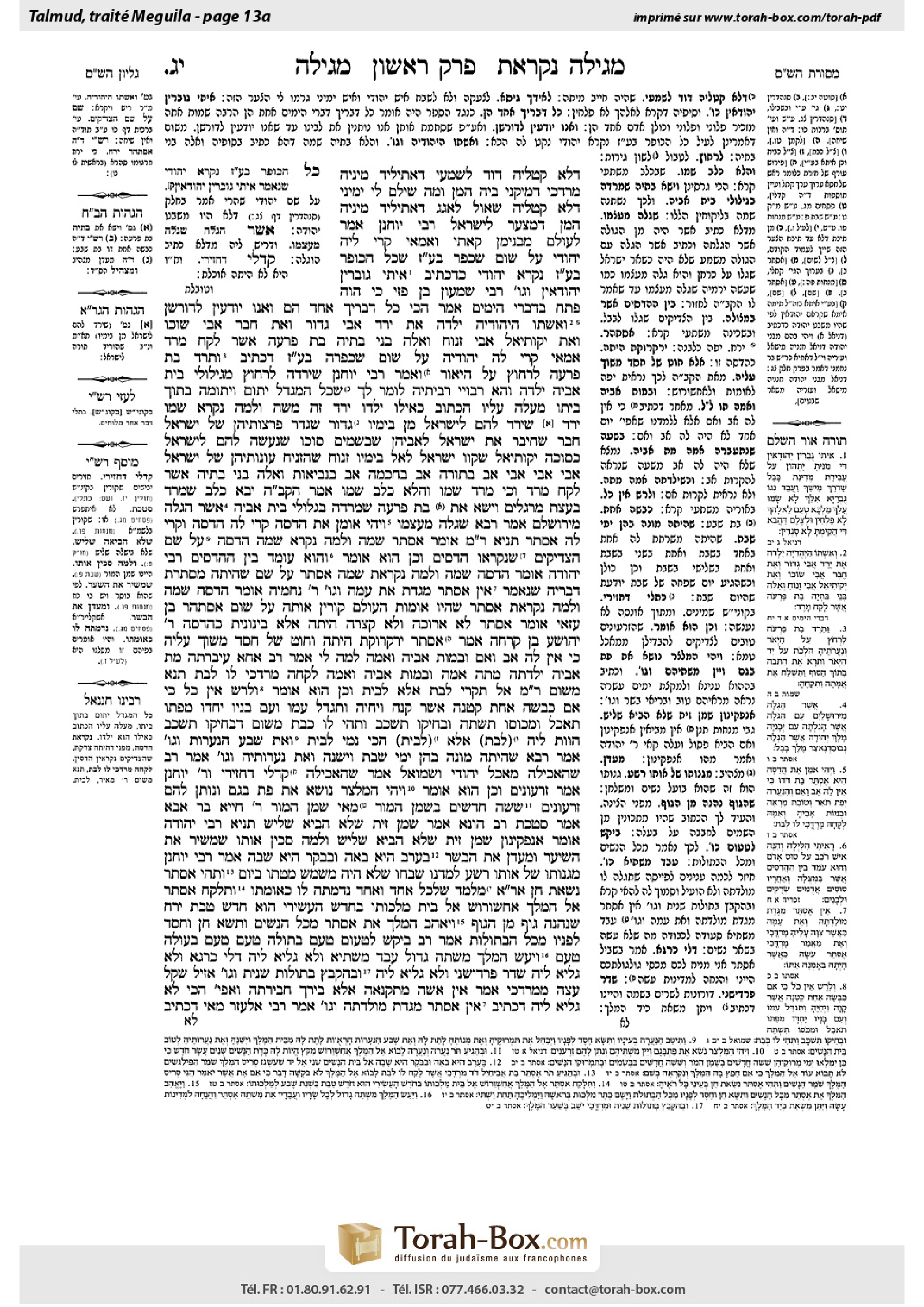
Megillah 13a: Talmud study for Daf Yomi
Daf Yomi is the daily study of one Talmud folio. Explore 37 tractates with scans, Hebrew text, Sefaria English and AI-generated French translations where annotated.
Passage selection and English or AI-generated French translation are available where the scan has annotations. Daf Study is independent of Torah-Box and Sefaria.
Browse Megillah · מגילה · All tractatesMegillah 13a text and translations
This page of Megillah includes the Aramaic text, an English translation and an AI-generated French translation, alongside the scan above.
מגילה י״ג א · Aramaic and Hebrew text
דְּלָא קַטְלֵיהּ דָּוִד לְשִׁמְעִי, דְּאִתְיְלִיד מִינֵּיהּ מָרְדֳּכַי דְּמִיקַּנֵּי בֵּיהּ הָמָן. וּמָה שִׁילֵּם לִי יְמִינִי — דְּלָא קַטְלֵיהּ שָׁאוּל לַאֲגָג, דְּאִתְיְלִיד מִינֵּיהּ הָמָן דִּמְצַעַר לְיִשְׂרָאֵל.
רַבִּי יוֹחָנָן אָמַר: לְעוֹלָם מִבִּנְיָמִן קָאָתֵי, וְאַמַּאי קָרֵי לֵיהּ ״יְהוּדִי״? עַל שׁוּם שֶׁכָּפַר בָּעֲבוֹדָה זָרָה. שֶׁכׇּל הַכּוֹפֵר בַּעֲבוֹדָה זָרָה נִקְרָא ״יְהוּדִי״, כְּדִכְתִיב: ״אִיתַי גּוּבְרִין יְהוּדָאיִן וְגוֹ׳״.
רַבִּי שִׁמְעוֹן בֶּן פַּזִּי, כִּי הֲוָה פָּתַח בְּדִבְרֵי הַיָּמִים, אָמַר הָכִי: כׇּל דְּבָרֶיךָ אֶחָד הֵם, וְאָנוּ יוֹדְעִין לְדוֹרְשָׁן. ״וְאִשְׁתּוֹ הַיְהוּדִיָּה יָלְדָה אֶת יֶרֶד אֲבִי גְדוֹר וְאֶת חֶבֶר אֲבִי שׂוֹכוֹ וְאֶת יְקוּתִיאֵל אֲבִי זָנוֹחַ וְאֵלֶּה בְּנֵי בִּתְיָה בַת פַּרְעֹה אֲשֶׁר לָקַח מָרֶד״.
אַמַּאי קָרֵי לַהּ ״יְהוּדִיָּה״ — עַל שׁוּם שֶׁכָּפְרָה בַּעֲבוֹדָה זָרָה, דִּכְתִיב: ״וַתֵּרֶד בַּת פַּרְעֹה לִרְחוֹץ עַל הַיְאוֹר״, וְאָמַר רַבִּי יוֹחָנָן: שֶׁיָּרְדָה לִרְחוֹץ מִגִּילּוּלֵי בֵּית אָבִיהָ.
״יָלְדָה״? וְהָא רַבּוֹיֵי רַבִּיתֵיהּ! לוֹמַר לְךָ שֶׁכׇּל הַמְגַדֵּל יָתוֹם וִיתוֹמָה בְּתוֹךְ בֵּיתוֹ — מַעֲלֶה עָלָיו הַכָּתוּב כְּאִילּוּ יְלָדוֹ.
״יֶרֶד״ זֶה מֹשֶׁה, וְלָמָּה נִקְרָא שְׁמוֹ ״יֶרֶד״? שֶׁיָּרַד לָהֶם לְיִשְׂרָאֵל מָן בְּיָמָיו. ״גְּדוֹר״ — שֶׁגָּדַר פִּרְצוֹתֵיהֶן שֶׁל יִשְׂרָאֵל. ״חֶבֶר״ — שֶׁחִיבֵּר אֶת יִשְׂרָאֵל לַאֲבִיהֶן שֶׁבַּשָּׁמַיִם. ״סוֹכוֹ״ — שֶׁנַּעֲשָׂה לָהֶם לְיִשְׂרָאֵל כְּסוּכָּה. ״יְקוּתִיאֵל״ — שֶׁקִּוּוּ יִשְׂרָאֵל לָאֵל בְּיָמָיו. ״זָנוֹחַ״ — שֶׁהִזְנִיחַ עֲוֹנוֹתֵיהֶן שֶׁל יִשְׂרָאֵל.
״אֲבִי״ ״אֲבִי״ ״אֲבִי״ — אָב בַּתּוֹרָה, אָב בְּחׇכְמָה, אָב בִּנְבִיאוּת.
״וְאֵלֶּה בְּנֵי בִּתְיָה אֲשֶׁר לָקַח מָרֶד״, וְכִי מֶרֶד שְׁמוֹ? וַהֲלֹא כָּלֵב שְׁמוֹ! אָמַר הַקָּדוֹשׁ בָּרוּךְ הוּא: יָבֹא כָּלֵב שֶׁמָּרַד בַּעֲצַת מְרַגְּלִים, וְיִשָּׂא אֶת בַּת פַּרְעֹה שֶׁמָּרְדָה בְּגִלּוּלֵי בֵּית אָבִיהָ.
״אֲשֶׁר הׇגְלָה מִירוּשָׁלַיִם״, אָמַר רָבָא: שֶׁגָּלָה מֵעַצְמוֹ.
״וַיְהִי אוֹמֵן אֶת הֲדַסָּה״, קָרֵי לַהּ ״הֲדַסָּה״ וְקָרֵי לַהּ ״אֶסְתֵּר״? תַּנְיָא, רַבִּי מֵאִיר אוֹמֵר: אֶסְתֵּר שְׁמָהּ, וְלָמָּה נִקְרָא שְׁמָהּ הֲדַסָּה — עַל שֵׁם הַצַּדִּיקִים שֶׁנִּקְרְאוּ הֲדַסִּים. וְכֵן הוּא אוֹמֵר: ״וְהוּא עוֹמֵד בֵּין הַהֲדַסִּים״.
רַבִּי יְהוּדָה אוֹמֵר: הֲדַסָּה שְׁמָהּ, וְלָמָּה נִקְרֵאת שְׁמָהּ אֶסְתֵּר? עַל שֵׁם שֶׁהָיְתָה מַסְתֶּרֶת דְּבָרֶיהָ, שֶׁנֶּאֱמַר: ״אֵין אֶסְתֵּר מַגֶּדֶת אֶת עַמָּהּ וְגוֹ׳״.
רַבִּי נְחֶמְיָה אוֹמֵר: הֲדַסָּה שְׁמָהּ, וְלָמָּה נִקְרֵאת אֶסְתֵּר? שֶׁהָיוּ אוּמּוֹת הָעוֹלָם קוֹרִין אוֹתָהּ עַל שׁוּם אִסְתַּהַר. בֶּן עַזַּאי אוֹמֵר: אֶסְתֵּר, לֹא אֲרוּכָּה וְלֹא קְצָרָה הָיְתָה, אֶלָּא בֵּינוֹנִית כַּהֲדַסָּה. רַבִּי יְהוֹשֻׁעַ בֶּן קׇרְחָה אָמַר: אֶסְתֵּר — יְרַקְרוֹקֶת הָיְתָה, וְחוּט שֶׁל חֶסֶד מָשׁוּךְ עָלֶיהָ.
״כִּי אֵין לָהּ אָב וָאֵם״ — ״וּבְמוֹת אָבִיהָ וְאִמָּהּ״ לְמָה לִי? אָמַר רַב אַחָא: עִיבְּרַתָּה — מֵת אָבִיהָ, יְלָדַתָּה — מֵתָה אִמָּהּ.
״וּבְמוֹת אָבִיהָ וְאִמָּהּ לְקָחָהּ מׇרְדֳּכַי לוֹ לְבַת״, תָּנָא מִשּׁוּם רַבִּי מֵאִיר: אַל תִּקְרֵי ״לְבַת״ אֶלָּא לְבַיִת. וְכֵן הוּא אוֹמֵר: ״וְלָרָשׁ אֵין כֹּל כִּי אִם כִּבְשָׂה אַחַת קְטַנָּה אֲשֶׁר קָנָה וַיְחַיֶּהָ וַתִּגְדַּל עִמּוֹ וְעִם בָּנָיו יַחְדָּו מִפִּתּוֹ תֹאכַל וּמִכּוֹסוֹ תִשְׁתֶּה וּבְחֵיקוֹ תִשְׁכָּב וַתְּהִי לוֹ כְּבַת״, מִשּׁוּם דִּבְחֵיקוֹ תִשְׁכָּב הֲווֹת לֵיהּ (לְבַת)? אֶלָּא — (לְבַיִת) הָכִי נָמֵי לְבַיִת.
״וְאֵת שֶׁבַע הַנְּעָרוֹת וְגוֹ׳״. אָמַר רָבָא: שֶׁהָיְתָה מוֹנָה בָּהֶן יְמֵי שַׁבָּת. ״וַיְשַׁנֶּהָ וְאֶת נַעֲרוֹתֶיהָ וְגוֹ׳״. אָמַר רַב: שֶׁהֶאֱכִילָהּ מַאֲכָל יְהוּדִי.
וּשְׁמוּאֵל אָמַר: שֶׁהֶאֱכִילָהּ קְדָלֵי דַחֲזִירֵי.
וְרַבִּי יוֹחָנָן אָמַר: זֵרְעוֹנִים, וְכֵן הוּא אוֹמֵר: ״וַיְהִי הַמֶּלְצַר נוֹשֵׂא אֶת פַּת בָּגָם וְנוֹתֵן לָהֶם זֵרְעוֹנִים״.
״שִׁשָּׁה חֳדָשִׁים בְּשֶׁמֶן הַמּוֹר״. מַאי ״שֶׁמֶן הַמּוֹר״? רַבִּי חִיָּיא בַּר אַבָּא אָמַר: סְטָכַת, רַב הוּנָא אָמַר: שֶׁמֶן זַיִת שֶׁלֹּא הֵבִיא שְׁלִישׁ. תַּנְיָא, רַבִּי יְהוּדָה אוֹמֵר: אַנְפָּקִינוֹן — שֶׁמֶן זַיִת שֶׁלֹּא הֵבִיא שְׁלִישׁ, וְלָמָּה סָכִין אוֹתוֹ — שֶׁמַּשִּׁיר אֶת הַשֵּׂיעָר וּמְעַדֵּן אֶת הַבָּשָׂר.
״בָּעֶרֶב הִיא בָאָה וּבַבֹּקֶר הִיא שָׁבָה״, אָמַר רַבִּי יוֹחָנָן: מִגְּנוּתוֹ שֶׁל אוֹתוֹ רָשָׁע לָמַדְנוּ שִׁבְחוֹ, שֶׁלֹּא הָיָה מְשַׁמֵּשׁ מִטָּתוֹ בַּיּוֹם.
״וַתְּהִי אֶסְתֵּר נֹשֵׂאת חֵן״, אָמַר רַבִּי אֶלְעָזָר: מְלַמֵּד שֶׁלְּכׇל אֶחָד וְאֶחָד נִדְמְתָה לוֹ כְּאוּמָּתוֹ. ״וַתִּלָּקַח אֶסְתֵּר אֶל הַמֶּלֶךְ אֲחַשְׁוֵרוֹשׁ אֶל בֵּית מַלְכוּתוֹ בַּחֹדֶשׁ הָעֲשִׂירִי הוּא חֹדֶשׁ טֵבֵת״, יֶרַח שֶׁנֶּהֱנֶה גּוּף מִן הַגּוּף.
״וַיֶּאֱהַב הַמֶּלֶךְ אֶת אֶסְתֵּר מִכׇּל הַנָּשִׁים וַתִּשָּׂא חֵן וָחֶסֶד לְפָנָיו מִכׇּל הַבְּתוּלוֹת״, אָמַר רַב: בִּיקֵּשׁ לִטְעוֹם טַעַם בְּתוּלָה — טָעַם, טַעַם בְּעוּלָה — טָעַם.
״וַיַּעַשׂ הַמֶּלֶךְ מִשְׁתֶּה גָדוֹל״. עֲבַד מִשְׁתְּיָא וְלָא גַּלְּיָא לֵיהּ, דַּלִּי כְּרָגָא וְלָא גַּלְּיָא לֵיהּ, שַׁדַּר פַּרְדִּישְׁנֵי וְלָא גַּלְּיָא לֵיהּ.
״וּבְהִקָּבֵץ בְּתוּלוֹת שֵׁנִית וְגוֹ׳״. אֲזַיל שְׁקַל עֵצָה מִמָּרְדֳּכַי, אֲמַר: אֵין אִשָּׁה מִתְקַנְּאָה אֶלָּא בְּיֶרֶךְ חֲבֶירְתָּהּ, וַאֲפִילּוּ הָכִי לָא גַּלְּיָא לֵיהּ, דִּכְתִיב: ״אֵין אֶסְתֵּר מַגֶּדֶת מוֹלַדְתָּהּ וְגוֹ׳״.
אָמַר רַבִּי אֶלְעָזָר, מַאי דִּכְתִיב:
Megillah 13a · English translation
the responsibility of Judah, as David did not kill Shimei, although he was liable to the death penalty. The grave consequences of this failure included that Mordecai was born from him, and it was he against whom Haman was jealous, leading Haman to issue a decree against all of the Jewish people. And how a Benjamite has repaid me is referring to the fact that Saul, who was from the tribe of Benjamin, did not kill the Amalekite king Agag immediately, from whom Haman was later born, and he caused suffering to the Jewish people.
Rabbi Yoḥanan said a different explanation of the verse: Actually, Mordecai came from the tribe of Benjamin. Why, then, was he referred to as Yehudi? On account of the fact that he repudiated idol worship, for anyone who repudiates idolatry is called Yehudi. It is understood here in the sense of yiḥudi, one who declares the oneness of God, as it is written: “There are certain Jews [Yehuda’in] whom thou hast appointed over the affairs of the province of Babylonia, Shadrach, Meshach, and Abed-Nego; these men, O king, have not regarded you: They serve not your gods, nor worship the golden image which you have set up” (Daniel 3:12). These three individuals were in fact Hananiah, Mishael, and Azariah, who were not all from the tribe of Judah but are referred to as Yehuda’in because they repudiated idol worship.
§ Incidental to the exposition of the word Yehudi as one who repudiates idolatry, the Gemara relates that when Rabbi Shimon ben Pazi introduced his exposition of the book of Chronicles, he addressed the book of Chronicles and said as follows: All of your words are one, and we know how to expound them. This introduction made reference to the fact that the book of Chronicles cannot always be interpreted literally but requires exposition, as the same individual might be called by various different names, as in the following verse: “And his wife HaYehudiyya bore Jered the father of Gedor, and Heber the father of Soco, and Jekuthiel the father of Zanoah. And these are the sons of Bithiah the daughter of Pharaoh, whom Mered took” (I Chronicles 4:18).
Why is she, who we are told at the end of the verse was Pharaoh’s daughter Bithiah, referred to as Yehudiyya? Because she repudiated idol worship, as it is written: “And the daughter of Pharaoh came down to wash herself in the river” (Exodus 2:5), and Rabbi Yoḥanan said: She went down to wash and purify herself from the idols of her father’s house.
The Gemara understands that all the names referred to in the verse as children of Pharaoh’s daughter refer to Moses, as it will soon explain. The Gemara asks: Pharaoh’s daughter bore Moses? But didn’t she merely raise him? Rather, it is telling you that with regard to anyone who raises an orphan boy or girl in his house, the verse ascribes him credit as if he gave birth to him.
The Gemara explains how all the names in fact are referring to Moses: “Jered”; this is Moses, and why was he called Jered? Because manna came down [yarad] for the Jewish people in his days. He was also called “Gedor” because he fenced in [gadar] the breaches of the Jewish people. He was called “Heber” because he connected [ḥibber] the Jewish people to their Father in Heaven. He was called “Soco” because he was for the Jewish people like a shelter [sukka] and shield. He was called “Jekuthiel” because the Jewish people trusted in God [kivu laEl] in his days. Lastly, he was called “Zanoah” because he caused the iniquities of the Jewish people to be disregarded [hizniaḥ].
The Gemara notes that the words “father of” appear three times in that same verse: “And his wife Hajehudijah bore Jered the father of Gedor, and Heber the father of Soco, and Jekuthiel the father of Zanoah.” This teaches that Moses was a father to all of the Jewish people in three respects: A father in Torah, a father in wisdom, and a father in prophecy.
The aforementioned verse stated: “And these are the sons of Bithiah the daughter of Pharaoh, whom Mered took.” The Gemara asks: Was Bithiah’s husband’s name Mered? Wasn’t his name Caleb? Rather, the verse alludes to the reason that Caleb married Bithiah. The Holy One, Blessed be He, said: Let Caleb, who rebelled [marad] against the advice of the spies, come and marry the daughter of Pharaoh, who rebelled against the idols of her father’s home.
§ The Gemara resumes its explanation of the book of Esther. The verse states with regard to Mordecai: “Who had been exiled from Jerusalem” (Esther 2:6). Rava said: This language indicates that he went into exile on his own, not because he was forced to leave Jerusalem. He knew that he would be needed by those in exile, and therefore he consciously left Jerusalem to attend to the needs of his people.
The verse states: “And he had brought up Hadassah, that is, Esther” (Esther 2:7). She is referred to as “Hadassah” and she is referred to as “Esther.” What was her real name? It is taught in a baraita that the Sages differed in their opinion as to which was in fact her name and which one was a description: Rabbi Meir says: Esther was her real name. Why then was she called Hadassah? On account of the righteous, who are called myrtles [hadassim], and so it states: “And he stood among the myrtles [hahadassim]” (Zechariah 1:8).
Rabbi Yehuda differs and says: Hadassah was her real name. Why then was she called Esther? Because she concealed [masteret] the truth about herself, as it is stated: “Esther had not yet made known her kindred nor her people” (Esther 2:20).
Rabbi Neḥemya concurs and says: Hadassah was her real name. Why then was she called Esther? This was her non-Hebrew name, for owing to her beauty the nations of the world called her after Istahar, Venus. Ben Azzai says: Esther was neither tall nor short, but of average size like a myrtle tree, and therefore she was called Hadassah, the Hebrew name resembling that myrtle tree. Rabbi Yehoshua ben Korḥa said: Esther was called Hadassah because she was greenish, having a pale complexion like a myrtle, but a cord of Divine grace was strung around her, endowing her with a beautiful appearance.
The verse initially states with regard to Esther: “For she had neither father nor mother” (Esther 2:7). Why do I need to be told in the continuation of the verse: “And when her father and mother were dead, Mordecai took her for his own daughter”? Rav Aḥa said: This repetition indicates that when her mother became pregnant with her, her father died, and when she gave birth to her, her mother died, so that she did not have a mother or a father for even a single day.
The verse states: “And when her father and mother were dead, Mordecai took her for his own daughter” (Esther 2:7). A tanna taught a baraita in the name of Rabbi Meir: Do not read the verse literally as for a daughter [bat], but rather read it as for a home [bayit]. This indicates that Mordecai took Esther to be his wife. And so it states: “But the poor man had nothing, except one little ewe lamb, which he had bought and reared: And it grew up together with him, and with his children; it did eat of his bread, and drank of his own cup, and lay in his bosom, and was like a daughter [kevat] to him” (II Samuel 12:3). The Gemara questions: Because it lay in his bosom, it “was like a daughter to him”? Rather, the parable in II Samuel referenced the illicit taking of another’s wife, and the phrase should be read: Like a home [bayit] to him, i.e., a wife. So too, here, Mordecai took her for a home, i.e., a wife.
The verse states: “And the seven maids chosen to be given her out of the king’s house” (Esther 2:9). Rava said: She would have a separate maid attend her each day, and she would count the days of the week by them, so she was always aware when Shabbat was. The verse continues: “And he advanced her and her maids to the best place in the house of the women.” Rav said: The advancement in the verse signals that he fed her food of Jews, i.e., kosher food.
And Shmuel said an alternative understanding: The advancement was a well-intentioned act in that he fed her pig hinds, thinking she would view it as a delicacy, although in fact they were not kosher.
And Rabbi Yoḥanan said a third understanding: He gave her vegetables, which did not pose a problem with regard to the kosher laws. And so it states with regard to the kindness done for Daniel and his associates: “So the steward took away their food and the wine that they should drink; and gave them vegetables” (Daniel 1:16).
The verse states: “Six months with oil of myrrh” (Esther 2:12). The Gemara asks: What is “oil of myrrh”? Rabbi Ḥiyya bar Abba said: It is the aromatic oil called setakt. Rav Huna said: It is a cosmetic oil derived from olives that have not yet reached one-third of their growth. It is similarly taught in a baraita: Rabbi Yehuda says: Anpakinon is the oil of olives that have not reached one-third of their growth. And why is it smeared on the body? Because it removes the hair and softens the skin.
The verse states: “In the evening she went, and in the morning she returned” (Esther 2:14). Rabbi Yoḥanan said: From the implicit criticism of that wicked man, Ahasuerus, who cohabited with many women, we have incidentally learned his praise as well, that he would not engage in sexual relations during the day, but in a more modest fashion at night.
The verse states: “And Esther obtained favor in the sight of all those who looked upon her” (Esther 2:15). Rabbi Elazar said: This teaches that she appeared to each and every one as if she were a member of his own nation, and therefore she obtained favor in the eyes of all. The next verse states: “So Esther was taken to King Ahasuerus into his royal house in the tenth month, which is the month Tevet” (Esther 2:16). It was by act of divine providence that Esther was taken to Ahasuerus in a cold winter month, in which the body takes pleasure in the warmth of another body, and therefore she found favor in his eyes.
The verse states: “And the king loved Esther more than all the women, and she obtained grace and favor in his sight more than all the virgins” (Esther 2:17). Rav said: This double language indicates that if he wanted to taste in her the taste of a virgin during intercourse, he tasted it, and if he wanted to experience the taste of a non-virgin, he tasted it, and therefore he loved her more than all the other women.
The verse states: “Then the king made a great feast for all his princes and his servants, even Esther’s feast” (Esther 2:18). The Gemara explains that this was part of an attempt to have Esther reveal her true identity. He made a great feast in her honor, but she did not reveal her identity to him. He lowered the taxes [karga] in her name, but still she did not reveal it to him. He sent gifts [pardishenei] to the ministers in her name, but even so she did not reveal it to him.
The verse states: “And when the virgins were gathered together the second time and Mordecai sat in the king’s gate” (Esther 2:19). The Gemara explains: The reason Ahasuerus gathered the women together was that he went and took advice from Mordecai as to what he should do to get Esther to reveal her identity. Mordecai said to him: As a rule, a woman is jealous only of the thigh of another woman. Therefore, you should take for yourself additional women. But even so she did not reveal her origins to him, as it is written: “Esther had not yet made known her kindred nor her people” (Esther 2:20).
§ Rabbi Elazar said: What is the meaning of that which is written:
Megillah 13a · Traduction française (IA)
la responsabilité de Juda, car David n’a pas tué Shimeï, bien qu’il fût passible de la peine de mort. Parmi les graves conséquences de cette défaillance, il y eut la naissance de Mardochée, contre lequel Haman éprouva de la jalousie, ce qui le conduisit à décréter la destruction de tout le peuple juif. Et « comment un Benjaminite m’a rendu la pareille » fait référence au fait que Saül, qui appartenait à la tribu de Benjamin, ne tua pas immédiatement le roi amalécite Agag, dont Haman descendit par la suite, et qu’il fit souffrir le peuple juif.
Rabbi Yoḥanan donne une autre explication du verset : en réalité, Mardochée appartenait à la tribu de Benjamin. Pourquoi, alors, était-il appelé Yehudi ? Parce qu’il rejetait le culte des idoles : quiconque rejette l’idolâtrie est appelé Yehudi. Ici, le terme est compris au sens de yiḥudi, celui qui proclame l’unicité de Dieu, comme il est écrit : « Il y a des Juifs [Yehuda’in] que tu as chargés de l’administration de la province de Babylone, Shadrak, Méshak et Abed-Nego ; ces hommes, ô roi, n’ont pas tenu compte de toi : ils ne servent pas tes dieux et ne se prosternent pas devant la statue d’or que tu as dressée » (Daniel 3:12). Ces trois hommes étaient en réalité Hanania, Mishaël et Azaria ; ils n’appartenaient pas tous à la tribu de Juda, mais sont appelés Yehuda’in parce qu’ils rejetaient le culte des idoles.
§ À propos de l’interprétation du mot Yehudi comme désignant celui qui rejette l’idolâtrie, la Guemara rapporte incidemment que, lorsque Rabbi Shimon ben Pazi entreprit son commentaire du livre des Chroniques, il s’adressa au livre des Chroniques en ces termes : « Tous tes mots ne font qu’un, et nous savons comment les interpréter. » Cette introduction faisait allusion au fait que le livre des Chroniques ne peut pas toujours être interprété littéralement et nécessite une interprétation, car une même personne peut être désignée par plusieurs noms différents, comme dans le verset suivant : « Sa femme la Yehudiyya enfanta Yered, père de Guedor, et Héber, père de Soko, et Yekoutiel, père de Zanoah. Ce sont là les fils de Bithia, fille de Pharaon, que Mered épousa » (I Chroniques 4:18).
Pourquoi celle qui, nous dit-on à la fin du verset, était Bithia, fille de Pharaon, est-elle appelée Yehudiyya ? Parce qu’elle rejetait le culte des idoles, comme il est écrit : « La fille de Pharaon descendit au fleuve pour s’y baigner » (Exode 2:5), et Rabbi Yoḥanan dit : elle descendit pour se baigner et se purifier des idoles de la maison de son père.
La Guemara comprend que tous les noms mentionnés dans le verset comme étant ceux des enfants de la fille de Pharaon désignent Moïse, comme elle l’expliquera bientôt. La Guemara demande : La fille de Pharaon a-t-elle enfanté Moïse ? Ne l’a-t-elle pas seulement élevé ? Le verset t’enseigne plutôt que quiconque élève chez lui un orphelin ou une orpheline est considéré par le verset comme l’ayant mis au monde.
La Guemara explique que tous ces noms désignent en réalité Moïse : « Yered », c’est Moïse. Pourquoi était-il appelé Yered ? Parce que la manne descendit [yarad] pour le peuple juif de son vivant. Il était aussi appelé « Guedor », parce qu’il clôtura [gadar] les brèches du peuple juif. Il était appelé « Héber », parce qu’il relia [ḥibber] le peuple juif à son Père céleste. Il était appelé « Soko », parce qu’il était pour le peuple juif comme un abri [sukka] et un bouclier. Il était appelé « Yekoutiel », parce que, de son vivant, le peuple juif plaça sa confiance en Dieu [kivu laEl]. Enfin, il était appelé « Zanoah », parce qu’il fit négliger [hizniaḥ] les fautes du peuple juif.
La Guemara relève que les mots « père de » apparaissent trois fois dans ce même verset : « Sa femme la Yehudiyya enfanta Yered, père de Guedor, et Héber, père de Soko, et Yekoutiel, père de Zanoah. » Cela enseigne que Moïse fut un père pour tout le peuple juif à trois titres : père en Torah, père en sagesse et père en prophétie.
Le verset cité précédemment disait : « Ce sont là les fils de Bithia, fille de Pharaon, que Mered épousa. » La Guemara demande : Le mari de Bithia s’appelait-il Mered ? Ne s’appelait-il pas Caleb ? Le verset fait plutôt allusion à la raison pour laquelle Caleb épousa Bithia. Le Saint, béni soit-Il, dit : Que Caleb, qui s’est rebellé [marad] contre l’avis des explorateurs, vienne épouser la fille de Pharaon, qui s’est rebellée contre les idoles de la maison de son père.
§ La Guemara reprend son explication du livre d’Esther. Au sujet de Mardochée, le verset dit : « Qui avait été exilé de Jérusalem » (Esther 2:6). Rava dit : Cette formulation indique qu’il partit en exil de son propre gré, et non parce qu’il avait été contraint de quitter Jérusalem. Il savait qu’on aurait besoin de lui parmi les exilés ; il quitta donc délibérément Jérusalem pour s’occuper des besoins de son peuple.
Le verset dit : « Il avait élevé Hadassa, c’est-à-dire Esther » (Esther 2:7). Elle est appelée « Hadassa » et « Esther ». Quel était son véritable nom ? Une baraïta enseigne que les Sages étaient en désaccord sur la question de savoir lequel était son véritable nom et lequel était une appellation descriptive. Rabbi Meïr dit : Esther était son véritable nom. Pourquoi était-elle alors appelée Hadassa ? En raison des justes, qui sont appelés myrtes [hadassim], comme il est dit : « Il se tenait parmi les myrtes [hahadassim] » (Zacharie 1:8).
Rabbi Yehouda n’est pas d’accord et dit : Hadassa était son véritable nom. Pourquoi était-elle alors appelée Esther ? Parce qu’elle dissimulait [masteret] la vérité à son sujet, comme il est dit : « Esther n’avait pas encore fait connaître sa parenté ni son peuple » (Esther 2:20).
Rabbi Neḥemya partage cet avis et dit : Hadassa était son véritable nom. Pourquoi était-elle alors appelée Esther ? C’était son nom étranger, car, en raison de sa beauté, les nations du monde l’appelaient d’après Istahar, Vénus. Ben Azaï dit : Esther n’était ni grande ni petite, mais de taille moyenne, comme un myrte ; c’est pourquoi elle était appelée Hadassa, le nom hébreu de cet arbuste. Rabbi Yehoshua ben Korḥa dit : Esther était appelée Hadassa parce qu’elle avait le teint verdâtre et pâle comme un myrte, mais un fil de grâce divine l’entourait et lui conférait une belle apparence.
Le verset dit d’abord au sujet d’Esther : « Car elle n’avait ni père ni mère » (Esther 2:7). Pourquoi fallait-il ajouter ensuite : « Quand son père et sa mère moururent, Mardochée la prit pour sa fille » ? Rav Aḥa dit : Cette répétition indique qu’au moment où sa mère la conçut, son père mourut, et qu’au moment où elle lui donna naissance, sa mère mourut ; ainsi, elle n’eut ni mère ni père, ne serait-ce qu’un seul jour.
Le verset dit : « Quand son père et sa mère moururent, Mardochée la prit pour sa fille » (Esther 2:7). Un tanna enseigna une baraïta au nom de Rabbi Meïr : ne lis pas le verset littéralement, « pour une fille » [bat], mais lis plutôt « pour une maison » [bayit]. Cela indique que Mardochée prit Esther pour épouse. C’est aussi ce qui ressort du verset : « Le pauvre n’avait rien, sinon une petite brebis qu’il avait achetée et élevée ; elle grandit avec lui et avec ses enfants, mangeait de son pain, buvait à sa coupe, couchait dans son sein et était pour lui comme une fille [kevat] » (II Samuel 12:3). La Guemara objecte : parce qu’elle couchait dans son sein, elle « était pour lui comme une fille » ? L’allégorie de II Samuel évoquait plutôt la prise illicite de la femme d’un autre, et l’expression doit se lire : « comme une maison [bayit] pour lui », c’est-à-dire une épouse. De même, ici, Mardochée la prit pour une maison, c’est-à-dire pour épouse.
Le verset dit : « Les sept suivantes choisies pour lui être données depuis la maison du roi » (Esther 2:9). Rava dit : Chaque jour, une suivante différente était affectée à son service, et elle comptait les jours de la semaine en fonction d’elles ; elle savait ainsi toujours quand était Chabbat. Le verset poursuit : « Il lui accorda, ainsi qu’à ses suivantes, la meilleure place dans la maison des femmes. » Rav dit : La faveur mentionnée dans le verset signifie qu’il lui servit de la nourriture juive, c’est-à-dire de la nourriture casher.
Shmuel donne une autre interprétation : cette faveur consistait en un geste bien intentionné : il lui servait des cuisses de porc, pensant qu’elle les trouverait délicieuses, alors qu’elles n’étaient pas casher.
Rabbi Yoḥanan donne une troisième interprétation : il lui donnait des légumes, qui ne posaient aucun problème au regard des lois alimentaires. C’est aussi ce qui ressort du récit de la bonté témoignée à Daniel et à ses compagnons : « L’intendant leur retira leurs mets et le vin qu’ils devaient boire, et leur donna des légumes » (Daniel 1:16).
Le verset dit : « Six mois avec de l’huile de myrrhe » (Esther 2:12). La Guemara demande : Qu’est-ce que l’« huile de myrrhe » ? Rabbi Ḥiyya bar Abba dit : C’est l’huile parfumée appelée setakt. Rav Huna dit : C’est une huile cosmétique tirée d’olives qui n’ont pas encore atteint le tiers de leur croissance. Une baraïta enseigne de même : Rabbi Yehouda dit : L’anpakinon est l’huile tirée d’olives qui n’ont pas atteint le tiers de leur croissance. Pourquoi en enduit-on le corps ? Parce qu’elle épile et adoucit la peau.
Le verset dit : « Le soir, elle y allait, et le matin, elle en revenait » (Esther 2:14). Rabbi Yoḥanan dit : La critique implicite de ce méchant, Assuérus, qui eut des relations avec de nombreuses femmes, nous apprend incidemment aussi un mérite à son sujet : il n’avait pas de relations sexuelles pendant la journée, mais agissait avec davantage de pudeur la nuit.
Le verset dit : « Esther obtint la faveur de tous ceux qui la regardaient » (Esther 2:15). Rabbi Elazar dit : Cela enseigne qu’elle apparaissait à chacun comme si elle appartenait à son propre peuple ; elle obtint donc la faveur de tous. Le verset suivant dit : « Esther fut conduite auprès du roi Assuérus, dans sa maison royale, au dixième mois, qui est le mois de Tevet » (Esther 2:16). C’est par un acte de la Providence divine qu’Esther fut conduite auprès d’Assuérus pendant un mois froid de l’hiver, où le corps trouve du plaisir dans la chaleur d’un autre corps ; elle trouva ainsi grâce à ses yeux.
Le verset dit : « Le roi aima Esther plus que toutes les femmes, et elle obtint grâce et faveur à ses yeux plus que toutes les vierges » (Esther 2:17). Rav dit : Cette double formulation indique que, s’il voulait éprouver avec elle le goût d’une vierge pendant leurs relations, il l’éprouvait, et que, s’il voulait éprouver le goût d’une femme qui n’était plus vierge, il l’éprouvait aussi ; c’est pourquoi il l’aima plus que toutes les autres femmes.
Le verset dit : « Le roi donna un grand festin à tous ses princes et à ses serviteurs, le festin d’Esther » (Esther 2:18). La Guemara explique que cela faisait partie d’une tentative pour amener Esther à révéler sa véritable identité. Il donna un grand festin en son honneur, mais elle ne lui révéla pas son identité. Il réduisit les impôts [karga] en son nom, mais elle ne la lui révéla toujours pas. Il envoya des cadeaux [pardishenei] aux ministres en son nom, mais, malgré cela, elle ne la lui révéla pas.
Le verset dit : « Lorsque les vierges furent réunies une seconde fois et que Mardochée siégeait à la porte du roi » (Esther 2:19). La Guemara explique qu’Assuérus rassembla les femmes parce qu’il alla demander conseil à Mardochée sur ce qu’il devait faire pour qu’Esther révèle son identité. Mardochée lui dit : En règle générale, une femme n’est jalouse que de la cuisse d’une autre femme. Tu devrais donc prendre d’autres femmes. Mais, malgré cela, elle ne lui révéla pas ses origines, comme il est écrit : « Esther n’avait pas encore fait connaître sa parenté ni son peuple » (Esther 2:20).
§ Rabbi Elazar dit : Quel est le sens de ce qui est écrit :
Traduction française générée par IA à partir de l’édition anglaise de Sefaria. Vérifie toujours un passage avec le texte source.
Text from Sefaria: William Davidson Edition - Vocalized Aramaic (CC BY NC); William Davidson Edition - English (CC BY NC).