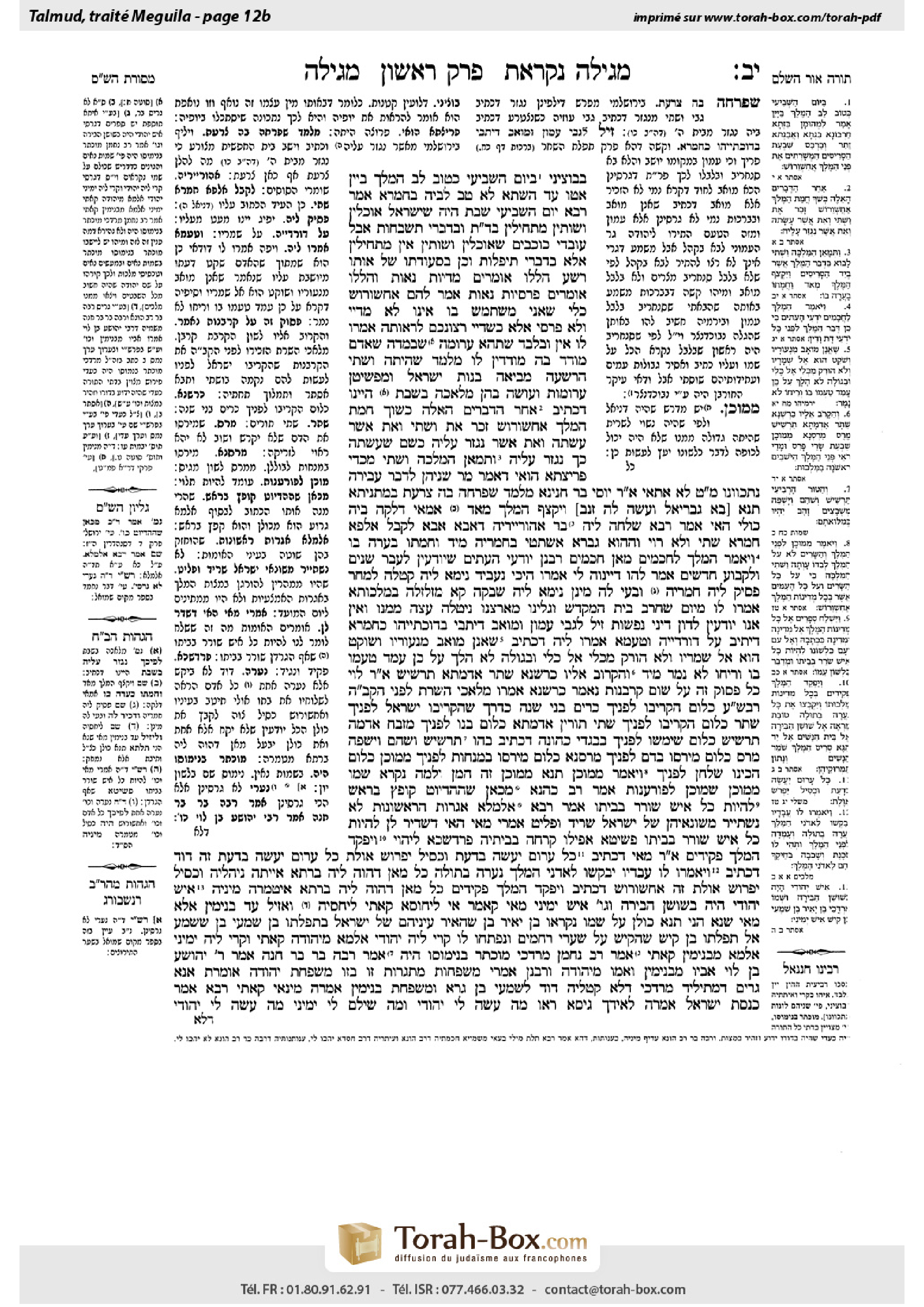
Megillah 12b: Talmud study for Daf Yomi
Daf Yomi is the daily study of one Talmud folio. Explore 37 tractates with scans, Hebrew text, Sefaria English and AI-generated French translations where annotated.
Passage selection and English or AI-generated French translation are available where the scan has annotations. Daf Study is independent of Torah-Box and Sefaria.
Browse Megillah · מגילה · All tractatesMegillah 12b text and translations
This page of Megillah includes the Aramaic text, an English translation and an AI-generated French translation, alongside the scan above.
מגילה י״ב ב · Aramaic and Hebrew text
בְּבוּצִינֵי.
״בַּיּוֹם הַשְּׁבִיעִי כְּטוֹב לֵב הַמֶּלֶךְ בַּיָּיִן״. אַטּוּ עַד הַשְׁתָּא לָא טָב לִבֵּיהּ בְּחַמְרָא? אֲמַר רָבָא: יוֹם הַשְּׁבִיעִי שַׁבָּת הָיָה. שֶׁיִּשְׂרָאֵל אוֹכְלִין וְשׁוֹתִין — מַתְחִילִין בְּדִבְרֵי תוֹרָה וּבְדִבְרֵי תִשְׁבָּחוֹת. אֲבָל אוּמּוֹת הָעוֹלָם שֶׁאוֹכְלִין וְשׁוֹתִין — אֵין מַתְחִילִין אֶלָּא בְּדִבְרֵי תִיפְלוּת.
וְכֵן בִּסְעוּדָּתוֹ שֶׁל אוֹתוֹ רָשָׁע, הַלָּלוּ אוֹמְרִים: מָדִיּוֹת נָאוֹת, וְהַלָּלוּ אוֹמְרִים: פָּרְסִיּוֹת נָאוֹת. אָמַר לָהֶם אֲחַשְׁוֵרוֹשׁ: כְּלִי שֶׁאֲנִי מִשְׁתַּמֵּשׁ בּוֹ, אֵינוֹ לֹא מָדִיִּי וְלֹא פָּרְסִי אֶלָּא כַּשְׂדִּיִּי, רְצוֹנְכֶם לִרְאוֹתָהּ? אָמְרוּ לוֹ: אִין, וּבִלְבַד שֶׁתְּהֵא עֲרוּמָּה.
שֶׁבַּמִּדָּה שֶׁאָדָם מוֹדֵד — בָּהּ מוֹדְדִין לוֹ, מְלַמֵּד שֶׁהָיְתָה וַשְׁתִּי הָרְשָׁעָה מְבִיאָה בְּנוֹת יִשְׂרָאֵל וּמַפְשִׁיטָתָן עֲרוּמּוֹת וְעוֹשָׂה בָּהֶן מְלָאכָה בְּשַׁבָּת. הַיְינוּ דִּכְתִיב: ״אַחַר הַדְּבָרִים הָאֵלֶּה כְּשׁוֹךְ חֲמַת הַמֶּלֶךְ אֲחַשְׁוֵרוֹשׁ זָכַר אֶת וַשְׁתִּי וְאֵת אֲשֶׁר עָשָׂתָה וְאֵת אֲשֶׁר נִגְזַר עָלֶיהָ״, כְּשֵׁם שֶׁעָשָׂתָה — כָּךְ נִגְזַר עָלֶיהָ.
״וַתְּמָאֵן הַמַּלְכָּה וַשְׁתִּי״. מִכְּדֵי פְּרִיצְתָּא הֲוַאי, דְּאָמַר מָר: שְׁנֵיהֶן לִדְבַר עֲבֵירָה נִתְכַּוְּונוּ, מַאי טַעְמָא לָא אֲתַאי? אָמַר רַבִּי יוֹסֵי בַּר חֲנִינָא: מְלַמֵּד שֶׁפָּרְחָה בָּהּ צָרַעַת. בְּמַתְנִיתָא תָּנָא: [בָּא גַּבְרִיאֵל וְעָשָׂה לָהּ זָנָב].
״וַיִּקְצֹף הַמֶּלֶךְ מְאֹד״. אַמַּאי דְּלַקָה בֵּיהּ כּוּלֵּי הַאי? אָמַר רָבָא, שְׁלַחָה לֵיהּ: בַּר אַהוּרְיָירֵיהּ דְּאַבָּא, אַבָּא לָקֳבֵל אַלְפָּא חַמְרָא שָׁתֵי וְלָא רָוֵי, וְהָהוּא גַּבְרָא אִשְׁתַּטִּי בְּחַמְרֵיהּ, מִיָּד: ״וַחֲמָתוֹ בָּעֲרָה בוֹ״.
״וַיֹּאמֶר הַמֶּלֶךְ לַחֲכָמִים״, מַאן חֲכָמִים — רַבָּנַן. ״יוֹדְעֵי הָעִתִּים״ — שֶׁיּוֹדְעִין לְעַבֵּר שָׁנִים וְלִקְבּוֹעַ חֳדָשִׁים. אֲמַר לְהוּ: דַּיְּינוּהָ לִי. אֲמַרוּ: הֵיכִי נַעֲבֵיד? נֵימָא לֵיהּ: קִטְלַהּ, לִמְחַר פָּסֵיק לֵיהּ חַמְרֵיהּ וּבָעֵי לַהּ מִינַּן. נֵימָא לֵיהּ: שִׁבְקַהּ — קָא מְזַלְזְלָה בְּמַלְכוּתָא, אָמְרוּ לוֹ: מִיּוֹם שֶׁחָרַב בֵּית הַמִּקְדָּשׁ וְגָלִינוּ מֵאַרְצֵנוּ, נִיטְּלָה עֵצָה מִמֶּנּוּ וְאֵין אָנוּ יוֹדְעִין לָדוּן דִּינֵי נְפָשׁוֹת. זִיל לְגַבֵּי עַמּוֹן וּמוֹאָב דְּיָתְבִי בְּדוּכְתַּיְיהוּ כְּחַמְרָא דְּיָתֵיב עַל דּוּרְדְּיֵיהּ.
וְטַעְמָא אֲמַרוּ לֵיהּ, דִּכְתִיב: ״שַׁאֲנַן מוֹאָב מִנְּעוּרָיו וְשׁוֹקֵט הוּא אֶל שְׁמָרָיו וְלֹא הוּרַק מִכְּלִי אֶל כֶּלִי וּבַגּוֹלָה לֹא הָלָךְ עַל כֵּן עָמַד טַעְמוֹ בּוֹ וְרֵיחוֹ לֹא נָמָר״, מִיָּד: ״וְהַקָּרוֹב אֵלָיו כַּרְשְׁנָא שֵׁתָר אַדְמָתָא תַרְשִׁישׁ״.
אָמַר רַבִּי לֵוִי: כׇּל פָּסוּק זֶה עַל שׁוּם קׇרְבָּנוֹת נֶאֱמַר.
״כַּרְשְׁנָא״ — אָמְרוּ מַלְאֲכֵי הַשָּׁרֵת לִפְנֵי הַקָּדוֹשׁ בָּרוּךְ הוּא: רִבּוֹנוֹ שֶׁל עוֹלָם, כְּלוּם הִקְרִיבוּ לְפָנֶיךָ כָּרִים בְּנֵי שָׁנָה כְּדֶרֶךְ שֶׁהִקְרִיבוּ יִשְׂרָאֵל לְפָנֶיךָ? ״שֵׁתָר״ — כְּלוּם הִקְרִיבוּ לְפָנֶיךָ שְׁתֵּי תוֹרִין? ״אַדְמָתָא״ — כְּלוּם בָּנוּ לְפָנֶיךָ מִזְבֵּחַ אֲדָמָה? ״תַּרְשִׁישׁ״ — כְּלוּם שִׁימְּשׁוּ לְפָנֶיךָ בְּבִגְדֵי כְהוּנָּה דִּכְתִיב בְּהוּ ״תַּרְשִׁישׁ וְשֹׁהַם וְיָשְׁפֵה״? ״מֶרֶס״ — כְּלוּם מֵירְסוּ בְּדָם לְפָנֶיךָ? ״מַרְסְנָא״ — כְּלוּם מֵירְסוּ בִּמְנָחוֹת לְפָנֶיךָ? ״מְמוּכָן״ — כְּלוּם הֵכִינוּ שֻׁלְחָן לְפָנֶיךָ?
״וַיֹּאמֶר מְמוּכָן״. תָּנָא: מְמוּכָן זֶה הָמָן, וְלָמָּה נִקְרָא שְׁמוֹ מְמוּכָן? שֶׁמּוּכָן לְפוּרְעָנוּת. אָמַר רַב כָּהֲנָא: מִכָּאן שֶׁהַהֶדְיוֹט קוֹפֵץ בָּרֹאשׁ.
״לִהְיוֹת כׇּל אִישׁ שׂוֹרֵר בְּבֵיתוֹ״. אָמַר רָבָא: אִלְמָלֵא אִגְּרוֹת הָרִאשׁוֹנוֹת לֹא נִשְׁתַּיֵּיר מִשּׂוֹנְאֵיהֶן שֶׁל יִשְׂרָאֵל שָׂרִיד וּפָלִיט.
אָמְרִי: מַאי הַאי דְּשַׁדַּיר לַן ״לִהְיוֹת כׇּל אִישׁ שׂוֹרֵר בְּבֵיתוֹ״? פְּשִׁיטָא, אֲפִילּוּ קָרָחָה — בְּבֵיתֵיהּ פַּרְדַּשְׁכָּא לֶיהֱוֵי!
״וְיַפְקֵד הַמֶּלֶךְ פְּקִידִים״. אָמַר רַבִּי, מַאי דִּכְתִיב: ״כׇּל עָרוּם יַעֲשֶׂה בְדָעַת וּכְסִיל יִפְרֹשׂ אִוֶּלֶת״ —
״כׇּל עָרוּם יַעֲשֶׂה בְדָעַת״ — זֶה דָּוִד, דִּכְתִיב: ״וַיֹּאמְרוּ לוֹ עֲבָדָיו יְבַקְשׁוּ לַאדֹנִי הַמֶּלֶךְ נַעֲרָה בְתוּלָה״; כֹּל מַאן דַּהֲוָה לֵיהּ בְּרַתָּא — אַיָּיתַהּ נִיהֲלֵיהּ. ״וּכְסִיל יִפְרוֹשׁ אִוֶּלֶת״ — זֶה אֲחַשְׁוֵרוֹשׁ, דִּכְתִיב: ״וְיַפְקֵד הַמֶּלֶךְ פְּקִידִים״; כֹּל מַאן דַּהֲוָה לֵיהּ בְּרַתָּא — אַיטְמְרַהּ מִינֵּיהּ.
״אִישׁ יְהוּדִי הָיָה בְּשׁוּשַׁן הַבִּירָה וְגוֹ׳ אִישׁ יְמִינִי״. מַאי קָאָמַר: אִי לְיַחוֹסֵיהּ קָאָתֵי — לְיַחֲסֵיהּ וְלֵיזִיל עַד בִּנְיָמִין! אֶלָּא מַאי שְׁנָא הָנֵי?
תָּנָא: כּוּלָּן עַל שְׁמוֹ נִקְרְאוּ. ״בֶּן יָאִיר״ — בֵּן שֶׁהֵאִיר עֵינֵיהֶם שֶׁל יִשְׂרָאֵל בִּתְפִלָּתוֹ. ״בֶּן שִׁמְעִי״ — בֵּן שֶׁשָּׁמַע אֵל תְּפִלָּתוֹ. ״בֶּן קִישׁ״ — שֶׁהִקִּישׁ עַל שַׁעֲרֵי רַחֲמִים וְנִפְתְּחוּ לוֹ.
קָרֵי לֵיהּ ״יְהוּדִי״ — אַלְמָא מִיהוּדָה קָאָתֵי, וְקָרֵי לֵיהּ ״יְמִינִי״ — אַלְמָא מִבִּנְיָמִין קָאָתֵי! אָמַר רַב נַחְמָן: מָרְדֳּכַי מוּכְתָּר בְּנִימוּסוֹ הָיָה.
אָמַר רַבָּה בַּר בַּר חָנָה אָמַר רַבִּי יְהוֹשֻׁעַ בֶּן לֵוִי: אָבִיו מִבִּנְיָמִין, וְאִמּוֹ מִיהוּדָה. וְרַבָּנַן אָמְרִי: מִשְׁפָּחוֹת מִתְגָּרוֹת זוֹ בָּזוֹ. מִשְׁפַּחַת יְהוּדָה אוֹמֶרֶת: אֲנָא גְּרַמִי דְּמִתְיְלִיד מָרְדֳּכַי, דְּלָא קַטְלֵיהּ דָּוִד לְשִׁמְעִי בֶּן גֵּרָא. וּמִשְׁפַּחַת בִּנְיָמִין אָמְרָה: מִינַּאי קָאָתֵי.
רָבָא אָמַר: כְּנֶסֶת יִשְׂרָאֵל אָמְרָה לְאִידַּךְ גִּיסָא: רְאוּ מָה עָשָׂה לִי יְהוּדִי וּמָה שִׁילֵּם לִי יְמִינִי. מָה עָשָׂה לִי יְהוּדִי —
Megillah 12b · English translation
with zucchinis, indicating that often a man and his wife engage in similar actions.
The verse states: “On the seventh day, when the heart of the king was merry with wine” (Esther 1:10). The Gemara asks: Is that to say that until now his heart was not merry with wine? Did it take seven days for him to achieve merriment? Rava said: The seventh day was Shabbat, when the difference between the Jewish people and the gentiles is most apparent. On Shabbat, when the Jewish people eat and drink, they begin by occupying themselves with words of Torah and words of praise for God. But the nations of the world, when they eat and drink, they begin only with words of licentiousness.
The Gemara continues to detail what occurred at the feast. So too, at the feast of that wicked man, Ahasuerus, when the men began to converse, some said: The Median women are the most beautiful, while others said: The Persian women are the most beautiful. Ahasuerus said to them: The vessel that I use, i.e., my wife, is neither Median nor Persian, but rather Chaldean. Do you wish to see her? They said to him: Yes, provided that she be naked, for we wish to see her without any additional adornments.
The Gemara comments: Vashti was punished in this humiliating way for it is with the measure that a man measures to others that he himself is measured. In other words, God punishes individuals in line with their transgressions, measure for measure. This teaches that the wicked Vashti would take the daughters of Israel, and strip them naked, and make them work on Shabbat. Therefore, it was decreed that she be brought before the king naked, on Shabbat. This is as it is written: “After these things, when the wrath of King Ahasuerus was appeased, he remembered Vashti, and what she had done, and what was decreed against her” (Esther 2:1). That is to say, just as she had done with the young Jewish women, so it was decreed upon her.
The verse states: “But the queen Vashti refused to come” (Esther 1:12). The Gemara asks: Since she was immodest, as the Master said above: The two of them had sinful intentions, what is the reason that she did not come? Rabbi Yosei bar Ḥanina said: This teaches that she broke out in leprosy, and therefore she was embarrassed to expose herself publicly. An alternative reason for her embarrassment was taught in a baraita: The angel Gabriel came and fashioned her a tail.
The verse continues: “Therefore the king was very wrathful, and his anger burned in him” (Esther 1:12). The Gemara asks: Why did his anger burn in him so greatly merely because she did not wish to come? Rava said: Vashti not only refused to come, but she also sent him a message by way of a messenger: You, son of my father’s stableman [ahuriyyarei]. Belshazzar, my father, drank wine against a thousand men and did not become inebriated, as the verse in Daniel (5:1) testifies about him: “Belshazzar the king made a great feast to a thousand of his lords, and drank wine before the thousand”; and that man, referring euphemistically to Ahasuerus himself, has become senseless from his wine. Due to her audacity, immediately “his anger burned in him” (Esther 1:12).
The following verse states: “Then the king said to the wise men, who knew the times” (Esther 1:13). The Gemara asks: Who are these wise men? These wise men are the Sages of the Jewish people, who are referred to as those “who knew the times,” for they know how to intercalate years and fix the months of the Jewish calendar. Ahasuerus said to them: Judge her for me. The Sages said in their hearts: What should we do? If we say to him: Kill her, tomorrow he will become sober and then come and demand her from us. If we say to him: Let her be, she has scorned royalty, and that cannot be tolerated. Consequently, they decided not to judge the matter, and they said to him as follows: From the day that the Temple was destroyed and we have been exiled from our land, counsel and insight have been removed from us, and we do not know how to judge capital cases, as they are exceptionally difficult. Go to the people of Ammon and Moab, who have remained permanently settled in their places like wine that is settled on its lees, and so their minds are settled as well.
And they provided a good reason when they spoke to him, as they proved that one who is settled retains his reasoning: For it is written: “Moab has been at ease from his youth, and he has settled on his lees, and has not been emptied from vessel to vessel, neither has he gone into exile; therefore his taste has remained in him, and his scent is not changed” (Jeremiah 48:11). Ahasuerus immediately acted on their advice and asked his advisors, as it is written: “And next to him was Carshena, Shethar, Admatha, Tarshish, Meres, Marsena, and Memucan” (Esther 1:14).
Rabbi Levi said: This entire verse listing the names of the king’s advisors is stated on account of offerings. Each name alludes to an aspect of the sacrificial service that was unique to the Jewish people, which the ministering angels mentioned as merit for the Jewish people.
“Carshena”; the ministering angels said before the Holy One, Blessed be He: Master of the Universe, did the gentiles ever offer before You lambs [karim] of the first year [shana], as the Jewish people have offered before You? “Shethar”; have they ever offered before You two turtledoves [shetei torim]? “Admatha”; have they ever built before You an altar of earth [adama]? “Tarshish”; have they ever ministered before You in the priestly vestments, as it is written that on the fourth of the four rows of precious stones contained on the breastplate were: “A beryl [tarshish], an onyx, and a jasper” (Exodus 28:20). “Meres”; have they ever stirred [meirsu] the blood of the offerings before You? “Marsena”; have they ever stirred [meirsu] the meal-offering before You? “Memucan”; have they ever prepared [hekhinu] the table before You, on which the shewbread was placed?
The verse states: “And Memucan said” (Esther 1:16). A Sage taught in a baraita: Memucan is Haman. And why is Haman referred to as Memucan? Because he was prepared [mukhan] to bring calamity upon the Jewish people. Rav Kahana said: From here we see that the common man jumps to the front and speaks first, for Memucan was mentioned last of the king’s seven advisors, and nevertheless he expressed his opinion first.
The king sent out letters to the people of all his provinces, in which it was written: “That every man shall wield authority in his own house and speak according to the language of his people” (Esther 1:22). Rava said: Were it not for the first letters sent by Ahasuerus, which everybody discounted, there would not have been left among the enemies of the Jewish people, a euphemism for the Jewish people themselves, a remnant or a refugee. Since these first letters were the subject of ridicule, people didn’t take the king seriously and did not immediately act upon the directive of the later letters, calling for the Jewish people’s destruction.
The Gemara continues. The reason that the first letters were not taken seriously is that they who received them would say: What is this that he has sent us: “That every man shall wield authority in his own house”? This is obvious; even a lowly weaver is commander [paredashekha] in his house. If so, why then did the king find it necessary to make such a proclamation?
The verse describes Ahasuerus’s search for a new wife by stating: “And let the king appoint officers in all the provinces of his kingdom, that they may gather together all the fair young virgins unto Shushan the castle” (Esther 2:3). Rabbi Yehuda HaNasi said: What is the meaning of that which is written: “In everything a prudent man acts with knowledge, but a fool unfolds his folly” (Proverbs 13:16)? The verse highlights the difference between two kings’ approaches to finding a wife.
“In everything a prudent man acts with knowledge”; this statement is referring to David, who also sought a wife for himself, as it is written: “And his servants said to him, Let there be sought for my lord the king a young virgin” (I Kings 1:2). Since he sought one maiden, whoever had a daughter brought her to him, for everyone wanted his daughter to be the king’s wife. With regard to the continuation of the verse: “But a fool unfolds his folly” (Proverbs 13:16), this statement is referring to Ahasuerus, as it is written: “And let the king appoint officers” to seek out many maidens. Since it became clear that the king would have relations with all of them, but in the end he would choose only one as his bride, whoever had a daughter hid her from him.
The verse that initially describes Mordecai states: “There was a certain Jew in Shushan the castle, whose name was Mordecai the son of Jair the son of Shimei the son of Kish, a Benjamite” (Esther 2:5). The Gemara asks: What is it conveying in the verse by saying the names of Mordecai’s ancestors? If the verse in fact comes to trace his ancestry, it should continue tracing his lineage back all the way to Benjamin, the founder of his tribe. Rather, what is different about these names that they deserve special mention?
The Gemara answers: A Sage taught the following baraita: All of them are names by which Mordecai was called. He was called “the son of Jair” because he was the son who enlightened [heir] the eyes of all of the Jewish people with his prayers; “the son of Shimei” because he was the son whom God heard [shama] his prayers; “the son of Kish” because he knocked [hikish] on the gates of mercy and they were opened to him.
The Gemara points out a contradiction: Mordecai is referred to as a “Jew [Yehudi],” apparently indicating that he came from the tribe of Judah, but in the continuation of the verse he is called “Benjamite” [Yemini], which indicates that he came from the tribe of Benjamin. Rav Naḥman said: Mordecai was crowned with honorary names. Yehudi is one such honorary epithet, due to its allusion to the royal tribe of Judah, but it is not referring to Mordecai’s tribal affiliation.
Rabba bar bar Ḥana said that Rabbi Yehoshua ben Levi said an alternative explanation: Mordecai’s father was from the tribe of Benjamin, and his mother was from the tribe of Judah. Therefore, he was both a Yemini, a Benjamite, and a Yehudi, from the tribe of Judah. And the Rabbis say that the dual lineage is due to a dispute: The families competed with each other over which tribe could take credit for Mordecai. The family of Judah would say: I caused the birth of Mordecai, as only because David did not kill Shimei, the son of Gera, when he cursed him (see II Samuel 16) was it possible for Mordecai to be born later from his descendants. And the family of Benjamin said in response: In the end he came from me, as he in fact was from Benjamin’s tribe.
Rava said: The Congregation of Israel at the time said this from the opposite perspective, not as a boast, but as a complaint, remarking: See what a Judean has done to me and how a Benjamite has repaid me. What a Judean has done to me is referring to
Megillah 12b · Traduction française (IA)
avec des courgettes, ce qui indique qu’un homme et sa femme agissent souvent de la même manière.
Le verset dit : « Le septième jour, alors que le cœur du roi était réjoui par le vin » (Esther 1:10). La Guemara demande : Cela signifie-t-il que jusque-là, son cœur n’était pas réjoui par le vin ? Lui a-t-il fallu sept jours pour se réjouir ? Rava dit : Le septième jour était le Chabbat, jour où la différence entre le peuple juif et les nations est la plus manifeste. Le Chabbat, lorsque les Juifs mangent et boivent, ils commencent par s’occuper de paroles de Torah et de louanges à Dieu. Mais les nations du monde, lorsqu’elles mangent et boivent, ne commencent qu’à parler de débauche.
La Guemara poursuit le récit de ce qui s’est passé au festin. De même, au festin de ce méchant, Assuérus, lorsque les hommes commencèrent à converser, certains dirent : « Les femmes mèdes sont les plus belles », tandis que d’autres dirent : « Les femmes perses sont les plus belles. » Assuérus leur dit : « Celle dont je dispose, c’est-à-dire mon épouse, n’est ni mède ni perse, mais chaldéenne. Voulez-vous la voir ? » Ils lui répondirent : « Oui, à condition qu’elle soit nue, car nous voulons la voir sans aucun ornement. »
La Guemara commente : Vachti fut punie de cette manière humiliante, car c’est selon la mesure dont un homme use envers les autres qu’il est lui-même traité. Autrement dit, Dieu punit chacun en fonction de ses transgressions, mesure pour mesure. Cela nous enseigne que la méchante Vachti faisait venir les filles d’Israël, les dénudait et les faisait travailler le Chabbat. Il fut donc décrété qu’elle soit amenée nue devant le roi, un Chabbat. C’est ce qui est écrit : « Après ces événements, lorsque la colère du roi Assuérus se fut apaisée, il se souvint de Vachti, de ce qu’elle avait fait et de ce qui avait été décrété contre elle » (Esther 2:1). Autrement dit, de même qu’elle avait agi envers les jeunes filles juives, ainsi fut-il décrété contre elle.
Le verset dit : « Mais la reine Vachti refusa de venir » (Esther 1:12). La Guemara demande : Puisqu’elle était impudique, comme le maître l’a dit plus haut — tous deux avaient des intentions coupables —, pourquoi ne vint-elle pas ? Rabbi Yosei bar Ḥanina dit : Cela nous enseigne qu’elle fut atteinte de lèpre et qu’elle eut donc honte de s’exposer en public. Une baraïta enseigne une autre raison de sa honte : l’ange Gabriel lui fit pousser une queue.
Le verset poursuit : « Alors le roi fut très irrité, et sa colère s’enflamma en lui » (Esther 1:12). La Guemara demande : Pourquoi sa colère s’enflamma-t-elle à ce point, simplement parce qu’elle ne voulait pas venir ? Rava dit : Vachti ne se contenta pas de refuser de venir ; elle lui fit aussi transmettre un message par un messager : « Toi, fils de l’écurier de mon père [ahuriyyarei]. Bélshatsar, mon père, a bu du vin devant mille hommes sans s’enivrer, comme le verset de Daniel (5:1) en témoigne : “Le roi Bélshatsar donna un grand festin à mille de ses grands et but du vin devant eux.” Et cet homme », désignant par euphémisme Assuérus lui-même, « a perdu la raison à cause du vin. » En raison de son insolence, aussitôt, « sa colère s’enflamma en lui » (Esther 1:12).
Le verset suivant dit : « Alors le roi dit aux sages, qui connaissaient les temps » (Esther 1:13). La Guemara demande : Qui sont ces sages ? Ce sont les Sages du peuple juif, désignés comme ceux « qui connaissaient les temps », car ils savent comment intercaler les années et fixer les mois du calendrier juif. Assuérus leur dit : « Jugez-la pour moi. » Les Sages se dirent en eux-mêmes : « Que devons-nous faire ? Si nous lui disons : “Tue-la”, demain il sera dégrisé, puis viendra nous la réclamer. Si nous lui disons : “Laisse-la vivre”, elle a méprisé la royauté, ce qui ne peut être toléré. » Ils décidèrent donc de ne pas juger l’affaire et lui dirent : « Depuis le jour où le Temple a été détruit et où nous avons été exilés de notre pays, le conseil et le discernement nous ont été retirés, et nous ne savons pas juger les affaires passibles de la peine capitale, car elles sont particulièrement difficiles. Adresse-toi aux gens d’Ammon et de Moab, qui sont demeurés en permanence dans leur pays, comme du vin reposant sur sa lie ; leur esprit, lui aussi, est donc posé. »
Ils lui donnèrent un argument valable, en démontrant que celui qui est établi conserve son discernement. En effet, il est écrit : « Moab a été tranquille depuis sa jeunesse ; il repose sur sa lie. Il n’a pas été transvasé de vase en vase et n’est pas allé en exil ; ainsi son goût est resté en lui et son parfum n’a pas changé » (Jérémie 48:11). Assuérus suivit aussitôt leur conseil et interrogea ses conseillers, comme il est écrit : « À ses côtés se trouvaient Carshena, Shethar, Admatha, Tarshish, Meres, Marsena et Memucan » (Esther 1:14).
Rabbi Levi dit : Ce verset entier, qui énumère les noms des conseillers du roi, est mentionné à propos des offrandes. Chaque nom fait allusion à un aspect du service sacrificiel propre au peuple juif, que les anges serviteurs invoquèrent comme mérite en faveur du peuple juif.
« Carshena » : les anges serviteurs dirent devant le Saint, béni soit-Il : « Maître de l’univers, les nations ont-elles jamais offert devant Toi des agneaux [karim] âgés d’un an [shana], comme le peuple juif en a offert devant Toi ? » « Shethar » : « Ont-elles jamais offert devant Toi deux tourterelles [shetei torim] ? » « Admatha » : « Ont-elles jamais bâti devant Toi un autel de terre [adama] ? » « Tarshish » : « Ont-elles jamais accompli devant Toi le service avec les vêtements sacerdotaux, comme il est écrit que la quatrième des quatre rangées de pierres précieuses du pectoral comprenait : “une chrysolithe [tarshish], une cornaline et un jaspe” (Exode 28:20 ? » « Meres » : « Ont-elles jamais remué [meirsu] devant Toi le sang des offrandes ? » « Marsena » : « Ont-elles jamais remué [meirsu] devant Toi l’offrande végétale ? » « Memucan » : « Ont-elles jamais préparé [hekhinu] devant Toi la table sur laquelle étaient disposés les pains de proposition ? »
Le verset dit : « Et Memucan prit la parole » (Esther 1:16). Un Sage enseigne dans une baraïta : Memucan, c’est Haman. Et pourquoi Haman est-il appelé Memucan ? Parce qu’il était prêt [mukhan] à causer un malheur au peuple juif. Rav Kahana dit : Nous voyons d’ici que l’homme du commun se précipite au premier rang et prend la parole le premier, car Memucan était mentionné en dernier parmi les sept conseillers du roi, et pourtant il exprima son avis le premier.
Le roi envoya des lettres aux habitants de toutes les provinces, où il était écrit : « Que tout homme exerce son autorité dans sa maison et parle la langue de son peuple » (Esther 1:22). Rava dit : Si les premières lettres envoyées par Assuérus avaient été prises au sérieux par tous, il ne serait resté, parmi les ennemis du peuple juif — expression euphémique désignant les Juifs eux-mêmes —, ni survivant ni réfugié. Comme ces premières lettres furent tournées en dérision, les gens ne prirent pas le roi au sérieux et n’exécutèrent pas immédiatement les directives des lettres suivantes, qui ordonnaient la destruction du peuple juif.
La Guemara poursuit. Les destinataires des premières lettres ne les prirent pas au sérieux, car ils se dirent : « Qu’est-ce qu’il nous a envoyé là : “Que tout homme exerce son autorité dans sa maison” ? C’est évident ; même un humble tisserand est le chef [paredashekha] de sa maison. Alors pourquoi le roi a-t-il jugé nécessaire de faire une telle proclamation ? »
Le verset décrit la recherche d’une nouvelle épouse par Assuérus en disant : « Que le roi nomme des fonctionnaires dans toutes les provinces de son royaume, afin qu’ils rassemblent toutes les jeunes vierges de belle apparence à Suse, la citadelle » (Esther 2:3). Rabbi Yehuda HaNassi dit : Que signifie ce qui est écrit : « En toute chose, l’homme prudent agit avec discernement, mais l’insensé étale sa folie » (Proverbes 13:16) ? Le verset souligne la différence entre la manière dont deux rois s’y prirent pour trouver une épouse.
« En toute chose, l’homme prudent agit avec discernement » : cette phrase se rapporte à David, qui chercha lui aussi une épouse, comme il est écrit : « Ses serviteurs lui dirent : “Qu’on cherche pour mon seigneur le roi une jeune vierge” » (I Rois 1:2). Comme il ne cherchait qu’une seule jeune fille, quiconque avait une fille la lui amenait, car chacun voulait que sa fille soit l’épouse du roi. Quant à la suite du verset : « Mais l’insensé étale sa folie » (Proverbes 13:16), elle se rapporte à Assuérus, comme il est écrit : « Que le roi nomme des fonctionnaires » pour chercher de nombreuses jeunes filles. Comme il apparut que le roi aurait des relations avec toutes, mais qu’à la fin il n’en choisirait qu’une seule comme épouse, tous ceux qui avaient une fille la lui cachèrent.
Le verset qui présente Mordekhaï au début dit : « Il y avait à Suse, la citadelle, un certain Juif nommé Mordekhaï, fils de Yaïr, fils de Shiméi, fils de Kish, un Benjaminite » (Esther 2:5). La Guemara demande : Que nous apprend le verset en mentionnant les noms des ancêtres de Mordekhaï ? Si le verset entend réellement retracer son ascendance, il aurait dû poursuivre jusqu’à Benjamin, fondateur de sa tribu. Qu’ont donc ces noms de particulier pour mériter d’être mentionnés ?
La Guemara répond : Un Sage enseigne la baraïta suivante : tous ces noms étaient des noms par lesquels Mordekhaï était appelé. Il était appelé « fils de Yaïr » parce qu’il était celui qui éclaira [heir], par ses prières, les yeux de tout le peuple juif ; « fils de Shiméi » parce qu’il était celui dont Dieu entendit [shama] les prières ; « fils de Kish » parce qu’il frappa [hikish] aux portes de la miséricorde, qui s’ouvrirent devant lui.
La Guemara relève une contradiction : Mordekhaï est appelé « Juif [Yehudi] », ce qui semble indiquer qu’il appartenait à la tribu de Juda, mais la suite du verset le qualifie de « Benjaminite [Yemini] », ce qui indique qu’il appartenait à la tribu de Benjamin. Rav Naḥman dit : Mordekhaï fut honoré de surnoms. Yehudi est l’un de ces titres honorifiques, en raison de son allusion à la tribu royale de Juda, mais il ne désigne pas l’appartenance tribale de Mordekhaï.
Rabba bar bar Ḥana dit au nom de Rabbi Yehoshua ben Levi une autre explication : le père de Mordekhaï était de la tribu de Benjamin et sa mère de la tribu de Juda. Il était donc à la fois Yemini, un Benjaminite, et Yehudi, de la tribu de Juda. Les Sages disent que cette double ascendance s’explique par une dispute : les familles rivalisaient pour savoir quelle tribu pouvait revendiquer Mordekhaï. La famille de Juda disait : « C’est grâce à moi que Mordekhaï est né, car si David n’avait pas épargné Shiméi, fils de Guéra, lorsqu’il le maudit (voir II Samuel 16), Mordekhaï n’aurait pas pu naître plus tard parmi ses descendants. » La famille de Benjamin répondit : « En définitive, il vient de moi, puisqu’il appartenait en fait à la tribu de Benjamin. »
Rava dit : À cette époque, la communauté d’Israël dit cela dans une perspective inverse, non pas pour se vanter, mais pour se plaindre : « Voyez ce qu’un homme de Juda m’a fait et comment un Benjaminite m’a rendu la pareille. » « Ce qu’un homme de Juda m’a fait » se rapporte à
Traduction française générée par IA à partir de l’édition anglaise de Sefaria. Vérifie toujours un passage avec le texte source.
Text from Sefaria: William Davidson Edition - Vocalized Aramaic (CC BY NC); William Davidson Edition - English (CC BY NC).