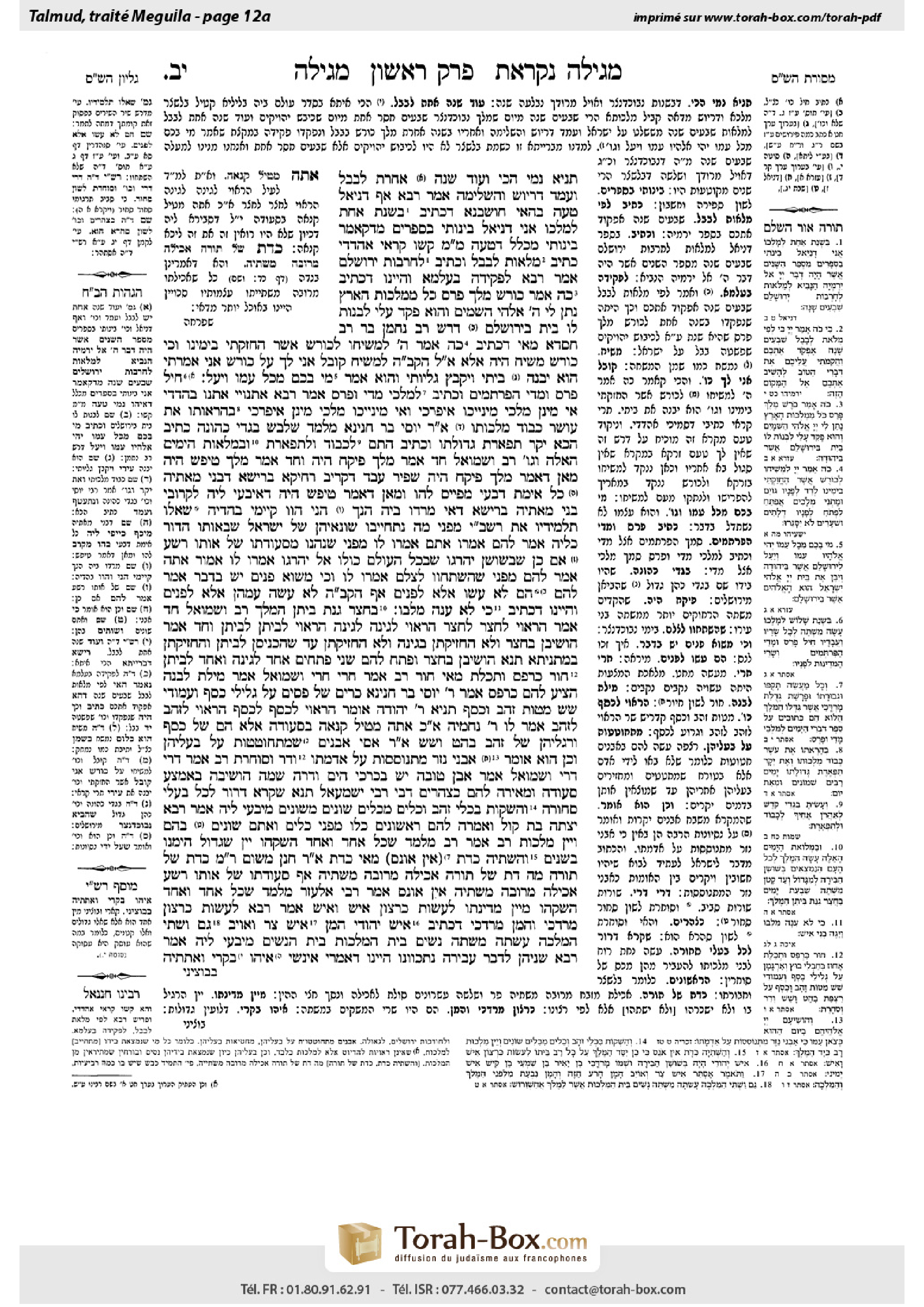
Megillah 12a: Talmud study for Daf Yomi
Daf Yomi is the daily study of one Talmud folio. Explore 37 tractates with scans, Hebrew text, Sefaria English and AI-generated French translations where annotated.
Passage selection and English or AI-generated French translation are available where the scan has annotations. Daf Study is independent of Torah-Box and Sefaria.
Browse Megillah · מגילה · All tractatesMegillah 12a text and translations
This page of Megillah includes the Aramaic text, an English translation and an AI-generated French translation, alongside the scan above.
מגילה י״ב א · Aramaic and Hebrew text
תַּנְיָא נָמֵי הָכִי: וְעוֹד שָׁנָה אַחֶרֶת לְבָבֶל וְעָמַד דָּרְיָוֶשׁ וְהִשְׁלִימָהּ.
אָמַר רָבָא: אַף דָּנִיאֵל טְעָה בְּהַאי חוּשְׁבָּנָא, דִּכְתִיב: ״בִּשְׁנַת אַחַת לְמׇלְכוֹ אֲנִי דָּנִיֵּאל בִּינוֹתִי בַּסְּפָרִים״. מִדְּקָאָמַר ״בִּינוֹתִי״ — מִכְּלָל דִּטְעָה.
מִכׇּל מָקוֹם קָשׁוּ קְרָאֵי אַהֲדָדֵי, כְּתִיב: ״מְלֹאות לְבָבֶל״, וּכְתִיב: ״לְחׇרְבוֹת יְרוּשָׁלַםִ״!
אָמַר רָבָא: לִפְקִידָה בְּעָלְמָא. וְהַיְינוּ דִּכְתִיב: ״כֹּה אָמַר כּוֹרֶשׁ מֶלֶךְ פָּרַס כֹּל מַמְלְכוֹת הָאָרֶץ נָתַן לִי ה׳ אֱלֹהֵי הַשָּׁמָיִם וְהוּא פָקַד עָלַי לִבְנוֹת לוֹ בַיִת בִּירוּשָׁלִַם״.
דָּרַשׁ רַב נַחְמָן בַּר רַב חִסְדָּא, מַאי דִּכְתִיב: ״כֹּה אָמַר ה׳ לִמְשִׁיחוֹ לְכוֹרֶשׁ אֲשֶׁר הֶחֱזַקְתִּי בִימִינוֹ״, וְכִי כּוֹרֶשׁ מָשִׁיחַ הָיָה? אֶלָּא אָמַר לֵיהּ הַקָּדוֹשׁ בָּרוּךְ הוּא לְמָשִׁיחַ: קוֹבֵל אֲנִי לְךָ עַל כּוֹרֶשׁ. אֲנִי אָמַרְתִּי: הוּא יִבְנֶה בֵּיתִי וִיקַבֵּץ גָּלִיּוֹתַי, וְהוּא אָמַר: ״מִי בָכֶם מִכׇּל עַמּוֹ וְיַעַל״.
״חֵיל פָּרַס וּמָדַי הַפַּרְתְּמִים״, וּכְתִיב: ״לְמַלְכֵי מָדַי וּפָרָס״. אָמַר רָבָא: אַתְנוֹיֵי אַתְנוֹ בַּהֲדָדֵי, אִי מִינַּן מַלְכֵי — מִינַּיְיכוּ אִיפַּרְכֵי וְאִי מִינַּיְיכוּ מַלְכֵי — מִינַּן אִיפַּרְכֵי.
״בְּהַרְאוֹתוֹ אֶת עוֹשֶׁר כְּבוֹד מַלְכוּתוֹ״, אָמַר רַבִּי יוֹסֵי בַּר חֲנִינָא: מְלַמֵּד שֶׁלָּבַשׁ בִּגְדֵי כְהוּנָּה. כְּתִיב הָכָא: ״יְקָר תִּפְאֶרֶת גְּדוּלָּתוֹ״, וּכְתִיב הָתָם: ״לְכָבוֹד וּלְתִפְאֶרֶת״.
״וּבִמְלֹאות הַיָּמִים הָאֵלֶּה וְגוֹ׳״. רַב וּשְׁמוּאֵל, חַד אָמַר: מֶלֶךְ פִּיקֵּחַ הָיָה, וְחַד אָמַר: מֶלֶךְ טִיפֵּשׁ הָיָה. מַאן דְּאָמַר מֶלֶךְ פִּיקֵּחַ הָיָה — שַׁפִּיר עֲבַד דְּקָרֵיב רַחִיקָא בְּרֵישָׁא, דִּבְנֵי מָאתֵיהּ כׇּל אֵימַת דְּבָעֵי מְפַיֵּיס לְהוּ. וּמַאן דְּאָמַר טִיפֵּשׁ הָיָה — דְּאִיבְּעִי לֵיהּ לְקָרוֹבֵי בְּנֵי מָאתֵיהּ בְּרֵישָׁא, דְּאִי מָרְדוּ בֵּיהּ הָנָךְ, הָנֵי הֲווֹ קָיְימִי בַּהֲדֵיהּ.
שָׁאֲלוּ תַּלְמִידָיו אֶת רַבִּי שִׁמְעוֹן בֶּן יוֹחַאי: מִפְּנֵי מָה נִתְחַיְּיבוּ שׂוֹנְאֵיהֶן שֶׁל יִשְׂרָאֵל שֶׁבְּאוֹתוֹ הַדּוֹר כְּלָיָה? אָמַר לָהֶם: אִמְרוּ אַתֶּם. אָמְרוּ לוֹ: מִפְּנֵי שֶׁנֶּהֱנוּ מִסְּעוּדָתוֹ שֶׁל אוֹתוֹ רָשָׁע. אִם כֵּן שֶׁבְּשׁוּשַׁן יֵהָרְגוּ, שֶׁבְּכׇל הָעוֹלָם כּוּלּוֹ אַל יֵהָרְגוּ! אָמְרוּ לוֹ: אֱמוֹר אַתָּה! אָמַר לָהֶם: מִפְּנֵי שֶׁהִשְׁתַּחֲווּ לַצֶּלֶם.
אָמְרוּ לוֹ: וְכִי מַשּׂוֹא פָּנִים יֵשׁ בַּדָּבָר? אָמַר לָהֶם: הֵם לֹא עָשׂוּ אֶלָּא לִפְנִים — אַף הַקָּדוֹשׁ בָּרוּךְ הוּא לֹא עָשָׂה עִמָּהֶן אֶלָּא לִפְנִים. וְהַיְינוּ דִּכְתִיב: ״כִּי לֹא עִנָּה מִלִּבּוֹ״.
״בַּחֲצַר גִּנַּת בִּיתַן הַמֶּלֶךְ״. רַב וּשְׁמוּאֵל, חַד אָמַר: הָרָאוּי לֶחָצֵר — לֶחָצֵר, הָרָאוּי לַגִּינָּה — לַגִּינָּה, הָרָאוּי לַבִּיתָן — לַבִּיתָן. וְחַד אָמַר: הוֹשִׁיבָן בֶּחָצֵר וְלֹא הֶחְזִיקָתַן, בַּגִּינָּה וְלֹא הֶחְזִיקָתַן, עַד שֶׁהִכְנִיסָן לַבִּיתָן וְהֶחְזִיקָתַן. בְּמַתְנִיתָא תָּנָא: הוֹשִׁיבָן בֶּחָצֵר וּפָתַח לָהֶם שְׁנֵי פְתָחִים, אֶחָד לַגִּינָּה וְאֶחָד לַבִּיתָן.
״חוּר כַּרְפַּס וּתְכֵלֶת״. מַאי חוּר? רַב אָמַר: חָרֵי חָרֵי, וּשְׁמוּאֵל אָמַר: מֵילָת לְבָנָה הִצִּיעַ לָהֶם. ״כַּרְפַּס״, אָמַר רַבִּי יוֹסֵי בַּר חֲנִינָא: כָּרִים שֶׁל פַּסִּים.
״עַל גְּלִילֵי כֶסֶף וְעַמּוּדֵי שֵׁשׁ מִטּוֹת זָהָב וָכֶסֶף״, תַּנְיָא, רַבִּי יְהוּדָה אוֹמֵר: הָרָאוּי לְכֶסֶף — לְכֶסֶף, הָרָאוּי לְזָהָב — לְזָהָב. אָמַר לוֹ רַבִּי נְחֶמְיָה: אִם כֵּן, אַתָּה מֵטִיל קִנְאָה בַּסְּעוּדָה. אֶלָּא: הֵם שֶׁל כֶּסֶף, וְרַגְלֵיהֶן שֶׁל זָהָב.
״בַּהַט וָשֵׁשׁ״. אֲמַר רַבִּי אַסִּי: אֲבָנִים שֶׁמִּתְחוֹטְטוֹת עַל בַּעֲלֵיהֶן. וְכֵן הוּא אוֹמֵר: ״אַבְנֵי נֵזֶר מִתְנוֹסְסוֹת עַל אַדְמָתוֹ״.
״וְדַר וְסוֹחָרֶת״, רַב אָמַר: דָּרֵי דָּרֵי. וּשְׁמוּאֵל אָמַר: אֶבֶן טוֹבָה יֵשׁ בִּכְרַכֵּי הַיָּם וְ״דָרָה״ שְׁמָהּ, הוֹשִׁיבָהּ בְּאֶמְצַע סְעוּדָה וּמְאִירָה לָהֶם כַּצׇּהֳרַיִם. דְּבֵי רַבִּי יִשְׁמָעֵאל תָּנָא: שֶׁקָּרָא דְּרוֹר לְכׇל בַּעֲלֵי סְחוֹרָה.
״וְהַשְׁקוֹת בִּכְלֵי זָהָב וְכֵלִים מִכֵּלִים שׁוֹנִים״. ״מְשׁוּנִּים״ מִיבְּעֵי לֵיהּ! אָמַר רָבָא, יָצְתָה בַּת קוֹל וְאָמְרָה לָהֶם: רִאשׁוֹנִים כָּלוּ מִפְּנֵי כֵלַי, וְאַתֶּם שׁוֹנִים בָּהֶם! ״וְיֵין מַלְכוּת רָב״, אָמַר רַב: מְלַמֵּד שֶׁכׇּל אֶחָד וְאֶחָד הִשְׁקָהוּ יַיִן שֶׁגָּדוֹל הֵימֶנּוּ בְּשָׁנִים.
״וְהַשְּׁתִיָּה כַדָּת (אֵין אוֹנֵס)״, מַאי ״כַּדָּת״? אָמַר רַבִּי חָנָן מִשּׁוּם רַבִּי מֵאִיר: כְּדָת שֶׁל תּוֹרָה, מָה דָּת שֶׁל תּוֹרָה אֲכִילָה מְרוּבָּה מִשְּׁתִיָּה — אַף סְעוּדָּתוֹ שֶׁל אוֹתוֹ רָשָׁע אֲכִילָה מְרוּבָּה מִשְּׁתִיָּה.
״אֵין אוֹנֵס״, אָמַר רַבִּי אֶלְעָזָר: מְלַמֵּד שֶׁכׇּל אֶחָד וְאֶחָד הִשְׁקָהוּ מִיֵּין מְדִינָתוֹ. ״לַעֲשׂוֹת כִּרְצוֹן אִישׁ וָאִישׁ״, אָמַר רָבָא: לַעֲשׂוֹת כִּרְצוֹן מָרְדֳּכַי וְהָמָן. מָרְדֳּכַי — דִּכְתִיב: ״אִישׁ יְהוּדִי״, הָמָן — ״אִישׁ צַר וְאוֹיֵב״.
״גַּם וַשְׁתִּי הַמַּלְכָּה עָשְׂתָה מִשְׁתֵּה נָשִׁים בֵּית הַמַּלְכוּת״. ״בֵּית הַנָּשִׁים״ מִיבְּעֵי לֵיהּ! אָמַר רָבָא: שְׁנֵיהֶן לִדְבַר עֲבֵירָה נִתְכַּוְּונוּ, הַיְינוּ דְּאָמְרִי אִינָשֵׁי: אִיהוּ בְּקָרֵי, וְאִתְּתֵיהּ
Megillah 12a · English translation
This is also taught in a baraita, as an indication that the years counted were only partial years: And when Belshazzar was killed, there was still another year left for Babylonia before the reckoning of the seventy years was completed. And then Darius arose and completed it. Although seventy years were previously counted according to Belshazzar’s count, from the exile of Jehoiakim, because the years were only partial, there was still one year left in order to complete those seventy years.
Rava said: Daniel also erred in this calculation, as it is written: “In the first year of his reign, I, Daniel, meditated in the books over the number of the years, whereof the word of the Lord came to Jeremiah the prophet, that He would accomplish for the desolations of Jerusalem seventy years” (Daniel 9:2). From the fact that he said “I meditated,” a term indicating recounting and calculating, it can be inferred that he had previously erred.
The Gemara comments: In any case, the verses contradict each other with regard to how the seventy years should be calculated. In one verse it is written: “After seventy years are accomplished for Babylonia I will remember [efkod] you, and perform My good word toward you, in causing you to return to this place” (Jeremiah 29:10), which indicates that the seventy years should be counted from the Babylonian exile. And in another verse it is written: “That he would accomplish for the desolations of Jerusalem seventy years” (Daniel 9:2), indicating that the seventy years are calculated from the destruction of Jerusalem.
Rava said in response: The seventy years that “are accomplished for Babylonia” were only for being remembered [lifekida], as mentioned in the verse, allowing the Jews to return to Eretz Yisrael but not to build the Temple. And this is as it is written with regard to Cyrus’s proclamation permitting the Jewish people’s return to Eretz Yisrael, in the seventieth year of the Babylonian exile: “Thus says Cyrus king of Persia: The Lord, God of heaven, has given me all the kingdoms of the earth; and He has charged [pakad] me to build Him a house in Jerusalem” (Ezra 1:2). The verse makes use of the same root, peh-kuf-dalet, heralding the return to Jerusalem to build the Temple, but not its actual completion.
Apropos its mention of Cyrus, the Gemara states that Rav Naḥman bar Rav Ḥisda interpreted homiletically a verse concerning Cyrus: What is the meaning of that which is written: “Thus says the Lord to His anointed, to Cyrus, whose right hand I have held” (Isaiah 45:1), which seemingly is referring to Cyrus as God’s anointed? Now was Cyrus God’s anointed one, i.e., the Messiah, that the verse should refer to him in this manner? Rather, the verse should be understood as God speaking to the Messiah with regard to Cyrus: The Holy One, Blessed be He, said to the Messiah: I am complaining to you about Cyrus, who is not acting in accordance with what he is intended to do. I had said: “He shall build My House and gather My exiles” (see Isaiah 45:13), but he did not carry this out. Rather, he said: “Whoever is among you of all His people…let him go up to Jerusalem” (Ezra 1:3). He gave permission to return to Israel, but he did no more than that.
§ The Gemara returns to its interpretations of verses in the Megilla. The Megilla mentions that among those invited to the king’s feast were: “The army of Persia and Media, the nobles and princes of the provinces” (Esther 1:3), and it is written near the conclusion of the Megilla: “In the book of chronicles of the kings of Media and Persia” (Esther 10:2). Why is Persia mentioned first at the beginning of the Megilla, while later in the Megilla, Media is mentioned first? Rava said in response: These two peoples, the Persians and the Medes, stipulated with each other, saying: If the kings will come from us, the ministers will come from you; and if the kings will come from you, the ministers will come from us. Therefore, in reference to kings, Media is mentioned first, whereas in connection with nobles and princes, Persia is given priority.
The verse states: “When he showed the riches of his glorious [kevod] kingdom and the honor of his majestic [tiferet] greatness” (Esther 1:4). Rabbi Yosei bar Ḥanina said: This teaches that Ahasuerus wore the priestly vestments. Proof for this assertion may be adduced from the fact that the same terms are written with regard to the priestly vestments, as it is written here: “The riches of his glorious [kevod] kingdom and the honor of his majestic [tiferet] greatness.” And it is written there, with regard to the priestly garments: “For glory [kavod] and for majesty [tiferet]” (Exodus 28:2).
The verse states: “And when these days were fulfilled, the king made a feast for all the people that were present in Shushan the capital” (Esther 1:5). Rav and Shmuel disagreed as to whether this was a wise decision. One said: Ahasuerus arranged a feast for the residents of Shushan, the capital, after the feast for foreign dignitaries that preceded it, as mentioned in the earlier verses, indicating that he was a clever king. And the other one said: It is precisely this that indicates that he was a foolish king. The one who said that this proves that he was a clever king maintains that he acted well when he first brought close those more distant subjects by inviting them to the earlier celebration, as he could appease the residents of his own city whenever he wished. And the one who said that he was foolish maintains that he should have invited the residents of his city first, so that if those faraway subjects rebelled against him, these who lived close by would have stood with him.
The students of Rabbi Shimon bar Yoḥai asked him: For what reason were the enemies of Jewish people, a euphemism for the Jewish people themselves when exhibiting behavior that is not in their best interests, in that generation deserving of annihilation? He, Rabbi Shimon, said to them: Say the answer to your question yourselves. They said to him: It is because they partook of the feast of that wicked one, Ahasuerus, and they partook there of forbidden foods. Rabbi Shimon responded: If so, those in Shushan should have been killed as punishment, but those in the rest of the world, who did not participate in the feast, should not have been killed. They said to him: Then you say your response to our question. He said to them: It is because they prostrated before the idol that Nebuchadnezzar had made, as is recorded that the entire world bowed down before it, except for Hananiah, Mishael, and Azariah.
They said to him: But if it is true that they worshipped idols and therefore deserved to be destroyed, why was a miracle performed on their behalf? Is there favoritism expressed by God here? He said to them: They did not really worship the idol, but pretended to do so only for appearance, acting as if they were carrying out the king’s command to bow before the idol. So too, the Holy One, Blessed be He, did not destroy them but did act angry with them only for appearance. He too merely pretended to desire to destroy them, as all He did was issue a threat, but in the end the decree was annulled. And this is as it is written: “For He does not afflict from His heart willingly” (Lamentations 3:33), but only for appearances’ sake.
The verse states: “In the court of the garden of the king’s palace” (Esther 1:5). Rav and Shmuel disagreed with regard to how to understand the relationship between these three places: Court, garden, and palace: One said: The guests were received in different places. One who, according to his stature, was fit for the courtyard was brought to the courtyard; one who was fit for the garden was brought to the garden; and one who was fit for the palace was brought to the palace. And the other one said: He first sat them in the courtyard, but it did not hold them, as they were too numerous. He then sat them in the garden, but it did not hold them either, until he brought them into the palace and it held them. A third understanding was taught in a baraita: He sat them in the courtyard and opened two entranceways for them, one to the garden and one to the palace.
The verse states: “There were hangings of ḥur, karpas, and sky blue” (Esther 1:6). The Gemara asks: What is ḥur? Rav said: A fabric fashioned with many holes [ḥarei ḥarei], similar to lace. And Shmuel said: He spread out for them carpets of white wool, as the word ḥavar means white. And what is karpas? Rabbi Yosei bar Ḥanina said: Cushions [karim] of velvet [pasim].
The verse states: “On silver rods and pillars of marble; the couches were of gold and silver” (Esther 1:6). It is taught in a baraita: Rabbi Yehuda says: Some couches were of gold and others of silver. One who, according to his stature, was fit for silver sat on a couch of silver, and one who was fit for gold sat on one of gold. Rabbi Neḥemya said to him: This was not done. If so, you would cast jealousy into the feast, for the guests would be envious of each other. Rather, the couches themselves were made of silver, and their feet were made of gold.
The verse continues: “Upon a pavement of bahat and marble” (Esther 1:6). Rabbi Asi said with regard to the definition of bahat: These are stones that ingratiate themselves with their owners, as they are precious stones that people are willing to spend large amounts of money to acquire. And similarly, it states elsewhere that the Jewish people will be likened to precious stones: “And the Lord their God shall save them in that day as the flock of His people; for they shall be as “the stones of a crown, glittering over His land” (Zechariah 9:16).
The verse concludes: “And dar and soḥaret” (Esther 1:6). Rav said: Dar means many rows [darei darei] around. Similarly, soḥaret is derived from seḥor seḥor, around and around, meaning that the floor was surrounded with numerous rows of bahat and marble stones. And Shmuel said: There is a precious stone in the seaports, and its name is dara, and Ahasuerus placed it in the center of the feast, and it illuminated the festivities for them as the sun illuminates the world at midday. He explains that the word soḥaret is derived from tzohar, a light. A scholar from the school of Rabbi Yishmael taught a baraita: This means that he proclaimed a remission for all the merchants, absolving them from paying their taxes, understanding that the word dar derives from deror, freedom, and soḥaret from soḥer, merchant.
The verse states: “And they gave them drink in vessels of gold, the vessels being diverse [shonim] from one another” (Esther 1:7). The Gemara asks: Why does the verse use the term shonim to express that they are different? It should have said the more proper term meshunim. Rava said: A Divine Voice issued forth and said to them: The early ones, referring to Belshazzar and his people, were destroyed because they used these vessels, the vessels of the Temple, and yet you use them again [shonim]? The verse continues: “And royal wine in abundance [rav]” (Esther 1:7). Rav said: This teaches that each and every guest at the feast was poured well-aged wine that was older [rav] than himself in years.
The verse states: “And the drinking was according to the law; none did compel” (Esther 1:8). The Gemara asks: What is the meaning of “according to the law”? Rabbi Ḥanan said in the name of Rabbi Meir: The drinking was according to the law of the Torah. Just as, according to the law of the Torah, with regard to offerings, the food sacrificed on the altar is greater in quantity than the drink, for the wine libation is quantitatively much smaller than the sacrificial offerings it accompanies, so too, at the feast of that wicked man, the food was greater in quantity than the drink.
The verse states: “None did compel” (Esther 1:8). Rabbi Elazar said: This teaches that each and every guest at the feast was poured a drink from wine of his own country, so that he would feel entirely free, as if he were in his home country. The verse continues: “That they should do according to every man’s pleasure” (Esther 1:8). Rava commented on the literal meaning of the verse, which is referring to two men, a man and a man [ish va’ish], and said: The man and man whom they should follow indicates that they should do according to the wishes of Mordecai and Haman. The two of them served as butlers at the feast, and they were in charge of distributing the wine. Why is the verse interpreted in this way? Mordecai is called “man,” as it is written: “There was a certain Jewish man [ish] in Shushan the castle, whose name was Mordecai, the son of Jair” (Esther 2:5). And Haman is also called man, as it states: “A man [ish] who is an adversary and an enemy, this evil Haman” (Esther 7:6).
The verse states: “Also Vashti the queen made a feast for the women, in the royal house, which belonged to King Ahasuerus” (Esther 1:9). The Gemara questions why she held the feast in the royal house, a place of men, rather than in the women’s house, where it should have been. Rava said in response: The two of them had sinful intentions. Ahasuerus wished to fornicate with the women, and Vashti wished to fornicate with the men. This explains the folk saying that people say: He with pumpkins and his wife
Megillah 12a · Traduction française (IA)
Cela est également enseigné dans une baraïta, pour montrer que les années comptées n’étaient que des années incomplètes : lorsque Belshatsar fut tué, il restait encore une année à Babylone avant que le décompte des soixante-dix années ne soit achevé. Darius se leva alors et compléta ce décompte. Bien que soixante-dix années eussent déjà été comptées selon le calcul de Belshatsar, à partir de l’exil de Yehoyaqim, comme il ne s’agissait que d’années incomplètes, il restait encore une année pour compléter ces soixante-dix années.
Rava dit : Daniel lui aussi se trompa dans ce calcul, comme il est écrit : « La première année de son règne, moi, Daniel, je méditai dans les livres sur le nombre des années dont la parole de l’Éternel était venue à Jérémie le prophète, annonçant qu’Il accomplirait les soixante-dix années de désolation de Jérusalem » (Daniel 9:2). Du fait qu’il dit « je méditai », terme qui indique qu’il recomptait et calculait, on peut déduire qu’il s’était auparavant trompé.
La Guemara remarque : Quoi qu’il en soit, les versets se contredisent quant à la manière de calculer les soixante-dix années. Dans un verset, il est écrit : « Lorsque soixante-dix années se seront accomplies pour Babylone, Je me souviendrai [efkod] de vous et j’accomplirai en votre faveur Ma bonne parole, en vous faisant revenir en ce lieu » (Jérémie 29:10), ce qui indique que les soixante-dix années doivent être comptées à partir de l’exil à Babylone. Dans un autre verset, il est écrit : « Il accomplirait les soixante-dix années de désolation de Jérusalem » (Daniel 9:2), ce qui indique que les soixante-dix années sont calculées à partir de la destruction de Jérusalem.
Rava répondit : Les soixante-dix années qui « se sont accomplies pour Babylone » ne marquaient que le moment du rappel [lifekida], comme le dit le verset : elles permettaient aux Juifs de retourner en Eretz Israël, mais pas de bâtir le Temple. C’est ce qu’indique le verset concernant la proclamation de Cyrus, qui autorisa le peuple juif à retourner en Eretz Israël durant la soixante-dixième année de l’exil à Babylone : « Ainsi parle Cyrus, roi de Perse : L’Éternel, Dieu des cieux, m’a donné tous les royaumes de la terre et Il m’a chargé [pakad] de Lui bâtir une maison à Jérusalem » (Esdras 1:2). Le verset emploie la même racine, peh-kuf-dalet, annonçant le retour à Jérusalem pour y bâtir le Temple, mais non son achèvement effectif.
À propos de la mention de Cyrus, la Guemara rapporte que Rav Naḥman bar Rav Ḥisda interpréta par homilétique un verset le concernant : que signifie ce qui est écrit : « Ainsi parle l’Éternel à Son oint, à Cyrus, dont J’ai saisi la main droite » (Isaïe 45:1), ce qui semble désigner Cyrus comme l’oint de Dieu ? Cyrus était-il donc l’oint de Dieu, c’est-à-dire le Messie, pour que le verset le désigne ainsi ? Le verset doit plutôt être compris comme des paroles de Dieu au Messie au sujet de Cyrus : le Saint, béni soit-Il, dit au Messie : « Je me plains auprès de toi de Cyrus, qui n’agit pas conformément à ce qu’il est censé faire. J’avais dit : “Il bâtira Ma maison et rassemblera Mes exilés” (voir Isaïe 45:13), mais il ne l’a pas fait. Il a plutôt dit : “Que celui d’entre vous qui appartient à tout Son peuple… monte à Jérusalem” (Esdras 1:3). » Il a autorisé le retour en Israël, mais il n’a rien fait de plus.
§ La Guemara revient à ses interprétations des versets de la Meguila. La Meguila mentionne que, parmi ceux qui furent invités au festin du roi, figuraient : « L’armée de Perse et de Médie, les nobles et les princes des provinces » (Esther 1:3), et il est écrit vers la fin de la Meguila : « Dans le livre des chroniques des rois de Médie et de Perse » (Esther 10:2). Pourquoi la Perse est-elle mentionnée en premier au début de la Meguila, alors que, plus loin, c’est la Médie qui est mentionnée en premier ? Rava répondit : Ces deux peuples, les Perses et les Mèdes, conclurent un accord : si les rois venaient de chez nous, les ministres viendraient de chez vous ; et si les rois venaient de chez vous, les ministres viendraient de chez nous. Ainsi, lorsqu’il est question des rois, la Médie est mentionnée en premier, tandis que, pour les nobles et les princes, la Perse a la priorité.
Le verset dit : « Lorsqu’il montra les richesses de la gloire [kevod] de son royaume et l’honneur de la splendeur [tiferet] de sa majesté » (Esther 1:4). Rabbi Yosei bar Ḥanina dit : Cela enseigne qu’Aḥashvérosh portait les vêtements sacerdotaux. On peut en apporter la preuve par le fait que les mêmes termes sont employés à propos des vêtements sacerdotaux. Il est écrit ici : « Les richesses de la gloire [kevod] de son royaume et l’honneur de la splendeur [tiferet] de sa majesté. » Et il est écrit là, à propos des vêtements sacerdotaux : « Pour la gloire [kavod] et pour la splendeur [tiferet] » (Exode 28:2).
Le verset dit : « Lorsque ces jours furent accomplis, le roi donna un festin à tout le peuple qui se trouvait à Suse, la capitale » (Esther 1:5). Rav et Shmuel étaient en désaccord sur la sagesse de cette décision. L’un disait : Aḥashvérosh organisa un festin pour les habitants de Suse, la capitale, après celui qu’il avait donné aux dignitaires étrangers, comme le rapportent les versets précédents, ce qui montre qu’il était un roi intelligent. L’autre disait : C’est précisément cela qui montre qu’il était un roi stupide. Selon celui qui disait que cela prouve qu’il était intelligent, il avait bien fait de rapprocher d’abord les sujets les plus éloignés en les invitant à la première célébration, car il pouvait apaiser les habitants de sa propre ville quand il le voulait. Selon celui qui disait qu’il était stupide, il aurait dû inviter d’abord les habitants de sa ville, afin que, si les sujets éloignés se révoltaient contre lui, ceux qui vivaient à proximité se tiennent à ses côtés.
Les élèves de Rabbi Shimon bar Yoḥai lui demandèrent : Pour quelle raison les ennemis du peuple juif — expression euphémique désignant le peuple juif lui-même lorsqu’il adoptait un comportement contraire à ses intérêts — méritaient-ils, dans cette génération, d’être anéantis ? Rabbi Shimon leur dit : « Donnez vous-mêmes la réponse à votre question. » Ils lui répondirent : « C’est parce qu’ils avaient pris part au festin de ce méchant, Aḥashvérosh, et y avaient consommé des aliments interdits. » Rabbi Shimon leur répliqua : « Dans ce cas, ceux de Suse auraient dû être tués en punition, mais ceux du reste du monde, qui n’avaient pas participé au festin, n’auraient pas dû être tués. » Ils lui dirent : « Alors, donnez vous-même la réponse à notre question. » Il leur dit : « C’est parce qu’ils s’étaient prosternés devant l’idole que Nevoukhanetsar avait fabriquée, comme il est rapporté que le monde entier se prosterna devant elle, à l’exception de Ḥanania, Mishaël et Azaria. »
Ils lui dirent : « Mais s’il est vrai qu’ils adoraient des idoles et qu’ils méritaient donc d’être détruits, pourquoi un miracle fut-il accompli en leur faveur ? Dieu leur a-t-Il témoigné de la partialité ? » Il leur dit : « En réalité, ils n’adoraient pas l’idole, mais faisaient semblant de le faire, uniquement pour les apparences, comme s’ils exécutaient l’ordre du roi de se prosterner devant l’idole. De même, le Saint, béni soit-Il, ne les détruisit pas, mais manifesta sa colère uniquement pour les apparences. Lui aussi fit seulement semblant de vouloir les détruire : Il se contenta de proférer une menace, mais le décret fut finalement annulé. » C’est ce que dit le verset : « Car Il n’afflige pas de bon cœur, volontairement » (Lamentations 3:33), mais seulement pour les apparences.
Le verset dit : « Dans la cour du jardin du palais du roi » (Esther 1:5). Rav et Shmuel étaient en désaccord sur la manière de comprendre le rapport entre ces trois lieux : la cour, le jardin et le palais. L’un disait : Les invités furent reçus en différents endroits. Celui qui, selon son rang, était digne d’être dans la cour fut conduit dans la cour ; celui qui était digne d’être dans le jardin fut conduit dans le jardin ; et celui qui était digne d’être dans le palais fut conduit dans le palais. L’autre disait : Il les fit d’abord asseoir dans la cour, mais celle-ci ne pouvait pas tous les contenir, car ils étaient trop nombreux. Il les fit alors asseoir dans le jardin, mais celui-ci ne pouvait pas non plus les contenir, jusqu’à ce qu’il les fasse entrer dans le palais, qui, lui, pouvait les accueillir. Une troisième interprétation est enseignée dans une baraïta : Il les fit asseoir dans la cour et ouvrit pour eux deux entrées, l’une donnant sur le jardin et l’autre sur le palais.
Le verset dit : « Il y avait des tentures de ḥur, de karpas et de bleu azur » (Esther 1:6). La Guemara demande : Qu’est-ce que ḥur ? Rav dit : Un tissu façonné avec de nombreux trous [ḥarei ḥarei], semblable à de la dentelle. Shmuel dit : Il étendit pour eux des tapis de laine blanche, car le mot ḥavar signifie « blanc ». Et qu’est-ce que karpas ? Rabbi Yosei bar Ḥanina dit : Des coussins [karim] de velours [pasim].
Le verset dit : « Sur des tiges d’argent et des colonnes de marbre ; les lits étaient d’or et d’argent » (Esther 1:6). Il est enseigné dans une baraïta : Rabbi Yehuda dit : Certains lits étaient en or et d’autres en argent. Celui qui, selon son rang, était digne de l’argent s’asseyait sur un lit d’argent, et celui qui était digne de l’or s’asseyait sur un lit d’or. Rabbi Neḥemya lui dit : « Cela ne fut pas fait ainsi. Dans ce cas, tu aurais introduit la jalousie dans le festin, car les invités se seraient enviés les uns les autres. » Les lits eux-mêmes étaient plutôt en argent, et leurs pieds en or.
Le verset poursuit : « Sur un pavement de bahat et de marbre » (Esther 1:6). Rabbi Asi dit, au sujet de la définition de bahat : Ce sont des pierres qui gagnent les faveurs de leurs propriétaires, car ce sont des pierres précieuses que les gens sont prêts à payer très cher. De même, ailleurs, il est dit que le peuple juif sera comparé à des pierres précieuses : « L’Éternel, leur Dieu, les sauvera en ce jour, eux, le troupeau de Son peuple ; car ils seront comme les pierres d’une couronne, étincelant sur Sa terre » (Zacharie 9:16).
Le verset conclut : « Et dar et soḥaret » (Esther 1:6). Rav dit : Dar signifie « plusieurs rangées » [darei darei], tout autour. De même, soḥaret dérive de seḥor seḥor, « tout autour », ce qui signifie que le sol était entouré de nombreuses rangées de pierres de bahat et de marbre. Shmuel dit : Il existe dans les ports maritimes une pierre précieuse appelée dara ; Aḥashvérosh la plaça au centre du festin, et elle illumina les réjouissances comme le soleil illumine le monde à midi. Il explique que le mot soḥaret dérive de tzohar, « lumière ». Un érudit de l’école de Rabbi Yishmael enseigna une baraïta : Cela signifie qu’il proclama une remise d’impôts pour tous les marchands, les exemptant de les payer ; selon cette interprétation, dar dérive de deror, « liberté », et soḥaret de soḥer, « marchand ».
Le verset dit : « On leur servait à boire dans des récipients d’or, les récipients étant différents [shonim] les uns des autres » (Esther 1:7). La Guemara demande : Pourquoi le verset emploie-t-il le terme shonim pour exprimer qu’ils étaient différents ? Il aurait dû employer le terme plus approprié meshunim. Rava dit : Une voix céleste retentit et leur dit : « Les premiers, c’est-à-dire Belshatsar et ses gens, ont été détruits parce qu’ils ont utilisé ces récipients, les récipients du Temple, et vous, vous les utilisez de nouveau [shonim] ? » Le verset poursuit : « Et du vin royal en abondance [rav] » (Esther 1:7). Rav dit : Cela enseigne que chacun des invités au festin se vit servir du vin ayant vieilli plus longtemps que lui-même [rav], en nombre d’années.
Le verset dit : « On buvait selon la règle ; nul n’imposait » (Esther 1:8). La Guemara demande : Que signifie « selon la règle » ? Rabbi Ḥanan dit au nom de Rabbi Meir : On buvait conformément à la règle de la Torah. De même que, selon la règle de la Torah concernant les offrandes, la nourriture offerte sur l’autel est en plus grande quantité que la boisson, car la libation de vin est quantitativement bien moindre que les offrandes sacrificielles qu’elle accompagne, de même, au festin de ce méchant, la nourriture était en plus grande quantité que la boisson.
Le verset dit : « Nul n’imposait » (Esther 1:8). Rabbi Elazar dit : Cela enseigne que chacun des invités au festin se voyait servir du vin de son propre pays, afin de se sentir tout à fait libre, comme s’il se trouvait dans son pays. Le verset poursuit : « Afin que chacun agisse selon son bon plaisir » (Esther 1:8). Rava commenta le sens littéral du verset, qui fait référence à deux hommes, « un homme et un homme » [ish va’ish], et dit : « Les hommes auxquels il fallait se conformer indiquent qu’il fallait agir selon les souhaits de Mordekhaï et de Haman. » Tous deux servaient de maîtres d’hôtel au festin et étaient chargés de distribuer le vin. Pourquoi le verset est-il interprété ainsi ? Mordekhaï est appelé « homme », comme il est écrit : « Il y avait à Suse, dans la citadelle, un certain homme juif [ish], nommé Mordekhaï, fils de Yaïr » (Esther 2:5). Haman est lui aussi appelé « homme », comme il est écrit : « Un homme [ish] qui est un adversaire et un ennemi, ce méchant Haman » (Esther 7:6).
Le verset dit : « Vashti, la reine, donna aussi un festin aux femmes, dans le palais royal qui appartenait au roi Aḥashvérosh » (Esther 1:9). La Guemara demande pourquoi elle donna le festin dans le palais royal, un lieu réservé aux hommes, plutôt que dans la maison des femmes, où il aurait dû se tenir. Rava répondit : Tous deux avaient des intentions pécheresses. Aḥashvérosh voulait forniquer avec les femmes, et Vashti voulait forniquer avec les hommes. Cela explique le dicton populaire : « Lui avec les citrouilles, et sa femme… »
Traduction française générée par IA à partir de l’édition anglaise de Sefaria. Vérifie toujours un passage avec le texte source.
Text from Sefaria: William Davidson Edition - Vocalized Aramaic (CC BY NC); William Davidson Edition - English (CC BY NC).