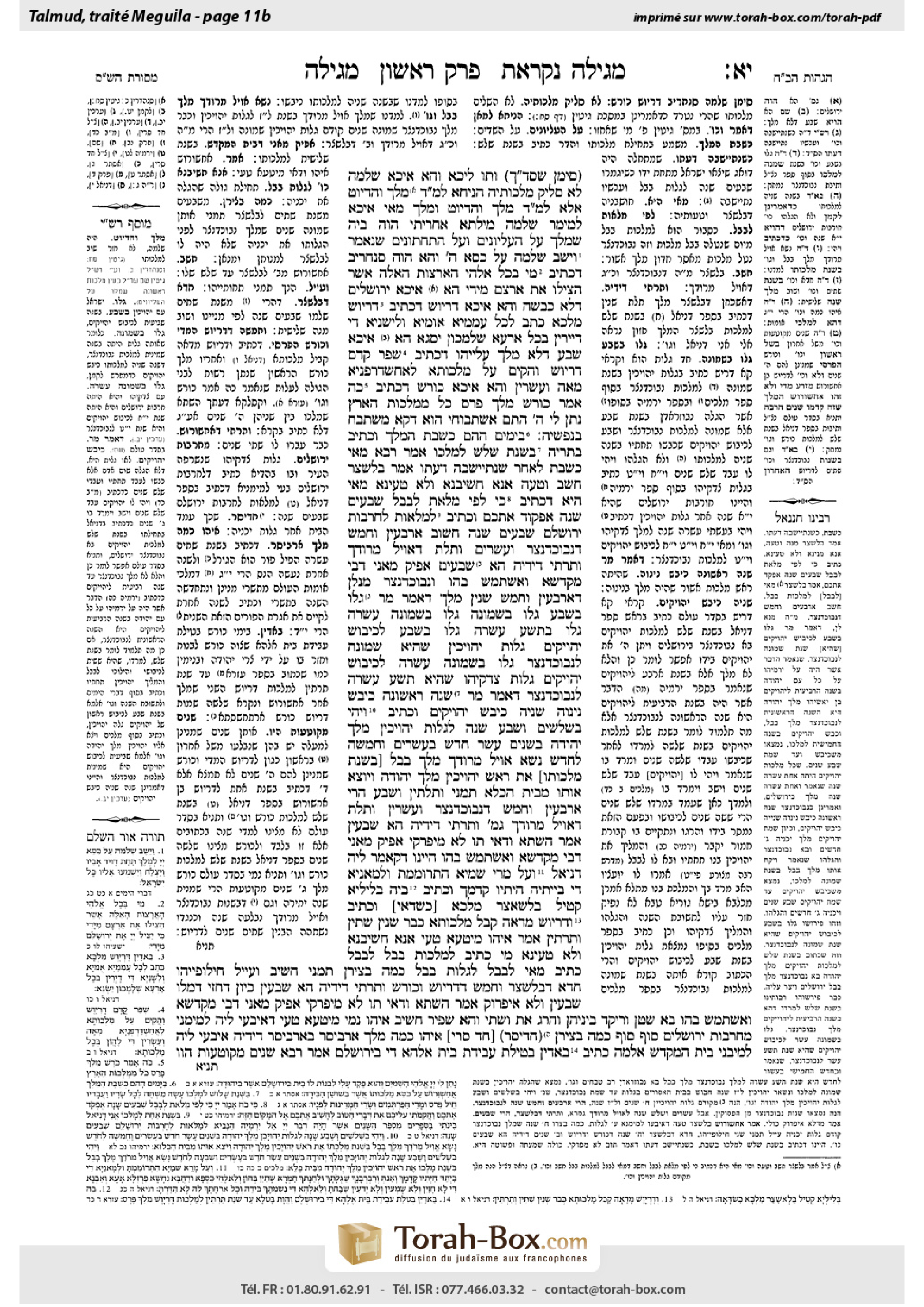
Megillah 11b: Talmud study for Daf Yomi
Daf Yomi is the daily study of one Talmud folio. Explore 37 tractates with scans, Hebrew text, Sefaria English and AI-generated French translations where annotated.
Passage selection and English or AI-generated French translation are available where the scan has annotations. Daf Study is independent of Torah-Box and Sefaria.
Browse Megillah · מגילה · All tractatesMegillah 11b text and translations
This page of Megillah includes the Aramaic text, an English translation and an AI-generated French translation, alongside the scan above.
מגילה י״א ב · Aramaic and Hebrew text
(סִימָן: שסד״ך) וְתוּ לֵיכָּא? וְהָא אִיכָּא שְׁלֹמֹה! לָא סְלִיק מַלְכוּתֵיהּ.
הָנִיחָא לְמַאן דְּאָמַר מֶלֶךְ וְהֶדְיוֹט. אֶלָּא לְמַאן דְּאָמַר מֶלֶךְ וְהֶדְיוֹט וּמֶלֶךְ — מַאי אִיכָּא לְמֵימַר? שְׁלֹמֹה מִילְּתָא אַחֲרִיתִי הֲוָה בֵּיהּ — שֶׁמָּלַךְ עַל הָעֶלְיוֹנִים וְעַל הַתַּחְתּוֹנִים, שֶׁנֶּאֱמַר: ״וַיֵּשֶׁב שְׁלֹמֹה עַל כִּסֵּא ה׳״.
וְהָא הֲוָה סַנְחֵרִיב, דִּכְתִיב: ״מִי בְּכׇל אֱלֹהֵי הָאֲרָצוֹת הָאֵלֶּה אֲשֶׁר הִצִּילוּ אֶת אַרְצָם מִיָּדִי״! הָא אִיכָּא יְרוּשָׁלַיִם דְּלָא כַּבְשַׁהּ!
וְהָא אִיכָּא דָּרְיָוֶשׁ, דִּכְתִיב: ״דָּרְיָוֶשׁ מַלְכָּא כְּתַב לְכׇל עַמְמַיָּא אוּמַיָּא וְלִשָּׁנַיָּא דִּי דָיְירִין בְּכׇל אַרְעָא שְׁלָמְכוֹן יִסְגֵּא״! הָא אִיכָּא שְׁבַע דְּלָא מְלַךְ עֲלַיְיהוּ, דִּכְתִיב: ״שְׁפַר קֳדָם דָּרְיָוֶשׁ וַהֲקִים עַל מַלְכוּתָא לַאֲחַשְׁדַּרְפְּנַיָּא מְאָה וְעֶשְׂרִין״!
וְהָא אִיכָּא כּוֹרֶשׁ, דִּכְתִיב: ״כֹּה אָמַר כּוֹרֶשׁ מֶלֶךְ פָּרַס כֹּל מַמְלְכוֹת הָאָרֶץ נָתַן לִי ה׳״! הָתָם אִשְׁתַּבּוֹחֵי הוּא דְּקָא מִשְׁתַּבַּח בְּנַפְשֵׁיהּ.
״בַּיָּמִים הָהֵם כְּשֶׁבֶת הַמֶּלֶךְ״, וּכְתִיב בָּתְרֵיהּ: ״בִּשְׁנַת שָׁלֹשׁ לְמׇלְכוֹ״! אָמַר רָבָא: מַאי ״כְּשֶׁבֶת״, לְאַחַר שֶׁנִּתְיַישְּׁבָה דַּעְתּוֹ. אָמַר: בֵּלְשַׁצַּר חַשֵּׁב וּטְעָה, אֲנָא חָשֵׁיבְנָא וְלָא טָעֵינָא.
מַאי הִיא — דִּכְתִיב: ״כִּי לְפִי מְלֹאת לְבָבֶל שִׁבְעִים שָׁנָה אֶפְקוֹד אֶתְכֶם״, וּכְתִיב: ״לְמַלֹּאות לְחׇרְבוֹת יְרוּשָׁלִַם שִׁבְעִים שָׁנָה״. חַשֵּׁוב: אַרְבְּעִין וַחֲמֵשׁ דִּנְבוּכַדְנֶצַּר, וְעֶשְׂרִים וּתְלָת דֶּאֱוִיל מְרוֹדַךְ, וְתַרְתֵּי דִּידֵיהּ — הָא שִׁבְעִים. אַפֵּיק מָאנֵי דְּבֵי מַקְדְּשָׁא וְאִשְׁתַּמַּשׁ בְּהוּ.
וּנְבוּכַדְנֶצַּר, מְנָלַן דְּאַרְבְּעִין וַחֲמֵשׁ שְׁנִין מְלַךְ? דְּאָמַר מָר: גָּלוּ בְּשֶׁבַע, גָּלוּ בִּשְׁמוֹנֶה, גָּלוּ בִּשְׁמוֹנֶה עֶשְׂרֵה, גָּלוּ בִּתְשַׁע עֶשְׂרֵה.
גָּלוּ בְּשֶׁבַע — לְכִיבּוּשׁ יְהוֹיָקִים גָּלוּת יְהוֹיָכִין, שֶׁהִיא שְׁמוֹנֶה לִנְבוּכַדְנֶצַּר. גָּלוּ בִּשְׁמוֹנֶה עֶשְׂרֵה — לְכִיבּוּשׁ יְהוֹיָקִים גָּלוּת צִדְקִיָּהוּ שֶׁהִיא תְּשַׁע עֶשְׂרֵה לִנְבוּכַדְנֶצַּר, דְּאָמַר מָר: שָׁנָה רִאשׁוֹנָה כִּיבֵּשׁ נִינְוֵה, שְׁנִיָּה כִּיבֵּשׁ יְהוֹיָקִים. וּכְתִיב: ״וַיְהִי בִשְׁלֹשִׁים וָשֶׁבַע שָׁנָה לְגָלוּת יְהוֹיָכִין מֶלֶךְ יְהוּדָה בִּשְׁנֵים עָשָׂר חֹדֶשׁ בְּעֶשְׂרִים וַחֲמִשָּׁה לַחֹדֶשׁ נָשָׂא אֱוִיל מְרוֹדַךְ מֶלֶךְ בָּבֶל [בִּשְׁנַת מַלְכוּתוֹ] אֶת רֹאשׁ יְהוֹיָכִין מֶלֶךְ יְהוּדָה וַיּוֹצֵא אוֹתוֹ מִבֵּית הַכֶּלֶא״.
תַּמְנֵי וּתְלָתִין וּשְׁבַע — הֲרֵי אַרְבְּעִין וַחֲמֵשׁ דִּנְבוּכַדְנֶצַּר. וְעֶשְׂרִין וּתְלָת דֶּאֱוִיל מְרוֹדַךְ — גְּמָרָא, וְתַרְתֵּי דִּידֵיהּ — הָא שִׁבְעִין. אֲמַר: הַשְׁתָּא וַדַּאי תּוּ לָא מִיפַּרְקִי, אַפֵּיק מָאנֵי דְּבֵי מַקְדְּשָׁא וְאִשְׁתַּמַּשׁ בְּהוּ.
הַיְינוּ דְּקָאָמַר לֵיהּ דָּנִיאֵל: ״וְעַל מָרֵי שְׁמַיָּא הִתְרוֹמַמְתָּ וּלְמָאנַיָּא דִי בַיְיתֵיהּ הַיְתִיו קׇדָמָךְ״, וּכְתִיב: ״בֵּיהּ בְּלֵילְיָא קְטִיל בֵּלְשַׁאצַּר מַלְכָּא [כַּשְׂדָּאָה]״. וּכְתִיב: ״וְדָרְיָוֶשׁ מָדָאָה קַבֵּל מַלְכוּתָא כְּבַר שְׁנִין שִׁתִּין וְתַרְתֵּין״.
אֲמַר: אִיהוּ מִיטְעָא טָעֵי, אֲנָא חָשֵׁיבְנָא וְלָא טָעֵינָא. מִי כְּתִיב ״לְמַלְכוּת בָּבֶל״? ״לְבָבֶל״ כְּתִיב, מַאי ״לְבָבֶל״? לְגָלוּת בָּבֶל, כַּמָּה בְּצִירָן — תַּמְנֵי, חַשֵּׁיב וְעַיֵּיל חִילּוּפַיְיהוּ חֲדָא דְּבֵלְשַׁצַּר, וַחֲמֵשׁ דְּדָרְיָוֶשׁ וְכוֹרֶשׁ, וְתַרְתֵּי דִּידֵיהּ — הָא שִׁבְעִין. כֵּיוָן דְּחָזֵי דִּמְלוֹ שִׁבְעִין וְלָא אִיפְּרוּק — אֲמַר: הַשְׁתָּא וַדַּאי תּוּ לָא מִיפַּרְקִי, אַפֵּיק מָאנֵי דְּבֵי מַקְדְּשָׁא וְאִשְׁתַּמַּשׁ בְּהוּ. בָּא שָׂטָן וְרִיקֵּד בֵּינֵיהֶן וְהָרַג אֶת וַשְׁתִּי.
וְהָא שַׁפִּיר חַשֵּׁיב? אִיהוּ נָמֵי מִיטְעָא טָעֵי, דְּאִיבְּעִי לֵיהּ לְמִימְנֵי מֵחׇרְבוֹת יְרוּשָׁלַיִם.
סוֹף סוֹף כַּמָּה בְּצִירָן? חֲדֵיסַר. אִיהוּ כַּמָּה מְלַךְ? אַרְבֵּיסַר, בְּאַרְבֵּיסַר דִּידֵיהּ אִיבְּעִי לֵיהּ לְמִיבְנֵי בֵּית הַמִּקְדָּשׁ, אַלְּמָה כְּתִיב: ״בֵּאדַיִן בְּטֵילַת עֲבִידַת בֵּית אֱלָהָא דִּי בִּירוּשְׁלֶם״, אָמַר רָבָא: שָׁנִים מְקוּטָּעוֹת הֲווֹ.
Megillah 11b · English translation
After mentioning three kings who ruled over the world, the Gemara presents a mnemonic for the names of other kings that will be discussed below: Shin, Solomon, i.e., Shlomo; samekh, Sennacherib; dalet, Darius; kaf, Cyrus, i.e., Koresh. The Gemara asks: But is there no other king besides those previously mentioned who ruled over the entire world? But there is King Solomon who ruled over the world and should be added to the list. The Gemara answers: Solomon did not complete his kingship, as he left the throne during his lifetime, and therefore, his name doesn’t appear on the list.
The Gemara asks: This works out well according to the one who said that Solomon was first a king and then a commoner, never returning to the throne. But according to the one who said that he was first a king and then a commoner, and then afterward he returned again to be a king, what can be said to explain why he is not mentioned in the list of kings who ruled over the entire world? The Gemara answers: There was something else about Solomon that makes it impossible to compare him to the others, for he ruled over the inhabitants of the heavenly worlds, i.e., demons and spirits, as well as the human inhabitants of the earthly worlds, as it is stated: “Then Solomon sat upon the throne of the Lord as king” (I Chronicles 29:23), which indicates that his reign extended even to the heavenly worlds, with King Solomon sitting upon the throne of the Lord, and therefore he cannot be compared to the others, who merely ruled on earth.
The Gemara asks further: But there was Sennacherib, who ruled over the entire world, as it is written: “Who are they among all the gods of these countries, that have delivered their country out of my hand that the Lord should deliver Jerusalem out of my hand?” (Isaiah 36:20). The Gemara answers: There is Jerusalem that he did not conquer, as indicated in the verse.
The Gemara continues to ask: But there is Darius, as it is stated: “Then King Darius wrote to all the peoples, nations, and languages that dwell in all the earth: Peace be multiplied to you” (Daniel 6:26). The Gemara answers: There are the seven provinces over which he did not rule, as it is written: “It pleased Darius to set over the kingdom a hundred and twenty satraps” (Daniel 6:2). It is apparent from here that Darius did not rule over the entire world, for his son Ahasuerus ruled over a hundred and twenty-seven provinces, an additional seven.
The Gemara raises another question: But there is Cyrus, as it is written: “Thus says Cyrus, king of Persia: The Lord, God of heaven, has given me all the kingdoms of the earth” (Ezra 1:2). The Gemara answers: This is not proof that he ruled the world, for there he was merely boasting about himself, although in fact there was no truth to his words.
§ The second verse in Esther states: “In those days when the king Ahasuerus sat on the throne of his kingdom” (Esther 1:2), implying that the events to follow took place during the first year of his reign; and one verse afterward it is written: “In the third year of his reign” (Esther 1:3), indicating that it was the third year, not the first. Rava said: There is no contradiction. What is the meaning of “when he sat” [keshevet]? It is intended to indicate that he acted not immediately upon his rise to the throne, but rather after his mind was settled [shenityasheva], and he overcame his anxiety and worry with regard to the redemption of the Jewish people. He said to himself as follows: Belshazzar, the king of Babylonia, calculated and erred with regard to the Jewish people’s redemption. I too will calculate, but I will not err.
The Gemara explains: What is this calculation? As it is written with regard to Jeremiah’s prophecy of a return to Eretz Yisrael: “After seventy years are accomplished for Babylonia I will remember you and perform My good word toward you, enabling you to return to this place” (Jeremiah 29:10), and elsewhere it is written in a slightly different formulation: “In the first year of his reign, I, Daniel, meditated in the books, over the number of the years, which the word of the Lord came to Jeremiah the prophet, that He would accomplish for the desolations of Jerusalem seventy years” (Daniel 9:2). He, Belshazzar, calculated as follows: Forty-five years of Nebuchadnezzar, and twenty-three of Evil-merodach, and two of his own, for a total of seventy years that had passed without redemption. He was therefore certain that Jeremiah’s prophecy would no longer be fulfilled, and he therefore said: I will take out the vessels of the Holy Temple and use them.
The Gemara asks: From where do we derive that Nebuchadnezzar reigned for forty-five years? As the Master said: They were exiled in the seventh year; they were exiled in the eighth year; they were exiled in the eighteenth year; and they were exiled in the nineteenth year.
The Gemara explains: They were exiled in the seventh year after Nebuchadnezzar’s subjugation of Jehoiakim, in what was known as the exile of Jehoiachin, which was actually the eighth year of Nebuchadnezzar’s reign. Then later they were exiled a second time in the eighteenth year after the subjugation of Jehoiakim, in what was known as the exile of Zedekiah, which was actually in the nineteenth year of Nebuchadnezzar’s reign, as the Master said: In the first year of his reign, Nebuchadnezzar conquered Nineveh; in his second year he conquered Jehoiakim. And it is written: “And it came to pass in the thirty-seventh year of the exile of Jehoiachin, king of Judea, in the twelfth month, on the twenty-fifth day of the month, that Evil-merodach, king of Babylonia, in the first year of his reign, lifted up the head of Jehoiachin, king of Judea, and brought him out of prison” (Jeremiah 52:31).
The Gemara calculates: Since Evil-merodach acted in the first year of his reign, immediately after coming to power, it turns out that Nebuchadnezzar ruled for eight years before he sent Jehoiachin into exile, and thirty-seven years during which Jehoiachin was in prison. This equals forty-five years of the reign of Nebuchadnezzar. And the twenty-three years of Evil-merodach are known through tradition. And together with the two years of Belshazzar, this brings the count of the years of exile to seventy. At that point Belshazzar said to himself: Now for sure they will not be redeemed. Therefore, I will take out the vessels of the Holy Temple and use them.
This is that which Daniel said to him with regard to his impending punishment for using the Temple’s vessels: “But you have lifted yourself up against the Lord of heaven; and they have brought the vessels of His House before you” (Daniel 5:23). And it is written further in the chapter: “In that night Belshazzar, the king of the Chaldeans, was slain” (Daniel 5:30). This was the description of Belshazzar’s mistaken calculation. And it states after the fall of Belshazzar: “And Darius the Mede received the kingdom, being about sixty-two years old” (Daniel 6:1).
Ahasuerus said: He, Belshazzar, erred. I too will calculate, but I will not err, thinking he understood the source of Belshazzar’s mistake. Is it written: “Seventy years for the kingdom of Babylonia”? It is written: “Seventy years for Babylonia.” What is meant by “for Babylonia”? These words are referring to the seventy years for the exile of Babylonia. How many years are still lacking from the seventy years? Eight years. He calculated, and inserted in their stead one year of Belshazzar, and five years of Darius and Cyrus, and two years of his own, bringing the total to seventy. Once he saw that seventy years had been completed, and the Jewish people were still not redeemed, he said: Now for sure they will not be redeemed. Therefore, I will take out the vessels of the Temple and use them. What happened to him? As a punishment for what he did, the Satan came and danced among them, and brought confusion to his celebration until he killed Vashti.
The Gemara asks: But he calculated properly; why then did this happen? The Gemara answers: He too erred in his calculation, for he should have counted from the destruction of Jerusalem at the time of the exile of Zedekiah and not from the first exile of Jehoiachin.
The Gemara asks: Ultimately, how many years were lacking? Eleven, for the exile of Zedekiah took place eleven years after that of Jehoiachin. How many years did Ahasuerus reign as king? Fourteen. Indeed, in his fourteenth year, then, the Temple should have been built. If so, why is it written: “Then the work of the House of God, which is in Jerusalem, ceased; so it ceased until the second year of the reign of Darius, king of Persia” (Ezra 4:24), which indicates that the Temple was not built during the entire reign of Ahasuerus? Rava said: The years reckoned were partial years. To complete the seventy years, it was necessary to wait until the second year of the rule of Darius II, when indeed the Temple was built.
Megillah 11b · Traduction française (IA)
Après avoir mentionné trois rois qui régnèrent sur le monde, la Guemara donne un moyen mnémotechnique pour retenir les noms d’autres rois qui seront évoqués plus loin : shin, Salomon, c’est-à-dire Shlomo ; samekh, Sennachérib ; dalet, Darius ; kaf, Cyrus, c’est-à-dire Koresh. La Guemara demande : N’y a-t-il donc aucun autre roi, outre ceux déjà mentionnés, qui ait régné sur le monde entier ? Pourtant, le roi Salomon a régné sur le monde et devrait être ajouté à la liste. La Guemara répond : Salomon n’a pas achevé son règne, car il a quitté le trône de son vivant ; c’est pourquoi son nom ne figure pas sur la liste.
La Guemara demande : Cela s’explique bien selon celui qui affirme que Salomon fut d’abord roi, puis simple particulier, sans jamais remonter sur le trône. Mais selon celui qui affirme qu’il fut d’abord roi, puis simple particulier, avant de redevenir roi par la suite, que peut-on répondre pour expliquer qu’il ne figure pas dans la liste des rois qui régnèrent sur le monde entier ? La Guemara répond : Salomon avait une autre caractéristique qui empêche de le comparer aux autres : il régnait sur les habitants des mondes célestes, c’est-à-dire les démons et les esprits, ainsi que sur les habitants humains des mondes terrestres, comme il est dit : « Alors Salomon s’assit sur le trône du Seigneur en tant que roi » (I Chroniques 29:23). Cela indique que son règne s’étendait jusque dans les mondes célestes, Salomon étant assis sur le trône du Seigneur ; il ne peut donc être comparé aux autres, qui ne régnaient que sur terre.
La Guemara demande encore : Pourtant, Sennachérib a régné sur le monde entier, comme il est écrit : « Qui, parmi tous les dieux de ces pays, a délivré son pays de ma main, pour que le Seigneur délivre Jérusalem de ma main ? » (Isaïe 36:20). La Guemara répond : Il y a Jérusalem, qu’il n’a pas conquise, comme l’indique le verset.
La Guemara poursuit sa question : Pourtant, il y a Darius, comme il est dit : « Alors le roi Darius écrivit à tous les peuples, aux nations et aux langues qui habitent sur toute la terre : Que votre paix soit grande ! » (Daniel 6:26). La Guemara répond : Il y a les sept provinces sur lesquelles il ne régnait pas, comme il est écrit : « Darius trouva bon d’établir sur le royaume cent vingt satrapes » (Daniel 6:2). Il ressort de là que Darius ne régnait pas sur le monde entier, car son fils Assuérus régna sur cent vingt-sept provinces, soit sept de plus.
La Guemara soulève une autre question : Pourtant, il y a Cyrus, comme il est écrit : « Ainsi parle Cyrus, roi de Perse : Le Seigneur, Dieu du ciel, m’a donné tous les royaumes de la terre » (Esdras 1:2). La Guemara répond : Cela ne prouve pas qu’il régnait sur le monde, car il ne faisait là que se vanter, alors qu’en réalité ses paroles étaient fausses.
§ Le deuxième verset d’Esther dit : « En ces jours-là, lorsque le roi Assuérus siégeait sur le trône de son royaume » (Esther 1:2), ce qui laisse entendre que les événements qui suivent se déroulèrent durant la première année de son règne ; or, un verset plus loin, il est écrit : « La troisième année de son règne » (Esther 1:3), ce qui indique qu’il s’agissait de la troisième année et non de la première. Rava dit : Il n’y a pas de contradiction. Que signifie « lorsqu’il siégeait » [keshevet] ? Cela indique qu’il n’agit pas dès son accession au trône, mais seulement lorsque son esprit fut apaisé [shenityasheva], après avoir surmonté son anxiété et son inquiétude au sujet de la délivrance du peuple juif. Il se dit alors : Belshatsar, le roi de Babylone, a fait un calcul au sujet de la délivrance du peuple juif et s’est trompé. Moi aussi, je vais calculer, mais je ne me tromperai pas.
La Guemara explique : Quel était ce calcul ? Il est écrit au sujet de la prophétie de Jérémie concernant le retour en Eretz Israël : « Lorsque soixante-dix ans seront accomplis pour Babylone, je me souviendrai de vous et j’accomplirai en votre faveur ma bonne parole, en vous permettant de revenir en ce lieu » (Jérémie 29:10). Ailleurs, la formulation diffère légèrement : « La première année de son règne, moi, Daniel, je méditais dans les livres sur le nombre des années au sujet desquelles la parole du Seigneur fut adressée à Jérémie le prophète, pour accomplir les soixante-dix ans de la désolation de Jérusalem » (Daniel 9:2). Voici le calcul de Belshatsar : quarante-cinq années de Nabuchodonosor, vingt-trois d’Évil-Merodak et deux de son propre règne, soit un total de soixante-dix années écoulées sans délivrance. Il était donc certain que la prophétie de Jérémie ne s’accomplirait plus, et il dit alors : « Je vais sortir les ustensiles du Temple saint et m’en servir. »
La Guemara demande : D’où déduisons-nous que Nabuchodonosor régna quarante-cinq ans ? Car le Maître a dit : Ils furent exilés la septième année ; ils furent exilés la huitième année ; ils furent exilés la dix-huitième année ; et ils furent exilés la dix-neuvième année.
La Guemara explique : Ils furent exilés la septième année après que Nabuchodonosor eut soumis Yehoyaqim, lors de ce qu’on appela l’exil de Yehoyakhin, qui eut en réalité lieu durant la huitième année du règne de Nabuchodonosor. Plus tard, ils furent exilés une seconde fois, la dix-huitième année après la soumission de Yehoyaqim, lors de ce qu’on appela l’exil de Sédécias, qui eut en réalité lieu durant la dix-neuvième année du règne de Nabuchodonosor. En effet, le Maître a dit : La première année de son règne, Nabuchodonosor conquit Ninive ; la deuxième année, il conquit Yehoyaqim. Et il est écrit : « Or, la trente-septième année de l’exil de Yehoyakhin, roi de Juda, au douzième mois, le vingt-cinquième jour du mois, Évil-Merodak, roi de Babylone, la première année de son règne, releva la tête de Yehoyakhin, roi de Juda, et le fit sortir de prison » (Jérémie 52:31).
La Guemara fait le calcul : Puisqu’Évil-Merodak agit dès la première année de son règne, immédiatement après son accession au pouvoir, il s’ensuit que Nabuchodonosor régna pendant huit ans avant d’envoyer Yehoyakhin en exil, puis pendant les trente-sept années où Yehoyakhin fut en prison. Cela fait quarante-cinq ans de règne pour Nabuchodonosor. Les vingt-trois années d’Évil-Merodak sont connues par tradition. Avec les deux années de Belshatsar, le nombre total des années d’exil atteint soixante-dix. À ce moment-là, Belshatsar se dit : « À présent, ils ne seront certainement pas délivrés. Je vais donc sortir les ustensiles du Temple saint et m’en servir. »
C’est ce que Daniel lui dit au sujet du châtiment qui le menace pour avoir utilisé les ustensiles du Temple : « Mais tu t’es élevé contre le Seigneur du ciel ; et l’on a apporté devant toi les ustensiles de Sa Maison » (Daniel 5:23). Et il est écrit plus loin dans le chapitre : « Cette nuit-là, Belshatsar, roi des Chaldéens, fut tué » (Daniel 5:30). Tel fut le récit du calcul erroné de Belshatsar. Après la chute de Belshatsar, il est écrit : « Darius le Mède reçut le royaume, âgé d’environ soixante-deux ans » (Daniel 6:1).
Assuérus dit : « Lui, Belshatsar, s’est trompé. Moi aussi, je vais calculer, mais je ne me tromperai pas », pensant avoir compris l’origine de l’erreur de Belshatsar. Est-il écrit : « Soixante-dix ans pour le royaume de Babylone » ? Il est écrit : « Soixante-dix ans pour Babylone. » Que signifie « pour Babylone » ? Ces mots désignent les soixante-dix années de l’exil de Babylone. Combien d’années manquent encore pour atteindre les soixante-dix ans ? Huit ans. Il fit son calcul et y ajouta, à la place de ces années, une année de Belshatsar, cinq années de Darius et de Cyrus, et deux années de son propre règne, pour atteindre un total de soixante-dix ans. Lorsqu’il vit que les soixante-dix années étaient écoulées et que le peuple juif n’était toujours pas délivré, il dit : « À présent, ils ne seront certainement pas délivrés. Je vais donc sortir les ustensiles du Temple et m’en servir. » Que lui arriva-t-il ? Pour le punir de son acte, le Satan vint danser parmi eux et sema la confusion dans sa fête, jusqu’à ce qu’il tue Vashti.
La Guemara demande : Pourtant, il avait fait le bon calcul ; pourquoi cela lui arriva-t-il alors ? La Guemara répond : Lui aussi s’était trompé dans son calcul, car il aurait dû compter à partir de la destruction de Jérusalem, au moment de l’exil de Sédécias, et non à partir du premier exil, celui de Yehoyakhin.
La Guemara demande : En définitive, combien d’années manquaient-il ? Onze, car l’exil de Sédécias eut lieu onze ans après celui de Yehoyakhin. Combien d’années Assuérus régna-t-il ? Quatorze. Le Temple aurait donc dû être construit durant sa quatorzième année. Si tel est le cas, pourquoi est-il écrit : « Alors les travaux de la Maison de Dieu, qui est à Jérusalem, cessèrent ; ils cessèrent ainsi jusqu’à la deuxième année du règne de Darius, roi de Perse » (Esdras 4:24), ce qui indique que le Temple ne fut pas construit pendant toute la durée du règne d’Assuérus ? Rava dit : Les années comptées étaient des années partielles. Pour compléter les soixante-dix ans, il fallait attendre la deuxième année du règne de Darius II ; c’est alors que le Temple fut effectivement construit.
Traduction française générée par IA à partir de l’édition anglaise de Sefaria. Vérifie toujours un passage avec le texte source.
Text from Sefaria: William Davidson Edition - Vocalized Aramaic (CC BY NC); William Davidson Edition - English (CC BY NC).