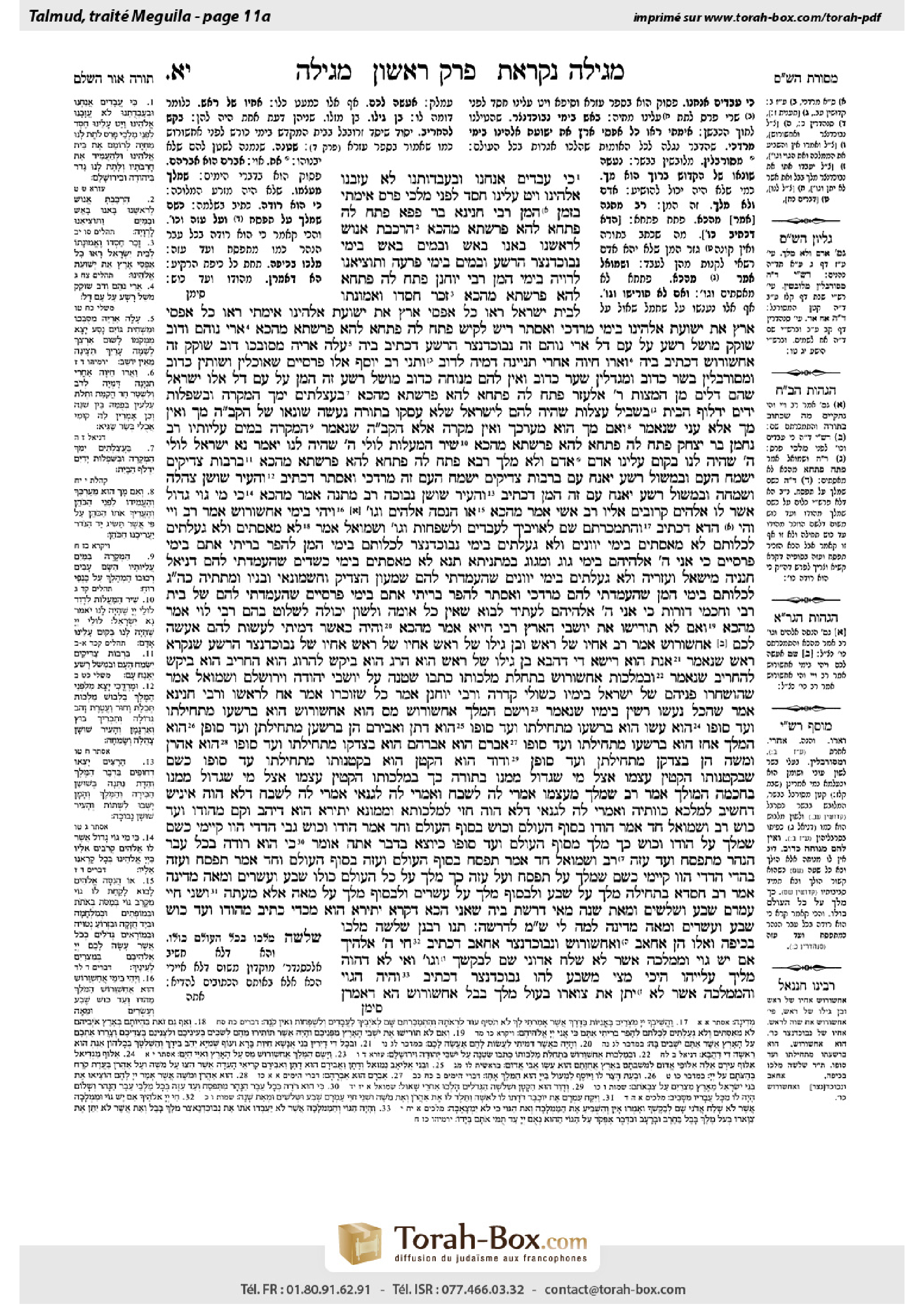
Megillah 11a: Talmud study for Daf Yomi
Daf Yomi is the daily study of one Talmud folio. Explore 37 tractates with scans, Hebrew text, Sefaria English and AI-generated French translations where annotated.
Passage selection and English or AI-generated French translation are available where the scan has annotations. Daf Study is independent of Torah-Box and Sefaria.
Browse Megillah · מגילה · All tractatesMegillah 11a text and translations
This page of Megillah includes the Aramaic text, an English translation and an AI-generated French translation, alongside the scan above.
מגילה י״א א · Aramaic and Hebrew text
״כִּי עֲבָדִים אֲנַחְנוּ וּבְעַבְדוּתֵנוּ לֹא עֲזָבָנוּ אֱלֹהֵינוּ וַיַּט עָלֵינוּ חֶסֶד לִפְנֵי מַלְכֵי פָרַס״, אֵימָתַי — בִּזְמַן הָמָן.
רַבִּי חֲנִינָא בַּר פָּפָּא פָּתַח לַהּ פִּתְחָא לְהָא פָּרַשְׁתָּא מֵהָכָא: ״הִרְכַּבְתָּ אֱנוֹשׁ לְרֹאשֵׁנוּ בָּאנוּ בָאֵשׁ וּבַמַּיִם״, ״בָּאֵשׁ״ — בִּימֵי נְבוּכַדְנֶצַּר הָרָשָׁע. ״וּבַמַּיִם״ — בִּימֵי פַרְעֹה, ״וַתּוֹצִיאֵנוּ לָרְוָיָה״ — בִּימֵי הָמָן.
רַבִּי יוֹחָנָן פָּתַח לֵהּ פִּתְחָא לְהָא פָּרַשְׁתָּא מֵהָכָא: ״זָכַר חַסְדּוֹ וֶאֱמוּנָתוֹ לְבֵית יִשְׂרָאֵל רָאוּ כׇל אַפְסֵי אָרֶץ אֵת יְשׁוּעַת אֱלֹהֵינוּ״, אֵימָתַי ״רָאוּ כׇל אַפְסֵי אָרֶץ אֵת יְשׁוּעַת אֱלֹהֵינוּ״ — בִּימֵי מׇרְדֳּכַי וְאֶסְתֵּר.
רֵישׁ לָקִישׁ פָּתַח לַהּ פִּתְחָא לְהָא פָּרַשְׁתָּא מֵהָכָא: ״אֲרִי נוֹהֵם וְדוֹב שׁוֹקֵק מוֹשֵׁל רָשָׁע עַל עַם דָּל״, ״אֲרִי נוֹהֵם״ — זֶה נְבוּכַדְנֶצַּר הָרָשָׁע, דִּכְתִיב בֵּיהּ: ״עָלָה אַרְיֵה מִסּוּבְּכוֹ״. ״דּוֹב שׁוֹקֵק״ — זֶה אֲחַשְׁוֵרוֹשׁ, דִּכְתִיב בֵּיהּ: ״וַאֲרוּ חֵיוָה אׇחֳרִי תִנְיָינָה דָּמְיָה לְדוֹב״, וְתָנֵי רַב יוֹסֵף: אֵלּוּ פַּרְסִיִּים, שֶׁאוֹכְלִין וְשׁוֹתִין כְּדוֹב, וּמְסוּרְבָּלִין בָּשָׂר כְּדוֹב, וּמְגַדְּלִין שֵׂעָר כְּדוֹב, וְאֵין לָהֶם מְנוּחָה כְּדוֹב.
״מוֹשֵׁל רָשָׁע״ — זֶה הָמָן. ״עַל עַם דָּל״ — אֵלּוּ יִשְׂרָאֵל, שֶׁהֵם דַּלִּים מִן הַמִּצְוֹת.
רַבִּי אֶלְעָזָר פָּתַח לֵהּ פִּתְחָא לְהָא פָּרַשְׁתָּא מֵהָכָא: ״בַּעֲצַלְתַּיִם יִמַּךְ הַמְּקָרֶה וּבְשִׁפְלוּת יָדַיִם יִדְלוֹף הַבָּיִת״, בִּשְׁבִיל עַצְלוּת שֶׁהָיָה לָהֶם לְיִשְׂרָאֵל שֶׁלֹּא עָסְקוּ בַּתּוֹרָה, נַעֲשָׂה שׂוֹנְאוֹ שֶׁל הַקָּדוֹשׁ בָּרוּךְ הוּא מָךְ. וְאֵין ״מָךְ״ אֶלָּא עָנִי, שֶׁנֶּאֱמַר: ״וְאִם מָךְ הוּא מֵעֶרְכֶּךָ״, וְאֵין ״מְקָרֶה״ אֶלָּא הַקָּדוֹשׁ בָּרוּךְ הוּא, שֶׁנֶּאֱמַר: ״הַמְקָרֶה בַמַּיִם עֲלִיּוֹתָיו״.
רַב נַחְמָן בַּר יִצְחָק פָּתַח לַהּ פִּתְחָא לְהָא פָּרַשְׁתָּא מֵהָכָא: ״שִׁיר הַמַּעֲלוֹת לוּלֵי ה׳ שֶׁהָיָה לָנוּ יֹאמַר נָא יִשְׂרָאֵל. לוּלֵי ה׳ שֶׁהָיָה לָנוּ בְּקוּם עָלֵינוּ אָדָם״. ״אָדָם״ — וְלֹא מֶלֶךְ.
רָבָא פָּתַח לַהּ פִּתְחָא לְהָא פָּרַשְׁתָּא מֵהָכָא: ״בִּרְבוֹת צַדִּיקִים יִשְׂמַח הָעָם וּבִמְשׁוֹל רָשָׁע יֵאָנַח עָם״, ״בִּרְבוֹת צַדִּיקִים יִשְׂמַח הָעָם״ — זֶה מׇרְדֳּכַי וְאֶסְתֵּר, דִּכְתִיב: ״וְהָעִיר שׁוּשָׁן צָהֲלָה וְשָׂמֵחָה״. ״וּבִמְשׁוֹל רָשָׁע יֵאָנַח עָם״ — זֶה הָמָן, דִּכְתִיב: ״וְהָעִיר שׁוּשָׁן נָבוֹכָה״.
רַב מַתְנָה אָמַר מֵהָכָא: ״כִּי מִי גוֹי גָּדוֹל אֲשֶׁר לוֹ אֱלֹהִים קְרוֹבִים אֵלָיו״. רַב אָשֵׁי אָמַר מֵהָכָא: ״אוֹ הֲנִסָּה אֱלֹהִים וְגוֹ׳״.
״וַיְהִי בִּימֵי אֲחַשְׁוֵרוֹשׁ״, אָמַר רַב: וַיי וְהֵי, הָדָא דִּכְתִיב: ״וְהִתְמַכַּרְתֶּם שָׁם לְאוֹיְבֶיךָ לַעֲבָדִים וְלִשְׁפָחוֹת וְגוֹ׳״.
וּשְׁמוּאֵל אָמַר: ״לֹא מְאַסְתִּים וְלֹא גְעַלְתִּים לְכַלּוֹתָם״. ״לֹא מְאַסְתִּים״ — בִּימֵי יְווֹנִים. ״וְלֹא גְעַלְתִּים״ — בִּימֵי נְבוּכַדְנֶצַּר. ״לְכַלּוֹתָם״ — בִּימֵי הָמָן. ״לְהָפֵר בְּרִיתִי אִתָּם״ — בִּימֵי פָרְסִיִּים. ״כִּי אֲנִי ה׳ אֱלֹהֵיהֶם״ — בִּימֵי גוֹג וּמָגוֹג.
בְּמַתְנִיתָא תָּנָא: ״לֹא מְאַסְתִּים״ — בִּימֵי כַּשְׂדִּים, שֶׁהֶעֱמַדְתִּי לָהֶם דָּנִיֵּאל חֲנַנְיָה מִישָׁאֵל וַעֲזַרְיָה. ״וְלֹא גְעַלְתִּים״ — בִּימֵי יְווֹנִים, שֶׁהֶעֱמַדְתִּי לָהֶם שִׁמְעוֹן הַצַּדִּיק, וְחַשְׁמוֹנַאי וּבָנָיו, וּמַתִּתְיָה כֹּהֵן גָּדוֹל. ״לְכַלּוֹתָם״ — בִּימֵי הָמָן, שֶׁהֶעֱמַדְתִּי לָהֶם מׇרְדֳּכַי וְאֶסְתֵּר. ״לְהָפֵר בְּרִיתִי אִתָּם״ — בִּימֵי רוֹמִיִּים, שֶׁהֶעֱמַדְתִּי לָהֶם שֶׁל בֵּית רַבִּי וְחַכְמֵי דוֹרוֹת. ״כִּי אֲנִי ה׳ אֱלֹהֵיהֶם״ — לֶעָתִיד לָבוֹא, שֶׁאֵין כׇּל אוּמָּה וְלָשׁוֹן יְכוֹלָה לִשְׁלוֹט בָּהֶם.
רַבִּי לֵוִי אָמַר מֵהָכָא: ״וְאִם לֹא תוֹרִישׁוּ אֶת יוֹשְׁבֵי הָאָרֶץ״.
רַבִּי חִיָּיא אָמַר מֵהָכָא: ״וְהָיָה כַּאֲשֶׁר דִּמִּיתִי לַעֲשׂוֹת לָהֶם אֶעֱשֶׂה לָכֶם״.
״אֲחַשְׁוֵרוֹשׁ״, אָמַר רַב: אָחִיו שֶׁל רֹאשׁ, וּבֶן גִּילוֹ שֶׁל רֹאשׁ. אָחִיו שֶׁל רֹאשׁ, אָחִיו שֶׁל נְבוּכַדְנֶצַּר הָרָשָׁע שֶׁנִּקְרָא ״רֹאשׁ״, שֶׁנֶּאֱמַר: ״אַנְתְּ הוּא רֵישָׁא דִּי דַהֲבָא״. בֶּן גִּילוֹ שֶׁל רֹאשׁ, הוּא הָרַג — הוּא בִּיקֵּשׁ לַהֲרוֹג, הוּא הֶחְרִיב — הוּא בִּיקֵּשׁ לְהַחְרִיב, שֶׁנֶּאֱמַר: ״וּבְמַלְכוּת אֲחַשְׁוֵרוֹשׁ בִּתְחִלַּת מַלְכוּתוֹ כָּתְבוּ שִׂטְנָה עַל יוֹשְׁבֵי יְהוּדָה וִירוּשָׁלִָם״.
וּשְׁמוּאֵל אָמַר: שֶׁהוּשְׁחֲרוּ פְּנֵיהֶם שֶׁל יִשְׂרָאֵל בְּיָמָיו כְּשׁוּלֵי קְדֵרָה. וְרַבִּי יוֹחָנָן אָמַר: כֹּל שֶׁזּוֹכְרוֹ אֹמֵר ״אָח לְרֹאשׁוֹ״. וְרַבִּי חֲנִינָא אָמַר: שֶׁהַכֹּל נַעֲשׂוּ רָשִׁין בְּיָמָיו, שֶׁנֶּאֱמַר: ״וַיָּשֶׂם הַמֶּלֶךְ אֲחַשְׁוֵרוֹשׁ מַס״.
״הוּא אֲחַשְׁוֵרוֹשׁ״ — הוּא בְּרִשְׁעוֹ מִתְּחִילָּתוֹ וְעַד סוֹפוֹ. ״הוּא עֵשָׂו״ — הוּא בְּרִשְׁעוֹ מִתְּחִילָּתוֹ וְעַד סוֹפוֹ. ״הוּא דָּתָן וַאֲבִירָם״ — הֵן בְּרִשְׁעָן מִתְּחִילָּתָן וְעַד סוֹפָן. ״הוּא הַמֶּלֶךְ אָחָז״ — הוּא בְּרִשְׁעוֹ מִתְּחִילָּתוֹ וְעַד סוֹפוֹ.
״אַבְרָם הוּא אַבְרָהָם״ — הוּא בְּצִדְקוֹ מִתְּחִילָּתוֹ וְעַד סוֹפוֹ. ״הוּא אַהֲרֹן וּמֹשֶׁה״ — הֵן בְּצִדְקָן מִתְּחִילָּתָן וְעַד סוֹפָן. ״וְדָוִד הוּא הַקָּטָן״ — הוּא בְּקַטְנוּתוֹ מִתְּחִילָּתוֹ עַד סוֹפוֹ, כְּשֵׁם שֶׁבְּקַטְנוּתוֹ הִקְטִין עַצְמוֹ אֵצֶל מִי שֶׁגָּדוֹל מִמֶּנּוּ בַּתּוֹרָה, כָּךְ בְּמַלְכוּתוֹ הִקְטִין עַצְמוֹ אֵצֶל מִי שֶׁגָּדוֹל מִמֶּנּוּ בְּחָכְמָה.
״הַמּוֹלֵךְ״, אָמַר רַב: שֶׁמָּלַךְ מֵעַצְמוֹ. אָמְרִי לַהּ לְשֶׁבַח וְאָמְרִי לַהּ לִגְנַאי. אָמְרִי לַהּ לְשֶׁבַח — דְּלָא הֲוָה אִינִישׁ דַּחֲשִׁיב לְמַלְכָּא כְּווֹתֵיהּ, וְאָמְרִי לַהּ לִגְנַאי — דְּלָא הֲוָה חֲזֵי לְמַלְכוּתָא, וּמָמוֹנָא יַתִּירָא הוּא דִּיהַב וְקָם.
״מֵהוֹדּוּ וְעַד כּוּשׁ״, רַב וּשְׁמוּאֵל חַד אָמַר: הוֹדּוּ בְּסוֹף הָעוֹלָם וְכוּשׁ בְּסוֹף הָעוֹלָם, וְחַד אָמַר: הוֹדּוּ וְכוּשׁ גַּבֵּי הֲדָדֵי הֲווֹ קָיְימִי; כְּשֵׁם שֶׁמָּלַךְ עַל הוֹדּוּ וְכוּשׁ, כָּךְ מָלַךְ מִסּוֹף הָעוֹלָם וְעַד סוֹפוֹ.
כַּיּוֹצֵא בַּדָּבָר אַתָּה אוֹמֵר: ״כִּי הוּא רוֹדֶה בְּכׇל עֵבֶר הַנָּהָר מִתִּפְסַח וְעַד עַזָּה״, רַב וּשְׁמוּאֵל חַד אָמַר: תִּפְסַח בְּסוֹף הָעוֹלָם וְעַזָּה בְּסוֹף הָעוֹלָם, וְחַד אָמַר: תִּפְסַח וְעַזָּה בַּהֲדֵי הֲדָדֵי הֲווֹ קָיְימִי; כְּשֵׁם שֶׁמָּלַךְ עַל תִּפְסַח וְעַל עַזָּה, כָּךְ מָלַךְ עַל כׇּל הָעוֹלָם כּוּלּוֹ.
״שֶׁבַע וְעֶשְׂרִים וּמֵאָה מְדִינָה״, אָמַר רַב חִסְדָּא: בַּתְּחִילָּה מָלַךְ עַל שֶׁבַע, וּלְבַסּוֹף מָלַךְ עַל עֶשְׂרִים, וּלְבַסּוֹף מָלַךְ עַל מֵאָה. אֶלָּא מֵעַתָּה: ״וּשְׁנֵי חַיֵּי עַמְרָם שֶׁבַע וּשְׁלֹשִׁים וּמְאַת שָׁנָה״, מַאי דָּרְשַׁתְּ בֵּיהּ? שָׁאנֵי הָכָא, דִּקְרָא יַתִּירָא הוּא: מִכְּדֵי כְּתִיב ״מֵהוֹדּוּ וְעַד כּוּשׁ״, ״שֶׁבַע וְעֶשְׂרִים וּמֵאָה מְדִינָה״ לְמָה לִי? שְׁמַע מִינַּהּ לִדְרָשָׁה.
תָּנוּ רַבָּנַן: שְׁלֹשָׁה מָלְכוּ בַּכִּיפָּה, וְאֵלּוּ הֵן: אַחְאָב וַאֲחַשְׁוֵרוֹשׁ וּנְבוּכַדְנֶצַּר. אַחְאָב, דִּכְתִיב: ״חַי ה׳ אֱלֹהֶיךָ אִם יֶשׁ גּוֹי וּמַמְלָכָה אֲשֶׁר לֹא שָׁלַח אֲדוֹנִי שָׁם לְבַקֶּשְׁךָ וְגוֹ׳״. וְאִי לָא דַּהֲוָה מָלֵיךְ עֲלַיְיהוּ, הֵיכִי מָצֵי מַשְׁבַּע לְהוּ?
נְבוּכַדְנֶצַּר, דִּכְתִיב: ״וְהָיָה הַגּוֹי וְהַמַּמְלָכָה אֲשֶׁר לֹא יִתֵּן אֶת צַוָּארוֹ בְּעוֹל מֶלֶךְ בָּבֶל״. אֲחַשְׁוֵרוֹשׁ, הָא דַּאֲמַרַן.
Megillah 11a · English translation
“For we are bondmen; yet our God has not forsaken us in our bondage, but has extended mercy unto us in the sight of the kings of Persia” (Ezra 9:9). When did this occur? In the time of Haman.
Rabbi Ḥanina bar Pappa introduced this passage with an introduction from here: The verse states: “You have caused men to ride over our heads; we went through fire and through water; but You brought us out into abundance” (Psalms 66:12). “Through fire”; this was in the days of the wicked Nebuchadnezzar, who cast the righteous into the furnace. “And through water”; this was in the days of Pharaoh, who decreed that all newborn males be cast into the water. “But You brought us out into abundance”; this was in the days of Haman, where abundant feasts played a pivotal role in their peril and salvation.
Rabbi Yoḥanan introduced this passage with an introduction from here: The verse states: “He has remembered His mercy and His faithfulness toward the house of Israel: All the ends of the earth have seen the salvation of our God” (Psalms 98:3). When did all the ends of the earth see the salvation of our God? In the days of Mordecai and Esther, for their peril and salvation became known through the letters sent throughout the empire.
Reish Lakish introduced this passage with an introduction from here: “As a roaring lion, and a ravenous bear, so is a wicked ruler over a poor people” (Proverbs 28:15). “A roaring lion”; this is the wicked Nebuchadnezzar, as it is written about him: “The lion has come up from his thicket” (Jeremiah 4:7). “A hungry bear”; this is Ahasuerus, as it is written about him: “And behold, another beast, a second one, like a bear” (Daniel 7:5). And Rav Yosef taught that these who are referred to as a bear in the verse are the Persians. They are compared to a bear, as they eat and drink in large quantities like a bear; and they are coated with flesh like a bear; and they grow their hair long like a bear; and they never rest like a bear, whose manner it is to move about from place to place.
“A wicked ruler”; this is Haman. “Over a poor people”; this is the Jewish people, who are referred to in this manner because they are poor in their observance of the mitzvot.
Rabbi Elazar introduced this passage with an introduction from here: “Through laziness the rafters [hamekare] sink in [yimakh]; and through idleness of the hands the house leaks” (Ecclesiastes 10:18). Rabbi Elazar interprets the verse homiletically: Through the laziness of the Jewish people, who did not occupy themselves with Torah study, the enemy of the Holy One, Blessed be He, a euphemism for God Himself, became poor [makh], so that, as it were, He was unable to help them, as makh is nothing other than poor, as it is stated: “But if he be too poor [makh] for the valuation” (Leviticus 27:8). And the word mekare in the verse is referring to no one other than the Holy One, Blessed be He, as it is stated: “Who lays the beams [hamekare] of His chambers in the waters” (Psalms 104:3).
Rav Naḥman bar Yitzḥak introduced this passage with an introduction from here: “A song of ascents of David. If not for the Lord Who was with us, let Israel now say; if not for the Lord who was with us, when a man rose up against us” (Psalms 124:1–2). The verse speaks of “a man” who rose up against us and not a king. This occurred in the days of Haman, as he, and not King Ahasuerus, was the chief enemy of the Jewish people.
Rava introduced this passage with an introduction from here: “When the righteous are on the increase, the people rejoice; but when the wicked man rules, the people mourn” (Proverbs 29:2). “When the righteous are on the increase, the people rejoice”; this is Mordecai and Esther, as it is written: “And the city of Shushan rejoiced and was glad” (Esther 8:15). “But when the wicked man rules, the people mourn”; this is Haman, as it is written: “But the city of Shushan was perplexed” (Esther 3:15).
Rav Mattana said his introduction from here: “For what nation is there so great, that has God so near to them” (Deuteronomy 4:7), as to witness the great miracles in the days of Mordecai and Esther? Rav Ashi said his introduction from here: The verse states: “Or has God ventured to go and take Him a nation from the midst of another nation?” (Deuteronomy 4:34), as in the times of Esther, God saved the Jewish people who were scattered throughout the Persian Empire.
§ The Gemara returns to its interpretation of the book of Esther. The verse states: “And it came to pass [vayhi] in the days of Ahasuerus” (Esther 1:1). Rav said: The word vayhi may be understood as if it said vai and hi, meaning woe and mourning. This is as it is written: “And there you shall sell yourselves to your enemies for bondsmen and bondswomen, and no man shall buy you” (Deuteronomy 28:68). The repetitive nature of the verse, indicating that no one will be willing to buy you for servitude, but they will purchase you in order to murder you, indicates a doubly horrific situation, which is symbolized by the dual term vayhi, meaning woe and mourning.
And Shmuel said his introduction from here: “And yet for all that, when they are in the land of their enemies, I will not reject them, nor will I abhor them, to destroy them utterly, and to break My covenant with them; for I am the Lord their God” (Leviticus 26:44). Shmuel explains: “I will not reject them”; this was in the days of the Greeks. “Nor will I abhor them”; this was in the days of Vespasian. “To destroy them utterly”; this was in the days of Haman. “To break My covenant with them”; this was in the days of the Persians. “For I am the Lord their God”; this is in the days of Gog and Magog.
An alternative understanding was taught in a baraita: “I will not reject them”; this was in the days of the Chaldeans, when I appointed for them Daniel, Hananiah, Mishael, and Azariah to pray on their behalf. “Nor will I abhor them”; this was in the days of the Greeks, when I appointed Shimon HaTzaddik for them, and the Hasmonean and his sons, and Mattithiah the High Priest. “To destroy them utterly”; this was in the days of Haman, when I appointed for them the righteous leaders Mordecai and Esther. “To break My covenant with them”; this was in the days of the Romans, when I appointed for them the Sages of the house of Rabbi Yehuda HaNasi and the Sages of other generations. “For I am the Lord their God”; this will be in the future, when no nation or people of a foreign tongue will be able to subjugate them further.
Rabbi Levi said his introduction from here: “But if you will not drive out the inhabitants of the land from before you, then it shall come to pass, that those whom you allow to remain of them shall be as thorns in your eyes” (Numbers 33:55). King Saul’s failure to completely annihilate Amalek allowed for the existence of his descendant Haman, who acted as a thorn in the eyes of Israel during the Purim episode.
Rabbi Ḥiyya said his introduction from here, the continuation of the previously cited verse: “And it shall come to pass, that as I thought to do unto them, so I shall do unto you” (Numbers 33:56). Prior to the miracle of Purim, the Jewish people were subject to the punishment that the Torah designated for its enemies, because they did not fulfill God’s commandments.
The Gemara continues with its explanation of the book of Esther, beginning with a discussion of the name Ahasuerus. Rav said: The name should be viewed as a contraction: The brother of the head [aḥiv shel rosh] and of the same character as the head [ben gilo shel rosh]. Rav explains: The brother of the head, i.e., the brother of the wicked Nebuchadnezzar, who is called “head,” as it is stated: “You are the head of gold” (Daniel 2:38). Of the same character as the head, for he, Nebuchadnezzar, killed the Jews, and he, Ahasuerus, sought to kill them. He destroyed the Temple, and he sought to destroy the foundations for the Temple laid by Zerubbabel, as it is stated: “And in the reign of Ahasuerus, in the beginning of his reign, they wrote to him an accusation against the inhabitants of Judah and Jerusalem” (Ezra 4:6), and he ordered that the construction of the Temple cease.
And Shmuel said: The name Ahasuerus should be understood in the sense of black [shaḥor], as the face of the Jewish people was blackened in his days like the bottom of a pot. And Rabbi Yoḥanan said a different explanation: Everyone who recalled him said: “Woe upon his head” [aḥ lerosho]. And Rabbi Ḥanina said: The name alludes to the fact that everyone became poor [rash] in his days, as it is stated: “And the king Ahasuerus laid a tribute upon the land” (Esther 10:1).
The Gemara continues: “This is [hu] Ahasuerus” (Esther 1:1); the term hu, this is, comes to teach that he remained as he was in his wickedness from beginning to end. Similarly, wherever the words “this is” appear in this manner, the verse indicates that the individual under discussion remained the same from beginning to end, for example: “This is [hu] Esau” (Genesis 36:43); he remained in his wickedness from beginning to end. “This is [hu] Dathan and Abiram” (Numbers 26:9); they remained in their wickedness from beginning to end. “This is [hu] the king Ahaz” (II Chronicles 28:22); he remained in his wickedness from beginning to end.
The Gemara continues: The word hu is also used to recognize sustained righteousness. “Abram, this is [hu] Abraham” (I Chronicles 1:27); this indicates that Abraham didn’t change, as he remained in his righteousness from beginning to end. Similarly, “This is [hu] Aaron and Moses” (Exodus 6:26); they remained in their righteousness from the beginning of their life to the end of their life. Similarly, with respect to David: “And David, this was [hu] the youngest” (I Samuel 17:14), indicates that he remained in his humility from beginning to end. Just as in his youth, when he was still an ordinary individual, he humbled himself before anyone who was greater than him in Torah, so too, in his kingship, he humbled himself before anyone who was greater than him in wisdom.
The next term in the opening verse: “Who reigned” (Esther 1:1), is now interpreted. Rav said: This comes to teach that he reigned on his own, without having inherited the throne. Some say this to his credit, and some say it to his disgrace. The Gemara explains: Some say this to his credit, that there was no other man as fit as him to be king. And some say it to his disgrace, that he was not fit to be king, but he distributed large amounts of money, and in that way rose to the throne.
The opening verse continues that Ahasuerus reigned “from Hodu to Cush.” Rav and Shmuel disagreed about its meaning. One said: Hodu is a country at one end of the world, and Cush is a country at the other end of the world. And one said: Hodu and Cush are situated next to each other, and the verse means to say as follows: Just as Ahasuerus reigned with ease over the adjacent countries of Hodu and Cush, so too, he reigned with ease from one end of the world to the other.
On a similar note, you say with regard to Solomon: “For he had dominion over all the region on this side of the river, from Tiphsah even to Gaza” (I Kings 5:4), and also with regard to this Rav and Shmuel disagreed. One said: Tiphsah is at one end of the world, whereas Gaza is at the other end of the world. And one said: Tiphsah and Gaza are situated next to each other, and the verse means to say as follows: Just as Solomon reigned with ease over the adjacent Tiphsah and Gaza, so too, he reigned with ease over the entire world.
The opening verse continues, stating that Ahasuerus reigned “over seven and twenty and a hundred provinces” (Esther 1:1). Rav Ḥisda said: This verse should be understood as follows: At first he reigned over seven provinces; and then he reigned over twenty more; and finally he reigned over another hundred. The Gemara asks: However, if that is so, with regard to the similarly worded verse: “And the years of the life of Amram were seven and thirty and a hundred years” (Exodus 6:20), what would you expound from it? The Gemara answers: It is different here, in the book of Esther, as this part of the verse is entirely superfluous. Since it is already written: “From Hodu to Cush,” why then do I need “Seven and twenty and a hundred provinces”? Rather, learn from here that these words come for this exposition, to teach that Ahasuerus did not begin to reign over all of them at the same time.
§ Apropos the discussion of the kingdoms of Ahasuerus and Solomon, the Gemara cites a baraita in which the Sages taught: Three men ruled over the entire world, and they were Ahab, and Ahasuerus, and Nebuchadnezzar. The Gemara explains: Ahab, as it is written in the words of Obadiah, servant of Ahab, to Elijah: “As the Lord your God lives, there is no nation or kingdom where my master has not sent to seek you, and they said: He is not there; and he made the kingdom and nation swear, that they had not found you” (I Kings 18:10). And if he did not reign over them, how could he have made them swear? Apparently, then, he reigned over the entire world.
Nebuchadnezzar also ruled over the whole world, as it is written: “And it shall come to pass, that the nation and the kingdom that not serve this same Nebuchadnezzar, the king of Babylonia, and that will not put their neck under the yoke of the king of Babylonia, that nation will I visit, says the Lord, with the sword, and with the famine, and with the pestilence, until I have consumed them by his hand” (Jeremiah 27:8). Ahasuerus also ruled the world, as we have said above.
Megillah 11a · Traduction française (IA)
« Car nous sommes esclaves ; pourtant, notre Dieu ne nous a pas abandonnés dans notre esclavage, mais nous a témoigné sa bonté devant les rois de Perse » (Esdras 9:9). Quand cela s’est-il produit ? À l’époque de Haman.
Rabbi Ḥanina bar Pappa introduisit ce passage par un enseignement tiré d’ici : le verset dit : « Tu as fait monter des hommes sur nos têtes ; nous sommes passés par le feu et par l’eau, mais Tu nous as conduits vers l’abondance » (Psaumes 66:12). « Par le feu » : c’était à l’époque du méchant Nabuchodonosor, qui jeta les justes dans la fournaise. « Et par l’eau » : c’était à l’époque de Pharaon, qui ordonna que tous les nouveau-nés mâles soient jetés dans l’eau. « Mais Tu nous as conduits vers l’abondance » : c’était à l’époque de Haman, où les festins abondants jouèrent un rôle essentiel dans le péril et le salut du peuple juif.
Rabbi Yoḥanan introduisit ce passage par un enseignement tiré d’ici : le verset dit : « Il s’est souvenu de sa bonté et de sa fidélité envers la maison d’Israël ; toutes les extrémités de la terre ont vu le salut de notre Dieu » (Psaumes 98:3). Quand toutes les extrémités de la terre ont-elles vu le salut de notre Dieu ? À l’époque de Mordekhaï et d’Esther, car leur péril et leur salut furent connus grâce aux lettres envoyées dans tout l’empire.
Reish Lakish introduisit ce passage par un enseignement tiré d’ici : « Comme un lion rugissant et un ours affamé, tel est un dirigeant méchant sur un peuple pauvre » (Proverbes 28:15). « Un lion rugissant » : c’est le méchant Nabuchodonosor, à son sujet duquel il est écrit : « Le lion est sorti de son fourré » (Jérémie 4:7). « Un ours affamé » : c’est Assuérus, à son sujet duquel il est écrit : « Et voici une autre bête, une deuxième, semblable à un ours » (Daniel 7:5). Rav Yosef enseignait que ceux qui sont désignés comme un ours dans le verset sont les Perses. Ils sont comparés à un ours parce qu’ils mangent et boivent en grandes quantités, comme un ours ; qu’ils sont couverts de chair, comme un ours ; qu’ils laissent pousser leurs cheveux longs, comme un ours ; et qu’ils ne se reposent jamais, à l’image de l’ours, qui a l’habitude d’aller d’un endroit à un autre.
« Un dirigeant méchant » : c’est Haman. « Sur un peuple pauvre » : c’est le peuple juif, ainsi désigné parce qu’il est pauvre dans l’observance des mitsvot.
Rabbi Elazar introduisit ce passage par un enseignement tiré d’ici : « Par la paresse, les poutres [hamekare] s’affaissent [yimakh] ; et par l’inactivité des mains, la maison prend l’eau » (Ecclésiaste 10:18). Rabbi Elazar interprète le verset de façon homilétique : à cause de la paresse du peuple juif, qui ne s’adonnait pas à l’étude de la Torah, l’ennemi du Saint, béni soit-Il — euphémisme désignant Dieu Lui-même — s’est appauvri [makh], si bien qu’Il était, pour ainsi dire, incapable de les aider ; car makh signifie uniquement « pauvre », comme il est dit : « Mais s’il est trop pauvre [makh] pour l’estimation » (Lévitique 27:8). Et le mot mekare dans le verset ne désigne personne d’autre que le Saint, béni soit-Il, comme il est dit : « Lui qui pose les poutres [hamekare] de ses chambres dans les eaux » (Psaumes 104:3).
Rav Naḥman bar Yitzḥak introduisit ce passage par un enseignement tiré d’ici : « Cantique des montées, de David. Si l’Éternel n’avait pas été avec nous — qu’Israël le dise maintenant —, si l’Éternel n’avait pas été avec nous quand un homme s’est dressé contre nous » (Psaumes 124:1-2). Le verset parle d’« un homme » qui s’est dressé contre nous, et non d’un roi. Cela eut lieu à l’époque de Haman, car c’est lui, et non le roi Assuérus, qui était le principal ennemi du peuple juif.
Rava introduisit ce passage par un enseignement tiré d’ici : « Quand les justes sont nombreux, le peuple se réjouit ; mais quand le méchant domine, le peuple gémit » (Proverbes 29:2). « Quand les justes sont nombreux, le peuple se réjouit » : il s’agit de Mordekhaï et d’Esther, comme il est écrit : « La ville de Suse se réjouissait et était dans l’allégresse » (Esther 8:15). « Mais quand le méchant domine, le peuple gémit » : il s’agit de Haman, comme il est écrit : « La ville de Suse était dans la consternation » (Esther 3:15).
Rav Mattana donna comme introduction un enseignement tiré d’ici : « Car quelle est la grande nation qui ait un dieu aussi proche d’elle ? » (Deutéronome 4:7), au point d’assister aux grands miracles de l’époque de Mordekhaï et d’Esther ? Rav Ashi donna comme introduction un enseignement tiré d’ici : le verset dit : « Ou bien un dieu a-t-il entrepris d’aller se choisir une nation au milieu d’une autre nation ? » (Deutéronome 4:34), car à l’époque d’Esther, Dieu sauva le peuple juif, dispersé dans tout l’Empire perse.
§ La Guemara revient à son interprétation du livre d’Esther. Le verset dit : « Et il arriva [vayhi], aux jours d’Assuérus » (Esther 1:1). Rav dit : le mot vayhi peut être compris comme s’il était écrit vai et hi, c’est-à-dire « malheur » et « deuil ». Cela correspond à ce qui est écrit : « Et là, vous vous vendrez à vos ennemis comme esclaves et servantes, et personne ne vous achètera » (Deutéronome 28:68). La répétition dans le verset, qui indique que personne ne voudra vous acheter pour vous réduire en servitude, mais qu’on vous achètera pour vous tuer, décrit une situation doublement terrible, symbolisée par le terme double vayhi, qui signifie « malheur » et « deuil ».
Et Shmuel donna comme introduction un enseignement tiré d’ici : « Malgré tout cela, lorsqu’ils seront dans le pays de leurs ennemis, je ne les rejetterai pas et je ne les prendrai pas en aversion au point de les anéantir et de rompre mon alliance avec eux ; car je suis l’Éternel, leur Dieu » (Lévitique 26:44). Shmuel explique : « Je ne les rejetterai pas » : cela eut lieu à l’époque des Grecs. « Et je ne les prendrai pas en aversion » : cela eut lieu à l’époque de Vespasien. « Au point de les anéantir » : cela eut lieu à l’époque de Haman. « Et de rompre mon alliance avec eux » : cela eut lieu à l’époque des Perses. « Car je suis l’Éternel, leur Dieu » : cela aura lieu à l’époque de Gog et Magog.
Une autre interprétation fut enseignée dans une baraïta : « Je ne les rejetterai pas » : cela eut lieu à l’époque des Chaldéens, quand je désignai Daniel, Hanania, Mishaël et Azaria pour prier en leur faveur. « Et je ne les prendrai pas en aversion » : cela eut lieu à l’époque des Grecs, quand je désignai pour eux Shimon HaTzaddik, le Hasmonéen et ses fils, ainsi que Mattithiah le Grand Prêtre. « Au point de les anéantir » : cela eut lieu à l’époque de Haman, quand je désignai pour eux les justes dirigeants Mordekhaï et Esther. « Et de rompre mon alliance avec eux » : cela eut lieu à l’époque des Romains, quand je désignai pour eux les Sages de la maison de Rabbi Yehuda HaNasi et les Sages des générations suivantes. « Car je suis l’Éternel, leur Dieu » : cela aura lieu dans l’avenir, quand aucune nation ni aucun peuple de langue étrangère ne pourra plus les assujettir.
Rabbi Levi donna comme introduction un enseignement tiré d’ici : « Mais si vous ne chassez pas devant vous les habitants du pays, alors ceux d’entre eux que vous laisserez subsister seront des épines dans vos yeux » (Nombres 33:55). L’échec du roi Saül à exterminer complètement Amalek permit à Haman, son descendant, d’exister ; il fut une épine dans les yeux d’Israël lors de l’épisode de Pourim.
Rabbi Ḥiyya donna comme introduction un enseignement tiré d’ici, la suite du verset cité précédemment : « Et il arrivera que, comme j’avais pensé leur faire, je vous ferai de même » (Nombres 33:56). Avant le miracle de Pourim, le peuple juif était soumis au châtiment que la Torah destinait à ses ennemis, parce qu’il n’avait pas accompli les commandements de Dieu.
La Guemara poursuit son explication du livre d’Esther en commençant par l’étude du nom d’Assuérus. Rav dit : son nom doit être considéré comme une contraction : « frère du chef » [aḥiv shel rosh] et « de même nature que le chef » [ben gilo shel rosh]. Rav explique : « frère du chef », c’est-à-dire frère du méchant Nabuchodonosor, appelé « chef », comme il est dit : « Tu es la tête d’or » (Daniel 2:38). « De même nature que le chef » : car Nabuchodonosor a tué les Juifs, et Assuérus a cherché à les tuer. Nabuchodonosor a détruit le Temple, et Assuérus a cherché à détruire les fondations du Temple posées par Zorobabel, comme il est dit : « Et sous le règne d’Assuérus, au début de son règne, ils écrivirent une accusation contre les habitants de Juda et de Jérusalem » (Esdras 4:6) ; Assuérus ordonna alors que la construction du Temple cesse.
Et Shmuel dit : le nom d’Assuérus doit être compris au sens de « noir » [shaḥor], car, de son temps, le visage du peuple juif fut noirci comme le fond d’une marmite. Rabbi Yoḥanan donna une autre explication : tous ceux qui se souvenaient de lui disaient : « Malheur à sa tête » [aḥ lerosho]. Rabbi Ḥanina dit que son nom fait allusion au fait que tous s’appauvrirent [rash] de son temps, comme il est dit : « Le roi Assuérus imposa un tribut au pays » (Esther 10:1).
La Guemara poursuit : « C’était [hu] Assuérus » (Esther 1:1) : le terme hu, « c’était », enseigne qu’il demeura aussi méchant du début à la fin. De même, chaque fois que les mots « c’était » apparaissent ainsi, le verset indique que la personne dont il est question demeura la même du début à la fin. Par exemple : « C’était [hu] Ésaü » (Genèse 36:43) : il demeura méchant du début à la fin. « C’étaient [hu] Dathan et Abiram » (Nombres 26:9) : ils demeurèrent méchants du début à la fin. « C’était [hu] le roi Achaz » (II Chroniques 28:22) : il demeura méchant du début à la fin.
La Guemara poursuit : le mot hu sert également à reconnaître une droiture constante. « Abram, c’est [hu] Abraham » (I Chroniques 1:27) : cela indique qu’Abraham ne changea pas, puisqu’il demeura juste du début à la fin. De même, « C’étaient [hu] Aaron et Moïse » (Exode 6:26) : ils demeurèrent justes du début à la fin de leur vie. De même, au sujet de David : « Et David, c’était [hu] le plus jeune » (I Samuel 17:14), indique qu’il demeura humble du début à la fin. De même que, dans sa jeunesse, alors qu’il n’était encore qu’un particulier, il s’humiliait devant quiconque le dépassait en Torah, de même, lorsqu’il fut roi, il s’humiliait devant quiconque le dépassait en sagesse.
Le terme suivant du verset d’ouverture, « qui régna » (Esther 1:1), est maintenant interprété. Rav dit : cela enseigne qu’il régna de son propre chef, sans avoir hérité du trône. Certains disent que c’est à son crédit, d’autres que c’est à sa honte. La Guemara explique : certains disent que c’est à son crédit, car aucun autre homme n’était aussi digne que lui de devenir roi. D’autres disent que c’est à sa honte : il n’était pas digne de devenir roi, mais il distribua de grosses sommes d’argent et accéda ainsi au trône.
Le verset d’ouverture poursuit en disant qu’Assuérus régna « de Hodu à Kush ». Rav et Shmuel étaient en désaccord sur le sens de ces mots. L’un disait : Hodu est un pays situé à une extrémité du monde, et Kush, un pays situé à l’autre extrémité du monde. L’autre disait : Hodu et Kush sont situés l’un à côté de l’autre, et le verset veut dire ceci : de même qu’Assuérus régnait sans difficulté sur les pays voisins de Hodu et de Kush, de même il régnait sans difficulté d’une extrémité du monde à l’autre.
Dans le même ordre d’idées, on dit au sujet de Salomon : « Car il dominait sur toute la région de ce côté du fleuve, depuis Tifsah jusqu’à Gaza » (I Rois 5:4). Là encore, Rav et Shmuel étaient en désaccord. L’un disait : Tifsah est à une extrémité du monde, tandis que Gaza est à l’autre extrémité du monde. L’autre disait : Tifsah et Gaza sont situées l’une à côté de l’autre, et le verset veut dire ceci : de même que Salomon régnait sans difficulté sur les villes voisines de Tifsah et de Gaza, de même il régnait sans difficulté sur le monde entier.
Le verset d’ouverture poursuit en disant qu’Assuérus régna « sur cent vingt-sept provinces » (Esther 1:1). Rav Ḥisda dit : ce verset doit être compris ainsi : il régna d’abord sur sept provinces, puis sur vingt autres, et enfin sur cent autres. La Guemara demande : si tel est le cas, que déduirais-tu du verset formulé de manière semblable : « La durée de la vie d’Amram fut de cent trente-sept ans » (Exode 6:20) ? La Guemara répond : le cas présent, dans le livre d’Esther, est différent, car cette partie du verset est entièrement superflue. Puisqu’il est déjà écrit « de Hodu à Kush », pourquoi ai-je besoin de « cent vingt-sept provinces » ? Apprends plutôt de là que ces mots servent à cette interprétation : ils enseignent qu’Assuérus ne commença pas à régner sur toutes ces provinces au même moment.
§ À propos de la discussion sur les royaumes d’Assuérus et de Salomon, la Guemara cite une baraïta dans laquelle les Sages enseignèrent : trois hommes régnèrent sur le monde entier : Ahab, Assuérus et Nabuchodonosor. La Guemara explique : Ahab, comme il est écrit dans les paroles d’Obadia, serviteur d’Ahab, adressées à Élie : « Par la vie de l’Éternel, ton Dieu, il n’est pas de nation ni de royaume où mon maître n’ait envoyé quelqu’un pour te chercher ; et l’on disait : “Il n’est pas ici” ; et il faisait jurer le royaume et la nation qu’ils ne t’avaient pas trouvé » (I Rois 18:10). S’il n’avait pas régné sur eux, comment aurait-il pu les faire jurer ? Il apparaît donc qu’il régnait sur le monde entier.
Nabuchodonosor régnait lui aussi sur le monde entier, comme il est écrit : « Et il arrivera que la nation et le royaume qui ne serviront pas ce même Nabuchodonosor, roi de Babylone, et qui ne placeront pas leur nuque sous le joug du roi de Babylone, je châtierai cette nation, dit l’Éternel, par l’épée, la famine et la peste, jusqu’à ce que je l’aie anéantie par sa main » (Jérémie 27:8). Assuérus régnait lui aussi sur le monde, comme nous l’avons dit plus haut.
Traduction française générée par IA à partir de l’édition anglaise de Sefaria. Vérifie toujours un passage avec le texte source.
Text from Sefaria: William Davidson Edition - Vocalized Aramaic (CC BY NC); William Davidson Edition - English (CC BY NC).