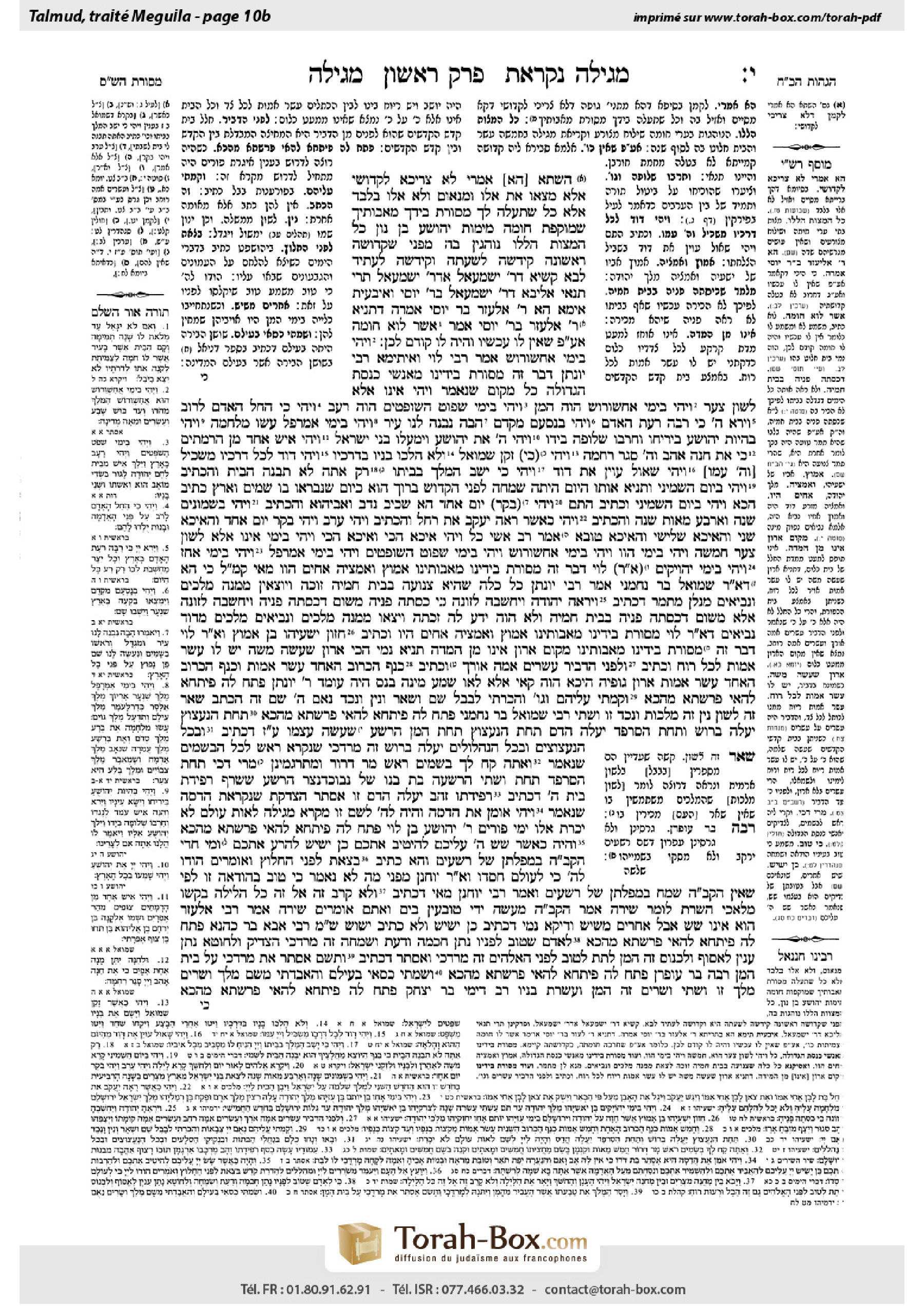
Megillah 10b: Talmud study for Daf Yomi
Daf Yomi is the daily study of one Talmud folio. Explore 37 tractates with scans, Hebrew text, Sefaria English and AI-generated French translations where annotated.
Passage selection and English or AI-generated French translation are available where the scan has annotations. Daf Study is independent of Torah-Box and Sefaria.
Browse Megillah · מגילה · All tractatesMegillah 10b text and translations
This page of Megillah includes the Aramaic text, an English translation and an AI-generated French translation, alongside the scan above.
מגילה י׳ ב · Aramaic and Hebrew text
הַשְׁתָּא [הָא] אָמְרִי לָא צְרִיכָא לְקַדּוֹשֵׁי! אֶלָּא: מָצְאוּ אֶת אֵלּוּ וּמְנָאוּם.
וְלֹא אֵלּוּ בִּלְבַד, אֶלָּא כׇּל שֶׁתַּעֲלֶה לְךָ מָסוֹרֶת בְּיָדְךָ מֵאֲבוֹתֶיךָ שֶׁמּוּקֶּפֶת חוֹמָה מִימוֹת יְהוֹשֻׁעַ בִּן נוּן — כׇּל הַמִּצְוֹת הַלָּלוּ נוֹהֲגִין בָּהּ, מִפְּנֵי שֶׁקְּדוּשָּׁה רִאשׁוֹנָה קִידְּשָׁה לִשְׁעָתָהּ וְקִידְּשָׁה לֶעָתִיד לָבֹא. קַשְׁיָא דְּרַבִּי יִשְׁמָעֵאל אַדְּרַבִּי יִשְׁמָעֵאל.
תְּרֵי תַנָּאֵי אַלִּיבָּא דְּרַבִּי יִשְׁמָעֵאל בְּרַבִּי יוֹסֵי. וְאִיבָּעֵית אֵימָא, הָא רַבִּי אֶלְעָזָר בַּר יוֹסֵי אַמְרַהּ, דְּתַנְיָא: רַבִּי אֶלְעָזָר בְּרַבִּי יוֹסֵי אָמַר: ״אֲשֶׁר לוֹא חוֹמָה״, אַף עַל פִּי שֶׁאֵין לוֹ עַכְשָׁיו וְהָיָה לוֹ קוֹדֶם לָכֵן.
״וַיְהִי בִּימֵי אֲחַשְׁוֵרוֹשׁ״, אָמַר רַבִּי לֵוִי וְאִיתֵּימָא רַבִּי יוֹנָתָן: דָּבָר זֶה מָסוֹרֶת בְּיָדֵינוּ מֵאַנְשֵׁי כְּנֶסֶת הַגְּדוֹלָה, כׇּל מָקוֹם שֶׁנֶּאֱמַר ״וַיְהִי״ אֵינוֹ אֶלָּא לְשׁוֹן צַעַר.
״וַיְהִי בִּימֵי אֲחַשְׁוֵרוֹשׁ״ — הֲוָה הָמָן. ״וַיְהִי בִּימֵי שְׁפוֹט הַשּׁוֹפְטִים״ — הֲוָה רָעָב. ״וַיְהִי כִּי הֵחֵל הָאָדָם לָרוֹב״ — ״וַיַּרְא ה׳ כִּי רַבָּה רָעַת הָאָדָם״.
״וַיְהִי בְּנׇסְעָם מִקֶּדֶם״ — ״הָבָה נִבְנֶה לָּנוּ עִיר״. ״וַיְהִי בִּימֵי אַמְרָפֶל״ — ״עָשׂוּ מִלְחָמָה״. ״וַיְהִי בִּהְיוֹת יְהוֹשֻׁעַ בִּירִיחוֹ״ — ״וְחַרְבּוֹ שְׁלוּפָה בְּיָדוֹ״. ״וַיְהִי ה׳ אֶת יְהוֹשֻׁעַ״ — ״וַיִּמְעֲלוּ בְּנֵי יִשְׂרָאֵל״. ״וַיְהִי אִישׁ אֶחָד מִן הָרָמָתַיִם״ — ״כִּי אֶת חַנָּה אָהֵב וַה׳ סָגַר רַחְמָהּ״.
״וַיְהִי (כִּי) זָקֵן שְׁמוּאֵל״ — ״וְלֹא הָלְכוּ בָנָיו בִּדְרָכָיו״. ״וַיְהִי דָוִד לְכׇל דְּרָכָיו מַשְׂכִּיל [וַה׳ עִמּוֹ]״ — ״וַיְהִי שָׁאוּל עוֹיֵן אֶת דָּוִד״. ״וַיְהִי כִּי יָשַׁב הַמֶּלֶךְ בְּבֵיתוֹ״ — ״רַק אַתָּה לֹא תִבְנֶה הַבָּיִת״.
וְהָכְתִיב: ״וַיְהִי בַּיּוֹם הַשְּׁמִינִי״, וְתַנְיָא: אוֹתוֹ הַיּוֹם הָיְתָה שִׂמְחָה לִפְנֵי הַקָּדוֹשׁ בָּרוּךְ הוּא כְּיוֹם שֶׁנִּבְרְאוּ בּוֹ שָׁמַיִם וָאָרֶץ, כְּתִיב הָכָא: ״וַיְהִי בְּיוֹם הַשְּׁמִינִי״, וּכְתִיב הָתָם: ״וַיְהִי (בֹקֶר) יוֹם אֶחָד״!
הָא שְׁכֵיב נָדָב וַאֲבִיהוּא.
וְהָכְתִיב: ״וַיְהִי בִשְׁמוֹנִים שָׁנָה וְאַרְבַּע מֵאוֹת שָׁנָה״! וְהָכְתִיב: ״וַיְהִי כַּאֲשֶׁר רָאָה יַעֲקֹב אֶת רָחֵל״! וְהָכְתִיב ״וַיְהִי עֶרֶב וַיְהִי בֹקֶר יוֹם אֶחָד״! וְהָאִיכָּא שֵׁנִי! וְהָאִיכָּא שְׁלִישִׁי! וְהָאִיכָּא טוּבָא!
אָמַר רַב אָשֵׁי: כׇּל ״וַיְהִי״ — אִיכָּא הָכִי וְאִיכָּא הָכִי, ״וַיְהִי בִּימֵי״ — אֵינוֹ אֶלָּא לְשׁוֹן צַעַר.
חַמְשָׁה ״וַיְהִי בִּימֵי״ הָווּ: ״וַיְהִי בִּימֵי אֲחַשְׁוֵרוֹשׁ״, ״וַיְהִי בִּימֵי שְׁפוֹט הַשּׁוֹפְטִים״, ״וַיְהִי בִּימֵי אַמְרָפֶל״, ״וַיְהִי בִּימֵי אָחָז״, ״וַיְהִי בִּימֵי יְהוֹיָקִים״.
וְאָמַר רַבִּי לֵוִי, דָּבָר זֶה מָסוֹרֶת בְּיָדֵינוּ מֵאֲבוֹתֵינוּ: אָמוֹץ וַאֲמַצְיָה — אֲחֵי הָווּ. מַאי קָא מַשְׁמַע לַן?
כִּי הָא דְּאָמַר רַבִּי שְׁמוּאֵל בַּר נַחְמָנִי אָמַר רַבִּי יוֹנָתָן: כׇּל כַּלָּה שֶׁהִיא צְנוּעָה בְּבֵית חָמִיהָ — זוֹכָה וְיוֹצְאִין מִמֶּנָּה מְלָכִים וּנְבִיאִים. מְנָלַן? מִתָּמָר, דִּכְתִיב: ״וַיִּרְאֶהָ יְהוּדָה וַיַּחְשְׁבֶהָ לְזוֹנָה כִּי כִסְּתָה פָּנֶיהָ״, מִשּׁוּם דְּכִסְּתָה פָּנֶיהָ ״וַיַּחְשְׁבֶהָ לְזוֹנָה״?
אֶלָּא מִשּׁוּם דְּכִסְּתָה פָּנֶיהָ בְּבֵית חָמִיהָ, וְלָא הֲוָה יָדַע לַהּ, זָכְתָה וְיָצְאוּ מִמֶּנָּה מְלָכִים וּנְבִיאִים. מְלָכִים — מִדָּוִד, נְבִיאִים — דְּאָמַר רַבִּי לֵוִי, מָסוֹרֶת בְּיָדֵינוּ מֵאֲבוֹתֵינוּ: אָמוֹץ וַאֲמַצְיָה אַחִים הָיוּ, וּכְתִיב: ״חֲזוֹן יְשַׁעְיָהוּ בֶן אָמוֹץ״.
וְאָמַר רַבִּי לֵוִי, דָּבָר זֶה מָסוֹרֶת בְּיָדֵינוּ מֵאֲבוֹתֵינוּ: מְקוֹם אָרוֹן אֵינוֹ מִן הַמִּדָּה.
תַּנְיָא נָמֵי הָכִי: אָרוֹן שֶׁעָשָׂה מֹשֶׁה יֵשׁ לוֹ עֶשֶׂר אַמּוֹת לְכׇל רוּחַ, וּכְתִיב: ״וְלִפְנֵי הַדְּבִיר עֶשְׂרִים אַמָּה אוֹרֶךְ״, וּכְתִיב: ״כְּנַף הַכְּרוּב הָאֶחָד עֶשֶׂר אַמּוֹת וּכְנַף הַכְּרוּב הָאֶחָד עֶשֶׂר אַמּוֹת״, אָרוֹן גּוּפֵיהּ הֵיכָא הֲוָה קָאֵי? אֶלָּא לָאו שְׁמַע מִינַּהּ: בְּנֵס הָיָה עוֹמֵד.
רַבִּי יוֹנָתָן פָּתַח לַהּ פִּיתְחָא לְהַאי פָּרַשְׁתָּא מֵהָכָא: ״וְקַמְתִּי עֲלֵיהֶם וְגוֹ׳ וְהִכְרַתִּי לְבָבֶל שֵׁם וּשְׁאָר וְנִין וָנֶכֶד נְאֻם ה׳״. ״שֵׁם״ — זֶה הַכְּתָב, ״שְׁאָר״ — זֶה לְשׁוֹן, ״נִין״ — זֶה מַלְכוּת, ״וָנֶכֶד״ — זוֹ וַשְׁתִּי.
רַבִּי שְׁמוּאֵל בַּר נַחְמָנִי, פָּתַח לַהּ פִּיתְחָא לְהַאי פָּרַשְׁתָּא מֵהָכָא: ״תַּחַת הַנַּעֲצוּץ יַעֲלֶה בְרוֹשׁ וְתַחַת הַסִּרְפַּד יַעֲלֶה הֲדַס״.
״תַּחַת הַנַּעֲצוּץ״ — תַּחַת הָמָן הָרָשָׁע שֶׁעָשָׂה עַצְמוֹ עֲבוֹדָה זָרָה, דִּכְתִיב: ״וּבְכֹל הַנַּעֲצוּצִים וּבְכֹל הַנַּהֲלוֹלִים״.
״יַעֲלֶה בְּרוֹשׁ״ — זֶה מָרְדֳּכַי שֶׁנִּקְרָא רֹאשׁ לְכׇל הַבְּשָׂמִים, שֶׁנֶּאֱמַר: ״וְאַתָּה קַח לְךָ בְּשָׂמִים רֹאשׁ מׇר דְּרוֹר״, וּמְתַרְגְּמִינַן: ״מֹר דְּכֵי״.
״תַּחַת הַסִּרְפַּד״ — תַּחַת וַשְׁתִּי הָרְשָׁעָה בַּת בְּנוֹ שֶׁל נְבוּכַדְנֶצַּר הָרָשָׁע שֶׁשָּׂרַף רְפִידַת בֵּית ה׳, דִּכְתִיב: ״רְפִידָתוֹ זָהָב״.
״יַעֲלֶה הֲדַס״ — זוֹ אֶסְתֵּר הַצַּדֶּקֶת שֶׁנִּקְרֵאת הֲדַסָּה, שֶׁנֶּאֱמַר: ״וַיְהִי אוֹמֵן אֶת הֲדַסָּה״. ״וְהָיָה לַה׳ לְשֵׁם״ — זוֹ מִקְרָא מְגִילָּה. ״לְאוֹת עוֹלָם לֹא יִכָּרֵת״ — אֵלּוּ יְמֵי פוּרִים.
רַבִּי יְהוֹשֻׁעַ בֶּן לֵוִי פָּתַח לַהּ פִּיתְחָא לְהַאי פָּרַשְׁתָּא מֵהָכָא: ״וְהָיָה כַּאֲשֶׁר שָׂשׂ ה׳ עֲלֵיכֶם לְהֵיטִיב אֶתְכֶם כֵּן יָשִׂישׂ... לְהָרַע אֶתְכֶם״.
וּמִי חָדֵי הַקָּדוֹשׁ בָּרוּךְ הוּא בְּמַפַּלְתָּן שֶׁל רְשָׁעִים? וְהָא כְּתִיב: ״בְּצֵאת לִפְנֵי הֶחָלוּץ וְאוֹמְרִים הוֹדוּ לַה׳ כִּי לְעוֹלָם חַסְדּוֹ״, וְאָמַר רַבִּי יוֹחָנָן: מִפְּנֵי מָה לֹא נֶאֱמַר ״כִּי טוֹב״ בְּהוֹדָאָה זוֹ? לְפִי שֶׁאֵין הַקָּדוֹשׁ בָּרוּךְ הוּא שָׂמֵחַ בְּמַפַּלְתָּן שֶׁל רְשָׁעִים.
וְאָמַר רַבִּי יוֹחָנָן, מַאי דִּכְתִיב: ״וְלֹא קָרַב זֶה אֶל זֶה כׇּל הַלָּיְלָה״ — בִּקְּשׁוּ מַלְאֲכֵי הַשָּׁרֵת לוֹמַר שִׁירָה, אָמַר הַקָּדוֹשׁ בָּרוּךְ הוּא: מַעֲשֵׂה יָדַי טוֹבְעִין בַּיָּם, וְאַתֶּם אוֹמְרִים שִׁירָה?
אָמַר רַבִּי אֶלְעָזָר: הוּא אֵינוֹ שָׂשׂ, אֲבָל אֲחֵרִים מֵשִׂישׂ. וְדַיְקָא נָמֵי, דִּכְתִיב: ״כֵּן יָשִׂישׂ״, וְלָא כְּתִיב ״יָשׂוּשׂ״. שְׁמַע מִינַּהּ.
רַבִּי אַבָּא בַּר כָּהֲנָא פָּתַח לַהּ פִּיתְחָא לְהַאי פָּרַשְׁתָּא מֵהָכָא: ״לְאָדָם שֶׁטּוֹב לְפָנָיו נָתַן חׇכְמָה וְדַעַת וְשִׂמְחָה״ — זֶה מָרְדֳּכַי הַצַּדִּיק, ״וְלַחוֹטֶא נָתַן עִנְיָן לֶאֱסוֹף וְלִכְנוֹס״ — זֶה הָמָן, ״לָתֵת לְטוֹב לִפְנֵי הָאֱלֹהִים״ — זֶה מָרְדְּכַי וְאֶסְתֵּר, דִּכְתִיב: ״וַתָּשֶׂם אֶסְתֵּר אֶת מׇרְדֳּכַי עַל בֵּית הָמָן״.
רַבָּה בַּר עוֹפְרָן פָּתַח לַהּ פִּיתְחָא לְהַאי פָּרַשְׁתָּא מֵהָכָא: ״וְשַׂמְתִּי כִסְאִי בְּעֵילָם וְהַאֲבַדְתִּי מִשָּׁם מֶלֶךְ וְשָׂרִים״. ״מֶלֶךְ״ — זוֹ וַשְׁתִּי, ״וְשָׂרִים״ — זֶה הָמָן וַעֲשֶׂרֶת בָּנָיו.
רַב דִּימִי בַּר יִצְחָק פָּתַח לַהּ פִּיתְחָא לְהַאי פָּרַשְׁתָּא מֵהָכָא,
Megillah 10b · English translation
Now, didn’t they say later in the same baraita that it is not necessary to consecrate them? Rather, this is what the baraita means to say: It is due to the fact that when the exiles ascended from Babylonia they discovered these and enumerated them.
The baraita continues. And not only these, but in any city with regard to which you receive a tradition from your ancestors that it was surrounded by a wall from the days of Joshua, son of Nun, all these mitzvot are observed in it, due to the fact that the initial consecration sanctified Eretz Yisrael for its time and sanctified Eretz Yisrael forever. This is difficult, as there is a contradiction between one statement of Rabbi Yishmael and another statement of Rabbi Yishmael.
The Gemara answers: This is a dispute between two later tanna’im, who hold according to the opinion of Rabbi Yishmael, son of Rabbi Yosei. Each transmitted Rabbi Yishmael’s opinion in a different manner. And if you wish, say instead that one of the traditions is mistaken, as with regard to this statement, Rabbi Elazar bar Yosei said it, as it is taught in a baraita: Rabbi Elazar, son of Rabbi Yosei, said that the verse states: “Which has [lo] a wall” (Leviticus 25:30). The word lo is written with an alef, meaning no, that it does not have a wall, but its vocalization is in the sense of its homonym, lo with a vav, meaning that it has a wall. This indicates that even though it does not presently have a wall, as it was destroyed, but it had a wall previously, it retains its status as a walled city. It is Rabbi Elazar, son of Rabbi Yosei, who maintains that the first consecration sanctified Jerusalem forever.
§ The Gemara returns to the primary topic of this chapter, the book of Esther. The Gemara cites various aggadic interpretations of the verses of the Megilla. The opening verse of the Megilla states: “And it came to pass [vayhi] in the days of Ahasuerus” (Esther 1:1). Rabbi Levi said, and some say that it was Rabbi Yonatan who said: This matter is a tradition that we received from the members of the Great Assembly. Anywhere that the word vayhi is stated, it is an ominous term indicating nothing other than impending grief, as if the word were a contraction of the words vai and hi, meaning woe and mourning.
The Gemara cites several proofs corroborating this interpretation. “And it came to pass [vayhi] in the days of Ahasuerus” led to grief, as there was Haman. “And it came to pass [vayhi] in the days when the judges ruled” (Ruth 1:1) introduces a period when there was famine. “And it came to pass [vayhi], when men began to multiply” (Genesis 6:1) is immediately followed by the verse: “And the Lord saw that the wickedness of man was great in the earth” (Genesis 6:5).
“And it came to pass [vayhi] as they journeyed from the east” (Genesis 11:2) is followed by: “Come, let us build us a city” (Genesis 11:4), which led to the sin of the Tower of Babel. The Gemara cites further examples: “And it came to pass in the days of Amraphel” (Genesis 14:1), about whom it is stated: “These made war” (Genesis 14:2). Another verse states: “And it came to pass, when Joshua was by Jericho” (Joshua 5:13), it was there that he saw an angel “with his sword drawn in his hand” as a warning. It is written: “And the Lord was [vayhi] with Joshua” (Joshua 6:27), and immediately afterward: “But the children of Israel committed a trespass” (Joshua 7:1). It states: “And it came to pass that there was a certain man of Ramathaim” (I Samuel 1:1), and it mentions shortly afterward Hannah’s inability to conceive: “For he loved Hannah, but the Lord had closed up her womb” (I Samuel 1:5).
Similarly, the verse states: “And it came to pass, when Samuel was old” (I Samuel 8:1), and then it is written: “And his sons did not walk in his ways” (I Samuel 8:3). Also, it states: “And it came to pass that David was successful in all his ways, and the Lord was with him” (I Samuel 18:14), and only a few verses prior it is written: “And Saul viewed David with suspicion” (I Samuel 18:9). In another instance, the verse states: “And it came to pass, when the king dwelt in his house” (II Samuel 7:1). Here King David mentioned his desire to build a temple for God, but it is written elsewhere that he was told: “Yet you shall not build the house” (II Chronicles 6:9).
After citing several verses where vayhi portends grief, the Gemara mentions a number of verses that seem to indicate otherwise. But isn’t it written: “And it came to pass [vayhi] on the eighth day” (Leviticus 9:1), which was the day of the dedication of the Tabernacle? And it is taught in a baraita with regard to that day: On that day there was joy before the Holy One, Blessed be He, similar to the joy that existed on the day on which the heavens and earth were created. The Gemara cites a verbal analogy in support of this statement. It is written here, with regard to the dedication of the Tabernacle: “And it came to pass [vayhi] on the eighth day,” and it is written there, in the Creation story: “And it was [vayhi] evening, and it was morning, one day” (Genesis 1:5). This indicates that there was joy on the eighth day, when the Tabernacle was dedicated, similar to the joy that existed on the day the world was created. Apparently, the term vayhi is not necessarily a portent of grief.
The Gemara answers: This verse does not contradict the principle. On the day of the dedication of the Tabernacle, a calamity also befell the people, as Nadav and Avihu died.
The Gemara cites additional verses where vayhi is not indicative of impending grief: But isn’t it written: “And it came to pass [vayhi] in the four hundred and eightieth year” (I Kings 6:1), which discusses the joyous occasion of the building of the Temple? And furthermore, isn’t it written: “And it came to pass [vayhi] when Jacob saw Rachel” (Genesis 29:10), which was a momentous occasion? And isn’t it written: “And it was [vayhi] evening, and it was [vayhi] morning, one day” (Genesis 1:5)? And isn’t there the second day of Creation, and isn’t there the third day, where the term vayhi is used? And aren’t there many verses in the Bible in which the term vayhi appears and no grief ensues? Apparently, the proposed principle is incorrect.
Rather, Rav Ashi said: With regard to every instance of vayhi alone, there are some that mean this, grief, and there are some that mean that, joy. However, wherever the phrase “and it came to pass in the days of [vayhi bimei]” is used in the Bible, it is nothing other than a term of impending grief.
The Gemara states that there are five instances of vayhi bimei in the Bible. “And it came to pass in the days of [vayhi bimei] Ahasuerus”; “And it came to pass in the days [vayhi bimei] when the judges ruled”; “And it came to pass in the days of [vayhi bimei] Amraphel”; “And it came to pass in the days of [vayhi bimei] Ahaz” (Isaiah 7:1); “And it came to pass in the days of [vayhi bimei] Jehoiakim” (Jeremiah 1:3). In all those incidents, grief ensued.
§ Apropos the tradition cited by Rabbi Levi above, the Gemara cites additional traditions that he transmitted. Rabbi Levi said: This matter is a tradition that we received from our ancestors: Amoz, father of Isaiah, and Amaziah, king of Judea, were brothers. The Gemara questions: What novel element is this statement teaching us?
The Gemara responds: It is in accordance with that which Rabbi Shmuel bar Naḥmani said that Rabbi Yonatan said: Any bride who is modest in the house of her father-in-law merits that kings and prophets will emerge from her. From where do we derive this? From Tamar, as it is written: “When Judah saw her, he thought her to be a prostitute; for she had covered her face” (Genesis 38:15). Can it be that because Tamar covered her face he thought her to be a prostitute? On the contrary, a harlot tends to uncover her face.
Rather, because she covered her face in the house of her father-in-law and he was not familiar with her appearance, Judah didn’t recognize Tamar, thought she was a harlot, and sought to have sexual relations with her. Ultimately, she merited that kings and prophets emerged from her. Kings emerged from her through David, who was a descendant of Tamar’s son, Peretz. However, there is no explicit mention that she was the forebear of prophets. This is derived from that which Rabbi Levi said: This matter is a tradition that we received from our ancestors. Amoz, father of Isaiah, and Amaziah, king of Judea, were brothers, and it is written: “The vision of Isaiah the son of Amoz” (Isaiah 1:1). Amoz was a member of the Davidic dynasty, and his son, the prophet Isaiah, was also a descendant of Tamar.
And Rabbi Levi said: This matter is a tradition that we received from our ancestors: The place of the Ark of the Covenant is not included in the measurement of the Holy of Holies in which it rested.
The Gemara comments: This is also taught in a baraita: The Ark crafted by Moses had ten cubits of empty space on each side. And it is written in the description of Solomon’s Temple: “And before the Sanctuary, which was twenty cubits in length, and twenty cubits in breadth” (I Kings 6:20). The place “before the Sanctuary” is referring to the Holy of Holies. It was twenty by twenty cubits. If there were ten cubits of empty space on either side of the Ark, apparently the Ark itself occupied no space. And it is written: And the wing of one of the cherubs was ten cubits and the wing of the other cherub was ten cubits; the wings of the cherubs occupied the entire area. If so, where was the Ark itself standing? Rather, must one not conclude from it that the Ark stood by means of a miracle and occupied no space?
§ The Gemara cites prologues utilized by various Sages to introduce study of the Megilla: Rabbi Yonatan introduced this passage, the book of Esther, with an introduction from here: “For I will rise up against them, says the Lord of hosts, and cut off from Babylonia name, and remnant, and offspring [nin], and posterity, says the Lord” (Isaiah 14:22). This verse may be interpreted homiletically: “Name,” this is the writing of ancient Babylonia that will disappear from the world. “Remnant,” this is the language of ancient Babylonia. “Offspring,” this is their kingdom. And “posterity,” this is Vashti, who according to tradition was Nebuchadnezzar’s granddaughter, and the book of Esther relates how she too was removed from the throne.
Rabbi Shmuel bar Naḥmani introduced this passage with an introduction from here: “Instead of the thorn shall the cypress come up, and instead of the nettle shall the myrtle come up; and it shall be to the Lord for a name, for an everlasting sign that shall not be cut off” (Isaiah 55:13). Rabbi Shmuel bar Naḥmani interpreted the verse homiletically as referring to the righteous individuals who superseded the wicked ones in the book of Esther.
“Instead of the thorn”; this means instead of the wicked Haman. He is referred to as a thorn because he turned himself into an object of idol worship, as he decreed that all must prostrate themselves before him. The Gemara cites proof that the term thorn is used in connection with idol worship, as it is written: “And upon all thorns, and upon all brambles” (Isaiah 7:19), which is understood to be a reference to idol worship.
The next section of the verse discusses what will replace the thorns, i.e., Haman: “Shall the cypress [berosh] come up”; this is Mordecai. Why is he called a cypress [berosh]? Because he was called the chief [rosh] of all the spices, as it is stated: “Take you also to yourself the chief spices, of pure myrrh [mar deror]” (Exodus 30:23), and we translate “pure myrrh,” into Aramaic as mari dakhei. Mordecai was like mari dakhi, the chief [rosh] of spices, and therefore he is called berosh.
The verse continues: “And instead of the nettle [sirpad],” this means instead of the wicked Vashti. Why is she called a nettle [sirpad]? Because she was the daughter of the son of the wicked Nebuchadnezzar, who burned the ceiling [saraf refidat] of the House of God, as it is written: “Its top [refidato] of gold” (Song of Songs 3:10).
The next section of the verse states: “Shall the myrtle [hadas] come up”; this is the righteous Esther, who was called Hadassah in the Megilla, as it is stated: “And he had brought up Hadassah; that is, Esther” (Esther 2:7). The concluding section of the verse states: “And it shall be to the Lord for a name”; this is the reading of the Megilla. “For an everlasting sign that shall not be cut off”; these are the days of Purim.
Rabbi Yehoshua ben Levi introduced this passage with an introduction from here: “And it shall come to pass, that as the Lord rejoiced over you to do you good, and to multiply you; so the Lord will rejoice over you to cause you to perish, and to destroy you” (Deuteronomy 28:63). The verse indicates that just as the Lord rejoiced in the good he did on behalf of Israel, so too, the Lord will rejoice to cause you harm.
Rabbi Yehoshua ben Levi asked: Does the Holy One, Blessed be He, in fact rejoice over the downfall of the wicked? But it is written: “As they went out before the army, and say: Give thanks to the Lord, for His kindness endures forever” (II Chronicles 20:21), and Rabbi Yoḥanan said: For what reason were the words: “for He is good” not stated in this statement of thanksgiving, as the classic formulation is: “Give thanks to the Lord; for He is good; for His kindness endures forever” (I Chronicles 16:34)? Because the Holy One, Blessed be He, does not rejoice over the downfall of the wicked. Since this song was sung in the aftermath of a military victory, which involved the downfall of the wicked, the name of God was not mentioned for the good.
And similarly, Rabbi Yoḥanan said: What is the meaning of that which is written: “And the one came not near the other all the night” (Exodus 14:20)? The ministering angels wanted to sing their song, for the angels would sing songs to each other, as it states: “And they called out to each other and said” (Isaiah 6:3), but the Holy One, Blessed be He, said: The work of My hands, the Egyptians, are drowning at sea, and you wish to say songs? This indicates that God does not rejoice over the downfall of the wicked.
Rabbi Elazar said that this is how the matter is to be understood: Indeed, God Himself does not rejoice over the downfall of the wicked, but He causes others to rejoice. The Gemara comments: One can learn from the language of the verse as well, as it is written: “So the Lord will rejoice [ken yasis]” (Deuteronomy 28:63). And it is not written yasus, the grammatical form of the verb meaning: He will rejoice. Rather, it is written yasis. The grammatical form of this verb indicates that one causes another to rejoice. Consequently, these words are understood to mean that God will cause others to rejoice. The Gemara concludes: Indeed, learn from it that this is the case.
Rabbi Abba bar Kahana introduced this passage with an introduction from here. The verse states with regard to God’s reward to the righteous: “He gives to a man that is good in His sight wisdom, and knowledge, and joy” (Ecclesiastes 2:26). The Gemara explains that this verse is referring to the righteous Mordecai. With regard to the next part of the verse: “But to the sinner He gives the task of gathering and heaping up,” this is referring to Haman. The conclusion of the verse states: “That he may give it to one who is good before God” (Ecclesiastes 2:26). This is Mordecai and Esther, as it is written: “And Esther set Mordecai over the house of Haman” (Esther 8:2).
Rabba bar Oferan introduced this passage with an introduction from here: “And I will set my throne in Elam, and destroy from there the king and the princes, says the Lord” (Jeremiah 49:38). “The king” who was destroyed; this is referring to Vashti. “And the princes”; this is referring to Haman and his ten sons.
Rav Dimi bar Yitzḥak introduced this passage with an introduction from here:
Megillah 10b · Traduction française (IA)
Or, n’a-t-on pas dit plus loin dans la même baraïta qu’il n’est pas nécessaire de les consacrer ? Il faut plutôt comprendre ainsi les propos de la baraïta : c’est parce que, lorsque les exilés remontèrent de Babylonie, ils les découvrirent et les dénombrèrent.
La baraïta poursuit : et pas seulement celles-ci ; dans toute ville dont vous tenez de vos ancêtres la tradition qu’elle était entourée d’un rempart depuis l’époque de Josué, fils de Noun, toutes ces mitsvot y sont observées, car la première consécration a sanctifié la terre d’Israël pour son temps et pour toujours. Cela pose une difficulté, car une déclaration de Rabbi Yishmaël contredit une autre déclaration de Rabbi Yishmaël.
La Guemara répond : il s’agit d’une controverse entre deux tannaïm tardifs, qui suivent l’opinion de Rabbi Yishmaël, fils de Rabbi Yossé. Chacun a transmis l’opinion de Rabbi Yishmaël d’une manière différente. Et si tu préfères, dis plutôt que l’une des traditions est erronée, car c’est Rabbi Elazar bar Yossé qui a formulé cette déclaration, comme il est enseigné dans une baraïta : Rabbi Elazar, fils de Rabbi Yossé, a dit que le verset dit : « Qui a [lo] un rempart » (Lévitique 25:30). Le mot lo est écrit avec un aleph, ce qui signifie « non », c’est-à-dire qu’elle n’a pas de rempart, mais il est vocalisé comme son homonyme, lo avec un vav, qui signifie qu’elle a un rempart. Cela indique que, bien qu’elle n’ait actuellement pas de rempart parce qu’elle a été détruite, elle en avait un auparavant et conserve donc le statut de ville fortifiée. C’est Rabbi Elazar, fils de Rabbi Yossé, qui soutient que la première consécration a sanctifié Jérusalem pour toujours.
§ La Guemara revient au sujet principal de ce chapitre, le livre d’Esther. Elle cite diverses interprétations aggadiques des versets de la Meguila. Le premier verset de la Meguila dit : « Et il arriva [vayhi] au temps d’Assuérus » (Esther 1:1). Rabbi Lévi a dit — certains disent que c’est Rabbi Yonatan qui l’a dit : « Cette affirmation est une tradition que nous avons reçue des membres de la Grande Assemblée : partout où apparaît le mot vayhi, il s’agit d’un terme de mauvais augure, qui annonce un malheur imminent, comme si le mot était la contraction de vai et hi, qui signifient “malheur” et “deuil” ».
La Guemara cite plusieurs preuves à l’appui de cette interprétation. « Et il arriva [vayhi] au temps d’Assuérus » annonçait un malheur, car il y avait Haman. « Et il arriva [vayhi] au temps où les juges gouvernaient » (Ruth 1:1) introduit une période de famine. « Et il arriva [vayhi], lorsque les hommes commencèrent à se multiplier » (Genèse 6:1) est immédiatement suivi du verset : « Le Seigneur vit que la méchanceté des hommes était grande sur la terre » (Genèse 6:5).
« Et il arriva [vayhi], lorsqu’ils partirent de l’est » (Genèse 11:2) est suivi de : « Allons, bâtissons-nous une ville » (Genèse 11:4), ce qui conduisit au péché de la tour de Babel. La Guemara cite d’autres exemples : « Et il arriva au temps d’Amraphel » (Genèse 14:1), au sujet duquel il est dit : « Ceux-ci firent la guerre » (Genèse 14:2). Un autre verset dit : « Et il arriva, lorsque Josué était près de Jéricho » (Josué 5:13) ; c’est là qu’il vit un ange « l’épée dégainée à la main », en guise d’avertissement. Il est écrit : « Et le Seigneur était [vayhi] avec Josué » (Josué 6:27), et immédiatement après : « Mais les enfants d’Israël commirent une infidélité » (Josué 7:1). Il est écrit : « Et il arriva qu’il y avait un certain homme de Ramataïm » (I Samuel 1:1), et peu après, le texte mentionne l’incapacité de Hanna à concevoir : « Car il aimait Hanna, mais le Seigneur avait fermé sa matrice » (I Samuel 1:5).
De même, le verset dit : « Et il arriva, lorsque Samuel fut vieux » (I Samuel 8:1), puis il est écrit : « Ses fils ne suivirent pas ses voies » (I Samuel 8:3). Il est également dit : « Et il arriva que David réussissait dans toutes ses entreprises, et le Seigneur était avec lui » (I Samuel 18:14), alors que quelques versets plus tôt, il est écrit : « Saül regardait David avec méfiance » (I Samuel 18:9). Dans un autre cas, le verset dit : « Et il arriva, lorsque le roi habita dans sa maison » (II Samuel 7:1). Le roi David y exprima son désir de bâtir un Temple pour Dieu, mais il est écrit ailleurs qu’on lui dit : « Pourtant, ce n’est pas toi qui bâtiras la Maison » (II Chroniques 6:9).
Après avoir cité plusieurs versets où vayhi annonce un malheur, la Guemara mentionne quelques versets qui semblent indiquer le contraire. Mais n’est-il pas écrit : « Et il arriva [vayhi], le huitième jour » (Lévitique 9:1), qui était le jour de l’inauguration du Tabernacle ? Et il est enseigné dans une baraïta à propos de ce jour : ce jour-là, il y eut devant le Saint, béni soit-Il, une joie semblable à celle du jour de la création des cieux et de la terre. La Guemara cite une analogie verbale à l’appui de cette affirmation. Ici, à propos de l’inauguration du Tabernacle, il est écrit : « Et il arriva [vayhi], le huitième jour », et là, dans le récit de la Création, il est écrit : « Et il y eut [vayhi] un soir et il y eut un matin, un jour » (Genèse 1:5). Cela indique qu’il y eut, le huitième jour, lors de l’inauguration du Tabernacle, une joie semblable à celle du jour où le monde fut créé. Apparemment, le terme vayhi n’annonce pas nécessairement un malheur.
La Guemara répond : ce verset ne contredit pas le principe. Le jour de l’inauguration du Tabernacle, un malheur s’abattit également sur le peuple, car Nadav et Avihou moururent.
La Guemara cite d’autres versets où vayhi n’annonce pas un malheur imminent. Mais n’est-il pas écrit : « Et il arriva [vayhi], dans la quatre cent quatre-vingtième année » (I Rois 6:1), ce qui évoque l’heureuse circonstance de la construction du Temple ? De plus, n’est-il pas écrit : « Et il arriva [vayhi], lorsque Jacob vit Rachel » (Genèse 29:10), ce qui fut un événement marquant ? Et n’est-il pas écrit : « Et il y eut [vayhi] un soir et il y eut [vayhi] un matin, un jour » (Genèse 1:5) ? Et il y a aussi le deuxième jour de la Création, ainsi que le troisième, où le terme vayhi est employé. Et les versets de la Bible où le terme vayhi apparaît sans qu’aucun malheur s’ensuive sont nombreux. Apparemment, le principe proposé est erroné.
Rav Ashi a plutôt dit : chaque fois que vayhi apparaît seul, il peut signifier ceci, un malheur, ou cela, une joie. Cependant, chaque fois que l’expression « et il arriva au temps de [vayhi bimei] » apparaît dans la Bible, elle annonce exclusivement un malheur imminent.
La Guemara indique que l’expression vayhi bimei apparaît cinq fois dans la Bible : « Et il arriva au temps de [vayhi bimei] Assuérus » ; « Et il arriva au temps [vayhi bimei] où les juges gouvernaient » ; « Et il arriva au temps de [vayhi bimei] Amraphel » ; « Et il arriva au temps de [vayhi bimei] Ahaz » (Isaïe 7:1) ; « Et il arriva au temps de [vayhi bimei] Yehoyakim » (Jérémie 1:3). Dans tous ces épisodes, un malheur s’ensuivit.
§ À propos de la tradition citée plus haut par Rabbi Lévi, la Guemara rapporte d’autres traditions qu’il a transmises. Rabbi Lévi a dit : « Cette affirmation est une tradition que nous avons reçue de nos ancêtres : Amots, père d’Isaïe, et Amatsia, roi de Judée, étaient frères. » La Guemara demande : quel élément nouveau cette déclaration nous enseigne-t-elle ?
La Guemara répond : cela s’accorde avec ce que Rabbi Shmouel bar Naḥmani a dit au nom de Rabbi Yonatan : toute jeune mariée qui se montre pudique dans la maison de son beau-père mérite que des rois et des prophètes descendent d’elle. D’où le déduisons-nous ? De Tamar, car il est écrit : « Lorsque Juda la vit, il la prit pour une prostituée, car elle avait couvert son visage » (Genèse 38:15). Est-il possible que, parce que Tamar avait couvert son visage, il l’ait prise pour une prostituée ? Au contraire, une prostituée a tendance à découvrir son visage.
C’est plutôt parce qu’elle avait couvert son visage dans la maison de son beau-père et qu’il ne connaissait pas son apparence que Juda ne reconnut pas Tamar, la prit pour une prostituée et chercha à avoir des relations sexuelles avec elle. En fin de compte, elle mérita que des rois et des prophètes descendent d’elle. Des rois descendirent d’elle par David, qui était un descendant de son fils Perets. Toutefois, rien n’indique explicitement qu’elle fut l’ancêtre de prophètes. Cela se déduit de ce que Rabbi Lévi a dit : « Cette affirmation est une tradition que nous avons reçue de nos ancêtres : Amots, père d’Isaïe, et Amatsia, roi de Judée, étaient frères », et il est écrit : « Vision d’Isaïe, fils d’Amots » (Isaïe 1:1). Amots appartenait à la dynastie davidique, et son fils, le prophète Isaïe, descendait lui aussi de Tamar.
Et Rabbi Lévi a dit : « Cette affirmation est une tradition que nous avons reçue de nos ancêtres : l’emplacement de l’Arche d’alliance n’est pas compris dans les dimensions du Saint des Saints où elle reposait. »
La Guemara fait remarquer que cela est également enseigné dans une baraïta : l’Arche façonnée par Moïse avait dix coudées d’espace vide de chaque côté. Et il est écrit dans la description du Temple de Salomon : « Devant le sanctuaire, qui avait vingt coudées de longueur et vingt coudées de largeur » (I Rois 6:20). L’endroit désigné comme « devant le sanctuaire » renvoie au Saint des Saints, qui mesurait vingt coudées sur vingt. S’il y avait dix coudées d’espace vide de chaque côté de l’Arche, il semblerait que l’Arche elle-même n’occupait aucun espace. Et il est écrit que l’aile de l’un des chérubins mesurait dix coudées et que l’aile de l’autre chérubin mesurait dix coudées ; les ailes des chérubins occupaient toute la surface. Si tel est le cas, où l’Arche elle-même reposait-elle ? Ne faut-il pas plutôt en conclure que l’Arche se tenait par un miracle et n’occupait aucun espace ?
§ La Guemara cite les introductions dont différents Sages se servaient pour commencer l’étude de la Meguila. Rabbi Yonatan a introduit ce passage, le livre d’Esther, par un verset tiré d’ici : « Je me lèverai contre eux, dit le Seigneur des armées, et je retrancherai de Babylonie le nom, le reste, la postérité [nin] et la descendance, dit le Seigneur » (Isaïe 14:22). Ce verset peut s’interpréter de façon homilétique : « Le nom », c’est l’écriture de l’ancienne Babylonie, qui disparaîtra du monde. « Le reste », c’est la langue de l’ancienne Babylonie. « La postérité », c’est leur royaume. Et « la descendance », c’est Vashti qui, selon la tradition, était la petite-fille de Nabuchodonosor ; le livre d’Esther raconte comment elle aussi fut écartée du trône.
Rabbi Shmouel bar Naḥmani a introduit ce passage par un verset tiré d’ici : « Au lieu de l’épine, le cyprès s’élèvera, et au lieu de l’ortie, le myrte s’élèvera ; cela sera pour le Seigneur un nom, un signe éternel qui ne sera pas retranché » (Isaïe 55:13). Rabbi Shmouel bar Naḥmani a interprété ce verset de manière homilétique comme une référence aux justes qui remplacèrent les méchants dans le livre d’Esther.
« Au lieu de l’épine » désigne le méchant Haman. Il est qualifié d’épine parce qu’il s’est transformé en objet d’idolâtrie, ayant décrété que tous devaient se prosterner devant lui. La Guemara apporte la preuve que le terme « épine » est employé en lien avec l’idolâtrie, car il est écrit : « Et sur toutes les épines et tous les buissons » (Isaïe 7:19), ce qui est compris comme une référence à l’idolâtrie.
La suite du verset évoque ce qui remplacera les épines, c’est-à-dire Haman : « Le cyprès [berosh] s’élèvera » ; cela désigne Mordekhaï. Pourquoi l’appelle-t-on cyprès [berosh] ? Parce qu’il était appelé le chef [rosh] de toutes les épices, comme il est dit : « Prends aussi pour toi les meilleures épices, de la myrrhe pure [mar deror] » (Exode 30:23), et que « myrrhe pure » se traduit en araméen par mari dakhei. Mordekhaï était comme mari dakhi, le chef [rosh] des épices ; c’est pourquoi il est appelé berosh.
Le verset poursuit : « Et au lieu de l’ortie [sirpad] » désigne la méchante Vashti. Pourquoi l’appelle-t-on ortie [sirpad] ? Parce qu’elle était la fille du fils du méchant Nabuchodonosor, qui brûla le plafond [saraf refidat] de la Maison de Dieu, comme il est écrit : « Son plafond [refidato] était d’or » (Cantique des Cantiques 3:10).
La suite du verset dit : « Le myrte [hadas] s’élèvera » ; cela désigne la juste Esther, appelée Hadassa dans la Meguila, comme il est dit : « Il avait élevé Hadassa, c’est-à-dire Esther » (Esther 2:7). La dernière partie du verset dit : « Et cela sera pour le Seigneur un nom » ; cela désigne la lecture de la Meguila. « Un signe éternel qui ne sera pas retranché » désigne les jours de Pourim.
Rabbi Yehoshoua ben Lévi a introduit ce passage par un verset tiré d’ici : « Et il arrivera que, de même que le Seigneur s’est réjoui de vous faire du bien et de vous multiplier, de même le Seigneur se réjouira de vous faire périr et de vous détruire » (Deutéronome 28:63). Le verset indique que, de même que le Seigneur s’est réjoui du bien qu’il a fait à Israël, de même le Seigneur se réjouira de vous faire du mal.
Rabbi Yehoshoua ben Lévi demanda : le Saint, béni soit-Il, se réjouit-il réellement de la chute des méchants ? Pourtant, il est écrit : « Ils marchaient devant l’armée et disaient : Rendez grâce au Seigneur, car sa bonté est éternelle » (II Chroniques 20:21), et Rabbi Yoḥanan a dit : pourquoi les mots « car Il est bon » ne figurent-ils pas dans cette action de grâce, dont la formule classique est : « Rendez grâce au Seigneur, car Il est bon, car sa bonté est éternelle » (I Chroniques 16:34) ? Parce que le Saint, béni soit-Il, ne se réjouit pas de la chute des méchants. Puisque ce chant fut chanté après une victoire militaire, qui impliquait la chute des méchants, la bonté de Dieu ne fut pas mentionnée.
De même, Rabbi Yoḥanan a dit : que signifie ce qui est écrit : « L’un ne s’approcha pas de l’autre de toute la nuit » (Exode 14:20) ? Les anges du service voulaient chanter leur cantique, car ils chantaient des chants les uns aux autres, comme il est dit : « Ils s’appelaient l’un l’autre et disaient » (Isaïe 6:3). Mais le Saint, béni soit-Il, leur dit : « Mes créatures, les Égyptiens, se noient dans la mer, et vous voulez chanter des cantiques ? » Cela indique que Dieu ne se réjouit pas de la chute des méchants.
Rabbi Elazar a dit qu’il faut comprendre la chose ainsi : Dieu lui-même ne se réjouit effectivement pas de la chute des méchants, mais Il fait en sorte que d’autres s’en réjouissent. La Guemara fait remarquer que le choix des termes du verset va également dans ce sens, car il est écrit : « Ainsi le Seigneur fera se réjouir [ken yasis] » (Deutéronome 28:63), et non yasus, forme grammaticale du verbe signifiant « il se réjouira ». Le texte emploie plutôt yasis. Cette forme grammaticale indique que l’on fait se réjouir quelqu’un d’autre. Ces mots signifient donc que Dieu fera se réjouir d’autres personnes. La Guemara conclut : en effet, apprends-en que c’est bien le cas.
Rabbi Abba bar Kahana a introduit ce passage par un verset tiré d’ici. Le verset dit à propos de la récompense que Dieu accorde aux justes : « Il donne à l’homme qui Lui est agréable la sagesse, la connaissance et la joie » (Ecclésiaste 2:26). La Guemara explique que ce verset désigne le juste Mordekhaï. Quant à la suite du verset : « Mais au pécheur, Il donne la tâche d’amasser et d’entasser », elle désigne Haman. La fin du verset dit : « Afin qu’il le donne à celui qui est agréable à Dieu » (Ecclésiaste 2:26). Cela désigne Mordekhaï et Esther, comme il est écrit : « Esther établit Mordekhaï sur la maison de Haman » (Esther 8:2).
Rabba bar Oferan a introduit ce passage par un verset tiré d’ici : « Je placerai mon trône en Élam, et j’en détruirai le roi et les princes, dit le Seigneur » (Jérémie 49:38). « Le roi » qui fut détruit désigne Vashti. « Les princes » désigne Haman et ses dix fils.
Rav Dimi bar Yitsḥak a introduit ce passage par un verset tiré d’ici :
Traduction française générée par IA à partir de l’édition anglaise de Sefaria. Vérifie toujours un passage avec le texte source.
Text from Sefaria: William Davidson Edition - Vocalized Aramaic (CC BY NC); William Davidson Edition - English (CC BY NC).