Megillah 15a: Talmud study for Daf Yomi
Daf Yomi is the daily study of one Talmud folio. Explore 37 tractates with scans, Hebrew text, Sefaria English and AI-generated French translations where annotated.
Passage selection and English or AI-generated French translation are available where the scan has annotations. Daf Study is independent of Torah-Box and Sefaria.
Browse Megillah · מגילה · All tractatesMegillah 15a text and translations
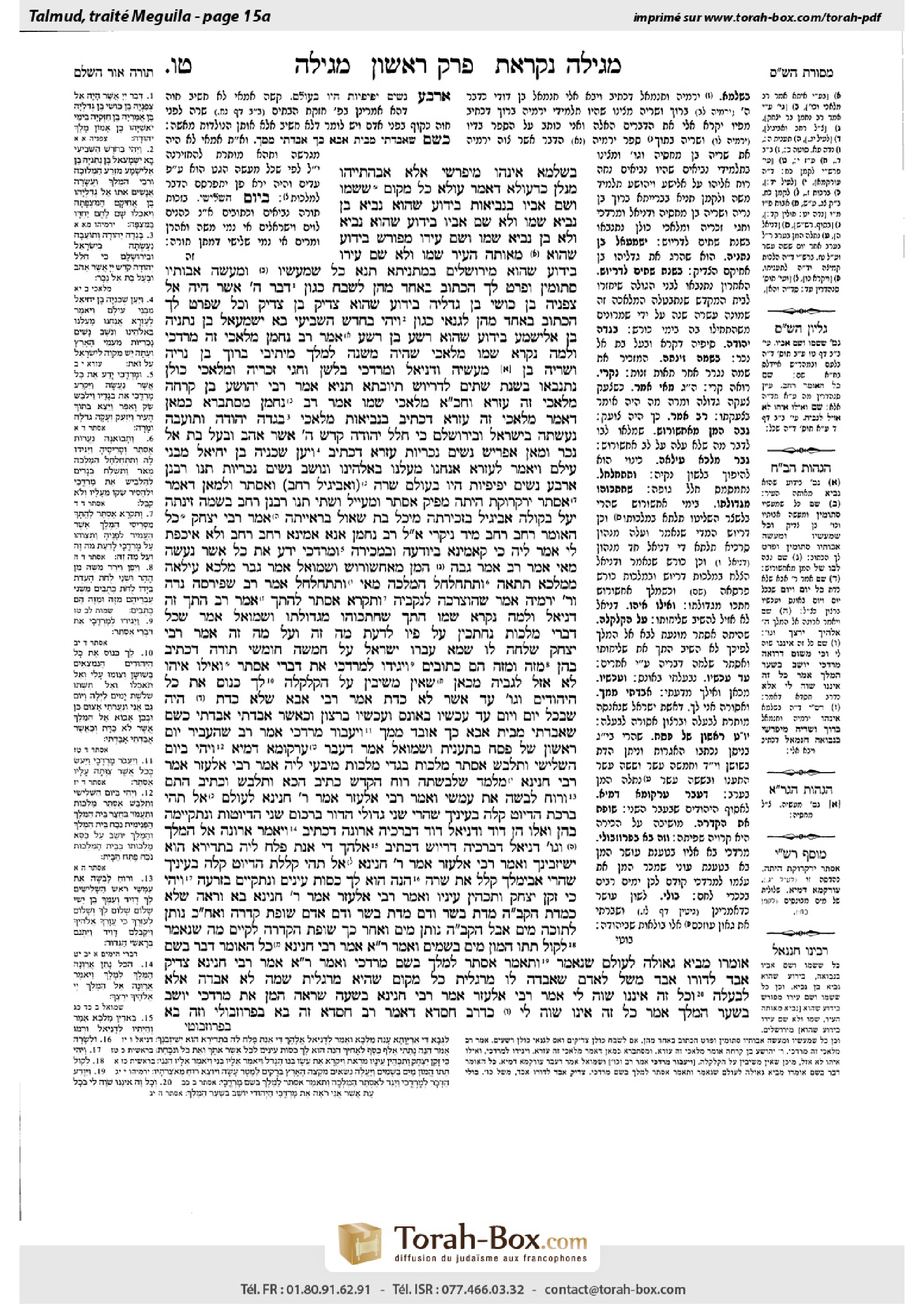
This page of Megillah includes the Aramaic text, an English translation and an AI-generated French translation, alongside the scan above.
מגילה י״ה א · Aramaic and Hebrew text
בִּשְׁלָמָא אִינְהוּ — מִיפָּרְשִׁי, אֶלָּא אֲבָהָתַיְיהוּ מְנָלַן?
כִּדְעוּלָּא. דְּאָמַר עוּלָּא: כׇּל מָקוֹם שֶׁשְּׁמוֹ וְשֵׁם אָבִיו בִּנְבִיאוּת — בְּיָדוּעַ שֶׁהוּא נָבִיא בֶּן נָבִיא. שְׁמוֹ וְלֹא שֵׁם אָבִיו — בְּיָדוּעַ שֶׁהוּא נָבִיא וְלֹא בֶּן נָבִיא, שְׁמוֹ וְשֵׁם עִירוֹ מְפוֹרָשׁ — בְּיָדוּעַ שֶׁהוּא מֵאוֹתָהּ הָעִיר, שְׁמוֹ וְלֹא שֵׁם עִירוֹ — בְּיָדוּעַ שֶׁהוּא מִירוּשָׁלַיִם.
בְּמַתְנִיתָא תָּנָא: כׇּל שֶׁמַּעֲשָׂיו וּמַעֲשֵׂה אֲבוֹתָיו סְתוּמִין, וּפָרַט לְךָ הַכָּתוּב בְּאֶחָד מֵהֶן לְשֶׁבַח, כְּגוֹן: ״דְּבַר ה׳ אֲשֶׁר הָיָה אֶל צְפַנְיָה בֶּן כּוּשִׁי בֶן גְּדַלְיָה״ — בְּיָדוּעַ שֶׁהוּא צַדִּיק בֶּן צַדִּיק. וְכֹל שֶׁפָּרַט לְךָ הַכָּתוּב בְּאֶחָד מֵהֶן לִגְנַאי, כְּגוֹן: ״וַיְהִי בַּחֹדֶשׁ הַשְּׁבִיעִי בָּא יִשְׁמָעֵאל בֶּן נְתַנְיָה בֶּן אֱלִישָׁמָע״ — בְּיָדוּעַ שֶׁהוּא רָשָׁע בֶּן רָשָׁע.
אָמַר רַב נַחְמָן: מַלְאָכִי — זֶה מָרְדֳּכַי, וְלָמָּה נִקְרָא שְׁמוֹ מַלְאָכִי? שֶׁהָיָה מִשְׁנֶה לַמֶּלֶךְ. מֵיתִיבִי: בָּרוּךְ בֶּן נֵרִיָּה וּשְׂרָיָה בֶּן מַעֲשֵׂיָה, וְדָנִיֵּאל וּמׇרְדֳּכַי בִּלְשָׁן וְחַגַּי, זְכַרְיָה וּמַלְאָכִי — כּוּלָּן נִתְנַבְּאוּ בִּשְׁנַת שְׁתַּיִם לְדָרְיָוֶשׁ. תְּיוּבְתָּא.
תַּנְיָא, אָמַר רַבִּי יְהוֹשֻׁעַ בֶּן קׇרְחָה: מַלְאָכִי זֶה עֶזְרָא, וַחֲכָמִים אוֹמְרִים: מַלְאָכִי שְׁמוֹ. אָמַר רַב נַחְמָן: מִסְתַּבְּרָא כְּמַאן דְּאָמַר מַלְאָכִי זֶה עֶזְרָא, דִּכְתִיב בִּנְבִיאוּת מַלְאָכִי: ״בָּגְדָה יְהוּדָה וְתוֹעֵבָה נֶעֶשְׂתָה בְיִשְׂרָאֵל וּבִירוּשָׁלִָם כִּי חִלֵּל יְהוּדָה קֹדֶשׁ ה׳ אֲשֶׁר אָהֵב וּבָעַל בַּת אֵל נֵכָר״.
וּמַאן אַפְרֵישׁ נָשִׁים גּוֹיוֹת — עֶזְרָא, דִּכְתִיב: ״וַיַּעַן שְׁכַנְיָה בֶן יְחִיאֵל מִבְּנֵי עֵילָם וַיֹּאמֶר לְעֶזְרָא אֲנַחְנוּ מָעַלְנוּ בֵאלֹהֵינוּ וַנּוֹשֶׁב נָשִׁים נׇכְרִיּוֹת״.
תָּנוּ רַבָּנַן: אַרְבַּע נָשִׁים יְפֵיפִיּוֹת הָיוּ בָּעוֹלָם: שָׂרָה (וַאֲבִיגַיִל, רָחָב) וְאֶסְתֵּר, וּלְמַאן דְּאָמַר אֶסְתֵּר יְרַקְרוֹקֶת הָיְתָה — מַפֵּיק אֶסְתֵּר וּמְעַיֵּיל וַשְׁתִּי.
תָּנוּ רַבָּנַן: רָחָב בִּשְׁמָהּ זִינְּתָה, יָעֵל — בְּקוֹלָהּ, אֲבִיגַיִל — בִּזְכִירָתָהּ, מִיכַל בַּת שָׁאוּל — בִּרְאִיָּיתָהּ. אָמַר רַבִּי יִצְחָק: כׇּל הָאוֹמֵר ״רָחָב״ ״רָחָב״ — מִיָּד נִיקְרֵי. אָמַר לֵיהּ רַב נַחְמָן: אֲנָא אָמֵינָא ״רָחָב״ ״רָחָב״ וְלָא אִיכְפַּת לִי! אֲמַר לֵיהּ: כִּי קָאָמֵינָא בְּיוֹדְעָהּ וּבְמַכִּירָהּ.
״וּמׇרְדֳּכַי יָדַע אֶת כׇּל אֲשֶׁר נַעֲשָׂה״. מַאי אָמַר? רַב אָמַר: גָּבַהּ הָמָן מֵאֲחַשְׁוֵרוֹשׁ, וּשְׁמוּאֵל אָמַר: גְּבַר מַלְכָּא עִילָּאָה מִמַּלְכָּא תַּתָּאָה.
״וַתִּתְחַלְחַל הַמַּלְכָּה״. מַאי ״וַתִּתְחַלְחַל״? אָמַר רַב: שֶׁפֵּירְסָה נִדָּה, וְרַבִּי יִרְמְיָה אָמַר: שֶׁהוּצְרְכָה לִנְקָבֶיהָ.
״וַתִּקְרָא אֶסְתֵּר לַהֲתָךְ״, אָמַר רַב: הֲתָךְ זֶה דָּנִיאֵל, וְלָמָּה נִקְרָא שְׁמוֹ הֲתָךְ — שֶׁחֲתָכוּהוּ מִגְּדוּלָּתוֹ. וּשְׁמוּאֵל אָמַר: שֶׁכׇּל דִּבְרֵי מַלְכוּת נֶחְתָּכִין עַל פִּיו.
״לָדַעַת מַה זֶּה וְעַל מַה זֶּה״. אָמַר רַבִּי יִצְחָק, שָׁלְחָה לוֹ: שֶׁמָּא עָבְרוּ יִשְׂרָאֵל עַל חֲמִשָּׁה חוּמְשֵׁי תוֹרָה, דִּכְתִיב בָּהֶן: ״מִזֶּה וּמִזֶּה הֵם כְּתוּבִים״.
״וַיַּגִּידוּ לְמׇרְדֳּכָי אֵת דִּבְרֵי אֶסְתֵּר״, וְאִילּוּ אִיהוּ לָא אֲזַל לְגַבֵּיהּ. מִכָּאן שֶׁאֵין מְשִׁיבִין עַל הַקַּלְקָלָה.
״לֵךְ כְּנוֹס אֶת כׇּל הַיְּהוּדִים״ וְגוֹ׳ עַד ״אֲשֶׁר לֹא כַדָּת״, אָמַר רַבִּי אַבָּא: שֶׁלֹּא כַּדָּת הָיָה, שֶׁבְּכׇל יוֹם וָיוֹם עַד עַכְשָׁיו — בְּאוֹנֶס, וְעַכְשָׁיו — בְּרָצוֹן. ״וְכַאֲשֶׁר אָבַדְתִּי אָבָדְתִּי״ — כְּשֵׁם שֶׁאָבַדְתִּי מִבֵּית אַבָּא, כָּךְ אוֹבַד מִמְּךָ.
״וַיַּעֲבוֹר מָרְדֳּכָי״. אָמַר רַב: שֶׁהֶעֱבִיר יוֹם רִאשׁוֹן שֶׁל פֶּסַח בְּתַעֲנִית. וּשְׁמוּאֵל אָמַר: דַּעֲבַר עַרְקוּמָא דְמַיָּא.
״וַיְהִי בַּיּוֹם הַשְּׁלִישִׁי וַתִּלְבַּשׁ אֶסְתֵּר מַלְכוּת״. ״בִּגְדֵי מַלְכוּת״ מִיבְּעֵי לֵיהּ! אָמַר רַבִּי אֶלְעָזָר אָמַר רַבִּי חֲנִינָא: מְלַמֵּד שֶׁלְּבָשַׁתָּה רוּחַ הַקֹּדֶשׁ. כְּתִיב הָכָא: ״וַתִּלְבַּשׁ״, וּכְתִיב הָתָם: ״וְרוּחַ לָבְשָׁה אֶת עֲמָשַׂי״.
וְאָמַר רַבִּי אֶלְעָזָר אָמַר רַבִּי חֲנִינָא: לְעוֹלָם אַל תְּהִי בִּרְכַּת הֶדְיוֹט קַלָּה בְּעֵינֶיךָ, שֶׁהֲרֵי שְׁנֵי גְּדוֹלֵי הַדּוֹר בֵּרְכוּם שְׁנֵי הֶדְיוֹטוֹת, וְנִתְקַיְּימָה בָּהֶן, וְאֵלּוּ הֵן: דָּוִד וְדָנִיֵּאל. דָּוִד — דְּבָרְכֵיהּ אֲרַוְנָה, דִּכְתִיב: ״וַיֹּאמֶר אֲרַוְנָה אֶל הַמֶּלֶךְ וְגוֹ׳״. דָּנִיאֵל — דְּבָרְכֵיהּ דָּרְיָוֶשׁ, דִּכְתִיב: ״אֱלָהָךְ דִּי אַנְתְּ פָּלַח לֵיהּ בִּתְדִירָא הוּא יְשֵׁיזְבִינָּךְ״.
וְאָמַר רַבִּי אֶלְעָזָר אָמַר רַבִּי חֲנִינָא: אֵל תְּהִי קִלְלַת הֶדְיוֹט קַלָּה בְּעֵינֶיךָ, שֶׁהֲרֵי אֲבִימֶלֶךְ קִלֵּל אֶת שָׂרָה ״הִנֵּה הוּא לָךְ כְּסוּת עֵינַיִם״, וְנִתְקַיֵּים בְּזַרְעָהּ: ״וַיְהִי כִּי זָקֵן יִצְחָק וַתִּכְהֶיןָ עֵינָיו״.
וְאָמַר רַבִּי אֶלְעָזָר אָמַר רַבִּי חֲנִינָא: בֹּא וּרְאֵה שֶׁלֹּא כְּמִדַּת הַקָּדוֹשׁ בָּרוּךְ הוּא מִדַּת בָּשָׂר וְדָם. מִדַּת בָּשָׂר וָדָם — אָדָם שׁוֹפֵת קְדֵרָה וְאַחַר כָּךְ נוֹתֵן לְתוֹכָהּ מַיִם, אֲבָל הַקָּדוֹשׁ בָּרוּךְ הוּא — נוֹתֵן מַיִם וְאַחַר כָּךְ שׁוֹפֵת הַקְּדֵרָה, לְקַיֵּים מַה שֶּׁנֶּאֱמַר: ״לְקוֹל תִּתּוֹ הֲמוֹן מַיִם בַּשָּׁמַיִם״.
וְאָמַר רַבִּי אֶלְעָזָר אָמַר רַבִּי חֲנִינָא: כׇּל הָאוֹמֵר דָּבָר בְּשֵׁם אוֹמְרוֹ מֵבִיא גְּאוּלָּה לָעוֹלָם, שֶׁנֶּאֱמַר: ״וַתֹּאמֶר אֶסְתֵּר לַמֶּלֶךְ בְּשֵׁם מׇרְדֳּכָי״.
וְאָמַר רַבִּי אֶלְעָזָר אָמַר רַבִּי חֲנִינָא: צַדִּיק אָבָד — לְדוֹרוֹ אָבַד. מָשָׁל לְאָדָם שֶׁאָבְדָה לוֹ מַרְגָּלִית, כׇּל מָקוֹם שֶׁהִיא — מַרְגָּלִית שְׁמָהּ, לֹא אָבְדָה אֶלָּא לְבַעְלָהּ.
״וְכׇל זֶה אֵינֶנּוּ שֹׁוֶה לִי״. אָמַר רַבִּי אֶלְעָזָר אָמַר רַבִּי חֲנִינָא: בְּשָׁעָה שֶׁרָאָה הָמָן אֶת מׇרְדֳּכַי יוֹשֵׁב בְּשַׁעַר הַמֶּלֶךְ, אָמַר: ״כׇּל זֶה אֵינוֹ שֹׁוֶה לִי״. כִּדְרַב חִסְדָּא, דְּאָמַר רַב חִסְדָּא: זֶה בָּא בִּפְרוֹזְבּוּלֵי וְזֶה בָּא
Megillah 15a · English translation
The Gemara asks in reference to the eight prophets descended from Rahab: Granted, with regard to them, it is explicit, i.e., the four sons recorded in the list were certainly prophets, as the Bible states this explicitly: Jeremiah was a prophet, his student Baruch was one of the sons of the prophets, his cousin Hanamel came to him at the word of God (see Jeremiah, chapter 32), and Seraiah was his student. But as for their fathers, Hilkiah, Neriah, Shallum, and Mahseiah, from where do we derive that they were prophets?
The Gemara answers: As taught by Ulla, as Ulla said: Wherever one’s name and his father’s name are mentioned with regard to prophecy, it is known that he was a prophet the son of a prophet, and therefore his father’s name is also mentioned. And wherever his name is mentioned but not his father’s name, it is known that he was a prophet but not the son of a prophet. Similarly, wherever his name and the name of his city are specified, it is known that he was from that particular city, and wherever his name is mentioned but not the name of his city, it is known that he was from Jerusalem.
It was taught in a baraita: With regard to anyone whose actions and the actions of his ancestors are obscured and not explained, and the verse mentioned one of them favorably, for example, the way in which Zephaniah the prophet is introduced: “The word of the Lord which came to Zephaniah the son of Cushi, the son of Gedaliah” (Zephaniah 1:1), it is known that not only was he a righteous man, he was also the son of a righteous man. And conversely, whenever the verse mentioned one of them unfavorably, for example, in the verse that introduces Ishmael as the one who killed Gedaliah, which states: “And it came to pass in the seventh month that Ishmael the son of Nethaniah, the son of Elishama” (Jeremiah 41:1), it is known that not only was he a wicked man, he was also the son of a wicked man.
Rav Naḥman said: Malachi the prophet is in fact Mordecai, and why was he called Malachi? To indicate that he was second to the king [melekh], as Mordecai was appointed such, as is recorded at the end of the Megilla. The Gemara raises an objection from the following baraita: Baruch, the son of Neriah; Seraiah, the son of Mahseiah; Daniel; Mordecai; Bilshan; Haggai; Zechariah; and Malachi; all prophesied in the second year of the reign of Darius. The fact that the baraita mentions Mordecai and Malachi separately indicates that they were two different people. The Gemara concludes: This is indeed a conclusive refutation.
It is taught in a baraita: Rabbi Yehoshua ben Korḥa said: Malachi is in fact Ezra. And the Rabbis say otherwise: Malachi was his real name, and it was not merely another name for Ezra or another prophet. Rav Naḥman said: It stands to reason that indeed, they are one and the same person, like the opinion of the one who said that Malachi is Ezra, since there is a similarity between them, as it is stated in Malachi’s prophecy: “Judah has dealt treacherously, and a disgusting thing has been done in Israel and in Jerusalem; for Judah has profaned the sanctity of the Lord which he loved, and has married the daughter of a strange god” (Malachi 2:11).
And who was the one that removed the foreign women who were married to Jews? It was Ezra, as it is written: “And Shecaniah the son of Jehiel, one of the sons of Elam, answered and said unto Ezra: We have broken faith with our God, and have married foreign women of the peoples of the land” (Ezra 10:2). It therefore appears that Malachi was one of Ezra’s names, as the Bible describes them both as confronting an intermarriage epidemic.
To complete the discussion about the prophetesses, the Gemara cites a baraita in which the Sages taught: There were four women of extraordinary beauty in the world: Sarah, and Abigail, Rahab, and Esther. And according to the one who said that Esther was greenish in color, lacking natural beauty, only that a cord of divine grace was strung around her, remove Esther from the list and insert Vashti in her place, for she was indeed beautiful.
The Sages taught in a baraita: Rahab aroused impure thoughts by her name, i.e., the mere mention of her name would inspire lust for her; Yael, by her voice; Abigail, by remembering her; Michal, the daughter of Saul, by her appearance. Similarly, Rabbi Yitzḥak said: Anyone who says Rahab, Rahab, immediately experiences a seminal emission due to the arousal of desire caused by Rahab’s great beauty. Rav Naḥman said to him: I say: Rahab, Rahab, and it does not affect me. Rabbi Yitzchak said to Rav Naḥman: When I said this, I was specifically referring to one who knows her personally and recognizes her beauty. Only for one who has met Rahab in person is the mere mention of her name capable of arousing lust.
§ The Gemara returns to its explanation of the verses of the book of Esther. The verse states: “When Mordecai perceived all that was done, Mordecai rent his clothes, and put on sackcloth with ashes, and went out into the midst of the city, and cried with a loud and bitter cry” (Esther 4:1). The Gemara asks: What did Mordecai say when he cried out? Rav said: He said that Haman has risen above Ahasuerus, for he saw that Haman had become even stronger than Ahasuerus himself, and that he controlled all affairs of the empire. And Shmuel said: The upper King has prevailed over the lower king, saying this euphemistically and insinuating just the opposite. In other words, it would appear that Ahasuerus, the lower king, has prevailed over the higher King, God in Heaven, Who desires good for the Jewish people.
The verse states: “Then the queen was exceedingly distressed” [vatitḥalḥal] (Esther 4:4). The Gemara asks: What is the meaning of vatitḥalḥal? Rav said: This means that she began to menstruate out of fear, as the cavities, ḥalalim, of her body opened. And Rabbi Yirmeya said: Her bowels were loosened, also understanding the verse as referring to her bodily cavities.
The verse states: “Then Esther called for Hathach, one of the king’s chamberlains, whom he had appointed to attend upon her” (Esther 4:5). Rav said: Hathach is in fact the prophet Daniel. And why was he called Hathach? Because he was cut down [ḥatakh] from his greatness during Ahasuerus’s reign, as he was demoted from his high position. Previously he had served as a senior minister, and now he had become Esther’s steward. And Shmuel expounded the name Hathach as derived from ḥatakh in the opposite sense, as he said: Daniel was called Hathach because all the affairs of the kingdom were decided [neḥtakhin] by his word.
The verse continues to relate that Esther sent Hathach to Mordecai after hearing about the decree: “To know what this [zeh] was, and why it [zeh] was” (Esther 4:5). Rabbi Yitzḥak said that Esther sent a message to Mordecai, saying: Perhaps the Jews have transgressed the five books of the Torah, as it is written with regard to the two tablets: “On this [zeh] side and on the other [zeh] side were they written” (Exodus 32:15).
The verse states: “And they told Esther’s words to Mordecai” (Esther 4:12), but he, Hathach himself, did not go to tell him directly. The Gemara explains: From here we see that one does not bring back a sad report. If one has nothing positive to say, it is best for him to remain silent. This explains why Hathach himself did not report the information to Mordecai, and Esther’s words had to be delivered by other messengers.
Esther sent a message to Mordecai: “Go, gather together all the Jews who are present in Shushan, and fast for me, and neither eat nor drink for three days, night and day; I also and my maidens will fast likewise, and so will I go in to the king, not according to the custom” (Esther 4:16). Rabbi Abba said: It will not be according to my usual custom, for every day until now when I submitted myself to Ahasuerus it was under compulsion, but now I will be submitting myself to him of my own free will. And Esther further said: “And if I perish, I perish” (Esther 4:16). What she meant was: Just as I was lost to my father’s house ever since I was brought here, so too, shall I be lost to you, for after voluntarily having relations with Ahasuerus, I shall be forever forbidden to you.
There is a dispute with regard to the meaning of the verse: “So Mordecai passed [vaya’avor]” (Esther 4:17). Rav said: This means that he passed the first day of Passover as a fast day, understanding the word vaya’avor in the sense of sin [aveira], as by doing so he transgressed the obligation to rejoice on the Festival. And Shmuel said: It means that he crossed over [avar] a stream in order to bring the message to all.
The verse states: “And it came to pass on the third day, that Esther clothed herself in royalty” (Esther 5:1). The Gemara asks: It should have said: Esther clothed herself in royal garments. Rabbi Elazar said that Rabbi Ḥanina said: This teaches that she clothed herself with a divine spirit of inspiration, as it is written here: “And she clothed herself,” and it is written elsewhere: “And the spirit clothed Amasai” (I Chronicles 12:19). Just as there the reference is to the spirit of divine inspiration, so too here, the term royalty is referring to the spirit of divine inspiration.
Apropos a statement that Rabbi Elazar said that Rabbi Ḥanina said, the Gemara records other such statements: And Rabbi Elazar further said that Rabbi Ḥanina said: One should never regard the blessing of an ordinary person [hedyot] as light in your eyes, as two of the great men of their generations received blessings from ordinary people and those blessings were fulfilled in them. And they were David and Daniel. David, for Araunah blessed him, as it is written: “And Araunah said to the king, May the Lord your God accept you” (II Samuel 24:23), and it was fulfilled. Daniel, for Darius blessed him, as it is written: “Your God Whom you serve continually, He will rescue you” (Daniel 6:17), and this too was fulfilled when Daniel was saved from the lions’ den.
And Rabbi Elazar further said that Rabbi Ḥanina said: One should not regard the curse of an ordinary person as light in your eyes, for Abimelech cursed Sarah, saying: “Behold, it is to you a covering of the eyes to all that are with you” (Genesis 20:16), and indeed this was fulfilled in her descendant, as it is stated: “And it came to pass, that when Isaac was old, and his eyes were dim, so that he could not see” (Genesis 27:1). Abimelech’s curse of covered eyes was fulfilled through her son Isaac’s blindness.
And Rabbi Elazar further said that Rabbi Ḥanina said: Come and see that the attribute of the Holy One, Blessed be He, is unlike the attribute of a man of flesh and blood; for it is the attribute of flesh and blood that a man places the pot on the fire and then puts in the water. However, the Holy One, Blessed be He, first puts in the water and then places the pot on the fire, to fulfill that which is stated: “At the sound of His giving a multitude of waters in the heavens” (Jeremiah 10:13), which he explains as follows: First God set the multitudes of water in place, and afterward He created the heavens to hold the water.
And Rabbi Elazar further said that Rabbi Ḥanina said: Whoever reports a saying in the name of he who said it brings redemption to the world. As it is stated with respect to the incident of Bigthan and Teresh: “And Esther reported it to the king in the name of Mordecai” (Esther 2:22), and this eventually brought redemption, as Mordecai was later rewarded for saving the king’s life, paving the way for the miraculous salvation.
And Rabbi Elazar further said that Rabbi Ḥanina said: When a righteous man passes from this earth and is lost, he is lost only for the rest of his generation, who is now deprived of him, not for the righteous individual himself. This is similar to a man who has lost a pearl. The pearl does not care if it is lost, as wherever it is found, it is still a pearl; it is lost only to its owner.
Haman said: “Yet all this avails me nothing” (Esther 5:13). Rabbi Elazar said that Rabbi Ḥanina said: When Haman saw Mordecai sitting at the king’s gate he said: Yet all this avails me nothing. This may be understood as was suggested by Rav Ḥisda, for Rav Ḥisda said: This one, Mordecai, came as one with the heritage of a rich man [perozebuli], whereas that one, Haman, came
Megillah 15a · Traduction française (IA)
La Guemara demande, au sujet des huit prophètes issus de Rahab : Certes, à leur propos, c’est explicite, c’est-à-dire que les quatre fils mentionnés dans la liste étaient assurément des prophètes, comme le dit explicitement la Bible : Jérémie était prophète, son disciple Baruch était l’un des fils des prophètes, son cousin Hanamel vint le trouver sur l’ordre de Dieu (voir Jérémie, chapitre 32), et Seraiah était son disciple. Mais pour leurs pères, Hilkiah, Neriah, Shallum et Mahseiah, d’où savons-nous qu’ils étaient prophètes ?
La Guemara répond : Comme l’a enseigné Ulla, qui a dit : Chaque fois que le nom d’une personne et celui de son père sont mentionnés à propos de la prophétie, on sait qu’elle était prophète et fils de prophète ; c’est pourquoi le nom de son père est également mentionné. Et chaque fois que son nom est mentionné, mais pas celui de son père, on sait qu’elle était prophète, mais non fils de prophète. De même, lorsque son nom et celui de sa ville sont précisés, on sait qu’elle venait de cette ville ; lorsque son nom est mentionné, mais pas celui de sa ville, on sait qu’elle venait de Jérusalem.
Il a été enseigné dans une baraïta : Pour toute personne dont les actes et ceux de ses ancêtres sont obscurs et ne sont pas explicités, si le verset mentionne favorablement l’un d’eux, par exemple dans la manière dont le prophète Sophonie est présenté : « Parole de l’Éternel qui fut adressée à Sophonie, fils de Cushi, fils de Gedaliah » (Sophonie 1:1), on sait que non seulement il était juste, mais qu’il était aussi fils d’un juste. À l’inverse, chaque fois que le verset mentionne défavorablement l’un d’eux, par exemple dans le verset qui présente Ismaël comme celui qui tua Gedaliah et qui dit : « Et il arriva, au septième mois, qu’Ismaël, fils de Nethaniah, fils d’Elishama » (Jérémie 41:1), on sait que non seulement il était méchant, mais qu’il était aussi fils d’un méchant.
Rav Naḥman a dit : Le prophète Malachie est en réalité Mordecai. Et pourquoi l’appelait-on Malachie ? Pour indiquer qu’il était second après le roi [melekh], car Mordecai fut nommé à cette fonction, comme cela est rapporté à la fin de la Meguila. La Guemara soulève une objection à partir de la baraïta suivante : Baruch, fils de Neriah ; Seraiah, fils de Mahseiah ; Daniel ; Mordecai ; Bilshan ; Haggai ; Zechariah ; et Malachie prophétisèrent tous durant la deuxième année du règne de Darius. Le fait que la baraïta mentionne Mordecai et Malachie séparément indique qu’il s’agissait de deux personnes différentes. La Guemara conclut : Il s’agit bien là d’une réfutation définitive.
Il est enseigné dans une baraïta : Rabbi Yehoshua ben Korḥa a dit : Malachie est en réalité Ezra. Mais les Sages disent le contraire : Malachie était son véritable nom, et non simplement un autre nom d’Ezra ou d’un autre prophète. Rav Naḥman a dit : Il est raisonnable de penser qu’ils sont bien une seule et même personne, conformément à l’opinion de celui qui dit que Malachie est Ezra, car ils ont un point commun, comme il est dit dans la prophétie de Malachie : « Juda a agi avec perfidie, et une abomination a été commise en Israël et à Jérusalem ; car Juda a profané la sainteté de l’Éternel qu’il aimait, et il a épousé la fille d’un dieu étranger » (Malachie 2:11).
Et qui fit renvoyer les femmes étrangères épousées par des Juifs ? Ezra, comme il est écrit : « Shecaniah, fils de Jehiel, l’un des fils d’Elam, prit la parole et dit à Ezra : Nous avons été infidèles à notre Dieu en épousant des femmes étrangères appartenant aux peuples du pays » (Ezra 10:2). Il semble donc que Malachie était l’un des noms d’Ezra, puisque la Bible les décrit tous deux comme intervenant face à une épidémie de mariages mixtes.
Pour achever la discussion sur les prophétesses, la Guemara cite une baraïta dans laquelle les Sages ont enseigné : Il y eut dans le monde quatre femmes d’une beauté extraordinaire : Sarah, Abigail, Rahab et Esther. Et selon celui qui dit qu’Esther avait le teint verdâtre et manquait de beauté naturelle, seule une grâce divine l’entourant comme un fil la rendait belle, il faut retirer Esther de la liste et la remplacer par Vashti, car elle, en effet, était belle.
Les Sages ont enseigné dans une baraïta : Le nom de Rahab suscitait des pensées impures, c’est-à-dire que la simple mention de son nom éveillait le désir de la posséder ; Yael, sa voix ; Abigail, le souvenir d’elle ; et Michal, fille de Saül, son apparence. De même, Rabbi Yitzḥak a dit : Quiconque prononce « Rahab, Rahab » connaît aussitôt une émission séminale, en raison du désir éveillé par la grande beauté de Rahab. Rav Naḥman lui dit : Moi, je dis « Rahab, Rahab », et cela ne me fait rien. Rabbi Yitzḥak dit à Rav Naḥman : Quand j’ai dit cela, je faisais précisément référence à celui qui la connaît personnellement et reconnaît sa beauté. Pour celui qui a rencontré Rahab en personne, la simple mention de son nom peut éveiller le désir.
§ La Guemara revient à son explication des versets du livre d’Esther. Le verset dit : « Lorsque Mordecai eut connaissance de tout ce qui s’était passé, Mordecai déchira ses vêtements, se couvrit d’un sac et de cendres, sortit au milieu de la ville et poussa un grand cri amer » (Esther 4:1). La Guemara demande : Que disait Mordecai en criant ? Rav a dit : Il disait qu’Haman s’était élevé au-dessus d’Assuérus, car il voyait qu’Haman était devenu encore plus puissant qu’Assuérus lui-même et qu’il contrôlait toutes les affaires de l’empire. Et Shmuel a dit : Le Roi d’en haut a triomphé du roi d’en bas, en employant cette formule comme euphémisme et en laissant entendre exactement le contraire. Autrement dit, il semblerait qu’Assuérus, le roi d’en bas, l’ait emporté sur le Roi suprême, Dieu dans les Cieux, qui veut le bien du peuple juif.
Le verset dit : « Alors la reine fut extrêmement bouleversée » [vatitḥalḥal] (Esther 4:4). La Guemara demande : Que signifie vatitḥalḥal ? Rav a dit : Cela signifie qu’elle se mit à avoir ses règles sous l’effet de la peur, car les cavités, ḥalalim, de son corps s’ouvrirent. Et Rabbi Yirmeya a dit : Ses intestins se relâchèrent, lui aussi comprenant le verset comme une référence aux cavités de son corps.
Le verset dit : « Alors Esther appela Hathach, l’un des eunuques du roi, qu’il avait chargé de la servir » (Esther 4:5). Rav a dit : Hathach est en réalité le prophète Daniel. Et pourquoi l’appelait-on Hathach ? Parce qu’il avait été abaissé [ḥatakh] de sa grandeur sous le règne d’Assuérus, puisqu’il avait été rétrogradé de son poste élevé. Auparavant, il avait été un haut dignitaire ; à présent, il était devenu l’intendant d’Esther. Shmuel interpréta le nom Hathach en le faisant dériver de ḥatakh, mais dans le sens contraire, car il a dit : Daniel était appelé Hathach parce que toutes les affaires du royaume étaient tranchées [neḥtakhin] selon sa parole.
Le verset poursuit en rapportant qu’après avoir entendu parler du décret, Esther envoya Hathach auprès de Mordecai : « Pour savoir ce qu’était ceci [zeh], et pourquoi ceci [zeh] était ainsi » (Esther 4:5). Rabbi Yitzḥak a dit qu’Esther envoya un message à Mordecai, disant : Peut-être les Juifs ont-ils transgressé les cinq livres de la Torah, comme il est écrit au sujet des deux tables : « D’un côté [zeh] et de l’autre [zeh] elles étaient écrites » (Exode 32:15).
Le verset dit : « On rapporta à Mordecai les paroles d’Esther » (Esther 4:12), mais Hathach lui-même n’alla pas les lui transmettre directement. La Guemara explique : Nous apprenons de là qu’on ne rapporte pas une mauvaise nouvelle. Si l’on n’a rien de positif à dire, mieux vaut se taire. Cela explique pourquoi Hathach lui-même ne transmit pas l’information à Mordecai et pourquoi les paroles d’Esther durent être portées par d’autres messagers.
Esther envoya un message à Mordecai : « Va, rassemble tous les Juifs qui se trouvent à Suse, jeûnez pour moi, ne mangez ni ne buvez pendant trois jours, nuit et jour ; moi aussi, avec mes servantes, je jeûnerai de même, puis j’irai trouver le roi, à l’encontre de l’usage » (Esther 4:16). Rabbi Abba a dit : Cela sera à l’encontre de mon usage habituel, car jusqu’à présent, chaque jour où je me suis donnée à Assuérus, j’y étais contrainte ; mais cette fois, je me donnerai à lui de mon plein gré. Esther ajouta : « Et si je péris, je péris » (Esther 4:16). Elle voulait dire : De même que j’ai été perdue pour la maison de mon père depuis que j’ai été amenée ici, de même serai-je perdue pour toi, car après avoir eu volontairement des relations avec Assuérus, je te serai interdite à jamais.
Un désaccord porte sur le sens du verset : « Mordecai passa [vaya’avor] » (Esther 4:17). Rav a dit : Cela signifie qu’il fit du premier jour de Pessaḥ un jour de jeûne, comprenant le mot vaya’avor au sens de faute [aveira], car il transgressa ainsi l’obligation de se réjouir pendant la fête. Et Shmuel a dit : Cela signifie qu’il traversa [avar] un cours d’eau afin de porter le message à tous.
Le verset dit : « Le troisième jour, Esther revêtit la royauté » (Esther 5:1). La Guemara demande : Il aurait dû dire : Esther revêtit des habits royaux. Rabbi Elazar a dit au nom de Rabbi Ḥanina : Cela enseigne qu’elle se revêtit d’un esprit d’inspiration divine, comme il est écrit ici : « Elle se revêtit », et comme il est écrit ailleurs : « L’esprit revêtit Amasai » (I Chroniques 12:19). De même que là, il s’agit de l’esprit d’inspiration divine, de même ici, le terme « royauté » désigne l’esprit d’inspiration divine.
À propos d’un propos rapporté par Rabbi Elazar au nom de Rabbi Ḥanina, la Guemara consigne d’autres propos de même nature : Rabbi Elazar a également dit au nom de Rabbi Ḥanina : Il ne faut jamais tenir pour négligeable la bénédiction d’une personne ordinaire [hedyot], car deux grands hommes de leur génération reçurent des bénédictions de personnes ordinaires, et ces bénédictions se réalisèrent pour eux. Il s’agissait de David et de Daniel. David, car Araunah le bénit, comme il est écrit : « Et Araunah dit au roi : Que l’Éternel, ton Dieu, t’agrée » (II Samuel 24:23), et cela se réalisa. Daniel, car Darius le bénit, comme il est écrit : « Ton Dieu, que tu sers sans cesse, te délivrera » (Daniel 6:17) ; cela aussi se réalisa lorsque Daniel fut sauvé de la fosse aux lions.
Rabbi Elazar a également dit au nom de Rabbi Ḥanina : Il ne faut pas tenir pour négligeable la malédiction d’une personne ordinaire, car Abimélec maudit Sarah en disant : « Voici, je te donne un voile sur les yeux pour tous ceux qui sont avec toi » (Genèse 20:16), et cela se réalisa effectivement chez l’un de ses descendants, comme il est dit : « Lorsqu’Isaac fut vieux, ses yeux s’obscurcirent, si bien qu’il ne pouvait plus voir » (Genèse 27:1). La malédiction d’Abimélec, qui souhaitait que ses yeux soient couverts, s’accomplit à travers la cécité de son fils Isaac.
Rabbi Elazar a également dit au nom de Rabbi Ḥanina : Venez voir que la manière d’agir du Saint, béni soit-Il, est différente de celle d’un être humain de chair et de sang. En effet, l’usage d’un être humain est de poser la marmite sur le feu, puis d’y verser l’eau. Mais le Saint, béni soit-Il, verse d’abord l’eau, puis pose la marmite sur le feu, afin d’accomplir ce qui est dit : « Au bruit de l’abondance des eaux qu’Il fait venir dans les cieux » (Jérémie 10:13), ce qu’il explique ainsi : Dieu plaça d’abord les masses d’eau, puis créa les cieux pour les contenir.
Rabbi Elazar a également dit au nom de Rabbi Ḥanina : Quiconque rapporte un enseignement au nom de celui qui l’a énoncé apporte la rédemption au monde. Comme il est dit à propos de l’épisode de Bigthan et Teresh : « Esther le rapporta au roi au nom de Mordecai » (Esther 2:22). Cela apporta finalement la rédemption, car Mordecai fut plus tard récompensé pour avoir sauvé la vie du roi, ouvrant ainsi la voie à une délivrance miraculeuse.
Rabbi Elazar a également dit au nom de Rabbi Ḥanina : Lorsqu’un juste quitte ce monde et disparaît, il ne disparaît que pour le reste de sa génération, qui est désormais privée de lui, et non pour le juste lui-même. Cela ressemble à un homme qui a perdu une perle. La perle ne se soucie pas d’être perdue, car où qu’on la trouve, elle reste une perle ; elle n’est perdue que pour son propriétaire.
Haman a dit : « Mais tout cela ne me sert à rien » (Esther 5:13). Rabbi Elazar a dit au nom de Rabbi Ḥanina : Lorsque Haman vit Mordecai assis à la porte du roi, il dit : « Mais tout cela ne me sert à rien. » On peut comprendre cela comme Rav Ḥisda l’a suggéré, car Rav Ḥisda a dit : Celui-ci, Mordecai, est venu avec l’héritage d’un homme riche [perozebuli], tandis que celui-là, Haman, est venu
Traduction française générée par IA à partir de l’édition anglaise de Sefaria. Vérifie toujours un passage avec le texte source.
Text from Sefaria: William Davidson Edition - Vocalized Aramaic (CC BY NC); William Davidson Edition - English (CC BY NC).