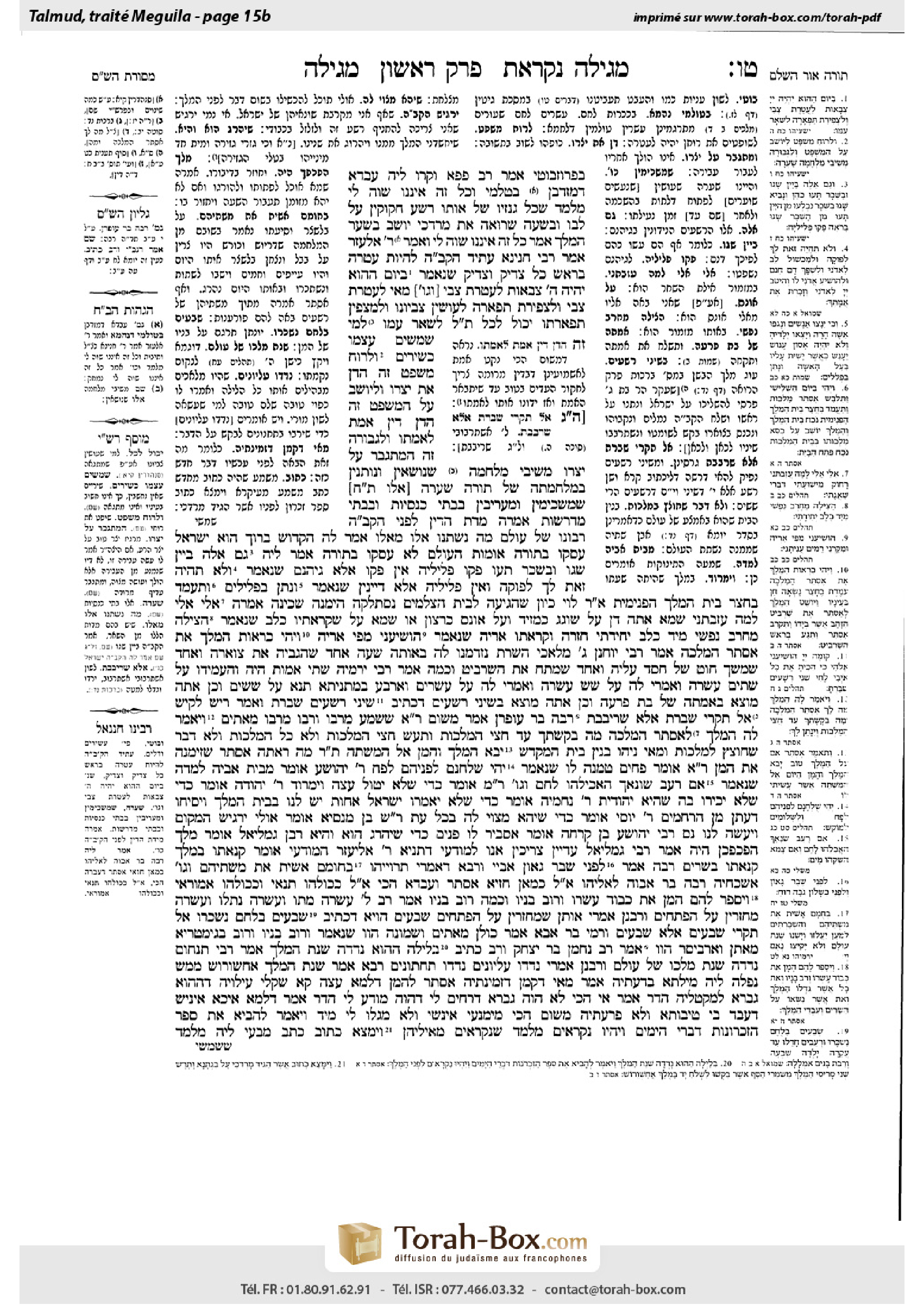
Megillah 15b: Talmud study for Daf Yomi
Daf Yomi is the daily study of one Talmud folio. Explore 37 tractates with scans, Hebrew text, Sefaria English and AI-generated French translations where annotated.
Passage selection and English or AI-generated French translation are available where the scan has annotations. Daf Study is independent of Torah-Box and Sefaria.
Browse Megillah · מגילה · All tractatesMegillah 15b text and translations
This page of Megillah includes the Aramaic text, an English translation and an AI-generated French translation, alongside the scan above.
מגילה י״ה ב · Aramaic and Hebrew text
בִּפְרוֹזְבּוּטֵי. אָמַר רַב פָּפָּא: וְקָרוּ לֵיהּ עַבְדָּא דְּמִזְדַּבַּן בְּטֻלְמֵי.
״וְכׇל זֶה אֵינֶנּוּ שֹׁוֶה לִי״ — מְלַמֵּד שֶׁכׇּל גְּנָזָיו שֶׁל אוֹתוֹ רָשָׁע חֲקוּקִין עַל לִבּוֹ, וּבְשָׁעָה שֶׁרוֹאֶה אֶת מׇרְדֳּכַי יוֹשֵׁב בְּשַׁעַר הַמֶּלֶךְ, אָמַר: כׇּל זֶה אֵינֶנּוּ שֹׁוֶה לִי.
וְאָמַר רַבִּי אֶלְעָזָר אָמַר רַבִּי חֲנִינָא: עָתִיד הַקָּדוֹשׁ בָּרוּךְ הוּא לִהְיוֹת עֲטָרָה בְּרֹאשׁ כׇּל צַדִּיק וְצַדִּיק, שֶׁנֶּאֱמַר: ״בַּיּוֹם הַהוּא יִהְיֶה ה׳ צְבָאוֹת לַעֲטֶרֶת צְבִי [וְגוֹ׳]״. מַאי ״לַעֲטֶרֶת צְבִי וְלִצְפִירַת תִּפְאָרָה״ — לָעוֹשִׂין צִבְיוֹנוֹ וְלַמְצַפִּין תִּפְאַרְתּוֹ. יָכוֹל לַכֹּל — תַּלְמוּד לוֹמַר: ״לִשְׁאָר עַמּוֹ״, לְמִי שֶׁמֵּשִׂים עַצְמוֹ כְּשִׁירַיִם.
״וּלְרוּחַ מִשְׁפָּט״ — זֶה הַדָּן אֶת יִצְרוֹ. ״וְלַיּוֹשֵׁב עַל הַמִּשְׁפָּט״ — זֶה הַדָּן דִּין אֱמֶת לַאֲמִתּוֹ. ״וְלִגְבוּרָה״ — זֶה הַמִּתְגַּבֵּר עַל יִצְרוֹ. ״מְשִׁיבֵי מִלְחָמָה״ — שֶׁנּוֹשְׂאִין וְנוֹתְנִין בְּמִלְחַמְתָּהּ שֶׁל תּוֹרָה. ״שָׁעְרָה״ — [אֵלּוּ תַּלְמִידֵי חֲכָמִים] שֶׁמַּשְׁכִּימִין וּמַעֲרִיבִין בְּבָתֵּי כְנֵסִיּוֹת וּבְבָתֵּי מִדְרָשׁוֹת.
אָמְרָה מִדַּת הַדִּין לִפְנֵי הַקָּדוֹשׁ בָּרוּךְ הוּא: רִבּוֹנוֹ שֶׁל עוֹלָם, מָה נִשְׁתַּנּוּ אֵלּוּ מֵאֵלּוּ? אָמַר לָהּ הַקָּדוֹשׁ בָּרוּךְ הוּא: יִשְׂרָאֵל עָסְקוּ בַּתּוֹרָה, אוּמּוֹת הָעוֹלָם לֹא עָסְקוּ בַּתּוֹרָה.
אֲמַר לֵיהּ: ״גַּם אֵלֶּה בַּיַּיִן שָׁגוּ וּבַשֵּׁכָר תָּעוּ פָּקוּ פְּלִילִיָּה״, אֵין ״פָּקוּ״ אֶלָּא גֵּיהִנָּם, שֶׁנֶּאֱמַר: ״וְלֹא תִהְיֶה זֹאת לְךָ לְפוּקָה״, וְאֵין ״פְּלִילִיָּה״ אֶלָּא דַּיָּינִין, שֶׁנֶּאֱמַר: ״וְנָתַן בִּפְלִילִים״.
״וַתַּעֲמֹד בַּחֲצַר בֵּית הַמֶּלֶךְ הַפְּנִימִית״. אָמַר רַבִּי לֵוִי: כֵּיוָן שֶׁהִגִּיעָה לְבֵית הַצְּלָמִים, נִסְתַּלְּקָה הֵימֶנָּה שְׁכִינָה. אָמְרָה: ״אֵלִי אֵלִי לָמָה עֲזַבְתָּנִי״?! שֶׁמָּא אַתָּה דָּן עַל שׁוֹגֵג כְּמֵזִיד וְעַל אוֹנֶס כְּרָצוֹן?
אוֹ שֶׁמָּא עַל שֶׁקְּרָאתִיו ״כֶּלֶב״, שֶׁנֶּאֱמַר: ״הַצִּילָה מֵחֶרֶב נַפְשִׁי מִיַּד כֶּלֶב יְחִידָתִי״. חָזְרָה וּקְרָאַתּוּ ״אַרְיֵה״, שֶׁנֶּאֱמַר: ״הוֹשִׁיעֵנִי מִפִּי אַרְיֵה״.
״וַיְהִי כִרְאוֹת הַמֶּלֶךְ אֶת אֶסְתֵּר הַמַּלְכָּה״. אָמַר רַבִּי יוֹחָנָן: שְׁלֹשָׁה מַלְאֲכֵי הַשָּׁרֵת נִזְדַּמְּנוּ לָהּ בְּאוֹתָהּ שָׁעָה, אֶחָד שֶׁהִגְבִּיהַּ אֶת צַוָּארָהּ, וְאֶחָד שֶׁמָּשַׁךְ חוּט שֶׁל חֶסֶד עָלֶיהָ, וְאֶחָד שֶׁמָּתַח אֶת הַשַּׁרְבִיט.
וְכַמָּה? אָמַר רַבִּי יִרְמְיָה: שְׁתֵּי אַמּוֹת הָיָה, וְהֶעֱמִידוֹ עַל שְׁתֵּים עֶשְׂרֵה, וְאָמְרִי לַהּ עַל שֵׁשׁ עֶשְׂרֵה, וְאָמְרִי לַהּ עַל עֶשְׂרִים וְאַרְבַּע. בְּמַתְנִיתָא תָּנָא: עַל שִׁשִּׁים, וְכֵן אַתָּה מוֹצֵא בְּאַמָּתָהּ שֶׁל בַּת פַּרְעֹה, וְכֵן אַתָּה מוֹצֵא בְּשִׁינֵּי רְשָׁעִים, דִּכְתִיב: ״שִׁינֵּי רְשָׁעִים שִׁבַּרְתָּ״, וְאָמַר רֵישׁ לָקִישׁ: אַל תִּקְרֵי ״שִׁבַּרְתָּ״ אֶלָּא ״שִׁרְיבַּבְתָּ״. רַבָּה בַּר עוֹפְרָן אָמַר מִשּׁוּם רַבִּי אֶלְעָזָר שֶׁשָּׁמַע מֵרַבּוֹ וְרַבּוֹ מֵרַבּוֹ: מָאתַיִם.
״וַיֹּאמֶר לָהּ הַמֶּלֶךְ לְאֶסְתֵּר הַמַּלְכָּה מַה בַּקָּשָׁתֵךְ עַד חֲצִי הַמַּלְכוּת וְתֵעָשׂ״. חֲצִי הַמַּלְכוּת וְלֹא כׇּל הַמַּלְכוּת, וְלֹא דָּבָר שֶׁחוֹצֵץ לַמַּלְכוּת, וּמַאי נִיהוּ — בִּנְיַן בֵּית הַמִּקְדָּשׁ.
״יָבֹא הַמֶּלֶךְ וְהָמָן אֶל הַמִּשְׁתֶּה״. תָּנוּ רַבָּנַן: מָה רָאֲתָה אֶסְתֵּר שֶׁזִּימְּנָה אֶת הָמָן? רַבִּי אֶלְעָזָר אוֹמֵר: פַּחִים טָמְנָה לוֹ, שֶׁנֶּאֱמַר: ״יְהִי שֻׁלְחָנָם לִפְנֵיהֶם לְפָח״.
רַבִּי יְהוֹשֻׁעַ אוֹמֵר: מִבֵּית אָבִיהָ לָמְדָה, שֶׁנֶּאֱמַר: ״אִם רָעֵב שׂוֹנַאֲךָ הַאֲכִילֵהוּ לֶחֶם וְגוֹ׳״. רַבִּי מֵאִיר אוֹמֵר: כְּדֵי שֶׁלֹּא יִטּוֹל עֵצָה וְיִמְרוֹד.
רַבִּי יְהוּדָה אוֹמֵר: כְּדֵי שֶׁלֹּא יַכִּירוּ בָּהּ שֶׁהִיא יְהוּדִית. רַבִּי נְחֶמְיָה אוֹמֵר: כְּדֵי שֶׁלֹּא יֹאמְרוּ יִשְׂרָאֵל: אָחוֹת יֵשׁ לָנוּ בְּבֵית הַמֶּלֶךְ, וְיַסִּיחוּ דַּעְתָּן מִן הָרַחֲמִים. רַבִּי יוֹסֵי אוֹמֵר: כְּדֵי שֶׁיְּהֵא מָצוּי לָהּ בְּכׇל עֵת. רַבִּי שִׁמְעוֹן בֶּן מְנַסְיָא אוֹמֵר: אוּלַי יַרְגִּישׁ הַמָּקוֹם וְיַעֲשֶׂה לָנוּ נֵס.
רַבִּי יְהוֹשֻׁעַ בֶּן קׇרְחָה אוֹמֵר: אַסְבִּיר לוֹ פָּנִים כְּדֵי שֶׁיֵּהָרֵג הוּא וְהִיא. רַבָּן גַּמְלִיאֵל אוֹמֵר: מֶלֶךְ הֲפַכְפְּכָן הָיָה. אָמַר רַבִּי גַּמְלִיאֵל: עֲדַיִין צְרִיכִין אָנוּ לַמּוֹדָעִי, דְּתַנְיָא, רַבִּי אֱלִיעֶזֶר הַמּוֹדָעִי אוֹמֵר: קִנְּאַתּוּ בַּמֶּלֶךְ קִנְּאַתּוּ בַּשָּׂרִים.
רַבָּה אָמַר: ״לִפְנֵי שֶׁבֶר גָּאוֹן״. אַבָּיֵי וְרָבָא דְּאָמְרִי תַּרְוַיְיהוּ: ״בְּחוּמָּם אָשִׁית אֶת מִשְׁתֵּיהֶם וְגוֹ׳״. אַשְׁכְּחֵיהּ רַבָּה בַּר אֲבוּהּ לְאֵלִיָּהוּ, אֲמַר לֵיהּ: כְּמַאן חַזְיָא אֶסְתֵּר וַעֲבַדָא הָכִי? אֲמַר לֵיהּ: כְּכוּלְּהוּ תַּנָּאֵי וּכְכוּלְּהוּ אָמוֹרָאֵי.
״וַיְסַפֵּר לָהֶם הָמָן אֶת כְּבוֹד עׇשְׁרוֹ וְרוֹב בָּנָיו״, וְכַמָּה רוֹב בָּנָיו? אָמַר רַב, שְׁלֹשִׁים: עֲשָׂרָה מֵתוּ, וַעֲשָׂרָה נִתְלוּ, וַעֲשָׂרָה מְחַזְּרִין עַל הַפְּתָחִים.
וְרַבָּנַן אָמְרִי: אוֹתָן שֶׁמְּחַזְּרִין עַל הַפְּתָחִים שִׁבְעִים הָיוּ, דִּכְתִיב: ״שְׂבֵעִים בַּלֶּחֶם נִשְׂכָּרוּ״, אַל תִּקְרֵי ״שְׂבֵעִים״ אֶלָּא ״שִׁבְעִים״.
וְרָמֵי בַּר אַבָּא אָמַר: כּוּלָּן מָאתַיִם וּשְׁמוֹנָה הֲווֹ, שֶׁנֶּאֱמַר: ״וְרוֹב בָּנָיו״. ״וְרוֹב״ בְּגִימַטְרִיָּא מָאתַן וְאַרְבֵּיסַר הָווּ! אָמַר רַב נַחְמָן בַּר יִצְחָק: ״וְרֹב״ כְּתִיב.
״בַּלַּיְלָה הַהוּא נָדְדָה שְׁנַת הַמֶּלֶךְ״. אָמַר רַבִּי תַּנְחוּם: נָדְדָה שְׁנַת מַלְכּוֹ שֶׁל עוֹלָם. וְרַבָּנַן אָמְרִי: נָדְדוּ עֶלְיוֹנִים, נָדְדוּ תַּחְתּוֹנִים. רָבָא אָמַר: שְׁנַת הַמֶּלֶךְ אֲחַשְׁוֵרוֹשׁ מַמָּשׁ.
נְפַלָה לֵיהּ מִילְּתָא בְּדַעְתֵּיהּ, אָמַר: מַאי דְּקַמַּן דְּזַמֵּינְתֵּיהּ אֶסְתֵּר לְהָמָן? דִּלְמָא עֵצָה קָא שָׁקְלִי עִילָּוֵיהּ דְּהָהוּא גַּבְרָא לְמִקְטְלֵיהּ. הֲדַר אָמַר: אִי הָכִי, לָא הֲוָה גַּבְרָא דְּרָחֵים לִי דַּהֲוָה מוֹדַע לִי? הֲדַר אָמַר: דִּלְמָא אִיכָּא אִינִישׁ דַּעֲבַד בִּי טֵיבוּתָא וְלָא פְּרַעְתֵּיהּ, מִשּׁוּם הָכִי מִימַּנְעִי אִינָשֵׁי וְלָא מְגַלּוּ לִי, מִיָּד: ״וַיֹּאמֶר לְהָבִיא אֶת סֵפֶר הַזִּכְרוֹנוֹת דִּבְרֵי הַיָּמִים״.
״וַיִּהְיוּ נִקְרָאִים״ — מְלַמֵּד שֶׁנִּקְרָאִים מֵאֵילֵיהֶן. ״וַיִּמָּצֵא כָתוּב״ — ״כְּתָב״ מִבְּעֵי לֵיהּ? מְלַמֵּד
Megillah 15b · English translation
as one with the heritage of a poor man [perozeboti], as Mordecai had been Haman’s slave master and was aware of Haman’s lowly lineage. Rav Pappa said: And he was called: The slave who was sold for a loaf of bread.
Haman’s previously quoted statement: “Yet all this avails me nothing” (Esther 5:13), teaches that all the treasures of that wicked one were engraved on his heart, and when he saw Mordecai sitting at the king’s gate, he said: As long as Mordecai is around, all this that I wear on my heart avails me nothing.
And Rabbi Elazar further said that Rabbi Ḥanina said: In the future, the Holy One, Blessed be He, will be a crown on the head of each and every righteous man. As it is stated: “In that day shall the Lord of hosts be for a crown of glory, and for a diadem of beauty, to the residue of His people” (Isaiah 28:5). What is the meaning of “for a crown of glory [tzevi], and for a diadem [velitzefirat] of beauty”? A crown for those that do His will [tzivyono] and a diadem for those that await [velamtzapin] His glory. One might have thought that this extends to all such individuals. Therefore, the verse states: “To the residue of his people,” to whoever regards himself as a remainder, i.e., small and unimportant like residue. But whoever holds himself in high esteem will not merit this.
Apropos the quotation from Isaiah, the Gemara explains the following verse, which states: “And for a spirit of justice to him that sits in judgment and for strength to them that turn back the battle to the gate” (Isaiah 28:6). “And for a spirit of justice”; this is referring to one who brings his evil inclination to trial and forces himself to repent. “To him that sits in judgment”; this is referring to one who judges an absolutely true judgment. “And for strength”; this is referring to one who triumphs over his evil inclination. “Them that turn back the battle”; this is referring to those that give and take in their discussion of halakha in the battle of understanding the Torah. “To the gate”; this is referring to the Torah scholars who arrive early and stay late at the darkened gates of the synagogues and study halls.
The Gemara continues with an episode associated with a verse in Isaiah. The Attribute of Justice said before the Holy One, Blessed be He: Master of the Universe, how are these, referring to the Jewish people, different from those, the other nations of the world, such that God performs miracles only on behalf of the Jewish people? The Holy One, Blessed be He, said to it: The Jewish people occupied themselves with Torah, whereas the other nations of the world did not occupy themselves with Torah.
The Attribute of Justice said to Him: “These also reel through wine, and stagger through strong drink; the priest and the prophet reel through strong drink, they are confused because of wine, they stagger because of strong drink; they reel in vision, they stumble [paku] in judgment [peliliyya]” (Isaiah 28:7). The word paku in this context is referring only to Gehenna, as it is stated: “That this shall not be a cause of stumbling [puka] to you” (I Samuel 25:31), and the word peliliyya here is referring only to judges, as it is stated: “And he shall pay as the judges determine [bifelilim]” (Exodus 21:22). The response of the Attribute of Justice was essentially that the Jewish people have also sinned and are consequently liable to receive punishment.
§ The Gemara returns to its explanation of the verses of the Megilla. The verse states with regard to Esther: “And she stood in the inner court of the king’s house” (Esther 5:1). Rabbi Levi said: Once she reached the chamber of the idols, which was in the inner court, the Divine Presence left her. She immediately said: “My God, my God, why have You forsaken me?” (Psalms 22:2). Perhaps it is because You judge an unintentional sin as one performed intentionally, and an action done due to circumstances beyond one’s control as one done willingly.
Or perhaps You have left me because in my prayers I called Haman a dog, as it is stated: “Deliver my soul from the sword; my only one from the hand of the dog” (Psalms 22:21). She at once retracted and called him in her prayers a lion, as it is stated in the following verse: “Save me from the lion’s mouth” (Psalms 22:22).
The verse states: “And so it was, that when the king saw Esther the queen standing in the court, that she obtained favor in his sight; and the king held out to Esther the golden scepter that was in his hand” (Esther 5:2). Rabbi Yoḥanan said: Three ministering angels happened to join her at that time: One that raised up her neck, so that she could stand erect, free of shame; one that strung a cord of divine grace around her, endowing her with charm and beauty; and one that stretched the king’s scepter.
How much was it stretched? Rabbi Yirmeya said: The scepter was two cubits, and he made it twelve cubits. And some say that he made it sixteen cubits, and yet others say twenty-four cubits. It was taught in a baraita: He made it sixty cubits. And similarly you find with the arm of Pharaoh’s daughter, which she stretched out to take Moshe. And so too, you find with the teeth of the wicked, as it is written: “You have broken the teeth of the wicked” (Psalms 3:8), with regard to which Reish Lakish said: Do not read it as “You have broken [shibbarta],” but as: You have enlarged [sheribavta]. Rabba bar Oferan said in the name of Rabbi Elazar, who heard it from his teacher, who in turn heard it from his teacher: The scepter was stretched two hundred cubits.
The verse states: “Then the king said to her” (Esther 5:3), to Esther the queen, “What is your wish, even to half the kingdom, it shall be performed” (Esther 5:6). The Gemara comments that Ahasuerus intended only a limited offer: Only half the kingdom, but not the whole kingdom, and not something that would serve as a barrier to the kingdom, as there is one thing to which the kingdom will never agree. And what is that? The building of the Temple; if that shall be your wish, realize that it will not be fulfilled.
The verse states that Esther requested: “If it seem good unto the king, let the king and Haman come this day to the banquet that I have prepared for him” (Esther 5:4). The Sages taught in a baraita: What did Esther see to invite Haman to the banquet? Rabbi Elazar says: She hid a snare for him, as it is stated: “Let their table become a snare before them” (Psalms 69:23), as she assumed that she would be able to trip up Haman during the banquet.
Rabbi Yehoshua says: She learned to do this from the Jewish teachings of her father’s house, as it is stated: “If your enemy be hungry, give him bread to eat” (Proverbs 25:21). Rabbi Meir says: She invited him in order that he be near her at all times, so that he would not take counsel and rebel against Ahasuerus when he discovered that the king was angry with him.
Rabbi Yehuda says: She invited Haman so that it not be found out that she was a Jew, as had she distanced him, he would have become suspicious. Rabbi Neḥemya says: She did this so that the Jewish people would not say: We have a sister in the king’s house, and consequently neglect their prayers for divine mercy. Rabbi Yosei says: She acted in this manner, so that Haman would always be on hand for her, as that would enable her to find an opportunity to cause him to stumble before the king. Rabbi Shimon ben Menasya said that Esther said to herself: Perhaps the Omnipresent will take notice that all are supporting Haman and nobody is supporting the Jewish people, and He will perform for us a miracle.
Rabbi Yehoshua ben Korḥa says: She said to herself: I will act kindly toward him and thereby bring the king to suspect that we are having an affair; she did so in order that both he and she would be killed. Essentially, Esther was willing to be killed with Haman in order that the decree would be annulled. Rabban Gamliel says: Ahasuerus was a fickle king, and Esther hoped that if he saw Haman on multiple occasions, eventually he would change his opinion of him. Rabban Gamliel said: We still need the words of Rabbi Eliezer HaModa’i to understand why Esther invited Haman to her banquet. As it is taught in a baraita: Rabbi Eliezer HaModa’i says: She made the king jealous of him and she made the other ministers jealous of him, and in this way she brought about his downfall.
Rabba says: Esther invited Haman to her banquet in order to fulfill that which is stated: “Pride goes before destruction” (Proverbs 16:18), which indicates that in order to destroy the wicked, one must first bring them to pride. It can be understood according to Abaye and Rava, who both say that she invited Haman in order to fulfill the verse: “When they are heated, I will make feasts for them, and I will make them drunk, that they may rejoice, and sleep a perpetual sleep” (Jeremiah 51:39). The Gemara relates that Rabba bar Avuh once happened upon Elijah the Prophet and said to him: In accordance with whose understanding did Esther see fit to act in this manner? What was the true reason behind her invitation? He, Elijah, said to him: Esther was motivated by all the reasons previously mentioned and did so for all the reasons previously stated by the tanna’im and all the reasons stated by the amora’im.
The verse states: “And Haman recounted to them the glory of his riches, and the multitude of his sons” (Esther 5:11). The Gemara asks: And how many sons did he in fact have that are referred to as “the multitude of his sons”? Rav said: There were thirty sons; ten of them died in childhood, ten of them were hanged as recorded in the book of Esther, and ten survived and were forced to beg at other people’s doors.
And the Rabbis say: Those that begged at other people’s doors numbered seventy, as it is written: “Those that were full, have hired themselves out for bread” (I Samuel 2:5). Do not read it as: “Those that were full” [seve’im]; rather, read it as seventy [shivim], indicating that there were seventy who “hired themselves out for bread.”
And Rami bar Abba said: All of Haman’s sons together numbered two hundred and eight, as it is stated: “And the multitude [verov] of his sons.” The numerical value of the word verov equals two hundred and eight, alluding to the number of his sons. The Gemara comments: But in fact, the numerical value [gimatriyya] of the word verov equals two hundred and fourteen, not two hundred and eight. Rav Naḥman bar Yitzḥak said: The word verov is written in the Bible without the second vav, and therefore its numerical value equals two hundred and eight.
The verse states: “On that night the sleep of the king was disturbed” (Esther 6:1). Rabbi Tanḥum said: The verse alludes to another king who could not sleep; the sleep of the King of the universe, the Holy One, Blessed be He, was disturbed. And the Sages say: The sleep of the higher ones, the angels, was disturbed, and the sleep of the lower ones, the Jewish people, was disturbed. Rava said: This should be understood literally: The sleep of King Ahasuerus was disturbed.
And this was the reason Ahasuerus could not sleep: A thought occurred to him and he said to himself: What is this before us that Esther has invited Haman? Perhaps they are conspiring against that man, i.e., against me, to kill him. He then said again to himself: If this is so, is there no man who loves me and would inform me of this conspiracy? He then said again to himself: Perhaps there is some man who has done a favor for me and I have not properly rewarded him, and due to that reason people refrain from revealing to me information regarding such plots, as they see no benefit for themselves. Immediately afterward, the verse states: “And he commanded the book of remembrances of the chronicles to be brought” (Esther 6:1).
The verse states: “And they were read before the king” (Esther 6:1). The Gemara explains that this passive form: “And they were read,” teaches that they were read miraculously by themselves. It further says: “And it was found written [katuv]” (Esther 6:2). The Gemara asks: Why does the Megilla use the word katuv, which indicates that it was newly written? It should have said: A writing [ketav] was found, which would indicate that it had been written in the past. The Gemara explains: This teaches
Megillah 15b · Traduction française (IA)
comme quelqu’un issu de la famille d’un pauvre [perozeboti], puisque Mordekhaï avait été le maître d’Haman, son esclave, et connaissait la basse extraction de celui-ci. Rav Pappa dit : On l’appelait aussi « l’esclave vendu pour un pain ».
La déclaration d’Haman citée précédemment : « Pourtant, tout cela ne me sert à rien » (Esther 5:13), enseigne que tous les trésors de ce méchant étaient gravés sur son cœur. Lorsqu’il vit Mordekhaï assis à la porte du roi, il dit : « Tant que Mordekhaï est là, tout ce que je porte gravé sur mon cœur ne me sert à rien. »
Et Rabbi Elazar dit encore au nom de Rabbi Ḥanina : À l’avenir, le Saint, béni soit-Il, sera une couronne sur la tête de chacun des justes. Comme il est dit : « En ce jour, l’Éternel des armées sera une couronne de gloire et un diadème de beauté pour le reste de Son peuple » (Isaïe 28:5). Que signifient « une couronne de gloire [tzevi] et un diadème [velitzefirat] de beauté » ? Une couronne pour ceux qui font Sa volonté [tzivyono], et un diadème pour ceux qui attendent [velamtzapin] Sa gloire. On aurait pu penser que cela s’applique à tous ceux qui répondent à ces critères. C’est pourquoi le verset précise : « Pour le reste de Son peuple », c’est-à-dire pour celui qui se considère comme un reste, petit et insignifiant comme un résidu. Mais celui qui s’estime hautement n’en sera pas digne.
À propos de cette citation d’Isaïe, la Guemara explique le verset suivant : « Et un esprit de justice pour celui qui siège en jugement, et une force pour ceux qui repoussent la bataille jusqu’à la porte » (Isaïe 28:6). « Et un esprit de justice » désigne celui qui traduit son mauvais penchant en justice et se contraint à se repentir. « Pour celui qui siège en jugement » désigne celui qui rend un jugement parfaitement juste. « Et une force » désigne celui qui triomphe de son mauvais penchant. « Ceux qui repoussent la bataille » désigne ceux qui échangent des arguments dans leur étude de la halakha, dans la bataille que constitue la compréhension de la Torah. « Jusqu’à la porte » désigne les érudits de la Torah qui arrivent tôt et restent tard aux portes obscures des synagogues et des maisons d’étude pour étudier.
La Guemara poursuit avec un épisode lié à un verset d’Isaïe. L’Attribut de justice dit au Saint, béni soit-Il : « Maître de l’univers, en quoi ceux-ci, c’est-à-dire le peuple juif, sont-ils différents de ceux-là, les autres nations du monde, pour que Dieu n’accomplisse des miracles qu’en faveur du peuple juif ? » Le Saint, béni soit-Il, lui répondit : « Le peuple juif s’est consacré à la Torah, tandis que les autres nations du monde ne s’y sont pas consacrées. »
L’Attribut de justice lui dit : « Ceux-ci aussi titubent à cause du vin et chancellent à cause des boissons fortes ; le prêtre et le prophète titubent à cause des boissons fortes, ils sont désorientés par le vin, ils chancellent à cause des boissons fortes ; ils titubent dans leurs visions, ils trébuchent [paku] dans leurs jugements [peliliyya] » (Isaïe 28:7). Ici, le mot paku ne désigne que la Géhenne, comme il est dit : « Que cela ne soit pas pour toi une cause de chute [puka] » (I Samuel 25:31) ; et le mot peliliyya ne désigne ici que les juges, comme il est dit : « Il paiera selon la décision des juges [bifelilim] » (Exode 21:22). La réponse de l’Attribut de justice revenait à dire que le peuple juif avait lui aussi péché et était donc passible de punition.
§ La Guemara revient à son explication des versets de la Meguila. À propos d’Esther, le verset dit : « Elle se tint dans la cour intérieure du palais du roi » (Esther 5:1). Rabbi Levi dit : Lorsqu’elle atteignit la salle des idoles, qui se trouvait dans la cour intérieure, la Présence divine la quitta. Elle dit aussitôt : « Mon Dieu, mon Dieu, pourquoi m’as-Tu abandonnée ? » (Psaumes 22:2). « Peut-être est-ce parce que Tu considères un péché involontaire comme s’il avait été commis volontairement, et un acte accompli en raison de circonstances indépendantes de ma volonté comme s’il avait été accompli de plein gré. »
« Ou peut-être m’as-Tu abandonnée parce que, dans mes prières, j’ai traité Haman de chien, comme il est dit : “Délivre mon âme de l’épée, ma vie unique de la patte du chien” » (Psaumes 22:21). Elle se reprit aussitôt et, dans ses prières, le qualifia de lion, comme il est dit dans le verset suivant : « Sauve-moi de la gueule du lion » (Psaumes 22:22).
Le verset dit : « Et il arriva que, lorsque le roi vit la reine Esther debout dans la cour, elle trouva grâce à ses yeux ; et le roi tendit vers Esther le sceptre d’or qu’il tenait à la main » (Esther 5:2). Rabbi Yoḥanan dit : Trois anges de service se présentèrent alors auprès d’elle : l’un redressa son cou, afin qu’elle puisse se tenir droite, sans honte ; un autre lui passa un fil de grâce divine, lui conférant charme et beauté ; et le troisième allongea le sceptre du roi.
De combien fut-il allongé ? Rabbi Yirmeya dit : Le sceptre mesurait deux coudées, et il le fit passer à douze coudées. Certains disent qu’il le fit passer à seize coudées, d’autres à vingt-quatre coudées. Une baraïta enseigne : Il le fit passer à soixante coudées. De même, on trouve le cas de la fille de Pharaon, qui tendit le bras pour prendre Moché. Et l’on trouve aussi le cas des dents des méchants, comme il est écrit : « Tu as brisé les dents des méchants » (Psaumes 3:8), au sujet duquel Reish Lakish dit : Ne lis pas « Tu as brisé [shibbarta] », mais « Tu as agrandi [sheribavta] ». Rabba bar Oferan dit au nom de Rabbi Elazar, qui l’avait entendu de son maître, lequel l’avait à son tour entendu de son maître : Le sceptre fut allongé à deux cents coudées.
Le verset dit : « Alors le roi lui dit » (Esther 5:3), à la reine Esther : « Quelle est ta demande ? Même jusqu’à la moitié du royaume, elle te sera accordée » (Esther 5:6). La Guemara fait remarquer qu’Assuérus ne lui faisait qu’une offre limitée : jusqu’à la moitié du royaume, mais pas le royaume tout entier, ni quoi que ce soit qui ferait obstacle au royaume, car il y a une chose à laquelle le royaume ne consentira jamais. Laquelle ? La construction du Temple ; si c’est ce que tu demandes, sache que cela ne sera pas accordé.
Le verset rapporte la demande d’Esther : « Si le roi le juge bon, que le roi et Haman viennent aujourd’hui au banquet que j’ai préparé pour lui » (Esther 5:4). Les Sages enseignent dans une baraïta : Pourquoi Esther a-t-elle invité Haman au banquet ? Rabbi Elazar dit : Elle lui tendit un piège, comme il est dit : « Que leur table devienne un piège devant eux » (Psaumes 69:23), car elle pensait pouvoir faire trébucher Haman au cours du banquet.
Rabbi Yehoshua dit : Elle avait appris cela des enseignements juifs de la maison de son père, comme il est dit : « Si ton ennemi a faim, donne-lui du pain à manger » (Proverbes 25:21). Rabbi Meir dit : Elle l’invita afin qu’il reste constamment près d’elle et ne puisse ainsi comploter ni se rebeller contre Assuérus lorsqu’il découvrirait que le roi était en colère contre lui.
Rabbi Yehuda dit : Elle invita Haman afin que l’on ne découvre pas qu’elle était juive, car, si elle avait gardé ses distances avec lui, il aurait commencé à se méfier. Rabbi Neḥemya dit : Elle fit cela pour que le peuple juif ne dise pas : « Nous avons une sœur au palais du roi », et ne néglige donc pas ses prières pour implorer la miséricorde divine. Rabbi Yosei dit : Elle agit ainsi pour qu’Haman soit toujours à sa portée, ce qui lui permettrait de trouver une occasion de le faire trébucher devant le roi. Rabbi Shimon ben Menasya dit qu’Esther se dit : « Peut-être le Tout-Puissant remarquera-t-Il que tous soutiennent Haman et que personne ne soutient le peuple juif, et accomplira-t-Il pour nous un miracle. »
Rabbi Yehoshua ben Korḥa dit : Elle se dit : « Je vais me montrer bienveillante envers lui et amener ainsi le roi à soupçonner que nous avons une liaison » ; elle agit ainsi afin que lui et elle soient tous deux tués. En substance, Esther était prête à mourir avec Haman pour que le décret soit annulé. Rabban Gamliel dit : Assuérus était un roi versatile, et Esther espérait que, s’il voyait Haman à plusieurs reprises, il finirait par changer d’opinion à son sujet. Rabban Gamliel dit : Il nous faut encore l’explication de Rabbi Eliezer HaModa’i pour comprendre pourquoi Esther invita Haman à son banquet. Car une baraïta enseigne : Rabbi Eliezer HaModa’i dit : Elle rendit le roi jaloux de Haman et les autres ministres jaloux de lui, et c’est ainsi qu’elle provoqua sa chute.
Rabba dit : Esther invita Haman à son banquet afin d’accomplir ce qui est dit : « L’orgueil précède la ruine » (Proverbes 16:18), ce qui indique que, pour détruire les méchants, il faut d’abord les rendre orgueilleux. Cela peut se comprendre à la lumière des propos d’Abaye et de Rava, qui disent tous deux qu’elle invita Haman afin d’accomplir le verset : « Quand ils seront échauffés, je leur préparerai des festins et les enivrerai, afin qu’ils se réjouissent et s’endorment d’un sommeil éternel » (Jérémie 51:39). La Guemara rapporte que Rabba bar Avuha rencontra un jour Élie le Prophète et lui demanda : « Selon quelle explication Esther a-t-elle jugé bon d’agir ainsi ? Quelle était la véritable raison de son invitation ? » Élie lui répondit : « Esther était motivée par toutes les raisons déjà mentionnées et agit pour toutes les raisons précédemment avancées par les tannaïm et par les amoraïm. »
Le verset dit : « Haman leur raconta la gloire de ses richesses et le nombre de ses fils » (Esther 5:11). La Guemara demande : Combien de fils avait-il réellement, ceux que désigne l’expression « le nombre de ses fils » ? Rav dit : Il en avait trente ; dix moururent en bas âge, dix furent pendus, comme le rapporte le livre d’Esther, et dix survécurent et furent réduits à mendier aux portes des maisons d’autrui.
Les Sages disent : Ceux qui mendiaient aux portes des maisons d’autrui étaient au nombre de soixante-dix, comme il est écrit : « Ceux qui étaient rassasiés se louent pour du pain » (I Samuel 2:5). Ne lis pas « ceux qui étaient rassasiés » [seve’im], mais « soixante-dix » [shivim], ce qui indique qu’ils étaient soixante-dix à « se louer pour du pain ».
Et Rami bar Abba dit : Tous les fils d’Haman réunis étaient au nombre de deux cent huit, comme il est dit : « Et le nombre [verov] de ses fils ». La valeur numérique du mot verov est de deux cent huit, ce qui fait allusion au nombre de ses fils. La Guemara fait remarquer que, de fait, la valeur numérique [gimatriyya] du mot verov est de deux cent quatorze, et non de deux cent huit. Rav Naḥman bar Yitzḥak dit : Dans la Bible, le mot verov s’écrit sans le second vav ; sa valeur numérique est donc de deux cent huit.
Le verset dit : « Cette nuit-là, le sommeil du roi fut troublé » (Esther 6:1). Rabbi Tanḥum dit : Le verset fait allusion à un autre roi qui ne put dormir : le sommeil du Roi de l’univers, le Saint, béni soit-Il, fut troublé. Les Sages disent : Le sommeil des êtres d’en haut, les anges, fut troublé, et celui des êtres d’en bas, le peuple juif, le fut également. Rava dit : Il faut comprendre le verset au sens littéral : le sommeil du roi Assuérus fut troublé.
Voici pourquoi Assuérus ne parvenait pas à dormir : une pensée lui vint et il se dit : « Que signifie cette situation, Esther qui a invité Haman ? Peut-être complotent-ils contre cet homme, c’est-à-dire contre moi, pour le tuer. » Puis il se dit encore : « Si c’est le cas, n’y a-t-il donc aucun homme qui m’aime et qui m’informerait de ce complot ? » Puis il se dit encore : « Peut-être un homme m’a-t-il rendu service sans que je l’aie correctement récompensé ; c’est pour cette raison que les gens s’abstiennent de me révéler des informations sur de tels complots, car ils n’y trouvent aucun intérêt. » Aussitôt après, le verset dit : « Il ordonna d’apporter le livre des chroniques, les annales » (Esther 6:1).
Le verset dit : « Elles furent lues devant le roi » (Esther 6:1). La Guemara explique que cette forme passive, « elles furent lues », enseigne qu’elles se lurent miraculeusement d’elles-mêmes. Le texte dit encore : « Et il fut trouvé écrit [katuv] » (Esther 6:2). La Guemara demande : Pourquoi la Meguila emploie-t-elle le mot katuv, qui indique que cela venait d’être écrit ? Elle aurait dû dire : « Un écrit [ketav] fut trouvé », ce qui aurait indiqué que le texte avait été écrit auparavant. La Guemara explique : Cela enseigne
Traduction française générée par IA à partir de l’édition anglaise de Sefaria. Vérifie toujours un passage avec le texte source.
Text from Sefaria: William Davidson Edition - Vocalized Aramaic (CC BY NC); William Davidson Edition - English (CC BY NC).