Megillah 16a: Talmud study for Daf Yomi
Daf Yomi is the daily study of one Talmud folio. Explore 37 tractates with scans, Hebrew text, Sefaria English and AI-generated French translations where annotated.
Passage selection and English or AI-generated French translation are available where the scan has annotations. Daf Study is independent of Torah-Box and Sefaria.
Browse Megillah · מגילה · All tractatesMegillah 16a text and translations
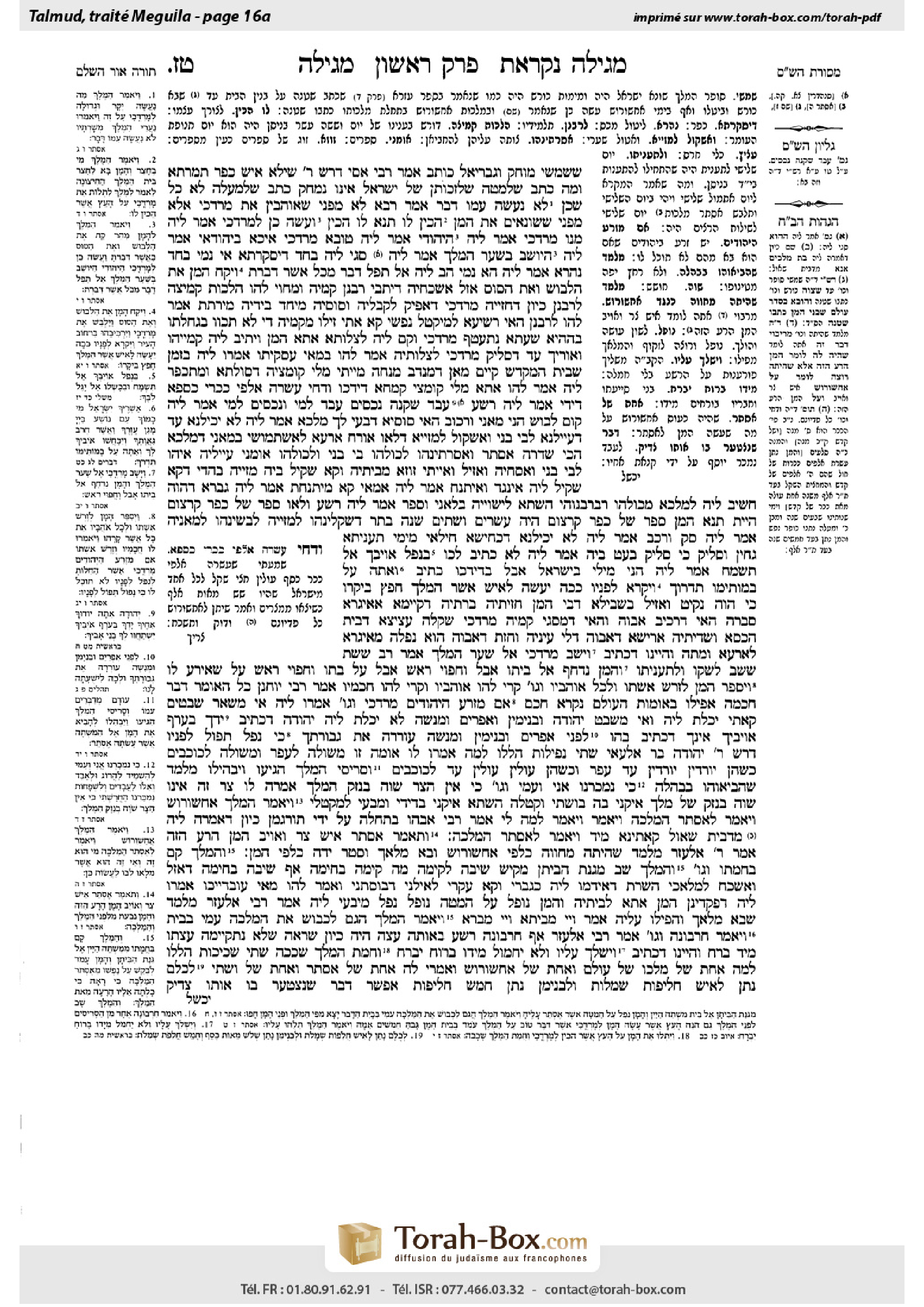
This page of Megillah includes the Aramaic text, an English translation and an AI-generated French translation, alongside the scan above.
מגילה י״ו א · Aramaic and Hebrew text
שֶׁשִּׁמְשַׁי מוֹחֵק וְגַבְרִיאֵל כּוֹתֵב. אָמַר רַבִּי אַסִּי, דָּרֵשׁ רַבִּי שֵׁילָא אִישׁ כְּפַר תְּמַרְתָּא: וּמָה כְּתָב שֶׁלְּמַטָּה שֶׁלִּזְכוּתָן שֶׁל יִשְׂרָאֵל — אֵינוֹ נִמְחָק, כְּתָב שֶׁלְמַעְלָה — לָא כׇּל שֶׁכֵּן.
״לֹא נַעֲשָׂה עִמּוֹ דָּבָר״. אָמַר רָבָא: לֹא מִפְּנֵי שֶׁאוֹהֲבִין אֶת מׇרְדֳּכַי, אֶלָּא מִפְּנֵי שֶׁשּׂוֹנְאִים אֶת הָמָן.
״הֵכִין לוֹ״. תָּנָא: לוֹ הֵכִין.
״וַעֲשֵׂה כֵן לְמָרְדֳּכַי״. אֲמַר לֵיהּ: מַנּוּ מָרְדֳּכַי? אֲמַר לֵיהּ: ״הַיְּהוּדִי״. אֲמַר לֵיהּ: טוּבָא מָרְדְּכַי אִיכָּא בִּיהוּדָאֵי. אֲמַר לֵיהּ: ״הַיּוֹשֵׁב בְּשַׁעַר הַמֶּלֶךְ״.
אֲמַר לֵיהּ: סַגִּי לֵיהּ בְּחַד דִּיסְקַרְתָּא, אִי נָמֵי בְּחַד נַהֲרָא. אָמַר לֵיהּ: הָא נָמֵי הַב לֵיהּ, ״אַל תַּפֵּל דָּבָר מִכֹּל אֲשֶׁר דִּבַּרְתָּ״.
״וַיִּקַּח הָמָן אֶת הַלְּבוּשׁ וְאֶת הַסּוּס״. אֲזַל אַשְׁכְּחֵיהּ דְּיָתְבִי רַבָּנַן קַמֵּיהּ וּמַחְוֵי לְהוּ הִלְכוֹת קְמִיצָה לְרַבָּנַן, כֵּיוָן דְּחַזְיֵיהּ מָרְדְּכַי דְּאַפֵּיק לְקִבְלֵיהּ וְסוּסְיָא מֵיחַד בִּידֵיהּ, מִירְתַת. אֲמַר לְהוּ לְרַבָּנַן: הַאי רַשִּׁיעָא לְמִיקְטַל נַפְשַׁי קָא אָתֵי זִילוּ מִקַּמֵּיהּ דִּי לָא תִּכָּווּ בְּגַחַלְתּוֹ. בְּהָהִיא שַׁעְתָּא נִתְעַטֵּף מָרְדְּכַי וְקָם לֵיהּ לִצְלוֹתָא, אֲתָא הָמָן וִיתֵיב לֵיהּ קַמַּיְיהוּ וְאוֹרֵיךְ עַד דְּסַלֵּיק מָרְדֳּכַי לִצְלוֹתֵיהּ.
אֲמַר לְהוּ: בְּמַאי עָסְקִיתוּ? אֲמַרוּ לֵיהּ: בִּזְמַן שֶׁבֵּית הַמִּקְדָּשׁ קַיָּים, מַאן דִּמְנַדֵּב מִנְחָה מַיְיתֵי מְלֵי קוּמְצֵיהּ דְּסוּלְתָּא וּמִתְכַּפַּר לֵיהּ. אֲמַר לְהוּ: אֲתָא מְלֵי קוּמְצֵי קִמְחָא דִּידְכוּ וְדָחֵי עַשְׂרָה אַלְפֵי כַּכְּרֵי כַסְפָּא דִּידִי. אֲמַר לֵיהּ: רָשָׁע, עֶבֶד שֶׁקָּנָה נְכָסִים, עֶבֶד לְמִי וּנְכָסִים לְמִי?
אֲמַר לֵיהּ: קוּם לְבוֹשׁ הָנֵי מָאנֵי וּרְכוֹב הַאי סוּסְיָא, דְּבָעֵי לָךְ מַלְכָּא. אֲמַר לֵיהּ: לָא יָכֵילְנָא עַד דְּעָיֵילְנָא לְבֵי בָנֵי וְאֶשְׁקוֹל לְמַזְיָיא, דְּלָאו אוֹרַח אַרְעָא לְאִשְׁתַּמּוֹשֵׁי בְּמָאנֵי דְמַלְכָּא הָכִי.
שַׁדַּרָה אֶסְתֵּר וַאֲסַרְתִּינְהוּ לְכוּלְּהוּ בֵּי בָנֵי וּלְכוּלְּהוּ אוּמָּנֵי. עַיְּילֵיהּ אִיהוּ לְבֵי בָנֵי וְאַסְחְיֵהּ, וַאֲזַל וְאַיְיתִי זוּזָא מִבֵּיתֵיהּ וְקָא שָׁקֵיל בֵּיהּ מַזְיֵיהּ. בַּהֲדֵי דְּקָא שָׁקֵיל לֵיהּ אִינְּגִיד וְאִיתְּנַח. אֲמַר לֵיהּ: אַמַּאי קָא מִיתְּנַחַתְּ? אֲמַר לֵיהּ: גַּבְרָא דַּהֲוָה חֲשִׁיב לֵיהּ לְמַלְכָּא מִכּוּלְּהוּ רַבְרְבָנוֹהִי, הַשְׁתָּא לִישַׁוְּיֵיהּ בַּלְנַאי וְסַפָּר? אֲמַר לֵיהּ: רָשָׁע, וְלָאו סַפָּר שֶׁל כְּפַר קַרְצוּם הָיִיתָ? תָּנָא: הָמָן, סַפָּר שֶׁל כְּפַר קַרְצוּם הָיָה עֶשְׂרִים וּשְׁתַּיִם שָׁנָה.
בָּתַר דְּשַׁקְלִינְהוּ לְמַזְיֵיהּ, לַבְשִׁינְהוּ לְמָאנֵיהּ, אֲמַר לֵיהּ: סַק וּרְכֹב. אֲמַר לֵיהּ: לָא יָכֵילְנָא, דִּכְחִישָׁא חֵילַאי מִימֵי תַּעֲנִיתָא. גְּחֵין וּסְלֵיק. כִּי סָלֵיק, בְּעַט בֵּיהּ. אֲמַר לֵיהּ: לָא כְּתִיב לְכוּ: ״בִּנְפֹל אוֹיִבְךָ אַל תִּשְׂמָח״? אֲמַר לֵיהּ: הָנֵי מִילֵּי בְּיִשְׂרָאֵל, אֲבָל בְּדִידְכוּ כְּתִיב: ״וְאַתָּה עַל בָּמוֹתֵימוֹ תִדְרוֹךְ״.
״וַיִּקְרָא לְפָנָיו כָּכָה יֵעָשֶׂה לְאִישׁ אֲשֶׁר הַמֶּלֶךְ חָפֵץ בִּיקָרוֹ״. כִּי הֲוָה נָקֵיט וְאָזֵיל בִּשְׁבִילָא דְּבֵי הָמָן, חֲזִיתֵיהּ בְּרַתֵּיה דְּקָיְימָא אַאִיגָּרָא, סְבַרָה הַאי דִּרְכִיב — אֲבוּהּ, וְהַאי דִּמְסַגֵּי קַמֵּיהּ — מָרְדֳּכַי. שְׁקַלָה עֲצִיצָא דְּבֵית הַכִּסֵּא וּשְׁדֵיתֵיהּ אַרֵישָׁא דַּאֲבוּהּ. דַּלִּי עֵינֵיהּ וַחֲזָת דַּאֲבוּהּ הוּא, נְפַלָה מֵאִיגָּרָא לְאַרְעָא וּמִתָה.
וְהַיְינוּ דִּכְתִיב: ״וַיָּשׇׁב מׇרְדֳּכַי אֶל שַׁעַר הַמֶּלֶךְ״, אָמַר רַב שֵׁשֶׁת: שֶׁשָּׁב לְשַׂקּוֹ וּלְתַעֲנִיתוֹ. ״וְהָמָן נִדְחַף אֶל בֵּיתוֹ אָבֵל וַחֲפוּי רֹאשׁ״, ״אָבֵל״ — עַל בִּתּוֹ, ״וַחֲפוּי רֹאשׁ״ — עַל שֶׁאֵירַע לוֹ.
״וַיְסַפֵּר הָמָן לְזֶרֶשׁ אִשְׁתּוֹ וּלְכׇל אוֹהֲבָיו וְגוֹ׳״. קָרֵי לְהוּ ״אוֹהֲבָיו״ וְקָרֵי לְהוּ ״חֲכָמָיו״. אָמַר רַבִּי יוֹחָנָן: כׇּל הָאוֹמֵר דְּבַר חָכְמָה, אֲפִילּוּ בְּאוּמּוֹת הָעוֹלָם, נִקְרָא חָכָם.
״אִם מִזֶּרַע הַיְּהוּדִים מׇרְדֳּכַי וְגוֹ׳״. אֲמַרוּ לֵיהּ: אִי מִשְּׁאָר שְׁבָטִים קָאָתֵי — יָכְלַתְּ לֵיהּ, וְאִי מִשֵּׁבֶט יְהוּדָה וּבִנְיָמִין וְאֶפְרַיִם וּמְנַשֶּׁה — לָא יָכְלַתְּ לֵיהּ. יְהוּדָה, דִּכְתִיב: ״יָדְךָ בְּעֹרֶף אוֹיְבֶיךָ״, אִינָךְ, דִּכְתִיב בְּהוּ: ״לִפְנֵי אֶפְרַיִם וּבִנְיָמִין וּמְנַשֶּׁה עוֹרְרָה אֶת גְּבוּרָתֶךָ״.
״כִּי נָפוֹל תִּפּוֹל לְפָנָיו״. דָּרֵשׁ רַבִּי יְהוּדָה בַּר אִלְעַאי: שְׁתֵּי נְפִילוֹת הַלָּלוּ, לָמָּה? אָמְרוּ לוֹ: אוּמָּה זוֹ, מְשׁוּלָה לְעָפָר וּמְשׁוּלָה לְכוֹכָבִים. כְּשֶׁהֵן יוֹרְדִין — יוֹרְדִין עַד עָפָר, וּכְשֶׁהֵן עוֹלִין — עוֹלִין עַד לַכּוֹכָבִים.
״וְסָרִיסֵי הַמֶּלֶךְ הִגִּיעוּ וַיַּבְהִילוּ״. מְלַמֵּד שֶׁהֱבִיאוּהוּ בְּבֶהָלָה.
״כִּי נִמְכַּרְנוּ אֲנִי וְעַמִּי וְגוֹ׳ כִּי אֵין הַצָּר שֹׁוֶה בְּנֵזֶק הַמֶּלֶךְ״. אָמְרָה לוֹ: צַר זֶה, אֵינוֹ שֹׁוֶה בְּנֵזֶק שֶׁל מֶלֶךְ. אִיקְּנִי בַּהּ בְּוַשְׁתִּי וְקַטְלַהּ, הַשְׁתָּא אִיקְּנִי בְּדִידִי וּ(מ)בָעֵי לְמִקְטְלִי.
״וַיֹּאמֶר הַמֶּלֶךְ אֲחַשְׁוֵרוֹשׁ וַיֹּאמֶר לְאֶסְתֵּר הַמַּלְכָּה״. ״וַיֹּאמֶר״ ״וַיֹּאמֶר״ לְמָה לִי? אָמַר רַבִּי אֲבָהוּ: בַּתְּחִלָּה עַל יְדֵי תּוּרְגְּמָן, כֵּיוָן דְּאָמְרָה לֵיהּ מִדְּבֵית שָׁאוּל קָאָתֵינָא, מִיָּד: ״וַיֹּאמֶר לְאֶסְתֵּר הַמַּלְכָּה״.
״וַתֹּאמֶר אֶסְתֵּר אִישׁ צַר וְאוֹיֵב הָמָן הָרָע הַזֶּה״. אָמַר רַבִּי אֶלְעָזָר: מְלַמֵּד שֶׁהָיְתָה מַחְווֹה כְּלַפֵּי אֲחַשְׁוֵרוֹשׁ, וּבָא מַלְאָךְ וְסָטַר יָדָהּ כְּלַפֵּי הָמָן.
״וְהַמֶּלֶךְ קָם בַּחֲמָתוֹ וְגוֹ׳ וְהַמֶּלֶךְ שָׁב מִגִּנַּת הַבִּיתָן״. מַקֵּישׁ שִׁיבָה לְקִימָה: מָה קִימָה בְּחֵימָה, אַף שִׁיבָה בְּחֵימָה. דַּאֲזַל וְאַשְׁכַּח לְמַלְאֲכֵי הַשָּׁרֵת דְּאִידְּמוֹ לֵיהּ כְּגַבְרֵי, וְקָא עָקְרִי לְאִילָנֵי דְּבוּסְתָּנֵי, וַאֲמַר לְהוּ: מַאי עוֹבָדַיְיכוּ? אֲמַרוּ לֵיהּ: דְּפַקְּדִינַן הָמָן.
אֲתָא לְבֵיתֵיהּ, ״וְהָמָן נוֹפֵל עַל הַמִּטָּה״, ״נוֹפֵל״ — ״נָפַל״ מִיבְּעֵי לֵיהּ! אָמַר רַבִּי אֶלְעָזָר: מְלַמֵּד שֶׁבָּא מַלְאָךְ וְהִפִּילוֹ עָלֶיהָ, אֲמַר: וַיי מִבֵּיתָא, וַיי מִבָּרָא. ״וַיֹּאמֶר הַמֶּלֶךְ הֲגַם לִכְבּוֹשׁ אֶת הַמַּלְכָּה עִמִּי בַּבָּיִת״.
״וַיֹּאמֶר חַרְבוֹנָה וְגוֹ׳״. אָמַר רַבִּי אֶלְעָזָר: אַף חַרְבוֹנָה רָשָׁע — בְּאוֹתָהּ עֵצָה הָיָה, כֵּיוָן שֶׁרָאָה שֶׁלֹּא נִתְקַיְּימָה עֲצָתוֹ, מִיָּד בָּרַח. וְהַיְינוּ דִּכְתִיב: ״וְיַשְׁלֵךְ עָלָיו וְלֹא יַחְמוֹל מִיָּדוֹ בָּרוֹחַ יִבְרָח״.
״וַחֲמַת הַמֶּלֶךְ שָׁכָכָה״. שְׁתֵּי שְׁכִיכוֹת הַלָּלוּ לָמָּה? אַחַת שֶׁל מַלְכּוֹ שֶׁל עוֹלָם וְאַחַת שֶׁל אֲחַשְׁוֵרוֹשׁ. וְאָמְרִי לַהּ: אַחַת שֶׁל אֶסְתֵּר וְאַחַת שֶׁל וַשְׁתִּי.
״לְכֻלָּם נָתַן לָאִישׁ חֲלִיפוֹת שְׂמָלוֹת וּלְבִנְיָמִן נָתַן חָמֵשׁ חֲלִיפוֹת״. אֶפְשָׁר דָּבָר שֶׁנִּצְטַעֵר בּוֹ אוֹתוֹ צַדִּיק —
Megillah 16a · English translation
that Shimshai, the king’s scribe who hated the Jews (see Ezra 4:17), was erasing the description of Mordecai’s saving the king, and the angel Gavriel was writing it again. Therefore, it was indeed being written in the present. Rabbi Asi said: Rabbi Sheila, a man of the village of Timarta, taught: If something written down below in this world that is for the benefit of the Jewish people cannot be erased, is it not all the more so the case that something written up above in Heaven cannot be erased?
The verse states that Ahasuerus was told with regard to Mordecai: “Nothing has been done for him” (Esther 6:3). Rava said: It is not because they love Mordecai that the king’s servants said this, but rather because they hate Haman.
The verse states: “Now Haman had come into the outer court of the king’s house, to speak to the king about hanging Mordecai on the gallows that he had prepared for him” (Esther 6:4). A Sage taught in a baraita: This should be understood to mean: On the gallows that he had prepared for himself.
The verse relates that Ahasuerus ordered Haman to fulfill his idea of the proper way to honor one who the king desires to glorify by parading him around on the king’s horse while wearing the royal garments: “And do so to Mordecai the Jew who sits at the king’s gate, let nothing fail of all that you have spoken” (Esther 6:10). The Gemara explains that when Ahasuerus said to Haman: “And do so to Mordecai,” Haman said to him in an attempt to evade the order: Who is Mordecai? Ahasuerus said to him: “The Jew.” Haman then said to him: There are several men named Mordecai among the Jews. Ahasuerus then said to him: I refer to the one “who sits at the king’s gate.”
Haman said to him: Why award him such a great honor? It would certainly be enough for him to receive one village [disekarta] as an estate, or one river for the levy of taxes. Ahasuerus said to him: This too you must give him. “Let nothing fail of all that you have spoken,” i.e., provide him with all that you proposed and spoke about in addition to what I had said.
The Gemara describes what occurred as Haman went to follow the king’s orders, as the verse states: “Then Haman took the apparel and the horse” (Esther 6:11). When he went, he found Mordecai as the Sages were sitting before him, and he was demonstrating to them the halakhot of the handful, i.e., the scooping out of a handful of flour from the meal-offering in order to burn it on the altar. Once Mordecai saw him coming toward him with his horse’s reins held in his hands, he became frightened, and he said to the Sages: This evil man has come to kill me. Go away from him so that you should not get burnt from his coals, i.e., that you should not suffer harm as well. At that moment Mordecai wrapped himself in his prayer shawl and stood up to pray. Haman came over to where they were and sat down before them and waited until Mordecai finished his prayer.
In the interim, as he waited, Haman said to the other Sages: With what were you occupied? They said to him: When the Temple is standing, one who pledges a meal-offering would bring a handful of fine flour and achieve atonement with it. He said to them: Your handful of fine flour has come and cast aside my ten thousand pieces of silver, which I had pledged toward the destruction of the Jewish people. When Mordecai finished praying, he said to Haman: Wicked man, when a slave buys property, to whom belongs the slave and to whom belongs the property? As I once bought you as a slave, what silver can be yours?
Haman said to him: Stand up, put on these garments and ride on this horse, for the king wants you to do so. Mordecai said to him: I cannot do so until I enter the bathhouse [bei vanei] and trim my hair, for it is not proper conduct to use the king’s garments in this state that I am in now.
In the meantime, Esther sent messengers and closed all the bathhouses and all the shops of the craftsmen, including the bloodletters and barbers. When Haman saw that there was nobody else to do the work, he himself took Mordecai into the bathhouse and washed him, and then he went and brought scissors [zuza] from his house and trimmed his hair. While he was trimming his hair he injured himself and sighed. Mordecai said to him: Why do you sigh? Haman said to him: The man whom the king had once regarded above all his other ministers is now made a bathhouse attendant [balanei] and a barber. Mordecai said to him: Wicked man, were you not once the barber of the village of Kartzum? If so, why do you sigh? You have merely returned to the occupation of your youth. It was taught in a baraita: Haman was the barber of the village of Kartzum for twenty-two years.
After Haman trimmed his hair, Haman dressed Mordecai in the royal garments. Haman then said to him: Mount the horse and ride. Mordecai said to him: I am unable, as my strength has waned from the days of fasting that I observed. Haman then stooped down before him and Mordecai ascended on him. As he was ascending the horse, Mordecai gave Haman a kick. Haman said to him: Is it not written for you: “Do not rejoice when your enemy falls” (Proverbs 24:17)? Mordecai said to him: This statement applies only to Jews, but with regard to you it is written: “And you shall tread upon their high places” (Deuteronomy 33:29).
The verse states: “And he proclaimed before him: Thus shall it be done to the man whom the king delights to honor” (Esther 6:11). As Haman was taking Mordecai along the street of Haman’s house, Haman’s daughter was standing on the roof and saw the spectacle. She thought to herself that the one who is riding on the horse must be her father, and the one walking before him must be Mordecai. She then took a chamber pot full of feces and cast its contents onto the head of her father, whom she mistakenly took as Mordecai. When Haman raised his eyes in disgust afterward, and looked up at his daughter, she saw that he was her father. In her distress, she fell from the roof to the ground and died.
And this is as it is written: “And Mordecai returned to the king’s gate” (Esther 6:12). Rav Sheshet said: This means that he returned to his sackcloth and his fasting over the troubles of the Jewish people. Simultaneously, “but Haman hastened to his house, mourning, and having his head covered” (Esther 6:12). “Mourning”; over the death of his daughter. “And having his head covered”; due to what had happened to him, as his head was full of filth.
The following verse states: “And Haman recounted to Zeresh his wife and to all his friends everything that had befallen him. Then his wise men and Zeresh his wife said to him: If Mordecai, before whom you have begun to fall, be of the seed of the Jews, then you will not prevail over him, but you shall fall before him” (Esther 6:13). The Gemara comments: At the beginning of the verse it calls them “his friends,” and in the continuation of the verse it calls them “his wise men.” Rabbi Yoḥanan said: Whoever says something wise, even if he is from the nations of the world, is called a wise man.
The Gemara explains that their wise remark, which earned them their distinction, is contained in their advice: “If Mordecai be of the seed of the Jews [Yehudim], then you will not prevail over him” (Esther 6:13). The word Yehudim can also refer to people from the tribe of Judah. Haman’s wise men thereby said to him: If he descends from the other tribes, you can still prevail over him, but if he descends from the tribe of either Judah, Benjamin, Ephraim, or Manasseh, you cannot prevail over him. With regard to Judah, the proof of this is as it is written: “Your hand shall be on the neck of your enemies” (Genesis 49:8), indicating that Judah will emerge victorious over his enemies. And the proof that Haman cannot prevail over the others that were mentioned is as it is written with regard to them: “Before Ephraim and Benjamin and Manasseh, stir up Your might” (Psalms 80:3).
The wise men continued: “But you shall fall [nafol tippol] before him” (Esther 6:13). Rabbi Yehuda bar Ilai interpreted a verse homiletically: Why are these two fallings, nafol and tippol, mentioned here? The wise men said to Haman: This Jewish nation is compared in the Bible to the dust of the earth and it is also compared to the stars in heaven. This teaches you that when they descend, they descend to the dust, and when they rise, they rise to the stars. Accordingly, when Mordecai is on the rise, you will be utterly incapable of prevailing over him.
The next verse states: “The king’s chamberlains came, and they hastened [vayavhilu] to bring Haman” (Esther 6:14). This teaches that they brought him in disarray [behala], not even giving him a chance to wash himself from the filth.
During the banquet Esther said to Ahasuerus: “For we are sold, I and my people, to be destroyed, to be slain, and to be annihilated. But if we had been sold merely for bondmen and bondwomen, I would have held my tongue, since the affliction [tzar] would not have been worth [eino shoveh] the damage to the king” (Esther 7:4). The Gemara explains that she said to him: This adversary [tzar] is not concerned [eino shoveh] about the damage that he is constantly causing to the king. First he was jealous of Vashti and killed her, as it has been explained that Memucan, who suggesting killing Vashti, was Haman; now he is jealous of me and desires to kill me.
The verse states: “Then said the king Ahasuerus and said to Esther the queen” (Esther 7:5). The Gemara asks: Why do I need it to say “said” and again “said”? Rabbi Abbahu said: At first he spoke to her through the translator, who would interpret on his behalf, because he thought that she was a common woman of lowly ancestry. Once she told him that she came from the house of Saul, immediately it says: “And said to Esther the queen.” Ahasuerus himself spoke to her, as if she had royal lineage, she was a woman befitting his status.
The next verse states: “And Esther said: An adversary and enemy is this wicked Haman” (Esther 7:6). Rabbi Elazar said: This teaches that she was in fact pointing toward Ahasuerus, indicating that in fact he was an adversary and enemy, and an angel came and pushed her hand toward Haman.
The verse states: “And the king arose from the banquet of wine in his wrath and went into the palace garden” (Esther 7:7), and the next verse states: “Then the king returned out of the palace garden to the place of the wine drinking” (Esther 7:8). The Gemara comments: The verses here compare his returning to his arising: Just as his arising was in wrath, so too, his returning was in wrath. And why did he return in wrath? For when he went out he found ministering angels who appeared to him as people and they were uprooting trees from the garden, and he said to them: What are you doing? They said to him: Haman commanded us to do this.
And when he entered his house he saw that “Haman was falling upon the bed” (Esther 7:8). The Gemara asks: Why does it say “was falling” [nofel] in the present tense, implying that he was currently falling? It should have said “fell” [nafal] in the past tense. Rabbi Elazar said: This teaches that an angel came and pushed him down on it, and every time he would try to stand up, the angel would push him down again. Ahasuerus said: Woe unto me in the house and woe unto me outside, as the verse continues: “Then the king said: Will he even force the queen before me in the house?” (Esther 7:8).
“And Harbonah, one of the chamberlains, said before the king, Behold also, the gallows fifty cubits high, which Haman has made for Mordecai, who spoke good for the king, stands in the house of Haman” (Esther 7:9). Rabbi Elazar said: Harbonah was also wicked and involved in that plot, as he too wanted Mordecai executed. Once he saw that his plot had not succeeded, he immediately fled and joined Mordecai’s side. And this is the meaning of that which is written: “It hurls itself at him, and does not spare; he would fain flee out of its hand” (Job 27:22), indicating that when God sends calamity upon a wicked person, his friends immediately flee from him.
The verse states: “Then the king’s wrath was assuaged [shakhakha]” (Esther 7:10). The Gemara asks: Why are there two assuagings here? The term shakhakha is used rather than shaka and indicates doubled wrath. There was one assuaging of the wrath of the King of the universe, and one of the wrath of Ahasuerus. And some say: Ahasuerus’s wrath burned within him for two reasons; one due to Haman’s involvement with Esther, and one due to his involvement with Vashti, and now they were both assuaged.
Before continuing its midrashic interpretation of the rest of the book of Esther, the Gemara expounds a verse concerning Joseph that relates to the Megilla: “To all of them he gave each man changes of clothing, but to Benjamin he gave three hundred pieces of silver, and five changes of clothing” (Genesis 45:22). The Gemara asks: Is it possible that in the very thing from which that righteous man Joseph had suffered, as his father’s show of favoritism toward him aroused the enmity of his brothers,
Megillah 16a · Traduction française (IA)
que Shimshaï, le scribe du roi qui haïssait les Juifs (voir Esdras 4:17), effaçait le récit du sauvetage du roi par Mordekhaï, tandis que l’ange Gavriel le réécrivait. C’est pourquoi le texte était bien en train d’être écrit à ce moment-là. Rabbi Assi dit : Rabbi Sheila, un homme du village de Timarta, enseignait : Si ce qui est écrit ici-bas, dans ce monde, au bénéfice du peuple juif ne peut être effacé, à plus forte raison ce qui est écrit là-haut, au Ciel, ne peut-il l’être ?
Le verset rapporte qu’on dit à Assuérus, à propos de Mordekhaï : « Rien n’a été fait pour lui » (Esther 6:3). Rava dit : Si les serviteurs du roi dirent cela, ce n’est pas parce qu’ils aimaient Mordekhaï, mais plutôt parce qu’ils haïssaient Haman.
Le verset dit : « Haman était alors arrivé dans la cour extérieure du palais royal, pour parler au roi de faire pendre Mordekhaï au gibet qu’il avait préparé pour lui » (Esther 6:4). Un Sage enseigna dans une baraïta : Il faut comprendre cela ainsi : au gibet qu’il avait préparé pour lui-même.
Le verset rapporte qu’Assuérus ordonna à Haman de mettre en œuvre son idée de la manière convenable d’honorer celui que le roi souhaite glorifier : le faire défiler sur le cheval du roi, vêtu des habits royaux. « Fais de même pour Mordekhaï le Juif, qui siège à la porte du roi ; ne néglige rien de tout ce que tu as dit » (Esther 6:10). La Guemara explique que, lorsqu’Assuérus dit à Haman : « Fais de même pour Mordekhaï », Haman lui demanda, pour tenter d’échapper à l’ordre : « De quel Mordekhaï s’agit-il ? » Assuérus lui répondit : « Le Juif. » Haman lui dit alors : « Il y a plusieurs hommes nommés Mordekhaï parmi les Juifs. » Assuérus lui répondit : « Je parle de celui “qui siège à la porte du roi”. »
Haman lui dit : Pourquoi lui accorder un si grand honneur ? Il lui suffirait certainement de recevoir un village [disekarta] comme domaine, ou un fleuve dont il percevrait les impôts. Assuérus lui répondit : Tu dois aussi lui donner cela. « Ne néglige rien de tout ce que tu as dit », c’est-à-dire : donne-lui tout ce que tu as proposé et mentionné, en plus de ce que j’avais dit.
La Guemara décrit ce qui se passa lorsqu’Haman se mit à exécuter les ordres du roi, comme le dit le verset : « Haman prit les vêtements et le cheval » (Esther 6:11). En arrivant, il trouva Mordekhaï avec les Sages assis devant lui, tandis qu’il leur enseignait les halakhot de la poignée, c’est-à-dire le prélèvement d’une poignée de farine de l’offrande végétale afin de la brûler sur l’autel. En voyant Haman s’avancer vers lui, les rênes du cheval à la main, Mordekhaï prit peur et dit aux Sages : « Cet homme mauvais est venu pour me tuer. Éloignez-vous de lui, afin de ne pas être brûlés par ses braises », c’est-à-dire afin de ne pas subir vous aussi de dommages. À cet instant, Mordekhaï s’enveloppa dans son talit de prière et se leva pour prier. Haman s’approcha d’eux, s’assit devant eux et attendit que Mordekhaï ait terminé sa prière.
Pendant qu’il attendait, Haman demanda aux autres Sages : À quoi étiez-vous occupés ? Ils lui répondirent : Lorsque le Temple est debout, celui qui fait vœu d’apporter une offrande végétale apporte une poignée de fleur de farine et obtient ainsi l’expiation. Haman leur dit : Votre poignée de fleur de farine est venue écarter mes dix mille pièces d’argent, que j’avais promises pour la destruction du peuple juif. Lorsque Mordekhaï eut terminé sa prière, il dit à Haman : Homme mauvais, quand un esclave achète un bien, à qui appartiennent l’esclave et le bien ? Puisque je t’ai acheté autrefois comme esclave, quel argent pourrait t’appartenir ?
Haman lui dit : Lève-toi, revêts ces vêtements et monte sur ce cheval, car le roi veut que tu le fasses. Mordekhaï lui répondit : Je ne peux pas le faire avant d’être entré aux bains [bei vanei] et de m’être fait couper les cheveux, car il ne convient pas de porter les vêtements du roi dans l’état où je suis maintenant.
Entre-temps, Esther envoya des messagers et fit fermer tous les bains ainsi que toutes les boutiques d’artisans, notamment celles des saigneurs et des barbiers. Voyant qu’il n’y avait personne d’autre pour faire le travail, Haman lui-même emmena Mordekhaï aux bains et le lava. Puis il alla chercher chez lui des ciseaux [zuza] et lui coupa les cheveux. Pendant qu’il les lui coupait, il se blessa et soupira. Mordekhaï lui demanda : Pourquoi soupires-tu ? Haman lui répondit : L’homme que le roi plaçait autrefois au-dessus de tous ses autres ministres est maintenant devenu préposé aux bains [balanei] et barbier. Mordekhaï lui dit : Homme mauvais, n’étais-tu pas autrefois le barbier du village de Kartzum ? Alors, pourquoi soupires-tu ? Tu es simplement revenu au métier que tu exerçais dans ta jeunesse. Il a été enseigné dans une baraïta : Haman fut le barbier du village de Kartzum pendant vingt-deux ans.
Après lui avoir coupé les cheveux, Haman revêtit Mordekhaï des habits royaux. Haman lui dit alors : Monte sur le cheval et pars. Mordekhaï répondit : Je ne le peux pas, car mes forces ont diminué à cause des jours de jeûne que j’ai observés. Haman se baissa alors devant lui, et Mordekhaï monta sur son dos. Tandis qu’il montait sur le cheval, Mordekhaï donna un coup de pied à Haman. Haman lui dit : N’est-il pas écrit pour toi : « Ne te réjouis pas quand ton ennemi tombe » (Proverbes 24:17) ? Mordekhaï lui répondit : Cette parole ne s’applique qu’aux Juifs ; à ton sujet, il est écrit : « Et tu fouleras leurs hauteurs » (Deutéronome 33:29).
Le verset dit : « Il criait devant lui : Ainsi sera traité l’homme que le roi veut honorer » (Esther 6:11). Tandis qu’Haman conduisait Mordekhaï dans la rue où se trouvait sa maison, la fille d’Haman se tenait sur le toit et vit la scène. Elle se dit que celui qui montait le cheval devait être son père, et que celui qui marchait devant lui devait être Mordekhaï. Elle prit alors un pot de chambre plein d’excréments et en jeta le contenu sur la tête de son père, qu’elle avait pris par erreur pour Mordekhaï. Ensuite, Haman leva les yeux avec dégoût et regarda vers sa fille ; elle vit alors que c’était son père. Bouleversée, elle tomba du toit et mourut.
C’est ce que signifie le verset : « Mordekhaï retourna à la porte du roi » (Esther 6:12). Rav Sheshet dit : Cela signifie qu’il retourna à son sac et à ses jeûnes, à cause des malheurs qui menaçaient le peuple juif. Au même moment, « Haman se hâta de rentrer chez lui, en deuil et la tête couverte » (Esther 6:12). « En deuil » : à cause de la mort de sa fille. « La tête couverte » : à cause de ce qui lui était arrivé, car sa tête était pleine d’immondices.
Le verset suivant dit : « Haman raconta à Zéresh, sa femme, et à tous ses amis tout ce qui lui était arrivé. Ses sages et Zéresh, sa femme, lui dirent alors : Si Mordekhaï, devant qui tu as commencé à tomber, est de la descendance des Juifs, tu ne pourras rien contre lui ; au contraire, tu tomberas devant lui » (Esther 6:13). La Guemara fait remarquer qu’au début du verset, ils sont appelés « ses amis », tandis que la suite du verset les appelle « ses sages ». Rabbi Yo’hanan dit : Quiconque prononce une parole sage, même s’il appartient aux nations du monde, est appelé un sage.
La Guemara explique que leur remarque avisée, qui leur valut ce titre, se trouve dans leur conseil : « Si Mordekhaï est de la descendance des Juifs [Yehudim], tu ne pourras rien contre lui » (Esther 6:13). Le mot Yehudim peut aussi désigner les membres de la tribu de Juda. Les sages d’Haman lui dirent ainsi : S’il descend des autres tribus, tu peux encore l’emporter sur lui ; mais s’il descend de l’une des tribus de Juda, de Benjamin, d’Éphraïm ou de Manassé, tu ne pourras pas l’emporter sur lui. Pour Juda, la preuve se trouve dans ce verset : « Ta main sera sur la nuque de tes ennemis » (Genèse 49:8), ce qui indique que Juda l’emportera sur ses ennemis. Quant à la preuve qu’Haman ne peut l’emporter sur les autres tribus mentionnées, elle se trouve dans ce qui est écrit à leur sujet : « Devant Éphraïm, Benjamin et Manassé, réveille ta puissance » (Psaumes 80:3).
Les sages poursuivirent : « Mais tu tomberas [nafol tippol] devant lui » (Esther 6:13). Rabbi Yehouda bar Ilaï interpréta un verset de manière homilétique : Pourquoi ces deux termes de chute, nafol et tippol, sont-ils mentionnés ici ? Les sages dirent à Haman : Dans la Bible, cette nation juive est comparée à la poussière de la terre et aux étoiles du ciel. Cela t’enseigne que lorsqu’elle descend, elle descend jusqu’à la poussière, et que lorsqu’elle s’élève, elle s’élève jusqu’aux étoiles. Par conséquent, dès lors que Mordekhaï est en train de s’élever, tu es absolument incapable de l’emporter sur lui.
Le verset suivant dit : « Les eunuques du roi arrivèrent et se hâtèrent [vayavhilu] d’amener Haman » (Esther 6:14). Cela enseigne qu’ils l’amenèrent dans la précipitation [behala], sans même lui laisser le temps de se laver des immondices.
Pendant le banquet, Esther dit à Assuérus : « Car nous avons été vendus, moi et mon peuple, pour être exterminés, massacrés et anéantis. Mais si nous avions seulement été vendus comme esclaves et servantes, je me serais tue, car le mal [tzar] n’aurait pas valu [eino shoveh] le dommage causé au roi » (Esther 7:4). La Guemara explique qu’elle lui dit : Cet adversaire [tzar] ne se soucie pas [eino shoveh] du dommage qu’il cause constamment au roi. D’abord, il a été jaloux de Vashti et l’a fait tuer, comme il a été expliqué que Memucan, celui qui avait conseillé de tuer Vashti, était Haman ; maintenant, il est jaloux de moi et veut me tuer.
Le verset dit : « Le roi Assuérus prit la parole et dit à la reine Esther » (Esther 7:5). La Guemara demande : Pourquoi le verset dit-il « prit la parole » puis encore « dit » ? Rabbi Abbahou dit : Au début, il lui parlait par l’intermédiaire d’un interprète, qui traduisait ses paroles, car il croyait qu’elle était une femme ordinaire, de basse extraction. Dès qu’elle lui dit qu’elle était issue de la maison de Saül, le verset dit aussitôt : « Et il dit à la reine Esther. » Assuérus lui parla lui-même, car, puisqu’elle était de lignée royale, elle était une femme digne de son rang.
Le verset suivant dit : « Esther dit : Un adversaire et un ennemi, c’est ce méchant Haman » (Esther 7:6). Rabbi Elazar dit : Cela enseigne qu’en réalité, elle désignait Assuérus, indiquant qu’il était un adversaire et un ennemi ; mais un ange vint et poussa sa main vers Haman.
Le verset dit : « Le roi se leva de son banquet de vin, furieux, et se rendit dans le jardin du palais » (Esther 7:7), et le verset suivant dit : « Le roi revint du jardin du palais à l’endroit où l’on buvait le vin » (Esther 7:8). La Guemara fait remarquer que les versets mettent son retour en parallèle avec le fait qu’il se soit levé : de même qu’il s’était levé dans la colère, de même revint-il dans la colère. Et pourquoi revint-il en colère ? En sortant, il avait trouvé des anges qui le servaient, apparus à ses yeux sous la forme d’hommes, en train d’arracher les arbres du jardin. Il leur demanda : Que faites-vous ? Ils lui répondirent : Haman nous a ordonné de le faire.
Quand il entra dans sa maison, il vit que « Haman tombait sur le divan » (Esther 7:8). La Guemara demande : Pourquoi le verset dit-il « tombait » [nofel], au présent, ce qui laisse entendre qu’il était en train de tomber ? Il aurait dû dire « tomba » [nafal], au passé. Rabbi Elazar dit : Cela enseigne qu’un ange vint et le poussa sur le divan ; chaque fois qu’il essayait de se relever, l’ange le repoussait. Assuérus dit : Malheur à moi dans la maison et malheur à moi dehors, comme le poursuit le verset : « Le roi dit alors : Va-t-il même faire violence à la reine en ma présence, dans la maison ? » (Esther 7:8).
« Harbona, l’un des eunuques, dit au roi : Voici aussi le gibet de cinquante coudées qu’Haman a fait pour Mordekhaï, celui qui a parlé en faveur du roi ; il se trouve dans la maison d’Haman » (Esther 7:9). Rabbi Elazar dit : Harbona était lui aussi un homme mauvais et avait pris part à ce complot, car lui aussi voulait faire exécuter Mordekhaï. Dès qu’il vit que son complot avait échoué, il s’enfuit aussitôt et se rangea du côté de Mordekhaï. C’est le sens de ce qui est écrit : « Il se précipite sur lui sans pitié ; il voudrait fuir de sa main » (Job 27:22), ce qui indique que lorsque Dieu envoie un malheur sur un méchant, ses amis le fuient aussitôt.
Le verset dit : « Alors la colère du roi s’apaisa [shakhakha] » (Esther 7:10). La Guemara demande : Pourquoi y a-t-il ici deux apaisements ? Le terme shakhakha est employé plutôt que shaka et indique une colère redoublée. Il y eut un apaisement de la colère du Roi de l’univers et un apaisement de celle d’Assuérus. Certains disent : La colère d’Assuérus brûlait en lui pour deux raisons : l’une à cause de l’implication d’Haman auprès d’Esther, l’autre à cause de son implication auprès de Vashti ; à présent, les deux colères s’étaient apaisées.
Avant de poursuivre son interprétation midrashique du reste du livre d’Esther, la Guemara développe un verset concernant Joseph, qui a un rapport avec la Meguila : « Il donna à chacun d’eux des vêtements de rechange, mais à Benjamin il donna trois cents pièces d’argent et cinq vêtements de rechange » (Genèse 45:22). La Guemara demande : Est-il possible que précisément dans le domaine même où ce juste, Joseph, avait souffert — car la préférence que son père lui témoignait avait éveillé l’hostilité de ses frères —
Traduction française générée par IA à partir de l’édition anglaise de Sefaria. Vérifie toujours un passage avec le texte source.
Text from Sefaria: William Davidson Edition - Vocalized Aramaic (CC BY NC); William Davidson Edition - English (CC BY NC).