Megillah 16b: Talmud study for Daf Yomi
Daf Yomi is the daily study of one Talmud folio. Explore 37 tractates with scans, Hebrew text, Sefaria English and AI-generated French translations where annotated.
Passage selection and English or AI-generated French translation are available where the scan has annotations. Daf Study is independent of Torah-Box and Sefaria.
Browse Megillah · מגילה · All tractatesMegillah 16b text and translations
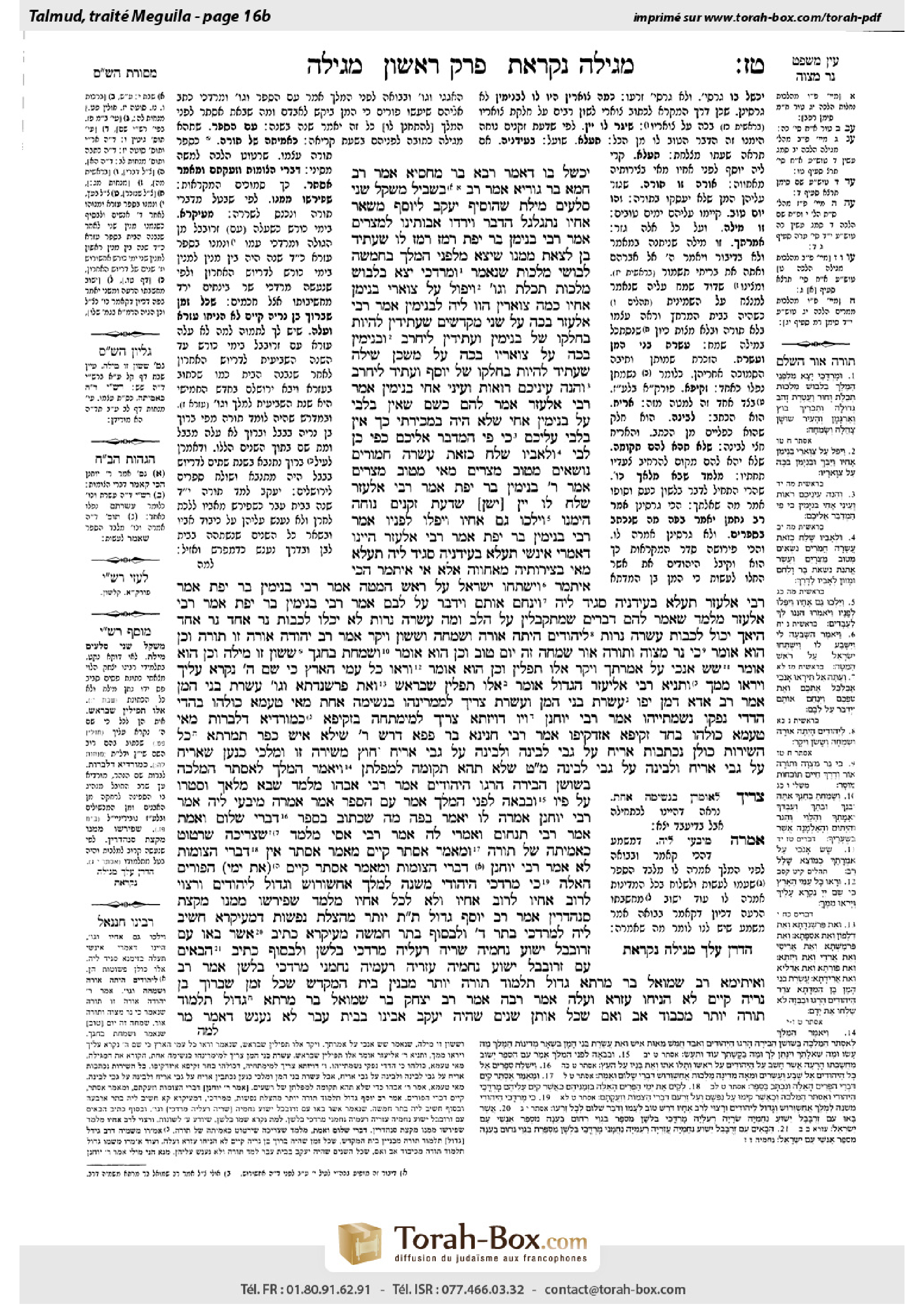
This page of Megillah includes the Aramaic text, an English translation and an AI-generated French translation, alongside the scan above.
מגילה י״ו ב · Aramaic and Hebrew text
יִכָּשֵׁל בּוֹ? דְּאָמַר רָבָא בַּר מַחְסֵיָא אָמַר רַב חָמָא בַּר גּוּרְיָא, אָמַר רַב: בִּשְׁבִיל מִשְׁקַל שְׁנֵי סְלָעִים מֵילָת שֶׁהוֹסִיף יַעֲקֹב לְיוֹסֵף מִשְּׁאָר אֶחָיו נִתְגַּלְגֵּל הַדָּבָר וְיָרְדוּ אֲבוֹתֵינוּ לְמִצְרַיִם. אָמַר רַבִּי בִּנְיָמִן בַּר יֶפֶת: רֶמֶז רָמַז לוֹ, שֶׁעָתִיד בֵּן לָצֵאת מִמֶּנּוּ, שֶׁיֵּצֵא מִלִּפְנֵי הַמֶּלֶךְ בַּחֲמִשָּׁה לְבוּשֵׁי מַלְכוּת, שֶׁנֶּאֱמַר: ״וּמׇרְדֳּכַי יָצָא בִּלְבוּשׁ מַלְכוּת תְּכֵלֶת וְגוֹ׳״.
״וַיִּפּוֹל עַל צַוְּארֵי בִנְיָמִן אָחִיו״. כַּמָּה צַוָּארִין הֲווֹ לֵיהּ לְבִנְיָמִין? אָמַר רַבִּי אֶלְעָזָר: בָּכָה עַל שְׁנֵי מִקְדָּשִׁים שֶׁעֲתִידִין לִהְיוֹת בְּחֶלְקוֹ שֶׁל בִּנְיָמִין וַעֲתִידִין לֵיחָרֵב. ״וּבִנְיָמִין בָּכָה עַל צַוָּארָיו״ — בָּכָה עַל מִשְׁכַּן שִׁילֹה, שֶׁעָתִיד לִהְיוֹת בְּחֶלְקוֹ שֶׁל יוֹסֵף וְעָתִיד לֵיחָרֵב.
״וְהִנֵּה עֵינֵיכֶם רוֹאוֹת וְעֵינֵי אָחִי בִנְיָמִין״. אָמַר רַבִּי אֶלְעָזָר, אָמַר לָהֶם: כְּשֵׁם שֶׁאֵין בְּלִבִּי עַל בִּנְיָמִין אָחִי, שֶׁלֹּא הָיָה בִּמְכִירָתִי, כָּךְ אֵין בְּלִבִּי עֲלֵיכֶם. ״כִּי פִי הַמְדַבֵּר אֲלֵיכֶם״. כְּפִי — כֵּן לִבִּי.
״וּלְאָבִיו שָׁלַח כְּזֹאת עֲשָׂרָה חֲמוֹרִים נוֹשְׂאִים מִטּוּב מִצְרָיִם״. מַאי ״מִטּוּב מִצְרָיִם״? אָמַר רַבִּי בִּנְיָמִין בַּר יֶפֶת אָמַר רַבִּי אֶלְעָזָר: שָׁלַח לוֹ יַיִן [יָשָׁן], שֶׁדַּעַת זְקֵנִים נוֹחָה הֵימֶנּוּ.
״וַיֵּלְכוּ גַּם אֶחָיו וַיִּפְּלוּ לְפָנָיו״. אָמַר רַבִּי בִּנְיָמִין בַּר יֶפֶת אָמַר רַבִּי אֶלְעָזָר, הַיְינוּ דְּאָמְרִי אִינָשֵׁי: תַּעֲלָא בְּעִידָּנֵיהּ סְגֵיד לֵיהּ.
תַּעֲלָא? מַאי בְּצִירוּתֵיהּ מֵאֲחווֹהַּ? אֶלָּא, אִי אִיתְּמַר הָכִי אִיתְּמַר: ״וַיִּשְׁתַּחוּ יִשְׂרָאֵל עַל רֹאשׁ הַמִּטָּה״, אָמַר רַבִּי בִּנְיָמִין בַּר יֶפֶת אָמַר רַבִּי אֶלְעָזָר: תַּעֲלָא בְּעִידָּנֵיהּ סְגֵיד לֵיהּ.
״וַיְנַחֵם אוֹתָם וַיְדַבֵּר עַל לִבָּם״. אָמַר רַבִּי בִּנְיָמִין בַּר יֶפֶת אָמַר רַבִּי אֶלְעָזָר: מְלַמֵּד שֶׁאָמַר לָהֶם דְּבָרִים שֶׁמִּתְקַבְּלִין עַל הַלֵּב: וּמָה עֲשָׂרָה נֵרוֹת לֹא יָכְלוּ לְכַבּוֹת נֵר אֶחָד, נֵר אֶחָד הֵיאַךְ יָכוֹל לְכַבּוֹת עֲשָׂרָה נֵרוֹת?
״לַיְּהוּדִים הָיְתָה אוֹרָה וְשִׂמְחָה וְשָׂשׂוֹן וִיקָר״. אָמַר רַב יְהוּדָה: ״אוֹרָה״ — זוֹ תּוֹרָה, וְכֵן הוּא אוֹמֵר: ״כִּי נֵר מִצְוָה וְתוֹרָה אוֹר״. ״שִׂמְחָה״ — זֶה יוֹם טוֹב, וְכֵן הוּא אוֹמֵר: ״וְשָׂמַחְתָּ בְּחַגֶּךָ״. ״שָׂשׂוֹן״ — זוֹ מִילָה, וְכֵן הוּא אוֹמֵר: ״שָׂשׂ אָנֹכִי עַל אִמְרָתֶךָ״.
״וִיקָר״ — אֵלּוּ תְּפִלִּין, וְכֵן הוּא אוֹמֵר: ״וְרָאוּ כׇּל עַמֵּי הָאָרֶץ כִּי שֵׁם ה׳ נִקְרָא עָלֶיךָ וְיָרְאוּ מִמֶּךָּ״, וְתַנְיָא, רַבִּי אֱלִיעֶזֶר הַגָּדוֹל אוֹמֵר: אֵלּוּ תְּפִלִּין שֶׁבָּרֹאשׁ.
״וְאֵת פַּרְשַׁנְדָּתָא וְגוֹ׳ עֲשֶׂרֶת בְּנֵי הָמָן״. אָמַר רַב אַדָּא דְּמִן יָפוֹ: ״עֲשֶׂרֶת בְּנֵי הָמָן״ וַ״עֲשֶׂרֶת״ צָרִיךְ לְמֵמְרִינְהוּ בִּנְשִׁימָה אַחַת, מַאי טַעְמָא — כּוּלְּהוּ בַּהֲדֵי הֲדָדֵי נְפַקוּ נִשְׁמְתַיְיהוּ. אָמַר רַבִּי יוֹחָנָן: וָיו דְּ״וַיְזָתָא״ צָרִיךְ לְמִימְתְּחַהּ בִּזְקִיפָא כְּמוּרְדְּיָא דְלִבְרוּת. מַאי טַעְמָא — כּוּלְּהוּ בְּחַד זְקִיפָא אִזְדְּקִיפוּ.
אָמַר רַבִּי חֲנִינָא בַּר פָּפָּא, דָּרֵשׁ רַבִּי שֵׁילָא אִישׁ כְּפַר תְּמַרְתָּא: כׇּל הַשִּׁירוֹת כּוּלָּן נִכְתָּבוֹת אָרִיחַ עַל גַּבֵּי לְבֵינָה וּלְבֵינָה עַל גַּבֵּי אָרִיחַ —
חוּץ מִשִּׁירָה זוֹ וּמַלְכֵי כְנַעַן, שֶׁאָרִיחַ עַל גַּבֵּי אָרִיחַ וּלְבֵינָה עַל גַּבֵּי לְבֵינָה. מַאי טַעְמָא — שֶׁלֹּא תְּהֵא תְּקוּמָה לְמַפַּלְתָּן.
״וַיֹּאמֶר הַמֶּלֶךְ לְאֶסְתֵּר הַמַּלְכָּה בְּשׁוּשַׁן הַבִּירָה הָרְגוּ הַיְּהוּדִים״. אָמַר רַבִּי אֲבָהוּ: מְלַמֵּד שֶׁבָּא מַלְאָךְ וּסְטָרוֹ עַל פִּיו.
״וּבְבֹאָהּ לִפְנֵי הַמֶּלֶךְ אָמַר עִם הַסֵּפֶר״. ״אָמַר״ — ״אָמְרָה״ מִיבְּעֵי לֵיהּ! אָמַר רַבִּי יוֹחָנָן, אָמְרָה לוֹ: יֵאָמֵר בַּפֶּה מַה שֶּׁכָּתוּב בַּסֵּפֶר.
״דִּבְרֵי שָׁלוֹם וֶאֱמֶת״. אָמַר רַבִּי תַּנְחוּם, וְאָמְרִי לַהּ אָמַר רַבִּי אַסִּי: מְלַמֵּד שֶׁצְּרִיכָה שִׂרְטוּט כַּאֲמִיתָּה שֶׁל תּוֹרָה.
״וּמַאֲמַר אֶסְתֵּר קִיַּים״. ״מַאֲמַר אֶסְתֵּר״ — אִין, ״דִּבְרֵי הַצּוֹמוֹת״ — לָא?! אָמַר רַבִּי יוֹחָנָן: ״דִּבְרֵי הַצּוֹמוֹת ... וּמַאֲמַר אֶסְתֵּר קִיַּים (אֵת יְמֵי) הַפּוּרִים הָאֵלֶּה״.
״כִּי מׇרְדֳּכַי הַיְּהוּדִי מִשְׁנֶה לַמֶּלֶךְ אֲחַשְׁוֵרוֹשׁ וְגָדוֹל לַיְּהוּדִים וְרָצוּי לְרוֹב אֶחָיו״. ״לְרוֹב אֶחָיו״, וְלֹא לְכׇל אֶחָיו. מְלַמֵּד שֶׁפֵּירְשׁוּ מִמֶּנּוּ מִקְצָת סַנְהֶדְרִין.
אָמַר רַב יוֹסֵף: גָּדוֹל תַּלְמוּד תּוֹרָה יוֹתֵר מֵהַצָּלַת נְפָשׁוֹת, דְּמֵעִיקָּרָא חָשֵׁיב לֵיהּ לְמׇרְדֳּכַי בָּתַר אַרְבְּעָה, וּלְבַסּוֹף בָּתַר חַמְשָׁה. מֵעִיקָּרָא כְּתִיב: ״אֲשֶׁר בָּאוּ עִם זְרוּבָּבֶל יֵשׁוּעַ נְחֶמְיָה שְׂרָיָה רְעֵלָיָה מׇרְדֳּכַי בִּלְשָׁן״, וּלְבַסּוֹף כְּתִיב: ״הַבָּאִים עִם זְרוּבָּבֶל יֵשׁוּעַ נְחֶמְיָה עֲזַרְיָה רַעַמְיָה נַחֲמָנִי מׇרְדֳּכַי בִּלְשָׁן״.
אָמַר רַב וְאִיתֵּימָא רַב שְׁמוּאֵל בַּר מָרְתָּא: גָּדוֹל תַּלְמוּד תּוֹרָה יוֹתֵר מִבִּנְיַן בֵּית הַמִּקְדָּשׁ, שֶׁכׇּל זְמַן שֶׁבָּרוּךְ בֶּן נֵרִיָּה קַיָּים — לֹא הִנִּיחוֹ עֶזְרָא וְעָלָה.
אָמַר רַבָּה אָמַר רַב יִצְחָק בַּר שְׁמוּאֵל בַּר מָרְתָּא: גָּדוֹל תַּלְמוּד תּוֹרָה יוֹתֵר מִכִּבּוּד אָב וָאֵם, שֶׁכׇּל אוֹתָן שָׁנִים שֶׁהָיָה יַעֲקֹב אָבִינוּ בְּבֵית עֵבֶר לֹא נֶעֱנַשׁ, דְּאָמַר מָר:
Megillah 16b · English translation
he himself should stumble by showing favoritism to Benjamin? As Rava bar Meḥaseyya said that Rav Ḥama bar Gurya said that Rav said: Due to the weight of two sela of fine wool that Jacob gave to Joseph, which he added to what he gave Joseph beyond what he gave the rest of his brothers, as he made him his special coat, the story progressed and our forefathers went down to Egypt. How then could Joseph have displayed similar favoritism toward Benjamin? Rabbi Binyamin bar Yefet said: He was not showing favoritism. Rather, he intimated to him that a descendant was destined to issue from him who would go out from the presence of the king wearing five royal garments, as it is stated: “And Mordecai went forth from the presence of the king in royal apparel of sky blue and white, and with a great crown of gold, and with a wrap of fine linen and purple” (Esther 8:15).
The Gemara elaborates on certain elements in the story of Joseph and his brothers. The verse states with regard to Joseph: “And he fell on his brother Benjamin’s neck [tzavarei] and wept” (Genesis 45:14). The wording of the verse gives rise to a question, as the word tzavarei is plural, meaning necks: How many necks did Benjamin have, such that the verse should use the plural tzavarei rather than the singular tzavar? Rabbi Elazar said: This intimates that Joseph cried over the two Temples that were destined to be in the tribal territory of Benjamin and were destined to be destroyed. The same verse continues: “And Benjamin wept on his neck” (Genesis 45:14); he cried over the tabernacle of Shiloh that was destined to be in the tribal territory of Joseph and was destined to be destroyed.
The verse states: “And behold, your eyes see, and the eyes of my brother Benjamin” (Genesis 45:12). Rabbi Elazar said: Joseph said to his brothers as follows: Just as I certainly harbor no resentment in my heart toward my brother Benjamin, for he was not even present when I was sold, so too, I harbor no resentment toward you. The verse continues: “That it is my mouth [ki fi] that speaks to you” (Genesis 45:12), i.e., As my mouth [kefi] is, so is my heart.
The verse states: “And to his father he sent after this manner ten donkeys laden with the good things of Egypt” (Genesis 45:23). The Gemara asks: What are “the good things of Egypt” that are mentioned but not specified here? Rabbi Binyamin bar Yefet said that Rabbi Elazar said: He sent him aged wine, which the elderly find pleasing.
Following Jacob’s death, it states concerning Joseph: “And his brothers even went and fell down before him” (Genesis 50:18). Rabbi Binyamin bar Yefet said that Rabbi Elazar said: This explains the folk saying that people say: When the fox is in its hour, bow down to it, i.e., if a fox is appointed king, one must bow down before and submit oneself to it.
The Gemara expresses astonishment at the use of this parable: Are you calling Joseph a fox? What, was he inferior to his brothers such that in relation to them you call him a fox? Rather, if such a statement was stated, it was stated as follows, not in connection with this verse, but rather in connection with a different verse. The verse states: “And Israel bowed himself upon the head of the bed” (Genesis 47:31). With regard to this, Rabbi Binyamin bar Yefet said that Rabbi Elazar said: When the fox is in its hour, bow down to it, as Jacob had to bow down before his son Joseph, who had reached greatness.
It says with regard to Joseph’s remarks to his brothers: “And he comforted them and spoke to their hearts” (Genesis 50:21). Rabbi Binyamin bar Yefet said that Rabbi Elazar said: This teaches that he spoke to them words that are acceptable to the heart, and alleviated their fears. This is what he said: If ten lights could not put out one light, as all of you were unable to do me harm, how can one light put out ten lights?
§ The Gemara returns to its explanation of the Megilla. The verse states: “The Jews had light and gladness, and joy and honor” (Esther 8:16). Rav Yehuda said: “Light”; this is referring to the Torah that they once again studied. And similarly it says: “For the mitzva is a lamp and the Torah is light” (Proverbs 6:23). “Gladness” [simḥa]; this is referring to the Festivals that they once again observed. And similarly it says: “And you shall be glad [vesamakhta] on your Festival” (Deuteronomy 16:14). “Joy” [sasson]; this is referring to circumcision, as they once again circumcised their sons. And similarly it says: “I rejoice [sas] at Your word” (Psalms 119:162), which the Sages understood as referring to David’s rejoicing over the mitzva of circumcision.
“Honor”; this is referring to phylacteries, which they once again donned. And similarly it says: “And all peoples of the earth will see that you are called by the name of the Lord; and they will be afraid of you” (Deuteronomy 28:10). And it was taught in a baraita: Rabbi Eliezer the Great said: This is referring to the phylacteries worn on the head. Haman had banned the fulfillment of all the mitzvot mentioned, but upon Haman’s demise the Jews returned to their observance.
The verse states: “And in Shushan the capital the Jews slew and destroyed five hundred men. And Parshandatha…and Vaizatha, the ten sons of Haman” (Esther 9:6–10). Rav Adda from Jaffa said: When reading the Megilla, the names of the ten sons of Haman and the word “ten” must be said in one breath. What is the reason for this? It is that their souls all departed together. Rabbi Yoḥanan said: The letter vav in the name “Vaizatha” is a lengthened vav and must be elongated as a pole, like a steering oar of a ship [liberot]. What is the reason for this? To indicate that they were all hanged on one pole.
Rabbi Ḥanina bar Pappa said that Rabbi Sheila, a man of the village of Timarta, interpreted a verse homiletically: All of the songs in the Bible are written in the form of a half brick arranged upon a whole brick and a whole brick arranged upon a half brick, i.e., each line of the song is divided into a stitch of text, referred to as a half brick, which is separated by a blank space, referred to as a whole brick, from the concluding stitch of that line of text.
The next line of the song inverts the sequence. This is the principle for all songs in the Bible except for this song, referring to the list of Haman’s sons, and the song listing the kings of Canaan who were defeated by Joshua. These two songs are written in the form of a half brick arranged upon a half brick and a whole brick arranged upon a whole brick, i.e., one stitch of text over another, and one blank space over another. What is the reason that these two songs are written in this anomalous fashion? So that they should never rise from their downfall. Just as a wall that is built in this manner will not stand, so too, these individuals should have no resurgence.
The verse states: “And the king said to Esther the queen: The Jews have slain and destroyed five hundred men in Shushan the capital, and also the ten sons of Haman; what have they done in the rest of the king’s provinces? Now what is your petition and it shall be granted to you; and what more do you request, and it shall be done” (Esther 9:12). Rabbi Abbahu said: This teaches that an angel came and slapped him on his mouth, so that he was unable to finish what he was saying; he started with a complaint about what the Jews were doing, but ended on an entirely different note.
The verse states: “But when she came before the king, he said with a letter” (Esther 9:25). Why does it say: “He said”? It should have said: “She said,” as it was Esther who changed the decree. Rabbi Yoḥanan said: She said to Ahasuerus: Let it be said by word of mouth, indicating that that which is written in the letter should also be ordered verbally.
With regard to what is stated: “Words of peace and truth” (Esther 9:30), Rabbi Tanḥum said, and some say that Rabbi Asi said: This teaches that a Megilla scroll requires scoring, i.e., that the lines for the text must be scored onto the parchment, as the Torah itself, i.e., as is done in a Torah scroll.
The verses say: “The matters of the fasts and their cry. And the decree of Esther confirmed these matters of Purim” (Esther 9:31–32). The Gemara asks: Should we say that “the decree of Esther” indeed confirmed these matters of Purim, but “the matters of the fasts” did not? But didn’t the fasts also contribute to the miracle? Rabbi Yoḥanan said: These two verses, “The matters of the fasts and their cry. And the decree of Esther confirmed these matters of Purim,” should be read as one.
The verse states: “For Mordecai the Jew was second to the king Ahasuerus, and great among the Jews, and accepted by the majority of his brethren” (Esther 10:3). The Gemara comments: The verse indicates that Mordecai was accepted only “By the majority of his brethren,” but not by all his brethren. This teaches that some members of the Sanhedrin parted from him, because he occupied himself with community needs, and was therefore compelled to neglect his Torah study. They felt that this was a mistake and that he should have remained active on the Sanhedrin.
Rav Yosef said: Studying Torah is greater than saving lives, as initially, when listing the Jewish leaders who came to Eretz Yisrael, Mordecai was mentioned after four other people, but at the end he was listed after five. This is taken to indicate that his involvement in governmental affairs instead of in Torah study lowered his stature one notch. The Gemara proves this: At first it is written: “Who came with Zerubbabel, Jeshua, Nehemiah, Seraiah, Reelaiah, Mordecai, Bilshan” (Ezra 2:2); but in the end in a later list it is written: “Who came with Zerubbabel, Jeshua, Nehemiah, Azariah, Raamiah, Nahmani, Mordecai, Bilshan” (Nehemiah 7:7).
Rav said, and some say that Rav Shmuel bar Marta said: Studying Torah is greater and more important than building the Temple. A proof of this is that for as long as Baruch ben Neriah was alive in Babylonia, Ezra, who was his disciple, did not leave him and go up to Eretz Yisrael to build the Temple.
Rabba said that Rav Yitzḥak bar Shmuel bar Marta said: Studying Torah is greater and more important than honoring one’s father and mother, and a proof of this is that for all those years that our father Jacob spent in the house of Eber and studied Torah there he was not punished for having neglected to fulfill the mitzva of honoring one’s parents. As the Master said:
Megillah 16b · Traduction française (IA)
aurait-il lui-même trébuché en faisant preuve de favoritisme envers Benjamin ? Car Rava bar Meḥaseyya a dit que Rav Ḥama bar Gurya a dit que Rav a dit : À cause des deux séla de laine fine que Jacob donna à Joseph en plus de ce qu’il donna à ses autres fils, en lui confectionnant un manteau particulier, les événements suivirent leur cours et nos ancêtres descendirent en Égypte. Comment Joseph aurait-il donc pu faire preuve d’un favoritisme semblable envers Benjamin ? Rabbi Binyamin bar Yefet dit : Il ne faisait pas preuve de favoritisme. Il lui indiquait plutôt qu’un descendant de lui était destiné à sortir de la présence du roi vêtu de cinq habits royaux, comme il est dit : « Et Mordekhaï sortit de la présence du roi en vêtements royaux bleu ciel et blancs, avec une grande couronne d’or et un manteau de fin lin et de pourpre » (Esther 8:15).
La Guemara développe certains éléments du récit de Joseph et de ses frères. À propos de Joseph, le verset dit : « Il se jeta au cou [tzavarei] de son frère Benjamin et pleura » (Genèse 45:14). La formulation du verset soulève une question : le mot tzavarei est au pluriel et signifie « cous ». Combien de cous Benjamin avait-il donc pour que le verset emploie le pluriel tzavarei plutôt que le singulier tzavar ? Rabbi Elazar dit : Cela indique que Joseph pleura sur les deux Temples qui devaient se trouver sur le territoire de la tribu de Benjamin et être détruits. Le même verset poursuit : « Et Benjamin pleura sur son cou » (Genèse 45:14) ; il pleura sur le tabernacle de Silo, qui devait se trouver sur le territoire de la tribu de Joseph et être détruit.
Le verset dit : « Et voici, vos yeux le voient, ainsi que les yeux de mon frère Benjamin » (Genèse 45:12). Rabbi Elazar dit : Joseph dit à ses frères : De même que je n’éprouve certainement aucun ressentiment envers mon frère Benjamin, car il n’était même pas présent quand on m’a vendu, de même je n’éprouve aucun ressentiment envers vous. Le verset poursuit : « C’est ma bouche [ki fi] qui vous parle » (Genèse 45:12), c’est-à-dire : comme ma bouche [kefi], ainsi est mon cœur.
Le verset dit : « À son père, il envoya de la manière suivante dix ânes chargés des bonnes choses d’Égypte » (Genèse 45:23). La Guemara demande : Quelles sont ces « bonnes choses d’Égypte » qui sont mentionnées ici sans être précisées ? Rabbi Binyamin bar Yefet a dit au nom de Rabbi Elazar : Il lui envoya du vin vieux, qui plaît aux personnes âgées.
Après la mort de Jacob, il est dit au sujet de Joseph : « Ses frères vinrent eux aussi et se prosternèrent devant lui » (Genèse 50:18). Rabbi Binyamin bar Yefet a dit au nom de Rabbi Elazar : Cela explique le proverbe que l’on dit : « Quand le renard est à son heure, prosterne-toi devant lui », c’est-à-dire que si un renard est nommé roi, il faut se prosterner devant lui et se soumettre à lui.
La Guemara s’étonne de l’emploi de cette parabole : Vous qualifiez Joseph de renard ? Était-il inférieur à ses frères, au point que vous le traitiez de renard par rapport à eux ? En réalité, si une telle parole a été rapportée, elle l’a été à propos d’un autre verset, et non de celui-ci. Le verset dit : « Israël se prosterna à la tête du lit » (Genèse 47:31). À ce sujet, Rabbi Binyamin bar Yefet a dit au nom de Rabbi Elazar : « Quand le renard est à son heure, prosterne-toi devant lui », car Jacob dut se prosterner devant son fils Joseph, qui était parvenu à la grandeur.
À propos des paroles de Joseph à ses frères, il est dit : « Il les consola et parla à leur cœur » (Genèse 50:21). Rabbi Binyamin bar Yefet a dit au nom de Rabbi Elazar : Cela enseigne qu’il leur adressa des paroles qui touchent le cœur et apaisent leurs craintes. Voici ce qu’il leur dit : Si dix lumières n’ont pas pu en éteindre une seule — puisque vous tous n’avez pas réussi à me faire du mal —, comment une seule lumière pourrait-elle en éteindre dix ?
§ La Guemara reprend son explication de la Meguila. Le verset dit : « Les Juifs eurent lumière et allégresse, joie et honneur » (Esther 8:16). Rav Yehuda dit : « Lumière » désigne la Torah, qu’ils se remirent à étudier. Et de même, il est dit : « Car la mitsva est une lampe et la Torah est lumière » (Proverbes 6:23). « Allégresse » [simḥa] désigne les fêtes, qu’ils se remirent à célébrer. Et de même, il est dit : « Tu te réjouiras [vesamakhta] lors de ta fête » (Deutéronome 16:14). « Joie » [sasson] désigne la circoncision, puisqu’ils se remirent à circoncire leurs fils. Et de même, il est dit : « Je me réjouis [sas] de Ta parole » (Psaumes 119:162), ce que les Sages ont compris comme désignant la joie de David au sujet de la mitsva de la circoncision.
« Honneur » désigne les tefilines, qu’ils se remirent à porter. Et de même, il est dit : « Tous les peuples de la terre verront que tu es appelé du nom de l’Éternel, et ils te craindront » (Deutéronome 28:10). Et il a été enseigné dans une baraïta : Rabbi Eliezer le Grand a dit que cela désigne les tefilines portées sur la tête. Haman avait interdit l’accomplissement de toutes les mitsvot mentionnées ; après sa mort, les Juifs reprirent leur observance.
Le verset dit : « Dans Suse, la capitale, les Juifs tuèrent et détruisirent cinq cents hommes. Et Parshandatha… et Vaizatha, les dix fils de Haman » (Esther 9:6–10). Rav Adda de Jaffa dit : Lors de la lecture de la Meguila, les noms des dix fils de Haman et le mot « dix » doivent être prononcés en une seule respiration. Pourquoi ? Parce que leurs âmes quittèrent toutes leur corps en même temps. Rabbi Yoḥanan dit : Le vav du nom « Vaizatha » est un vav allongé ; il faut l’étirer comme une hampe, à la manière d’une rame de gouvernail de navire [liberot]. Pourquoi ? Pour indiquer qu’ils furent tous pendus à une seule hampe.
Rabbi Ḥanina bar Pappa a dit que Rabbi Sheila, un homme du village de Timarta, a interprété un verset de manière homilétique : Tous les chants de la Bible sont écrits selon la disposition d’une demi-brique au-dessus d’une brique entière, puis d’une brique entière au-dessus d’une demi-brique. Autrement dit, chaque ligne du chant est divisée en un segment de texte, appelé « demi-brique », séparé par un espace vide, appelé « brique entière », du segment qui conclut cette ligne.
La ligne suivante du chant inverse l’ordre. C’est la règle pour tous les chants de la Bible, à l’exception de ce chant, à savoir la liste des fils de Haman, et du chant énumérant les rois de Canaan vaincus par Josué. Ces deux chants sont écrits selon la disposition d’une demi-brique au-dessus d’une demi-brique et d’une brique entière au-dessus d’une brique entière, c’est-à-dire un segment de texte au-dessus d’un autre segment, et un espace vide au-dessus d’un autre espace vide. Pourquoi ces deux chants sont-ils écrits de cette manière inhabituelle ? Afin qu’ils ne se relèvent jamais de leur chute. De même qu’un mur construit ainsi ne tiendrait pas debout, ces individus ne devaient pas non plus connaître de résurgence.
Le verset dit : « Le roi dit à Esther la reine : Les Juifs ont tué et détruit cinq cents hommes à Suse, la capitale, ainsi que les dix fils de Haman ; qu’ont-ils donc fait dans le reste des provinces du roi ? Quelle est maintenant ta requête ? Elle te sera accordée. Et que demandes-tu encore ? Cela sera fait » (Esther 9:12). Rabbi Abbahu dit : Cela enseigne qu’un ange vint lui donner une gifle sur la bouche, de sorte qu’il ne put achever ce qu’il disait : il commença par se plaindre de ce que faisaient les Juifs, mais termina sur un tout autre sujet.
Le verset dit : « Mais lorsqu’elle se présenta devant le roi, il dit, par une lettre » (Esther 9:25). Pourquoi est-il écrit : « il dit » ? Il aurait fallu écrire : « elle dit », puisque c’est Esther qui modifia le décret. Rabbi Yoḥanan dit : Elle dit à Aḥachvéroch : « Que cela soit dit de vive voix », indiquant ainsi que ce qui était écrit dans la lettre devait aussi être ordonné oralement.
À propos de ce qui est dit : « Des paroles de paix et de vérité » (Esther 9:30), Rabbi Tanḥum dit, et certains disent que c’est Rabbi Asi qui a dit : Cela enseigne qu’un rouleau de Meguila doit être réglé, c’est-à-dire que les lignes du texte doivent être tracées sur le parchemin, comme pour la Torah elle-même, autrement dit comme on le fait dans un rouleau de Torah.
Les versets disent : « Les affaires des jeûnes et leur cri. Et le décret d’Esther confirma ces affaires de Pourim » (Esther 9:31–32). La Guemara demande : Faut-il comprendre que « le décret d’Esther » confirma effectivement ces affaires de Pourim, mais pas « les affaires des jeûnes » ? Pourtant, les jeûnes aussi contribuèrent au miracle ? Rabbi Yoḥanan dit : Ces deux versets, « Les affaires des jeûnes et leur cri. Et le décret d’Esther confirma ces affaires de Pourim », doivent être lus comme un seul.
Le verset dit : « Car Mordekhaï le Juif était le second après le roi Aḥachvéroch, grand parmi les Juifs et agréé par la majorité de ses frères » (Esther 10:3). La Guemara fait remarquer que le verset indique que Mordekhaï était agréé seulement « par la majorité de ses frères », mais pas par tous. Cela enseigne que certains membres du Sanhédrin se séparèrent de lui, parce qu’il s’occupait des affaires de la communauté et était par conséquent obligé de négliger son étude de la Torah. Ils estimaient qu’il avait commis une erreur et aurait dû rester actif au sein du Sanhédrin.
Rav Yosef dit : L’étude de la Torah est supérieure au sauvetage de vies, car, dans la première liste des dirigeants juifs venus en Eretz Yisrael, Mordekhaï était mentionné après quatre autres personnes, tandis que dans la liste ultérieure, il était mentionné après cinq personnes. On en déduit que son implication dans les affaires du gouvernement plutôt que dans l’étude de la Torah abaissa son rang d’un échelon. La Guemara le démontre : Il est d’abord écrit : « Ceux qui vinrent avec Zeroubavel, Yéchoua, Neḥemya, Seraya, Reelaïa, Mordekhaï, Bilshan » (Esdras 2:2) ; mais, dans une liste ultérieure, il est écrit : « Ceux qui vinrent avec Zeroubavel, Yéchoua, Neḥemya, Azarya, Raamya, Naḥmani, Mordekhaï, Bilshan » (Néhémie 7:7).
Rav a dit, et certains disent que c’est Rav Shmuel bar Marta qui a dit : L’étude de la Torah est supérieure et plus importante que la construction du Temple. La preuve en est que, tant que Baruch ben Neriya était vivant en Babylonie, Ezra, qui était son disciple, ne le quitta pas pour monter en Eretz Yisrael et construire le Temple.
Rabba a dit au nom de Rav Yitzḥak bar Shmuel bar Marta : L’étude de la Torah est supérieure et plus importante que l’honneur dû à son père et à sa mère. La preuve en est que, pendant toutes ces années où notre père Jacob résida dans la maison d’Eber et y étudia la Torah, il ne fut pas puni pour avoir négligé d’accomplir la mitsva d’honorer ses parents. Car le Maître a dit :
Traduction française générée par IA à partir de l’édition anglaise de Sefaria. Vérifie toujours un passage avec le texte source.
Text from Sefaria: William Davidson Edition - Vocalized Aramaic (CC BY NC); William Davidson Edition - English (CC BY NC).