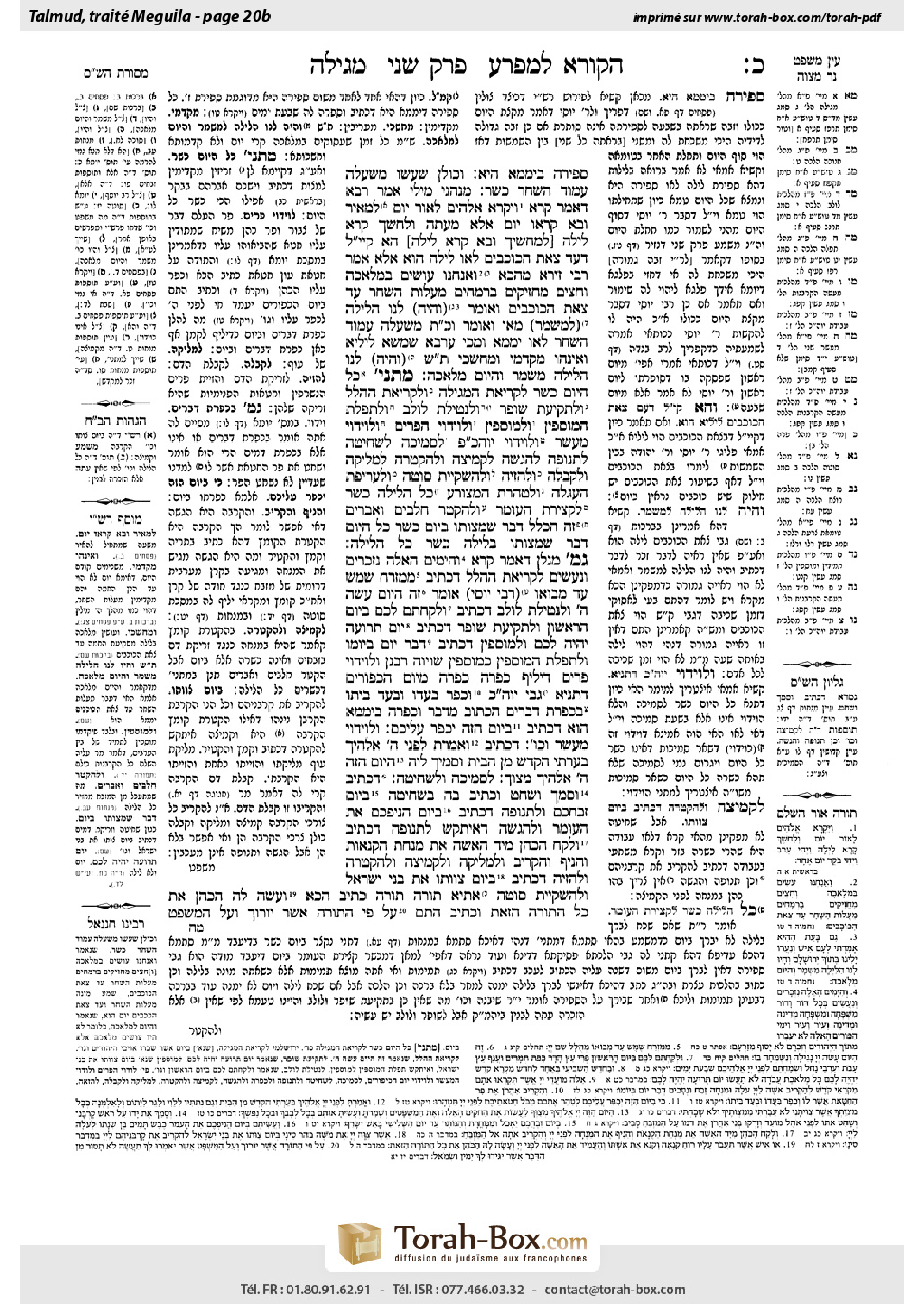
Megillah 20b: Talmud study for Daf Yomi
Daf Yomi is the daily study of one Talmud folio. Explore 37 tractates with scans, Hebrew text, Sefaria English and AI-generated French translations where annotated.
Passage selection and English or AI-generated French translation are available where the scan has annotations. Daf Study is independent of Torah-Box and Sefaria.
Browse Megillah · מגילה · All tractatesMegillah 20b text and translations
This page of Megillah includes the Aramaic text, an English translation and an AI-generated French translation, alongside the scan above.
מגילה כ׳ ב · Aramaic and Hebrew text
סְפִירָה בִּימָמָא הִיא.
וְכוּלָּן שֶׁעָשׂוּ מִשֶּׁעָלָה עַמּוּד הַשַּׁחַר כָּשֵׁר. מְנָהָנֵי מִילֵּי? אָמַר רָבָא: דְּאָמַר קְרָא: ״וַיִּקְרָא אֱלֹהִים לָאוֹר יוֹם״, לַמֵּאִיר וּבָא קְרָאוֹ ״יוֹם״.
אֶלָּא מֵעַתָּה: ״וְלַחֹשֶׁךְ קָרָא לָיְלָה״ [לַמַּחְשִׁיךְ וּבָא קָרָא לַיְלָה]? הָא קַיְימָא לַן דְּעַד צֵאת הַכּוֹכָבִים לָאו לַיְלָה הוּא!
אֶלָּא אָמַר רַבִּי זֵירָא, מֵהָכָא: ״וַאֲנַחְנוּ עוֹשִׂים בַּמְּלָאכָה וְחֶצְיָם מַחֲזִיקִים בָּרְמָחִים מֵעֲלוֹת הַשַּׁחַר עַד צֵאת הַכּוֹכָבִים״, וְאוֹמֵר: ״(וְהָיָה) לָנוּ הַלַּיְלָה (לְמִשְׁמָר)״.
מַאי וְאוֹמֵר? וְכִי תֵּימָא: מִשֶּׁעָלָה עַמּוּד הַשַּׁחַר לָאו יְמָמָא, וּמִכִּי עָרְבָא שִׁמְשָׁא לֵילְיָא, וְאִינְהוּ מְקַדְּמִי וּמְחַשְּׁכִי — תָּא שְׁמַע: ״(וְהָיָה) לָנוּ הַלַּיְלָה מִשְׁמָר וְהַיּוֹם מְלָאכָה״.
מַתְנִי׳ כׇּל הַיּוֹם כָּשֵׁר לִקְרִיאַת הַמְּגִילָּה, וְלִקְרִיאַת הַהַלֵּל, וְלִתְקִיעַת שׁוֹפָר, וְלִנְטִילַת לוּלָב, וְלִתְפִלַּת הַמּוּסָפִין, וּלְמוּסָפִין,
וּלְוִידּוּי הַפָּרִים, וּלְוִידּוּי מַעֲשֵׂר, וּלְוִידּוּי יוֹם הַכִּפּוּרִים.
לִסְמִיכָה, לִשְׁחִיטָה, לִתְנוּפָה, לְהַגָּשָׁה, לִקְמִיצָה, וּלְהַקְטָרָה, לִמְלִיקָה, וּלְקַבָּלָה, וּלְהַזָּיָה,
וּלְהַשְׁקָיַית סוֹטָה, וְלַעֲרִיפַת הָעֶגְלָה, וּלְטׇהֳרַת הַמְּצוֹרָע.
כׇּל הַלַּיְלָה כָּשֵׁר לִקְצִירַת הָעוֹמֶר, וּלְהֶקְטֵר חֲלָבִים, וְאֵבָרִים. זֶה הַכְּלָל: דָּבָר שֶׁמִּצְוָתוֹ בַּיּוֹם — כָּשֵׁר כׇּל הַיּוֹם. דָּבָר שֶׁמִּצְוָתוֹ בַּלַּיְלָה — כָּשֵׁר כׇּל הַלַּיְלָה.
גְּמָ׳ מְנָלַן? דְּאָמַר קְרָא: ״וְהַיָּמִים הָאֵלֶּה נִזְכָּרִים וְנַעֲשִׂים״. לִקְרִיאַת הַהַלֵּל, דִּכְתִיב: ״מִמִּזְרַח שֶׁמֶשׁ עַד מְבוֹאוֹ״. (רַבִּי יוֹסֵי) אוֹמֵר: ״זֶה הַיּוֹם עָשָׂה ה׳״.
וְלִנְטִילַת לוּלָב, דִּכְתִיב: ״וּלְקַחְתֶּם לָכֶם בַּיּוֹם הָרִאשׁוֹן״. וְלִתְקִיעַת שׁוֹפָר, דִּכְתִיב: ״יוֹם תְּרוּעָה יִהְיֶה לָכֶם״. וּלְמוּסָפִין, דִּכְתִיב: ״דְּבַר יוֹם בְּיוֹמוֹ״. וְלִתְפִלַּת הַמּוּסָפִין — כְּמוּסָפִין שַׁוְּיוּהָ רַבָּנַן.
וּלְוִידּוּי פָּרִים, דְּיָלֵיף ״כַּפָּרָה״ ״כַּפָּרָה״ מִיּוֹם הַכִּפּוּרִים. דְּתַנְיָא גַּבֵּי יוֹם הַכִּפּוּרִים: ״וְכִפֶּר בַּעֲדוֹ וּבְעַד בֵּיתוֹ״ — בְּכַפָּרַת דְּבָרִים הַכָּתוּב מְדַבֵּר. וְכַפָּרָה בִּימָמָא הוּא, דִּכְתִיב: ״בַּיּוֹם הַזֶּה יְכַפֵּר עֲלֵיכֶם״.
וּלְוִידּוּי מַעֲשֵׂר וְכוּ׳, דִּכְתִיב: ״וְאָמַרְתָּ לִפְנֵי ה׳ אֱלֹהֶיךָ בִּעַרְתִּי הַקֹּדֶשׁ מִן הַבַּיִת״, וּסְמִיךְ לֵיהּ: ״הַיּוֹם הַזֶּה ה׳ אֱלֹהֶיךָ מְצַוְּךָ״.
לִסְמִיכָה וְלִשְׁחִיטָה, דִּכְתִיב: ״וְסָמַךְ ... וְשָׁחַט״, וּכְתִיב בַּהּ בִּשְׁחִיטָה: ״בַּיּוֹם זִבְחֲכֶם״. וְלִתְנוּפָה, דִּכְתִיב: ״בְּיוֹם הֲנִיפְכֶם אֶת הָעוֹמֶר״.
וּלְהַגָּשָׁה — דְּאִיתַּקַּשׁ לִתְנוּפָה, דִּכְתִיב: ״וְלָקַח הַכֹּהֵן מִיַּד הָאִשָּׁה אֵת מִנְחַת הַקְּנָאוֹת וְהֵנִיף... וְהִקְרִיב״. וְלִמְלִיקָה וְלִקְמִיצָה וּלְהַקְטָרָה וּלְהַזָּיָה, דִּכְתִיב: ״בַּיּוֹם צַוּוֹתוֹ אֶת בְּנֵי יִשְׂרָאֵל״.
וּלְהַשְׁקָיַית סוֹטָה — אָתְיָא ״תּוֹרָה״ ״תּוֹרָה״. כְּתִיב הָכָא: ״וְעָשָׂה לָהּ הַכֹּהֵן אֵת כׇּל הַתּוֹרָה הַזֹּאת״, וּכְתִיב הָתָם: ״עַל פִּי הַתּוֹרָה אֲשֶׁר יוֹרוּךָ וְעַל הַמִּשְׁפָּט״.
Megillah 20b · English translation
and counting can only be done during the day and not at night, as it says: “And she shall count for herself seven days” (Leviticus 15:28), she cannot immerse herself until after sunrise, although here she has to count only one day.
§ The mishna concludes: And with regard to all these things, if one did them after daybreak they are valid. The Gemara asks: From where is this matter derived, that from daybreak it is already considered daytime? Rava said: As the verse states: “And God called the light [or] day” (Genesis 1:5), meaning: To that which was becoming lighter and lighter he called day. The Hebrew word or is not to be understood in its usual sense of light, but as a verbal noun: that which is becoming lighter and lighter. It teaches that as soon as light begins to appear in the sky it is called daytime.
The Gemara raises a difficulty with this interpretation: However, if it is so that Rava’s interpretation of this phrase is correct, the following phrase: “And the darkness [ḥoshekh] He called night” (Genesis 1:5), should be interpreted in a similar fashion: That which was becoming darker and darker He called night, so that immediately after sunset it would be considered nighttime. But don’t we maintain that until the stars come out it is not nighttime? We are forced to say that ḥoshekh literally means darkness, and similarly, or in the first part of the verse literally means light.
Rather, Rabbi Zeira said: We derive this halakha from here, as it is stated: “So we labored in the work; and half of them held the spears from the rising of the morning till the stars appeared” (Nehemiah 4:15), where “rising of the morning” means daybreak, and the next verse states: “So that in the night they may be a guard to us; and labor in the day” (Nehemiah 4:16). This demonstrates that the day begins with the dawn.
The Gemara clarifies Rabbi Zeira’s statement: What need is there for the additional verse introduced by the words “and it states”? Why does the first proof-text not suffice? The Gemara explains: The second verse comes to deflect the following possible objection: You might say that even after “the rising of the morning” it is not yet considered day, and that from the time when the sun sets it is already considered night, and in this particular incident it happened that they began their work early, before the official beginning of daytime, and remained working late, after the official end of daytime. Therefore, Rabbi Zeira continued and said: Come and hear that which is stated in the next verse: “So that in the night they may be a guard to us; and labor in the day.” The entire time during which they worked is referred to as “day,” which proves that the day begins at daybreak.
MISHNA: Although it is preferable to fulfill a particular day’s mitzva at the earliest possible hour, the entire day is a valid time for reading the Megilla; for reciting hallel; for sounding the shofar on Rosh HaShana; for taking the lulav and the other species on Sukkot; for the additional prayer recited on Shabbat and other occasions; and for the additional offerings sacrificed in the Temple on these occasions.
And the entire day is also a valid time for the confession over the bulls brought by the Sanhedrin or by the High Priest to atone for mistakes they had made in their instruction to the people; for the declaration made on the last day of Passover in the fourth and seventh year of the Sabbatical cycle, stating that one’s obligations with regard to tithes have been properly fulfilled (see Deuteronomy 26:12–15); and for the confession of sins made by the High Priest on Yom Kippur over the special offerings brought on that day.
The entire day is also a valid time for placing hands on the head of an offering; for slaughtering an offering; for waving those offerings that require waving in the Temple; for bringing meal-offerings near to the altar; for scooping out a fistful of flour from a meal-offering in order to burn it on the altar; and for burning the fistful of flour on the altar; for pinching the necks of the turtledoves and young pigeons sacrificed as offerings in the Temple; and for receiving the blood of an offering in a vessel; and for sprinkling blood on the altar and on the curtain separating between the Holy and the Holy of Holies.
And the entire day is also a valid time for giving a woman suspected by her husband of having been unfaithful [sota] to drink from the bitter waters (see Numbers 5:11–31); for breaking the neck of the heifer as part of the procedure followed when a corpse is found outside a town and it is not known who caused his death (see Deuteronomy 21:1–9); and for all the steps in the purification process of the leper (see Leviticus 14:1–20).
Correspondingly, all the mitzvot that must be performed at night may be performed anytime during the night: The entire night is a valid time for reaping the omer of barley on the night following the first day of Passover, for burning the fats of offerings that had been brought during the preceding day, and for burning the limbs of burnt-offerings. This is the principle: Something that it is a mitzva to perform during the day is valid if performed anytime during the entire day; something that it is a mitzva to perform at night is valid if performed anytime during the entire night.
GEMARA: The Gemara asks: From where do we derive that these mitzvot were commanded to be performed specifically during the day? With regard to reading the Megilla, the verse states: “That these days should be remembered and kept” (Esther 9:28). For reciting the hallel, the proof is from that which is written in hallel: “From the rising of the sun to its setting, the Lord’s name is to be praised” (Psalms 113:3). Rabbi Yosei said: The proof is from another verse in hallel: “This is the day that the Lord has made” (Psalms 118:24), implying that it is to be recited during the day and not at night.
And daytime is the time for taking the lulav, as it is written: “And you shall take for yourselves on the first day the fruit of a beautiful tree, branches of a date palm, and boughs of a dense-leaved tree, and willows of the brook” (Leviticus 23:40). Daytime is also the time for sounding the shofar, as it is written: “It is a day of sounding the shofar to you” (Numbers 29:1). Likewise, the time for the additional offerings is day, as it is written with regard to these offerings: “To sacrifice an offering made by fire to the Lord, a burnt-offering, and a meal-offering, a sacrifice, and libations, each on its own day” (Leviticus 23:37). And this is also so for the additional prayer, because the Sages made it equivalent to those additional offerings.
And daytime is the time for the confession over the bulls, as this is derived by way of a verbal analogy between one instance of atonement in this context and another instance of atonement in the context of Yom Kippur. As it is taught in a baraita with regard to Yom Kippur, the verse states: “And Aaron shall present the bull of the sin-offering that is his, and atone for himself and for his household” (Leviticus 16:11). The verse speaks of atonement achieved through words, i.e., the atonement here is not referring to the sacrifice of offerings and the sprinkling of blood, but rather to atonement achieved through confession. And the atonement of Yom Kippur is only during the day, as it is written: “For on that day will He atone for you” (Leviticus 16:30). Just as the atonement on Yom Kippur must take place during the day, so must the other cases of atonement, over other bulls brought as sin-offerings, take place during the day.
And daytime is the time for the declaration with regard to tithes, as it is written in the formula of this declaration: “And you shall say before the Lord your God, I have removed the sacred things out of my house” (Deuteronomy 26:13–15); and juxtaposed to that passage it is written: “This day the Lord your God has commanded you to do” (Deuteronomy 26:16), implying during the day and not at night.
For placing hands on the head of an offering and for slaughtering an offering, it is derived as it is written: “And he shall lay his hand upon the head of his offering, and slaughter it” (Leviticus 3:8), comparing the laying of hands to slaughtering. And it is written with regard to slaughtering: “On the day that you slaughter” (Leviticus 19:6), meaning during the day and not at night. And for waving the offerings that require waving, it is derived as it is written: “And on the day you wave the omer” (Leviticus 23:12).
And with regard to bringing the meal-offerings near the altar, it is likened to waving, as it is written: “And the priest shall take the meal-offering of jealousy from the woman’s hand, and shall wave the offering before the Lord, and sacrifice it upon the altar” (Numbers 5:25). The words “sacrifice it” are referring to bringing the offering near the altar. And for scooping out a fistful of flour, and for pinching the necks of the bird-offerings, and for burning the fistful of flour on the altar, and for sprinkling the blood, these are derived as it is written: “This is the law of the burnt-offering, of the meal-offering, and of the sin-offering, and of the guilt-offering, and of the consecration-offering, and of the sacrifice of the peace-offering; which the Lord commanded Moses on Mount Sinai on the day that he commanded the children of Israel to present their offerings” (Leviticus 7:37–38).
And with regard to giving the sota to drink from the bitter waters, this is derived from a verbal analogy between one instance of the word “Torah” and another instance of the word “Torah.” It is written here with respect to a sota: “And the priest shall execute upon her all this Torah” (Numbers 5:30), and it is written there with regard to judgment: “According to the Torah, which they shall teach you, and according to the judgment, which they shall tell you” (Deuteronomy 17:11).
Megillah 20b · Traduction française (IA)
Et le décompte ne peut se faire que pendant le jour, et non la nuit, comme il est dit : « Elle comptera pour elle-même sept jours » (Lévitique 15:28). Elle ne peut donc s’immerger qu’après le lever du soleil, bien qu’ici elle n’ait à compter qu’un seul jour.
§ La Michna conclut : Pour toutes ces choses, si on les a accomplies après le lever du jour, elles sont valides. La Guemara demande : D’où apprend-on que dès le lever du jour, on considère qu’il fait jour ? Rava dit : Comme le verset le dit : « Dieu appela la lumière [or] “jour” » (Genèse 1:5), c’est-à-dire qu’il appela « jour » ce qui devenait de plus en plus clair. Le mot hébreu or ne doit pas être compris dans son sens habituel de « lumière », mais comme un nom verbal : ce qui s’éclaircit de plus en plus. Cela enseigne que dès que la lumière commence à apparaître dans le ciel, on considère qu’il fait jour.
La Guemara soulève une difficulté contre cette interprétation : Cependant, si l’interprétation de cette expression par Rava est correcte, l’expression suivante, « Il appela les ténèbres [ḥoshekh] “nuit” » (Genèse 1:5), devrait s’interpréter de la même manière : il appela « nuit » ce qui devenait de plus en plus sombre, de sorte qu’on considérerait qu’il fait nuit immédiatement après le coucher du soleil. Mais ne tenons-nous pas que la nuit ne commence qu’à l’apparition des étoiles ? Nous sommes donc contraints de dire que ḥoshekh signifie littéralement « ténèbres » et, de même, que or, dans la première partie du verset, signifie littéralement « lumière ».
Rabbi Zeira dit plutôt : Nous déduisons cette halakha de ce passage, comme il est dit : « Nous nous consacrions au travail, tandis que la moitié d’entre eux tenait les lances, depuis le lever du matin jusqu’à l’apparition des étoiles » (Néhémie 4:15). L’expression « lever du matin » désigne l’aube, et le verset suivant dit : « Afin qu’ils soient pour nous une garde pendant la nuit, et qu’ils travaillent pendant le jour » (Néhémie 4:16). Cela démontre que le jour commence à l’aube.
La Guemara précise la déclaration de Rabbi Zeira : Pourquoi ajouter un autre verset, introduit par les mots « et il est dit » ? Pourquoi le premier verset à l’appui ne suffit-il pas ? La Guemara explique : Le second verset vient écarter l’objection suivante : On pourrait dire que même après le « lever du matin », on ne considère pas encore qu’il fait jour, et qu’à partir du coucher du soleil, on considère déjà qu’il fait nuit ; dans cet épisode précis, ils auraient commencé à travailler tôt, avant le début officiel du jour, et auraient continué tard, après sa fin officielle. Rabbi Zeira poursuit donc : « Viens et écoute » ce qui est dit dans le verset suivant : « Afin qu’ils soient pour nous une garde pendant la nuit, et qu’ils travaillent pendant le jour. » Toute la période pendant laquelle ils ont travaillé est qualifiée de « jour », ce qui prouve que le jour commence à l’aube.
MICHNA : Bien qu’il soit préférable d’accomplir la mitsva d’un jour donné à l’heure la plus précoce possible, toute la journée est un moment valable pour lire la Meguila, réciter le Hallel, sonner du chofar à Roch Hachana, prendre le loulav et les autres espèces à Souccot, réciter la prière supplémentaire dite le Chabbat et en d’autres occasions, ainsi que pour offrir les sacrifices supplémentaires au Temple lors de ces occasions.
Toute la journée est également un moment valable pour la confession concernant les taureaux apportés par le Sanhédrin ou par le grand prêtre afin d’expier les erreurs commises dans leur enseignement au peuple ; pour la déclaration faite le dernier jour de Pessa’h, la quatrième et la septième année du cycle sabbatique, attestant que l’on s’est acquitté comme il se doit de ses obligations concernant les dîmes (voir Deutéronome 26:12–15) ; et pour la confession des péchés faite par le grand prêtre à Yom Kippour au sujet des sacrifices particuliers apportés ce jour-là.
Toute la journée est également un moment valable pour poser les mains sur la tête d’un sacrifice ; pour abattre un sacrifice ; pour balancer au Temple les sacrifices qui nécessitent un balancement ; pour présenter les offrandes végétales près de l’autel ; pour prélever une poignée de farine d’une offrande végétale afin de la brûler sur l’autel, puis pour brûler cette poignée de farine sur l’autel ; pour pincer la nuque des tourterelles et des jeunes pigeons offerts en sacrifice au Temple ; pour recueillir le sang d’un sacrifice dans un récipient ; et pour asperger de sang l’autel ainsi que le rideau séparant le Saint du Saint des Saints.
Toute la journée est également un moment valable pour faire boire les eaux amères à une femme que son mari soupçonne d’infidélité [sota] (voir Nombres 5:11–31) ; pour briser la nuque de la génisse dans le cadre de la procédure suivie lorsqu’un cadavre est retrouvé hors d’une ville et que l’on ignore qui a causé sa mort (voir Deutéronome 21:1–9) ; et pour toutes les étapes du processus de purification du lépreux (voir Lévitique 14:1–20).
De même, toutes les mitsvot qui doivent être accomplies la nuit peuvent l’être à tout moment de la nuit : toute la nuit est un moment valable pour moissonner l’omer d’orge, la nuit qui suit le premier jour de Pessa’h ; pour brûler les graisses des sacrifices apportés durant la journée précédente ; et pour brûler les membres des holocaustes. Voici le principe : une chose qu’il est une mitsva d’accomplir pendant le jour est valide si elle est accomplie à n’importe quel moment de la journée ; une chose qu’il est une mitsva d’accomplir la nuit est valide si elle est accomplie à n’importe quel moment de la nuit.
GUEMARA : La Guemara demande : D’où déduisons-nous que ces mitsvot doivent être accomplies précisément pendant le jour ? Concernant la lecture de la Meguila, le verset dit : « Ces jours doivent être rappelés et observés » (Esther 9:28). Pour la récitation du Hallel, la preuve se trouve dans ces paroles du Hallel : « Du lever du soleil à son coucher, que le nom du Seigneur soit loué » (Psaumes 113:3). Rabbi Yossi dit : La preuve se trouve dans un autre verset du Hallel : « C’est le jour que le Seigneur a fait » (Psaumes 118:24), ce qui implique qu’il faut le réciter pendant le jour et non la nuit.
Le moment pour prendre le loulav est le jour, comme il est écrit : « Vous prendrez le premier jour le fruit d’un bel arbre, des branches de palmier-dattier, des rameaux d’un arbre à feuillage dense et des saules du torrent » (Lévitique 23:40). Le moment pour sonner du chofar est également le jour, comme il est écrit : « C’est un jour où l’on sonne du chofar pour vous » (Nombres 29:1). De même, le moment des sacrifices supplémentaires est le jour, comme il est écrit à leur sujet : « Pour offrir un sacrifice consumé par le feu au Seigneur : un holocauste, une offrande végétale, un sacrifice et des libations, chacun le jour qui lui est assigné » (Lévitique 23:37). Il en va également ainsi de la prière supplémentaire, car les Sages l’ont assimilée à ces sacrifices supplémentaires.
Le moment pour la confession concernant les taureaux est le jour, comme on le déduit au moyen d’une analogie verbale entre une mention de l’expiation dans ce contexte et une autre mention de l’expiation dans le contexte de Yom Kippour. En effet, une baraïta enseigne au sujet de Yom Kippour que le verset dit : « Aaron présentera le taureau du sacrifice expiatoire qui lui appartient et fera expiation pour lui-même et pour sa maison » (Lévitique 16:11). Le verset parle d’une expiation obtenue par des paroles, c’est-à-dire que l’expiation dont il est question ici ne désigne pas l’offrande de sacrifices et l’aspersion du sang, mais une expiation obtenue par la confession. Or l’expiation de Yom Kippour n’a lieu que pendant le jour, comme il est écrit : « Car c’est en ce jour qu’il fera expiation pour vous » (Lévitique 16:30). De même que l’expiation de Yom Kippour doit avoir lieu pendant le jour, les autres cas d’expiation concernant d’autres taureaux apportés comme sacrifices expiatoires doivent également avoir lieu pendant le jour.
Le moment pour la déclaration concernant les dîmes est le jour, comme il est écrit dans sa formule : « Tu diras devant le Seigneur ton Dieu : J’ai retiré de ma maison les choses consacrées » (Deutéronome 26:13–15). Juste après ce passage, il est écrit : « Aujourd’hui, le Seigneur ton Dieu t’ordonne de mettre ces lois en pratique » (Deutéronome 26:16), ce qui implique que cela doit se faire le jour et non la nuit.
Pour poser les mains sur la tête d’un sacrifice et pour abattre un sacrifice, on le déduit de ce qui est écrit : « Il posera sa main sur la tête de son sacrifice, puis il l’abattra » (Lévitique 3:8), ce qui établit un parallèle entre l’imposition des mains et l’abattage. Or il est écrit au sujet de l’abattage : « Le jour où vous l’abattrez » (Lévitique 19:6), ce qui signifie pendant le jour et non la nuit. Quant au balancement des sacrifices qui nécessitent un balancement, on le déduit de ce qui est écrit : « Le jour où vous balancerez l’omer » (Lévitique 23:12).
Pour présenter les offrandes végétales près de l’autel, on l’assimile au balancement, comme il est écrit : « Le prêtre prendra des mains de la femme l’offrande végétale de jalousie, balancera l’offrande devant le Seigneur et la fera fumer sur l’autel » (Nombres 5:25). Les mots « la fera fumer » désignent le fait d’apporter l’offrande près de l’autel. Quant au prélèvement d’une poignée de farine, au pincement de la nuque des offrandes d’oiseaux, à la combustion de la poignée de farine sur l’autel et à l’aspersion du sang, on le déduit de ce qui est écrit : « Telle est la loi de l’holocauste, de l’offrande végétale, du sacrifice expiatoire, du sacrifice de culpabilité, du sacrifice d’investiture et du sacrifice de paix, que le Seigneur ordonna à Moïse sur le mont Sinaï, le jour où il ordonna aux enfants d’Israël de présenter leurs sacrifices » (Lévitique 7:37–38).
Pour faire boire les eaux amères à la sota, on le déduit au moyen d’une analogie verbale entre une occurrence du mot « Torah » et une autre occurrence du mot « Torah ». Il est écrit ici, au sujet d’une sota : « Le prêtre exécutera à son égard toute cette Torah » (Nombres 5:30), et il est écrit là, au sujet du jugement : « Selon la Torah qu’ils t’enseigneront et selon le jugement qu’ils te diront » (Deutéronome 17:11).
Traduction française générée par IA à partir de l’édition anglaise de Sefaria. Vérifie toujours un passage avec le texte source.
Text from Sefaria: William Davidson Edition - Vocalized Aramaic (CC BY NC); William Davidson Edition - English (CC BY NC).