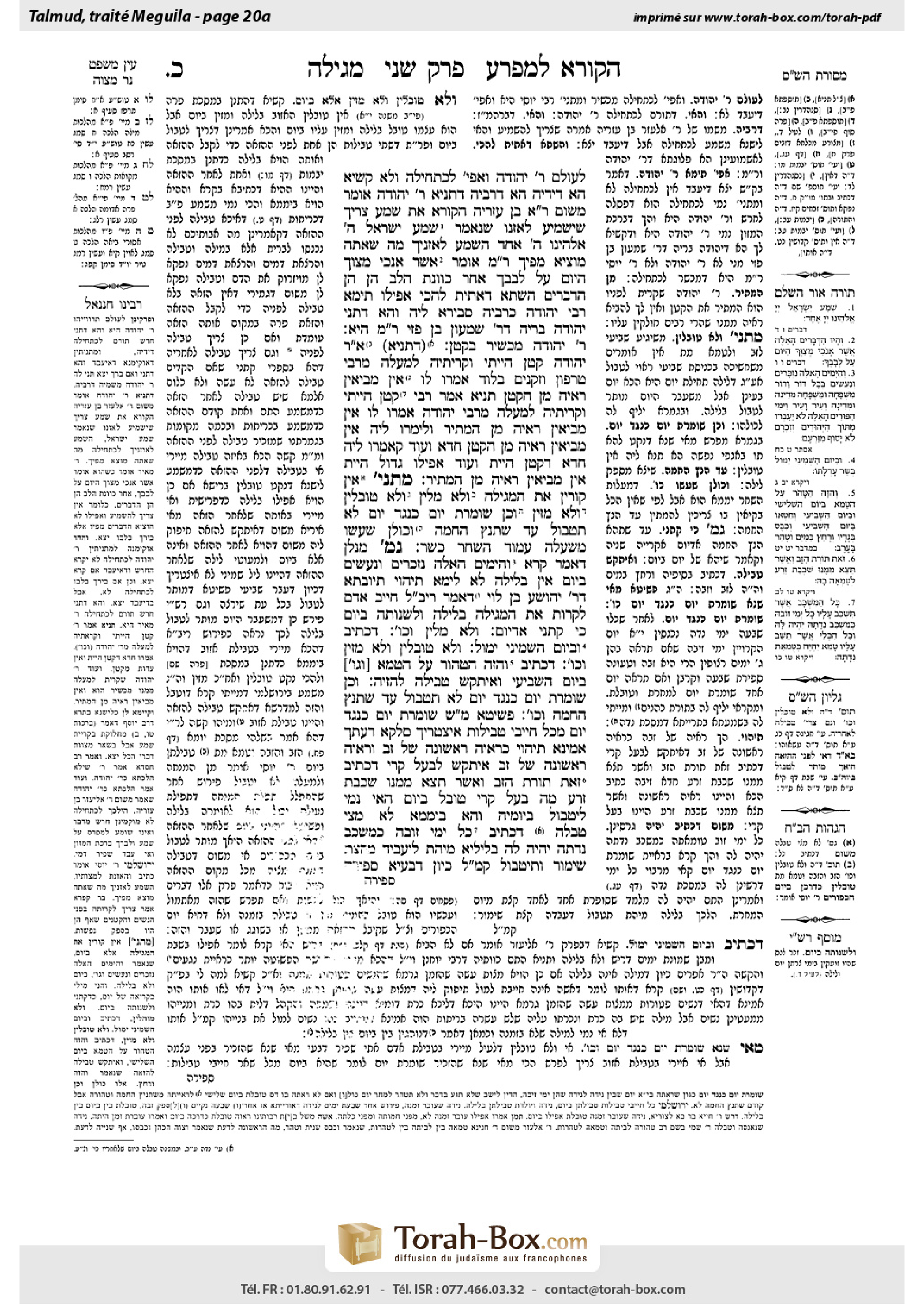
Megillah 20a: Talmud study for Daf Yomi
Daf Yomi is the daily study of one Talmud folio. Explore 37 tractates with scans, Hebrew text, Sefaria English and AI-generated French translations where annotated.
Passage selection and English or AI-generated French translation are available where the scan has annotations. Daf Study is independent of Torah-Box and Sefaria.
Browse Megillah · מגילה · All tractatesMegillah 20a text and translations
This page of Megillah includes the Aramaic text, an English translation and an AI-generated French translation, alongside the scan above.
מגילה כ׳ א · Aramaic and Hebrew text
לְעוֹלָם רַבִּי יְהוּדָה, וַאֲפִילּוּ לְכַתְּחִילָּה. וְלָא קַשְׁיָא: הָא דִּידֵיהּ, הָא דְּרַבֵּיהּ.
דְּתַנְיָא, רַבִּי יְהוּדָה אוֹמֵר מִשּׁוּם רַבִּי אֶלְעָזָר בֶּן עֲזַרְיָה: הַקּוֹרֵא אֶת שְׁמַע צָרִיךְ שֶׁיַּשְׁמִיעַ לְאׇזְנוֹ, שֶׁנֶּאֱמַר: ״שְׁמַע יִשְׂרָאֵל ה׳ אֱלֹהֵינוּ ה׳ אֶחָד״ — הַשְׁמַע לְאָזְנֶיךָ מַה שֶּׁאַתָּה מוֹצִיא מִפִּיךָ. רַבִּי מֵאִיר אוֹמֵר: ״אֲשֶׁר אָנֹכִי מְצַוְּךָ הַיּוֹם עַל לְבָבֶךָ״ — אַחַר כַּוּוֹנַת הַלֵּב הֵן הֵן הַדְּבָרִים.
הַשְׁתָּא דְּאָתֵית לְהָכִי — אֲפִילּוּ תֵּימָא רַבִּי יְהוּדָה כְּרַבֵּיהּ סְבִירָא לֵיהּ, וְהָא דְּתָנֵי יְהוּדָה בְּרֵיהּ דְּרַבִּי שִׁמְעוֹן בֶּן פַּזִּי — רַבִּי מֵאִיר הִיא.
רַבִּי יְהוּדָה מַכְשִׁיר בְּקָטָן. (דְּתַנְיָא) אָמַר רַבִּי יְהוּדָה: קָטָן הָיִיתִי, וּקְרִיתִיהָ לְמַעְלָה מֵרַבִּי טַרְפוֹן וּזְקֵנִים בְּלוֹד. אָמְרוּ לוֹ: אֵין מְבִיאִין רְאָיָה מִן הַקָּטָן.
תַּנְיָא, אָמַר רַבִּי: קָטָן הָיִיתִי, וּקְרִיתִיהָ לְמַעְלָה מֵרַבִּי יְהוּדָה, אָמְרוּ לוֹ: אֵין מְבִיאִין רְאָיָה מִן הַמַּתִּיר.
וְלֵימְרוּ לֵיהּ: אֵין מְבִיאִין רְאָיָה מִן הַקָּטָן! חֲדָא וְעוֹד קָאָמְרוּ לֵיהּ. חֲדָא: דְּקָטָן הָיִיתָ, וְעוֹד: אֲפִילּוּ גָּדוֹל הָיִיתָ — אֵין מְבִיאִין רְאָיָה מִן הַמַּתִּיר.
מַתְנִי׳ אֵין קוֹרִין אֶת הַמְּגִילָּה, וְלֹא מָלִין, וְלֹא טוֹבְלִין, וְלֹא מַזִּין, וְכֵן שׁוֹמֶרֶת יוֹם כְּנֶגֶד יוֹם — לֹא תִּטְבּוֹל עַד שֶׁתָּנֵץ הַחַמָּה. וְכוּלָּן שֶׁעָשׂוּ מִשֶּׁעָלָה עַמּוּד הַשַּׁחַר — כָּשֵׁר.
גְּמָ׳ מְנָלַן? דְּאָמַר קְרָא: ״וְהַיָּמִים הָאֵלֶּה נִזְכָּרִים וְנַעֲשִׂים״ — בַּיּוֹם אִין, בַּלַּיְלָה לָא. לֵימָא תֶּיהְוֵי תְּיוּבְתָּא דְּרַבִּי יְהוֹשֻׁעַ בֶּן לֵוִי, דְּאָמַר רַבִּי יְהוֹשֻׁעַ בֶּן לֵוִי: חַיָּיב אָדָם לִקְרוֹת אֶת הַמְּגִילָּה בַּלַּיְלָה וְלִשְׁנוֹתָהּ בַּיּוֹם! כִּי קָתָנֵי — אַדְּיוֹם.
וְלֹא מָלִין וְכוּ׳. דִּכְתִיב: ״וּבַיּוֹם הַשְּׁמִינִי יִמּוֹל״.
וְלֹא טוֹבְלִין וְלֹא מַזִּין וְכוּ׳. דִּכְתִיב: ״וְהִזָּה הַטָּהוֹר עַל הַטָּמֵא [וְגוֹ׳] בַּיּוֹם הַשְּׁבִיעִי״, וְאִיתַּקַּשׁ טְבִילָה לְהַזָּיָה.
וְכֵן שׁוֹמֶרֶת יוֹם כְּנֶגֶד יוֹם לֹא תִּטְבּוֹל עַד שֶׁתָּנֵץ הַחַמָּה וְכוּ׳. פְּשִׁיטָא! מַאי שְׁנָא שׁוֹמֶרֶת יוֹם כְּנֶגֶד יוֹם מִכׇּל חַיָּיבֵי טְבִילוֹת!
אִיצְטְרִיךְ: סָלְקָא דַּעְתָּךְ אָמֵינָא תֶּיהְוֵי כִּרְאִיָּה רִאשׁוֹנָה שֶׁל זָב — וּרְאִיָּה רִאשׁוֹנָה שֶׁל זָב אִיתַּקַּשׁ לְבַעַל קֶרִי, דִּכְתִיב: ״זֹאת תּוֹרַת הַזָּב וַאֲשֶׁר תֵּצֵא מִמֶּנּוּ שִׁכְבַת זָרַע״. מָה בַּעַל קֶרִי טוֹבֵל בַּיּוֹם — הַאי נָמֵי לִיטְבּוֹל בְּיוֹמֵיהּ.
וְהָא בִּימָמָא לָא מָצְיָא טָבְלָה, דִּכְתִיב: ״כׇּל יְמֵי זוֹבָהּ כְּמִשְׁכַּב נִדָּתָהּ יִהְיֶה לָּהּ״, בְּלֵילְיָא מִיהַת לֶיעְבֵּיד מִקְצָת שִׁימּוּר, וְתִיטְבּוֹל, קָא מַשְׁמַע לַן כֵּיוָן דְּבָעֲיָא סְפִירָה —
Megillah 20a · English translation
The Gemara answers: Actually, you can indeed say that the baraita about teruma was taught in accordance with the opinion of Rabbi Yehuda, and that Rabbi Yehuda permits a deaf person to read even ab initio, while Rabbi Yosei disqualifies a deaf person even after the fact. And the baraita that teaches that one should not recite the Grace after Meals in his heart, but if he did he has fulfilled his obligation, is not difficult, as that baraita was taught by Rabbi Yehuda as well. The explanation for this is that in this baraita, about teruma, he was teaching his own opinion, that it is permitted even ab initio, whereas in that baraita, concerning the Grace after Meals, he was teaching the opinion of his master, Rabbi Elazar ben Azarya, that one is required to hear what he is saying when he recites blessings.
As it is taught in a baraita: Rabbi Yehuda said in the name of Rabbi Elazar ben Azarya: One who recites the Shema must make it audible to his ears, as it is stated: “Hear O Israel, the Lord our God; the Lord is One” (Deuteronomy 6:4), the word “hear” indicating that you should allow your ears to hear the words you are expressing with your mouth. Rabbi Meir disagrees and says: This is not necessary, as it is also stated there: “And these words, which I command you this day shall be in your heart” (Deuteronomy 6:6), indicating that “these words,” the words of the Shema, go after the intent of the heart, as it is unnecessary to pronounce them out loud. We see that according to Rabbi Elazar ben Azarya, as cited by Rabbi Yehuda, the words must be audible to one’s ears ab initio.
The Gemara proposes a second solution: Now that you have arrived at this point and cited this baraita, you can even say that Rabbi Yehuda holds in accordance with his teacher, Rabbi Elazar ben Azarya, that a deaf person is disqualified ab initio, and it is only after the fact that his reading is valid. And as for that baraita that Rabbi Yehuda, son of Rabbi Shimon ben Pazi, taught stating that a deaf person may set aside teruma even ab initio, this was taught in accordance with the other opinion cited in the baraita, i.e., that of Rabbi Meir, who maintains that everything depends on the intent of one’s heart, and that it is not necessary to pronounce words audibly, even ab initio.
§ It was taught in the mishna: Rabbi Yehuda says that a minor is fit to read the Megilla. It is taught in a baraita: Rabbi Yehuda said: I can offer proof to my opinion, as when I was a minor I myself read the Megilla before Rabbi Tarfon and the other Elders in Lod. They said to him in response: One cannot bring a proof from the testimony of a minor. Since at the time of the supposed incident you were a minor, you are not qualified now to testify about it.
It is taught in a different baraita: Rabbi Yehuda HaNasi said: When I was a minor I read the Megilla before Rabbi Yehuda. They said to him: One cannot bring a proof that an act is permitted from the behavior of the very one who permits it. We know that Rabbi Yehuda maintains that a minor is fit to read the Megilla, and the fact that he acted in accordance with his own opinion does not prove that this is the accepted halakha.
The Gemara asks: And let them say to him, as the Sages said to Rabbi Yehuda in the previous baraita, that one cannot bring a proof from the testimony of a minor. The Gemara answers: They said one thing to him and then another; i.e., they rejected him with a twofold argument: One objection is that you were a minor at that time, and therefore your testimony is disqualified. And furthermore, even if you had been an adult at that time and you had testified that you saw some other minor read the Megilla before Rabbi Yehuda, one cannot bring a proof that an act is permitted from the behavior of the very one who permits it.
MISHNA: One may not read the Megilla, nor perform a circumcision, nor immerse himself in a ritual bath, nor sprinkle water of purification to purify people and objects that had contracted ritual impurity through contact with a corpse until after sunrise. And also a woman who observes a clean day for each day she experiences a discharge, i.e., a woman who experienced one or two days of non-menstrual bleeding, and must now wait until a day has passed without any discharge of blood before regaining ritual purity, she too may not immerse herself until the sun has risen. And with regard to all these activities that are supposed to be performed during the day, if one did them after daybreak, i.e., after the appearance of the first light of the sun, even before sunrise, they are valid, as at this point it is already considered daytime.
GEMARA: The Gemara asks: From where do we derive the halakha taught in the mishna that the Megilla may be read only during the day? The Gemara answers: As the verse states: “And that these days should be remembered and kept” (Esther 9:28). The word “days” indicates during the day, yes, but at night, no. The Gemara asks: Let us say that this is a conclusive refutation of the opinion of Rabbi Yehoshua ben Levi, as Rabbi Yehoshua ben Levi said: A person is obligated to read the Megilla at night and then repeat it during the day. The Gemara rejects this: There is no proof from here, as when the mishna teaches that the Megilla may be read only during the day, it was referring to the daytime reading, but the nighttime reading is not considered here at all.
§ The mishna continues: And one may not perform a circumcision until after sunrise, as it is written: “And on the eighth day he shall be circumcised” (Leviticus 12:3). This indicates that the circumcision must be during the day, not at night.
§ It is further taught in the mishna: And one may not immerse himself in a ritual bath, or sprinkle waters of purification until after sunrise. This too is derived from a verse, as it is written: “And the pure person shall sprinkle upon the impure on the third day and on the seventh day; and on the seventh day he shall purify himself and wash his clothes, and bathe himself in water, and shall be pure at evening” (Numbers 19:19), which teaches that the sprinkling must take place during the day and not at night. And immersion is likened to sprinkling, as it too is mentioned in the verse, “and bathe himself in water,” so that whatever is invalid with respect to sprinkling is also invalid with respect to immersion.
§ The mishna states: And also a woman who observes a day for a day may not immerse herself until the sun has risen. The Gemara asks: This is obvious. What is different about a woman who observes a day for a day, who must immerse herself in a ritual bath, from all the others who are obligated to immerse themselves, as it was already taught that one may not immerse himself in a ritual bath until it is day?
The Gemara answers: It is nevertheless necessary to mention separately the case of a woman who observes a day for a day. As, it might enter your mind to say that this woman’s bleeding should be treated like the first emission of a zav, a man who experiences a gonorrhea-like secretion, in that just as a man attains the status of a full-fledged zav once he has three such emissions, so too, a woman attains the status of a full-fledged zava once she experiences three days of bleeding. And the first emission of a zav is likened to one who experienced a seminal discharge, as it is written: “This is the halakha of him that has an issue and of him whose semen goes from him” (Leviticus 15:32). From this it is learned: Just as one who experienced a seminal discharge immerses on the same day that he had the discharge, so too, that one, the zav, may immerse himself on the same day that he had the emission.
And although this one, i.e., a woman who observes a day for a day, cannot immerse on the same day that she experienced the bleeding, as it is written: “All the days of her issue shall be to her as the bed of her menstruation” (Leviticus 15:26), which teaches that she remains the entire day of her issue in her impure state and must wait until the day is over before she can immerse herself, nevertheless, one might have said that at least during the night following the day of her issue she should be able to perform a partial observation, i.e., she should verify that part of the night has gone by without bleeding, and then immerse herself at night, without waiting until morning. Therefore, the mishna teaches us that since she is required to count one day of purity after her day of impurity,
Megillah 20a · Traduction française (IA)
La Guemara répond : En réalité, on peut bien dire que la baraïta concernant la terouma a été enseignée conformément à l’opinion de Rabbi Yehouda, selon laquelle un sourd est autorisé à lire même a priori, tandis que Rabbi Yossi invalide la lecture d’un sourd même a posteriori. Quant à la baraïta qui enseigne qu’on ne doit pas réciter le Birkat Hamazon à voix basse, mais que, si on l’a fait, on s’est acquitté de son obligation, elle ne pose pas de difficulté, car elle aussi a été enseignée par Rabbi Yehouda. En effet, dans cette baraïta sur la terouma, il enseignait sa propre opinion, selon laquelle cela est permis même a priori, tandis que dans la baraïta sur le Birkat Hamazon, il enseignait l’opinion de son maître, Rabbi Elazar ben Azarya, selon laquelle il faut entendre ce que l’on dit lorsqu’on récite les bénédictions.
Comme il est enseigné dans une baraïta : Rabbi Yehouda a dit au nom de Rabbi Elazar ben Azarya : Celui qui récite le Chéma doit le faire entendre à ses oreilles, comme il est dit : « Écoute, Israël : l’Éternel est notre Dieu, l’Éternel est Un » (Deutéronome 6,4). Le mot « écoute » indique qu’il faut faire entendre à ses oreilles les paroles que l’on prononce de sa bouche. Rabbi Meïr n’est pas d’accord et dit que cela n’est pas nécessaire, car il est également écrit dans ce passage : « Et ces paroles que je t’ordonne aujourd’hui seront dans ton cœur » (Deutéronome 6,6), ce qui indique que « ces paroles », celles du Chéma, dépendent de l’intention du cœur et qu’il n’est donc pas nécessaire de les prononcer à voix haute. Nous voyons donc que, selon Rabbi Elazar ben Azarya, cité par Rabbi Yehouda, les paroles doivent être audibles à ses oreilles a priori.
La Guemara propose une deuxième solution : À présent que vous en êtes arrivés là et que vous avez cité cette baraïta, vous pouvez même dire que Rabbi Yehouda partage l’opinion de son maître, Rabbi Elazar ben Azarya, selon laquelle un sourd est inapte a priori et que sa lecture n’est valable qu’a posteriori. Quant à la baraïta enseignée par Rabbi Yehouda, fils de Rabbi Shimon ben Pazi, qui affirme qu’un sourd peut prélever la terouma même a priori, elle a été enseignée conformément à l’autre opinion citée dans la baraïta, à savoir celle de Rabbi Meïr, qui soutient que tout dépend de l’intention du cœur et qu’il n’est pas nécessaire de prononcer les paroles de façon audible, même a priori.
§ Il a été enseigné dans la Michna : Rabbi Yehouda dit qu’un mineur est apte à lire la Meguila. Une baraïta enseigne : Rabbi Yehouda a dit : « Je peux apporter une preuve à l’appui de mon opinion, car, lorsque j’étais mineur, j’ai moi-même lu la Meguila devant Rabbi Tarfon et les autres Anciens, à Lod. » Ils lui répondirent : « On ne peut pas apporter comme preuve le témoignage d’un mineur. » Puisque, au moment de l’incident dont tu parles, tu étais mineur, tu n’es pas habilité aujourd’hui à témoigner à son sujet.
Une autre baraïta enseigne : Rabbi Yehouda HaNassi a dit : « Lorsque j’étais mineur, j’ai lu la Meguila devant Rabbi Yehouda. » Ils lui dirent : « On ne peut pas prouver qu’un acte est permis en invoquant le comportement de celui-là même qui le permet. » Nous savons que Rabbi Yehouda soutient qu’un mineur est apte à lire la Meguila ; le fait qu’il ait agi conformément à sa propre opinion ne prouve donc pas qu’il s’agit de la halakha admise.
La Guemara demande : Pourquoi ne lui ont-ils pas répondu, comme les Sages l’avaient fait à Rabbi Yehouda dans la baraïta précédente, qu’on ne peut pas apporter comme preuve le témoignage d’un mineur ? La Guemara répond : Ils lui ont opposé un argument, puis un autre ; autrement dit, ils l’ont réfuté par un double argument. Première objection : tu étais mineur à l’époque, et ton témoignage est donc irrecevable. De plus, même si tu avais été adulte à l’époque et que tu avais témoigné avoir vu un autre mineur lire la Meguila devant Rabbi Yehouda, on ne peut pas prouver qu’un acte est permis en invoquant le comportement de celui-là même qui le permet.
MICHNA : On ne peut pas lire la Meguila, pratiquer une circoncision, s’immerger dans un mikvé ni asperger les eaux de purification pour purifier des personnes ou des objets ayant contracté une impureté rituelle au contact d’un cadavre avant le lever du soleil. De même, une femme qui observe un jour de pureté pour chaque jour d’écoulement — c’est-à-dire une femme qui a eu des saignements non menstruels pendant un ou deux jours et doit maintenant attendre qu’une journée s’écoule sans aucun saignement avant de retrouver la pureté rituelle — ne peut pas non plus s’immerger avant le lever du soleil. Pour toutes ces activités qui doivent être accomplies de jour, si on les a effectuées après l’aube, c’est-à-dire après l’apparition de la première lueur du soleil, même avant son lever, elles sont valides, car à ce stade, le moment est déjà considéré comme le jour.
GUEMARA : La Guemara demande : D’où déduisons-nous la halakha enseignée dans la Michna, selon laquelle on ne peut lire la Meguila que de jour ? La Guemara répond : Du verset qui dit : « Et que ces jours soient commémorés et observés » (Esther 9,28). Le mot « jours » indique que c’est de jour, oui, mais pas la nuit. La Guemara demande : Ne peut-on pas en conclure une réfutation décisive de l’opinion de Rabbi Yehoshoua ben Levi ? Car Rabbi Yehoshoua ben Levi a dit : « Une personne est tenue de lire la Meguila la nuit, puis de la relire le jour. » La Guemara écarte cette conclusion : Cela ne constitue pas une preuve, car lorsque la Michna enseigne que la Meguila ne peut être lue que de jour, elle parle de la lecture diurne ; la lecture nocturne n’est pas du tout abordée ici.
§ La Michna poursuit : On ne peut pas pratiquer une circoncision avant le lever du soleil, comme il est écrit : « Et le huitième jour, il sera circoncis » (Lévitique 12,3). Cela indique que la circoncision doit avoir lieu de jour et non de nuit.
§ La Michna enseigne également : On ne peut pas s’immerger dans un mikvé ni asperger les eaux de purification avant le lever du soleil. Cela aussi se déduit d’un verset, comme il est écrit : « L’homme pur aspergera l’impur le troisième jour et le septième jour ; le septième jour, il se purifiera, lavera ses vêtements, se baignera dans l’eau et sera pur le soir » (Nombres 19,19). Cela enseigne que l’aspersion doit avoir lieu de jour et non de nuit. L’immersion est assimilée à l’aspersion, puisqu’elle aussi est mentionnée dans le verset, avec les mots « se baignera dans l’eau » ; par conséquent, tout ce qui invalide l’aspersion invalide également l’immersion.
§ La Michna dit : De même, une femme qui observe un jour de pureté pour chaque jour d’écoulement ne peut pas s’immerger avant le lever du soleil. La Guemara demande : Cela va de soi. En quoi une femme qui observe un jour de pureté pour chaque jour d’écoulement et qui doit s’immerger dans un mikvé diffère-t-elle de tous les autres qui sont tenus de s’immerger, alors qu’il a déjà été enseigné qu’on ne peut pas s’immerger avant qu’il fasse jour ?
La Guemara répond : Il est néanmoins nécessaire de mentionner séparément le cas d’une femme qui observe un jour de pureté pour chaque jour d’écoulement. Car on pourrait penser que ses saignements doivent être considérés comme la première émission d’un zav, un homme qui a un écoulement semblable à la gonorrhée : de même qu’un homme acquiert le statut de zav à part entière après trois émissions de ce type, une femme acquiert le statut de zava à part entière après trois jours de saignements. Or, la première émission d’un zav est assimilée à un écoulement séminal, comme il est écrit : « Telle est la loi de celui qui a un écoulement et de celui dont le sperme s’écoule » (Lévitique 15,32). On apprend de là que, de même qu’une personne ayant eu un écoulement séminal s’immerge le jour même, de même cet homme, le zav, peut s’immerger le jour même de son émission.
Et bien que cette femme, c’est-à-dire celle qui observe un jour de pureté pour chaque jour d’écoulement, ne puisse pas s’immerger le jour même où elle a eu des saignements, comme il est écrit : « Tous les jours de son écoulement seront pour elle comme le lit de ses règles » (Lévitique 15,26), ce qui enseigne qu’elle demeure impure pendant toute la journée de son écoulement et doit attendre la fin de cette journée avant de pouvoir s’immerger, on aurait néanmoins pu dire qu’au moins pendant la nuit qui suit le jour de son écoulement, elle pourrait observer une partie de la période, c’est-à-dire vérifier qu’une partie de la nuit s’est écoulée sans saignement, puis s’immerger la nuit, sans attendre le matin. La Michna nous enseigne donc que, puisqu’elle doit compter un jour de pureté après son jour d’impureté,
Traduction française générée par IA à partir de l’édition anglaise de Sefaria. Vérifie toujours un passage avec le texte source.
Text from Sefaria: William Davidson Edition - Vocalized Aramaic (CC BY NC); William Davidson Edition - English (CC BY NC).