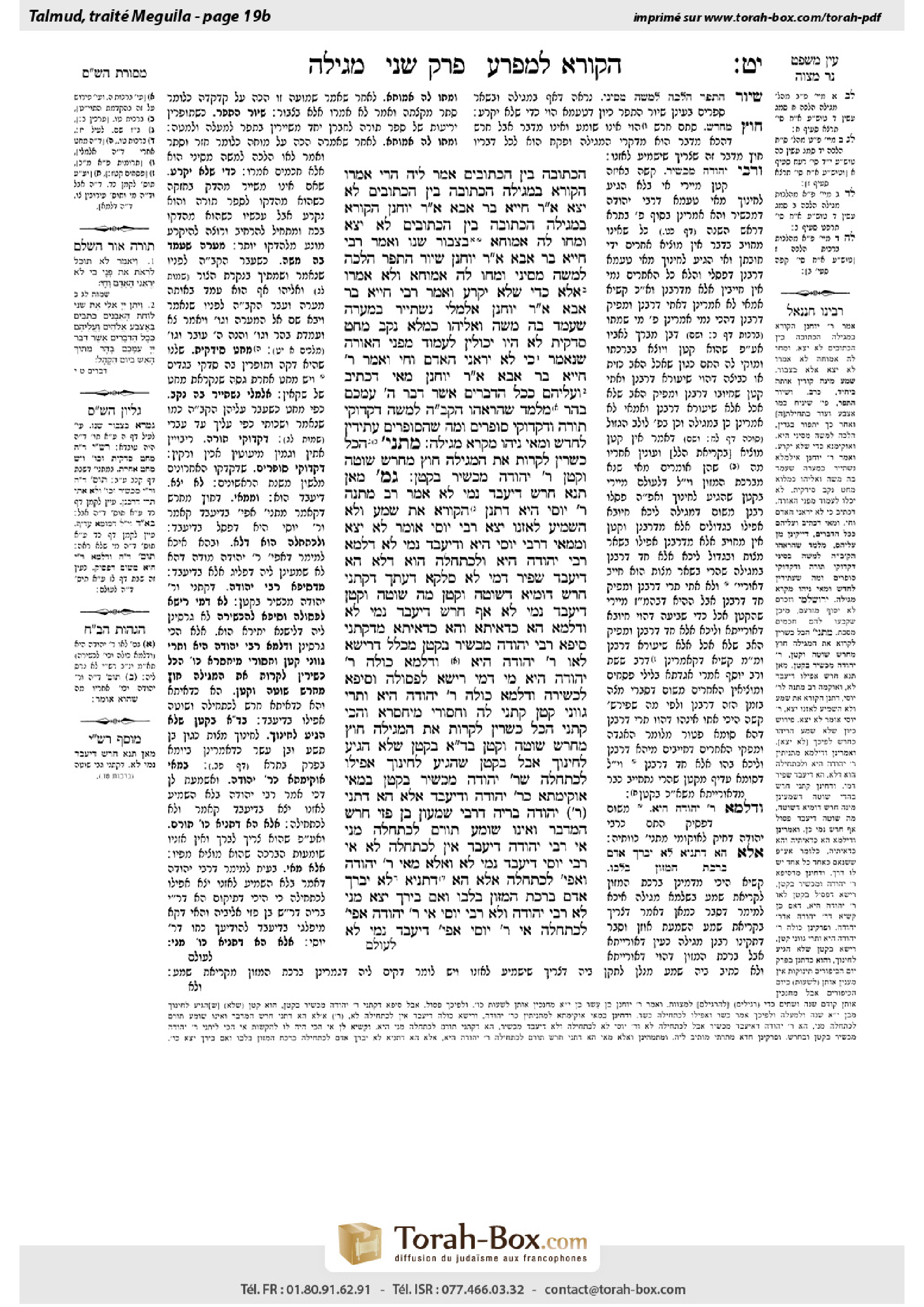
Megillah 19b: Talmud study for Daf Yomi
Daf Yomi is the daily study of one Talmud folio. Explore 37 tractates with scans, Hebrew text, Sefaria English and AI-generated French translations where annotated.
Passage selection and English or AI-generated French translation are available where the scan has annotations. Daf Study is independent of Torah-Box and Sefaria.
Browse Megillah · מגילה · All tractatesMegillah 19b text and translations
This page of Megillah includes the Aramaic text, an English translation and an AI-generated French translation, alongside the scan above.
מגילה י״ט ב · Aramaic and Hebrew text
הַכְּתוּבָה בֵּין הַכְּתוּבִים. אֲמַר לֵיהּ: הֲרֵי אָמְרוּ, הַקּוֹרֵא בִּמְגִילָּה הַכְּתוּבָה בֵּין הַכְּתוּבִים — לֹא יָצָא.
אָמַר רַבִּי חִיָּיא בַּר אַבָּא אָמַר רַבִּי יוֹחָנָן: הַקּוֹרֵא בִּמְגִילָּה הַכְּתוּבָה בֵּין הַכְּתוּבִים — לֹא יָצָא. וּמָחוּ לַהּ אַמּוֹחָא: בְּצִבּוּר שָׁנוּ.
וְאָמַר רַבִּי חִיָּיא בַּר אַבָּא אָמַר רַבִּי יוֹחָנָן: שִׁיּוּר הַתֶּפֶר — הֲלָכָה לְמֹשֶׁה מִסִּינַי. וּמָחוּ לַהּ אַמּוֹחָא: וְלֹא אָמְרוּ אֶלָּא כְּדֵי שֶׁלֹּא יִקָּרַע.
וְאָמַר רַבִּי חִיָּיא בַּר אַבָּא אָמַר רַבִּי יוֹחָנָן: אִלְמָלֵי נִשְׁתַּיֵּיר בִּמְעָרָה שֶׁעָמַד בָּהּ מֹשֶׁה וְאֵלִיָּהוּ כִּמְלֹא נֶקֶב מַחַט סִדְקִית, לֹא הָיוּ יְכוֹלִין לַעֲמוֹד מִפְּנֵי הָאוֹרָה, שֶׁנֶּאֱמַר: ״כִּי לֹא יִרְאַנִי הָאָדָם וָחָי״.
וְאָמַר רַבִּי חִיָּיא בַּר אַבָּא אָמַר רַבִּי יוֹחָנָן: מַאי דִּכְתִיב: ״וַעֲלֵיהֶם כְּכׇל הַדְּבָרִים אֲשֶׁר דִּבֶּר ה׳ עִמָּכֶם בָּהָר״ — מְלַמֵּד שֶׁהֶרְאָהוּ הַקָּדוֹשׁ בָּרוּךְ הוּא לְמֹשֶׁה דִּקְדּוּקֵי תוֹרָה וְדִקְִדּוּקֵי סוֹפְרִים וּמַה שֶּׁהַסּוֹפְרִים עֲתִידִין לְחַדֵּשׁ, וּמַאי נִיהוּ? מִקְרָא מְגִילָּה.
מַתְנִי׳ הַכֹּל כְּשֵׁרִין לִקְרוֹת אֶת הַמְּגִילָּה, חוּץ מֵחֵרֵשׁ שׁוֹטֶה וְקָטָן. רַבִּי יְהוּדָה מַכְשִׁיר בְּקָטָן.
גְּמָ׳ מַאן תְּנָא חֵרֵשׁ דִּיעֲבַד נָמֵי לָא? אָמַר רַב מַתְנָה: רַבִּי יוֹסֵי הִיא, דִּתְנַן: הַקּוֹרֵא אֶת שְׁמַע וְלֹא הִשְׁמִיעַ לְאׇזְנוֹ — יָצָא, רַבִּי יוֹסֵי אוֹמֵר: לֹא יָצָא.
וּמִמַּאי דְּרַבִּי יוֹסֵי הִיא וְדִיעֲבַד נָמֵי לָא? דִּלְמָא רַבִּי יְהוּדָה הִיא, וּלְכַתְּחִלָּה הוּא דְּלָא, הָא דִּיעֲבַד — שַׁפִּיר דָּמֵי?
לָא סָלְקָא דַּעְתָּךְ, דְּקָתָנֵי חֵרֵשׁ דּוּמְיָא דְּשׁוֹטֶה וְקָטָן: מָה שׁוֹטֶה וְקָטָן — דִּיעֲבַד נָמֵי לָא, אַף חֵרֵשׁ — דִּיעֲבַד נָמֵי לָא.
וְדִלְמָא הָא כִּדְאִיתָא וְהָא כִּדְאִיתָא! מִדְּקָתָנֵי סֵיפָא: רַבִּי יְהוּדָה מַכְשִׁיר בְּקָטָן — מִכְּלָל דְּרֵישָׁא לָאו רַבִּי יְהוּדָה הִיא.
וְדִלְמָא כּוּלַּהּ רַבִּי יְהוּדָה הִיא! מִי דָּמֵי? רֵישָׁא לִפְסוּלָה, וְסֵיפָא לִכְשֵׁירָה.
וְדִלְמָא כּוּלַּהּ רַבִּי יְהוּדָה הִיא, וּתְרֵי גַוְונֵי קָטָן קָתָנֵי לַהּ, וְחַסּוֹרֵי מִיחַסְּרָא וְהָכִי קָתָנֵי: הַכֹּל כְּשֵׁרִין לִקְרוֹת אֶת הַמְּגִילָּה חוּץ מֵחֵרֵשׁ שׁוֹטֶה וְקָטָן, בַּמֶּה דְּבָרִים אֲמוּרִים — בְּקָטָן שֶׁלֹּא הִגִּיעַ לְחִינּוּךְ, אֲבָל בְּקָטָן שֶׁהִגִּיעַ לְחִינּוּךְ — אֲפִילּוּ לְכַתְּחִלָּה. שֶׁרַבִּי יְהוּדָה מַכְשִׁיר בְּקָטָן.
בְּמַאי אוֹקֵימְתָּא — כְּרַבִּי יְהוּדָה, וְדִיעֲבַד?
אֶלָּא הָא דְּתָנֵי (רַבִּי) יְהוּדָה בְּרֵיהּ דְּרַבִּי שִׁמְעוֹן בֶּן פַּזִּי: חֵרֵשׁ הַמְדַבֵּר וְאֵינוֹ שׁוֹמֵעַ תּוֹרֵם לְכַתְּחִלָּה, מַנִּי? אִי רַבִּי יְהוּדָה — דִּיעֲבַד אִין לְכַתְּחִלָּה לָא, אִי רַבִּי יוֹסֵי — דִּיעֲבַד נָמֵי לָא.
וְאֶלָּא מַאי — רַבִּי יְהוּדָה וַאֲפִילּוּ לְכַתְּחִלָּה? אֶלָּא הָא דְּתַנְיָא: לֹא יְבָרֵךְ אָדָם בִּרְכַּת הַמָּזוֹן בְּלִבּוֹ, וְאִם בֵּירַךְ יָצָא, מַנִּי? לָא רַבִּי יְהוּדָה וְלָא רַבִּי יוֹסֵי! אִי רַבִּי יְהוּדָה — אֲפִילּוּ לְכַתְּחִלָּה, אִי רַבִּי יוֹסֵי — אֲפִילּוּ דִּיעֲבַד נָמֵי לָא!
Megillah 19b · English translation
that was written together with the rest of the Writings. Rav Yehuda said to him: The Sages have said: If one reads from a Megilla that was written together with the rest of the Writings he has not fulfilled his obligation.
Rabbi Ḥiyya bar Abba said that Rabbi Yoḥanan said: If one reads from a Megilla that was written together with the rest of the Writings he has not fulfilled his obligation. But they hit this halakha on its head, i.e., immediately after reporting this ruling they added a qualification that removed much of its force: They taught this halakha only with respect to reading the Megilla for a congregation. An individual who reads the Megilla in private fulfills his obligation even if the Megilla was written together with the rest of the Writings. Only when it is read in public must it be from a Megilla that is a separate scroll.
Rabbi Ḥiyya bar Abba also said that Rabbi Yoḥanan said: The halakha of leaving a space without stitches, i.e., that the parchment sheets of a Torah scroll must not be sewn all the way to the edge, but rather a small margin must be left at the top and at the bottom, is a halakha transmitted to Moses from Sinai, i.e., it was not written in the Torah but was received in the framework of the Oral Law. But they immediately hit this halakha on its head, explaining that this halakha is not due to the special sanctity of a Torah scroll; rather, they said that it is only so that it not rip. If the scroll is wound too forcefully, the sheets of parchment will begin to spread apart since they are not sewn together at their extremities, and the one who is winding will cease to wind it so forcefully. If the stitching went all the way to the end there would be no such warning and the stitches would cause the parchment to rip.
And Rabbi Ḥiyya bar Abba also said that Rabbi Yoḥanan said: Had there been left open a crack so much as the size of small sewing needle in the cave in which Moses and Elijah stood when God’s glory was revealed to them, as it is written: “And it shall come to pass, while My glory passes by, that I will put you in a cleft of the rock” (Exodus 33:22), and: “And he came there to a cave…and, behold, the Lord passed by” (I Kings 19:9–11), they would not have been able to endure due to the intense light that would have entered that crack, as it is stated: “For no man shall see Me and live” (Exodus 33:20).
And Rabbi Ḥiyya bar Abba further said that Rabbi Yoḥanan said: What is the meaning of that which is written: “And the Lord delivered to me two tablets of stone written with the finger of God; and on them was written according to all the words which the Lord spoke with you in the mountain” (Deuteronomy 9:10)? This teaches that the Holy One, Blessed be He, showed Moses on the mountain all the inferences that can be derived from the words of the Torah; and all the inferences that can be derived from the words of the Scribes, the early Sages; and also all the new halakhot that the Scribes were destined to introduce in the future in addition to the laws of the Torah. And what is it specifically that the Scribes would introduce in addition to the laws of the Torah? The reading of the Megilla.
MISHNA: Everyone is fit to read the Megilla, except for a deaf person, an imbecile, and a minor. Rabbi Yehuda disagrees and says that a minor is fit to read the Megilla.
GEMARA: The Gemara asks: Who is the tanna that taught that the reading of a deaf person, even after the fact, no, it is not valid? Rav Mattana said: It is Rabbi Yosei, as we learned in a mishna elsewhere (Berakhot 15a): If one recites the Shema but does not make it audible to his ears, he has nevertheless fulfilled his obligation. This is the statement of Rabbi Yehuda. Rabbi Yosei said: He has not fulfilled his obligation. Rabbi Yosei’s statement implies that one who does not hear what he is saying does not fulfill his obligation. Presumably the halakhot for Shema recitation and Megilla reading are equivalent.
The Gemara questions the assumption on which the previous discussion is based: But from where do you know that the mishna, which states that a deaf person may not read the Megilla, reflects the opinion of Rabbi Yosei, and that it means to say that even after the fact, no, one does not fulfill his obligation if the Megilla is read by a deaf person? Perhaps the mishna was taught in accordance with the opinion of Rabbi Yehuda, and it should be understood as saying that a deaf person may not read ab initio, but after the fact his reading is valid.
The Gemara rejects this proposal: This should not enter your mind, as the mishna teaches the halakha of a deaf person, an imbecile, and a minor together, implying that a deaf person is similar to an imbecile or a minor. Therefore, it may be inferred that just as the readings of an imbecile and a minor are not valid even after the fact, so too, even after the fact, no, the reading of a deaf person is not valid.
The Gemara asks: But perhaps it is not so that all three cases are equivalent. Perhaps with regard to the imbecile and the minor, this halakha is as it is, and with regard to a deaf person, that halakha is as it is. Although all three cases are taught together, this may be merely because in all three cases he may not read ab initio; there may be a difference between them with regard to their status after the fact. It is possible that the mishna means that the reading of a deaf person is valid after the fact, and is citing the opinion of Rabbi Yehuda. The Gemara rejects this: It is impossible to say that the anonymous first tanna of the mishna is Rabbi Yehuda, as from the fact that the latter clause teaches: Rabbi Yehuda says that a minor is fit, it may be inferred that the first clause of the mishna was not taught by Rabbi Yehuda.
The Gemara continues to ask: But perhaps the mishna in its entirety was taught by Rabbi Yehuda after all, but the first clause of the mishna was taught anonymously, whereas the latter clause was taught explicitly in the name of Rabbi Yehuda. The Gemara rejects this argument: Are the two parts of the mishna comparable, that they can be associated with a single Sage? The first clause of the mishna comes to disqualify the reading of a minor, whereas the latter clause comes to declare a minor fit. These two contradictory opinions therefore cannot be understood as the statement of a single Sage.
The Gemara asks: But perhaps the mishna in its entirety expresses the opinion of Rabbi Yehuda after all. And it is teaching the halakha concerning two different types of minors, and the mishna is incomplete, lacking some words of elaboration, and is teaching the following: Everyone is fit to read the Megilla except for a deaf person, an imbecile, and a minor. In what case is this statement said? Only with regard to a minor who has not reached the age of training in mitzvot. But a minor who has reached the age of training in mitzvot may read the Megilla even ab initio, as Rabbi Yehuda says that a minor who has reached that requisite age is fit to read the Megilla.
The Gemara raises a difficulty with this interpretation of the mishna: In what manner did you establish the mishna? You established it as being in accordance with the opinion of Rabbi Yehuda, and you understand the opinion of Rabbi Yehuda to be that a deaf person is disqualified from reading the Megilla ab initio, but after the fact his reading is valid.
But then that which Rabbi Yehuda, son of Rabbi Shimon ben Pazi, taught will present a difficulty, as he taught a baraita: A deaf person who can speak but cannot hear may set aside teruma even ab initio, although he cannot hear himself reciting the blessing that is recited before setting aside teruma. Upon whose opinion is this baraita based? If you say it is in accordance with the opinion of Rabbi Yehuda, that cannot be, as you have established that Rabbi Yehuda maintains that if one recites something and does not hear it, after the fact, yes, his action is valid, but he should not do so ab initio. And if you say it is in accordance with the opinion of Rabbi Yosei, this is even more difficult, as he maintains that even after the fact, no, his action is not valid. Who, then, is the Sage who would say that a deaf person may set aside teruma even ab initio?
The Gemara rejects this reasoning: Rather, what then do you propose to say, that this baraita is in accordance with Rabbi Yehuda and that Rabbi Yehuda permits a deaf person to read even ab initio, whereas Rabbi Yosei would disqualify him even after the fact? But then whose is the opinion that is represented in that which is taught in a baraita: A person should not recite the Grace after Meals in his heart, i.e., inaudibly, but if he recited it in this manner, he has fulfilled his obligation. It is the opinion of neither Rabbi Yehuda nor Rabbi Yosei. As, if it follows the opinion of Rabbi Yehuda, it should be permitted even ab initio, and if it follows the opinion of Rabbi Yosei, then even after the fact, no, this should not be valid.
Megillah 19b · Traduction française (IA)
qui avait été écrit avec le reste des Écrits. Rav Yehouda lui dit : Les Sages ont enseigné : Si quelqu’un lit dans une Meguila écrite avec le reste des Écrits, il ne s’est pas acquitté de son obligation.
Rabbi Ḥiyya bar Abba dit au nom de Rabbi Yoḥanan : Si quelqu’un lit dans une Meguila écrite avec le reste des Écrits, il ne s’est pas acquitté de son obligation. Mais ils ont aussitôt affaibli cette halakha, c’est-à-dire qu’immédiatement après avoir rapporté cette décision, ils lui ont ajouté une restriction qui en réduisait considérablement la portée : cet enseignement ne concerne que la lecture de la Meguila devant une assemblée. Un particulier qui lit la Meguila en privé s’acquitte de son obligation, même si la Meguila a été écrite avec le reste des Écrits. Ce n’est que lorsqu’elle est lue en public qu’elle doit être écrite sur un rouleau distinct.
Rabbi Ḥiyya bar Abba dit également au nom de Rabbi Yoḥanan : La règle qui consiste à laisser une marge non cousue — autrement dit, les feuilles de parchemin d’un rouleau de la Torah ne doivent pas être cousues jusqu’au bord, mais une petite marge doit être laissée en haut et en bas — est une halakha transmise à Moïse au Sinaï, c’est-à-dire qu’elle n’est pas écrite dans la Torah, mais qu’elle a été reçue dans le cadre de la Torah orale. Mais ils ont aussitôt affaibli cette halakha en expliquant qu’elle ne relève pas de la sainteté particulière d’un rouleau de la Torah ; ils ont plutôt dit qu’il s’agit simplement d’éviter qu’il ne se déchire. Si le rouleau est enroulé trop fortement, les feuilles de parchemin commenceront à s’écarter puisqu’elles ne sont pas cousues à leurs extrémités, et celui qui l’enroule cessera de le faire avec autant de force. Si les coutures allaient jusqu’au bord, rien ne l’inciterait à modérer sa force et les coutures provoqueraient la déchirure du parchemin.
Rabbi Ḥiyya bar Abba dit aussi au nom de Rabbi Yoḥanan : S’il était resté une fente, même de la taille d’une petite aiguille à coudre, dans la grotte où Moïse et Élie se tinrent lorsque la gloire de Dieu leur fut révélée, comme il est écrit : « Et il arrivera, lorsque ma gloire passera, que je te mettrai dans une fente du rocher » (Exode 33:22), et : « Il arriva là à une grotte… et voici, le Seigneur passa » (I Rois 19:9–11), ils n’auraient pas pu le supporter, à cause de l’intense lumière qui serait entrée par cette fente, comme il est dit : « Car nul homme ne peut me voir et vivre » (Exode 33:20).
Rabbi Ḥiyya bar Abba dit encore au nom de Rabbi Yoḥanan : Quel est le sens de ce qui est écrit : « Et le Seigneur me donna les deux tables de pierre, écrites du doigt de Dieu ; et sur elles étaient inscrites toutes les paroles que le Seigneur vous avait dites sur la montagne » (Deutéronome 9:10) ? Cela enseigne que le Saint, béni soit-Il, montra à Moïse sur la montagne toutes les déductions que l’on peut tirer des paroles de la Torah, toutes celles que l’on peut tirer des paroles des Scribes, les premiers Sages, ainsi que toutes les nouvelles halakhot que les Scribes devaient introduire à l’avenir en plus des lois de la Torah. Et quelle est précisément la nouveauté que les Scribes devaient introduire en plus des lois de la Torah ? La lecture de la Meguila.
MICHNA : Toute personne est apte à lire la Meguila, à l’exception d’un sourd, d’un déficient mental et d’un mineur. Rabbi Yehouda est d’un avis différent et affirme qu’un mineur est apte à lire la Meguila.
GUEMARA : La Guemara demande : Quel est le tanna qui a enseigné que la lecture faite par un sourd n’est pas valable, même après coup ? Rav Mattana dit : C’est Rabbi Yosei, comme nous l’avons appris dans une Michna ailleurs (Berakhot 15a) : Si quelqu’un récite le Chéma sans le faire entendre à ses oreilles, il s’est néanmoins acquitté de son obligation. Telle est l’opinion de Rabbi Yehouda. Rabbi Yosei dit : Il ne s’est pas acquitté de son obligation. La déclaration de Rabbi Yosei implique que celui qui n’entend pas ce qu’il dit ne s’acquitte pas de son obligation. Il semble que les règles relatives à la récitation du Chéma et à la lecture de la Meguila soient équivalentes.
La Guemara remet en question l’hypothèse sur laquelle repose la discussion précédente : Mais d’où sais-tu que la Michna, qui dit qu’un sourd ne peut pas lire la Meguila, reflète l’opinion de Rabbi Yosei et signifie que, même après coup, on ne s’acquitte pas de son obligation si la Meguila est lue par un sourd ? Peut-être la Michna a-t-elle été enseignée conformément à l’opinion de Rabbi Yehouda, et faut-il comprendre qu’un sourd ne peut pas lire a priori, mais que sa lecture est valable après coup.
La Guemara rejette cette proposition : Cette interprétation ne doit pas te venir à l’esprit, car la Michna enseigne ensemble les règles relatives à un sourd, à un déficient mental et à un mineur, ce qui implique que le sourd est comparable au déficient mental ou au mineur. On peut donc déduire que, de même que les lectures faites par un déficient mental et par un mineur ne sont pas valables même après coup, de même, la lecture faite par un sourd n’est pas valable, même après coup.
La Guemara demande : Mais peut-être les trois cas ne sont-ils pas équivalents. Peut-être la règle concernant le déficient mental et le mineur est-elle celle-ci, tandis que celle concernant le sourd est différente. Bien que les trois cas soient enseignés ensemble, c’est peut-être simplement parce que, dans les trois cas, la personne ne peut pas lire a priori ; leur statut après coup peut différer. Il est possible que la Michna signifie que la lecture d’un sourd est valable après coup et qu’elle cite l’opinion de Rabbi Yehouda. La Guemara rejette cette hypothèse : Il est impossible de dire que le premier tanna anonyme de la Michna est Rabbi Yehouda, car le fait que la dernière partie enseigne : « Rabbi Yehouda dit qu’un mineur est apte » permet de déduire que la première partie de la Michna n’a pas été enseignée par Rabbi Yehouda.
La Guemara poursuit : Mais peut-être la Michna tout entière a-t-elle bien été enseignée par Rabbi Yehouda, la première partie étant anonyme et la dernière partie étant explicitement attribuée à Rabbi Yehouda. La Guemara rejette cet argument : Les deux parties de la Michna sont-elles comparables, au point de pouvoir être attribuées à un seul Sage ? La première partie de la Michna vient invalider la lecture d’un mineur, tandis que la dernière partie vient déclarer un mineur apte. Ces deux opinions contradictoires ne peuvent donc pas être comprises comme celles d’un seul Sage.
La Guemara demande : Mais peut-être la Michna tout entière exprime-t-elle bien l’opinion de Rabbi Yehouda. Elle enseignerait alors la règle relative à deux catégories différentes de mineurs, et la Michna serait incomplète, certaines paroles explicatives ayant été omises. Elle enseignerait ce qui suit : Toute personne est apte à lire la Meguila, à l’exception d’un sourd, d’un déficient mental et d’un mineur. Dans quel cas cette déclaration s’applique-t-elle ? Uniquement à un mineur qui n’a pas atteint l’âge auquel on l’habitue à accomplir les mitsvot. Mais un mineur qui a atteint cet âge peut lire la Meguila même a priori, car Rabbi Yehouda affirme qu’un mineur ayant atteint l’âge requis est apte à lire la Meguila.
La Guemara soulève une difficulté à propos de cette interprétation de la Michna : Comment as-tu établi la Michna ? Tu l’as établie conformément à l’opinion de Rabbi Yehouda, et tu comprends cette opinion comme signifiant qu’un sourd est inapte à lire la Meguila a priori, mais que sa lecture est valable après coup.
Mais alors, l’enseignement de Rabbi Yehouda, fils de Rabbi Shimon ben Pazi, pose une difficulté, car il a enseigné dans une baraïta : Un sourd qui peut parler, mais n’entend pas, peut prélever la terouma même a priori, bien qu’il ne puisse pas entendre la bénédiction qu’il récite avant de prélever la terouma. Selon l’opinion de qui cette baraïta est-elle fondée ? Si tu dis qu’elle est conforme à l’opinion de Rabbi Yehouda, cela ne convient pas, car tu as établi que, selon Rabbi Yehouda, si quelqu’un récite quelque chose sans l’entendre, son acte est valable après coup, mais qu’il ne doit pas agir ainsi a priori. Et si tu dis qu’elle est conforme à l’opinion de Rabbi Yosei, la difficulté est encore plus grande, car selon lui, même après coup, son acte n’est pas valable. Quel est donc le Sage qui dirait qu’un sourd peut prélever la terouma même a priori ?
La Guemara rejette ce raisonnement : Alors, que proposes-tu ? Que cette baraïta est conforme à l’opinion de Rabbi Yehouda et que Rabbi Yehouda autorise un sourd à lire même a priori, tandis que Rabbi Yosei l’invaliderait même après coup ? Mais alors, quelle opinion est exprimée dans cette baraïta : « Une personne ne doit pas réciter le Birkat Hamazon à voix basse, c’est-à-dire sans émettre de son, mais si elle l’a récité ainsi, elle s’est acquittée de son obligation » ? Cette opinion n’est ni celle de Rabbi Yehouda ni celle de Rabbi Yosei. En effet, si elle suit l’opinion de Rabbi Yehouda, la récitation devrait être autorisée même a priori ; et si elle suit l’opinion de Rabbi Yosei, alors, même après coup, elle ne devrait pas être valable.
Traduction française générée par IA à partir de l’édition anglaise de Sefaria. Vérifie toujours un passage avec le texte source.
Text from Sefaria: William Davidson Edition - Vocalized Aramaic (CC BY NC); William Davidson Edition - English (CC BY NC).