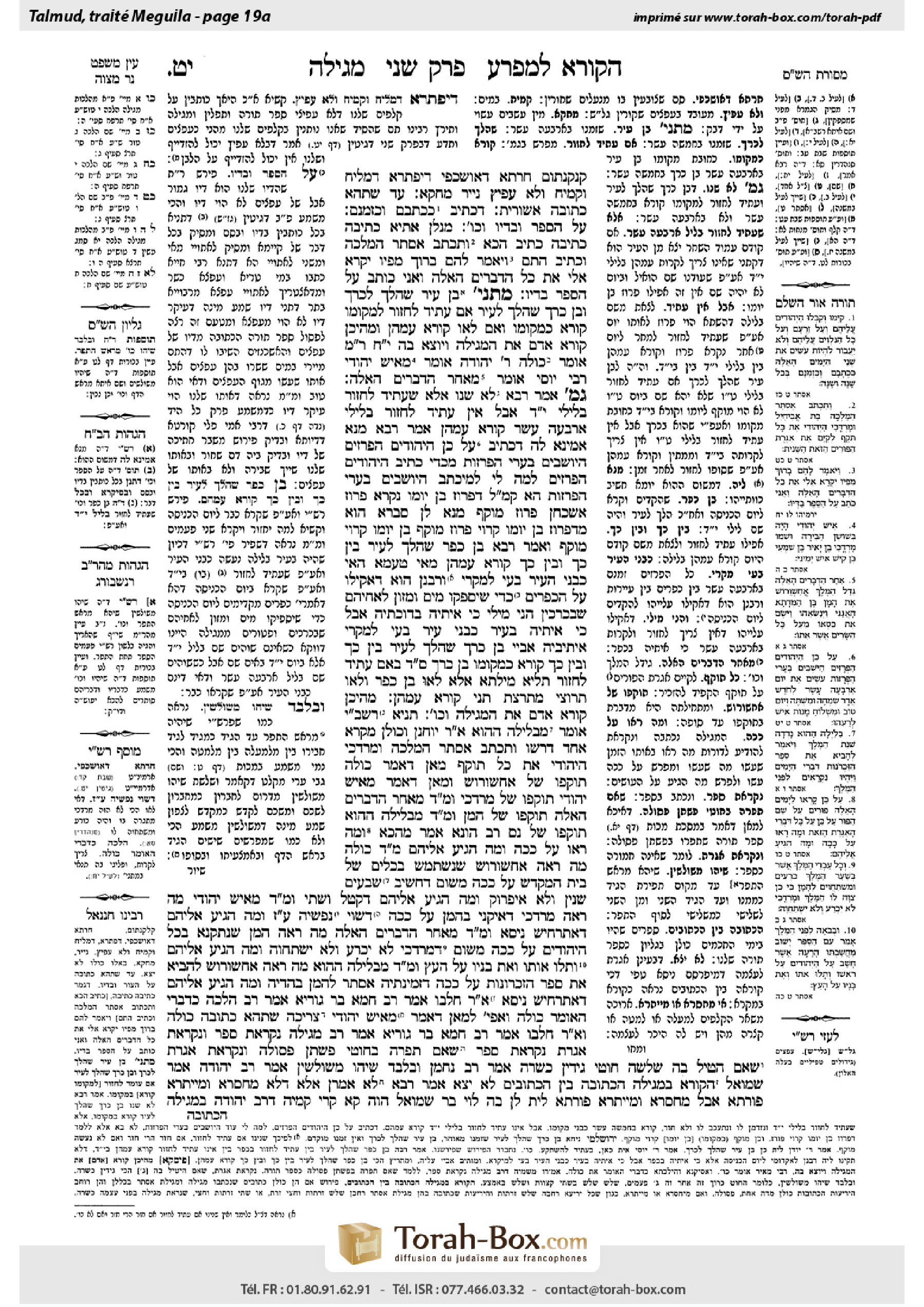
Megillah 19a: Talmud study for Daf Yomi
Daf Yomi is the daily study of one Talmud folio. Explore 37 tractates with scans, Hebrew text, Sefaria English and AI-generated French translations where annotated.
Passage selection and English or AI-generated French translation are available where the scan has annotations. Daf Study is independent of Torah-Box and Sefaria.
Browse Megillah · מגילה · All tractatesMegillah 19a text and translations
This page of Megillah includes the Aramaic text, an English translation and an AI-generated French translation, alongside the scan above.
מגילה י״ט א · Aramaic and Hebrew text
קַנְקַנְתּוֹם — חַרְתָּא דְאוּשְׁכָּפֵי. דִּיפְתְּרָא — דִּמְלִיחַ וּקְמִיחַ וְלָא עֲפִיץ. נְיָיר — מְחָקָא.
עַד שֶׁתְּהֵא כְּתוּבָה אַשּׁוּרִית, דִּכְתִיב: ״כִּכְתָבָם וְכִזְמַנָּם״.
״עַל הַסֵּפֶר וּבִדְיוֹ וְכוּ׳״. מְנָלַן? אַתְיָא ״כְּתִיבָה״ ״כְּתִיבָה״. כְּתִיב הָכָא: ״וַתִּכְתֹּב אֶסְתֵּר הַמַּלְכָּה״, וּכְתִיב הָתָם: ״וַיֹּאמֶר לָהֶם בָּרוּךְ מִפִּיו יִקְרָא אֵלַי אֵת כׇּל הַדְּבָרִים הָאֵלֶּה וַאֲנִי כּוֹתֵב עַל הַסֵּפֶר בַּדְּיוֹ״.
מַתְנִי׳ בֶּן עִיר שֶׁהָלַךְ לִכְרַךְ וּבֶן כְּרַךְ שֶׁהָלַךְ לְעִיר, אִם עָתִיד לַחְזוֹר לִמְקוֹמוֹ — קוֹרֵא כִּמְקוֹמוֹ, וְאִם לָאו — קוֹרֵא עִמָּהֶן.
וּמֵהֵיכָן קוֹרֵא אָדָם אֶת הַמְּגִילָּה וְיוֹצֵא בָּהּ יְדֵי חוֹבָה? רַבִּי מֵאִיר אוֹמֵר: כּוּלָּהּ. רַבִּי יְהוּדָה אוֹמֵר: מֵ״אִישׁ יְהוּדִי״. רַבִּי יוֹסֵי אוֹמֵר: מֵ״אַחַר הַדְּבָרִים הָאֵלֶּה״.
גְּמָ׳ אָמַר רָבָא: לֹא שָׁנוּ אֶלָּא שֶׁעָתִיד לַחְזוֹר בְּלֵילֵי אַרְבָּעָה עָשָׂר, אֲבָל אֵין עָתִיד לַחְזוֹר בְּלֵילֵי אַרְבָּעָה עָשָׂר — קוֹרֵא עִמָּהֶן. אָמַר רָבָא: מְנָא אָמֵינָא לַהּ? דִּכְתִיב: ״עַל כֵּן הַיְּהוּדִים הַפְּרָזִים הַיּוֹשְׁבִים בְּעָרֵי הַפְּרָזוֹת״. מִכְּדֵי כְּתִיב: ״הַיְּהוּדִים הַפְּרָזִים״, לְמָה לִי לְמִיכְתַּב ״הַיּוֹשְׁבִים בְּעָרֵי הַפְּרָזוֹת״? הָא קָא מַשְׁמַע לַן, דְּפָרוּז בֶּן יוֹמוֹ נִקְרָא פָּרוּז.
אַשְׁכְּחַן פָּרוּז, מוּקָּף מְנָא לַן? סְבָרָא הוּא: מִדְּפָרוּז בֶּן יוֹמוֹ קָרוּי פָּרוּז, מוּקָּף בֶּן יוֹמוֹ קָרוּי מוּקָּף.
וְאָמַר רָבָא: בֶּן כְּפָר שֶׁהָלַךְ לְעִיר — בֵּין כָּךְ וּבֵין כָּךְ קוֹרֵא עִמָּהֶן. מַאי טַעְמָא? הַאי כִּבְנֵי הָעִיר בָּעֵי לְמִקְרֵי, וְרַבָּנַן הוּא דַּאֲקִילּוּ עַל הַכְּפָרִים כְּדֵי שֶׁיְּסַפְּקוּ מַיִם וּמָזוֹן לַאֲחֵיהֶם שֶׁבַּכְּרַכִּין. הָנֵי מִילֵּי — כִּי אִיתֵיהּ בְּדוּכְתֵּיהּ, אֲבָל כִּי אִיתֵיהּ בְּעִיר — כִּבְנֵי עִיר בָּעֵי לְמִקְרֵי.
אֵיתִיבֵיהּ אַבָּיֵי: בֶּן כְּרַךְ שֶׁהָלַךְ לְעִיר — בֵּין כָּךְ וּבֵין כָּךְ קוֹרֵא כִּמְקוֹמוֹ. בֶּן כְּרַךְ סָלְקָא דַּעְתָּךְ?! בְּאִם עָתִיד לַחְזוֹר תַּלְיָא מִילְּתָא, אֶלָּא לָאו, בֶּן כְּפָר.
וְלָאו תָּרוֹצֵי מְתָרְצַתְּ? תְּנִי: קוֹרֵא עִמָּהֶן.
מֵהֵיכָן קוֹרֵא אָדָם אֶת הַמְּגִילָּה וְכוּ׳. תַּנְיָא, רַבִּי שִׁמְעוֹן בֶּן יוֹחַאי אוֹמֵר: מִ״בַּלַּיְלָה הַהוּא״.
אָמַר רַבִּי יוֹחָנָן, וְכוּלָּן מִקְרָא אֶחָד דָּרְשׁוּ: ״וַתִּכְתֹּב אֶסְתֵּר הַמַּלְכָּה וּמׇרְדֳּכַי הַיְּהוּדִי אֶת כׇּל תּוֹקֶף״, מַאן דְּאָמַר כּוּלָּהּ — תּוֹקְפּוֹ שֶׁל אֲחַשְׁוֵרוֹשׁ.
וּמַאן דְּאָמַר מֵ״אִישׁ יְהוּדִי״ — תּוֹקְפּוֹ שֶׁל מָרְדֳּכַי, וּמַאן דְּאָמַר מֵ״אַחַר הַדְּבָרִים הָאֵלֶּה״ — תּוֹקְפּוֹ שֶׁל הָמָן, וּמַאן דְּאָמַר מִ״בַּלַּיְלָה הַהוּא״ — תּוֹקְפּוֹ שֶׁל נֵס.
רַב הוּנָא אָמַר, מֵהָכָא: ״וּמָה רָאוּ עַל כָּכָה וּמָה הִגִּיעַ אֲלֵיהֶם״,
מַאן דְּאָמַר כּוּלָּהּ: ״מָה רָאָה״ — אֲחַשְׁוֵרוֹשׁ שֶׁנִּשְׁתַּמֵּשׁ בְּכֵלִים שֶׁל בֵּית הַמִּקְדָּשׁ, ״עַל כָּכָה״ — מִשּׁוּם דְּחַשֵּׁיב שִׁבְעִים שְׁנִין וְלָא אִיפְּרוּק, ״וּמָה הִגִּיעַ אֲלֵיהֶם״ — דִּקְטַל וַשְׁתִּי.
וּמַאן דְּאָמַר מֵ״אִישׁ יְהוּדִי״: ״מָה רָאָה״ — מָרְדְּכַי דְּאִיקַּנִּי בְּהָמָן, ״עַל כָּכָה״ — דְּשַׁוִּי נַפְשֵׁיהּ עֲבוֹדָה זָרָה, ״וּמָה הִגִּיעַ אֲלֵיהֶם״ — דְּאִתְרְחִישׁ נִיסָּא.
וּמַאן דְּאָמַר מֵ״אַחַר הַדְּבָרִים הָאֵלֶּה״: ״מָה רָאָה״ — הָמָן שֶׁנִּתְקַנֵּא בְּכׇל הַיְּהוּדִים, ״עַל כָּכָה״ — מִשּׁוּם דְּמָרְדְּכַי ״לֹא יִכְרַע וְלֹא יִשְׁתַּחֲוֶה״, ״וּמָה הִגִּיעַ אֲלֵיהֶם״ — ״וְתָלוּ אוֹתוֹ וְאֶת בָּנָיו עַל הָעֵץ״.
וּמַאן דְּאָמַר מִ״בַּלַּיְלָה הַהוּא״: ״מָה רָאָה״ — אֲחַשְׁוֵרוֹשׁ לְהָבִיא אֶת סֵפֶר הַזִּכְרוֹנוֹת, ״עַל כָּכָה״ — דְּזַמֵּינְתֵּיהּ אֶסְתֵּר לְהָמָן בַּהֲדֵיהּ, ״וּמָה הִגִּיעַ אֲלֵיהֶם״ — דְּאִתְרְחִישׁ נִיסָּא.
אָמַר רַבִּי חֶלְבּוֹ אָמַר רַב חָמָא בַּר גּוּרְיָא אָמַר רַב: הֲלָכָה כְּדִבְרֵי הָאוֹמֵר כּוּלָּהּ. וַאֲפִילּוּ לְמַאן דְּאָמַר מֵ״אִישׁ יְהוּדִי״ — צְרִיכָה שֶׁתְּהֵא כְּתוּבָה כּוּלָּהּ.
וְאָמַר רַבִּי חֶלְבּוֹ אָמַר רַב חָמָא בַּר גּוּרְיָא אָמַר רַב: מְגִילָּה נִקְרֵאת ״סֵפֶר״, וְנִקְרֵאת ״אִגֶּרֶת״. נִקְרֵאת ״סֵפֶר״ — שֶׁאִם תְּפָרָהּ בְּחוּטֵי פִשְׁתָּן פְּסוּלָה. וְנִקְרֵאת ״אִגֶּרֶת״ — שֶׁאִם הֵטִיל בָּהּ שְׁלֹשָׁה חוּטֵי גִידִין כְּשֵׁרָה. אָמַר רַב נַחְמָן: וּבִלְבַד שֶׁיְּהוּ מְשׁוּלָּשִׁין.
אָמַר רַב יְהוּדָה אָמַר שְׁמוּאֵל: הַקּוֹרֵא בִּמְגִילָּה הַכְּתוּבָה בֵּין הַכְּתוּבִים — לֹא יָצָא. אָמַר רָבָא: לָא אֲמַרַן אֶלָּא דְּלָא מְחַסְּרָא וּמְיַיתְּרָא פּוּרְתָּא, אֲבָל מְחַסְּרָא וּמְיַיתְּרָא פּוּרְתָּא — לֵית לַן בַּהּ.
לֵוִי בַּר שְׁמוּאֵל הֲוָה קָא קָרֵי קַמֵּיהּ דְּרַב יְהוּדָה בִּמְגִילָּה
Megillah 19a · English translation
Kankantom is what is called in Aramaic ḥarta de’ushkafei, a black dye used by shoemakers. Diftera is hide that was processed with salt and flour, but not with gallnuts. Neyar is known in Aramaic as maḥaka, paper made from reeds.
§ It was taught in the mishna: He does not fulfill his obligation unless the Megilla is written in Ashurit. The Gemara explains the reason for this: As it is written concerning the Megilla: “According to their writing and according to their time” (Esther 9:27), i.e., the way it was originally written.
The mishna concludes: He does not fulfill his obligation unless the Megilla is written “upon parchment and with ink.” The Gemara asks: From where do we derive this? The Gemara answers: It is derived by way of a verbal analogy between one instance of writing and another instance of writing. It is written here in the book of Esther: “Then Esther the queen, the daughter of Abihail, and Mordecai the Jew, wrote all the acts of power, to confirm this second letter of Purim” (Esther 9:29), and it is written there: “Then Baruch answered them: He pronounced all these words to me with his mouth, and I wrote them with ink on the parchment” (Jeremiah 36:18). Just as there the writing was with ink on parchment, so too here, a Megilla must be written with ink on parchment.
MISHNA: With regard to a resident of an unwalled town who went to a walled city, where the Megilla is read on the fifteenth of Adar, and conversely, a resident of a walled city who went to an unwalled town where it is read on the fourteenth, the following distinction applies: If he is destined to return to his original place, he reads it according to the halakha governing his own place, and if not, i.e., if he is not destined to return to his place, he reads with them, the residents of his current location.
Beginning from where must a person read the Megilla in order to fulfill his obligation? Rabbi Meir says: He must read all of it. Rabbi Yehuda says: He need read only from “There was a certain Jew” (Esther 2:5). Rabbi Yosei says: From “After these things” (Esther 3:1).
GEMARA: Rava said: They taught the mishna that one who is destined to return to his own place reads according to the halakha governing his own place only with regard to one who is destined to return to his own place on the night of the fourteenth of Adar. But if he is not destined to return on the night of the fourteenth, although he does intend to return to his own place eventually, he reads with the residents of his current location. Rava said: From where do I say this? As it is written: “Therefore the Jews of unwalled towns, who dwell in the unwalled towns, make the fourteenth day of the month Adar a day of gladness and feasting” (Esther 9:19). Since it is already written: “The Jews of unwalled towns,” why do I need it to write further, “who dwell in the unwalled towns”? It comes to teach us this: That one who is in an unwalled town even for the day is also called one who lives in an unwalled town.
The Gemara asks: We have found proof for a resident of a walled city who is temporarily located in an unwalled town. But from where do we derive the opposite case, that one from an unwalled town who is temporarily in a walled city is governed by a similar halakha? The Gemara answers: It is based on logical reasoning: Since one who is in an unwalled town for the day is called someone from an unwalled town, so too conversely, one who is in a walled city for a day is called someone from a walled city.
And Rava said further: Someone from a village, where the Megilla is read on the Monday or Thursday prior to Purim (2a), who went to a town, reads the Megilla with the residents of the town, even if he had already read it in his own place. He does so in all circumstances, whether or not he will be returning to his own village. The Gemara explains: What is the reason for this ruling? This villager should actually have read at the same time as the residents of the towns, but the Sages showed leniency toward the people of the villages and allowed them to advance their reading of the Megilla to the previous day of assembly so that they would be free to supply water and food to their brethren in the cities on the day of Purim. This, however, applies only when the villager is in his place, in the village, but when he is in a town, he is required to read like the residents of the town, and not like the villagers.
Abaye raised an objection to Rava from a baraita: A resident of a walled city who went to an unwalled town, in all circumstances, whether or not he will be returning to his own city, reads the Megilla according to the halakha governing his permanent place. The Gemara first questions the text of the baraita as it is currently worded: Can it enter your mind that the resident of a walled city always reads in accordance with the halakha governing his own place, even if he is currently situated in an unwalled town? But doesn’t the matter depend on whether or not he will be returning on Purim to his hometown, as stated in the mishna? Therefore, it is clear that the baraita must be emended. Rather, is it not to be changed to: A resident of a village who went to an unwalled town? The baraita therefore teaches that a resident of a village who is visiting in a town must read the Megilla according to the halakha governing his own place, the village, unlike Rava’s teaching.
The Gemara rejects this: But did you not emend the reading in the baraita? Since you admit that the baraita in any event requires revision, change it further and teach: He reads the Megilla with the residents of the town. This wording in the baraita would then support the opinion of Rava.
§ The mishna teaches that three Sages disagree about the question: Beginning from where must a person read the Megilla in order to fulfill his obligation? It is taught in a baraita that there is a fourth opinion as well: Rabbi Shimon bar Yoḥai says: One must start to read from “On that night” (Esther 6:1).
Rabbi Yoḥanan said: And all of these tanna’im, in arriving at their respective opinions, were expounding the same verse. As it is stated: “Then Esther the queen, the daughter of Abihail, and Mordecai the Jew, wrote about all the acts of power to confirm this second letter of Purim” (Esther 9:29). The one who said that the Megilla must be read in its entirety interprets “acts of power” as referring to the power of Ahasuerus, and so the Megilla must be read from the beginning, where the power of Ahasuerus is recounted.
And the one who said that it needs to be read from “There was a certain Jew” explains that “acts of power” is referring to the power of Mordecai. And the one who said that it needs to be read from “After these things” maintains that “acts of power” is referring to the power of Haman. And the one who said that it needs to be read from “On that night” understands that the expression is referring to the power of the miracle, which began on that night when Ahasuerus could not sleep, and therefore one must begin reading the Megilla from there.
Rav Huna said: The four Sages derived their respective opinions from here: “Therefore, because of all the words of this letter, and of that which they saw concerning this matter, and that which had befallen them, the Jews ordained...that they would keep these two days” (Esther 9:26–27).
Rav Huna continued: The one who said that the Megilla must be read in its entirety explains the verse as follows: “They saw” refers to what Ahasuerus saw, in that he used the vessels of the Temple. “Concerning this matter” was because he had calculated seventy years from the Babylonian exile and the Jews were still not redeemed, and he consequently thought that they would never enjoy deliverance. “And that which had befallen them” is referring to the fact that he had killed Vashti. Since the Megilla was written and continues to be read in order to inform future generations of all these events and what had happened to the people who were involved, and these are detailed at the beginning of the Megilla, it must be read in its entirety.
And the one who said that the Megilla needs to be read from “There was a certain Jew” interprets this verse as follows: That which Mordecai “saw” in that he acted so zealously concerning Haman. “Concerning this matter” was because Haman had made himself an object of idol worship. “And that which had befallen them” is referring to the fact that a miracle took place. Therefore one must read the Megilla from “There was a certain man,” where all this is recounted.
And the one who said that it needs to be read from “After these things” interprets the verse in this way: That which Haman “saw” in that he became incensed with all the Jews. “Concerning this matter” was because “Mordecai did not bow down, nor prostrate himself before him” (Esther 3:2). “And that which had befallen them” is referring to the fact that “he and his sons were hanged on the gallows” (Esther 9:25). Accordingly, the Megilla must be read from the first mention of Haman.
And the one who said that the Megilla must be read from “On that night” offers the following explanation: That which Ahasuerus “saw” in that he commanded to bring the book of chronicles before him. “Concerning this matter” was because Esther had invited Haman along with him to the banquet she made. “And that which had befallen them” is referring to the fact that a miracle took place. And therefore one must read the Megilla from “On that night the king could not sleep and he commanded to bring the book of chronicles.”
Rabbi Ḥelbo said that Rav Ḥama bar Gurya said that Rav said: The halakha is in accordance with the statement of the one who says that the Megilla must be read in its entirety. And moreover, even according to the one who said that it need be read only from “There was a certain Jew” and onward, the Megilla itself must nevertheless be written in its entirety.
And Rabbi Ḥelbo said further that Rav Ḥama bar Gurya said that Rav said: The Megilla is referred to as a “book” (Esther 9:32), and it is also referred to as a “letter” (Esther 9:29). It is called a book, indicating a comparison to the book of the Torah, i.e., to a Torah scroll, to teach us that if one sewed its parchment sheets together with flax threads the Megilla is unfit, just as a Torah scroll sewn in this manner is unfit. And it is called a letter to teach us that if one stitched the Megilla sheets together with only three threads of sinew, in the manner of a letter, the Megilla is fit for use, as it does not have to be completely stitched like a Torah scroll. Rav Naḥman said: This is true provided that the stitches are made in three parts.
Rav Yehuda said that Shmuel said: If one reads from a Megilla that was written together with the rest of the Writings he has not fulfilled his obligation, as it must be evident that one is reading specifically from the Megilla rather than simply reading ordinary passages from the Bible. Rava said: We said this only in a case where the parchment of the Megilla is not a little shorter or longer than the parchment of the other biblical books on the scroll and are consequently not plainly discernible among them. But if it is a little shorter or longer than the other sheets of parchment of the other biblical books, we have no problem with it, and one may read from such a scroll.
It was related that Levi bar Shmuel was once reading before Rav Yehuda from a Megilla
Megillah 19a · Traduction française (IA)
Kankantom désigne ce qu’on appelle en araméen ḥarta de’ushkafei, une teinture noire utilisée par les cordonniers. Diftera est une peau traitée au sel et à la farine, mais pas avec des noix de galle. Neyar est appelé en araméen maḥaka : c’est du papier fabriqué à partir de roseaux.
§ Il est enseigné dans la Michna : On ne s’acquitte pas de son obligation à moins que la Meguila soit écrite en écriture ashourite. La Guemara en explique la raison : car il est écrit à propos de la Meguila : « Selon leur écriture et selon leur époque » (Esther 9,27), c’est-à-dire de la manière dont elle fut écrite à l’origine.
La Michna conclut : On ne s’acquitte pas de son obligation à moins que la Meguila soit écrite « sur du parchemin et à l’encre ». La Guemara demande : D’où déduisons-nous cela ? La Guemara répond : On le déduit au moyen d’une analogie verbale entre une occurrence du terme « écrire » et une autre. Il est écrit ici, dans le livre d’Esther : « Alors la reine Esther, fille d’Abihaïl, et Mardochée le Juif écrivirent tous les actes de puissance afin de confirmer cette seconde lettre de Pourim » (Esther 9,29), et il est écrit là-bas : « Baruch leur répondit : Il m’a dicté de sa bouche toutes ces paroles, et je les ai écrites à l’encre sur le parchemin » (Jérémie 36,18). De même que là-bas l’écrit était à l’encre sur du parchemin, de même ici, la Meguila doit être écrite à l’encre sur du parchemin.
MICHNA : Concernant un habitant d’une ville non fortifiée qui s’est rendu dans une ville fortifiée, où l’on lit la Meguila le quinze Adar, et inversement, un habitant d’une ville fortifiée qui s’est rendu dans une ville non fortifiée, où l’on lit la Meguila le quatorze, la distinction suivante s’applique : s’il est destiné à retourner dans son lieu d’origine, il la lit conformément à la halakha de son propre lieu ; sinon, c’est-à-dire s’il n’est pas destiné à retourner dans son lieu d’origine, il la lit avec les habitants de l’endroit où il se trouve actuellement.
À partir de quel passage faut-il lire la Meguila pour s’acquitter de son obligation ? Rabbi Meïr dit : Il faut la lire en entier. Rabbi Yehouda dit : Il suffit de la lire à partir de « Il y avait un certain Juif » (Esther 2,5). Rabbi Yossei dit : À partir de « Après ces événements » (Esther 3,1).
GUEMARA : Rava a dit : La Michna enseigne que celui qui est destiné à retourner dans son propre lieu lit conformément à la halakha de ce lieu uniquement dans le cas où il est destiné à y retourner dans la nuit du quatorze Adar. Mais s’il n’est pas destiné à y retourner dans la nuit du quatorze, même s’il a l’intention d’y retourner plus tard, il lit avec les habitants de l’endroit où il se trouve actuellement. Rava a dit : D’où est-ce que je déduis cela ? Car il est écrit : « C’est pourquoi les Juifs des villes non fortifiées, qui habitent dans les villes non fortifiées, font du quatorze du mois d’Adar un jour de joie et de festin » (Esther 9,19). Puisqu’il est déjà écrit « les Juifs des villes non fortifiées », pourquoi fallait-il ajouter « qui habitent dans les villes non fortifiées » ? Cela vient nous enseigner ceci : celui qui se trouve dans une ville non fortifiée même pour la journée est lui aussi considéré comme quelqu’un qui habite dans une ville non fortifiée.
La Guemara demande : Nous avons trouvé une preuve concernant un habitant d’une ville fortifiée qui se trouve temporairement dans une ville non fortifiée. Mais d’où déduisons-nous le cas inverse, celui d’un habitant d’une ville non fortifiée qui se trouve temporairement dans une ville fortifiée et auquel s’applique une halakha analogue ? La Guemara répond : Cela repose sur un raisonnement logique : de même que celui qui se trouve dans une ville non fortifiée pour la journée est considéré comme quelqu’un d’une ville non fortifiée, inversement, celui qui se trouve dans une ville fortifiée pour une journée est considéré comme quelqu’un d’une ville fortifiée.
Rava a ajouté : Un habitant d’un village, où l’on lit la Meguila le lundi ou le jeudi précédant Pourim (2a), qui se rend dans une ville lit la Meguila avec les habitants de la ville, même s’il l’a déjà lue dans son propre lieu. Cela s’applique dans tous les cas, qu’il soit destiné ou non à retourner dans son village. La Guemara explique : Quelle est la raison de cette règle ? Cet habitant du village aurait dû lire en même temps que les habitants des villes, mais les Sages se sont montrés indulgents envers les habitants des villages et leur ont permis d’avancer la lecture de la Meguila au jour de rassemblement précédent, afin qu’ils soient libres d’apporter de l’eau et de la nourriture à leurs frères dans les villes le jour de Pourim. Cela ne s’applique toutefois que lorsque l’habitant du village se trouve chez lui, au village ; lorsqu’il se trouve dans une ville, il doit lire comme les habitants de la ville et non comme les habitants des villages.
Abaye a soulevé une objection à Rava à partir d’une baraïta : Un habitant d’une ville fortifiée qui s’est rendu dans une ville non fortifiée lit la Meguila, dans tous les cas, qu’il soit destiné ou non à retourner dans sa propre ville, conformément à la halakha de son lieu de résidence permanent. La Guemara met d’abord en question le texte de la baraïta tel qu’il est formulé : Peut-on concevoir que l’habitant d’une ville fortifiée lise toujours conformément à la halakha de son propre lieu, même s’il se trouve actuellement dans une ville non fortifiée ? Mais la question ne dépend-elle pas du fait qu’il soit destiné ou non à retourner dans sa ville d’origine pour Pourim, comme l’enseigne la Michna ? Il est donc clair qu’il faut corriger la baraïta. Ne faut-il pas plutôt remplacer le texte par : « Un habitant d’un village qui s’est rendu dans une ville non fortifiée » ? La baraïta enseigne donc qu’un habitant d’un village qui séjourne dans une ville doit lire la Meguila conformément à la halakha de son propre lieu, le village, contrairement à l’enseignement de Rava.
La Guemara rejette cette interprétation : Mais n’as-tu pas corrigé le texte de la baraïta ? Puisque tu reconnais qu’il faut de toute façon réviser la baraïta, corrige-la encore et enseigne : « Il lit la Meguila avec les habitants de la ville. » Cette formulation de la baraïta appuierait alors l’opinion de Rava.
§ La Michna enseigne que trois Sages sont en désaccord sur la question suivante : À partir de quel passage faut-il lire la Meguila pour s’acquitter de son obligation ? Une baraïta enseigne qu’il existe également une quatrième opinion : Rabbi Shimon bar Yoḥaï dit qu’il faut commencer la lecture à partir de « Cette nuit-là » (Esther 6,1).
Rabbi Yoḥanan a dit : Tous ces tannaïm, pour parvenir chacun à son opinion, interprétaient le même verset. Car il est dit : « Alors la reine Esther, fille d’Abihaïl, et Mardochée le Juif écrivirent au sujet de tous les actes de puissance afin de confirmer cette seconde lettre de Pourim » (Esther 9,29). Celui qui dit qu’il faut lire la Meguila en entier interprète l’expression « actes de puissance » comme désignant la puissance d’Assuérus ; il faut donc lire la Meguila depuis le début, où la puissance d’Assuérus est relatée.
Celui qui dit qu’il faut la lire à partir de « Il y avait un certain Juif » explique que les « actes de puissance » désignent la puissance de Mardochée. Celui qui dit qu’il faut la lire à partir de « Après ces événements » soutient que les « actes de puissance » désignent la puissance de Haman. Et celui qui dit qu’il faut la lire à partir de « Cette nuit-là » comprend que l’expression désigne la puissance du miracle, qui commença cette nuit-là, quand Assuérus ne put dormir ; il faut donc commencer la lecture de la Meguila à partir de là.
Rav Houna a dit : Les quatre Sages ont déduit leurs opinions respectives de ce passage : « C’est pourquoi, à cause de toutes les paroles de cette lettre, de ce qu’ils avaient vu concernant cette affaire et de ce qui leur était arrivé, les Juifs instituèrent […] qu’ils observeraient ces deux jours » (Esther 9,26-27).
Rav Houna poursuivit : Celui qui dit qu’il faut lire la Meguila en entier explique le verset ainsi : « Ils avaient vu » désigne ce qu’Assuérus avait vu, puisqu’il avait utilisé les ustensiles du Temple. « Concernant cette affaire » fait référence au fait qu’il avait calculé que soixante-dix années s’étaient écoulées depuis l’exil de Babylone et que les Juifs n’avaient toujours pas été délivrés ; il avait donc pensé qu’ils ne connaîtraient jamais la délivrance. « Et ce qui leur était arrivé » fait référence au fait qu’il avait fait tuer Vashti. Puisque la Meguila a été écrite et continue d’être lue afin d’informer les générations futures de tous ces événements et de ce qui était arrivé aux personnes concernées, et que ces faits sont détaillés au début de la Meguila, il faut la lire en entier.
Celui qui dit qu’il faut lire la Meguila à partir de « Il y avait un certain Juif » interprète le verset ainsi : Ce que Mardochée avait « vu », c’est qu’il avait agi avec tant de zèle contre Haman. « Concernant cette affaire » fait référence au fait que Haman s’était fait un objet d’idolâtrie. « Et ce qui leur était arrivé » fait référence au fait qu’un miracle avait eu lieu. Il faut donc lire la Meguila à partir de « Il y avait un certain homme », où tout cela est relaté.
Celui qui dit qu’il faut la lire à partir de « Après ces événements » interprète le verset de cette manière : Ce que Haman avait « vu », c’est qu’il s’était irrité contre tous les Juifs. « Concernant cette affaire » fait référence au fait que « Mardochée ne pliait pas le genou et ne se prosternait pas devant lui » (Esther 3,2). « Et ce qui leur était arrivé » fait référence au fait que « lui et ses fils furent pendus au gibet » (Esther 9,25). Par conséquent, il faut lire la Meguila à partir de la première mention de Haman.
Celui qui dit qu’il faut lire la Meguila à partir de « Cette nuit-là » propose l’explication suivante : Ce qu’Assuérus avait « vu », c’est qu’il avait ordonné qu’on lui apporte le livre des chroniques. « Concernant cette affaire » fait référence au fait qu’Esther avait invité Haman avec lui au banquet qu’elle avait organisé. « Et ce qui leur était arrivé » fait référence au fait qu’un miracle avait eu lieu. Il faut donc lire la Meguila à partir de « Cette nuit-là, le roi ne put dormir et il ordonna qu’on lui apporte le livre des chroniques ».
Rabbi Ḥelbo a dit que Rav Ḥama bar Gourya a dit au nom de Rav : La halakha suit l’opinion de celui qui dit qu’il faut lire la Meguila en entier. De plus, même selon celui qui dit qu’il suffit de la lire à partir de « Il y avait un certain Juif », la Meguila elle-même doit néanmoins être écrite en entier.
Et Rabbi Ḥelbo a ajouté que Rav Ḥama bar Gourya a dit au nom de Rav : La Meguila est appelée un « livre » (Esther 9,32), et elle est également appelée une « lettre » (Esther 9,29). Elle est appelée un livre, ce qui indique qu’on la compare au livre de la Torah, c’est-à-dire à un rouleau de Torah ; cela nous enseigne que si l’on a cousu ensemble ses feuilles de parchemin avec des fils de lin, la Meguila est impropre, de même qu’un rouleau de Torah cousu de cette manière est impropre. Elle est appelée une lettre afin de nous enseigner que si l’on a cousu les feuilles de la Meguila avec seulement trois fils de nerf, à la manière d’une lettre, la Meguila est apte à l’usage, car elle n’a pas besoin d’être cousue entièrement comme un rouleau de Torah. Rav Naḥman a dit : Cela est vrai à condition que les points de couture soient répartis en trois endroits.
Rav Yehouda a dit au nom de Shmouel : Si quelqu’un lit dans une Meguila écrite avec le reste des Écrits, il ne s’est pas acquitté de son obligation, car il doit être manifeste qu’il lit précisément la Meguila et non de simples passages de la Bible. Rava a dit : Nous n’avons dit cela que dans le cas où le parchemin de la Meguila n’est ni un peu plus court ni un peu plus long que celui des autres livres bibliques du rouleau et où il ne se distingue donc pas clairement parmi eux. Mais s’il est un peu plus court ou plus long que les autres feuilles de parchemin des autres livres bibliques, cela ne pose aucun problème et on peut lire dans un tel rouleau.
Il fut rapporté que Levi bar Shmouel lisait un jour devant Rav Yehouda dans une Meguila.
Traduction française générée par IA à partir de l’édition anglaise de Sefaria. Vérifie toujours un passage avec le texte source.
Text from Sefaria: William Davidson Edition - Vocalized Aramaic (CC BY NC); William Davidson Edition - English (CC BY NC).