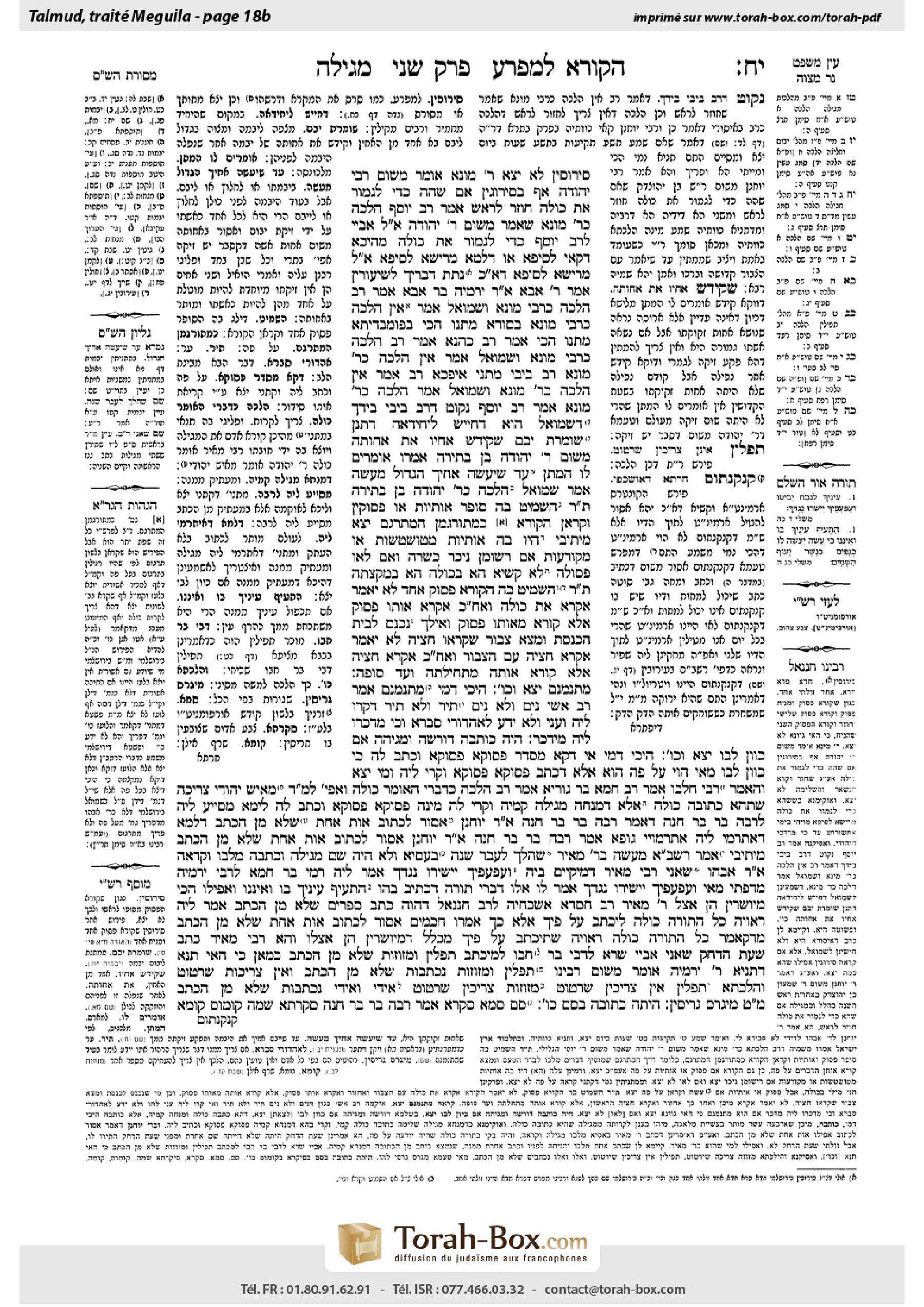
Megillah 18b: Talmud study for Daf Yomi
Daf Yomi is the daily study of one Talmud folio. Explore 37 tractates with scans, Hebrew text, Sefaria English and AI-generated French translations where annotated.
Passage selection and English or AI-generated French translation are available where the scan has annotations. Daf Study is independent of Torah-Box and Sefaria.
Browse Megillah · מגילה · All tractatesMegillah 18b text and translations
This page of Megillah includes the Aramaic text, an English translation and an AI-generated French translation, alongside the scan above.
מגילה י״ח ב · Aramaic and Hebrew text
סֵירוּסִין — לֹא יָצָא. רַבִּי מוּנָא אוֹמֵר מִשּׁוּם רַבִּי יְהוּדָה: אַף בְּסֵירוּגִין, אִם שָׁהָה כְּדֵי לִגְמוֹר אֶת כּוּלָּהּ — חוֹזֵר לָרֹאשׁ. אָמַר רַב יוֹסֵף: הֲלָכָה כְּרַבִּי מוּנָא שֶׁאָמַר מִשּׁוּם רַבִּי יְהוּדָה.
אֲמַר לֵיהּ אַבָּיֵי לְרַב יוֹסֵף: כְּדֵי לִגְמוֹר אֶת כּוּלָּהּ — מֵהֵיכָא דְּקָאֵי לְסֵיפָא, אוֹ דִלְמָא: מֵרֵישָׁא לְסֵיפָא? אֲמַר לֵיהּ: מֵרֵישָׁא לְסֵיפָא, דְּאִם כֵּן, נָתַתָּ דְּבָרֶיךָ לְשִׁיעוּרִין.
אָמַר רַבִּי אַבָּא אָמַר רַבִּי יִרְמְיָה בַּר אַבָּא אָמַר רַב: הֲלָכָה כְּרַבִּי מוּנָא. וּשְׁמוּאֵל אָמַר: אֵין הֲלָכָה כְּרַבִּי מוּנָא. בְּסוּרָא מַתְנוּ הָכִי. בְּפוּמְבְּדִיתָא מַתְנוּ הָכִי: אָמַר רַב כָּהֲנָא אָמַר רַב: הֲלָכָה כְּרַבִּי מוּנָא. וּשְׁמוּאֵל אָמַר: אֵין הֲלָכָה כְּרַבִּי מוּנָא. רַב בִּיבִי מַתְנִי אִיפְּכָא, רַב אָמַר: אֵין הֲלָכָה כְּרַבִּי מוּנָא, וּשְׁמוּאֵל אָמַר: הֲלָכָה כְּרַבִּי מוּנָא.
אָמַר רַב יוֹסֵף: נְקוֹט דְּרַב בִּיבִי בִּידָךְ, דִּשְׁמוּאֵל הוּא דְּחָיֵישׁ לִיחִידָאָה. דִּתְנַן: שׁוֹמֶרֶת יָבָם שֶׁקִּידֵּשׁ אָחִיו אֶת אֲחוֹתָהּ, מִשּׁוּם רַבִּי יְהוּדָה בֶּן בְּתִירָה אָמְרוּ, אוֹמְרִים לוֹ: הַמְתֵּן עַד שֶׁיַּעֲשֶׂה אָחִיךָ הַגָּדוֹל מַעֲשֶׂה.
אָמַר שְׁמוּאֵל: הֲלָכָה כְּרַבִּי יְהוּדָה בֶּן בְּתִירָה.
תָּנוּ רַבָּנַן: הִשְׁמִיט בָּהּ סוֹפֵר אוֹתִיּוֹת אוֹ פְּסוּקִין וּקְרָאָן הַקּוֹרֵא כִּמְתוּרְגְּמָן הַמְתַרְגֵּם — יָצָא.
מֵיתִיבִי: הָיוּ בָּהּ אוֹתִיּוֹת מְטוּשְׁטָשׁוֹת אוֹ מְקוֹרָעוֹת, אִם רִשּׁוּמָן נִיכָּר — כְּשֵׁרָה, וְאִם לָאו — פְּסוּלָה! לָא קַשְׁיָא: הָא בְּכוּלַּהּ, הָא בְּמִקְצָתַהּ.
תָּנוּ רַבָּנַן: הִשְׁמִיט בָּהּ הַקּוֹרֵא פָּסוּק אֶחָד, לֹא יֹאמַר: אֶקְרָא אֶת כּוּלָּהּ וְאַחַר כָּךְ אֶקְרָא אוֹתוֹ פָּסוּק, אֶלָּא קוֹרֵא מֵאוֹתוֹ פָּסוּק וְאֵילָךְ. נִכְנַס לְבֵית הַכְּנֶסֶת וּמָצָא צִבּוּר שֶׁקָּרְאוּ חֶצְיָהּ, לֹא יֹאמַר: אֶקְרָא חֶצְיָהּ עִם הַצִּבּוּר וְאַחַר כָּךְ אֶקְרָא חֶצְיָהּ, אֶלָּא קוֹרֵא אוֹתָהּ מִתְּחִילָּתָהּ וְעַד סוֹפָהּ.
מִתְנַמְנֵם יָצָא וְכוּ׳. הֵיכִי דָּמֵי מִתְנַמְנֵם? אָמַר רַב אָשֵׁי: נִים וְלָא נִים, תִּיר וְלָא תִּיר, דְּקָרוּ לֵיהּ וְעָנֵי וְלָא יָדַע לְאַהְדּוֹרֵי סְבָרָא, וְכִי מַדְכְּרוּ לֵיהּ מִידְּכַר.
הָיָה כּוֹתְבָהּ דּוֹרְשָׁהּ וּמַגִּיהָהּ אִם כִּוֵּון לִבּוֹ יָצָא וְכוּ׳. הֵיכִי דָמֵי? אִי דְּקָא מְסַדַּר פְּסוּקָא פְּסוּקָא וְכָתֵב לַהּ, כִּי כִּוֵּון לִבּוֹ מַאי הָוֵי? עַל פֶּה הוּא! אֶלָּא דְּכָתֵב פְּסוּקָא פְּסוּקָא וְקָרֵי לֵיהּ,
וּמִי יָצָא? וְהָאָמַר רַבִּי חֶלְבּוֹ אָמַר רַב חָמָא בַּר גּוּרְיָא אָמַר רַב: הֲלָכָה כְּדִבְרֵי הָאוֹמֵר כּוּלָּהּ. וַאֲפִילּוּ לְמַאן דְּאָמַר ״מֵאִישׁ יְהוּדִי״ — צְרִיכָה שֶׁתְּהֵא כְּתוּבָה כּוּלָּהּ!
אֶלָּא: דְּמַנְּחָה מְגִילָּה קַמֵּיהּ וְקָרֵי (לַהּ) מִינַּהּ פְּסוּקָא פְּסוּקָא וְכָתַב לָהּ. לֵימָא מְסַיַּיע לֵיהּ לְרַבָּה בַּר בַּר חָנָה, דְּאָמַר רַבָּה בַּר בַּר חָנָה אָמַר רַבִּי יוֹחָנָן: אָסוּר לִכְתּוֹב אוֹת אַחַת שֶׁלֹּא מִן הַכְּתָב. דִּלְמָא דְּאִתְרְמִי לֵיהּ אִתְרְמוֹיֵי.
גּוּפָא, אָמַר רַבָּה בַּר בַּר חָנָה אָמַר רַבִּי יוֹחָנָן: אָסוּר לִכְתּוֹב אוֹת אַחַת שֶׁלֹּא מִן הַכְּתָב. מֵיתִיבִי, אָמַר רַבִּי שִׁמְעוֹן בֶּן אֶלְעָזָר: מַעֲשֶׂה בְּרַבִּי מֵאִיר שֶׁהָלַךְ לְעַבֵּר שָׁנָה בְּעַסְיָא, וְלֹא הָיָה שָׁם מְגִילָּה וּכְתָבָהּ מִלִּבּוֹ — וּקְרָאָהּ!
אָמַר רַבִּי אֲבָהוּ: שָׁאנֵי רַבִּי מֵאִיר דְּמִיקַּיַּים בֵּיהּ ״וְעַפְעַפֶּיךָ יַיְשִׁירוּ נֶגְדְּךָ״. אֲמַר לֵיהּ רָמֵי בַּר חָמָא לְרַבִּי יִרְמְיָה מִדִּפְתִּי: מַאי ״וְעַפְעַפֶּיךָ יַיְשִׁירוּ נֶגְדְּךָ״? אָמַר לוֹ: אֵלּוּ דִּבְרֵי תוֹרָה, דִּכְתִיב בְּהוּ: ״הֲתָעִיף עֵינֶיךָ בּוֹ וְאֵינֶנּוּ״, וַאֲפִילּוּ הָכִי מְיוּשָּׁרִין הֵן אֵצֶל רַבִּי מֵאִיר.
רַב חִסְדָּא אַשְׁכְּחֵיהּ לְרַב חֲנַנְאֵל דַּהֲוָה כָּתֵב סְפָרִים שֶׁלֹּא מִן הַכְּתָב, אֲמַר לֵיהּ: רְאוּיָה כׇּל הַתּוֹרָה כּוּלָּהּ לִיכָּתֵב עַל פִּיךְ, אֶלָּא כָּךְ אָמְרוּ חֲכָמִים: אָסוּר לִכְתּוֹב אוֹת אַחַת שֶׁלֹּא מִן הַכְּתָב. מִדְּקָאָמַר: כׇּל הַתּוֹרָה כּוּלָּהּ רְאוּיָה שֶׁתִּיכָּתֵב עַל פִּיךְ, מִכְּלָל דִּמְיוּשָּׁרִין הֵן אֶצְלוֹ, וְהָא רַבִּי מֵאִיר כָּתַב? שְׁעַת הַדְּחָק שָׁאנֵי.
אַבָּיֵי שְׁרָא לִדְבֵי בַּר חָבוּ לְמִיכְתַּב תְּפִלִּין וּמְזוּזוֹת שֶׁלֹּא מִן הַכְּתָב. כְּמַאן? כִּי הַאי תַּנָּא, דְּתַנְיָא: רַבִּי יִרְמְיָה אוֹמֵר מִשּׁוּם רַבֵּינוּ: תְּפִלִּין וּמְזוּזוֹת נִכְתָּבוֹת שֶׁלֹּא מִן הַכְּתָב, וְאֵין צְרִיכוֹת שִׂרְטוּט.
וְהִלְכְתָא: תְּפִלִּין אֵין צְרִיכִין שִׂרְטוּט, מְזוּזוֹת צְרִיכִין שִׂרְטוּט. אִידֵּי וְאִידֵּי נִכְתָּבוֹת שֶׁלֹּא מִן הַכְּתָב. מַאי טַעְמָא — מִיגְרָס גְּרִיסִין.
הָיְתָה כְּתוּבָה בְּסַם כּוּ׳. סַם — סַמָּא. סִקְרָא, אָמַר רַבָּה בַּר בַּר חָנָה: סְקַרְתָּא שְׁמַהּ. קוֹמוֹס — קוֹמָא.
Megillah 18b · English translation
But if he reads it out of order, i.e., if he changes the order of the words or verses of the Megilla, he has not fulfilled his obligation. Rabbi Mona said in the name of Rabbi Yehuda: Even when he reads it at intervals, if he pauses and interrupts his reading long enough for one to finish reading the whole Megilla during that time, he must go back to the beginning and start again. Rav Yosef said: The halakha is in accordance with the opinion of Rabbi Mona, who stated his opinion in the name of Rabbi Yehuda.
Abaye said to Rav Yosef: When Rabbi Mona said: Long enough for one to finish reading the whole Megilla, did he mean from the verse where he is now until the end? Or perhaps he meant long enough to read the entire Megilla from the beginning until the end. He said to him: Rabbi Mona meant from the beginning until the end, as if it were so that he meant from where he paused until the end of the Megilla, you would be subjecting your statement to the varying circumstances of each case. There would be no standard principle to determine the length of a permitted pause; in each case, depending on where one stopped, it would take a different amount of time to finish the Megilla until the end. And the Sages did not institute measures that are not standardized.
Rabbi Abba said that Rabbi Yirmeya bar Abba said: Rav said that the halakha is in accordance with the opinion of Rabbi Mona, but Shmuel said that the halakha is not in accordance with the opinion of Rabbi Mona. The Gemara elaborates: This is how they taught the opinions of the Sages in Sura. However, in Pumbedita they taught it slightly differently, like this: Rav Kahana said that Rav said that the halakha is in accordance with the opinion of Rabbi Mona, but Shmuel said that the halakha is not in accordance with the opinion of Rabbi Mona. Rav Beivai taught the opposite: Rav said that the halakha is not in accordance with the opinion of Rabbi Mona, but Shmuel said that the halakha is in accordance with the opinion of Rabbi Mona.
Rav Yosef said: Grasp the version of Rav Beivai in your hand, i.e., accept it as the most authoritative one. It appears to be correct, as we know that Shmuel takes into consideration even an individual dissenting opinion when it is more stringent than the majority opinion. The Gemara proves its assertion about Shmuel: As we learned in a mishna (Yevamot 41a) with regard to a different matter, the case of a widow whose husband died childless and who was waiting for one of his surviving brothers to perform the required levirate marriage with her or, alternatively, to release her with the ḥalitza ceremony: In a case where a woman was waiting for her brother-in-law and in the meantime one of her deceased husband’s brothers betrothed this woman’s sister, they said in the name of Rabbi Yehuda ben Beteira: We say to this brother: Wait before marrying your betrothed until your older brother acts, performing the levirate marriage or ḥalitza. The reason for this is that before levirate marriage or ḥalitza is performed, all the brothers are considered, by rabbinic decree, to have a quasi-marital connection with the widow. Consequently, just as one may not marry his wife’s sister, he may not marry the sister of a woman who is waiting for him to perform levirate marriage. The Sages, however, disagree with Rabbi Yehuda ben Beteira and maintain that only the oldest of the brothers is considered bound to the widow, as he is the primary candidate to perform these acts. Consequently, the widow has no connection at all with the other brothers.
And Shmuel said: The halakha is in accordance with the opinion of Rabbi Yehuda ben Beteira. This demonstrates that Shmuel takes into consideration the opinion of a single Sage against the majority when that minority opinion is more stringent than the majority opinion.
§ The Sages taught in a baraita: If the scribe who wrote the Megilla omitted letters or even complete verses when he wrote it, and the reader read these missing items as a translator would do when translating, i.e., he recited the missing parts by heart, he has fulfilled his obligation. Missing material in a Megilla and reading words or verses by heart do not invalidate the reading.
The Gemara raises an objection from another baraita: If a Megilla contains letters that are blurred or torn, the following distinction applies: If their imprint is still visible, the Megilla is fit for reading, but if not, it is unfit. This baraita indicates that even the omission of several letters invalidates the Megilla. The Gemara resolves the contradiction between the two baraitot: This is not difficult. This second baraita, which says that a Megilla with blurred or torn letters is unfit, is referring to a case where this is so throughout the whole of the Megilla; whereas this first baraita, which says that a Megilla is fit even if whole verses are missing, is referring to a case where the missing material is in only part of it.
The Sages taught in a baraita: If the reader of the Megilla omitted one verse, he may not say: I will continue to read the whole of the Megilla in order, and afterward I will go back and read that verse that I omitted. Rather, he must go back and read from that verse that he omitted and continue from there to the end of the Megilla. Similarly, if one enters a synagogue and encounters a congregation that has already read half of the Megilla, he may not say: I will read the second half of the Megilla with the congregation, and afterward I will go back and read the first half. Rather, he must go back and read it in its proper order from the beginning until the end.
§ It is taught in the mishna: If one read the Megilla while he is dozing off, he has fulfilled his obligation. The Gemara asks: What are the circumstances of the case of dozing off? Rav Ashi said: It is referring to a situation in which one is asleep yet not fully asleep, awake yet not fully awake. If someone calls him he answers. And he is in a mental state in which he does not know how to provide an answer that requires logical reasoning, but when people remind him about something that has happened, he remembers it.
§ The mishna continues: If one was writing a Megilla, or expounding upon it, or correcting it, and he read all its words as he was doing so, if he had intent to fulfill his obligation with that reading he has fulfilled his obligation. The Gemara asks: What are the circumstances of this case? If he was articulating each verse of the Megilla and then writing it down, what of it that he intended to fulfill his obligation with that reading, since he recited those words by heart? Rather, it must be that he first wrote each verse in the Megilla and then read it out.
The Gemara asks: But does one really fulfill his obligation in this way? Didn’t Rabbi Ḥelbo say that Rav Ḥama bar Gurya said that Rav said: The halakha is in accordance with the statement of the one who says that the Megilla must be read in its entirety in order to fulfill one’s obligation. And moreover, he said that even according to the one who said that one need not read the entire Megilla, but only from “There was a certain Jew” (Esther 2:5) and onward, the Megilla itself must nevertheless be written in its entirety. How, then, can it be suggested that one who is reading each verse as he writes it can fulfill his obligation by reading from a Megilla that is not yet written to the end?
The Gemara answers: Rather, this is a case in which a complete Megilla is lying before him and he is copying from it, and he was reading from that complete Megilla verse by verse and then writing each verse in his new copy. The Gemara proposes: Let us say that this supports the opinion of Rabba bar bar Ḥana, as Rabba bar bar Ḥana said that Rabbi Yoḥanan said: It is prohibited to write even a single letter of the Bible when not copying from a written text. Since it was necessary to explain the mishna as addressing a case in which one was copying a Megilla out of a written text lying before him, this supports Rabbi Yoḥanan’s ruling. The Gemara rejects this: This is not a proof, as perhaps the mishna is merely dealing with a case where this is what happened to be what occurred, that one happened to be copying the text from an existing Megilla, but it is not a requirement to do this.
The Gemara examines Rabba bar bar Ḥana’s statement. With regard to the matter itself, Rabba bar bar Ḥana said that Rabbi Yoḥanan said: It is prohibited to write even a single letter of the Bible when not copying from a written text. The Gemara raises an objection from a baraita: Rabbi Shimon ben Elazar said: One Adar there was an incident involving Rabbi Meir, who went to intercalate the year in Asia Minor, as, owing to persecutory decrees, he could not do this in Eretz Yisrael. And there was no Megilla there when Purim arrived, so he wrote a Megilla by heart and read from it.
Rabbi Abbahu said: Rabbi Meir is different, as in him is fulfilled the verse: “And let your eyelids look straight before you” (Proverbs 4:25), and with regard to this verse, Rami bar Ḥama said to Rabbi Yirmeya of Difti: What is the meaning of the phrase “and let your eyelids [afapekha],” from the root a-p-p, “look straight [yaishiru] before you”? He said to him: This is referring to the words of the Torah, which are difficult to remember exactly, and with regard to which it is written: “Will you glance upon it fleetingly [hata’if ], from the root a-p-p, with your eyes? It is already gone” (Proverbs 23:5), but nevertheless they remain exact [meyusharin] in the memory of Rabbi Meir, since he knows them all by heart.
It was related that Rav Ḥisda once found Rav Ḥananel writing Torah scrolls, but he was not copying them from a written text, as he knew it all by heart. He said to him: It is fitting for the entire Torah to be written by your mouth, i.e., relying on your memory, but this is what the Sages said: It is prohibited to write even a single letter of the Bible when not copying from a written text. The Gemara asks: Since Rav Ḥisda said to him: The entire Torah is fitting to be written by your mouth, it may be concluded by inference that the words of the Torah were exact in his memory, i.e., that Rav Ḥananel enjoyed total mastery of the text. But didn’t we say that Rabbi Meir wrote a Megilla without copying from a text due to similar proficiency? The Gemara answers: A time of exigent circumstances is different; since there was no other option available, he was permitted to rely on his expertise, but otherwise this must not be done.
It was further related that Abaye permitted the scribes of the house of ben Ḥavu to write phylacteries and mezuzot when they were not copying from a pre-existing text. The Gemara asks: In accordance with whose opinion did he issue this allowance? The Gemara explains: In accordance with the opinion of the following tanna, as it is taught in a baraita: Rabbi Yirmeya said in the name of our master, Rabbi Yehuda HaNasi: Phylacteries and mezuzot may be written when they are not copied from a written text, and they do not require scoring, i.e., the parchment is not required to have lines etched in it.
The Gemara concludes: And the halakha is as follows: Phylacteries do not require scoring, whereas mezuzot require scoring. And unlike biblical books, both these and those, phylacteries and mezuzot, may be written when the scribe is not copying from a written text. What is the reason for this exception? These short texts are well known to all scribes, and therefore it is permitted to write them by heart.
§ The mishna teaches: If one reads from a Megilla that was written with sam or with sikra or with komos or with kankantom, he has not fulfilled his obligation. The Gemara identifies these writing materials: Sam is what is called in Aramaic samma. With regard to sikra, Rabba bar bar Ḥana said: Its name in Aramaic is sikreta, a type of red paint. Komos is what is called koma, a tree resin.
Megillah 18b · Traduction française (IA)
Mais s’il la lit dans le désordre, c’est-à-dire s’il modifie l’ordre des mots ou des versets de la Meguila, il ne s’est pas acquitté de son obligation. Rabbi Mona a dit au nom de Rabbi Yehuda : même s’il la lit par intermittence, s’il fait une pause assez longue pour qu’on puisse lire toute la Meguila pendant ce temps, il doit revenir au début et recommencer. Rav Yosef a dit : la halakha suit l’opinion de Rabbi Mona, qui l’a exprimée au nom de Rabbi Yehuda.
Abaye dit à Rav Yosef : quand Rabbi Mona a dit « assez longtemps pour qu’on puisse lire toute la Meguila », voulait-il dire depuis le verset où l’on en est jusqu’à la fin ? Ou voulait-il peut-être dire assez longtemps pour lire toute la Meguila, du début à la fin ? Il lui répondit : Rabbi Mona voulait dire du début à la fin. En effet, s’il avait voulu dire depuis l’endroit où l’on s’est arrêté jusqu’à la fin de la Meguila, tu ferais dépendre ta règle des circonstances propres à chaque cas. Il n’y aurait aucun principe uniforme permettant de déterminer la durée d’une pause autorisée ; selon l’endroit où l’on s’est arrêté, le temps nécessaire pour terminer la Meguila serait différent. Or les Sages n’ont pas fixé de mesures non uniformes.
Rabbi Abba a dit que Rabbi Yirmeya bar Abba a dit que Rav a dit que la halakha suit l’opinion de Rabbi Mona, tandis que Shmuel a dit que la halakha ne suit pas l’opinion de Rabbi Mona. La Guemara précise : c’est ainsi que les opinions des Sages ont été enseignées à Soura. À Pumbedita, cependant, elles ont été enseignées légèrement différemment, comme suit : Rav Kahana a dit que Rav a dit que la halakha suit l’opinion de Rabbi Mona, tandis que Shmuel a dit que la halakha ne suit pas l’opinion de Rabbi Mona. Rav Beivai a enseigné l’inverse : Rav a dit que la halakha ne suit pas l’opinion de Rabbi Mona, tandis que Shmuel a dit que la halakha suit l’opinion de Rabbi Mona.
Rav Yosef a dit : retenez la version de Rav Beivai, c’est-à-dire acceptez-la comme la plus autorisée. Elle semble exacte, car nous savons que Shmuel tient compte même de l’opinion dissidente d’un seul Sage lorsqu’elle est plus rigoureuse que l’opinion majoritaire. La Guemara étaye son affirmation au sujet de Shmuel : nous avons en effet appris dans une Michna (Yevamot 41a), à propos d’une autre question, le cas d’une veuve dont le mari est mort sans enfant et qui attend qu’un de ses beaux-frères survivants accomplisse avec elle le mariage léviratique requis ou, à défaut, la libère par la cérémonie de ḥalitza. Dans le cas où une femme attend son beau-frère et où, entre-temps, un des frères de son défunt mari a fiancé la sœur de cette femme, ils ont dit au nom de Rabbi Yehuda ben Beteira : nous disons à ce frère : « Attends avant d’épouser ta fiancée, jusqu’à ce que ton frère aîné agisse, en accomplissant le mariage léviratique ou la ḥalitza. » La raison en est qu’avant que le mariage léviratique ou la ḥalitza n’ait lieu, tous les frères sont considérés, par décret rabbinique, comme ayant un lien quasi conjugal avec la veuve. Par conséquent, de même qu’un homme ne peut pas épouser la sœur de sa femme, il ne peut pas épouser la sœur d’une femme qui attend qu’il accomplisse le mariage léviratique. Les Sages, toutefois, sont en désaccord avec Rabbi Yehuda ben Beteira et soutiennent que seul le frère aîné est considéré comme lié à la veuve, puisqu’il est le candidat prioritaire pour accomplir ces actes. Par conséquent, la veuve n’a aucun lien avec les autres frères.
Et Shmuel a dit : la halakha suit l’opinion de Rabbi Yehuda ben Beteira. Cela montre que Shmuel tient compte de l’opinion d’un Sage isolé contre la majorité lorsque cette opinion minoritaire est plus rigoureuse que celle de la majorité.
§ Les Sages ont enseigné dans une baraïta : si le scribe qui a écrit la Meguila a omis des lettres, voire des versets entiers, et que le lecteur a lu ces passages manquants comme le ferait un traducteur lorsqu’il traduit, c’est-à-dire qu’il a récité de mémoire les parties manquantes, il s’est acquitté de son obligation. Les passages manquants dans une Meguila et la lecture de mots ou de versets de mémoire n’invalident pas la lecture.
La Guemara soulève une objection tirée d’une autre baraïta : si une Meguila comporte des lettres effacées ou déchirées, la règle suivante s’applique : si leur trace reste visible, la Meguila peut être lue ; sinon, elle ne peut pas l’être. Cette baraïta indique que même l’omission de plusieurs lettres invalide la Meguila. La Guemara résout la contradiction entre les deux baraïtot : il n’y a pas de difficulté. Cette seconde baraïta, qui dit qu’une Meguila comportant des lettres effacées ou déchirées ne peut pas être lue, concerne un cas où cela se produit dans toute la Meguila ; tandis que la première baraïta, qui dit qu’une Meguila peut être lue même si des versets entiers manquent, concerne un cas où les passages manquants ne se trouvent que dans une partie de celle-ci.
Les Sages ont enseigné dans une baraïta : si le lecteur de la Meguila a omis un verset, il ne peut pas dire : « Je vais continuer à lire toute la Meguila dans l’ordre, puis je reviendrai lire le verset que j’ai omis. » Il doit plutôt revenir au verset qu’il a omis et poursuivre à partir de là jusqu’à la fin de la Meguila. De même, si quelqu’un entre dans une synagogue et trouve une assemblée qui a déjà lu la moitié de la Meguila, il ne peut pas dire : « Je vais lire la seconde moitié de la Meguila avec l’assemblée, puis je reviendrai lire la première moitié. » Il doit plutôt revenir au début et la lire dans l’ordre, du début à la fin.
§ La Michna enseigne : si quelqu’un a lu la Meguila alors qu’il somnolait, il s’est acquitté de son obligation. La Guemara demande : dans quelles circonstances parle-t-on de somnolence ? Rav Ashi a dit : il s’agit d’une situation où l’on est endormi sans l’être complètement, éveillé sans l’être complètement. Si quelqu’un l’appelle, il répond. Il est dans un état d’esprit où il ne sait pas donner une réponse qui exige un raisonnement logique, mais si on lui rappelle quelque chose qui s’est produit, il s’en souvient.
§ La Michna poursuit : si quelqu’un était en train d’écrire une Meguila, de l’expliquer ou de la corriger, et qu’il en lisait tous les mots au fur et à mesure, s’il avait l’intention de s’acquitter de son obligation par cette lecture, il s’en est acquitté. La Guemara demande : dans quelles circonstances cela se produit-il ? S’il prononçait chaque verset de la Meguila, puis le couchait par écrit, qu’importe qu’il ait eu l’intention de s’acquitter de son obligation par cette lecture, puisqu’il a récité ces mots de mémoire ? Il faut donc comprendre qu’il écrivait d’abord chaque verset de la Meguila, puis le lisait.
La Guemara demande : mais s’acquitte-t-on réellement de son obligation de cette manière ? Rabbi Ḥelbo n’a-t-il pas dit que Rav Ḥama bar Gurya a dit que Rav a dit : la halakha suit l’opinion de celui qui dit qu’il faut lire la Meguila dans son intégralité pour s’acquitter de son obligation ? De plus, il a dit que même selon celui qui affirme qu’il n’est pas nécessaire de lire toute la Meguila, mais seulement à partir de « Il y avait à Suse un homme juif » (Esther 2, 5), la Meguila elle-même doit néanmoins être écrite dans son intégralité. Comment peut-on alors avancer que celui qui lit chaque verset au fur et à mesure qu’il l’écrit peut s’acquitter de son obligation en lisant une Meguila qui n’est pas encore écrite jusqu’à la fin ?
La Guemara répond : il s’agit plutôt d’un cas où une Meguila complète se trouve devant lui et où il la recopie ; il lisait alors dans cette Meguila complète, verset après verset, puis écrivait chacun d’eux dans son nouvel exemplaire. La Guemara propose : disons que cela confirme l’opinion de Rabba bar bar Ḥana, car Rabba bar bar Ḥana a dit que Rabbi Yoḥanan a dit : il est interdit d’écrire ne serait-ce qu’une seule lettre de la Bible sans copier un texte écrit. Puisqu’il a fallu expliquer la Michna comme portant sur un cas où l’on copiait la Meguila à partir d’un texte écrit qui se trouvait devant soi, cela confirme la décision de Rabbi Yoḥanan. La Guemara rejette cette conclusion : ce n’est pas une preuve, car la Michna traite peut-être simplement d’un cas où les choses se sont trouvées ainsi, où quelqu’un copiait le texte à partir d’une Meguila existante ; mais il n’est pas obligatoire de procéder de cette manière.
La Guemara examine la déclaration de Rabba bar bar Ḥana. Sur le fond, Rabba bar bar Ḥana a dit que Rabbi Yoḥanan a dit : il est interdit d’écrire ne serait-ce qu’une seule lettre de la Bible sans copier un texte écrit. La Guemara soulève une objection tirée d’une baraïta : Rabbi Shimon ben Elazar a dit : un mois d’Adar, un événement impliquant Rabbi Meir se produisit : il se rendit en Asie Mineure pour intercaler l’année, car, en raison des décrets de persécution, il ne pouvait pas le faire en Eretz Israël. Or, il n’y avait pas de Meguila sur place lorsque arriva Pourim ; il en écrivit donc une de mémoire et la lut.
Rabbi Abbahu a dit : Rabbi Meir fait exception, car le verset suivant s’accomplit en lui : « Que tes yeux regardent droit devant toi » (Proverbes 4, 25). À propos de ce verset, Rami bar Ḥama demanda à Rabbi Yirmeya de Difti : que signifie l’expression « que tes paupières [afapekha] », du radical a-p-p, « regardent droit [yaishiru] devant toi » ? Il lui répondit : cela désigne les paroles de la Torah, qu’il est difficile de retenir avec exactitude et au sujet desquelles il est écrit : « Vas-tu jeter un regard furtif [hata’if], du radical a-p-p, sur elles ? Elles ont déjà disparu » (Proverbes 23, 5). Pourtant, elles demeurent exactes [meyusharin] dans la mémoire de Rabbi Meir, puisqu’il les connaît toutes par cœur.
Il a été rapporté que Rav Ḥisda trouva un jour Rav Ḥananel en train d’écrire des rouleaux de la Torah, sans les recopier à partir d’un texte écrit, car il les connaissait tous par cœur. Il lui dit : « Il serait juste que toute la Torah soit écrite de ta bouche », c’est-à-dire en s’appuyant sur ta mémoire ; mais voici ce qu’ont dit les Sages : il est interdit d’écrire ne serait-ce qu’une seule lettre de la Bible sans copier un texte écrit. La Guemara demande : puisque Rav Ḥisda lui a dit qu’il serait juste que toute la Torah soit écrite de sa bouche, on peut en déduire que les paroles de la Torah étaient exactes dans sa mémoire, c’est-à-dire que Rav Ḥananel maîtrisait parfaitement le texte. Mais n’avons-nous pas dit que Rabbi Meir avait écrit une Meguila sans la recopier à partir d’un texte, en raison d’une maîtrise semblable ? La Guemara répond : une situation de nécessité extrême est différente ; puisqu’il n’y avait pas d’autre possibilité, il lui était permis de s’appuyer sur sa maîtrise, mais en temps normal, il ne faut pas agir ainsi.
Il a encore été rapporté qu’Abaye autorisa les scribes de la maison de ben Ḥavu à écrire des téfilines et des mezouzot sans les recopier à partir d’un texte existant. La Guemara demande : selon l’opinion de quel tanna a-t-il donné cette permission ? La Guemara explique : selon l’opinion du tanna suivant, comme il est enseigné dans une baraïta : Rabbi Yirmeya a dit au nom de notre maître, Rabbi Yehuda HaNasi : on peut écrire des téfilines et des mezouzot sans les recopier à partir d’un texte écrit, et elles n’ont pas besoin de réglure, c’est-à-dire qu’il n’est pas nécessaire de graver des lignes sur le parchemin.
La Guemara conclut : voici quelle est la halakha : les téfilines n’ont pas besoin de réglure, tandis que les mezouzot en ont besoin. Et, contrairement aux livres bibliques, les unes comme les autres, les téfilines et les mezouzot, peuvent être écrites sans que le scribe copie un texte écrit. Pour quelle raison cette exception ? Ces textes courts sont bien connus de tous les scribes ; il est donc permis de les écrire de mémoire.
§ La Michna enseigne : si quelqu’un lit dans une Meguila écrite avec du sam, du sikra, du komos ou du kankantom, il ne s’est pas acquitté de son obligation. La Guemara identifie ces matières d’écriture : le sam est ce qu’on appelle samma en araméen. Quant au sikra, Rabba bar bar Ḥana a dit : son nom en araméen est sikreta, une sorte de peinture rouge. Le komos est ce qu’on appelle koma, une résine d’arbre.
Traduction française générée par IA à partir de l’édition anglaise de Sefaria. Vérifie toujours un passage avec le texte source.
Text from Sefaria: William Davidson Edition - Vocalized Aramaic (CC BY NC); William Davidson Edition - English (CC BY NC).