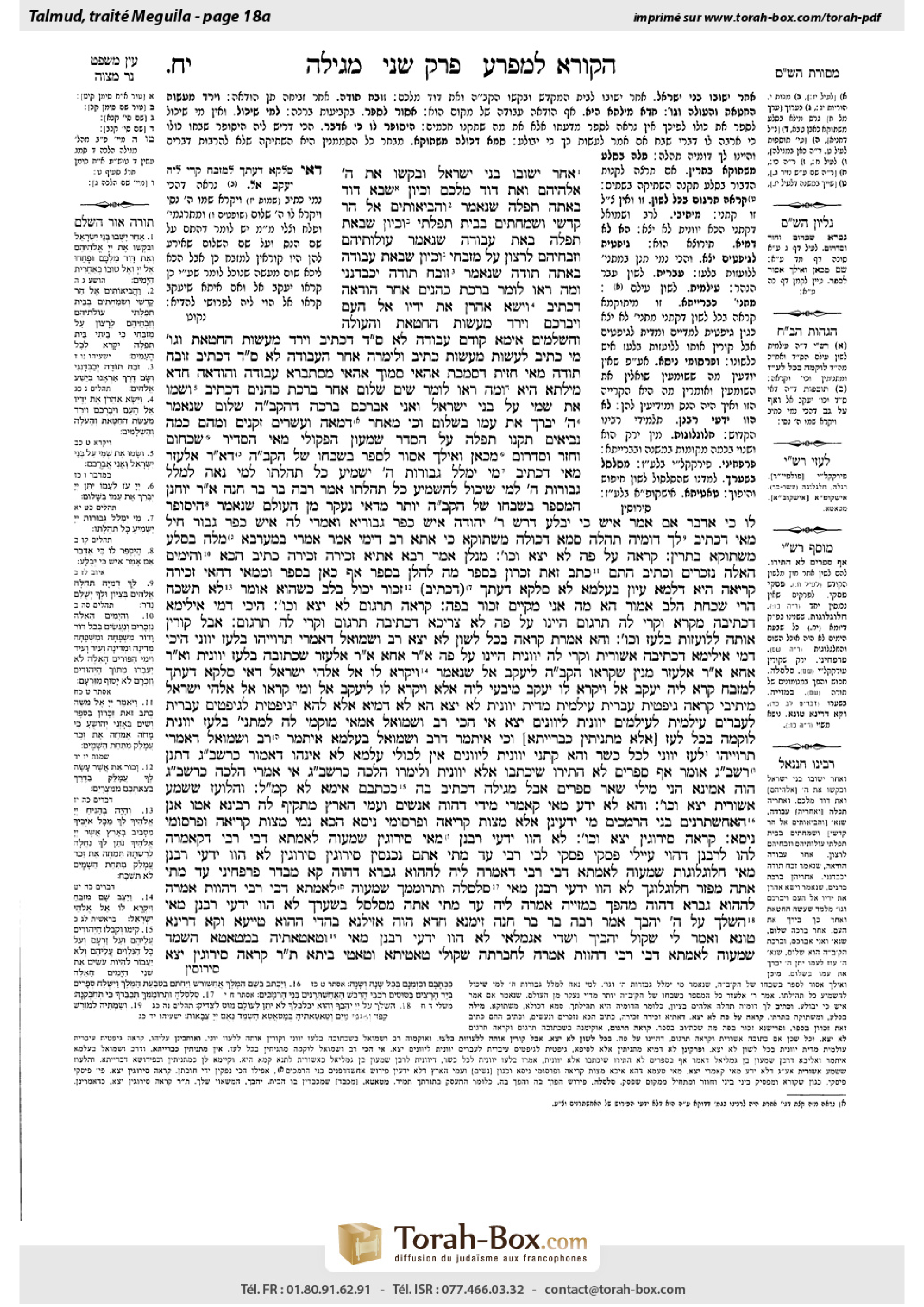
Megillah 18a: Talmud study for Daf Yomi
Daf Yomi is the daily study of one Talmud folio. Explore 37 tractates with scans, Hebrew text, Sefaria English and AI-generated French translations where annotated.
Passage selection and English or AI-generated French translation are available where the scan has annotations. Daf Study is independent of Torah-Box and Sefaria.
Browse Megillah · מגילה · All tractatesMegillah 18a text and translations
This page of Megillah includes the Aramaic text, an English translation and an AI-generated French translation, alongside the scan above.
מגילה י״ח א · Aramaic and Hebrew text
״אַחַר יָשׁוּבוּ בְּנֵי יִשְׂרָאֵל וּבִקְשׁוּ אֶת ה׳ אֱלֹהֵיהֶם וְאֵת דָּוִד מַלְכָּם״. וְכֵיוָן שֶׁבָּא דָּוִד — בָּאתָה תְּפִלָּה, שֶׁנֶּאֱמַר: ״וַהֲבִיאוֹתִים אֶל הַר קׇדְשִׁי וְשִׂמַּחְתִּים בְּבֵית תְּפִלָּתִי״.
וְכֵיוָן שֶׁבָּאת תְּפִלָּה — בָּאת עֲבוֹדָה, שֶׁנֶּאֱמַר: ״עוֹלוֹתֵיהֶם וְזִבְחֵיהֶם לְרָצוֹן עַל מִזְבְּחִי״. וְכֵיוָן שֶׁבָּאת עֲבוֹדָה — בָּאתָה תּוֹדָה, שֶׁנֶּאֱמַר: ״זוֹבֵחַ תּוֹדָה יְכַבְּדָנְנִי״.
וּמָה רָאוּ לוֹמַר בִּרְכַּת כֹּהֲנִים אַחַר הוֹדָאָה? דִּכְתִיב: ״וַיִּשָּׂא אַהֲרֹן אֶת יָדָיו אֶל הָעָם וַיְבָרְכֵם וַיֵּרֶד מֵעֲשׂוֹת הַחַטָּאת וְהָעוֹלָה וְהַשְּׁלָמִים״.
אֵימָא, קוֹדֶם עֲבוֹדָה? לָא סָלְקָא דַּעְתָּךְ, דִּכְתִיב: ״וַיֵּרֶד מֵעֲשׂוֹת הַחַטָּאת וְגוֹ׳״. מִי כְּתִיב ״לַעֲשׂוֹת״, ״מֵעֲשׂוֹת״ כְּתִיב.
וְלֵימְרַהּ אַחַר הָעֲבוֹדָה! לָא סָלְקָא דַּעְתָּךְ, דִּכְתִיב: ״זוֹבֵחַ תּוֹדָה״.
מַאי חָזֵית דְּסָמְכַתְּ אַהַאי, סְמוֹךְ אַהַאי! מִסְתַּבְּרָא עֲבוֹדָה וְהוֹדָאָה חֲדָא מִילְּתָא הִיא.
וּמָה רָאוּ לוֹמַר ״שִׂים שָׁלוֹם״ אַחַר בִּרְכַּת כֹּהֲנִים? דִּכְתִיב: ״וְשָׂמוּ אֶת שְׁמִי עַל בְּנֵי יִשְׂרָאֵל וַאֲנִי אֲבָרְכֵם״, בְּרָכָה דְּהַקָּדוֹשׁ בָּרוּךְ הוּא שָׁלוֹם, שֶׁנֶּאֱמַר: ״ה׳ יְבָרֵךְ אֶת עַמּוֹ בַשָּׁלוֹם״.
וְכִי מֵאַחַר דְּמֵאָה וְעֶשְׂרִים זְקֵנִים וּמֵהֶם כַּמָּה נְבִיאִים תִּקְּנוּ תְּפִלָּה עַל הַסֵּדֶר, שִׁמְעוֹן הַפָּקוֹלִי מַאי הִסְדִּיר? שְׁכָחוּם, וְחָזַר וְסִדְּרוֹם.
מִכָּאן וְאֵילָךְ, אָסוּר לְסַפֵּר בְּשִׁבְחוֹ שֶׁל הַקָּדוֹשׁ בָּרוּךְ הוּא. דְּאָמַר רַבִּי אֶלְעָזָר, מַאי דִּכְתִיב: ״מִי יְמַלֵּל גְּבוּרוֹת ה׳ יַשְׁמִיעַ כׇּל תְּהִלָּתוֹ״, לְמִי נָאֶה לְמַלֵּל גְּבוּרוֹת ה׳ לְמִי שֶׁיָּכוֹל לְהַשְׁמִיעַ כׇּל תְּהִלָּתוֹ.
אָמַר רַבָּה בַּר בַּר חָנָה אָמַר רַבִּי יוֹחָנָן: הַמְסַפֵּר בְּשִׁבְחוֹ שֶׁל הַקָּדוֹשׁ בָּרוּךְ הוּא יוֹתֵר מִדַּאי — נֶעֱקָר מִן הָעוֹלָם, שֶׁנֶּאֱמַר: ״הַיְסוּפַּר לוֹ כִּי אֲדַבֵּר אִם אָמַר אִישׁ כִּי יְבֻלָּע״.
דָּרֵשׁ רַבִּי יְהוּדָה אִישׁ כְּפַר גִּבּוֹרַיָּא, וְאָמְרִי לַהּ אִישׁ כְּפַר גִּבּוֹר חַיִל: מַאי דִּכְתִיב: ״לְךָ דוּמִיָּה תְהִלָּה״? סַמָּא דְּכוֹלָּה — מַשְׁתּוּקָא. כִּי אֲתָא רַב דִּימִי, אֲמַר: אָמְרִי בְּמַעְרְבָא: מִלָּה — בְּסֶלַע, מַשְׁתּוּקָא — בִּתְרֵין.
קְרָאָהּ עַל פֶּה לֹא יָצָא וְכוּ׳. מְנָלַן? אָמַר רָבָא: אָתְיָא זְכִירָה זְכִירָה, כְּתִיב הָכָא: ״וְהַיָּמִים הָאֵלֶּה נִזְכָּרִים״, וּכְתִיב הָתָם: ״כְּתֹב זֹאת זִכָּרוֹן בַּסֵּפֶר״. מָה לְהַלָּן — בְּסֵפֶר, אַף כָּאן — בְּסֵפֶר.
וּמִמַּאי דְּהַאי זְכִירָה קְרִיאָה הִיא, דִּלְמָא עִיּוּן בְּעָלְמָא! לָא סָלְקָא דַּעְתָּךְ (דִּכְתִיב): ״זָכוֹר״ — יָכוֹל בַּלֵּב? כְּשֶׁהוּא אוֹמֵר ״לֹא תִּשְׁכָּח״, הֲרֵי שִׁכְחַת הַלֵּב אָמוּר, הָא מָה אֲנִי מְקַיֵּים ״זָכוֹר״ — בַּפֶּה.
קְרָאָהּ תַּרְגּוּם לֹא יָצָא וְכוּ׳. הֵיכִי דָמֵי? אִילֵּימָא דִּכְתִיבָה מִקְרָא וְקָרֵי לַהּ תַּרְגּוּם, הַיְינוּ עַל פֶּה! לָא צְרִיכָא, דִּכְתִיבָה תַּרְגּוּם וְקָרֵי לַהּ תַּרְגּוּם.
אֲבָל קוֹרִין אוֹתָהּ לַלּוֹעֲזוֹת בְּלַעַז וְכוּ׳. וְהָא אָמְרַתְּ: קְרָאָהּ בְּכׇל לָשׁוֹן — לֹא יָצָא! רַב וּשְׁמוּאֵל דְּאָמְרִי תַּרְוַיְיהוּ: בְּלַעַז יְווֹנִי.
הֵיכִי דָמֵי? אִילֵּימָא דִּכְתִיבָה אַשּׁוּרִית וְקָרֵי לַהּ יְווֹנִית, הַיְינוּ עַל פֶּה! אָמַר רַבִּי אַחָא אָמַר רַבִּי אֶלְעָזָר: שֶׁכְּתוּבָה בְּלַעַז יְווֹנִית.
וְאָמַר רַבִּי אַחָא אָמַר רַבִּי אֶלְעָזָר: מִנַּיִן שֶׁקְּרָאוֹ הַקָּדוֹשׁ בָּרוּךְ הוּא לְיַעֲקֹב ״אֵל״, שֶׁנֶּאֱמַר: ״וַיִּקְרָא לוֹ אֵל אֱלֹהֵי יִשְׂרָאֵל״. דְּאִי סָלְקָא דַעְתָּךְ לְמִזְבֵּחַ קְרָא לֵיהּ יַעֲקֹב ״אֵל״ — ״וַיִּקְרָא לוֹ יַעֲקֹב״ מִיבְּעֵי לֵיהּ! אֶלָּא ״וַיִּקְרָא לוֹ״, לְיַעֲקֹב, ״אֵל״. וּמִי קְרָאוֹ ״אֵל״ — ״אֱלֹהֵי יִשְׂרָאֵל״.
מֵיתִיבִי: קְרָאָהּ גִּיפְּטִית, עִבְרִית, עֵילָמִית, מָדִית, יְווֹנִית — לֹא יָצָא!
הָא לָא דָּמְיָא אֶלָּא לְהָא: גִּיפְּטִית לְגִיפְּטִים, עִבְרִית לְעִבְרִים, עֵילָמִית לְעֵילָמִים, יְווֹנִית לִיווֹנִים — יָצָא.
אִי הָכִי, רַב וּשְׁמוּאֵל אַמַּאי מוֹקְמִי לַהּ לְמַתְנִיתִין בְּלַעַז יְווֹנִית? לוֹקְמוּהָ בְּכֹל לַעַז! [אֶלָּא, מַתְנִיתִין כְּבָרַיְיתָא.] וְכִי אִיתְּמַר דְּרַב וּשְׁמוּאֵל, בְּעָלְמָא אִיתְּמַר. רַב וּשְׁמוּאֵל דְּאָמְרִי תַּרְוַיְיהוּ: לַעַז יְווֹנִי לַכֹּל כָּשֵׁר.
וְהָא קָתָנֵי: יְווֹנִית לִיווֹנִים [לִיווֹנִים] — אִין, לְכוּלֵּי עָלְמָא — לָא! אִינְהוּ דַּאֲמוּר כְּרַבָּן שִׁמְעוֹן בֶּן גַּמְלִיאֵל. דִּתְנַן, רַבָּן שִׁמְעוֹן בֶּן גַּמְלִיאֵל אוֹמֵר: אַף סְפָרִים לֹא הִתִּירוּ שֶׁיִּכָּתְבוּ אֶלָּא יְווֹנִית.
וְלֵימְרוּ: הֲלָכָה כְּרַבָּן שִׁמְעוֹן בֶּן גַּמְלִיאֵל? אִי אָמְרִי הֲלָכָה כְּרַבָּן שִׁמְעוֹן בֶּן גַּמְלִיאֵל, הֲוָה אָמֵינָא הָנֵי מִילֵּי שְׁאָר סְפָרִים, אֲבָל מְגִילָּה דִּכְתִיב בַּהּ ״כִּכְתָבָם״ — אֵימָא לָא. קָא מַשְׁמַע לַן.
וְהַלּוֹעֵז שֶׁשָּׁמַע אַשּׁוּרִית יָצָא וְכוּ׳. וְהָא לָא יָדַע מַאי קָאָמְרִי? מִידֵּי דְּהָוֵה אַנָּשִׁים וְעַמֵּי הָאָרֶץ.
מַתְקֵיף לַהּ רָבִינָא: אַטּוּ אֲנַן ״הָאֲחַשְׁתְּרָנִים בְּנֵי הָרַמָּכִים״, מִי יָדְעִינַן? אֶלָּא מִצְוַת קְרִיאָה וּפַרְסוֹמֵי נִיסָּא, הָכָא נָמֵי — מִצְוַת קְרִיאָה וּפַרְסוֹמֵי נִיסָּא.
קְרָאָהּ סֵירוּגִין יָצָא וְכוּ׳. לָא הֲווֹ יָדְעִי רַבָּנַן מַאי ״סֵירוּגִין״, שַׁמְעוּהָ לְאַמְּתָא דְבֵי רַבִּי דְּקָאָמְרָה לְהוּ לְרַבָּנַן דַּהֲווֹ עָיְילִי פִּסְקֵי פִּסְקֵי לְבֵי רַבִּי: עַד מָתַי אַתֶּם נִכְנָסִין סֵירוּגִין סֵירוּגִין?
לָא הֲווֹ יָדְעִי רַבָּנַן מַאי ״חֲלוֹגְלוֹגוֹת״. שַׁמְעוּהָ לְאַמְּתָא דְבֵי רַבִּי דַּאֲמַרָה לֵיהּ לְהָהוּא גַּבְרָא דַּהֲוָה קָא מְבַדַּר פַּרְפְּחִינֵי: עַד מָתַי אַתָּה מְפַזֵּר חֲלוֹגְלוֹגְךָ?
לָא הֲווֹ יָדְעִי רַבָּנַן מַאי ״סַלְסְלֶהָ וּתְרוֹמְמֶךָּ״. שַׁמְעוּהָ לְאַמְּתָא דְּבֵי רַבִּי דַּהֲווֹת אָמְרָה לְהָהוּא גַּבְרָא דַּהֲוָה מְהַפֵּךְ בְּמַזְיֵיהּ, אֲמַרָה לֵיהּ: עַד מָתַי אַתָּה מְסַלְסֵל בִּשְׂעָרְךָ?
לָא הֲווֹ יָדְעִי רַבָּנַן מַאי: ״הַשְׁלֵךְ עַל ה׳ יְהָבְךָ״. אָמַר רַבָּה בַּר בַּר חָנָה: זִימְנָא חֲדָא הֲוָה אָזֵילְנָא בַּהֲדֵי הָהוּא טַיָּיעָא, וְקָא דָרֵינָא טוּנָא וַאֲמַר לִי: שְׁקוֹל יַהְבָּיךְ וּשְׁדִי אַגַּמְלַאי.
לָא הֲווֹ יָדְעִי רַבָּנַן מַאי ״וְטֵאטֵאתִיהָ בְּמַטְאֲטֵא הַשְׁמֵד״. שַׁמְעוּהָ לְאַמְּתָא דְּבֵי רַבִּי דַּהֲווֹת אָמְרָה לַחֲבֶרְתָּהּ: שְׁקוּלִי טָאטִיתָא וְטַאטִי בֵּיתָא.
תָּנוּ רַבָּנַן: קְרָאָהּ סֵירוּגִין — יָצָא,
Megillah 18a · English translation
“Afterward the children of Israel shall return, and seek the Lord their God and David their king” (Hosea 3:5), and consequently, the blessing of the kingdom of David follows the blessing of the building of Jerusalem. And once the scion of David comes, the time for prayer will come, as it is stated: “I will bring them to My sacred mountain and make them joyful in My house of prayer” (Isaiah 56:7). Therefore, the blessing of hearing prayer is recited after the blessing of the kingdom of David.
And after prayer comes, the Temple service will arrive, as it is stated in the continuation of that verse: “Their burnt-offerings and their sacrifices shall be accepted on My altar” (Isaiah 56:7). The blessing of restoration of the Temple service follows the blessing of hearing prayer. And when the Temple service comes, with it will also come thanksgiving, as it is stated: “Whoever sacrifices a thanks-offering honors Me” (Psalms 50:23), which teaches that thanksgiving follows sacrifice. Therefore, the blessing of thanksgiving follows the blessing of restoration of the Temple service.
And why did they see fit to institute that one says the Priestly Benediction after the blessing of thanksgiving? As it is written: “And Aaron lifted up his hand toward the people and blessed them, and he came down from sacrificing the sin-offering, and the burnt-offering, and the peace-offerings” (Leviticus 9:22), teaching that the Priestly Benediction follows the sacrificial service, which includes the thanks-offering.
The Gemara asks: But the cited verse indicates that Aaron blessed the people and then sacrificed the offerings. Should we not then say the Priestly Benediction before the blessing of the Temple service? The Gemara answers: It should not enter your mind to say this, as it is written: “And he came down from sacrificing the sin-offering.” Is it written that he came down to sacrifice the offerings, implying that after blessing the people Aaron came down and sacrificed the offerings? No, it is written, “from sacrificing,” indicating that the offerings had already been sacrificed.
The Gemara asks: If, as derived from this verse, the Priestly Benediction follows the sacrificial service, the Priestly Benediction should be said immediately after the blessing of restoration of the Temple service, without the interruption of the blessing of thanksgiving. The Gemara rejects this argument: It should not enter your mind to say this, as it is written: “Whoever sacrifices a thanks-offering honors Me,” from which we learn that thanksgiving follows sacrifice, as already explained.
The Gemara asks: What did you see to rely on this verse and juxtapose thanksgiving with sacrifice? Rely rather on the other verse, which indicates that it is the Priestly Benediction that should be juxtaposed with the sacrificial service. The Gemara answers: It stands to reason to have the blessing of thanksgiving immediately following the blessing of the sacrificial service, since the sacrificial service and thanksgiving, which are closely related conceptually, are one matter.
And why did they see fit to institute that one says the blessing beginning with the words: Grant peace, after the Priestly Benediction? As it is written immediately following the Priestly Benediction: “And they shall put My name upon the children of Israel, and I will bless them” (Numbers 6:27). The Priestly Benediction is followed by God’s blessing, and the blessing of the Holy One, Blessed be He, is peace, as it is stated: “The Lord blesses His people with peace” (Psalms 29:11).
The Gemara returns to the baraita cited at the beginning of the discussion: Now, since the baraita teaches that a hundred and twenty Elders, including many prophets, established the Amida prayer in its fixed order, what is it that Shimon HaPakuli arranged in a much later period of time, as related by Rabbi Yoḥanan? The Gemara answers: Indeed, the blessings of the Amida prayer were originally arranged by the hundred and twenty members of the Great Assembly, but over the course of time the people forgot them, and Shimon HaPakuli then arranged them again.
The Gemara comments: These nineteen blessings are a fixed number, and beyond this it is prohibited for one to declare the praises of the Holy One, Blessed be He, by adding additional blessings to the Amida. As Rabbi Elazar said: What is the meaning of that which is written: “Who can utter the mighty acts of the Lord? Who can declare all His praise?” (Psalms 106:2)? It means: For whom is it fitting to utter the mighty acts of the Lord? Only for one who can declare all His praise. And since no one is capable of declaring all of God’s praises, we must suffice with the set formula established by the Sages.
Rabba bar bar Ḥana said that Rabbi Yoḥanan said: With regard to one who excessively declares the praises of the Holy One, Blessed be He, his fate is to be uprooted from the world, as it appears as if he had exhausted all of God’s praises. As it is stated: “Shall it be told to Him when I speak? If a man says it, he would be swallowed up” (Job 37:20). The Gemara interprets the verse as saying: Can all of God’s praises be expressed when I speak? If a man would say such a thing, he would be “swallowed up” as punishment.
The Gemara relates: Rabbi Yehuda, a man of Kefar Gibboraya, and some say he was a man of Kefar Gibbor Ĥayil, taught: What is the meaning of that which is written: “For You silence is praise” (Psalms 65:2)? The best remedy of all is silence, i.e., the optimum form of praising God is silence. The Gemara relates: When Rav Dimi came from Eretz Israel to Babylonia, he said: In the West, Eretz Yisrael, they say an adage: If a word is worth one sela, silence is worth two.
§ It is taught in the mishna: If one read the Megilla by heart he has not fulfilled his obligation. The Gemara asks: From where do we derive this? Rava said: This is derived by means of a verbal analogy between one instance of the term remembrance and another instance of the term remembrance. It is written here, with regard to the Megilla: “That these days should be remembered” (Esther 9:28), and it is written elsewhere: “And the Lord said to Moses: Write this for a memorial in the book, and rehearse it in the ears of Joshua: That I will utterly blot out the remembrance of Amalek from under the heavens” (Exodus 17:14). Just as there, with regard to Amalek, remembrance is referring specifically to something written in a book, as it is stated, “in the book,” so too here, the Megilla remembrance is through being written in a book.
The Gemara raises a question: But from where do we know that this remembrance that is stated with regard to Amalek and to the Megilla involves reading it out loud from a book? Perhaps it requires merely looking into the book, reading it silently. The Gemara answers: It should not enter your mind to say this, as it was taught in a baraita: The verse states: “Remember what Amalek did to you” (Deuteronomy 25:17). One might have thought that it suffices for one to remember this silently, in his heart. But this cannot be, since when it says subsequently: “You shall not forget” (Deuteronomy 25:19), it is already referring to forgetting from the heart. How, then, do I uphold the meaning of “remember”? What does this command to remember add to the command to not forget? Therefore, it means that the remembrance must be expressed out loud, with the mouth.
§ It was taught further in the mishna: If one read the Megilla in Aramaic translation he has not fulfilled his obligation. The Gemara asks: What are the circumstances of this case? If we say that the Megilla was written in the original biblical text, i.e., in Hebrew, and he read it in Aramaic translation, then this is the same as reading it by heart, as he is not reading the words written in the text, and the mishna has already stated that one does not fulfill his obligation by reading the Megilla by heart. The Gemara answers: No, it is necessary to teach this case as well, as it is referring to a case in which the Megilla was written not in the original Hebrew but in Aramaic translation, and he read it as written, in Aramaic translation.
§ The mishna continues: However, for those who speak a foreign language, one may read the Megilla in that foreign language. The Gemara raises a difficulty: But didn’t you say in the mishna: If he read it in any other language he has not fulfilled his obligation? The Gemara cites the answer of Rav and Shmuel, who both say: When the mishna says: A foreign language, it is referring specifically to the Greek foreign language, which has a unique status with regard to biblical translation.
The Gemara asks: What are the circumstances of the case? If we say that the Megilla was written in Ashurit, i.e., in Hebrew, and he read it in Greek, this is the same as reading it by heart, and the mishna teaches that one does not fulfill his obligation by reading by heart. The Gemara answers: Rabbi Aḥa said that Rabbi Elazar said: The mishna is dealing with a case in which the Megilla was written in the Greek foreign language and was also read in that language.
Apropos statements in this line of tradition, the Gemara adds: And Rabbi Aḥa further said that Rabbi Elazar said: From where is it derived that the Holy One, Blessed be He, called Jacob El, meaning God? As it is stated: “And he erected there an altar, and he called it El, God of Israel” (Genesis 33:20). It is also possible to translate this as: And He, i.e., the God of Israel, called him, Jacob, El. Indeed, it must be understood this way, as if it enters your mind to say that the verse should be understood as saying that Jacob called the altar El, it should have specified the subject of the verb and written: And Jacob called it El. But since the verse is not written this way, the verse must be understood as follows: He called Jacob El; and who called him El? The God of Israel.
The Gemara returns to discussing languages for reading the Megilla and raises an objection against Rav and Shmuel, who said that one may read the Megilla in Greek but not in other foreign languages. It is taught in a baraita: If one read the Megilla in Coptic [Giptit], Ivrit, Elamite, Median, or Greek, he has not fulfilled his obligation, indicating that one cannot fulfill his obligation by reading the Megilla in Greek.
The Gemara answers: The clause in the mishna that teaches that the Megilla may be read in a foreign language to one who speaks that foreign language is comparable only to that which was taught in a different baraita: If one reads the Megilla in Coptic to Copts, in Ivrit to Ivrim, in Elamite to Elamites, or in Greek to Greeks, he has fulfilled his obligation. The Megilla may be read in any language, provided the listener understands that language.
The Gemara asks: But if so, that one who reads the Megilla in a foreign language that he speaks fulfills his obligation, why did Rav and Shmuel establish the ruling of the mishna as referring specifically to Greek? Let them interpret it as referring to any foreign language that one speaks. The Gemara explains: Rather, the mishna is to be understood like the baraita, that one who reads the Megilla in a language that he speaks fulfills his obligation; and that which was stated in the name of Rav and Shmuel was said as a general statement, not relating to the mishna but as an independent ruling, as follows: Rav and Shmuel both say: The Greek language is acceptable for everyone, i.e., anyone who reads the Megilla in Greek has fulfilled his obligation, even if he does not understand Greek.
The Gemara raises a difficulty: But doesn’t the baraita cited above teach that if one reads the Megilla in Greek to Greeks he has fulfilled his obligation? This implies that reading in Greek, yes, this is acceptable for Greeks, but for everyone else, no, it is not. The Gemara answers: Rav and Shmuel disagree with this statement of the baraita, because they agree with the opinion of Rabban Shimon ben Gamliel. As we learned in a mishna (Megilla 8b): Rabban Shimon ben Gamliel says: Even for books of the Bible, the Sages did not permit them to be written in any foreign language other than Greek, indicating that Greek has a special status, and is treated like the original Hebrew.
The Gemara asks: But if this was the intention of Rav and Shmuel, let them state explicitly: The halakha is in accordance with the opinion of Rabban Shimon ben Gamliel. Why did Rav and Shmuel formulate their statement as if they were issuing a new ruling? The Gemara answers: Had they said simply that the halakha is in accordance with Rabban Shimon ben Gamliel, I would have said that this applies only to the other books of the Bible, but with regard to the Megilla, of which it is written: “According to their writing,” I would say that one does not fulfill his obligation if he reads it in Greek. Therefore they stated their own opinion to teach us that even in the case of the Megilla one fulfills his obligation if he reads it in Greek.
§ It was taught in the mishna: And one who speaks a foreign language who heard the Megilla being read in Ashurit, i.e., in Hebrew, has fulfilled his obligation. The Gemara asks: But isn’t it so that he does not understand what they are saying? Since he does not understand Hebrew, how does he fulfill his obligation? The Gemara answers: It is just as it is with women and uneducated people; they too understand little Hebrew, but nevertheless they fulfill their obligation when they hear the Megilla read in that language.
Ravina strongly objects to the premise of the question raised above, i.e., that someone who does not understand the original, untranslated language of the Megilla cannot fulfill his obligation. Is that to say that even we, the Sages, who are very well acquainted with Hebrew, know for certain the meaning of the obscure words ha’aḥashteranim benei haramakhim (Esther 8:10), often translated as: “Used in the royal service, bred from the stud”? But nevertheless, we fulfill the mitzva of reading the Megilla and publicizing the miracle of Purim by reading these words as they appear in the original text. Here too, one who speaks a foreign language who hears the Megilla being read in Hebrew fulfills the mitzva of reading the Megilla and publicizing the Purim miracle, even if he does not understand the words themselves.
§ The mishna continues: If one reads the Megilla at intervals [seirugin] he has fulfilled his obligation. The Gemara relates that the Sages did not know what is meant by the word seirugin. One day they heard the maidservant in Rabbi Yehuda HaNasi’s house saying to the Sages who were entering the house intermittently rather than in a single group: How long are you going to enter seirugin seirugin? As she lived in Rabbi Yehuda HaNasi’s house and certainly heard the most proper Hebrew being spoken, they understood from this that the word seirugin means at intervals.
It is similarly related that the Sages did not know what is meant by the word ḥalogelogot, which appears in various mishnayot and baraitot. One day they heard the maidservant in Rabbi Yehuda HaNasi’s house saying to a certain man who was scattering purslane: How long will you go on scattering your ḥalogelogot? And from this they understood that ḥalogelogot is purslane.
Likewise, the Sages did not know what is meant by salseleha in the verse: “Get wisdom…salseleha and it will exalt you” (Proverbs 4:7–8). One day they heard the maidservant in Rabbi Yehuda HaNasi’s house talking to a certain man who was twirling his hair, saying to him: How long will you go on twirling [mesalsel] your hair? And from this they understood that the verse is saying: Turn wisdom around and around, and it will exalt you.
The Gemara relates additional examples: The Sages did not know what is meant by the word yehav in the verse: “Cast upon the Lord your yehav” (Psalms 55:23). Rabba bar bar Ḥana said: One time I was traveling with a certain Arab [Tayya’a] and I was carrying a load, and he said to me: Take your yehav and throw it on my camel, and I understood that yehav means a load or burden.
And similarly, the Sages did not know what is meant by the word matatei in the verse: “And I will tatei it with the matatei of destruction” (Isaiah 14:23). One day they heard the maidservant in Rabbi Yehuda HaNasi’s house saying to her friend: Take a tateita and tati the house, from which they understood that a matatei is a broom, and the verb tati means to sweep.
On the matter of reading the Megilla with interruptions, the Sages taught the following baraita: If one reads the Megilla at intervals, pausing and resuming at intervals, he has fulfilled his obligation.
Megillah 18a · Traduction française (IA)
« Après cela, les enfants d’Israël reviendront et rechercheront l’Éternel, leur Dieu, et David, leur roi » (Osée 3:5). Par conséquent, la bénédiction concernant la royauté de David suit celle de la reconstruction de Jérusalem. Et lorsque le descendant de David viendra, le temps de la prière viendra, comme il est dit : « Je les conduirai sur Ma montagne sainte et les réjouirai dans Ma maison de prière » (Isaïe 56:7). C’est pourquoi la bénédiction relative à l’exaucement de la prière est récitée après celle concernant la royauté de David.
Et après la prière viendra le service du Temple, comme il est dit dans la suite de ce verset : « Leurs holocaustes et leurs sacrifices seront agréés sur Mon autel » (Isaïe 56:7). La bénédiction concernant le rétablissement du service du Temple suit donc celle relative à l’exaucement de la prière. Et lorsque le service du Temple viendra, l’action de grâce viendra aussi avec lui, comme il est dit : « Celui qui offre un sacrifice d’action de grâce M’honore » (Psaumes 50:23), ce qui enseigne que l’action de grâce suit le sacrifice. C’est pourquoi la bénédiction d’action de grâce suit celle concernant le rétablissement du service du Temple.
Et pourquoi a-t-on jugé bon d’instituer que la bénédiction sacerdotale soit récitée après la bénédiction d’action de grâce ? Car il est écrit : « Aaron leva la main vers le peuple et le bénit, puis il descendit après avoir offert le sacrifice expiatoire, l’holocauste et les sacrifices de paix » (Lévitique 9:22). Cela enseigne que la bénédiction sacerdotale suit le service sacrificiel, qui comprend le sacrifice d’action de grâce.
La Guemara demande : Mais le verset cité indique qu’Aaron bénit le peuple, puis offrit les sacrifices. Ne devrait-on donc pas réciter la bénédiction sacerdotale avant celle concernant le service du Temple ? La Guemara répond : Ne va pas penser cela, car il est écrit : « Il descendit après avoir offert le sacrifice expiatoire. » Est-il écrit qu’il descendit pour offrir les sacrifices, ce qui laisserait entendre qu’après avoir béni le peuple, Aaron descendit et offrit les sacrifices ? Non, il est écrit « après avoir offert », ce qui indique que les sacrifices avaient déjà été offerts.
La Guemara demande : Si, comme on le déduit de ce verset, la bénédiction sacerdotale suit le service sacrificiel, elle devrait être récitée immédiatement après la bénédiction concernant le rétablissement du service du Temple, sans que la bénédiction d’action de grâce ne s’interpose. La Guemara rejette cet argument : Ne va pas penser cela, car il est écrit : « Celui qui offre un sacrifice d’action de grâce M’honore », d’où nous apprenons que l’action de grâce suit le sacrifice, comme cela a déjà été expliqué.
La Guemara demande : Qu’as-tu vu pour t’appuyer sur ce verset et associer l’action de grâce au sacrifice ? Appuie-toi plutôt sur l’autre verset, qui indique que c’est la bénédiction sacerdotale qui doit être associée au service sacrificiel. La Guemara répond : Il est logique que la bénédiction d’action de grâce suive immédiatement celle du service sacrificiel, puisque le service sacrificiel et l’action de grâce, étroitement liés sur le plan conceptuel, ne font qu’un.
Et pourquoi a-t-on jugé bon d’instituer que la bénédiction qui commence par les mots « Accorde la paix » soit récitée après la bénédiction sacerdotale ? Car il est écrit immédiatement après celle-ci : « Ils mettront ainsi Mon nom sur les enfants d’Israël, et Moi, Je les bénirai » (Nombres 6:27). La bénédiction sacerdotale est suivie de la bénédiction de Dieu ; or, la bénédiction du Saint, béni soit-Il, c’est la paix, comme il est dit : « L’Éternel bénit Son peuple par la paix » (Psaumes 29:11).
La Guemara revient à la baraïta citée au début de la discussion : puisque la baraïta enseigne que cent vingt Anciens, parmi lesquels se trouvaient de nombreux prophètes, ont établi la prière de la Amida dans son ordre fixe, qu’est-ce donc que Shimon HaPakuli a mis en ordre à une époque bien plus tardive, comme le rapporte Rabbi Yoḥanan ? La Guemara répond : En effet, les bénédictions de la prière de la Amida avaient d’abord été ordonnées par les cent vingt membres de la Grande Assemblée, mais, au fil du temps, le peuple les avait oubliées ; Shimon HaPakuli les ordonna alors de nouveau.
La Guemara fait remarquer : Ces dix-neuf bénédictions constituent un nombre fixe, et il est interdit d’aller au-delà en louant le Saint, béni soit-Il, par l’ajout de bénédictions à la Amida. Car Rabbi Elazar a dit : Que signifie ce qui est écrit : « Qui pourrait raconter les hauts faits de l’Éternel ? Qui pourrait proclamer toutes Ses louanges ? » (Psaumes 106:2) ? Cela signifie : À qui convient-il de raconter les hauts faits de l’Éternel ? Seulement à celui qui peut proclamer toutes Ses louanges. Or, puisque personne n’est capable de proclamer toutes les louanges de Dieu, nous devons nous en tenir à la formule fixe instituée par les Sages.
Rabba bar bar Ḥana a dit au nom de Rabbi Yoḥanan : Celui qui multiplie à l’excès les louanges du Saint, béni soit-Il, est destiné à être extirpé du monde, car il donne l’impression d’avoir épuisé toutes les louanges de Dieu. Comme il est dit : « Lui sera-t-il raconté quand je parlerai ? Si un homme le disait, il serait englouti » (Job 37:20). La Guemara interprète le verset ainsi : Toutes les louanges de Dieu peuvent-elles être exprimées quand je parle ? Si un homme prétendait le faire, il serait « englouti » en punition.
La Guemara rapporte : Rabbi Yehuda, un homme de Kefar Gibboraya — certains disent qu’il était de Kefar Gibbor Ḥayil — enseignait : Que signifie ce qui est écrit : « Pour Toi, le silence est une louange » (Psaumes 65:2) ? Le meilleur remède de tous est le silence, c’est-à-dire que la meilleure manière de louer Dieu est de garder le silence. La Guemara rapporte : Lorsque Rav Dimi vint d’Eretz Israël en Babylonie, il dit : En Occident, c’est-à-dire en Eretz Israël, on dit ce proverbe : Si une parole vaut un sela, le silence en vaut deux.
§ La Michna enseigne : Si quelqu’un a lu la Meguila de mémoire, il ne s’est pas acquitté de son obligation. La Guemara demande : D’où le déduisons-nous ? Rava dit : On le déduit par une analogie verbale entre une occurrence du terme « souvenir » et une autre occurrence de ce terme. Ici, à propos de la Meguila, il est écrit : « Afin que ces jours soient rappelés » (Esther 9:28), et ailleurs, il est écrit : « L’Éternel dit à Moïse : Écris cela dans un livre comme souvenir, et répète-le à Josué : J’effacerai entièrement le souvenir d’Amalek de dessous les cieux » (Exode 17:14). De même que là, à propos d’Amalek, le souvenir désigne spécifiquement quelque chose d’écrit dans un livre, comme il est dit « dans un livre », de même ici, le souvenir de la Meguila doit se faire par écrit dans un livre.
La Guemara soulève une question : Mais d’où savons-nous que le souvenir mentionné à propos d’Amalek et de la Meguila implique une lecture à voix haute à partir d’un livre ? Peut-être suffit-il de regarder le livre et de lire en silence. La Guemara répond : Ne va pas penser cela, car une baraïta enseigne : Le verset dit : « Souviens-toi de ce qu’Amalek t’a fait » (Deutéronome 25:17). On aurait pu penser qu’il suffit de s’en souvenir en silence, dans son cœur. Mais cela ne peut être le cas, puisque, lorsque le verset dit ensuite : « Tu n’oublieras pas » (Deutéronome 25:19), il s’agit déjà de l’oubli dans le cœur. Comment donc comprendre le commandement « souviens-toi » ? Qu’ajoute-t-il au commandement de ne pas oublier ? Il signifie donc que le souvenir doit être exprimé à voix haute, par la bouche.
§ La Michna enseigne ensuite : Si quelqu’un a lu la Meguila dans une traduction araméenne, il ne s’est pas acquitté de son obligation. La Guemara demande : Dans quelles circonstances ? Si nous disons que la Meguila était écrite dans le texte biblique original, c’est-à-dire en hébreu, et qu’il l’a lue en traduction araméenne, cela revient à la lire de mémoire, puisqu’il ne lit pas les mots écrits dans le texte ; or la Michna a déjà indiqué qu’on ne s’acquitte pas de son obligation en lisant la Meguila de mémoire. La Guemara répond : Non, il était également nécessaire d’enseigner ce cas, qui concerne une Meguila écrite non pas dans l’hébreu original, mais en traduction araméenne, et lue telle qu’elle était écrite, en traduction araméenne.
§ La Michna poursuit : Toutefois, pour ceux qui parlent une langue étrangère, on peut lire la Meguila dans cette langue. La Guemara soulève une difficulté : Mais n’as-tu pas dit dans la Michna : S’il l’a lue dans une autre langue, il ne s’est pas acquitté de son obligation ? La Guemara cite la réponse de Rav et de Shmuel, qui disent tous deux : Lorsque la Michna parle d’une langue étrangère, elle désigne spécifiquement le grec, qui a un statut particulier en matière de traduction biblique.
La Guemara demande : Dans quelles circonstances ? Si nous disons que la Meguila était écrite en achourit, c’est-à-dire en hébreu, et qu’il l’a lue en grec, cela revient à la lire de mémoire, alors que la Michna enseigne qu’on ne s’acquitte pas de son obligation en lisant de mémoire. La Guemara répond : Rabbi Aḥa a dit au nom de Rabbi Elazar : La Michna traite d’un cas où la Meguila était écrite dans la langue étrangère qu’est le grec et où elle a également été lue dans cette langue.
À propos des enseignements transmis dans cette tradition, la Guemara ajoute : Rabbi Aḥa a également dit au nom de Rabbi Elazar : D’où déduit-on que le Saint, béni soit-Il, a appelé Jacob El, c’est-à-dire Dieu ? Comme il est dit : « Il y érigea un autel et l’appela El, Dieu d’Israël » (Genèse 33:20). On peut aussi traduire : Et Lui, c’est-à-dire le Dieu d’Israël, l’appela, lui, Jacob, El. En effet, c’est ainsi qu’il faut comprendre le verset : si l’on devait penser que Jacob appela l’autel El, le sujet du verbe aurait dû être précisé et le texte aurait dû dire : « Et Jacob l’appela El. » Mais puisque le verset n’est pas formulé ainsi, il faut le comprendre de la manière suivante : Il appela Jacob El ; et qui l’appela El ? Le Dieu d’Israël.
La Guemara revient aux langues dans lesquelles on peut lire la Meguila et soulève une objection contre Rav et Shmuel, qui ont dit qu’on peut lire la Meguila en grec, mais pas dans les autres langues étrangères. Une baraïta enseigne : Si quelqu’un a lu la Meguila en copte [Giptit], en ivrit, en élamite, en mède ou en grec, il ne s’est pas acquitté de son obligation. Cela indique qu’on ne peut pas s’acquitter de son obligation en lisant la Meguila en grec.
La Guemara répond : La clause de la Michna qui enseigne que la Meguila peut être lue dans une langue étrangère à l’intention de celui qui parle cette langue ne correspond qu’à ce qui a été enseigné dans une autre baraïta : Si quelqu’un lit la Meguila en copte à des Coptes, en ivrit à des Ivrites, en élamite à des Élamites ou en grec à des Grecs, il s’est acquitté de son obligation. La Meguila peut être lue dans n’importe quelle langue, à condition que l’auditeur la comprenne.
La Guemara demande : Mais dans ce cas, si celui qui lit la Meguila dans une langue étrangère qu’il parle s’acquitte de son obligation, pourquoi Rav et Shmuel ont-ils établi que la règle de la Michna concerne spécifiquement le grec ? Qu’ils l’interprètent comme visant n’importe quelle langue étrangère que l’on parle. La Guemara explique : Il faut plutôt comprendre la Michna comme la baraïta : celui qui lit la Meguila dans une langue qu’il parle s’acquitte de son obligation. Quant à ce qui a été rapporté au nom de Rav et de Shmuel, il s’agissait d’une déclaration générale, sans rapport avec la Michna, mais d’une décision indépendante, formulée ainsi : Rav et Shmuel disent tous deux que le grec convient à tous, c’est-à-dire que quiconque lit la Meguila en grec s’acquitte de son obligation, même s’il ne comprend pas le grec.
La Guemara soulève une difficulté : Mais la baraïta citée plus haut n’enseigne-t-elle pas que celui qui lit la Meguila en grec à des Grecs s’est acquitté de son obligation ? Cela implique que la lecture en grec convient aux Grecs, mais pas aux autres. La Guemara répond : Rav et Shmuel ne sont pas d’accord avec cet enseignement de la baraïta, car ils adhèrent à l’opinion de Rabban Shimon ben Gamliel. En effet, nous avons appris dans une Michna (Meguila 8b) : Rabban Shimon ben Gamliel dit : Même pour les livres de la Bible, les Sages n’ont autorisé leur rédaction dans aucune langue étrangère autre que le grec. Cela indique que le grec a un statut particulier et qu’il est traité comme l’hébreu original.
La Guemara demande : Mais si telle était l’intention de Rav et de Shmuel, qu’ils déclarent explicitement : La halakha est conforme à l’opinion de Rabban Shimon ben Gamliel. Pourquoi Rav et Shmuel ont-ils formulé leur propos comme s’ils édictaient une nouvelle règle ? La Guemara répond : S’ils avaient simplement dit que la halakha est conforme à l’opinion de Rabban Shimon ben Gamliel, j’aurais pensé que cela ne s’applique qu’aux autres livres de la Bible ; mais concernant la Meguila, au sujet de laquelle il est écrit : « Selon leur écrit », j’aurais pensé qu’on ne s’acquitte pas de son obligation en la lisant en grec. Ils ont donc énoncé leur propre opinion pour nous apprendre que, même pour la Meguila, on s’acquitte de son obligation en la lisant en grec.
§ La Michna enseigne : Celui qui parle une langue étrangère et qui a entendu la Meguila lue en achourit, c’est-à-dire en hébreu, s’est acquitté de son obligation. La Guemara demande : Mais ne comprend-il pas ce qui est dit ? Puisqu’il ne comprend pas l’hébreu, comment peut-il s’acquitter de son obligation ? La Guemara répond : Il en va comme pour les femmes et les ignorants ; eux aussi comprennent peu l’hébreu, mais ils s’acquittent néanmoins de leur obligation lorsqu’ils entendent la Meguila lue dans cette langue.
Ravina s’oppose vivement au présupposé de la question posée plus haut, à savoir qu’une personne qui ne comprend pas la langue originale, non traduite, de la Meguila ne peut pas s’acquitter de son obligation. Cela voudrait-il dire que même nous, les Sages, qui connaissons très bien l’hébreu, savons avec certitude ce que signifient les mots obscurs ha’aḥashteranim benei haramakhim (Esther 8:10), souvent traduits par « montés au service royal, issus des haras » ? Pourtant, nous nous acquittons de la mitsva de lire la Meguila et de faire connaître le miracle de Pourim en lisant ces mots tels qu’ils figurent dans le texte original. De même ici, celui qui parle une langue étrangère et qui entend la Meguila lue en hébreu s’acquitte de la mitsva de lire la Meguila et de faire connaître le miracle de Pourim, même s’il ne comprend pas les mots eux-mêmes.
§ La Michna poursuit : Si quelqu’un lit la Meguila par intermittence [seirugin], il s’est acquitté de son obligation. La Guemara rapporte que les Sages ne savaient pas ce que signifiait le mot seirugin. Un jour, ils entendirent la servante de la maison de Rabbi Yehuda HaNasi dire aux Sages, qui entraient dans la maison par intermittence plutôt qu’en un seul groupe : « Combien de temps allez-vous entrer seirugin seirugin ? » Comme elle vivait dans la maison de Rabbi Yehuda HaNasi et entendait certainement parler l’hébreu le plus correct, ils comprirent que le mot seirugin signifie « par intermittence ».
De même, les Sages ne savaient pas ce que signifiait le mot ḥalogelogot, qui apparaît dans diverses michnayot et baraïtot. Un jour, ils entendirent la servante de la maison de Rabbi Yehuda HaNasi dire à un homme qui répandait du pourpier : « Combien de temps vas-tu continuer à répandre ton ḥalogelogot ? » Ils comprirent alors que ḥalogelogot désigne le pourpier.
De même, les Sages ne savaient pas ce que signifiait salseleha dans le verset : « Acquiers la sagesse… salseleha, et elle t’élèvera » (Proverbes 4:7–8). Un jour, ils entendirent la servante de la maison de Rabbi Yehuda HaNasi parler à un homme qui se tortillait les cheveux et lui dire : « Combien de temps vas-tu continuer à te tortiller [mesalsel] les cheveux ? » Ils comprirent ainsi que le verset signifie : Fais tourner la sagesse encore et encore, et elle t’élèvera.
La Guemara rapporte d’autres exemples : Les Sages ne savaient pas ce que signifiait le mot yehav dans le verset : « Remets à l’Éternel ton yehav » (Psaumes 55:23). Rabba bar bar Ḥana dit : Un jour, je voyageais avec un certain Arabe [Tayya’a] et je portais un fardeau. Il me dit : « Prends ton yehav et jette-le sur mon chameau », et je compris que yehav signifie une charge ou un fardeau.
De même, les Sages ne savaient pas ce que signifiait le mot matatei dans le verset : « Je la balayerai avec le matatei de la destruction » (Isaïe 14:23). Un jour, ils entendirent la servante de la maison de Rabbi Yehuda HaNasi dire à son amie : « Prends un tateita et tati la maison. » Ils comprirent alors que matatei désigne un balai et que le verbe tati signifie balayer.
À propos de la lecture de la Meguila avec des interruptions, les Sages ont enseigné la baraïta suivante : Si quelqu’un lit la Meguila par intermittence, en faisant des pauses puis en reprenant à intervalles, il s’est acquitté de son obligation.
Traduction française générée par IA à partir de l’édition anglaise de Sefaria. Vérifie toujours un passage avec le texte source.
Text from Sefaria: William Davidson Edition - Vocalized Aramaic (CC BY NC); William Davidson Edition - English (CC BY NC).