Megillah 17b: Talmud study for Daf Yomi
Daf Yomi is the daily study of one Talmud folio. Explore 37 tractates with scans, Hebrew text, Sefaria English and AI-generated French translations where annotated.
Passage selection and English or AI-generated French translation are available where the scan has annotations. Daf Study is independent of Torah-Box and Sefaria.
Browse Megillah · מגילה · All tractatesMegillah 17b text and translations
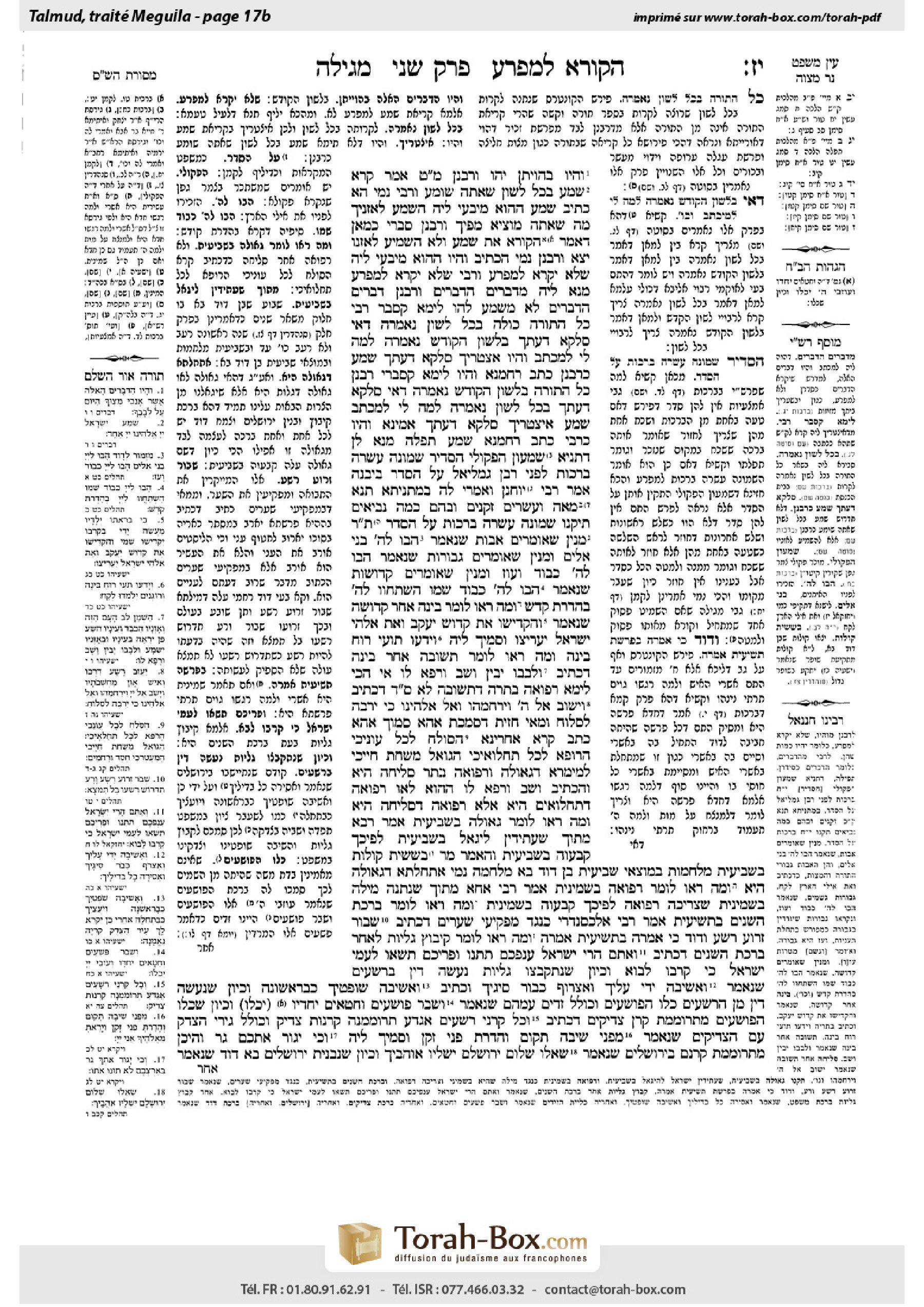
This page of Megillah includes the Aramaic text, an English translation and an AI-generated French translation, alongside the scan above.
מגילה י״ז ב · Aramaic and Hebrew text
״וְהָיוּ״, בַּהֲוָיָתָן יְהוּ. וְרַבָּנַן, מַאי טַעְמָא? אָמַר קְרָא: ״שְׁמַע״, בְּכׇל לָשׁוֹן שֶׁאַתָּה שׁוֹמֵעַ.
וְרַבִּי נָמֵי, הָא כְּתִיב: ״שְׁמַע״? הַהוּא מִיבְּעֵי לֵיהּ: הַשְׁמַע לְאָזְנֶיךָ מַה שֶּׁאַתָּה מוֹצִיא מִפִּיךָ. וְרַבָּנַן — סָבְרִי כְּמַאן דְּאָמַר הַקּוֹרֵא אֶת שְׁמַע וְלֹא הִשְׁמִיעַ לְאׇזְנוֹ יָצָא.
וְרַבָּנַן נָמֵי, הָכְתִיב ״וְהָיוּ״? הַהוּא מִיבְּעֵי לֵיהּ שֶׁלֹּא יִקְרָא לְמַפְרֵעַ. וְרַבִּי, שֶׁלֹּא יִקְרָא לְמַפְרֵעַ מְנָא לֵיהּ? מִ״דְּבָרִים״ ״הַדְּבָרִים״. וְרַבָּנַן — ״דְּבָרִים״ ״הַדְּבָרִים״ לָא מַשְׁמַע לְהוּ.
לֵימָא קָסָבַר רַבִּי כׇּל הַתּוֹרָה כּוּלָּהּ בְּכׇל לָשׁוֹן נֶאֶמְרָה, דְּאִי סָלְקָא דַּעְתָּךְ בִּלְשׁוֹן הַקּוֹדֶשׁ נֶאֶמְרָה — לְמָה לִי לְמִכְתַּב ״וְהָיוּ״!
אִצְטְרִיךְ, סָלְקָא דַּעְתָּךְ ״שְׁמַע״ — כְּרַבָּנַן, כְּתַב רַחֲמָנָא ״וְהָיוּ״.
לֵימָא קָסָבְרִי רַבָּנַן כׇּל הַתּוֹרָה בִּלְשׁוֹן הַקּוֹדֶשׁ נֶאֶמְרָה, דְּאִי סָלְקָא דַּעְתָּךְ בְּכׇל לָשׁוֹן נֶאֶמְרָה — לְמָה לִי לְמִכְתַּב ״שְׁמַע״!
אִיצְטְרִיךְ, סָלְקָא דַּעְתָּךְ אָמֵינָא ״וְהָיוּ״ — כְּרַבִּי, כְּתַב רַחֲמָנָא ״שְׁמַע״.
תְּפִלָּה מְנָא לַן? דְּתַנְיָא: שִׁמְעוֹן הַפָּקוֹלִי הִסְדִּיר שְׁמוֹנֶה עֶשְׂרֵה בְּרָכוֹת לִפְנֵי רַבָּן גַּמְלִיאֵל עַל הַסֵּדֶר בְּיַבְנֶה. אָמַר רַבִּי יוֹחָנָן, וְאָמְרִי לַהּ בְּמַתְנִיתָא תָּנָא: מֵאָה וְעֶשְׂרִים זְקֵנִים, וּבָהֶם כַּמָּה נְבִיאִים, תִּיקְּנוּ שְׁמוֹנֶה עֶשְׂרֵה בְּרָכוֹת עַל הַסֵּדֶר.
תָּנוּ רַבָּנַן: מִנַּיִן שֶׁאוֹמְרִים אָבוֹת — שֶׁנֶּאֱמַר: ״הָבוּ לַה׳ בְּנֵי אֵלִים״. וּמִנַּיִן שֶׁאוֹמְרִים גְּבוּרוֹת — שֶׁנֶּאֱמַר: ״הָבוּ לַה׳ כָּבוֹד וָעוֹז״. וּמִנַּיִן שֶׁאוֹמְרִים קְדוּשּׁוֹת — שֶׁנֶּאֱמַר: ״הָבוּ לַה׳ כְּבוֹד שְׁמוֹ הִשְׁתַּחֲווּ לַה׳ בְּהַדְרַת קֹדֶשׁ״.
וּמָה רָאוּ לוֹמַר בִּינָה אַחַר קְדוּשָּׁה — שֶׁנֶּאֱמַר: ״וְהִקְדִּישׁוּ אֶת קְדוֹשׁ יַעֲקֹב וְאֶת אֱלֹהֵי יִשְׂרָאֵל יַעֲרִיצוּ״, וּסְמִיךְ לֵיהּ: ״וְיָדְעוּ תוֹעֵי רוּחַ בִּינָה״. וּמָה רָאוּ לוֹמַר תְּשׁוּבָה אַחַר בִּינָה — דִּכְתִיב: ״וּלְבָבוֹ יָבִין וָשָׁב וְרָפָא לוֹ״.
אִי הָכִי — לֵימָא רְפוּאָה בָּתְרַהּ דִּתְשׁוּבָה? לָא סָלְקָא דַּעְתָּךְ, דִּכְתִיב: ״וְיָשׁוֹב אֶל ה׳ וִירַחֲמֵהוּ וְאֶל אֱלֹהֵינוּ כִּי יַרְבֶּה לִסְלוֹחַ״.
וּמַאי חָזֵית דְּסָמְכַתְּ אַהָא? סְמוֹךְ אַהָא! כְּתַב קְרָא אַחֲרִינָא: ״הַסּוֹלֵחַ לְכׇל עֲוֹנֵיכִי הָרוֹפֵא לְכׇל תַּחֲלוּאָיְכִי הַגּוֹאֵל מִשַּׁחַת חַיָּיְכִי״. לְמֵימְרָא דִּגְאוּלָּה וּרְפוּאָה בָּתַר סְלִיחָה הִיא, וְהָכְתִיב: ״וָשָׁב וְרָפָא לוֹ״! הָהוּא לָאו רְפוּאָה דְתַחְלוּאִים הִיא, אֶלָּא רְפוּאָה דִסְלִיחָה הִיא.
וּמָה רָאוּ לוֹמַר גְּאוּלָּה בִּשְׁבִיעִית? אָמַר רָבָא: מִתּוֹךְ שֶׁעֲתִידִין לִיגָּאֵל בִּשְׁבִיעִית — לְפִיכָךְ קְבָעוּהָ בִּשְׁבִיעִית. וְהָאָמַר מָר: בְּשִׁשִּׁית קוֹלוֹת, בִּשְׁבִיעִית מִלְחָמוֹת, בְּמוֹצָאֵי שְׁבִיעִית בֶּן דָּוִד בָּא! מִלְחָמָה נָמֵי אַתְחַלְתָּא דִגְאוּלָּה הִיא.
וּמָה רָאוּ לוֹמַר רְפוּאָה בִּשְׁמִינִית? אָמַר רַבִּי אַחָא: מִתּוֹךְ שֶׁנִּתְּנָה מִילָה בִּשְׁמִינִית שֶׁצְּרִיכָה רְפוּאָה — לְפִיכָךְ קְבָעוּהָ בִּשְׁמִינִית.
וּמָה רָאוּ לוֹמַר בִּרְכַּת הַשָּׁנִים בִּתְשִׁיעִית? אָמַר רַבִּי אֲלֶכְּסַנְדְּרִי: כְּנֶגֶד מַפְקִיעֵי שְׁעָרִים, דִּכְתִיב: ״שְׁבוֹר זְרוֹעַ רָשָׁע״, וְדָוִד כִּי אַמְרַהּ — בִּתְשִׁיעִית אַמְרַהּ.
וּמָה רָאוּ לוֹמַר קִיבּוּץ גָּלִיּוֹת לְאַחַר בִּרְכַּת הַשָּׁנִים? דִּכְתִיב: ״וְאַתֶּם הָרֵי יִשְׂרָאֵל עַנְפְּכֶם תִּתֵּנוּ וּפֶרְיְכֶם תִּשְׂאוּ לְעַמִּי יִשְׂרָאֵל כִּי קֵרְבוּ לָבוֹא״. וְכֵיוָן שֶׁנִּתְקַבְּצוּ גָּלִיּוֹת — נַעֲשֶׂה דִּין בָּרְשָׁעִים, שֶׁנֶּאֱמַר: ״וְאָשִׁיבָה יָדִי עָלַיִךְ וְאֶצְרוֹף כַּבּוֹר סִיגָיִךְ״, וּכְתִיב: ״וְאָשִׁיבָה שׁוֹפְטַיִךְ כְּבָרִאשׁוֹנָה״.
וְכֵיוָן שֶׁנַּעֲשָׂה דִּין מִן הָרְשָׁעִים — כָּלוּ הַפּוֹשְׁעִים, וְכוֹלֵל זֵדִים עִמָּהֶם, שֶׁנֶּאֱמַר: ״וְשֶׁבֶר פּוֹשְׁעִים וְחַטָּאִים יַחְדָּיו (יִכְלוּ)״.
וְכֵיוָן שֶׁכָּלוּ הַפּוֹשְׁעִים — מִתְרוֹמֶמֶת קֶרֶן צַדִּיקִים, דִּכְתִיב: ״וְכׇל קַרְנֵי רְשָׁעִים אֲגַדֵּעַ תְּרוֹמַמְנָה קַרְנוֹת צַדִּיק״. וְכוֹלֵל גֵּירֵי הַצֶּדֶק עִם הַצַּדִּיקִים, שֶׁנֶּאֱמַר: ״מִפְּנֵי שֵׂיבָה תָּקוּם וְהָדַרְתָּ פְּנֵי זָקֵן״ — וּסְמִיךְ לֵיהּ: ״וְכִי יָגוּר אִתְּכֶם גֵּר״.
וְהֵיכָן מִתְרוֹמֶמֶת קַרְנָם — בִּירוּשָׁלַיִם, שֶׁנֶּאֱמַר: ״שַׁאֲלוּ שְׁלוֹם יְרוּשָׁלִָם יִשְׁלָיוּ אוֹהֲבָיִךְ״.
וְכֵיוָן שֶׁנִּבְנֵית יְרוּשָׁלַיִם — בָּא דָּוִד, שֶׁנֶּאֱמַר:
Megillah 17b · English translation
“And these words…shall be” (Deuteronomy 6:6), teaching that these words, the words of the Shema, always “shall be” as they are, i.e., in the Hebrew language. The Gemara asks: And as for the Sages, what is the reason for their opinion? The verse states: “Hear, O Israel” (Deuteronomy 6:4), which could also be translated, “Understand, O Israel,” indicating that you may recite these words in any language that you hear, i.e., understand.
The Gemara asks: And according to Rabbi Yehuda HaNasi as well, isn’t it indeed written, “hear”? What does he learn from this word, if not that the Shema may be recited in any language? The Gemara answers: This word is necessary to teach something else: Make heard to your ears what your mouth is saying, i.e., the Shema must be recited audibly, not merely thought in one’s heart. The Gemara asks: And how do the Sages know this? The Gemara explains: They hold like the one who said that if one recites the Shema but does not make it audible to his ears, he has nevertheless fulfilled his obligation.
The Gemara asks: And according to the Sages as well, isn’t it indeed written, “And these words shall be”? What do they learn from this, if not that the Shema must be recited in Hebrew? The Gemara answers: That word is necessary to teach that one must not recite the words of the Shema out of order, but they “shall be” as they are, in the proper order. The Gemara asks: And from where does Rabbi Yehuda HaNasi learn that one must not recite the Shema out of order? The Gemara answers: He derives it from the fact that the verse does not say just: Words, but “the words,” referring to specific words, which teaches that they must be recited in their proper order without any variation. The Gemara asks: And what do the Sages learn from the phrase “the words”? The difference between words and “the words” is inconsequential according to them.
The Gemara analyzes the dispute: Shall we say that Rabbi Yehuda HaNasi maintains that the entire Torah may be recited in any language? As, if it enters your mind to say that the entire Torah may be recited only in the sacred tongue, Hebrew, and not in any other language, why do I need the Torah to write “and these words shall be” with respect to the Shema? Why would I think that the Shema is different from the rest of the Torah?
The Gemara rejects this argument: There is no proof from here, as even if the Torah must generally be recited in Hebrew it is nevertheless necessary to specify the matter here, since without such specification it might have entered your mind to say that in this context “hear” means understand, as maintained by the Sages, and that the Shema may be recited in any language. Therefore the Merciful One writes in the Torah, “and these words shall be,” to teach us that the Shema may be recited only in the original Hebrew.
The Gemara suggests: Shall we say then that the Sages maintain that the entire Torah must be recited specifically in the sacred tongue, Hebrew? As, if it enters your mind to say that the entire Torah may be recited in any language, why do I need the Torah to write “hear” with respect to the Shema? Why would one think that the Shema is different from the rest of the Torah?
The Gemara rejects this argument: Even if the Torah may generally be recited in any language, it was nevertheless necessary to specify the matter here. Without such specification it could enter your mind to say that the words “and these words shall be” teach that the Shema may be recited only in Hebrew, as asserted by Rabbi Yehuda HaNasi. Therefore the Merciful One writes the word “hear” in the Torah, to teach us that the Shema may be recited in any language.
§ The baraita cited previously taught that the halakha against reciting a text out of order applies to the Amida prayer as well. The Gemara asks: From where do we derive this? As it is taught in a baraita: Shimon HaPakuli arranged the eighteen blessings of the Amida prayer before Rabban Gamliel in their fixed order in Yavne, which indicates that there is a specific order to these blessings that must not be changed. Rabbi Yoḥanan said, and some say that it was taught in a baraita: A hundred and twenty Elders, i.e., the Men of the Great Assembly, and among them several prophets, established the eighteen blessings of the Amida in their fixed order, which also shows that the order of these blessings may not be changed.
The Gemara proceeds to explain this order: The Sages taught in a baraita: From where is it derived that one says the blessing of the Patriarchs, the first blessing of the Amida? As it is stated: “Ascribe to the Lord, mighty ones” (Psalms 29:1), which means that one should mention before the Lord the mighty ones of the world, i.e., the Patriarchs. And from where is it derived that one then says the blessing of mighty deeds? As it is stated in the continuation of that verse: “Ascribe to the Lord glory and strength” (Psalms 29:1). And from where is it derived that one then says the blessing of holiness? As it is stated in the next verse: “Give to the Lord the glory due to His name; worship the Lord in the beauty of holiness” (Psalms 29:2).
The Gemara continues: And why did they see fit to institute to say the blessing of understanding after the blessing of holiness? As it is stated: “They shall sanctify the Holy One of Jacob, and shall revere the God of Israel” (Isaiah 29:23), and adjacent to that verse it is written: “They also that erred in spirit shall come to understanding” (Isaiah 29:24). This shows that it is proper for the theme of understanding to follow the theme of God’s holiness. And why did they see fit to institute to say the blessing of repentance after the blessing of understanding? As it is written: “And they will understand with their heart, repent, and be healed” (Isaiah 6:10-11), showing that the theme of repentance properly follows the theme of understanding.
The Gemara asks: If so, that the sequence of blessings is based on this verse, let us say that the blessing of healing should be said after the blessing of repentance. Why, then, is the next blessing in the Amida the blessing of forgiveness and not the blessing of healing? The Gemara explains: This cannot enter your mind, as it is written: “And let him return to the Lord, and He will have compassion upon him; and to our God, for He will abundantly pardon” (Isaiah 55:7), which shows that the theme of repentance should be followed by that of forgiveness.
The Gemara poses a question: But what did you see to rely on this verse? Rely on the other verse, which juxtaposes repentance to healing. The Gemara answers: Another verse, in which it is written: “Who forgives all your iniquities, Who heals all your diseases, Who redeems your life from the pit” (Psalms 103:3–4), proves that the theme of healing should follow that of forgiveness. The Gemara asks: Is that verse coming to say that the blessings of redemption and healing should be placed following the blessing of forgiveness? But isn’t it written: “Repent, and be healed” (Isaiah 6:10), which suggests that repentance should be followed by healing? The Gemara answers: That verse is referring not to the literal healing from illness, but rather to the figurative healing of forgiveness, and therefore this verse too supports the sequence of forgiveness following repentance.
The Gemara continues: And why did they see fit to institute to say the blessing of redemption as the seventh blessing? Rava said: Since there is a tradition that the Jewish people are destined to be redeemed in the seventh year of the Sabbatical cycle, consequently, they fixed redemption as the seventh blessing. But didn’t the Master say in a baraita: In the sixth year of the Sabbatical cycle in the days of the arrival of the Messiah, heavenly sounds will be heard; in the seventh year there will be wars; and upon the conclusion of the seventh year, in the eighth year, the son of David, the Messiah, will come? The redemption will take place not during the seventh year but after it. The Gemara answers: Nevertheless, the war that takes place during the seventh year is also the beginning of the redemption process, and it is therefore correct to say that Israel will be redeemed in the seventh year.
The Gemara continues: And why did they see fit to institute that one says the blessing of healing as the eighth blessing? Rabbi Aḥa said: Since circumcision was assigned to the eighth day of life, and circumcision requires healing, consequently, they established healing as the eighth blessing.
And why did they see fit to institute that one says the blessing of bountiful years as the ninth blessing? Rabbi Alexandri said: This blessing was instituted in reference to those who raise the prices of food. We pray for rain so that the price of produce will not rise as a result of shortages, as it is written: “Break the arm of the wicked” (Psalms 10:15), referring to the wicked, who practice deception and extort the poor. And when David expressed this request, he expressed it in the ninth psalm. Although today it is considered the tenth psalm, the first and second psalms are actually counted as one, and therefore this is the ninth psalm. Therefore, the blessing of the years was fixed as the ninth blessing.
The Gemara asks: And why did they see fit to institute that one says the blessing of the ingathering of the exiles after the blessing of the years? As it is written: “And you, O mountains of Israel, you shall shoot forth your branches, and yield your fruit to My people Israel; for they will soon be coming” (Ezekiel 36:8), which indicates that the ingathering of the exiles will follow after Eretz Yisrael is blessed with bountiful produce. And once the exiles have been gathered, judgment will be meted out to the wicked, as it is stated: “And I will turn my hand against you and purge away your dross as with lye” (Isaiah 1:25), and immediately after it is written: “And I will restore your judges as at first” (Isaiah 1:26). For this reason the blessing of the restoration of judges comes after the blessing of the ingathering of the exiles.
And once judgment is meted out to the wicked, the transgressors, i.e., the heretics and sectarians, will cease to be. Consequently, the next blessing is that of the heretics, and one includes evildoers with them, as it is stated: “And the destruction of the transgressors and of the sinners shall be together, and they that forsake the Lord shall cease to be” (Isaiah 1:28). The “transgressors and sinners” are the evildoers, and “they that forsake the Lord” are the heretics.
And once the heretics cease to be, the horn, i.e., the glory, of the righteous will be exalted, as it is written: “All the horns of the wicked will I cut off; but the horns of the righteous shall be exalted” (Psalms 75:11). Therefore, after the blessing of the heretics, one says the blessing about the righteous. And he includes the righteous converts along with the righteous, as it is stated: “You shall rise up before the hoary head, and honor the face of the elder” (Leviticus 19:32), and adjacent to this it is stated: “And if a stranger sojourns with you” (Leviticus 19:33). An “elder” is one with Torah wisdom and a “stranger” is one who has converted to Judaism.
And where will the horns of the righteous be exalted? In Jerusalem, as it is stated: “Pray for the peace of Jerusalem; they who love you shall prosper” (Psalms 122:6). “They who love you” are the righteous. Therefore, the blessing of the rebuilding of Jerusalem is placed after the blessing of the righteous.
And once Jerusalem is rebuilt, the Messiah, scion of the house of David, will come, as it is stated:
Megillah 17b · Traduction française (IA)
« Et ces paroles… seront » (Deutéronome 6:6), ce qui enseigne que ces paroles, celles du Chéma, « seront » toujours telles qu’elles sont, c’est-à-dire en hébreu. La Guemara demande : Quelle est donc la raison de l’opinion des Sages ? Le verset dit : « Écoute, Israël » (Deutéronome 6:4), ce qui peut aussi se traduire par « Comprends, Israël » et indique qu’on peut réciter ces paroles dans toute langue que l’on entend, c’est-à-dire que l’on comprend.
La Guemara demande : Mais selon Rabbi Yehouda HaNassi aussi, n’est-il pas écrit « écoute » ? Que déduit-il de ce mot, s’il ne s’agit pas d’enseigner que le Chéma peut être récité dans toute langue ? La Guemara répond : Ce mot est nécessaire pour enseigner autre chose : fais entendre à tes oreilles ce que dit ta bouche, c’est-à-dire que le Chéma doit être récité à voix haute et non simplement pensé. La Guemara demande : Et comment les Sages le savent-ils ? La Guemara explique : Ils suivent l’opinion de celui qui dit que si quelqu’un récite le Chéma sans le faire entendre à ses oreilles, il s’est néanmoins acquitté de son obligation.
La Guemara demande : Mais selon les Sages aussi, n’est-il pas écrit : « Et ces paroles seront » ? Que déduisent-ils de ces mots, s’il ne s’agit pas d’enseigner que le Chéma doit être récité en hébreu ? La Guemara répond : Ces mots sont nécessaires pour enseigner qu’on ne doit pas réciter le Chéma dans le désordre ; les paroles « seront » telles qu’elles sont, dans le bon ordre. La Guemara demande : Et d’où Rabbi Yehouda HaNassi déduit-il qu’on ne doit pas réciter le Chéma dans le désordre ? La Guemara répond : Il le déduit du fait que le verset ne dit pas simplement « paroles », mais « les paroles », désignant des paroles précises ; cela enseigne qu’elles doivent être récitées dans l’ordre prescrit, sans aucune variation. La Guemara demande : Et que déduisent les Sages de l’expression « les paroles » ? Selon eux, la différence entre « paroles » et « les paroles » est sans conséquence.
La Guemara examine la controverse : Faut-il en conclure que Rabbi Yehouda HaNassi estime que toute la Torah peut être récitée dans n’importe quelle langue ? En effet, si l’on pouvait penser que toute la Torah ne peut être récitée qu’en langue sainte, c’est-à-dire en hébreu, et dans aucune autre langue, pourquoi la Torah aurait-elle besoin d’écrire, à propos du Chéma, « et ces paroles seront » ? Pourquoi penserait-on que le Chéma diffère du reste de la Torah ?
La Guemara rejette cet argument : On ne peut rien en conclure, car même si, en règle générale, la Torah doit être récitée en hébreu, il est néanmoins nécessaire de préciser ce point ici. En effet, sans cette précision, on aurait pu penser que, dans ce contexte, « écoute » signifie « comprends », comme le soutiennent les Sages, et que le Chéma peut être récité dans n’importe quelle langue. C’est pourquoi le Miséricordieux écrit dans la Torah : « Et ces paroles seront », pour nous enseigner que le Chéma ne peut être récité que dans sa langue originale, l’hébreu.
La Guemara suggère : Faut-il donc en conclure que les Sages estiment que toute la Torah doit être récitée spécifiquement en langue sainte, c’est-à-dire en hébreu ? En effet, si l’on pouvait penser que toute la Torah peut être récitée dans n’importe quelle langue, pourquoi la Torah aurait-elle besoin d’écrire « écoute » à propos du Chéma ? Pourquoi penserait-on que le Chéma diffère du reste de la Torah ?
La Guemara rejette cet argument : Même si, en règle générale, la Torah peut être récitée dans n’importe quelle langue, il était néanmoins nécessaire de préciser ce point ici. Sans cette précision, on aurait pu penser que les mots « et ces paroles seront » enseignent que le Chéma ne peut être récité qu’en hébreu, comme l’affirme Rabbi Yehouda HaNassi. C’est pourquoi le Miséricordieux écrit dans la Torah le mot « écoute », pour nous enseigner que le Chéma peut être récité dans n’importe quelle langue.
§ La baraïta citée précédemment enseignait que l’interdiction de réciter un texte dans le désordre s’applique également à la prière de la Amida. La Guemara demande : D’où le déduisons-nous ? Comme il est enseigné dans une baraïta : Shimon HaPakuli ordonna les dix-huit bénédictions de la prière de la Amida devant Rabban Gamliel, selon leur ordre fixe, à Yavné, ce qui indique que ces bénédictions suivent un ordre précis qu’on ne doit pas modifier. Rabbi Yo’hanan a dit — et certains disent que cela a été enseigné dans une baraïta : cent vingt Anciens, c’est-à-dire les Hommes de la Grande Assemblée, parmi lesquels se trouvaient plusieurs prophètes, établirent les dix-huit bénédictions de la Amida selon leur ordre fixe, ce qui montre également que l’ordre de ces bénédictions ne peut être modifié.
La Guemara explique ensuite cet ordre : les Sages enseignèrent dans une baraïta : D’où déduit-on qu’on récite la bénédiction des Patriarches, la première bénédiction de la Amida ? Car il est dit : « Rendez au Seigneur, ô puissants » (Psaumes 29:1), ce qui signifie qu’on doit mentionner devant le Seigneur les puissants de ce monde, c’est-à-dire les Patriarches. Et d’où déduit-on qu’on récite ensuite la bénédiction des actes de puissance ? Car la suite de ce verset dit : « Rendez au Seigneur gloire et force » (Psaumes 29:1). Et d’où déduit-on qu’on récite ensuite la bénédiction de la sainteté ? Car le verset suivant dit : « Rendez au Seigneur la gloire due à son nom ; prosternez-vous devant le Seigneur dans la splendeur de la sainteté » (Psaumes 29:2).
La Guemara poursuit : Et pourquoi ont-ils jugé bon d’instituer la bénédiction de l’intelligence après celle de la sainteté ? Car il est dit : « Ils sanctifieront le Saint de Jacob et révéreront le Dieu d’Israël » (Isaïe 29:23), et le verset immédiatement suivant dit : « Ceux qui erraient en esprit parviendront à l’intelligence » (Isaïe 29:24). Cela montre qu’il convient que le thème de l’intelligence suive celui de la sainteté de Dieu. Et pourquoi ont-ils jugé bon d’instituer la bénédiction du repentir après celle de l’intelligence ? Car il est écrit : « Ils comprendront avec leur cœur, se repentiront et seront guéris » (Isaïe 6:10-11), ce qui montre que le thème du repentir doit à juste titre suivre celui de l’intelligence.
La Guemara demande : Dans ce cas, puisque l’ordre des bénédictions repose sur ce verset, récitons la bénédiction de la guérison après celle du repentir. Pourquoi, alors, la bénédiction suivante dans la Amida est-elle celle du pardon et non celle de la guérison ? La Guemara explique : On ne peut pas en conclure cela, car il est écrit : « Qu’il retourne vers le Seigneur, qui aura compassion de lui, et vers notre Dieu, car il pardonne abondamment » (Isaïe 55:7), ce qui montre que le thème du repentir doit être suivi de celui du pardon.
La Guemara demande : Mais pourquoi t’appuyer sur ce verset ? Appuie-toi sur l’autre verset, qui rapproche le repentir de la guérison. La Guemara répond : Un autre verset, où il est écrit : « Lui qui pardonne toutes tes fautes, qui guérit toutes tes maladies, qui rachète ta vie de la fosse » (Psaumes 103:3-4), prouve que le thème de la guérison doit suivre celui du pardon. La Guemara demande : Ce verset enseigne-t-il que les bénédictions de la rédemption et de la guérison doivent être placées après celle du pardon ? Mais n’est-il pas écrit : « Repentez-vous et soyez guéris » (Isaïe 6:10), ce qui suggère que la guérison doit suivre le repentir ? La Guemara répond : Ce verset ne parle pas de la guérison physique d’une maladie, mais de la guérison métaphorique qu’est le pardon ; ce verset aussi appuie donc l’ordre selon lequel le pardon suit le repentir.
La Guemara poursuit : Et pourquoi ont-ils jugé bon d’instituer la bénédiction de la rédemption comme septième bénédiction ? Rava dit : Puisqu’une tradition enseigne que le peuple juif est destiné à être délivré au cours de la septième année du cycle sabbatique, ils ont par conséquent fixé la rédemption comme septième bénédiction. Mais le Maître n’a-t-il pas enseigné dans une baraïta : Durant la sixième année du cycle sabbatique, à l’époque de la venue du Messie, des manifestations célestes se feront entendre ; durant la septième année, il y aura des guerres ; et à la fin de la septième année, durant la huitième année, viendra le fils de David, le Messie ? La rédemption aura donc lieu non pas durant la septième année, mais après celle-ci. La Guemara répond : Néanmoins, la guerre qui a lieu durant la septième année marque elle aussi le début du processus de rédemption ; il est donc juste de dire qu’Israël sera délivré durant la septième année.
La Guemara poursuit : Et pourquoi ont-ils jugé bon d’instituer la bénédiction de la guérison comme huitième bénédiction ? Rabbi A’ha dit : Puisque la circoncision est fixée au huitième jour de la vie et qu’elle nécessite une guérison, ils ont par conséquent établi la guérison comme huitième bénédiction.
Et pourquoi ont-ils jugé bon d’instituer la bénédiction des années d’abondance comme neuvième bénédiction ? Rabbi Alexandri dit : Cette bénédiction a été instituée en référence à ceux qui font monter le prix des denrées alimentaires. Nous prions pour la pluie afin que le prix des produits agricoles n’augmente pas en raison des pénuries, comme il est écrit : « Brise le bras du méchant » (Psaumes 10:15), en référence aux méchants qui trompent et exploitent les pauvres. Lorsque David formula cette requête, il l’exprima dans le neuvième psaume. Bien qu’il soit aujourd’hui considéré comme le dixième psaume, les premier et deuxième psaumes sont en réalité comptés comme un seul ; il s’agit donc du neuvième psaume. C’est pourquoi la bénédiction des années d’abondance fut fixée comme neuvième bénédiction.
La Guemara demande : Et pourquoi ont-ils jugé bon d’instituer la bénédiction du rassemblement des exilés après celle des années ? Car il est écrit : « Et vous, montagnes d’Israël, vous pousserez vos branches et porterez vos fruits pour mon peuple Israël, car ils vont bientôt revenir » (Ézéchiel 36:8), ce qui indique que le rassemblement des exilés suivra la bénédiction d’Eretz Yisrael, qui produira des récoltes abondantes. Et une fois les exilés rassemblés, le jugement sera rendu contre les méchants, comme il est dit : « Je tournerai ma main contre toi et purifierai tes scories comme avec de la soude » (Isaïe 1:25), et il est écrit immédiatement après : « Je rétablirai tes juges comme autrefois » (Isaïe 1:26). C’est pourquoi la bénédiction du rétablissement des juges vient après celle du rassemblement des exilés.
Et une fois le jugement rendu contre les méchants, les transgresseurs, c’est-à-dire les hérétiques et les sectaires, disparaîtront. La bénédiction suivante est donc celle contre les hérétiques, à laquelle on associe les malfaiteurs, comme il est dit : « La ruine des transgresseurs et des pécheurs sera commune, et ceux qui abandonnent le Seigneur disparaîtront » (Isaïe 1:28). Les « transgresseurs et pécheurs » sont les malfaiteurs, et ceux « qui abandonnent le Seigneur » sont les hérétiques.
Et une fois les hérétiques disparus, la corne, c’est-à-dire la gloire, des justes sera exaltée, comme il est écrit : « Je briserai toutes les cornes des méchants ; mais les cornes des justes seront exaltées » (Psaumes 75:11). Par conséquent, après la bénédiction contre les hérétiques, on récite la bénédiction concernant les justes. On y inclut les convertis justes avec les justes, comme il est dit : « Tu te lèveras devant les cheveux blancs et tu honoreras la personne du vieillard » (Lévitique 19:32), et le verset suivant dit : « Si un étranger séjourne avec toi » (Lévitique 19:33). Un « vieillard » est une personne qui possède la sagesse de la Torah, et un « étranger » est une personne convertie au judaïsme.
Et où les cornes des justes seront-elles exaltées ? À Jérusalem, comme il est dit : « Priez pour la paix de Jérusalem ; que ceux qui t’aiment prospèrent » (Psaumes 122:6). Ceux « qui t’aiment » sont les justes. La bénédiction de la reconstruction de Jérusalem vient donc après celle des justes.
Et une fois Jérusalem reconstruite, le Messie, descendant de la maison de David, viendra, comme il est dit :
Traduction française générée par IA à partir de l’édition anglaise de Sefaria. Vérifie toujours un passage avec le texte source.
Text from Sefaria: William Davidson Edition - Vocalized Aramaic (CC BY NC); William Davidson Edition - English (CC BY NC).