Megillah 21b: Talmud study for Daf Yomi
Daf Yomi is the daily study of one Talmud folio. Explore 37 tractates with scans, Hebrew text, Sefaria English and AI-generated French translations where annotated.
Passage selection and English or AI-generated French translation are available where the scan has annotations. Daf Study is independent of Torah-Box and Sefaria.
Browse Megillah · מגילה · All tractatesMegillah 21b text and translations
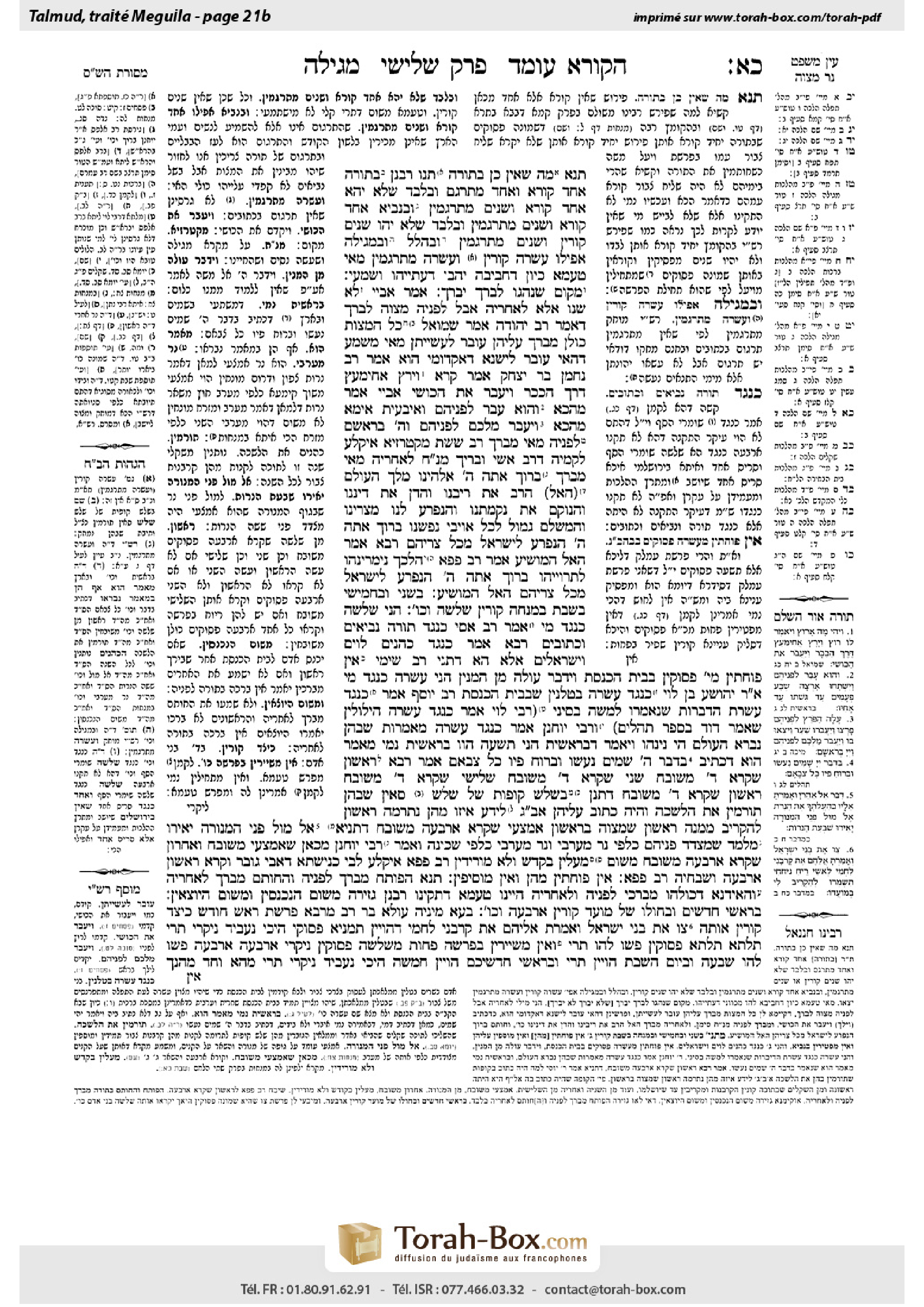
This page of Megillah includes the Aramaic text, an English translation and an AI-generated French translation, alongside the scan above.
מגילה כ״א ב · Aramaic and Hebrew text
תָּנָא: מַה שֶּׁאֵין כֵּן בַּתּוֹרָה. תָּנוּ רַבָּנַן: בַּתּוֹרָה — אֶחָד קוֹרֵא וְאֶחָד מְתַרְגֵּם, וּבִלְבַד שֶׁלֹּא יְהֵא אֶחָד קוֹרֵא וּשְׁנַיִם מְתַרְגְּמִין. וּבַנָּבִיא — אֶחָד קוֹרֵא וּשְׁנַיִם מְתַרְגְּמִין, וּבִלְבַד שֶׁלֹּא יְהוּ שְׁנַיִם קוֹרִין וּשְׁנַיִם מְתַרְגְּמִין. וּבַהַלֵּל וּבַמְּגִילָּה — אֲפִילּוּ עֲשָׂרָה קוֹרִין וַעֲשָׂרָה מְתַרְגְּמִין.
מַאי טַעְמָא? כֵּיוָן דַּחֲבִיבָה — יָהֲבִי דַּעְתַּיְיהוּ וְשָׁמְעִי.
מָקוֹם שֶׁנָּהֲגוּ לְבָרֵךְ — יְבָרֵךְ. אָמַר אַבָּיֵי: לֹא שָׁנוּ אֶלָּא לְאַחֲרֶיהָ, אֲבָל לְפָנֶיהָ — מִצְוָה לְבָרֵךְ. דְּאָמַר רַב יְהוּדָה אָמַר שְׁמוּאֵל: כׇּל הַמִּצְוֹת כּוּלָּן מְבָרֵךְ עֲלֵיהֶן עוֹבֵר לַעֲשִׂיָּיתָן.
מַאי מַשְׁמַע דְּהַאי ״עוֹבֵר״ לִישָּׁנָא דְּאַקְדּוֹמֵי הוּא? אָמַר רַב נַחְמָן בַּר יִצְחָק, אָמַר קְרָא: ״וַיָּרׇץ אֲחִימַעַץ דֶּרֶךְ הַכִּכָּר וַיַּעֲבֹר אֶת הַכּוּשִׁי״. אַבָּיֵי אָמַר מֵהָכָא: ״וְהוּא עָבַר לִפְנֵיהֶם״. וְאִיבָּעֵית אֵימָא, מֵהָכָא: ״וַיַּעֲבֹר מַלְכָּם לִפְנֵיהֶם וַה׳ בְּרֹאשָׁם״.
לְפָנֶיהָ מַאי מְבָרֵךְ? רַב שֵׁשֶׁת מִקַּטְרַזְיָא אִיקְּלַע לְקַמֵּיהּ דְּרַב אָשֵׁי וּבָרֵיךְ מנ״ח.
לְאַחֲרֶיהָ מַאי מְבָרֵךְ? בָּרוּךְ אַתָּה ה׳ אֱלֹהֵינוּ מֶלֶךְ הָעוֹלָם (הָאֵל) הָרָב אֶת רִיבֵנוּ וְהַדָּן אֶת דִּינֵנוּ וְהַנּוֹקֵם אֶת נִקְמָתֵנוּ וְהַנִּפְרָע לָנוּ מִצָּרֵינוּ וְהַמְשַׁלֵּם גְּמוּל לְכׇל אוֹיְבֵי נַפְשֵׁנוּ, בָּרוּךְ אַתָּה ה׳ הַנִּפְרָע לְיִשְׂרָאֵל מִכׇּל צָרֵיהֶם. רָבָא אָמַר: הָאֵל הַמּוֹשִׁיעַ. אָמַר רַב פָּפָּא: הִלְכָּךְ — נֵימְרִינְהוּ לְתַרְוַיְיהוּ: בָּרוּךְ אַתָּה ה׳ הַנִּפְרָע לְיִשְׂרָאֵל מִכׇּל צָרֵיהֶם הָאֵל הַמּוֹשִׁיעַ.
בְּשֵׁנִי וּבַחֲמִישִׁי בַּשַּׁבָּת בַּמִּנְחָה קוֹרִין שְׁלֹשָׁה וְכוּ׳. הָנֵי שְׁלֹשָׁה, כְּנֶגֶד מִי? אָמַר רַב אַסִּי: כְּנֶגֶד תּוֹרָה נְבִיאִים וּכְתוּבִים. רָבָא אָמַר: כְּנֶגֶד כֹּהֲנִים לְוִיִּם וְיִשְׂרְאֵלִים.
אֶלָּא הָא דְּתָנֵי רַב שִׁימִי: אֵין פּוֹחֲתִין מֵעֲשָׂרָה פְּסוּקִין בְּבֵית הַכְּנֶסֶת, ״וַיְדַבֵּר״ עוֹלֶה מִן הַמִּנְיָן. הָנֵי עֲשָׂרָה כְּנֶגֶד מִי?
אָמַר רַבִּי יְהוֹשֻׁעַ בֶּן לֵוִי: כְּנֶגֶד עֲשָׂרָה בַּטְלָנִין שֶׁבְּבֵית הַכְּנֶסֶת. רַב יוֹסֵף: אָמַר כְּנֶגֶד עֲשֶׂרֶת הַדִּבְּרוֹת שֶׁנֶּאֶמְרוּ לְמֹשֶׁה בְּסִינַי. (רַבִּי לֵוִי אָמַר: כְּנֶגֶד עֲשָׂרָה הִילּוּלִין שֶׁאָמַר דָּוִד בְּסֵפֶר תְּהִלִּים.) וְרַבִּי יוֹחָנָן אָמַר: כְּנֶגֶד עֲשָׂרָה מַאֲמָרוֹת שֶׁבָּהֶן נִבְרָא הָעוֹלָם.
הֵי נִינְהוּ? ״וַיֹּאמֶר״ דִּבְרֵאשִׁית. הָנֵי תִּשְׁעָה הָווּ! ״בְּרֵאשִׁית״ נָמֵי מַאֲמָר הוּא, דִּכְתִיב: ״בִּדְבַר ה׳ שָׁמַיִם נַעֲשׂוּ וּבְרוּחַ פִּיו כׇּל צְבָאָם״.
אָמַר רָבָא, רִאשׁוֹן שֶׁקָּרָא אַרְבָּעָה — מְשׁוּבָּח, שֵׁנִי שֶׁקָּרָא אַרְבָּעָה — מְשׁוּבָּח, שְׁלִישִׁי שֶׁקָּרָא אַרְבָּעָה — מְשׁוּבָּח.
רִאשׁוֹן שֶׁקָּרָא אַרְבָּעָה מְשׁוּבָּח — דִּתְנַן: בְּשָׁלֹשׁ קוּפּוֹת שֶׁל שָׁלֹשׁ סְאִין שֶׁבָּהֶן תּוֹרְמִין אֶת הַלִּשְׁכָּה, וְהָיָה כָּתוּב עֲלֵיהֶן אב״ג, לֵידַע אֵיזוֹ מֵהֶן נִתְרְמָה רִאשׁוֹן, לְהַקְרִיב מִמֶּנָּה רִאשׁוֹן — שֶׁמִּצְוָה בָּרִאשׁוֹן.
אֶמְצָעִי שֶׁקָּרָא אַרְבָּעָה מְשׁוּבָּח — דְּתַנְיָא: ״אֶל מוּל פְּנֵי הַמְּנוֹרָה יָאִירוּ״, מְלַמֵּד שֶׁמְּצַדֵּד פְּנֵיהֶם כְּלַפֵּי נֵר מַעֲרָבִי, וְנֵר מַעֲרָבִי כְּלַפֵּי שְׁכִינָה. וְאָמַר רַבִּי יוֹחָנָן: מִכָּאן שֶׁאֶמְצָעִי מְשׁוּבָּח.
וְאַחֲרוֹן שֶׁקָּרָא אַרְבָּעָה מְשׁוּבָּח — מִשּׁוּם מַעֲלִין בַּקֹּדֶשׁ וְלֹא מוֹרִידִין. רַב פָּפָּא אִיקְּלַע לְבֵי כְּנִישְׁתָּא דַּאֲבִי גוֹבָר וְקָרָא רִאשׁוֹן אַרְבָּעָה, וְשַׁבְּחֵיהּ רַב פָּפָּא.
אֵין פּוֹחֲתִין מֵהֶן וְאֵין מוֹסִיפִין. תָּנָא: הַפּוֹתֵחַ — מְבָרֵךְ לְפָנֶיהָ, וְהַחוֹתֵם — מְבָרֵךְ לְאַחֲרֶיהָ.
וְהָאִידָּנָא, דְּכוּלְּהוּ מְבָרְכִי לְפָנֶיהָ וּלְאַחֲרֶיהָ — הַיְינוּ טַעְמָא דְּתַקִּינוּ רַבָּנַן: גְּזֵירָה מִשּׁוּם הַנִּכְנָסִין וּמִשּׁוּם הַיּוֹצְאִין.
בְּרָאשֵׁי חֳדָשִׁים וּבְחוּלּוֹ שֶׁל מוֹעֵד קוֹרִין אַרְבָּעָה וְכוּ׳. בְּעָא מִינֵּיהּ עוּלָּא בַּר רַב מֵרָבָא: פָּרָשַׁת רֹאשׁ חוֹדֶשׁ, כֵּיצַד קוֹרִין אוֹתָהּ? ״צַו אֶת בְּנֵי יִשְׂרָאֵל וְאָמַרְתָּ אֲלֵיהֶם אֶת קׇרְבָּנִי לַחְמִי״, דְּהָוְיָין תְּמָנְיָא פְּסוּקֵי, הֵיכִי נֶעְבֵּיד?
נִיקְרֵי תְּרֵי תְּלָתָא תְּלָתָא פְּסוּקִין — פָּשׁוּ לְהוּ תְּרֵי, וְאֵין מְשַׁיְּירִין בַּפָּרָשָׁה פָּחוֹת מִשְּׁלֹשָׁה פְּסוּקִין. נִיקְרֵי אַרְבָּעָה אַרְבְּעָה — פָּשׁוּ לְהוּ שִׁבְעָה, ״וּבְיוֹם הַשַּׁבָּת״ הָוַיִין תְּרֵי, ״וּבְרָאשֵׁי חׇדְשֵׁיכֶם״ הָוַיִין חֲמִשָּׁה, הֵיכִי נַעֲבֵיד? נִיקְרֵי תְּרֵי מֵהָא וְחַד מֵהָנָךְ —
Megillah 21b · English translation
It was taught: This is not the case with regard to reading the Torah, which may be read only by a single person. The Sages taught (Tosefta, Megilla 3:20): When reading from the Torah, one person reads and one may translate the reading into Aramaic for the congregation, provided that there are not one person reading and two people translating, because two voices cannot be heard simultaneously. And when reading from the Prophets, one person reads and two may translate, as there is less of a need to ensure that everyone hears the precise translation, as the Prophets do not teach halakha. This is the case provided that there are not two people reading and two translating. And when reciting hallel and reading the Megilla, even ten people may read and ten may translate.
The Gemara asks: What is the reason that the Megilla may be read by several people at once? Since the Megilla is cherished by the congregation, they will pay close attention and hear it, and they will not become distracted by the different voices.
§ We learned in the mishna: In a place where the people are accustomed to recite a blessing over the reading, one should recite a blessing. Abaye said: They taught that the matter depends upon local custom only with regard to the blessing that is recited after the reading of the Megilla. But as for the blessing that is recited before the reading, it is a mitzva to recite the blessing according to all opinions, as Rav Yehuda said that Shmuel said: With regard to all the mitzvot, one recites a blessing over them prior to [over] their performance.
The Gemara asks: From where may it be inferred that the word over is the language of precedence? Rav Naḥman bar Yitzḥak said that the verse states: “And Ahimaaz ran by the way of the plain, and overran [vaya’avor] the Cushite” (II Samuel 18:23), i.e., Ahimaaz overtook the Cushite. Abaye said: It is derived from here: “And he passed [avar] before them” (Genesis 33:3). And if you wish, say instead that the proof is from here: “And their king passed [vaya’avor] before them and the Lord at their head” (Micah 2:13).
The Gemara asks: What blessing is recited before the reading of the Megilla? The Gemara relates that Rav Sheshet from Katrazya once happened to come before Rav Ashi, and he recited three blessings, alluded to by the letters mem, nun, ḥet: Concerning the reading [mikra] of the Megilla; Who has performed miracles [nissim] for our fathers; and Who has given us life [sheheḥeyanu].
The Gemara asks: What blessing is recited after the reading of the Megilla in places where it is customary to recite such a blessing? The Gemara answers that the following blessing is recited: Blessed are You, Lord our God, King of the universe, the God Who pleads our cause, and Who judges our claim, and Who avenges our vengeance, and Who punishes our foes, and Who brings retribution to our enemies. Blessed are You, Lord, Who, on behalf of Israel, exacts punishment from all of their foes. Rava said: The conclusion of the blessing is as follows: Blessed are you, Lord, the God who brings salvation. Rav Pappa said: Therefore, since there are two opinions on the matter, we should say both of them: Blessed are you, Lord, Who, on behalf of Israel, exacts punishment from all their foes; the God Who brings salvation.
We learned in the mishna: On Mondays and on Thursdays during the morning service and on Shabbat during the afternoon service, three people read from the Torah. The Gemara asks: Corresponding to what were these three readers instituted? Rav Asi said: They correspond to the three sections of the Bible: Pentateuch, Prophets, and Writings. Rava said: They correspond to the three components of the Jewish people: Priests, Levites, and Israelites.
The Gemara raises a question: But with regard to this baraita that Rav Shimi taught: One may not decrease to fewer than ten the number of verses read during a public Torah reading in the synagogue, and a generic verse, e.g., “And God spoke to Moses saying,” is included in the count, to what do these ten verses correspond? Why specifically the number ten?
Rabbi Yehoshua ben Levi said: They correspond to the ten idlers that are in the synagogue, i.e., ten men who have the leisure not to work, and instead sit in the synagogue and are available to attend to communal needs. Rav Yosef said: They correspond to the Ten Commandments that were spoken to Moses at Sinai. Rabbi Levi said: They correspond to the ten psalms of praise that David said in the book of Psalms. And Rabbi Yoḥanan said: They correspond to the ten utterances with which the world was created.
The Gemara asks: What are these ten utterances? Presumably, they are the utterances introduced by the words “and God said” in the story of Creation in the first chapter of Genesis. However, there are only nine of these utterances and not ten. The Gemara answers: The expression: “In the beginning” (Genesis 1:1) is also considered an utterance, as it is written: “By the word of the Lord were the heavens made; and all the host of them by the breath of His mouth” (Psalms 33:6), which indicates that the first utterance of Creation was the general creation of the entire universe.
Rava said: Since ten verses must be read, if the first of the three readers called to the Torah read four verses, he is praiseworthy; if the second one read four verses, he is praiseworthy; and if the third one read four verses, he is praiseworthy.
Rava explains: If the first of the three readers called to the Torah read four verses, he is praiseworthy because the first in a series is privileged, as we learned in a mishna (Shekalim 8a): One removes the funds from the Temple treasury chamber, in order to use them for purchasing communal offerings and attending to other needs of the Temple, with three large baskets, each measuring three se’a. On the baskets is written, respectively, alef, beit, gimmel, in order to know which of them was removed first, in order to sacrifice offerings purchased with money from that basket first, as it is a mitzva to use the money collected with the first basket before the money collected with the others.
If the middle one read four verses, he is also praiseworthy, as the middle position is also dignified, as it is taught in a baraita: “The seven lamps shall give light in front of the candelabrum” (Numbers 8:2); this teaches that the priest turns the front of each lamp toward the western lamp of the candelabrum, i.e., the middle lamp, and the western lamp faces toward the Divine Presence. And Rabbi Yoḥanan said: It is derived from here that the middle one is especially praiseworthy.
And if the last one called to the Torah read four verses, he too is praiseworthy, due to the principle that one elevates to a higher level of sanctity and does not downgrade. If the last reader reads more verses than did the first two, this is an elevation in sanctity. The Gemara relates that Rav Pappa happened to come to the synagogue of the place called Avi Gover, and the first person called to the Torah read four verses, and Rav Pappa praised him.
We learned in the mishna that one may neither decrease the number of readers nor add to them. The one who begins the reading and the one who concludes the reading from the Torah each recite a blessing. It is taught in a baraita: The one who begins the reading recites a blessing before reading from the Torah, and the one who concludes the reading recites a blessing after the reading.
The Gemara comments: And now that all who read from the Torah recite blessings both before and after reading from the Torah, this is the reason that the Sages instituted this policy: It is a decree due to both those who enter the synagogue in middle of the reading and do not hear the first reader’s initial blessing and due to those who leave the synagogue early and do not hear the final reader’s concluding blessing, lest they come to the erroneous conclusion that one blessing suffices.
We learned in the mishna: On the days of the New Moon and on the intermediate days of a Festival, four people read from the Torah. Ulla bar Rav raised a dilemma before Rava: The Torah portion read on the New Moon consists of three short consecutive paragraphs (Numbers 28:1–8, 9–10, 11–15). How does one read it in order to divide it among four readers? With regard to the first paragraph, which includes the verse: “Command the children of Israel and say to them, My offering, the provision of My sacrifices made by fire” (Numbers 28:2), and which is eight verses, what shall we do?
If you say that the first two readers should read three verses each, there will remain only two more verses until the end of the paragraph, and one may not leave fewer than three verses before the end of a paragraph at the conclusion of a reading. If you say that the first two readers should read four verses each and complete the first paragraph, then seven verses will be left until the end of entire portion; the second paragraph of “And on Shabbat day” (Numbers 28:9) is two verses, and the third paragraph of “And on the beginnings of your months” (Numbers 28:11) is five verses. What shall we do with them? If the third reader reads the two verses from this paragraph and one of those verses in the following paragraph, this is improper due to the principle that
Megillah 21b · Traduction française (IA)
Il a été enseigné : Tel n’est pas le cas pour la lecture de la Torah, qui ne peut être faite que par une seule personne. Les Sages ont enseigné (Tosefta, Meguila 3:20) : Lorsqu’on lit la Torah, une personne lit et une autre peut traduire la lecture en araméen pour l’assemblée, à condition qu’il n’y ait pas une personne qui lise et deux personnes qui traduisent, car deux voix ne peuvent être entendues simultanément. Lorsqu’on lit les Prophètes, une personne lit et deux peuvent traduire, car il est moins nécessaire de veiller à ce que chacun entende la traduction exacte, puisque les Prophètes n’enseignent pas la halakha. Cela est permis à condition qu’il n’y ait pas deux personnes qui lisent et deux qui traduisent. Lorsqu’on récite le Hallel et qu’on lit la Meguila, même dix personnes peuvent lire et dix autres traduire.
La Guemara demande : Pourquoi la Meguila peut-elle être lue par plusieurs personnes à la fois ? Comme la Meguila est chère à l’assemblée, ses membres y prêteront une grande attention et l’entendront ; ils ne seront pas distraits par les différentes voix.
§ Nous avons appris dans la Michna : Là où les gens ont l’habitude de réciter une bénédiction après la lecture, on doit réciter une bénédiction. Abayé dit : Ils ont enseigné que la question dépend de l’usage local uniquement pour la bénédiction récitée après la lecture de la Meguila. Mais pour la bénédiction récitée avant la lecture, il y a une mitsva de la réciter selon toutes les opinions, comme Rav Yehouda a dit au nom de Chmouel : Pour toutes les mitsvot, on récite une bénédiction avant [leur accomplissement].
La Guemara demande : D’où peut-on déduire que le mot « sur » exprime l’antériorité ? Rav Naḥman bar Yitzḥak dit que le verset énonce : « Ahimaas courut par le chemin de la plaine et dépassa [vaya’avor] le Koushite » (II Samuel 18:23), c’est-à-dire qu’Ahimaas devança le Koushite. Abayé dit que cela se déduit d’ici : « Il passa [avar] devant eux » (Genèse 33:3). Et si tu préfères, dis plutôt que la preuve vient d’ici : « Leur roi passa [vaya’avor] devant eux, et l’Éternel était à leur tête » (Michée 2:13).
La Guemara demande : Quelle bénédiction récite-t-on avant la lecture de la Meguila ? La Guemara rapporte que Rav Chéchet, de Katrazya, se trouva un jour devant Rav Achi, et qu’il récita trois bénédictions, évoquées par les lettres mem, noun, ḥet : au sujet de la lecture [mikra] de la Meguila ; « Qui a accompli des miracles [nissim] pour nos ancêtres » ; et « Qui nous a fait vivre [sheheḥeyanu] ».
La Guemara demande : Quelle bénédiction récite-t-on après la lecture de la Meguila dans les lieux où il est d’usage d’en réciter une ? La Guemara répond qu’on récite la bénédiction suivante : Béni sois-Tu, Seigneur notre Dieu, Roi de l’univers, Dieu qui défend notre cause, qui juge notre revendication, qui venge notre vengeance, qui punit nos ennemis et qui fait rendre justice à nos adversaires. Béni sois-Tu, Seigneur, qui, au nom d’Israël, châtie tous ses ennemis. Rava dit que la conclusion de la bénédiction est la suivante : Béni sois-Tu, Seigneur, Dieu qui apporte le salut. Rav Pappa dit : Par conséquent, puisqu’il existe deux opinions sur la question, nous devons dire les deux : Béni sois-Tu, Seigneur, qui, au nom d’Israël, châtie tous ses ennemis ; Dieu qui apporte le salut.
Nous avons appris dans la Michna : Les lundis et les jeudis, pendant l’office du matin, et le Chabbat, pendant l’office de l’après-midi, trois personnes lisent la Torah. La Guemara demande : À quoi correspondent ces trois lecteurs ? Rav Assi dit : Ils correspondent aux trois parties de la Bible : le Pentateuque, les Prophètes et les Écrits. Rava dit : Ils correspondent aux trois composantes du peuple juif : les prêtres, les lévites et les Israélites.
La Guemara soulève une question : Mais concernant cette baraïta qu’a enseignée Rav Chimi — on ne peut pas réduire à moins de dix le nombre de versets lus lors d’une lecture publique de la Torah à la synagogue, et un verset générique, par exemple « Dieu parla à Moïse en disant », est compris dans le décompte — à quoi correspondent ces dix versets ? Pourquoi précisément le nombre dix ?
Rabbi Yehoshua ben Levi dit : Ils correspondent aux dix oisifs qui se trouvent dans la synagogue, c’est-à-dire dix hommes qui ont le loisir de ne pas travailler et qui, au lieu de cela, restent assis dans la synagogue et sont disponibles pour s’occuper des besoins de la communauté. Rav Yossef dit : Ils correspondent aux Dix Commandements prononcés à Moïse au Sinaï. Rabbi Lévi dit : Ils correspondent aux dix psaumes de louange que David a dits dans le livre des Psaumes. Et Rabbi Yoḥanan dit : Ils correspondent aux dix paroles par lesquelles le monde a été créé.
La Guemara demande : Quelles sont ces dix paroles ? On suppose qu’il s’agit des paroles introduites par les mots « et Dieu dit », dans le récit de la Création au premier chapitre de la Genèse. Or, il n’y en a que neuf, et non dix. La Guemara répond que l’expression « Au commencement » (Genèse 1:1) est également considérée comme une parole, car il est écrit : « Par la parole de l’Éternel, les cieux ont été faits, et toute leur armée par le souffle de sa bouche » (Psaumes 33:6), ce qui indique que la première parole de la Création était la création générale de l’univers entier.
Rava dit : Puisqu’il faut lire dix versets, si le premier des trois lecteurs appelés à la Torah en lit quatre, il est digne d’éloges ; si le deuxième en lit quatre, il est digne d’éloges ; et si le troisième en lit quatre, il est digne d’éloges.
Rava explique : Si le premier des trois lecteurs appelés à la Torah en lit quatre, il est digne d’éloges, car le premier d’une série bénéficie d’un privilège, comme nous l’avons appris dans une Michna (Chekalim 8a) : On retire les fonds de la salle du trésor du Temple, afin de les utiliser pour acheter les sacrifices communautaires et répondre à d’autres besoins du Temple, au moyen de trois grands paniers contenant chacun trois séa. Sur les paniers sont inscrites respectivement les lettres alef, beit, guimel, afin de savoir lequel a été retiré en premier et de pouvoir offrir d’abord les sacrifices achetés avec l’argent de ce panier, car c’est une mitsva d’utiliser l’argent recueilli dans le premier panier avant celui recueilli dans les autres.
Si celui du milieu en lit quatre, il est lui aussi digne d’éloges, car la position du milieu est également honorée, comme il est enseigné dans une baraïta : « Les sept lampes éclaireront devant la menorah » (Nombres 8:2). Cela enseigne que le prêtre tourne l’avant de chaque lampe vers la lampe occidentale de la menorah, c’est-à-dire la lampe du milieu, et que la lampe occidentale est tournée vers la Présence divine. Rabbi Yoḥanan dit : On déduit d’ici que celui qui occupe la position du milieu est particulièrement digne d’éloges.
Et si le dernier appelé à la Torah en lit quatre, il est lui aussi digne d’éloges, en vertu du principe selon lequel on élève à un niveau supérieur de sainteté et on ne rétrograde pas. Si le dernier lecteur lit davantage de versets que les deux premiers, cela constitue une élévation du niveau de sainteté. La Guemara rapporte que Rav Pappa se trouva un jour dans la synagogue du lieu appelé Avi Gover, où le premier appelé à la Torah lut quatre versets, et Rav Pappa le loua.
Nous avons appris dans la Michna qu’on ne peut ni réduire le nombre de lecteurs ni l’augmenter. Celui qui commence la lecture et celui qui la conclut récitent chacun une bénédiction. Il est enseigné dans une baraïta : Celui qui commence la lecture récite une bénédiction avant de lire la Torah, et celui qui la conclut récite une bénédiction après la lecture.
La Guemara commente : Et maintenant que tous ceux qui lisent la Torah récitent des bénédictions avant et après la lecture, voici pourquoi les Sages ont institué cette règle : c’est un décret visant à la fois ceux qui entrent dans la synagogue au milieu de la lecture et n’entendent pas la bénédiction initiale du premier lecteur, et ceux qui quittent la synagogue trop tôt et n’entendent pas la bénédiction finale du dernier lecteur, de peur qu’ils en viennent à conclure à tort qu’une seule bénédiction suffit.
Nous avons appris dans la Michna : Les jours de Roch ‘Hodech et les jours intermédiaires d’une fête, quatre personnes lisent la Torah. Oulla bar Rav soumit une difficulté à Rava : La portion de la Torah lue à Roch ‘Hodech se compose de trois courts paragraphes consécutifs (Nombres 28:1–8, 9–10, 11–15). Comment la lit-on pour la répartir entre quatre lecteurs ? Concernant le premier paragraphe, qui comprend le verset : « Ordonne aux enfants d’Israël et dis-leur : Mon offrande, la nourriture de mes sacrifices consumés par le feu » (Nombres 28:2), et qui compte huit versets, que devons-nous faire ?
Si tu dis que les deux premiers lecteurs doivent lire chacun trois versets, il ne restera que deux versets jusqu’à la fin du paragraphe, et on ne peut pas laisser moins de trois versets avant la fin d’un paragraphe à la conclusion d’une lecture. Si tu dis que les deux premiers lecteurs doivent lire chacun quatre versets et terminer le premier paragraphe, alors il restera sept versets jusqu’à la fin de toute la portion : le deuxième paragraphe, « Et le jour du Chabbat » (Nombres 28:9), compte deux versets, et le troisième, « Et au début de vos mois » (Nombres 28:11), en compte cinq. Que devons-nous en faire ? Si le troisième lecteur lit les deux versets de ce paragraphe et l’un des versets du paragraphe suivant, cela ne convient pas, en vertu du principe selon lequel
Traduction française générée par IA à partir de l’édition anglaise de Sefaria. Vérifie toujours un passage avec le texte source.
Text from Sefaria: William Davidson Edition - Vocalized Aramaic (CC BY NC); William Davidson Edition - English (CC BY NC).