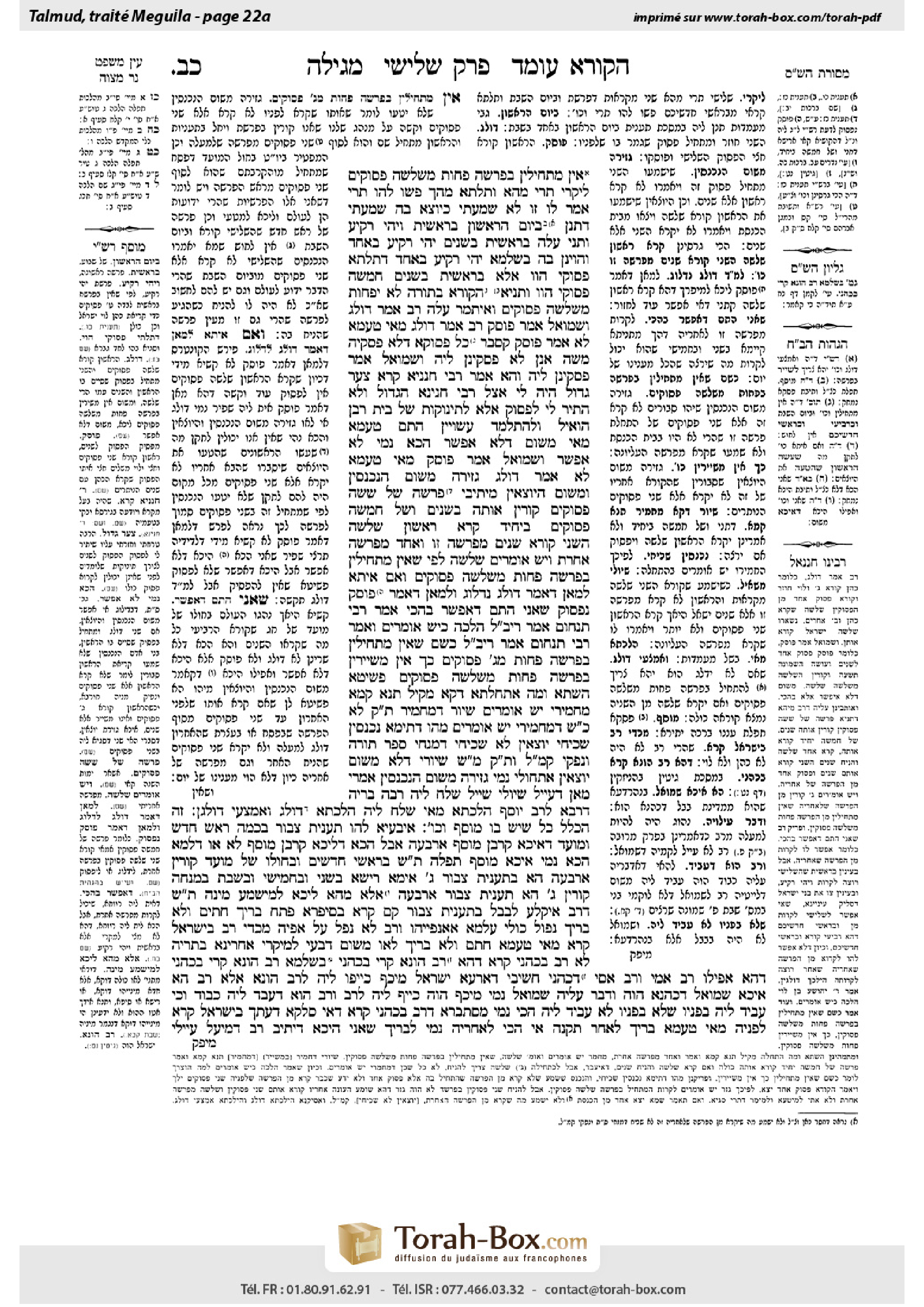
Megillah 22a: Talmud study for Daf Yomi
Daf Yomi is the daily study of one Talmud folio. Explore 37 tractates with scans, Hebrew text, Sefaria English and AI-generated French translations where annotated.
Passage selection and English or AI-generated French translation are available where the scan has annotations. Daf Study is independent of Torah-Box and Sefaria.
Browse Megillah · מגילה · All tractatesMegillah 22a text and translations
This page of Megillah includes the Aramaic text, an English translation and an AI-generated French translation, alongside the scan above.
מגילה כ״ב א · Aramaic and Hebrew text
אֵין מַתְחִילִין בַּפָּרָשָׁה פָּחוֹת מִשְּׁלֹשָׁה פְּסוּקִים. לִיקְרֵי תְּרֵי מֵהָא וּתְלָתָא מֵהָךְ, פָּשׁוּ לְהוּ תְּרֵי!
אָמַר לוֹ: זוֹ לֹא שָׁמַעְתִּי, כַּיּוֹצֵא בָּהּ שָׁמַעְתִּי, דִּתְנַן: בַּיּוֹם הָרִאשׁוֹן — ״בְּרֵאשִׁית״ וִ״יְהִי רָקִיעַ״, וְתָנֵי עֲלַהּ: ״בְּרֵאשִׁית״ — בִּשְׁנַיִם, ״יְהִי רָקִיעַ״ — בְּאֶחָד.
וְהָוֵינַן בַּהּ: בִּשְׁלָמָא ״יְהִי רָקִיעַ״ בְּאֶחָד, דִּתְלָתָא פְּסוּקֵי הָווּ, אֶלָּא ״בְּרֵאשִׁית״ בִּשְׁנַיִם? חַמְשָׁה פְּסוּקֵי הָווּ, וְתַנְיָא: הַקּוֹרֵא בַּתּוֹרָה לֹא יִפְחוֹת מִשְּׁלֹשָׁה פְּסוּקִים!
וְאִיתְּמַר עֲלַהּ, רַב אָמַר: דּוֹלֵג. וּשְׁמוּאֵל אָמַר: פּוֹסֵק.
רַב אָמַר דּוֹלֵג, מַאי טַעְמָא לָא אָמַר פּוֹסֵק? קָסָבַר: כֹּל פְּסוּקָא דְּלָא פַּסְקֵיהּ מֹשֶׁה — אֲנַן לָא פָּסְקִינַן לֵיהּ.
וּשְׁמוּאֵל אָמַר פָּסְקִינַן לֵיהּ? וְהָא אָמַר רַבִּי חֲנַנְיָא קָרָא: צַעַר גָּדוֹל הָיָה לִי אֵצֶל רַבִּי חֲנִינָא הַגָּדוֹל, וְלֹא הִתִּיר לִי לִפְסוֹק אֶלָּא לְתִינוֹקוֹת שֶׁל בֵּית רַבָּן, הוֹאִיל וּלְהִתְלַמֵּד עֲשׂוּיִין.
הָתָם טַעְמָא מַאי — מִשּׁוּם דְּלָא אֶפְשָׁר, הָכָא נָמֵי לָא אֶפְשָׁר.
וּשְׁמוּאֵל אָמַר פּוֹסֵק, מַאי טַעְמָא לָא אָמַר דּוֹלֵג? גְּזֵירָה מִשּׁוּם הַנִּכְנָסִין וּמִשּׁוּם הַיּוֹצְאִין.
מֵיתִיבִי: פָּרָשָׁה שֶׁל שִׁשָּׁה פְּסוּקִים קוֹרִין אוֹתָהּ בִּשְׁנַיִם, וְשֶׁל חֲמִשָּׁה פְּסוּקִים בְּיָחִיד. קָרָא רִאשׁוֹן שְׁלֹשָׁה — הַשֵּׁנִי קוֹרֵא שְׁנַיִם מִפָּרָשָׁה זוֹ וְאֶחָד מִפָּרָשָׁה אַחֶרֶת. וְיֵשׁ אוֹמְרִים שְׁלֹשָׁה, לְפִי שֶׁאֵין מַתְחִילִין בַּפָּרָשָׁה פָּחוֹת מִשְּׁלֹשָׁה פְּסוּקִים.
וְאִם אִיתָא, לְמַאן דְּאָמַר דּוֹלֵג — נִדְלוֹג, וּלְמַאן דְּאָמַר פּוֹסֵק — נִפְסוֹק!
שָׁאנֵי הָתָם, דְּאֶפְשָׁר בְּהָכִי.
אָמַר רַבִּי תַּנְחוּם אָמַר רַבִּי יְהוֹשֻׁעַ בֶּן לֵוִי: הֲלָכָה כְּיֵשׁ אוֹמְרִים, וְאָמַר רַבִּי תַּנְחוּם אָמַר רַבִּי יְהוֹשֻׁעַ בֶּן לֵוִי: כְּשֵׁם שֶׁאֵין מַתְחִילִין בַּפָּרָשָׁה פָּחוֹת מִשְּׁלֹשָׁה פְּסוּקִים, כָּךְ אֵין מְשַׁיְּירִין בַּפָּרָשָׁה פָּחוֹת מִשְּׁלֹשָׁה פְּסוּקִים.
פְּשִׁיטָא! הַשְׁתָּא וּמָה אַתְחַלְתָּא, דְּקָא מַקֵּיל תַּנָּא קַמָּא — מַחְמְירִי יֵשׁ אוֹמְרִים, שִׁיּוּר, דְּמַחְמִיר תַּנָּא קַמָּא — לֹא כׇּל שֶׁכֵּן דְּמַחְמְירִי יֵשׁ אוֹמְרִים?!
מַהוּ דְּתֵימָא: נִכְנָסִין שְׁכִיחִי, יוֹצְאִין לָא שְׁכִיחִי, דְּמַנְּחִי סֵפֶר תּוֹרָה וְנָפְקִי, קָא מַשְׁמַע לַן.
וְתַנָּא קַמָּא מַאי שְׁנָא שַׁיּוֹרֵי דְּלָא — מִשּׁוּם יוֹצְאִין, אַתְחוֹלֵי נָמֵי, גְּזֵירָה מִשּׁוּם הַנִּכְנָסִין? אָמְרִי: מַאן דְּעָיֵיל שַׁיּוֹלֵי [מְ]שַׁיֵּיל.
שְׁלַח לֵיהּ רַבָּה בְּרֵיהּ דְּרָבָא לְרַב יוֹסֵף: הִלְכְתָא מַאי? שְׁלַח לֵיהּ, הִלְכְתָא: דּוֹלֵג, וְאֶמְצָעִי דּוֹלְגָן.
זֶה הַכְּלָל, כֹּל שֶׁיֵּשׁ בּוֹ מוּסָף וְכוּ׳. אִיבַּעְיָא לְהוּ: תַּעֲנִית צִבּוּר בְּכַמָּה? רֹאשׁ חֹדֶשׁ וּמוֹעֵד דְּאִיכָּא קׇרְבַּן מוּסַף — אַרְבָּעָה, אֲבָל הָכָא דְּלֵיכָּא קׇרְבַּן מוּסַף — לָא. אוֹ דִלְמָא: הָכָא נָמֵי אִיכָּא מוּסַף תְּפִלָּה.
תָּא שְׁמַע: בְּרָאשֵׁי חֳדָשִׁים וּבְחוּלּוֹ שֶׁל מוֹעֵד קוֹרִין אַרְבָּעָה, הָא בְּתַעֲנִית צִבּוּר שְׁלֹשָׁה! אֵימָא רֵישָׁא: בְּשֵׁנִי וּבַחֲמִישִׁי וּבַשַּׁבָּת בַּמִּנְחָה קוֹרִין שְׁלֹשָׁה: הָא תַּעֲנִית צִבּוּר אַרְבָּעָה! אֶלָּא מֵהָא לֵיכָּא לְמִישְׁמַע מִינַּהּ.
תָּא שְׁמַע: דְּרַב אִיקְּלַע לְבָבֶל בְּתַעֲנִית צִבּוּר, קָם קְרָא בְּסִיפְרָא. פְּתַח בָּרֵיךְ, חֲתַים וְלָא בָּרֵיךְ. נְפוּל כּוּלֵּי עָלְמָא אַאַנְפַּיְיהוּ, וְרַב לָא נְפַל עַל אַפֵּיהּ.
מִכְּדֵי רַב בְּיִשְׂרָאֵל קְרָא, מַאי טַעְמָא חֲתַם וְלָא בָּרֵיךְ? לָאו מִשּׁוּם דְּבָעֵי לְמִיקְרֵי אַחֲרִינָא בָּתְרֵיהּ?
לָא, רַב בְּכָהֲנֵי קְרָא. דְּהָא רַב הוּנָא קָרֵי בְּכָהֲנֵי.
בִּשְׁלָמָא רַב הוּנָא קָרֵי בְּכָהֲנֵי, דְּהָא אֲפִילּוּ רַב אַמֵּי וְרַב אַסִּי דְּכָהֲנֵי חֲשִׁיבִי דְּאַרְעָא יִשְׂרָאֵל, מִיכָּף כַּיְיפִי לֵיהּ לְרַב הוּנָא. אֶלָּא רַב — הָא אִיכָּא שְׁמוּאֵל, דְּכָהֲנָא הֲוָה, וְדָבַר עֲלֵיהּ!
שְׁמוּאֵל נָמֵי מִיכָּף הֲוָה כַּיִיף לֵיהּ לְרַב, וְרַב הוּא דַּעֲבַד לֵיהּ כָּבוֹד, וְכִי עָבֵיד לֵיהּ — בְּפָנָיו, שֶׁלֹּא בְּפָנָיו — לָא עָבֵיד לֵיהּ.
הָכִי נָמֵי מִסְתַּבְּרָא דְּרַב בְּכָהֲנֵי קְרָא, דְּאִי סָלְקָא דַעְתָּךְ בְּיִשְׂרָאֵל קְרָא, לְפָנֶיהָ מַאי טַעְמָא בָּרֵיךְ! לְאַחַר תַּקָּנָה.
אִי הָכִי, לְאַחֲרֶיהָ נָמֵי לְבָרֵיךְ! שָׁאנֵי הֵיכָא דְּיָתֵיב רַב — דְּמֵיעָל עָיְילִי,
Megillah 22a · English translation
one may not begin a new paragraph and read fewer than three verses from it. And if you say he should read two verses from this paragraph, i.e., the entire second paragraph, and then three verses from that final paragraph, only two verses will remain from the final paragraph. This is problematic because one may not conclude a reading with fewer than three verses left until the end of a paragraph and because the fourth reader will not have a sufficient number of verses to read.
Rava said to him: I have not heard a solution for this problem from my teachers. However, with regard to a similar problem I heard a solution from them, as we learned in a mishna (Ta’anit 26a): On Sunday, the non-priestly watches would read two paragraphs from the Torah: “In the beginning” (Genesis 1:1–5) and “Let there be a firmament” (Genesis 1:6–8). And it is taught in that regard that the paragraph “In the beginning” was read by two readers and the paragraph “Let there be a firmament” by one reader.
And we discussed this ruling and raised difficulties with it: Granted, the paragraph “Let there be a firmament” was read by one reader, as it consists of three verses. But how was the paragraph “In the beginning” read by two? It consists of only five verses, and it was taught in a mishna (23b): One who reads from the Torah should not read fewer than three verses.
And it was stated with regard to that mishna that the amora’im disagreed about how to divide the verses. Rav said: The second reader repeats the last verse that the first reader had recited, so that each of them reads three verses. And Shmuel said: The first reader divides the third verse and reads half of it, and the second reader begins with the second half of that verse, as though each half were its own verse.
The Gemara explains the opinions of Rav and Shmuel. Rav said that the second reader repeats the last verse that the first reader recited. What is the reason that he did not state that the first reader divides the third verse, in accordance with the opinion of Shmuel? The Gemara answers: He holds that any verse that Moses did not divide, we may not divide.
The Gemara asks: Does Shmuel say that we may divide a verse into two parts? Didn’t Rabbi Ḥananya Kara, the Bible expert, say: I had great distress with Rabbi Ḥanina the Great; there were many times I had to ask his permission to divide a verse, and he permitted me to divide it only for the benefit of schoolchildren, since they need to be taught in this manner, as it is difficult for children to learn long verses all at once? In other cases, however it is prohibited to divide a verse.
The Gemara answers: There, in the case of schoolchildren, what is the reason that it is permitted to divide a verse? Because it is not possible to teach the children without doing so. Here, too, when a paragraph of five verses must be divided between two readers, it is not possible to divide them without dividing the middle verse.
The Gemara now examines the opinion of Shmuel. And Shmuel said: The first reader divides the third verse and reads half of it. The Gemara asks: What is the reason that he did not state that the second reader repeats the last verse recited by the first reader, in accordance with the opinion of Rav? The Gemara answers: It is because of a rabbinic decree that was instituted due to those who enter and those who leave the synagogue between the readings. These individuals might erroneously conclude that since the reading they heard consisted of three verses, the reading they missed consisted of only two verses. Therefore, the middle verse is divided into two parts, so that all will realize that no reader recites only two verses.
The Gemara raises an objection to the opinions of Rav and Shmuel from the following baraita: Two people may read a paragraph of six verses, but a paragraph of five verses may be read only by a single reader. If the first one read three verses, the second one reads the remaining two verses from this paragraph and then one verse from another, i.e., the following, paragraph. And some say that it does not suffice to read one verse from the next paragraph; rather, he must read three verses, as one may not begin a new paragraph and read fewer than three verses from it.
And if it is so, if it is permissible to do as Rav and Shmuel suggested, according to the one who said that the second reader repeats a verse that the previous reader recited, i.e., Rav, let him repeat the verse in this case as well. And according to the one who said that the second reader divides the verse, i.e., Shmuel, let him divide the verse in this case as well.
The Gemara answers: There, in the case of the baraita, it is different, as it is possible to solve the problem in this manner by reading additional verses. On the New Moon, however, the next paragraph deals with an entirely different subject, and consequently it cannot be included in the Torah reading. Therefore, Rav and Shmuel presented alternate solutions.
With regard to the dispute cited in the baraita, Rabbi Tanḥum said that Rabbi Yehoshua ben Levi said: The halakha is in accordance with the opinion introduced by the phrase: Some say, which maintains that at least three verses must be read from the next paragraph. And furthermore, Rabbi Tanḥum said that Rabbi Yehoshua ben Levi said: Just as one may not begin a new paragraph and read fewer than three verses from it, so too, one may not leave fewer than three verses before the end of a paragraph at the conclusion of a reading.
The Gemara challenges this statement: This is obvious. Now, if with regard to the beginning of a paragraph, where the first tanna is lenient and holds that it is sufficient to read one verse from the next paragraph, the opinion introduced with the phrase: Some say, is stringent, then with regard to leaving verses at the end of a paragraph, where even the first tanna is stringent and holds that one may not conclude a reading with fewer than three verses remaining until the end of a paragraph, is it not all the more so obvious that the opinion introduced with: Some say, is stringent?
The Gemara answers: Lest you say: Entering in the middle of the Torah reading is common, and therefore one should not conclude a reading after having read fewer than three verses of a paragraph, but leaving in the middle of the Torah reading, whereby one abandons a Torah scroll and leaves, is not common, and therefore one may conclude a reading with fewer than three verses left in the paragraph, Rabbi Yehoshua ben Levi teaches us that the second opinion cited in the baraita is also concerned that people may leave in the middle of the Torah reading, and consequently one may not conclude a reading with fewer than three verses left in the paragraph.
The Gemara asks: And according to the first tanna, what is different about leaving fewer than three verses at the end of a paragraph, which is not permitted due to concern about those who leave the synagogue in the middle of the Torah reading? In the case of beginning a paragraph without reading at least three verses, he should also hold that there is a rabbinic decree due to those who enter, lest the latecomer think that the previous reader read fewer than three verses. The Gemara responds: Say in answer to this question that one who enters in the middle of the Torah reading asks how the Torah was read until then, and those present will explain to him that the reader started in the previous paragraph. Therefore, he will not erroneously think that the reader recited fewer than three verses.
Rabba, son of Rava, sent a messenger to ask Rav Yosef: What is the halakha with regard to dividing a small Torah portion? Rav Yosef sent him the following answer: The halakha is that one repeats a verse, in accordance with the opinion of Rav, and it is the middle reader who repeats it, and not the last reader, so that it will not be necessary to leave fewer than three verses until the end of the paragraph.
§ We learned in the mishna: This is the principle: Any day on which there is an additional offering sacrificed in the Temple and that is not a Festival, four people read from the Torah. A dilemma was raised before the Sages: On a public fast, how many people read from the Torah? Does the mishna mean to say that only on the New Moon and the intermediate days of a Festival, when there is an additional offering, four people read; but here, on a public fast day, when there is no additional offering, no, only three people read? Or perhaps here, too, there is an additional prayer, as on public fast days the prayer: Aneinu, is inserted into the Amida prayer, and so too an additional reader is called to read from the Torah.
The Gemara attempts to adduce a proof: Come and hear that which we learned in the mishna: On the days of the New Moon and on the intermediate days of a Festival, four people read from the Torah. Doesn’t this indicate that on a public fast, only three people read? The Gemara responds: Say the first clause of the mishna: On Mondays and Thursdays during the morning service and on Shabbat during the afternoon service, three people read from the Torah. Doesn’t this indicate that on a public fast, four people read from the Torah? Rather, it must be concluded that nothing can be derived from this mishna with regard to a public fast day, as the mishna does not mean to indicate the halakha in every possible case.
A different proof is now suggested. Come and hear the following incident: Rav once happened to come to Babylonia on a public fast. He stood and read from a Torah scroll. When he began to read, he recited a blessing, but when he concluded, he did not recite a blessing. Everyone else fell on their faces, i.e., bowed down on the floor, during the Taḥanun supplication, as was the custom, but Rav did not fall on his face.
The Gemara attempts to clarify the halakha based upon Rav’s conduct. Now, Rav must have read the portion that is designated for an Israelite, as he was neither a priest nor a Levite, and therefore he was the third person to read from the Torah. What, then, is the reason that when he concluded his reading he did not recite a blessing? Was it not because another person was to read after him, and since only the last reader recites a blessing, Rav did not recite a blessing upon completion of his portion? This would indicate that four readers are called to the Torah on public fasts.
The Gemara rejects this proof: No, Rav read the first reading, which is generally designated for priests. He was the leading Torah authority of his generation, and one who holds this position is called to read from the Torah even before a priest, as Rav Huna would read the first reading, which is generally designated for priests, and Rav would do the same.
The Gemara raises a difficulty: Granted, Rav Huna read the portion designated for priests, as even Rav Ami and Rav Asi, who were the most esteemed priests in Eretz Yisrael, were subordinate to Rav Huna, and he was considered the undisputed rabbinic leader of the Jewish people. However, in the case of Rav, there was Shmuel, who was a priest, and Rav had elevated him above himself, showing Shmuel deference in all matters of honor. Consequently, Rav was not the singular leader of his generation and would not have read the first reading in place of a priest.
The Gemara answers: In fact, Shmuel was also subordinate to Rav, as Rav was indeed the leading authority in Babylonia, and it was Rav who showed Shmuel honor of his own volition, in order to appease him for having cursed him. And he did this only when Shmuel was in his presence, but when he was not in his presence, Rav did not do this, and therefore Rav would read first from the Torah when Shmuel was not present.
The Gemara comments: So too, it is reasonable to assume that Rav read first from the portion that is generally designated for priests, because if it enters your mind to say that he read third, from the portion designated for an ordinary Israelite, what is the reason he recited a blessing before reading his portion? Only the first reader recites a blessing before reading from the Torah. The Gemara rejects this argument: This incident took place after it was instituted that all those called to read from the Torah recite a blessing.
The Gemara asks: If so, he should also have recited a blessing after his reading, as the rabbinic enactment requires those who read from the Torah to recite blessings both before and after their reading. The Gemara answers: The reason that the Sages required all the readers to recite blessings both before and after their readings was to prevent misunderstandings on the part of both those who enter the synagogue in the middle of the reading and those who leave early. But it was different where Rav was present, as people would enter the synagogue in the middle of the reading,
Megillah 22a · Traduction française (IA)
On ne peut pas commencer un nouveau paragraphe et en lire moins de trois versets. Et si tu dis qu’il devrait lire deux versets de ce paragraphe, c’est-à-dire le deuxième paragraphe tout entier, puis trois versets du dernier paragraphe, il ne restera que deux versets dans ce dernier paragraphe. Cela pose problème, car on ne peut pas conclure une lecture en laissant moins de trois versets avant la fin d’un paragraphe, et le quatrième lecteur n’aura pas assez de versets à lire.
Rava lui dit : « Je n’ai pas entendu de mes maîtres de solution à ce problème. Toutefois, j’ai entendu d’eux une solution concernant un problème similaire, comme nous l’avons appris dans une Michna (Ta’anit 26a) : le dimanche, les gardes non sacerdotales lisaient deux paragraphes de la Torah : “Au commencement” (Genèse 1,1-5) et “Qu’il y ait un firmament” (Genèse 1,6-8). Et il est enseigné à ce propos que le paragraphe “Au commencement” était lu par deux lecteurs, et le paragraphe “Qu’il y ait un firmament” par un seul lecteur. »
Nous avons discuté de cette règle et soulevé des difficultés à son sujet : certes, le paragraphe “Qu’il y ait un firmament” était lu par un seul lecteur, puisqu’il compte trois versets. Mais comment le paragraphe “Au commencement” était-il lu par deux lecteurs ? Il ne compte que cinq versets, et il est enseigné dans une Michna (23b) : celui qui lit dans la Torah ne doit pas lire moins de trois versets.
À propos de cette Michna, il a été rapporté que les amoraïm étaient en désaccord sur la manière de répartir les versets. Rav dit que le deuxième lecteur répète le dernier verset récité par le premier lecteur, de sorte que chacun lise trois versets. Et Chmouel dit que le premier lecteur partage le troisième verset et en lit la moitié, tandis que le deuxième lecteur commence par l’autre moitié de ce verset, comme si chacune des deux moitiés constituait un verset à part entière.
La Guemara explique les avis de Rav et de Chmouel. Rav dit que le deuxième lecteur répète le dernier verset récité par le premier lecteur. Pourquoi n’a-t-il pas dit que le premier lecteur partage le troisième verset, conformément à l’avis de Chmouel ? La Guemara répond : il considère qu’on ne peut partager aucun verset que Moïse n’a pas partagé.
La Guemara demande : Chmouel dit-il que l’on peut partager un verset en deux parties ? Rabbi Ḥananya Kara, l’expert de la Bible, n’a-t-il pas dit : « J’ai eu beaucoup de peine avec Rabbi Ḥanina le Grand ; bien des fois, j’ai dû lui demander la permission de partager un verset, et il ne m’a permis de le faire que pour les besoins des écoliers, puisqu’ils doivent être instruits de cette manière, car il est difficile pour les enfants d’apprendre d’un seul coup de longs versets » ? Dans les autres cas, toutefois, il est interdit de partager un verset.
La Guemara répond : là, dans le cas des écoliers, pourquoi est-il permis de partager un verset ? Parce qu’il n’est pas possible de les instruire autrement. Ici aussi, lorsqu’un paragraphe de cinq versets doit être réparti entre deux lecteurs, il n’est pas possible de le faire sans partager le verset du milieu.
La Guemara examine maintenant l’avis de Chmouel. Chmouel dit que le premier lecteur partage le troisième verset et en lit la moitié. La Guemara demande : pourquoi n’a-t-il pas dit que le deuxième lecteur répète le dernier verset récité par le premier lecteur, conformément à l’avis de Rav ? La Guemara répond : c’est en raison d’un décret rabbinique institué à cause de ceux qui entrent dans la synagogue et de ceux qui en sortent entre les lectures. Ces personnes pourraient conclure à tort que, puisque la lecture qu’elles ont entendue comptait trois versets, celle qu’elles ont manquée n’en comptait que deux. C’est pourquoi le verset du milieu est partagé en deux, afin que tous comprennent qu’aucun lecteur ne récite seulement deux versets.
La Guemara soulève une objection aux avis de Rav et de Chmouel à partir de la baraïta suivante : deux personnes peuvent lire un paragraphe de six versets, mais un paragraphe de cinq versets ne peut être lu que par un seul lecteur. Si le premier en a lu trois, le deuxième lit les deux versets restants de ce paragraphe, puis un verset d’un autre paragraphe, c’est-à-dire du paragraphe suivant. Et certains disent qu’il ne suffit pas de lire un verset du paragraphe suivant ; il doit plutôt en lire trois, car on ne peut pas commencer un nouveau paragraphe et en lire moins de trois versets.
Et si tel est le cas, s’il est permis d’agir comme Rav et Chmouel l’ont proposé, selon celui qui dit que le deuxième lecteur répète un verset récité par le lecteur précédent, c’est-à-dire Rav, qu’il répète aussi le verset dans ce cas. Et selon celui qui dit que le deuxième lecteur partage le verset, c’est-à-dire Chmouel, qu’il le partage aussi dans ce cas.
La Guemara répond : là, dans le cas de la baraïta, c’est différent, car il est possible de résoudre le problème de cette manière en lisant des versets supplémentaires. À la néoménie, en revanche, le paragraphe suivant traite d’un sujet entièrement différent et ne peut donc pas être inclus dans la lecture de la Torah. C’est pourquoi Rav et Chmouel ont proposé des solutions différentes.
À propos du désaccord cité dans la baraïta, Rabbi Tanḥum a dit au nom de Rabbi Yehoshua ben Levi : la halakha suit l’avis introduit par la formule « Certains disent », selon lequel il faut lire au moins trois versets du paragraphe suivant. En outre, Rabbi Tanḥum a dit au nom de Rabbi Yehoshua ben Levi : de même qu’on ne peut pas commencer un nouveau paragraphe et en lire moins de trois versets, de même on ne peut pas laisser moins de trois versets avant la fin d’un paragraphe lorsqu’on conclut une lecture.
La Guemara conteste cette déclaration : cela va de soi. Si, au début d’un paragraphe, le premier tanna est indulgent et estime qu’il suffit de lire un verset du paragraphe suivant, tandis que l’avis introduit par la formule « Certains disent » est rigoureux, alors, lorsqu’il s’agit de laisser des versets à la fin d’un paragraphe, où même le premier tanna est rigoureux et estime qu’on ne peut pas conclure une lecture en laissant moins de trois versets avant la fin d’un paragraphe, n’est-il pas d’autant plus évident que l’avis introduit par « Certains disent » est rigoureux ?
La Guemara répond : de peur que tu ne dises qu’il est courant que des gens arrivent au milieu de la lecture de la Torah, et qu’il ne faut donc pas conclure une lecture après avoir lu moins de trois versets d’un paragraphe, tandis qu’il est rare que des gens partent au milieu de la lecture de la Torah en abandonnant un rouleau de la Torah, et qu’on puisse donc conclure une lecture en laissant moins de trois versets dans le paragraphe, Rabbi Yehoshua ben Levi nous enseigne que le second avis cité dans la baraïta tient lui aussi compte du fait que des gens peuvent partir au milieu de la lecture de la Torah ; par conséquent, on ne peut pas conclure une lecture en laissant moins de trois versets dans le paragraphe.
La Guemara demande : et selon le premier tanna, en quoi le fait de laisser moins de trois versets à la fin d’un paragraphe est-il différent, au point d’être interdit par crainte que des gens ne quittent la synagogue au milieu de la lecture de la Torah ? Lorsqu’on commence un paragraphe sans en lire au moins trois versets, ne devrait-il pas aussi considérer qu’un décret rabbinique est nécessaire à cause de ceux qui arrivent, de peur que le retardataire ne pense que le lecteur précédent a lu moins de trois versets ? La Guemara répond : à cette question, on peut répondre que celui qui arrive au milieu de la lecture de la Torah demande comment la Torah a été lue jusque-là, et que les personnes présentes lui expliqueront que le lecteur avait commencé au paragraphe précédent. Il ne pensera donc pas à tort que le lecteur a récité moins de trois versets.
Rabba, fils de Rava, envoya un messager demander à Rav Yossef : quelle est la halakha concernant la répartition d’une petite portion de Torah ? Rav Yossef lui fit parvenir la réponse suivante : la halakha est qu’on répète un verset, conformément à l’avis de Rav, et c’est le lecteur du milieu qui le répète, et non le dernier lecteur, afin qu’il ne soit pas nécessaire de laisser moins de trois versets avant la fin du paragraphe.
§ Nous avons appris dans la Michna : voici le principe : tout jour où une offrande supplémentaire est sacrifiée dans le Temple et qui n’est pas une fête, quatre personnes lisent dans la Torah. Les Sages ont soulevé une question : lors d’un jeûne public, combien de personnes lisent dans la Torah ? La Michna veut-elle dire que seuls, à la néoménie et pendant les jours intermédiaires d’une fête, lorsqu’il y a une offrande supplémentaire, quatre personnes lisent, mais qu’ici, le jour d’un jeûne public, où il n’y a pas d’offrande supplémentaire, seules trois personnes lisent ? Ou peut-être y a-t-il ici aussi une prière supplémentaire, puisque, les jours de jeûne public, la prière Aneinu est insérée dans la Amida, et qu’un lecteur supplémentaire est donc également appelé à lire dans la Torah ?
La Guemara tente d’apporter une preuve : examinons ce que nous avons appris dans la Michna : à la néoménie et pendant les jours intermédiaires d’une fête, quatre personnes lisent dans la Torah. Cela n’indique-t-il pas que lors d’un jeûne public, seules trois personnes lisent ? La Guemara répond : considérons la première partie de la Michna : les lundis et les jeudis pendant l’office du matin, et le Chabbat pendant l’office de l’après-midi, trois personnes lisent dans la Torah. Cela n’indique-t-il pas que lors d’un jeûne public, quatre personnes lisent dans la Torah ? Il faut donc conclure qu’on ne peut rien déduire de cette Michna au sujet d’un jour de jeûne public, car la Michna ne vise pas à indiquer la halakha dans tous les cas possibles.
Une autre preuve est maintenant proposée. Examinons le récit suivant : Rav se trouvait un jour en Babylonie lors d’un jeûne public. Il se leva et lut dans un rouleau de la Torah. Lorsqu’il commença à lire, il récita une bénédiction, mais, à la fin de sa lecture, il n’en récita pas. Tous les autres se prosternèrent, c’est-à-dire s’inclinèrent jusqu’à terre, pendant la supplication Taḥanoun, comme le voulait la coutume, mais Rav ne se prosterna pas.
La Guemara tente de déterminer la halakha à partir du comportement de Rav. Rav a nécessairement lu la portion destinée à un Israélite, puisqu’il n’était ni prêtre ni Lévite ; il était donc le troisième lecteur de la Torah. Pourquoi, alors, n’a-t-il pas récité de bénédiction à la fin de sa lecture ? N’est-ce pas parce qu’une autre personne devait lire après lui et que, puisque seul le dernier lecteur récite une bénédiction, Rav n’en a pas récité à la fin de sa portion ? Cela indiquerait que quatre lecteurs sont appelés à la Torah lors des jeûnes publics.
La Guemara rejette cette preuve : non, Rav a effectué la première lecture, généralement réservée aux prêtres. Il était la principale autorité en Torah de sa génération, et celui qui occupe cette position est appelé à lire dans la Torah avant même un prêtre ; Rav Houna effectuait ainsi la première lecture, généralement réservée aux prêtres, et Rav faisait de même.
La Guemara soulève une difficulté : certes, Rav Houna lisait la portion réservée aux prêtres, puisque même Rav Ami et Rav Assi, les prêtres les plus estimés en Terre d’Israël, lui étaient subordonnés, et qu’il était considéré comme le chef rabbinique incontesté du peuple juif. Mais dans le cas de Rav, il y avait Chmouel, qui était prêtre, et Rav l’avait placé au-dessus de lui, témoignant à Chmouel de la déférence en toute matière honorifique. Par conséquent, Rav n’était pas l’unique chef de sa génération et n’aurait pas lu la première portion à la place d’un prêtre.
La Guemara répond : en fait, Chmouel aussi était subordonné à Rav, car Rav était bel et bien la principale autorité en Babylonie, et c’est Rav qui témoignait de son plein gré des marques d’honneur à Chmouel, afin de l’apaiser après l’avoir maudit. Il ne le faisait que lorsque Chmouel était présent ; en son absence, Rav ne le faisait pas. Rav lisait donc en premier dans la Torah lorsque Chmouel n’était pas présent.
La Guemara fait remarquer qu’il est également raisonnable de supposer que Rav a lu en premier la portion généralement réservée aux prêtres, car, si l’on envisage qu’il ait lu en troisième, dans la portion destinée à un Israélite ordinaire, pourquoi a-t-il récité une bénédiction avant de lire sa portion ? Seul le premier lecteur récite une bénédiction avant de lire dans la Torah. La Guemara rejette cet argument : cet épisode eut lieu après qu’il eut été institué que tous ceux qui sont appelés à lire dans la Torah récitent une bénédiction.
La Guemara demande : dans ce cas, il aurait aussi dû réciter une bénédiction après sa lecture, puisque le décret rabbinique exige que ceux qui lisent dans la Torah récitent des bénédictions avant et après leur lecture. La Guemara répond : les Sages ont exigé que tous les lecteurs récitent des bénédictions avant et après leur lecture afin d’éviter les malentendus chez ceux qui entrent dans la synagogue au milieu de la lecture et chez ceux qui partent avant la fin. Mais le cas était différent lorsque Rav était présent, car des gens entraient dans la synagogue au milieu de la lecture,
Traduction française générée par IA à partir de l’édition anglaise de Sefaria. Vérifie toujours un passage avec le texte source.
Text from Sefaria: William Davidson Edition - Vocalized Aramaic (CC BY NC); William Davidson Edition - English (CC BY NC).