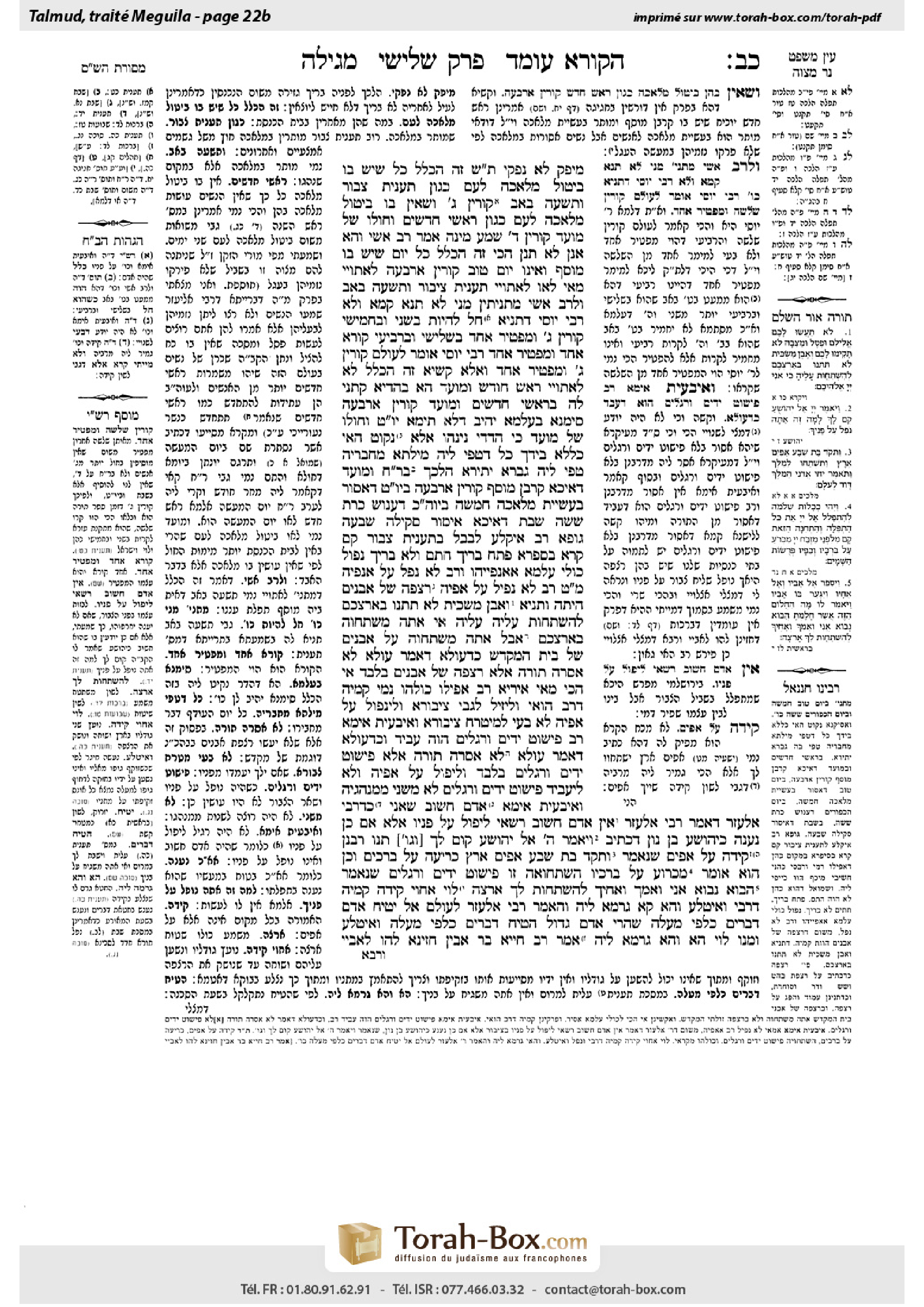
Megillah 22b: Talmud study for Daf Yomi
Daf Yomi is the daily study of one Talmud folio. Explore 37 tractates with scans, Hebrew text, Sefaria English and AI-generated French translations where annotated.
Passage selection and English or AI-generated French translation are available where the scan has annotations. Daf Study is independent of Torah-Box and Sefaria.
Browse Megillah · מגילה · All tractatesMegillah 22b text and translations
This page of Megillah includes the Aramaic text, an English translation and an AI-generated French translation, alongside the scan above.
מגילה כ״ב ב · Aramaic and Hebrew text
מִיפָּק לָא נָפְקִי.
תָּא שְׁמַע, זֶה הַכְּלָל: כֹּל שֶׁיֵּשׁ בּוֹ בִּיטּוּל מְלָאכָה לָעָם, כְּגוֹן תַּעֲנִית צִבּוּר וְתִשְׁעָה בְּאָב — קוֹרִין שְׁלֹשָׁה,
וְשֶׁאֵין בּוֹ בִּיטּוּל מְלָאכָה לָעָם, כְּגוֹן רָאשֵׁי חֳדָשִׁים וְחוּלּוֹ שֶׁל מוֹעֵד — קוֹרִין אַרְבָּעָה. שְׁמַע מִינַּהּ.
אָמַר רַב אָשֵׁי, וְהָא אֲנַן לָא תְּנַן הָכִי: זֶה הַכְּלָל, כׇּל יוֹם שֶׁיֵּשׁ בּוֹ מוּסָף וְאֵינוֹ יוֹם טוֹב — קוֹרִין אַרְבָּעָה. לְאֵתוֹיֵי מַאי? לָאו לְאֵתוֹיֵי תַּעֲנִית צִיבּוּר וְתִשְׁעָה בְּאָב!
וּלְרַב אָשֵׁי מַתְנִיתִין מַנִּי? לָא תַּנָּא קַמָּא וְלָא רַבִּי יוֹסֵי, דְּתַנְיָא: חָל לִהְיוֹת בְּשֵׁנִי וּבַחֲמִישִׁי — קוֹרִין שְׁלֹשָׁה וּמַפְטִיר אֶחָד. בִּשְׁלִישִׁי וּבִרְבִיעִי — קוֹרֵא אֶחָד וּמַפְטִיר אֶחָד. רַבִּי יוֹסֵי אוֹמֵר: לְעוֹלָם קוֹרִין שְׁלֹשָׁה וּמַפְטִיר אֶחָד!
וְאֶלָּא, קַשְׁיָא ״זֶה הַכְּלָל״! לָא, לְאֵתוֹיֵי רֹאשׁ חוֹדֶשׁ וּמוֹעֵד.
הָא בְּהֶדְיָא קָתָנֵי לַהּ: בְּרָאשֵׁי חֳדָשִׁים וּמוֹעֵד קוֹרִין אַרְבָּעָה!
סִימָנָא בְּעָלְמָא יָהֵיב, דְּלָא תֵּימָא יוֹם טוֹב וְחוּלּוֹ שֶׁל מוֹעֵד כִּי הֲדָדֵי נִינְהוּ, אֶלָּא נְקוֹט הַאי כְּלָלָא בִּידָךְ: כֹּל דְּטָפֵי לֵיהּ מִילְּתָא מֵחַבְרֵיהּ, טָפֵי לֵיהּ גַּבְרָא יַתִּירָא.
הִלְכָּךְ בְּרֹאשׁ חוֹדֶשׁ וּמוֹעֵד, דְּאִיכָּא קׇרְבַּן מוּסָף — קוֹרִין אַרְבָּעָה. בְּיוֹם טוֹב, דְּאָסוּר בַּעֲשִׂיַּית מְלָאכָה — חֲמִשָּׁה. בְּיוֹם הַכִּפּוּרִים, דְּעָנוּשׁ כָּרֵת — שִׁשָּׁה. שַׁבָּת, דְּאִיכָּא אִיסּוּר סְקִילָה — שִׁבְעָה.
גּוּפַהּ: רַב אִיקְּלַע לְבָבֶל בְּתַעֲנִית צִבּוּר, קָם קְרָא בְּסִפְרָא. פְּתַח בָּרֵיךְ, חֲתַם וְלָא בָּרֵיךְ. נְפוּל כּוּלֵּי עָלְמָא אַאַנְפַּיְיהוּ וְרַב לָא נְפַל עַל אַנְפֵּיהּ. מַאי טַעְמָא רַב לָא נְפַל עַל אַפֵּיהּ?
רִצְפָּה שֶׁל אֲבָנִים הָיְתָה, וְתַנְיָא: ״וְאֶבֶן מַשְׂכִּית לֹא תִתְּנוּ בְּאַרְצְכֶם לְהִשְׁתַּחֲוֹת עָלֶיהָ״. ״עָלֶיהָ״ אִי אַתָּה מִשְׁתַּחֲוֶה בְּאַרְצְכֶם, אֲבָל אַתָּה מִשְׁתַּחֲוֶה עַל אֲבָנִים שֶׁל בֵּית הַמִּקְדָּשׁ. כִּדְעוּלָּא, דְּאָמַר עוּלָּא: לֹא אָסְרָה תּוֹרָה אֶלָּא רִצְפָּה שֶׁל אֲבָנִים בִּלְבָד.
אִי הָכִי מַאי אִירְיָא רַב, אֲפִילּוּ כּוּלְּהוּ נָמֵי! קַמֵּיהּ דְּרַב הֲוַאי.
וְלֵיזִיל לְגַבֵּי צִיבּוּרָא וְלִינְפּוֹל עַל אַפֵּיהּ! לָא בָּעֵי (ל)מַיטְרַח צִיבּוּרָא. וְאִיבָּעֵית אֵימָא: רַב פִּישּׁוּט יָדַיִם וְרַגְלַיִם הֲוָה עָבֵיד, וְכִדְעוּלָּא. דְּאָמַר עוּלָּא: לָא אָסְרָה תּוֹרָה אֶלָּא פִּישּׁוּט יָדַיִם וְרַגְלַיִם בִּלְבַד.
וְלִיפּוֹל עַל אַפֵּיהּ, וְלָא לֶיעְבֵּיד פִּישּׁוּט יָדַיִם וְרַגְלַיִם! לָא מְשַׁנֵּי מִמִּנְהֲגֵיהּ.
וְאִיבָּעֵית אֵימָא: אָדָם חָשׁוּב שָׁאנֵי, כִּדְרַבִּי אֶלְעָזָר. דְּאָמַר רַבִּי אֶלְעָזָר: אֵין אָדָם חָשׁוּב רַשַּׁאי לִיפּוֹל עַל פָּנָיו אֶלָּא אִם כֵּן נַעֲנֶה כִּיהוֹשֻׁעַ בִּן נוּן, דִּכְתִיב: ״וַיֹּאמֶר ה׳ אֶל יְהוֹשֻׁעַ קוּם לָךְ [וְגוֹ׳]״.
תָּנוּ רַבָּנַן: קִידָּה — עַל אַפַּיִם, שֶׁנֶּאֱמַר: ״וַתִּקֹּד בַּת שֶׁבַע אַפַּיִם אֶרֶץ״. כְּרִיעָה — עַל בִּרְכַּיִם, וְכֵן הוּא אוֹמֵר: ״מִכְּרוֹעַ עַל בִּרְכָּיו״. הִשְׁתַּחֲוָאָה — זוֹ פִּישּׁוּט יָדַיִם וְרַגְלַיִם, שֶׁנֶּאֱמַר: ״הֲבוֹא נָבוֹא אֲנִי וְאִמְּךָ וְאַחֶיךָ לְהִשְׁתַּחֲוֹת לְךָ אָרְצָה״.
לֵוִי אַחְוִי קִידָּה קַמֵּיהּ דְּרַבִּי, וְאִיטְּלַע.
וְהָא (קָא) גְּרַמָא לֵיהּ? וְהָאָמַר רַבִּי אֶלְעָזָר: לְעוֹלָם אַל יָטִיחַ אָדָם דְּבָרִים כְּלַפֵּי מַעְלָה, שֶׁהֲרֵי אָדָם גָּדוֹל הֵטִיחַ דְּבָרִים כְּלַפֵּי מַעְלָה וְאִיטְּלַע וּמַנּוּ — לֵוִי. הָא וְהָא גְּרַמָא לֵיהּ.
אָמַר רַב חִיָּיא בַּר אָבִין: חֲזֵינָא לְהוּ לְאַבָּיֵי
Megillah 22b · English translation
but they would not leave early, out of deference to Rav, and therefore it was not necessary for him to recite a blessing after he finished his portion. In any event, the incident with Rav does not provide conclusive proof as to the number of readers on a public fast day.
The Gemara tries to adduce another proof: Come and hear the following baraita: This is the general principle: Any day on which labor is permitted and prolonging the prayer service would constitute a deprivation of labor for the masses, for example, a public fast day and the Ninth of Av, only three people read from the Torah, so as not to lengthen the prayer service unnecessarily.
But any day on which prolonging the prayer service would not constitute a deprivation of labor for the masses, for example, the days of the New Moon, when it is customary for women to refrain from work, and on the intermediate days of a Festival, when one may not perform labor unless refraining from labor will cause him to lose money, four people read from the Torah. The Gemara concludes: Indeed, learn from here that on a public fast day three people read from the Torah.
Rav Ashi said: Didn’t we learn in the mishna as follows: This is the principle: Any day on which there is an additional offering sacrificed in the Temple and it is not a Festival, four people read from the Torah? What is added by the formulation of this principle? Does it not come to add a public fast and the Ninth of Av, when there is an addition to the prayer service, and therefore four people read from the Torah?
The Gemara asks: But according to Rav Ashi, who is the tanna of the mishna? It is not the first tanna of the following baraita and not Rabbi Yosei. As it is taught in a baraita: If the Ninth of Av occurs on a Monday or a Thursday, days on which there is always a Torah reading, three people read from the Torah. And the last one of them concludes with a reading from the Prophets [haftara]. If it falls on a Tuesday or a Wednesday, one person reads from the Torah, and the same one concludes with a reading from the Prophets. Rabbi Yosei said: Three people always read from the Torah on the Ninth of Av, and the last one concludes with a reading from the Prophets. All agree that no more than three people read from the Torah on the Ninth of Av and other public fast days.
The Gemara responds: However, if only three people read from the Torah on these days, the statement: This is the principle, is difficult, as the mishna has already specifically mentioned every case included in the principle. The Gemara explains: No, it is not difficult; it comes to add the New Moon and the intermediate days of a Festival.
The Gemara challenges this explanation: Aren’t these days taught explicitly in the mishna: On the New Moon and on the intermediate days of a Festival, four people read from the Torah?
The Gemara answers: The principle was not intended to add to what is stated explicitly in the mishna. The mishna merely gives a mnemonic by which to remember the number of readers on each day. It expresses the following: Do not say that a Festival and the intermediate days of the Festival are the same with regard to their sanctity, and therefore the same numbers of readers are called to the Torah on these days. Rather, hold this rule firmly in your hand: On any day when there is an additional element of the laws of the day, an extra person is added to the number of those who read from the Torah.
Therefore, on the New Moon and the intermediate days of a Festival, when there is an additional offering, four people read from the Torah. On a Festival, when it is prohibited to perform labor, five people read from the Torah. On Yom Kippur, when performance of prohibited labor is punishable by karet, six people read from the Torah. On Shabbat, when there is a prohibition to perform labor that is punishable by stoning, seven people read.
The Gemara cited an incident involving Rav, and now it returns to examine the matter itself. Rav once happened to come to Babylonia on a public fast. He stood and read from a Torah scroll. When he began to read, he recited a blessing, but when he concluded, he did not recite a blessing. Everyone else fell on their faces, i.e., bowed down on the floor, during the taḥanun supplication, as was the custom, but Rav did not fall on his face. The Gemara asks: What is the reason that Rav did not fall on his face?
The Gemara answers: It was a stone floor, and it was taught in a baraita with regard to the verse: “Nor shall you install any figured stone in your land, to bow down upon it” (Leviticus 26:1), that, upon it, i.e., any type of figured stone, you shall not bow down in your land, i.e., anywhere in your land other than in the Temple; but you shall bow down upon the stones of the Temple. This is in accordance with the opinion of Ulla, as Ulla said: The Torah prohibited bowing down only upon a stone floor.
The Gemara asks: If so, why was it specifically Rav who did not bow down? All of the other people present were also prohibited from bowing down on the stone floor. The Gemara answers: The stone section of the floor was only in front of Rav, as the rest of the floor was not paved.
The Gemara comments: If so, Rav should have gone to where the rest of the congregation was standing and fallen on his face there. The Gemara responds: He did not want to trouble the congregation to make room for him. And if you wish, say the following: Rav would stretch out his arms and legs and fully prostrate himself on the ground, whereas the others would merely bend their bodies as a symbolic gesture but would not prostrate themselves on the ground. And this is in accordance with the opinion of Ulla, as Ulla said: The Torah prohibited bowing down upon a stone floor only when it is done with outstretched arms and legs.
The Gemara challenges this response: Rav should have fallen on his face without stretching out his arms and legs. The Gemara answers: He did not want to change his usual custom of full prostration, and where he was standing he could not fully prostrate himself in his usual manner because there the floor was of stone.
And if you wish, say a different reason as to why Rav did not fall on his face: An important person is different, in accordance with the opinion of Rabbi Elazar, as Rabbi Elazar said: An important person is not permitted to fall on his face in public unless he knows that he will be answered like Joshua bin Nun in his time, as it is written: “And the Lord said to Joshua: Get up; why do you lie upon your face?” (Joshua 7:10). It is a disgrace for a distinguished person to fall on his face and have his prayers unanswered. Consequently, Rav did not prostrate himself in public.
Apropos Rav’s practice of prostrating himself, the Gemara continues with a discussion of different forms of bowing. The Sages taught in a baraita: The term kidda indicates falling upon one’s face, with one’s face toward the ground, as it is stated: “Then Bathsheba bowed [vatikod] with her face to the ground” (I Kings 1:31). Keria means bowing upon one’s knees, as it is stated with regard to Solomon: He finished praying and “he rose from before the altar of the Lord, from kneeling [mikkeroa] upon his knees” (I Kings 8:54). Finally, hishtaḥava’a, that is bowing with one’s arms and legs spread in total submission, as it is stated that Jacob asked, in response to Joseph’s dream: “Shall I and your mother and your brothers indeed come to bow down [lehishtaḥavot] to you to the ground?” (Genesis 37:10).
The Gemara relates that Levi once demonstrated the form of kidda that was performed by the High Priest before Rabbi Yehuda HaNasi. This bowing was especially difficult, as it involved bending from the waist until his head reached the ground, supporting his body with his thumbs, and then rising at once. In the course of his demonstration, Levi dislocated his hip and became lame.
The Gemara asks: Was it this that caused Levi to become lame? Didn’t Rabbi Elazar say: A person should never speak impertinently toward God on High, as a great man once spoke impertinently toward God on High and he became lame? And who was he? Levi. The reason Levi became lame was because of the way he spoke to God (see Ta’anit 25a), not due to having performed kidda. The Gemara answers: Both this and that caused Levi to become lame. Since he spoke impertinently toward God, he was worthy of punishment, and he therefore suffered an injury while exerting himself to perform kidda.
On the topic of bowing, Rav Ḥiyya bar Avin said: I saw Abaye
Megillah 22b · Traduction française (IA)
mais ils ne partaient pas avant, par déférence envers Rav ; il n’était donc pas nécessaire qu’il récite une bénédiction après avoir terminé sa lecture. Quoi qu’il en soit, l’incident concernant Rav ne prouve pas de manière concluante combien de lecteurs il y avait lors d’un jour de jeûne public.
La Guemara tente d’apporter une autre preuve : Viens et entends la baraïta suivante : Voici le principe général : les jours où le travail est permis et où prolonger le service de prière priverait la multitude de temps de travail, par exemple les jours de jeûne public et le 9 Av, trois personnes seulement lisent dans la Torah, afin de ne pas prolonger inutilement le service de prière.
En revanche, les jours où prolonger le service de prière ne priverait pas la multitude de temps de travail, par exemple les jours de Roch ‘Hodech, où les femmes ont coutume de s’abstenir de travailler, ainsi que les jours intermédiaires d’une fête, où le travail est interdit sauf si s’en abstenir entraîne une perte d’argent, quatre personnes lisent dans la Torah. La Guemara conclut : En effet, apprends de là que, lors d’un jour de jeûne public, trois personnes lisent dans la Torah.
Rav Ashi dit : N’avons-nous pas appris dans la Michna ce qui suit : Voici le principe : tout jour où une offrande supplémentaire est sacrifiée dans le Temple et qui n’est pas une fête, quatre personnes lisent dans la Torah. Qu’ajoute la formulation de ce principe ? N’ajoute-t-elle pas les jours de jeûne public et le 9 Av, où le service de prière comporte un supplément et où, par conséquent, quatre personnes lisent dans la Torah ?
La Guemara demande : Mais, selon Rav Ashi, qui est le tanna de la Michna ? Ce n’est ni le premier tanna de la baraïta suivante, ni Rabbi Yosei. Car il est enseigné dans une baraïta : Si le 9 Av tombe un lundi ou un jeudi, jours où il y a toujours une lecture de la Torah, trois personnes lisent dans la Torah. Le dernier d’entre eux conclut par une lecture des Prophètes [haftara]. S’il tombe un mardi ou un mercredi, une seule personne lit dans la Torah, et c’est elle qui conclut par une lecture des Prophètes. Rabbi Yosei dit : Le 9 Av, trois personnes lisent toujours dans la Torah, et le dernier conclut par une lecture des Prophètes. Tous s’accordent à dire que, le 9 Av et les autres jours de jeûne public, pas plus de trois personnes ne lisent dans la Torah.
La Guemara répond : Cependant, si ces jours-là trois personnes seulement lisent dans la Torah, la déclaration « Voici le principe » pose problème, car la Michna a déjà mentionné explicitement tous les cas qu’il englobe. La Guemara explique : Non, il n’y a pas de difficulté ; ce principe vient ajouter Roch ‘Hodech et les jours intermédiaires d’une fête.
La Guemara conteste cette explication : Ces jours ne sont-ils pas déjà mentionnés explicitement dans la Michna : à Roch ‘Hodech et pendant les jours intermédiaires d’une fête, quatre personnes lisent dans la Torah ?
La Guemara répond : Le principe n’avait pas pour but d’ajouter des cas à ceux qui sont énoncés explicitement dans la Michna. La Michna donne simplement un moyen mnémotechnique pour se rappeler le nombre de lecteurs de chaque jour. Elle exprime ce qui suit : Ne dis pas qu’une fête et les jours intermédiaires de cette fête ont la même sainteté et que, par conséquent, le même nombre de personnes est appelé à la Torah ces jours-là. Au contraire, retiens fermement cette règle : chaque fois qu’un jour comporte un élément supplémentaire dans ses lois, une personne de plus s’ajoute au nombre de ceux qui lisent dans la Torah.
Ainsi, à Roch ‘Hodech et pendant les jours intermédiaires d’une fête, où une offrande supplémentaire est apportée, quatre personnes lisent dans la Torah. Un jour de fête, où le travail est interdit, cinq personnes lisent dans la Torah. À Yom Kippour, où l’accomplissement d’un travail interdit est passible de karet, six personnes lisent dans la Torah. Le Chabbat, où l’interdiction de travailler est passible de lapidation, sept personnes lisent.
La Guemara a cité un incident concernant Rav et revient maintenant examiner cet incident lui-même. Un jour, Rav arriva en Babylonie lors d’un jeûne public. Il se leva et lut dans un rouleau de la Torah. Lorsqu’il commença à lire, il récita une bénédiction, mais lorsqu’il termina, il n’en récita pas. Tous les autres se prosternaient face contre terre pendant la supplication de Ta’hanoun, selon la coutume, mais Rav ne se prosterna pas. La Guemara demande : Pourquoi Rav ne se prosterna-t-il pas ?
La Guemara répond : Le sol était en pierre, et une baraïta enseigne au sujet du verset : « Vous ne placerez pas dans votre pays de pierre sculptée devant laquelle vous vous prosternerez » (Lévitique 26:1), que devant elle, c’est-à-dire devant tout type de pierre sculptée, vous ne vous prosternerez pas dans votre pays, c’est-à-dire nulle part dans votre pays en dehors du Temple ; mais devant les pierres du Temple, vous pouvez vous prosterner. Cela est conforme à l’avis d’Oula, car Oula a dit : La Torah n’a interdit de se prosterner que sur un sol de pierre.
La Guemara demande : Si tel est le cas, pourquoi Rav, précisément, ne s’est-il pas prosterné ? Tous les autres présents avaient également l’interdiction de se prosterner sur le sol de pierre. La Guemara répond : La partie du sol en pierre se trouvait uniquement devant Rav, car le reste du sol n’était pas dallé.
La Guemara fait remarquer : Dans ce cas, Rav aurait dû se rendre là où se tenait le reste de l’assemblée et s’y prosterner face contre terre. La Guemara répond : Il ne voulait pas déranger l’assemblée en lui demandant de lui faire de la place. Et si tu le souhaites, dis plutôt : Rav étendait les bras et les jambes et se prosternait entièrement sur le sol, tandis que les autres se contentaient d’incliner le corps en un geste symbolique, sans se prosterner sur le sol. Cela est conforme à l’avis d’Oula, car Oula a dit : La Torah n’a interdit de se prosterner sur un sol de pierre que lorsque l’on le fait les bras et les jambes étendus.
La Guemara conteste cette réponse : Rav aurait pu se prosterner face contre terre sans étendre les bras et les jambes. La Guemara répond : Il ne voulait pas renoncer à son habitude de se prosterner entièrement et, là où il se tenait, il ne pouvait pas se prosterner entièrement comme à son habitude, car le sol y était en pierre.
Et si tu le souhaites, donne une autre raison pour laquelle Rav ne se prosterna pas : le cas d’un personnage important est différent, conformément à l’avis de Rabbi Elazar. Car Rabbi Elazar a dit : Un personnage important n’est pas autorisé à se prosterner face contre terre en public, à moins de savoir que sa prière sera exaucée comme celle de Josué fils de Noun en son temps, ainsi qu’il est écrit : « Et l’Éternel dit à Josué : Lève-toi ; pourquoi restes-tu ainsi prosterné face contre terre ? » (Josué 7:10). Il est déshonorant pour une personne éminente de se prosterner face contre terre et de voir ses prières rester sans réponse. Par conséquent, Rav ne se prosterna pas en public.
À propos de la pratique de Rav consistant à se prosterner, la Guemara poursuit en examinant différentes formes d’inclinaison. Les Sages ont enseigné dans une baraïta : Le terme kidda désigne le fait de tomber face contre terre, le visage tourné vers le sol, comme il est dit : « Alors Batcheva s’inclina [vatikod], le visage contre terre » (I Rois 1:31). Keria désigne le fait de s’incliner à genoux, comme il est dit au sujet de Salomon : il acheva sa prière et « se leva de devant l’autel de l’Éternel, après s’être agenouillé [mikkeroa] » (I Rois 8:54). Enfin, hishtaḥava’a désigne le fait de se prosterner les bras et les jambes étendus, en signe de soumission totale, comme il est dit que Jacob demanda en réponse au rêve de Joseph : « Est-ce que moi, ta mère et tes frères, nous viendrons vraiment nous prosterner [lehishtaḥavot] devant toi jusqu’à terre ? » (Genèse 37:10).
La Guemara rapporte que Levi montra un jour à Rabbi Yehouda HaNassi la forme de kidda pratiquée par le grand prêtre. Cette prosternation était particulièrement difficile : il fallait se pencher à partir de la taille jusqu’à ce que la tête touche le sol, soutenir son corps avec les pouces, puis se relever d’un seul coup. Au cours de sa démonstration, Levi se déboîta la hanche et devint boiteux.
La Guemara demande : Est-ce cela qui rendit Levi boiteux ? Rabbi Elazar n’a-t-il pas dit : Qu’une personne ne parle jamais avec insolence à Dieu là-haut, car un grand homme parla un jour avec insolence à Dieu là-haut et devint boiteux ? Et qui était-ce ? Levi. La raison pour laquelle Levi devint boiteux était sa manière de parler à Dieu (voir Ta’anit 25a), et non le fait d’avoir exécuté kidda. La Guemara répond : Les deux causes ont rendu Levi boiteux. Comme il avait parlé avec insolence à Dieu, il méritait une punition et fut donc blessé alors qu’il faisait l’effort d’exécuter kidda.
À propos de la prosternation, Rav Ḥiyya bar Avin a dit : J’ai vu Abaye
Traduction française générée par IA à partir de l’édition anglaise de Sefaria. Vérifie toujours un passage avec le texte source.
Text from Sefaria: William Davidson Edition - Vocalized Aramaic (CC BY NC); William Davidson Edition - English (CC BY NC).