Megillah 23a: Talmud study for Daf Yomi
Daf Yomi is the daily study of one Talmud folio. Explore 37 tractates with scans, Hebrew text, Sefaria English and AI-generated French translations where annotated.
Passage selection and English or AI-generated French translation are available where the scan has annotations. Daf Study is independent of Torah-Box and Sefaria.
Browse Megillah · מגילה · All tractatesMegillah 23a text and translations
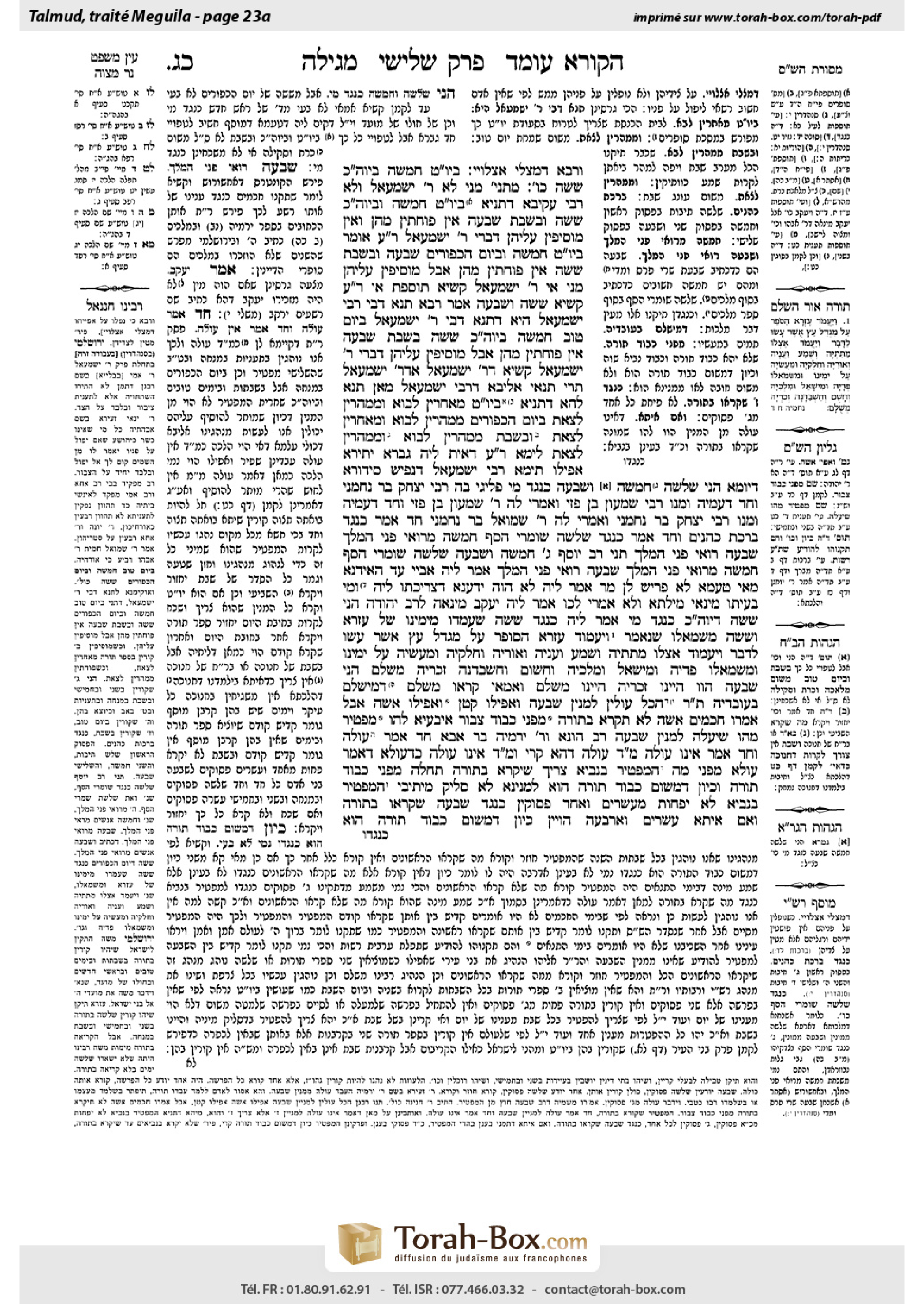
This page of Megillah includes the Aramaic text, an English translation and an AI-generated French translation, alongside the scan above.
מגילה כ״ג א · Aramaic and Hebrew text
וְרָבָא דִּמְצַלֵּי אַצְלוֹיֵי.
בְּיוֹם טוֹב חֲמִשָּׁה, בְּיוֹם הַכִּפּוּרִים שִׁשָּׁה כּוּ׳. מַתְנִיתִין מַנִּי? לֹא רַבִּי יִשְׁמָעֵאל וְלָא רַבִּי עֲקִיבָא. דְּתַנְיָא: בְּיוֹם טוֹב חֲמִשָּׁה, וּבְיוֹם הַכִּפּוּרִים שִׁשָּׁה, וּבְשַׁבָּת שִׁבְעָה, אֵין פּוֹחֲתִין מֵהֶן וְאֵין מוֹסִיפִין עֲלֵיהֶן, דִּבְרֵי רַבִּי יִשְׁמָעֵאל. רַבִּי עֲקִיבָא אוֹמֵר: בְּיוֹם טוֹב חֲמִשָּׁה, וּבְיוֹם הַכִּפּוּרִים שִׁבְעָה, וּבְשַׁבָּת שִׁשָּׁה, אֵין פּוֹחֲתִין מֵהֶן אֲבָל מוֹסִיפִין עֲלֵיהֶן.
מַנִּי? אִי רַבִּי יִשְׁמָעֵאל — קַשְׁיָא תּוֹסֶפֶת! אִי רַבִּי עֲקִיבָא — קַשְׁיָא שִׁשָּׁה וְשִׁבְעָה!
אָמַר רָבָא: תְּנָא דְּבֵי רַבִּי יִשְׁמָעֵאל הִיא. דְּתָנָא דְּבֵי רַבִּי יִשְׁמָעֵאל: בְּיוֹם טוֹב חֲמִשָּׁה, בְּיוֹם הַכִּפּוּרִים שִׁשָּׁה, בְּשַׁבָּת שִׁבְעָה, אֵין פּוֹחֲתִין מֵהֶן אֲבָל מוֹסִיפִין עֲלֵיהֶן, דִּבְרֵי רַבִּי יִשְׁמָעֵאל.
קַשְׁיָא דְּרַבִּי יִשְׁמָעֵאל אַדְּרַבִּי יִשְׁמָעֵאל! תְּרֵי תַּנָּאֵי אַלִּיבָּא דְּרַבִּי יִשְׁמָעֵאל.
מַאן תְּנָא לְהָא דְּתַנְיָא: בְּיוֹם טוֹב מְאַחֲרִין לָבוֹא, וּמִמֻּהְרִין לָצֵאת. בְּיוֹם הַכִּפּוּרִים מִמֻּהְרִין לָבוֹא, וּמְאַחֲרִין לָצֵאת. וּבְשַׁבָּת מִמֻּהְרִין לָבוֹא, וּמִמֻּהְרִין לָצֵאת. לֵימָא רַבִּי עֲקִיבָא, דְּאִית לֵיהּ גַּבְרָא יַתִּירָא? אֲפִילּוּ תֵּימָא רַבִּי יִשְׁמָעֵאל — דִּנְפִישׁ סִידּוּרָא דְּיוֹמָא.
הָנֵי שְׁלֹשָׁה חֲמִשָּׁה וְשִׁבְעָה כְּנֶגֶד מִי? פְּלִיגִי בַּהּ רַבִּי יִצְחָק בַּר נַחְמָנִי וְחַד דְּעַמְיָה, וּמַנּוּ — רַבִּי שִׁמְעוֹן בֶּן פַּזִּי. וְאָמְרִי לַהּ: רַבִּי שִׁמְעוֹן בֶּן פַּזִּי וְחַד דְּעַמֵּיהּ, וּמַנּוּ — רַבִּי יִצְחָק בַּר נַחְמָנִי, וְאָמְרִי לַהּ רַבִּי שְׁמוּאֵל בַּר נַחְמָנִי. חַד אָמַר: כְּנֶגֶד בִּרְכַּת כֹּהֲנִים, וְחַד אָמַר: כְּנֶגֶד שְׁלֹשָׁה שׁוֹמְרֵי הַסַּף, חֲמִשָּׁה מֵרוֹאֵי פְּנֵי הַמֶּלֶךְ, שִׁבְעָה רוֹאַי פְּנֵי הַמֶּלֶךְ.
תָּנֵי רַב יוֹסֵף: שְׁלֹשָׁה חֲמִשָּׁה וְשִׁבְעָה — שְׁלֹשָׁה שׁוֹמְרֵי הַסַּף, חֲמִשָּׁה מֵרוֹאֵי פְּנֵי הַמֶּלֶךְ, שִׁבְעָה רוֹאִי פְּנֵי הַמֶּלֶךְ. אָמַר לֵיהּ אַבָּיֵי: עַד הָאִידָּנָא מַאי טַעְמָא לָא פָּרִישׁ לַן מָר? אֲמַר לֵיהּ: לָא הֲוָה יָדַעְנָא דִּצְרִיכִיתוּ לֵיהּ, וּמִי בְּעֵיתוּ מִינַּאי מִילְּתָא וְלָא אֲמַרִי לְכוּ?!
אֲמַר לֵיהּ יַעֲקֹב מִינָאָה לְרַב יְהוּדָה: הָנֵי שִׁשָּׁה דְּיוֹם הַכִּפּוּרִים כְּנֶגֶד מִי? אֲמַר לֵיהּ: כְּנֶגֶד שִׁשָּׁה שֶׁעָמְדוּ מִימִינוֹ שֶׁל עֶזְרָא וְשִׁשָּׁה מִשְּׂמֹאלוֹ, שֶׁנֶּאֱמַר: ״וַיַּעֲמוֹד עֶזְרָא הַסּוֹפֵר עַל מִגְדַּל עֵץ אֲשֶׁר עָשׂוּ לַדָּבָר וַיַּעֲמוֹד אֶצְלוֹ מַתִּתְיָה וְשֶׁמַע וַעֲנָיָה וְאוּרִיָּה וְחִלְקִיָּה וּמַעֲשֵׂיָה עַל יְמִינוֹ וּמִשְּׂמֹאלוֹ פְּדָיָה וּמִישָׁאֵל וּמַלְכִּיָּה וְחָשׁוּם וְחַשְׁבַּדָּנָה זְכַרְיָה מְשֻׁלָּם״.
הָנֵי שִׁבְעָה הָווּ! הַיְינוּ ״זְכַרְיָה״ הַיְינוּ ״מְשֻׁלָּם״, וְאַמַּאי קְרָאוֹ ״מְשֻׁלָּם״? דְּמִישְׁלָם בְּעוֹבָדֵיהּ.
תָּנוּ רַבָּנַן: הַכֹּל עוֹלִין לַמִּנְיָן שִׁבְעָה, וַאֲפִילּוּ קָטָן וַאֲפִילּוּ אִשָּׁה. אֲבָל אָמְרוּ חֲכָמִים: אִשָּׁה לֹא תִּקְרָא בְּתוֹרָה, מִפְּנֵי כְּבוֹד צִבּוּר.
אִיבַּעְיָא לְהוּ: מַפְטִיר, מַהוּ שֶׁיַּעֲלֶה לַמִּנְיָן שִׁבְעָה? רַב הוּנָא וְרַבִּי יִרְמְיָה בַּר אַבָּא, חַד אָמַר: עוֹלֶה, וְחַד אָמַר: אֵינוֹ עוֹלֶה. מַאן דְּאָמַר עוֹלָה — דְּהָא קָרֵי,
וּמַאן דְּאָמַר אֵינוֹ עוֹלֶה — כִּדְעוּלָּא. דְּאָמַר עוּלָּא: מִפְּנֵי מָה הַמַּפְטִיר בְּנָבִיא צָרִיךְ שִׁיקְרָא בְּתוֹרָה תְּחִלָּה — מִפְּנֵי כְּבוֹד תּוֹרָה, וְכֵיוָן דְּמִשּׁוּם כְּבוֹד תּוֹרָה הוּא — לְמִנְיָנָא לָא סָלֵיק.
מֵיתִיבִי: הַמַּפְטִיר בְּנָבִיא לֹא יִפְחוֹת מֵעֶשְׂרִים וְאֶחָד פְּסוּקִין, כְּנֶגֶד שִׁבְעָה שֶׁקְּרָאוֹ בְּתוֹרָה. וְאִם אִיתָא, עֶשְׂרִים וְאַרְבָּעָה הָוְיִין! כֵּיוָן דְּמִשּׁוּם כְּבוֹד תּוֹרָה הוּא —
Megillah 23a · English translation
and Rava, who would bend their heads and not actually prostrate themselves on the ground.
We learned in the mishna: On a Festival, five people read; on Yom Kippur, six people read; and on Shabbat, seven people read. One may not decrease the number of readers, but one may add to them. The Gemara asks: Who is the tanna of the mishna? It is not Rabbi Yishmael and not Rabbi Akiva, as it is taught in a baraita: On a Festival, five people read from the Torah; and on Yom Kippur, six people read; and on Shabbat, seven people read. One may not decrease or add to the required number of readers. This is the statement of Rabbi Yishmael. Rabbi Akiva disagrees and says: On a Festival, five people read from the Torah; and on Yom Kippur, seven people read; and on Shabbat, six people read. One may not decrease these numbers, but one may add to them.
Who is the tanna of the mishna? If you say it is Rabbi Yishmael, it is difficult due to the ruling with regard to adding, as the mishna states that one may add additional readers but Rabbi Yishmael holds that one may not do so. If you say it is Rabbi Akiva, it is difficult due to the ruling concerning the days on which there are six and seven readers.
Rava said: It is the tanna of the school of Rabbi Yishmael, as it was taught in the school of Rabbi Yishmael: On a Festival, five people read from the Torah; on Yom Kippur, six people read; on Shabbat, seven people read. One may not decrease these numbers but one may add to them. This is the statement of Rabbi Yishmael.
The Gemara comments: If so, there is a contradiction between the opinion of Rabbi Yishmael, as expressed in the mishna, and the opinion of Rabbi Yishmael himself, as recorded in the baraita. The Gemara responds: Two tanna’im, students of Rabbi Yishmael, expressed different opinions in accordance with the opinion of Rabbi Yishmael.
The Gemara asks: Who is the tanna who taught that which is taught in a baraita: On a Festival, one is slow to arrive at the synagogue because one is busy preparing for the festive meal, and one is quick to leave in order to eat; on Yom Kippur, one is quick to arrive at the synagogue and slow to leave; and on Shabbat, one is quick to arrive, as the meal has been prepared before Shabbat, and quick to leave in order to eat the Shabbat meal? Let us say it is Rabbi Akiva, who holds that an additional man reads from the Torah on Yom Kippur, which prolongs the service on that day. The Gemara rejects this suggestion: Even if you say it is Rabbi Yishmael, one leaves the synagogue late because the order of the day, i.e., the prayer service, is very long, as it includes many supplications and confessions.
A question is raised with regard to the number of readers on different days. Corresponding to what were these three, five, and seven, readers instituted? Rabbi Yitzḥak bar Naḥmani and one other Sage who was with him disagree about this. And who was that other scholar? Rabbi Shimon ben Pazi. And some say that this was a matter of dispute between Rabbi Shimon ben Pazi and one other scholar who was with him. And who was that other scholar? Rabbi Yitzḥak bar Naḥmani, and some say it was Rabbi Shmuel bar Naḥmani. One said: These numbers correspond to the number of Hebrew words in the three verses of the Priestly Benediction. And one said: These numbers correspond to the three guards of the door (II Kings 25:18), five of the officers who saw the king’s face (II Kings 25:19), and the seven officers who saw the king’s face (Esther 1:14).
Similarly, Rav Yosef taught a baraita: The three, five, and seven people who read from the Torah correspond to the three guards of the door, five of the officers who saw the king’s face, and the seven officers who saw the king’s face. When Rav Yosef taught this, Abaye said to him: What is the reason that until now the Master did not explain the matter to us in this way? Rav Yosef said to him: I did not know that you needed this information, as I thought that you were already familiar with the baraita. Have you ever asked me something and I did not tell you?
Ya’akov of Mina said to Rav Yehuda: Corresponding to whom were these six readers on Yom Kippur instituted? Rav Yehuda said to him: The number six corresponds to the six people who stood to Ezra’s right and the six people who stood to his left, as it is stated: “And Ezra the Scribe stood upon a platform of wood, which they had made for the purpose, and beside him stood Mattithiah, and Shema, and Anaiah, and Uriah, and Hilkiah, and Maaseiah, on his right hand, and on his left hand, Pedaiah, and Mishael, and Malchiah, and Hashum, and Hashbadanah, Zechariah, Meshullam” (Nehemiah 8:4).
The Gemara challenges this answer: Those that stood to his left were seven and not six. The Gemara responds: Zechariah is the same as Meshullam, that is to say, they are not two separate people, but rather one person with two names. And why was he called Meshullam? Because he was perfect [mishlam] in his actions.
§ The Sages taught in a Tosefta (Megilla 3:11): All people count toward the quorum of seven readers, even a minor and even a woman. However, the Sages said that a woman should not read the Torah, out of respect for the congregation.
A dilemma was raised before the Sages: With regard to the reader who concludes [maftir] the Torah reading and reads from the Prophets [haftara], what is the halakha; does he count toward the quorum of seven readers? Rav Huna and Rabbi Yirmeya bar Abba disagreed about this matter. One said: He counts, and one said: He does not count. The one who said that he counts toward the seven readers holds that opinion because he reads from the Torah.
And the one who said that he does not count holds in accordance with the opinion of Ulla, as Ulla said: For what reason must the one who concludes with a reading from the Prophets read from the Torah first? It is due to respect for the Torah, so that those present should not conclude that he was called up only to read from the Prophets because the honor due the Torah and the honor due the Prophets are equal. And since he reads only out of respect for the Torah, he is not included in the quorum of seven readers.
The Gemara raises an objection based upon the following baraita: The one who concludes with a reading from the Prophets may not read fewer than twenty-one verses, corresponding to the seven who read from the Torah. Each one who reads from the Torah must read at least three verses, for a total of at least twenty-one verses. And if it is so, that the one who reads the haftara does not count toward the quorum of seven readers, and he is an eighth reader, the minimum number of verses that must be read from the Torah is twenty-four and not twenty-one. The Gemara answers: Since the one who reads the haftara reads from the Torah first only due to respect for the Torah,
Megillah 23a · Traduction française (IA)
et Rava, qui inclinaient la tête sans se prosterner réellement à terre.
Nous avons appris dans la Michna : lors d’une fête, cinq personnes lisent ; à Yom Kippour, six personnes lisent ; et à Chabbat, sept personnes lisent. On ne peut pas diminuer le nombre de lecteurs, mais on peut l’augmenter. La Guemara demande : Qui est le tanna de la Michna ? Ce n’est ni Rabbi Yishmael ni Rabbi Akiva, comme il est enseigné dans une baraïta : lors d’une fête, cinq personnes lisent dans la Torah ; à Yom Kippour, six personnes lisent ; et à Chabbat, sept personnes lisent. On ne peut ni diminuer ni augmenter le nombre requis de lecteurs. Telle est l’opinion de Rabbi Yishmael. Rabbi Akiva est en désaccord et dit : lors d’une fête, cinq personnes lisent dans la Torah ; à Yom Kippour, sept personnes lisent ; et à Chabbat, six personnes lisent. On ne peut pas diminuer ces nombres, mais on peut les augmenter.
Qui est le tanna de la Michna ? Si tu dis qu’il s’agit de Rabbi Yishmael, la règle concernant l’augmentation pose problème, car la Michna indique qu’on peut ajouter des lecteurs, tandis que Rabbi Yishmael soutient qu’on ne le peut pas. Si tu dis qu’il s’agit de Rabbi Akiva, la règle concernant les jours où il y a six et sept lecteurs pose problème.
Rava dit : Il s’agit du tanna de l’école de Rabbi Yishmael, comme il est enseigné dans l’école de Rabbi Yishmael : lors d’une fête, cinq personnes lisent dans la Torah ; à Yom Kippour, six personnes lisent ; à Chabbat, sept personnes lisent. On ne peut pas diminuer ces nombres, mais on peut les augmenter. Telle est l’opinion de Rabbi Yishmael.
La Guemara fait remarquer : Dans ce cas, il y a une contradiction entre l’opinion de Rabbi Yishmael telle qu’elle est exprimée dans la Michna et celle de Rabbi Yishmael lui-même, telle qu’elle est rapportée dans la baraïta. La Guemara répond : Deux tannaïm, disciples de Rabbi Yishmael, ont exprimé des opinions différentes conformément à l’opinion de Rabbi Yishmael.
La Guemara demande : Qui est le tanna qui a enseigné ce qui suit dans une baraïta : lors d’une fête, on arrive tard à la synagogue parce qu’on est occupé à préparer le repas de fête, et on part rapidement afin de manger ; à Yom Kippour, on arrive rapidement à la synagogue et on tarde à en partir ; et à Chabbat, on arrive rapidement, puisque le repas a été préparé avant Chabbat, et on part rapidement afin de manger le repas de Chabbat ? Disons qu’il s’agit de Rabbi Akiva, qui soutient qu’une personne supplémentaire lit dans la Torah à Yom Kippour, ce qui prolonge le service ce jour-là. La Guemara rejette cette proposition : même si tu dis qu’il s’agit de Rabbi Yishmael, on quitte tard la synagogue parce que l’office du jour, c’est-à-dire le service de prière, est très long, puisqu’il comprend de nombreuses supplications et confessions.
Une question est posée au sujet du nombre de lecteurs les différents jours. À quoi correspondent les trois, cinq et sept lecteurs institués ? Rabbi Yitzḥak bar Naḥmani et un autre Sage qui se trouvait avec lui sont en désaccord à ce sujet. Et qui était cet autre Sage ? Rabbi Shimon ben Pazi. Certains disent qu’il s’agissait d’un désaccord entre Rabbi Shimon ben Pazi et un autre Sage qui se trouvait avec lui. Et qui était cet autre Sage ? Rabbi Yitzḥak bar Naḥmani ; certains disent que c’était Rabbi Shmuel bar Naḥmani. L’un dit : Ces nombres correspondent au nombre de mots hébreux dans les trois versets de la bénédiction sacerdotale. L’autre dit : Ces nombres correspondent aux trois gardes du seuil (II Rois 25:18), aux cinq officiers qui voyaient le roi (II Rois 25:19) et aux sept officiers qui voyaient le roi (Esther 1:14).
De même, Rav Yosef enseigna une baraïta : les trois, cinq et sept personnes qui lisent dans la Torah correspondent aux trois gardes du seuil, aux cinq officiers qui voyaient le roi et aux sept officiers qui voyaient le roi. Lorsque Rav Yosef l’enseigna, Abaye lui dit : Pourquoi notre Maître ne nous a-t-il pas expliqué la chose ainsi jusqu’à présent ? Rav Yosef lui répondit : Je ne savais pas que tu avais besoin de cette information, car je pensais que tu connaissais déjà la baraïta. M’as-tu déjà demandé quelque chose sans que je te réponde ?
Ya’akov de Mina dit à Rav Yehuda : À qui correspondent les six lecteurs institués à Yom Kippour ? Rav Yehuda lui répondit : Le nombre six correspond aux six personnes qui se tenaient à la droite d’Ezra et aux six personnes qui se tenaient à sa gauche, comme il est dit : « Et Ezra le scribe se tenait sur une estrade de bois qu’ils avaient faite à cette fin, et à ses côtés se tenaient Mattithiah, Chéma, Anaiah, Uriah, Hilkiah et Maaseiah, à sa droite, et à sa gauche, Pedaiah, Mishael, Malchiah, Hashum, Hashbadanah, Zechariah, Meshullam » (Néhémie 8:4).
La Guemara objecte à cette réponse : ceux qui se tenaient à sa gauche étaient sept, et non six. La Guemara répond : Zechariah et Meshullam sont une seule et même personne ; autrement dit, il ne s’agit pas de deux personnes distinctes, mais d’une seule personne portant deux noms. Et pourquoi l’appelait-on Meshullam ? Parce qu’il était parfait [mishlam] dans ses actes.
§ Les Sages enseignèrent dans une Tosefta (Megilla 3:11) : tous comptent pour le quorum de sept lecteurs, même un mineur et même une femme. Toutefois, les Sages ont dit qu’une femme ne doit pas lire la Torah, par respect pour l’assemblée.
Une question fut soumise aux Sages : concernant le lecteur qui conclut [maftir] la lecture de la Torah et lit dans les Prophètes [haftara], quelle est la halakha ? Compte-t-il pour le quorum de sept lecteurs ? Rav Huna et Rabbi Yirmeya bar Abba étaient en désaccord à ce sujet. L’un disait qu’il compte, et l’autre qu’il ne compte pas. Celui qui disait qu’il compte parmi les sept lecteurs soutient cette opinion parce qu’il lit dans la Torah.
Et celui qui disait qu’il ne compte pas se conforme à l’opinion d’Ulla, car Ulla a dit : Pour quelle raison celui qui conclut par une lecture dans les Prophètes doit-il d’abord lire dans la Torah ? C’est par respect pour la Torah, afin que les personnes présentes ne concluent pas qu’il a été appelé uniquement pour lire dans les Prophètes, comme si l’honneur dû à la Torah et l’honneur dû aux Prophètes étaient égaux. Et puisqu’il ne lit que par respect pour la Torah, il n’est pas inclus dans le quorum de sept lecteurs.
La Guemara soulève une objection à partir de la baraïta suivante : celui qui conclut par une lecture dans les Prophètes ne peut pas lire moins de vingt et un versets, correspondant aux sept personnes qui lisent dans la Torah. Chacune des personnes qui lit dans la Torah doit lire au moins trois versets, soit un total d’au moins vingt et un versets. Or, s’il en est ainsi — si celui qui lit la haftara ne compte pas pour le quorum de sept lecteurs et qu’il est un huitième lecteur —, le nombre minimal de versets qui doivent être lus dans la Torah est de vingt-quatre, et non de vingt et un. La Guemara répond : puisque celui qui lit la haftara ne lit d’abord dans la Torah que par respect pour la Torah,
Traduction française générée par IA à partir de l’édition anglaise de Sefaria. Vérifie toujours un passage avec le texte source.
Text from Sefaria: William Davidson Edition - Vocalized Aramaic (CC BY NC); William Davidson Edition - English (CC BY NC).