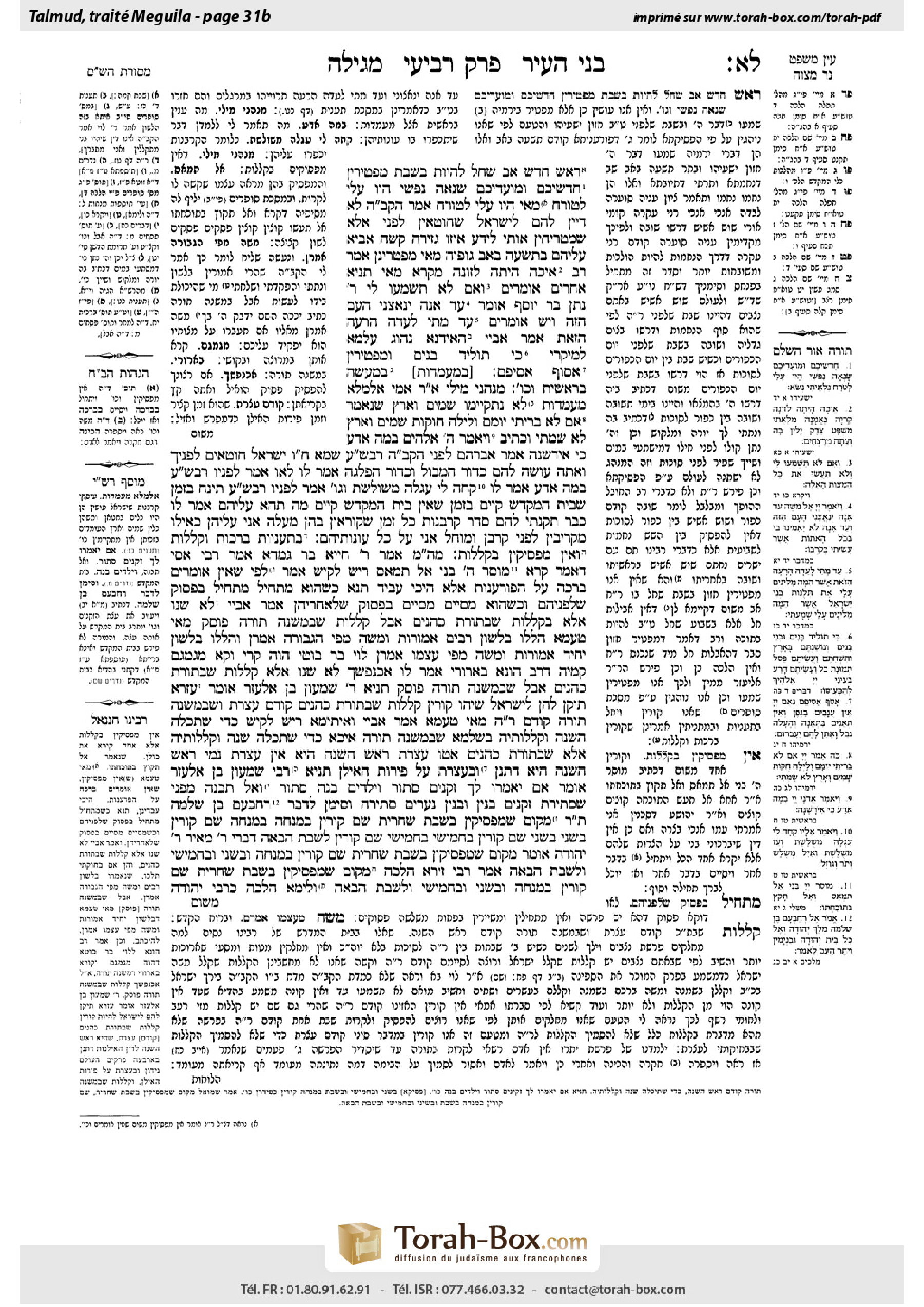
Megillah 31b: Talmud study for Daf Yomi
Daf Yomi is the daily study of one Talmud folio. Explore 37 tractates with scans, Hebrew text, Sefaria English and AI-generated French translations where annotated.
Passage selection and English or AI-generated French translation are available where the scan has annotations. Daf Study is independent of Torah-Box and Sefaria.
Browse Megillah · מגילה · All tractatesMegillah 31b text and translations
This page of Megillah includes the Aramaic text, an English translation and an AI-generated French translation, alongside the scan above.
מגילה ל״א ב · Aramaic and Hebrew text
רֹאשׁ חֹדֶשׁ אָב שֶׁחָל לִהְיוֹת בְּשַׁבָּת, מַפְטִירִין ״חׇדְשֵׁיכֶם וּמוֹעֲדֵיכֶם שָׂנְאָה נַפְשִׁי הָיוּ עָלַי לָטוֹרַח״. מַאי ״הָיוּ עָלַי לָטוֹרַח״? אָמַר הַקָּדוֹשׁ בָּרוּךְ הוּא: לֹא דַּיָּין לָהֶם לְיִשְׂרָאֵל שֶׁחוֹטְאִין לְפָנַי, אֶלָּא שֶׁמַּטְרִיחִין אוֹתִי לֵידַע אֵיזוֹ גְּזֵירָה קָשָׁה אָבִיא עֲלֵיהֶם.
בְּתִשְׁעָה בְּאָב גּוּפֵיהּ מַאי מַפְטְרִינַן? אָמַר רַב: ״אֵיכָה הָיְתָה לְזוֹנָה״. מִקְרָא מַאי? תַּנְיָא, אֲחֵרִים אוֹמְרִים: ״וְאִם לֹא תִשְׁמְעוּ לִי״, רַבִּי נָתָן בַּר יוֹסֵף אוֹמֵר: ״עַד אָנָה יְנַאֲצוּנִי הָעָם הַזֶּה״, וְיֵשׁ אוֹמְרִים: ״עַד מָתַי לָעֵדָה הָרָעָה הַזֹּאת״. אָמַר אַבָּיֵי: הָאִידָּנָא נְהוּג עָלְמָא לְמִיקְרֵי ״כִּי תוֹלִיד בָּנִים״, וּמַפְטִירִין ״אָסוֹף אֲסִיפֵם״.
[בְּמַעֲמָדוֹת] בְּמַעֲשֵׂה בְרֵאשִׁית וְכוּ׳. מְנָהָנֵי מִילֵּי? אָמַר רַבִּי אַמֵּי: אִלְמָלֵא מַעֲמָדוֹת לֹא נִתְקַיְּימוּ שָׁמַיִם וָאָרֶץ, שֶׁנֶּאֱמַר: ״אִם לֹא בְרִיתִי יוֹמָם וָלָיְלָה חוּקּוֹת שָׁמַיִם וָאָרֶץ לֹא שָׂמְתִּי״.
וּכְתִיב: ״וַיֹּאמַר ה׳ אֱלֹהִים בַּמָּה אֵדַע כִּי אִירָשֶׁנָּה״, אָמַר אַבְרָהָם לִפְנֵי הַקָּדוֹשׁ בָּרוּךְ הוּא: רִבּוֹנוֹ שֶׁל עוֹלָם, שֶׁמָּא חַס וְשָׁלוֹם יִשְׂרָאֵל חוֹטְאִים לְפָנֶיךָ וְאַתָּה עוֹשֶׂה לָהֶם כְּדוֹר הַמַּבּוּל וּכְדוֹר הַפְּלַגָּה? אָמַר לוֹ: לָאו.
אָמַר לְפָנָיו: רִבּוֹנוֹ שֶׁל עוֹלָם, ״בַּמֶּה אֵדַע״? אָמַר לוֹ: ״קְחָה לִי עֶגְלָה מְשׁוּלֶּשֶׁת וְגוֹ׳״. אָמַר לְפָנָיו: רִבּוֹנוֹ שֶׁל עוֹלָם, תִּינַח בִּזְמַן שֶׁבֵּית הַמִּקְדָּשׁ קַיָּים. בִּזְמַן שֶׁאֵין בֵּית הַמִּקְדָּשׁ קַיָּים מָה תְּהֵא עֲלֵיהֶם? אָמַר לוֹ: כְּבָר תִּקַּנְתִּי לָהֶם סֵדֶר קׇרְבָּנוֹת, כׇּל זְמַן שֶׁקּוֹרְאִין בָּהֶן מַעֲלֶה אֲנִי עֲלֵיהֶן כְּאִילּוּ מַקְרִיבִין לְפָנַי קׇרְבָּן, וּמוֹחֵל אֲנִי עַל כׇּל עֲוֹנוֹתֵיהֶם.
בְּתַעֲנִיּוֹת בְּרָכוֹת וּקְלָלוֹת, וְאֵין מַפְסִיקִין בַּקְּלָלוֹת. מְנָא הָנֵי מִילֵּי? אָמַר רַבִּי חִיָּיא בַּר גַּמָּדָא אָמַר רַבִּי אַסִּי: דְּאָמַר קְרָא ״מוּסַר ה׳ בְּנִי אַל תִּמְאָס״.
רֵישׁ לָקִישׁ אָמַר: לְפִי שֶׁאֵין אוֹמְרִים בְּרָכָה עַל הַפּוּרְעָנוּת: אֶלָּא הֵיכִי עָבֵיד? תָּנָא: כְּשֶׁהוּא מַתְחִיל — מַתְחִיל בַּפָּסוּק שֶׁלִּפְנֵיהֶם, וּכְשֶׁהוּא מְסַיֵּים — מְסַיֵּים בַּפָּסוּק שֶׁלְּאַחֲרֵיהֶן.
אָמַר אַבָּיֵי: לֹא שָׁנוּ אֶלָּא בִּקְלָלוֹת שֶׁבְּתוֹרַת כֹּהֲנִים, אֲבָל קְלָלוֹת שֶׁבְּמִשְׁנֵה תוֹרָה — פּוֹסֵק. מַאי טַעְמָא — הַלָּלוּ בִּלְשׁוֹן רַבִּים אֲמוּרוֹת, וּמֹשֶׁה מִפִּי הַגְּבוּרָה אֲמָרָן, וְהַלָּלוּ בִּלְשׁוֹן יָחִיד אֲמוּרוֹת, וּמֹשֶׁה מִפִּי עַצְמוֹ אֲמָרָן.
לֵוִי בַּר בּוּטֵי הֲוָה קָרֵי וְקָא מְגַמְגֵּם קַמֵּיהּ דְּרַב הוּנָא בַּאֲרוּרֵי. אָמַר לוֹ: אַכְּנַפְשָׁךְ. לֹא שָׁנוּ אֶלָּא קְלָלוֹת שֶׁבְּתוֹרַת כֹּהֲנִים, אֲבָל שֶׁבְּמִשְׁנֵה תוֹרָה — פּוֹסֵק.
תַּנְיָא, רַבִּי שִׁמְעוֹן בֶּן אֶלְעָזָר אוֹמֵר: עֶזְרָא תִּיקֵּן לָהֶן לְיִשְׂרָאֵל שֶׁיְּהוּ קוֹרִין קְלָלוֹת שֶׁבְּתוֹרַת כֹּהֲנִים קוֹדֶם עֲצֶרֶת, וְשֶׁבְּמִשְׁנֵה תוֹרָה קוֹדֶם רֹאשׁ הַשָּׁנָה. מַאי טַעְמָא? אָמַר אַבָּיֵי וְאִיתֵּימָא רֵישׁ לָקִישׁ: כְּדֵי שֶׁתִּכְלֶה הַשָּׁנָה וְקִלְלוֹתֶיהָ.
בִּשְׁלָמָא שֶׁבְּמִשְׁנֵה תוֹרָה, אִיכָּא כְּדֵי שֶׁתִּכְלֶה שָׁנָה וְקִלְלוֹתֶיהָ. אֶלָּא שֶׁבְּתוֹרַת כֹּהֲנִים, אַטּוּ עֲצֶרֶת רֹאשׁ הַשָּׁנָה הִיא? אִין, עֲצֶרֶת נָמֵי רֹאשׁ הַשָּׁנָה הִיא. דִּתְנַן: וּבַעֲצֶרֶת עַל פֵּירוֹת הָאִילָן.
תַּנְיָא, רַבִּי שִׁמְעוֹן בֶּן אֶלְעָזָר אוֹמֵר: אִם יֹאמְרוּ לָךְ זְקֵנִים ״סְתוֹר״ וִילָדִים ״בְּנֵה״ — סְתוֹר וְאַל תִּבְנֶה, מִפְּנֵי שֶׁסְּתִירַת זְקֵנִים בִּנְיָן, וּבִנְיַן נְעָרִים סְתִירָה. וְסִימָן לַדָּבָר — רְחַבְעָם בֶּן שְׁלֹמֹה.
תָּנוּ רַבָּנַן: מָקוֹם שֶׁמַּפְסִיקִין בַּשַּׁבָּת שַׁחֲרִית — שָׁם קוֹרִין בְּמִנְחָה, בְּמִנְחָה — שָׁם קוֹרִין בְּשֵׁנִי, בְּשֵׁנִי — שָׁם קוֹרִין בַּחֲמִישִׁי, בַּחֲמִישִׁי — שָׁם קוֹרִין לַשַּׁבָּת הַבָּאָה, דִּבְרֵי רַבִּי מֵאִיר. רַבִּי יְהוּדָה אוֹמֵר: מָקוֹם שֶׁמַּפְסִיקִין בַּשַּׁבָּת שַׁחֲרִית — שָׁם קוֹרִין בְּמִנְחָה, וּבַשֵּׁנִי וּבַחֲמִישִׁי, וְלַשַּׁבָּת הַבָּאָה.
אָמַר רַבִּי זֵירָא: הֲלָכָה, מָקוֹם שֶׁמַּפְסִיקִין בַּשַּׁבָּת שַׁחֲרִית — שָׁם קוֹרִין בְּמִנְחָה, וּבְשֵׁנִי וּבַחֲמִישִׁי, וְלַשַּׁבָּת הַבָּאָה. וְלֵימָא: הֲלָכָה כְּרַבִּי יְהוּדָה!
Megillah 31b · English translation
When the New Moon of Av occurs on Shabbat, they read as the haftara the portion that includes the verse “Your New Moons and your Festivals, My soul hated; they were a burden to Me” (Isaiah 1:14). The Gemara asks: What is the meaning of: “They were a burden to Me”? The Gemara explains: The Holy One, Blessed be He, said: It is not enough for the Jewish people that they sin before Me, but in addition, they burden Me to reconsider what harsh decree I shall bring upon them, for they are petitioning Me to annul those decrees.
The Gemara asks: On the Ninth of Av itself, what do we read as the haftara? Rav said: The portion containing the verse “How did the faithful city become a harlot?” (Isaiah 1:21). The Gemara asks: What Torah portion do they read? It is taught in a baraita that others say: They read the portion containing the verse “But if you will not hearken to me” (Leviticus 26:14). Rabbi Natan bar Yosef said: They read the portion containing the verse: “How long will this people provoke me?” (Numbers 14:11). And some say: They read the portion containing the verse: “How long shall I bear with this evil congregation?” (Numbers 14:27). The Gemara comments that Abaye said: Nowadays, everyone is accustomed to read the portion of “When you shall beget children” (Deuteronomy 4:25–40), and they read as the haftara the portion of “I will utterly consume them” (Jeremiah 8:13–9:23).
§ The mishna states: In the non-priestly watches they read the act of Creation. The Gemara asks: From where are these matters derived, i.e., why do they read the account of Creation? Rabbi Ami said: To allude to the fact that were it not for the non-priestly watches, heaven and earth would not endure, as it is stated: “Were it not for My covenant day and night, I would not have set the statutes of heaven and earth” (Jeremiah 33:25). God’s covenant is referring to the offerings sacrificed in the Temple, which sustain the world.
And with regard to Abraham it is written: “And he said, O Lord God, by what shall I know that I shall inherit it?” (Genesis 15:8). Abraham said before the Holy One, Blessed be He: Master of the Universe, perhaps, Heaven forbid, the Jewish people will sin before You, and You will do to them as You did to the generation of the Flood and as You did to the generation of the Dispersion, i.e., You will completely destroy them? God said to him: No, I will not do that.
Abraham then said before Him: Master of the Universe: “By what shall I know this?” God said to him: “Take Me a heifer of three years old” (Genesis 15:9). With this, God intimated to Abraham that even if his descendants will sin, they will be able to achieve atonement through sacrificing offerings. Abraham said before Him: Master of the Universe, this works out well when the Temple is standing and offerings can be brought to achieve atonement, but when the Temple will no longer be standing, what will become of them? God said to him: I have already established for them the order of offerings, i.e., the verses of the Torah pertaining to the halakhot of the offerings. Whenever they read those portions, I will deem it as if they sacrificed an offering before Me, and I will pardon them for all of their iniquities.
§ The mishna states: On fast days the congregation reads the portion of blessings and curses (Leviticus, chapter 16), and one may not interrupt the reading of the curses by having two different people read them. Rather, one person reads all of them. The Gemara asks: From where are these matters derived? Why does one not interrupt the reading of the curses? Rabbi Ḥiyya bar Gamda said that Rabbi Asi said: For the verse states: “My son, do not despise the chastening of the Lord, nor be weary of His correction” (Proverbs 3:11). If one makes a break in the middle of the curses, it appears as if he loathes rebuke.
Reish Lakish said a different answer: It is because one does not say a blessing over a calamity. If a second person were to begin to read in the middle of the portion of the curses, the blessing upon his reading would be considered a blessing over a calamity. Rather, what does one do? It is taught in a baraita: When one begins the reading, one begins with the verse before the curses, and when one concludes the reading, one concludes with the verse after them. In this way, neither the blessing before the reading nor after it relates directly to verses of calamity.
Abaye said: They taught this only with regard to the curses that are recorded in Leviticus, but with regard to the curses that are recorded in Deuteronomy, one may interrupt them by having two different people read them. What is the reason for this distinction? These curses in Leviticus are stated in the plural, and Moses pronounced them from the mouth of the Almighty. As such, they are more severe. However, these curses in Deuteronomy are stated in the singular, and Moses said them on his own, like the rest of the book of Deuteronomy. They are therefore less harsh and may be interrupted.
It was related that Levi bar Buti was once reading the portion of the curses before Rav Huna, and he was stammering in his reading, as it was difficult for him to utter such harsh pronouncements. Rav Huna said to him: If you wish, you may stop where you are and a different reader will continue, for they taught one may not have two people read the curses only with regard to the curses that are recorded in Leviticus. But with regard to the curses that are recorded in Deuteronomy, one may interrupt them by having two different people read them.
It is taught in a baraita: Rabbi Shimon ben Elazar said: Ezra enacted for the Jewish people that they should read the portion of the curses that are recorded in Leviticus before Shavuot and the portion of the curses that are recorded in Deuteronomy before Rosh HaShana. The Gemara asks: What is the reason for this? Abaye said, and some say that it was Reish Lakish who said: In order that the year may conclude together with its curses, and the new year may begin without the ominous reading of the curses.
The Gemara asks: Granted, with regard to the curses that are recorded in Deuteronomy, there is relevance to the reason: In order that the year may conclude together with its curses, for Rosh HaShana is clearly the beginning of a new year. However, with regard to the curses that are recorded in Leviticus, what relevance does that reason have? Is that to say Shavuot is a new year? The Gemara answers: Yes, indeed, Shavuot is also a new year, as we learned in a mishna (Rosh HaShana 16a): And on Shavuot, divine judgment is made concerning the fruit of the trees, which indicates that Shavuot also has the status of a new year.
It is taught in a baraita: Rabbi Shimon ben Elazar says: If old men say to you: Demolish, and children say to you: Build, then demolish and do not build, because the demolishing of old men is ultimately as constructive as building, despite the fact that it appears destructive, and the building of children is as destructive as demolishing. An indication of this matter is Rehoboam, son of Solomon. He ignored the advice of the Elders and did not lower himself before his people, which ultimately led to the people rebelling against him.
The Sages taught in a baraita: With regard to the place in the Torah where the congregation concludes the reading on Shabbat morning, it is from there that they continue to read in the afternoon service on Shabbat. Where they conclude in the afternoon service on Shabbat, from there they continue to read on Monday morning. Where they conclude on Monday, from there they continue to read on Thursday morning. Where they conclude on Thursday, from there they continue to read on the coming Shabbat. This is the statement of Rabbi Meir. Rabbi Yehuda says: With regard to the place in the Torah where they conclude the reading on Shabbat morning, it is from there that they continue to read in the afternoon service on Shabbat. And from that same place they continue to read on Monday morning, and on Thursday morning, and on the coming Shabbat.
The Gemara notes that Rabbi Zeira said: The halakha is that with regard to the place where they conclude the reading on Shabbat morning, it is from there that they continue to read in the afternoon service on Shabbat. And from that same place they continue to read on Monday morning, and on Thursday morning, and on the coming Shabbat. The Gemara asks: If so, let him simply say: The halakha is in accordance with the opinion of Rabbi Yehuda. Why did he have to explicitly state the whole halakha?
Megillah 31b · Traduction française (IA)
Lorsque la nouvelle lune d’Av tombe un Chabbat, on lit comme haftara le passage qui contient le verset : « Vos nouvelles lunes et vos fêtes, Mon âme les a prises en haine ; elles sont pour Moi un fardeau » (Isaïe 1:14). La Guemara demande : Que signifie : « Elles sont pour Moi un fardeau » ? La Guemara explique : Le Saint, béni soit-Il, a dit : Il ne suffit pas que le peuple juif pèche devant Moi ; en plus, il M’oblige à reconsidérer quel décret sévère Je vais prononcer contre lui, car il Me demande d’annuler ces décrets.
La Guemara demande : Le neuf Av lui-même, quelle haftara lit-on ? Rav dit : Le passage qui contient le verset : « Comment la ville fidèle est-elle devenue une prostituée ? » (Isaïe 1:21). La Guemara demande : Quel passage de la Torah lit-on ? Une baraïta enseigne que d’autres disent : On lit le passage qui contient le verset : « Mais si vous ne M’écoutez pas » (Lévitique 26:14). Rabbi Natan bar Yosef dit : On lit le passage qui contient le verset : « Jusqu’à quand ce peuple Me provoquera-t-il ? » (Nombres 14:11). Et certains disent : On lit le passage qui contient le verset : « Jusqu’à quand supporterai-je cette mauvaise assemblée ? » (Nombres 14:27). La Guemara rapporte qu’Abaye a dit : De nos jours, tout le monde a coutume de lire le passage « Quand tu engendreras des enfants » (Deutéronome 4:25–40), et comme haftara, le passage « Je les consumerai entièrement » (Jérémie 8:13–9:23).
§ La Michna enseigne : Pendant les gardes non sacerdotales, on lit le récit de la Création. La Guemara demande : D’où déduit-on cela, c’est-à-dire pourquoi lit-on le récit de la Création ? Rabbi Ami a dit : C’est pour faire allusion au fait que, sans les gardes non sacerdotales, le ciel et la terre ne subsisteraient pas, comme il est dit : « Si Mon alliance avec le jour et la nuit n’était pas établie, Je n’aurais pas fixé les lois du ciel et de la terre » (Jérémie 33:25). L’alliance de Dieu désigne les offrandes sacrifiées dans le Temple, qui soutiennent le monde.
Et au sujet d’Abraham, il est écrit : « Et il dit : Seigneur Dieu, à quoi connaîtrai-je que j’en hériterai ? » (Genèse 15:8). Abraham dit devant le Saint, béni soit-Il : Maître de l’univers, peut-être, à Dieu ne plaise, le peuple juif péchera-t-il devant Toi et lui feras-Tu ce que Tu as fait à la génération du Déluge et à celle de la Dispersion, c’est-à-dire le détruiras-Tu complètement ? Dieu lui répondit : Non, Je ne ferai pas cela.
Abraham lui dit alors : Maître de l’univers, « à quoi connaîtrai-je cela ? » Dieu lui répondit : « Prends pour Moi une génisse de trois ans » (Genèse 15:9). Par ces mots, Dieu laissait entendre à Abraham que, même si ses descendants pèchent, ils pourront obtenir l’expiation en offrant des sacrifices. Abraham lui dit : Maître de l’univers, cela convient lorsque le Temple est debout et que des offrandes peuvent être apportées pour obtenir l’expiation ; mais lorsque le Temple ne sera plus debout, qu’adviendra-t-il d’eux ? Dieu lui dit : J’ai déjà établi pour eux l’ordre des offrandes, c’est-à-dire les versets de la Torah relatifs aux halakhot des offrandes. Chaque fois qu’ils liront ces passages, Je considérerai que c’est comme s’ils avaient offert un sacrifice devant Moi, et Je leur pardonnerai toutes leurs fautes.
§ La Michna enseigne : Les jours de jeûne, la communauté lit le passage des bénédictions et des malédictions (Lévitique, chapitre 16), et l’on ne peut pas interrompre la lecture des malédictions en faisant lire deux personnes différentes. Une seule personne les lit toutes. La Guemara demande : D’où déduit-on cela ? Pourquoi n’interrompt-on pas la lecture des malédictions ? Rabbi Ḥiyya bar Gamda a dit au nom de Rabbi Asi : Car le verset dit : « Mon fils, ne méprise pas le châtiment de l’Éternel et ne te lasse pas de sa réprimande » (Proverbes 3:11). Si l’on fait une pause au milieu des malédictions, cela donne l’impression que l’on méprise la réprimande.
Reish Lakish a donné une autre réponse : C’est parce qu’on ne prononce pas de bénédiction sur un malheur. Si une deuxième personne commençait à lire au milieu du passage des malédictions, la bénédiction prononcée sur sa lecture serait considérée comme une bénédiction sur un malheur. Que faut-il donc faire ? Une baraïta enseigne : Au début de la lecture, on commence par le verset qui précède les malédictions et, à la fin, on la termine par le verset qui les suit. Ainsi, ni la bénédiction précédant la lecture ni celle qui la suit ne portent directement sur des versets annonçant un malheur.
Abaye a dit : Cela n’a été enseigné qu’au sujet des malédictions consignées dans le Lévitique ; mais, pour celles qui sont consignées dans le Deutéronome, on peut interrompre leur lecture en faisant lire deux personnes différentes. Quelle est la raison de cette distinction ? Les malédictions du Lévitique sont formulées au pluriel, et Moïse les a prononcées de la bouche du Tout-Puissant. Elles sont donc plus sévères. En revanche, les malédictions du Deutéronome sont formulées au singulier, et Moïse les a énoncées de lui-même, comme le reste du livre du Deutéronome. Elles sont donc moins sévères et l’on peut interrompre leur lecture.
On rapporte que Levi bar Buti lisait un jour le passage des malédictions devant Rav Huna et qu’il bégayait, car il lui était difficile de prononcer de telles paroles sévères. Rav Huna lui dit : Si tu le souhaites, tu peux t’arrêter là où tu en es et un autre lecteur poursuivra, car il a été enseigné qu’il ne faut pas faire lire les malédictions par deux personnes uniquement pour celles qui sont consignées dans le Lévitique. Mais, pour celles qui sont consignées dans le Deutéronome, on peut interrompre leur lecture en faisant lire deux personnes différentes.
Une baraïta enseigne : Rabbi Shimon ben Elazar a dit : Ezra a institué pour le peuple juif la lecture du passage des malédictions consignées dans le Lévitique avant Chavouot, et celle du passage des malédictions consignées dans le Deutéronome avant Roch Hachana. La Guemara demande : Quelle en est la raison ? Abaye a dit — certains disent que c’est Reish Lakish qui l’a dit — : Afin que l’année s’achève avec ses malédictions et que la nouvelle année commence sans cette lecture de mauvais augure.
La Guemara demande : Il est compréhensible que la raison « afin que l’année s’achève avec ses malédictions » s’applique aux malédictions consignées dans le Deutéronome, puisque Roch Hachana marque clairement le début d’une nouvelle année. Mais en quoi cette raison s’applique-t-elle aux malédictions consignées dans le Lévitique ? Cela signifie-t-il que Chavouot est une nouvelle année ? La Guemara répond : Oui, en effet, Chavouot est également une nouvelle année, comme nous l’avons appris dans une Michna (Roch Hachana 16a) : À Chavouot, le jugement divin porte sur les fruits des arbres, ce qui indique que Chavouot a également le statut de nouvelle année.
Une baraïta enseigne : Rabbi Shimon ben Elazar dit : Si des vieillards te disent : « Démolis », et que des enfants te disent : « Construis », alors démolis et ne construis pas, car la démolition des vieillards est, en fin de compte, aussi constructive qu’une construction, bien qu’elle paraisse destructrice ; et la construction des enfants est aussi destructrice qu’une démolition. Roboam, fils de Salomon, en est une illustration. Il ignora le conseil des Anciens et ne s’humilia pas devant son peuple, ce qui finit par entraîner la révolte de celui-ci contre lui.
Les Sages ont enseigné dans une baraïta : Le passage de la Torah où la communauté achève la lecture le Chabbat matin est celui à partir duquel elle poursuit la lecture à l’office de l’après-midi du Chabbat. À partir du passage où elle achève cette lecture de l’après-midi, elle poursuit le lundi matin. À partir du passage où elle achève la lecture du lundi, elle poursuit le jeudi matin. À partir du passage où elle achève la lecture du jeudi, elle poursuit le Chabbat suivant. Telle est l’opinion de Rabbi Meïr. Rabbi Yehuda dit : Le passage de la Torah où l’on achève la lecture le Chabbat matin est celui à partir duquel on poursuit la lecture à l’office de l’après-midi du Chabbat. Et c’est à partir de ce même passage que l’on poursuit la lecture le lundi matin, le jeudi matin et le Chabbat suivant.
La Guemara relève que Rabbi Zeira a dit : La halakha est que le passage de la Torah où l’on achève la lecture le Chabbat matin est celui à partir duquel on poursuit la lecture à l’office de l’après-midi du Chabbat. Et c’est à partir de ce même passage que l’on poursuit la lecture le lundi matin, le jeudi matin et le Chabbat suivant. La Guemara demande : Dans ce cas, qu’il dise simplement : La halakha est conforme à l’opinion de Rabbi Yehuda. Pourquoi a-t-il dû énoncer explicitement toute la halakha ?
Traduction française générée par IA à partir de l’édition anglaise de Sefaria. Vérifie toujours un passage avec le texte source.
Text from Sefaria: William Davidson Edition - Vocalized Aramaic (CC BY NC); William Davidson Edition - English (CC BY NC).