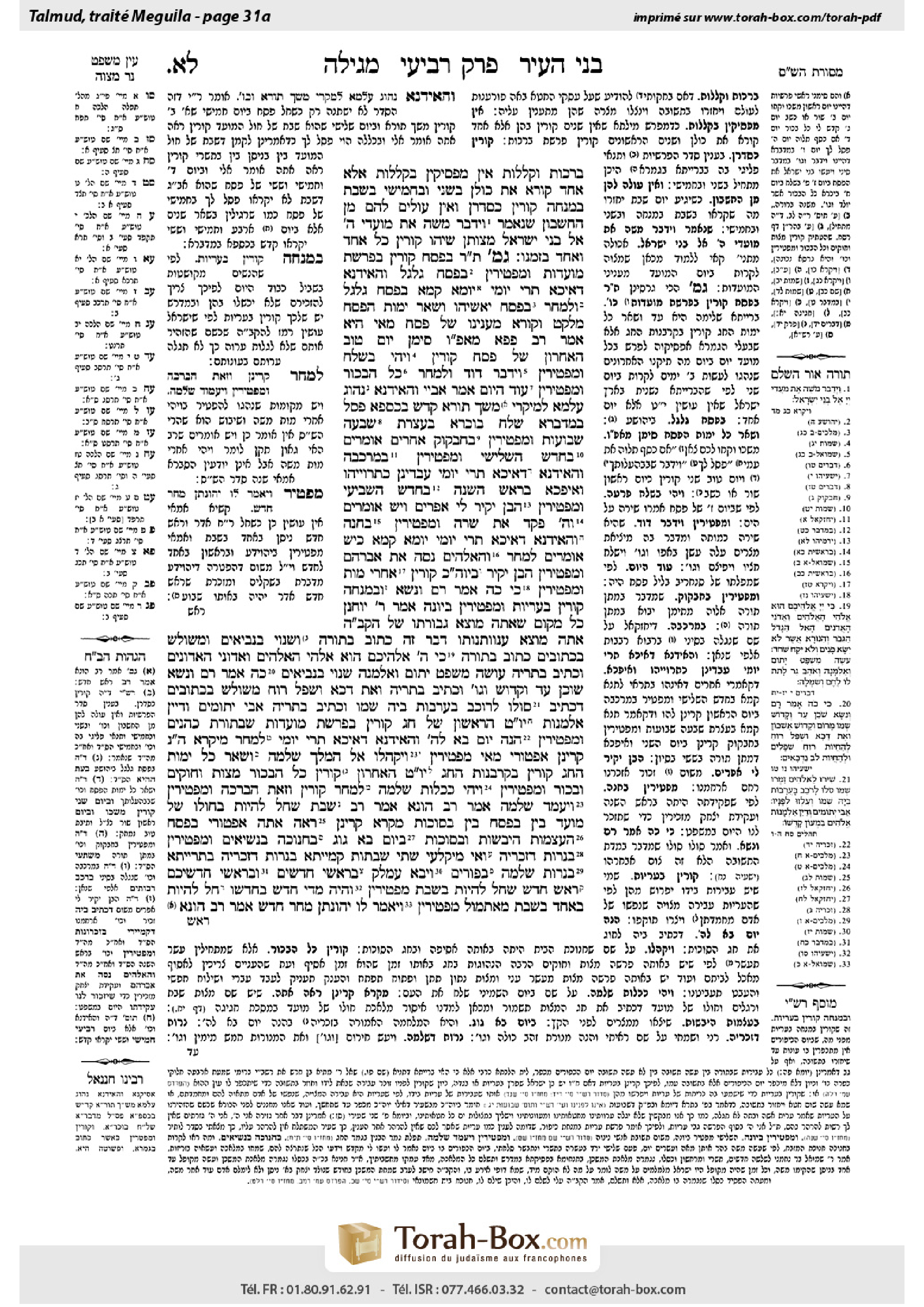
Megillah 31a: Talmud study for Daf Yomi
Daf Yomi is the daily study of one Talmud folio. Explore 37 tractates with scans, Hebrew text, Sefaria English and AI-generated French translations where annotated.
Passage selection and English or AI-generated French translation are available where the scan has annotations. Daf Study is independent of Torah-Box and Sefaria.
Browse Megillah · מגילה · All tractatesMegillah 31a text and translations
This page of Megillah includes the Aramaic text, an English translation and an AI-generated French translation, alongside the scan above.
מגילה ל״א א · Aramaic and Hebrew text
בְּרָכוֹת וּקְלָלוֹת. אֵין מַפְסִיקִין בִּקְלָלוֹת, אֶלָּא אֶחָד קוֹרֵא אֶת כּוּלָּן.
בְּשֵׁנִי וּבַחֲמִישִׁי, בַּשַּׁבָּת בַּמִּנְחָה — קוֹרִין כְּסִדְרָן, וְאֵין עוֹלִים לָהֶם מִן הַחֶשְׁבּוֹן.
שֶׁנֶּאֱמַר: ״וַיְדַבֵּר מֹשֶׁה אֶת מוֹעֲדֵי ה׳ אֶל בְּנֵי יִשְׂרָאֵל״, מִצְוָתָן שֶׁיְּהוּ קוֹרִין כׇּל אֶחָד וְאֶחָד בִּזְמַנּוֹ.
גְּמָ׳ תָּנוּ רַבָּנַן: בְּפֶסַח קוֹרִין בְּפָרָשַׁת מוֹעֲדוֹת וּמַפְטִירִין בְּפֶסַח גִּלְגָּל, וְהָאִידָּנָא דְּאִיכָּא תְּרֵי יוֹמֵי, יוֹמָא קַמָּא — בְּפֶסַח גִּלְגָּל, וּלְמָחָר — בְּפֶסַח יֹאשִׁיָּהוּ.
וּשְׁאָר יְמוֹת הַפֶּסַח מְלַקֵּט וְקוֹרֵא מֵעִנְיָנוֹ שֶׁל פֶּסַח. מַאי הִיא? אָמַר רַב פָּפָּא: מֵאַפּ״וֹ סִימָן.
יוֹם טוֹב הָאַחֲרוֹן שֶׁל פֶּסַח קוֹרִין ״וַיְהִי בְּשַׁלַּח״, וּמַפְטִירִין ״וַיְדַבֵּר דָּוִד״. וּלְמָחָר ״כׇּל הַבְּכוֹר״, וּמַפְטִירִין ״עוֹד הַיּוֹם״.
אָמַר אַבָּיֵי, וְהָאִידָּנָא נְהוּג עָלְמָא לְמִיקְרֵי: מְשַׁךְ תּוֹרָא, קַדֵּשׁ בְּכַסְפָּא, פְּסַל בְּמַדְבְּרָא, שַׁלַּח בּוּכְרָא.
בָּעֲצֶרֶת ״שִׁבְעָה שָׁבוּעוֹת״, וּמַפְטִירִין בַּחֲבַקּוּק. אֲחֵרִים אוֹמְרִים: ״בַּחֹדֶשׁ הַשְּׁלִישִׁי״, וּמַפְטִירִין בַּמֶּרְכָּבָה. וְהָאִידָּנָא דְּאִיכָּא תְּרֵי יוֹמֵי, עָבְדִינַן כְּתַרְוַיְיהוּ וְאִיפְכָּא.
בְּרֹאשׁ הַשָּׁנָה: ״בַּחֹדֶשׁ הַשְּׁבִיעִי״, וּמַפְטִירִין: ״הֲבֵן יַקִּיר לִי אֶפְרַיִם״. וְיֵשׁ אוֹמְרִים: ״וַה׳ פָּקַד אֶת שָׂרָה״, וּמַפְטִירִין בְּחַנָּה.
וְהָאִידָּנָא דְּאִיכָּא תְּרֵי יוֹמֵי — יוֹמָא קַמָּא כְּיֵשׁ אוֹמְרִים, לִמְחַר: ״וְהָאֱלֹהִים נִסָּה אֶת אַבְרָהָם״, וּמַפְטִירִין ״הֲבֵן יַקִּיר״.
בְּיוֹם הַכִּפּוּרִים קוֹרִין ״אַחֲרֵי מוֹת״, וּמַפְטִירִין ״כִּי כֹה אָמַר רָם וְנִשָּׂא״. וּבַמִּנְחָה קוֹרִין בָּעֲרָיוֹת וּמַפְטִירִין בְּיוֹנָה.
אָמַר רַבִּי יוֹחָנָן: כׇּל מָקוֹם שֶׁאַתָּה מוֹצֵא גְּבוּרָתוֹ שֶׁל הַקָּדוֹשׁ בָּרוּךְ הוּא, אַתָּה מוֹצֵא עִנְוְותָנוּתוֹ. דָּבָר זֶה כָּתוּב בַּתּוֹרָה, וְשָׁנוּי בַּנְּבִיאִים, וּמְשׁוּלָּשׁ בַּכְּתוּבִים.
כָּתוּב בַּתּוֹרָה: ״כִּי ה׳ אֱלֹהֵיכֶם הוּא אֱלֹהֵי הָאֱלֹהִים וַאֲדוֹנֵי הָאֲדוֹנִים״, וּכְתִיב בָּתְרֵיהּ: ״עוֹשֶׂה מִשְׁפַּט יָתוֹם וְאַלְמָנָה״. שָׁנוּי בַּנְּבִיאִים: ״כֹה אָמַר רָם וְנִשָּׂא שׁוֹכֵן עַד וְקָדוֹשׁ וְגוֹ׳״, וּכְתִיב בָּתְרֵיהּ: ״וְאֶת דַּכָּא וּשְׁפַל רוּחַ״, מְשׁוּלָּשׁ בַּכְּתוּבִים, דִּכְתִיב: ״סוֹלּוּ לָרוֹכֵב בָּעֲרָבוֹת בְּיָהּ שְׁמוֹ״, וּכְתִיב בָּתְרֵיהּ: ״אֲבִי יְתוֹמִים וְדַיַּין אַלְמָנוֹת״.
יוֹם טוֹב הָרִאשׁוֹן שֶׁל חַג קוֹרִין בְּפָרָשַׁת מוֹעֲדוֹת שֶׁבְּתוֹרַת כֹּהֲנִים, וּמַפְטִירִין ״הִנֵּה יוֹם בָּא לַה׳״. וְהָאִידָּנָא דְּאִיכָּא תְּרֵי יוֹמֵי, לִמְחַר מִיקְרָא הָכִי נָמֵי קָרֵינַן, אַפְטוֹרֵי מַאי מַפְטִירִין — ״וַיִּקָּהֲלוּ אֶל הַמֶּלֶךְ שְׁלֹמֹה״.
וּשְׁאָר כׇּל יְמוֹת הַחַג קוֹרִין בְּקׇרְבְּנוֹת הֶחָג. יוֹם טוֹב הָאַחֲרוֹן קוֹרִין ״כׇּל הַבְּכוֹר״, מִצְוֹת וְחוּקִּים וּבְכוֹר, וּמַפְטִירִין ״וַיְהִי כְּכַלּוֹת שְׁלֹמֹה״. לְמָחָר קוֹרִין ״וְזֹאת הַבְּרָכָה״, וּמַפְטִירִין ״וַיַּעֲמֹד שְׁלֹמֹה״.
אָמַר רַב הוּנָא אָמַר רַב: שַׁבָּת שֶׁחָל לִהְיוֹת בְּחוּלּוֹ שֶׁל מוֹעֵד, בֵּין בַּפֶּסַח, בֵּין בַּסּוּכּוֹת — מִקְרָא קָרֵינַן ״רְאֵה אַתָּה״. אַפְטוֹרֵי, בַּפֶּסַח — ״הָעֲצָמוֹת הַיְּבֵשׁוֹת״. וּבַסּוּכּוֹת — ״בְּיוֹם בֹּא גוֹג״.
בַּחֲנוּכָּה — בַּנְּשִׂיאִים, וּמַפְטִירִין בְּנֵרוֹת דִּזְכַרְיָה. וְאִי מִיקַּלְעִי שְׁתֵּי שַׁבָּתוֹת — קַמַּיְיתָא בְּנֵרוֹת דִּזְכַרְיָה, בָּתְרָיְיתָא בְּנֵרוֹת שְׁלֹמֹה.
בַּפּוּרִים — ״וַיָּבֹא עֲמָלֵק״. בְּרָאשֵׁי חֳדָשִׁים — ״וּבְרָאשֵׁי חׇדְשֵׁיכֶם״. רֹאשׁ חֹדֶשׁ שֶׁחָל לִהְיוֹת בְּשַׁבָּת, מַפְטִירִין ״וְהָיָה מִדֵּי חֹדֶשׁ בְּחׇדְשׁוֹ״. חָל לִהְיוֹת בְּאֶחָד בַּשַּׁבָּת, מֵאֶתְמוֹל מַפְטִירִין ״וַיֹּאמֶר לוֹ יְהוֹנָתָן מָחָר חֹדֶשׁ״.
אָמַר רַב הוּנָא:
Megillah 31a · English translation
they read the portion of blessings and curses (Leviticus, chapter 26). One should not interrupt the reading of the curses by having two different people read them. Rather, one person reads all of them.
On Mondays, and on Thursdays, and on Shabbat during the afternoon service, they read in accordance with the regular weekly order, i.e., they proceed to read the first section of the Torah portion that follows the portion that was read on the previous Shabbat morning. However, these readings are not counted as a progression in the reckoning of reading the Torah portions, i.e., they do not proceed on Monday to read the section that immediately follows the section read on Shabbat during the afternoon, and then the following section on Thursday. Rather, until the reading on the following Shabbat morning, they return to and read the same first section of the Torah portion that follows the portion that was read on the previous Shabbat morning.
On Festivals and holidays, they read a portion relating to the character of the day, as it is stated: “And Moses declared to the children of Israel the appointed seasons of the Lord” (Leviticus 23:44), which indicates that part of the mitzva of the Festivals is that the people should read the portion relating to them, each one in its appointed time.
GEMARA: The Sages taught in a baraita: On the first day of Passover, the congregation reads from the portion of the Festivals (Leviticus 22:26–23:44), and they read as the haftara the account of the Passover celebrated at Gilgal (Joshua 5:2–14). The Gemara comments: And nowadays, in the Diaspora, when there are two Festival days of Passover, on the first day they read as the haftara the account of the Passover celebrated at Gilgal, and on the next day they read from the account of the Passover observed by Josiah (II Kings 23).
The baraita continues: And on the other days of Passover, one collects and reads from various Torah portions of matters relating to Passover. The Gemara asks: What are these portions? Rav Pappa said: A mnemonic for them is mem, alef, peh vav. Each letter stands for a different reading: Mem for the portion of: “Draw out [mishkhu] and take your lambs” (Exodus 12:21–51); alef for the portion of “If [im] you lend money to any of My people” (Exodus 22:24–23:19); peh for the portion of “Hew [pesol] for yourself” (Exodus 34:1–26); and vav for the portion “And the Lord spoke [vaydabber]” (Numbers 9:1–14).
The baraita continues: On the last Festival day of Passover, they read the portion of “And it came to pass, when Pharaoh let the people go” (Exodus 13:17–15:26), because it includes the account of the splitting of the Red Sea, and they read as the haftara the portion “And David spoke” (II Samuel 22), which is the song of David. And in the Diaspora, on the next day, the eighth day of Passover, they read the portion “All the firstborns” (Deuteronomy 15:19–16:17), and they read as the haftara the portion of “This very day” (Isaiah 10:32–12:6), because it discusses the downfall of Sennacherib, which occurred on the night of Passover.
Abaye said: And nowadays, on the eight days of Passover in the Diaspora, everyone is accustomed to read portions that are indicated by the mnemonic phrase: Draw the bull, sanctify with money, hew in the wilderness, send the firstborn. This alludes to the following portions: “Draw out and take your lambs” (Exodus 12:21–51) and “A bull or a sheep” (Leviticus 22:26–23:44); “Sanctify to Me all the firstborn” (Exodus 13:1–16) and “If you lend money to any of My people” (Exodus 22:24–23:19); “Hew for yourself” (Exodus 34:1–26) and “And the Lord spoke to Moses in the wilderness of Sinai” (Numbers 9:1–14); “And it came to pass, when Pharaoh let the people go” (Exodus 13:17–15:26) and “All the firstborns” (Deuteronomy 15:19–16:17).
The baraita continues: On Shavuot they read the portion of “Seven weeks,” and they read as the haftara from Habakkuk, chapter 2, since it mentions the giving of the Torah at Sinai. Others say: They read the portion of “In the third month” (Exodus 19:1–20:23), which describes the giving of the Torah, and they read as the haftara from the account of the Divine Chariot (Ezekiel 1). The Gemara comments: And nowadays, in the Diaspora, when there are two days of Shavuot, we act in accordance with both opinions, but in the reverse order. On the first day they read the portion of “In the third month,” and on the second day they read the portion of “Seven weeks.”
The baraita continues: On Rosh HaShana they read the portion of “On the seventh month on the first of the month” (Numbers 29:1–6) and they read as the haftara “Is Ephraim My dear son?” (Jeremiah 31:1–20), as it contains the verse: “I earnestly remember him still,” which recalls God’s love for His people. And some say that they read “And the Lord visited Sarah” (Genesis 21), which describes how God blessed her that she should have a child, and, according to tradition, God blessed her on Rosh HaShana. And they read as the haftara from the account of Hannah (I Samuel 1:1–2:10), who, according to tradition, was also blessed on Rosh HaShana that she should have a child.
The Gemara comments: And nowadays, when there are two days of Rosh HaShana, on the first day they read Genesis 21 in accordance with the opinion cited as: Some say. And on the next day they read “And God tested Abraham” (Genesis 22), in order to mention the merit of the binding of Isaac on the day of God’s judgment, and they read as the haftara “Is Ephraim My dear son?”
The baraita continues: On Yom Kippur they read the portion of “After the death” (Leviticus 16), and they read as the haftara the portion of “For thus says the High and Lofty One” (Isaiah 57:14–58:14), which deals with fasting and repentance. And during the afternoon service they read from the portion detailing forbidden sexual relations (Leviticus 18) to convey the severity of these transgressions, so that if anyone transgressed any of these prohibitions he will repent on Yom Kippur. And they read as the haftara the book of Jonah, which mentions the repentance of the people of Nineveh.
Having mentioned the haftara read on Yom Kippur, the Gemara cites that which Rabbi Yoḥanan said: Wherever you find a reference in the Bible to the might of the Holy One, Blessed be He, you also find a reference to His humility adjacent to it. Evidence of this fact is written in the Torah, repeated in the Prophets, and stated a third time in the Writings.
It is written in the Torah: “For the Lord your God is the God of gods and the Lord of lords” (Deuteronomy 10:17), and it is written immediately afterward: “He executes the judgment of the fatherless and widow” (Deuteronomy 10:18), displaying his humility in caring for even the weakest parts of society. It is repeated in the Prophets: “For thus says the High and Lofty One that inhabits eternity, Whose name is sacred” (Isaiah 57:15), and it is written immediately afterward: “In the high and holy place I dwell with him that is of a contrite and humble spirit, to revive the spirit of the humble, and to revive the heart of the contrite ones” (Isaiah 57:15). It is stated a third time in the Writings, as it is written: “Extol Him Who rides upon the clouds, Whose name is the Lord” (Psalms 68:5), and it is written immediately afterward: “A father of the fatherless, and a judge of widows” (Psalms 68:6).
The baraita continues: On the first Festival day of Sukkot, they read from the portion of the Festivals found in Leviticus (Leviticus 22:26–23:44), and they read as the haftara the portion of “Behold the day of the Lord comes” (Zechariah 14), which mentions the festival of Sukkot. The Gemara comments: And nowadays, in the Diaspora, when there are two Festival days of Sukkot, on the next day, they read the same Torah portion. But what do they read as the haftara? They read the portion of “And all the men of Israel assembled themselves to King Solomon” (I Kings 8:2–21), which describes events that took place on the festival of Sukkot.
The baraita continues: And on all the other days of Sukkot, they read selections from the portion of the offerings of Sukkot found in the book of Numbers, chapter 29. On the last Festival day of Sukkot, i.e., the Eighth Day of Assembly, they read the portion of “All the firstborns,” starting with the portion of “You shall tithe,” since it includes many mitzvot and statutes relating to gifts for the poor, who should be helped during this period of rejoicing, and it concludes with the halakhot governing firstborns (Deuteronomy 14:22–16:17). And they read as the haftara the portion of “And it was so, that when Solomon had made an end of praying” (I Kings 8:54–9:1), which occurred on that day. On the next day, the second day of the Eighth Day of Assembly in the Diaspora, they read the portion of “And this is the blessing” (Deuteronomy, chapters 33–34) until the end of the Torah, and they read as the haftara “And Solomon stood” (I Kings 8:22–53).
Rav Huna said that Rav said: When Shabbat occurs on one of the intermediate days of a Festival, whether on Passover or on Sukkot, they read the Torah portion of “See, You say to me” (Exodus 33:12–34:26), as it includes the halakhot of the Festivals and the intermediate days. They read as the haftara, on Passover, from the portion of the dry bones (Ezekiel 37:1–14), which portrays redemption from servitude, and on Sukkot they read “And it shall come to pass on that day when Gog shall come” (Ezekiel 38:18–39:16), which speaks of the future redemption.
The baraita continues: On each day of Hanukkah they read a selection from the portion of the dedication of the altar by the tribal princes (Numbers 7), and they read as the haftara from the portion of the lamps of Zechariah (Zechariah 2:14–4:7). The Gemara comments: And if it occurs that there are two Shabbatot during Hanukkah, on the first Shabbat they read from the portion of the lamps of Zechariah, and on the latter one they read from the portion of the lamps of Solomon (I Kings 7:40–50), which discusses the lamps in the Temple.
The baraita continues: On Purim they read the portion of “And Amalek came” (Exodus 17:8–16). On the New Moon they read the portion of “And in the beginnings of your month” (Numbers 28:11–15). When the New Moon occurs on Shabbat, they read as the haftara the portion that concludes with “And it shall come to pass that every New Moon, and every Shabbat, shall all flesh come to bow down on the ground before Me” (Isaiah 66), as it mentions both Shabbat and the New Moon. When the New Moon occurs on Sunday, on the previous day, i.e., Shabbat, they read as the haftara the portion of “And Jonathan said to him: Tomorrow is the New Moon” (I Samuel 20:18–42), which describes events that took place on the eve of the New Moon.
Rav Huna said:
Megillah 31a · Traduction française (IA)
On lit le passage des bénédictions et des malédictions (Lévitique, chapitre 26). On ne doit pas interrompre la lecture des malédictions en les faisant lire par deux personnes différentes. Une seule personne les lit donc toutes.
Les lundis, les jeudis et le Chabbat pendant l’office de l’après-midi, on lit selon l’ordre hebdomadaire habituel, c’est-à-dire la première section de la paracha qui suit celle lue le Chabbat matin précédent. Toutefois, ces lectures ne sont pas comptabilisées comme une progression dans l’ordre des parachiot : le lundi, on ne lit pas la section qui suit immédiatement celle lue le Chabbat après-midi, puis la section suivante le jeudi. Au contraire, jusqu’à la lecture du Chabbat matin suivant, on revient à la même première section de la paracha qui suit celle lue le Chabbat matin précédent.
Lors des fêtes et des jours de fête, on lit un passage en rapport avec la nature du jour, comme il est dit : « Moïse déclara aux enfants d’Israël les fêtes fixées par le Seigneur » (Lévitique 23,44). Cela indique qu’une partie de la mitsva des fêtes consiste à lire le passage qui s’y rapporte, chacune à son temps fixé.
GUEMARA : Les Sages ont enseigné dans une baraïta : Le premier jour de Pessa’h, l’assemblée lit le passage des fêtes (Lévitique 22,26–23,44), et lit comme haftara le récit du Pessa’h célébré à Guilgal (Josué 5,2–14). La Guemara commente : De nos jours, en diaspora, où Pessa’h compte deux jours de fête, le premier jour, on lit comme haftara le récit du Pessa’h célébré à Guilgal, et le lendemain, le récit du Pessa’h observé par Josias (II Rois 23).
La baraïta poursuit : Les autres jours de Pessa’h, on rassemble et on lit des passages de différentes sections de la Torah portant sur des sujets liés à Pessa’h. La Guemara demande : Quels sont ces passages ? Rav Pappa dit : Le moyen mnémotechnique est formé des lettres mem, aleph, pé, vav. Chaque lettre désigne une lecture différente : mem, le passage « Retirez [mishkhu] et prenez vos agneaux » (Exode 12,21–51) ; aleph, le passage « Si [im] tu prêtes de l’argent à quelqu’un de Mon peuple » (Exode 22,24–23,19) ; pé, le passage « Taille [pesol] pour toi-même » (Exode 34,1–26) ; et vav, le passage « Et le Seigneur parla [vaydabber] » (Nombres 9,1–14).
La baraïta poursuit : Le dernier jour de fête de Pessa’h, on lit le passage « Et il arriva, lorsque Pharaon laissa partir le peuple » (Exode 13,17–15,26), car il comprend le récit de la séparation de la mer Rouge, et on lit comme haftara le passage « David prononça » (II Samuel 22), qui est le chant de David. En diaspora, le lendemain, le huitième jour de Pessa’h, on lit le passage « Tous les premiers-nés » (Deutéronome 15,19–16,17), et on lit comme haftara le passage « En ce jour même » (Isaïe 10,32–12,6), car il traite de la chute de Sennachérib, survenue la nuit de Pessa’h.
Abayé dit : De nos jours, pendant les huit jours de Pessa’h en diaspora, tout le monde a l’habitude de lire les passages désignés par le moyen mnémotechnique : « Prends le taureau, sanctifie avec de l’argent, taille dans le désert, envoie le premier-né. » Cela renvoie aux passages suivants : « Retirez et prenez vos agneaux » (Exode 12,21–51) et « Un taureau ou un mouton » (Lévitique 22,26–23,44) ; « Sanctifie pour Moi tous les premiers-nés » (Exode 13,1–16) et « Si tu prêtes de l’argent à quelqu’un de Mon peuple » (Exode 22,24–23,19) ; « Taille pour toi-même » (Exode 34,1–26) et « Le Seigneur parla à Moïse dans le désert du Sinaï » (Nombres 9,1–14) ; « Et il arriva, lorsque Pharaon laissa partir le peuple » (Exode 13,17–15,26) et « Tous les premiers-nés » (Deutéronome 15,19–16,17).
La baraïta poursuit : À Chavouot, on lit le passage « Sept semaines », et comme haftara un passage d’Habacuc, chapitre 2, car il mentionne le don de la Torah au Sinaï. D’autres disent qu’on lit le passage « Au troisième mois » (Exode 19,1–20,23), qui décrit le don de la Torah, et comme haftara le récit du Char divin (Ézéchiel 1). La Guemara commente : De nos jours, en diaspora, où Chavouot compte deux jours, nous suivons les deux opinions, mais dans l’ordre inverse. Le premier jour, on lit le passage « Au troisième mois », et le deuxième jour, le passage « Sept semaines ».
La baraïta poursuit : À Roch Hachana, on lit le passage « Au septième mois, le premier jour du mois » (Nombres 29,1–6), et comme haftara « Éphraïm n’est-il pas pour Moi un fils cher ? » (Jérémie 31,1–20), car il contient le verset « Je me souviens encore de lui avec tendresse », qui rappelle l’amour de Dieu pour Son peuple. Certains disent qu’on lit « Le Seigneur visita Sarah » (Genèse 21), qui raconte comment Dieu la bénit afin qu’elle ait un enfant et qui, selon la tradition, fut le jour où Dieu la bénit : Roch Hachana. On lit comme haftara le récit de Hannah (I Samuel 1,1–2,10), qui, selon la tradition, fut elle aussi bénie à Roch Hachana afin d’avoir un enfant.
La Guemara commente : De nos jours, quand Roch Hachana compte deux jours, le premier jour, on lit Genèse 21, conformément à l’opinion citée sous la formule « Certains disent ». Le lendemain, on lit « Dieu mit Abraham à l’épreuve » (Genèse 22), afin de rappeler le mérite de la ligature d’Isaac le jour du jugement de Dieu, et on lit comme haftara « Éphraïm n’est-il pas pour Moi un fils cher ? ».
La baraïta poursuit : À Yom Kippour, on lit le passage « Après la mort » (Lévitique 16), et comme haftara le passage « Car ainsi parle le Très-Haut, Celui qui réside éternellement » (Isaïe 57,14–58,14), qui traite du jeûne et du repentir. Pendant l’office de l’après-midi, on lit le passage détaillant les relations sexuelles interdites (Lévitique 18), afin d’en faire ressortir la gravité et que quiconque aurait transgressé l’une de ces interdictions se repente à Yom Kippour. On lit comme haftara le livre de Jonas, qui mentionne le repentir des habitants de Ninive.
Ayant mentionné la haftara lue à Yom Kippour, la Guemara cite ce que Rabbi Yo’hanan a dit : Partout où l’on trouve dans la Bible une référence à la puissance du Saint, béni soit-Il, on trouve aussi, à proximité, une référence à Son humilité. Ce fait est attesté dans la Torah, répété dans les Prophètes et énoncé une troisième fois dans les Écrits.
Il est écrit dans la Torah : « Car le Seigneur, votre Dieu, est le Dieu des dieux et le Seigneur des seigneurs » (Deutéronome 10,17), et il est écrit immédiatement après : « Il rend justice à l’orphelin et à la veuve » (Deutéronome 10,18), manifestant Son humilité en prenant soin même des plus vulnérables de la société. Cela est répété dans les Prophètes : « Car ainsi parle le Très-Haut, Celui qui réside éternellement et dont le nom est saint » (Isaïe 57,15), et il est écrit immédiatement après : « J’habite dans le lieu élevé et saint, mais aussi auprès de celui qui a l’esprit contrit et humble, afin de ranimer l’esprit des humbles et le cœur des contrits » (Isaïe 57,15). Cela est énoncé une troisième fois dans les Écrits, car il est écrit : « Chantez les louanges de Celui qui chevauche les nuées, dont le nom est le Seigneur » (Psaumes 68,5), et il est écrit immédiatement après : « Père des orphelins et juge des veuves » (Psaumes 68,6).
La baraïta poursuit : Le premier jour de fête de Souccot, on lit le passage des fêtes qui se trouve dans le Lévitique (Lévitique 22,26–23,44), et comme haftara le passage « Voici que vient le jour du Seigneur » (Zacharie 14), qui mentionne la fête de Souccot. La Guemara commente : De nos jours, en diaspora, où Souccot compte deux jours de fête, le lendemain, on lit le même passage de la Torah. Mais que lit-on comme haftara ? On lit le passage « Tous les hommes d’Israël se rassemblèrent auprès du roi Salomon » (I Rois 8,2–21), qui décrit des événements survenus pendant la fête de Souccot.
La baraïta poursuit : Les autres jours de Souccot, on lit des extraits du passage des sacrifices de Souccot dans le livre des Nombres, chapitre 29. Le dernier jour de fête de Souccot, c’est-à-dire le Huitième Jour d’Assemblée, on lit le passage « Tous les premiers-nés », en commençant par celui de « Tu prélèveras la dîme », car il comprend de nombreuses mitsvot et lois relatives aux dons destinés aux pauvres, qu’il convient d’aider durant cette période de réjouissance, et il se termine par les halakhot concernant les premiers-nés (Deutéronome 14,22–16,17). On lit comme haftara le passage « Or, lorsque Salomon eut achevé de prier » (I Rois 8,54–9,1), événement qui eut lieu ce jour-là. Le lendemain, deuxième jour du Huitième Jour d’Assemblée en diaspora, on lit le passage « Voici la bénédiction » (Deutéronome, chapitres 33–34), jusqu’à la fin de la Torah, et comme haftara « Salomon se tint debout » (I Rois 8,22–53).
Rav Houna dit au nom de Rav : Lorsque le Chabbat tombe un des jours intermédiaires d’une fête, que ce soit Pessa’h ou Souccot, on lit le passage de la Torah « Vois, Tu me dis » (Exode 33,12–34,26), car il comprend les halakhot des fêtes et des jours intermédiaires. À Pessa’h, on lit comme haftara le passage des ossements desséchés (Ézéchiel 37,1–14), qui dépeint la délivrance de la servitude ; à Souccot, on lit « Il arrivera en ce jour-là, lorsque Gog viendra » (Ézéchiel 38,18–39,16), qui parle de la délivrance future.
La baraïta poursuit : Chaque jour de Hanoucca, on lit un extrait du passage de la dédicace de l’autel par les princes des tribus (Nombres 7), et comme haftara le passage des lampes de Zacharie (Zacharie 2,14–4,7). La Guemara commente : S’il arrive qu’il y ait deux Chabbatot pendant Hanoucca, le premier Chabbat, on lit le passage des lampes de Zacharie, et le dernier, le passage des lampes de Salomon (I Rois 7,40–50), qui traite des lampes du Temple.
La baraïta poursuit : À Pourim, on lit le passage « Amalek survint » (Exode 17,8–16). À la néoménie, on lit le passage « Au début de vos mois » (Nombres 28,11–15). Lorsque la néoménie tombe un Chabbat, on lit comme haftara le passage qui se termine par « Il arrivera qu’à chaque néoménie et à chaque Chabbat, toute chair viendra se prosterner devant Moi » (Isaïe 66), car il mentionne à la fois le Chabbat et la néoménie. Lorsque la néoménie tombe un dimanche, la veille, c’est-à-dire le Chabbat, on lit comme haftara le passage « Jonathan lui dit : Demain, c’est la néoménie » (I Samuel 20,18–42), qui décrit des événements survenus la veille de la néoménie.
Rav Houna dit :
Traduction française générée par IA à partir de l’édition anglaise de Sefaria. Vérifie toujours un passage avec le texte source.
Text from Sefaria: William Davidson Edition - Vocalized Aramaic (CC BY NC); William Davidson Edition - English (CC BY NC).