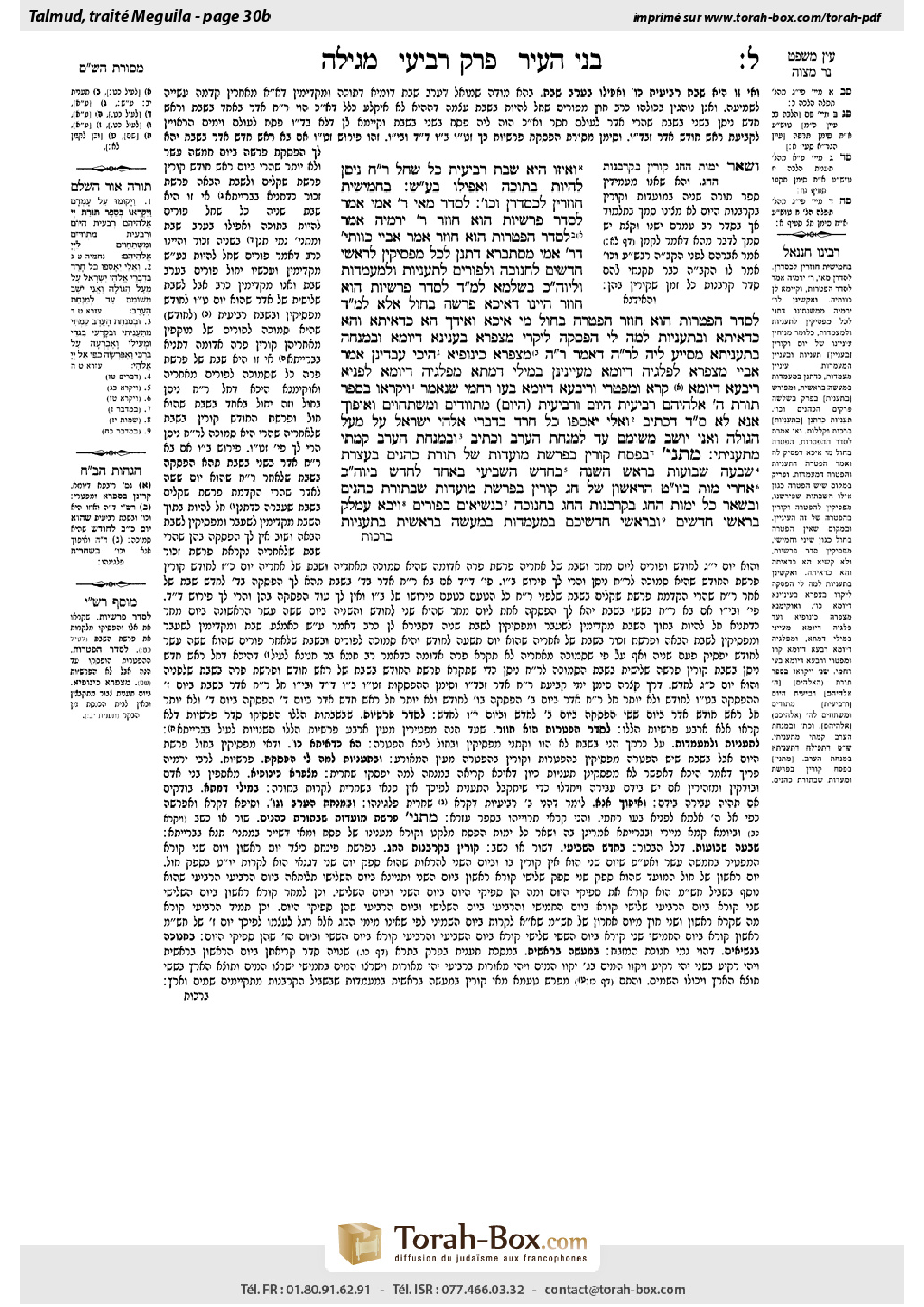
Megillah 30b: Talmud study for Daf Yomi
Daf Yomi is the daily study of one Talmud folio. Explore 37 tractates with scans, Hebrew text, Sefaria English and AI-generated French translations where annotated.
Passage selection and English or AI-generated French translation are available where the scan has annotations. Daf Study is independent of Torah-Box and Sefaria.
Browse Megillah · מגילה · All tractatesMegillah 30b text and translations
This page of Megillah includes the Aramaic text, an English translation and an AI-generated French translation, alongside the scan above.
מגילה ל׳ ב · Aramaic and Hebrew text
וְאֵיזוֹ הִיא שַׁבָּת רְבִיעִית — כֹּל שֶׁחָל רֹאשׁ חֹדֶשׁ נִיסָן לִהְיוֹת בְּתוֹכָהּ, וַאֲפִילּוּ בְּעֶרֶב שַׁבָּת.
בַּחֲמִישִׁית חוֹזְרִין לִכְסִדְרָן וְכוּ׳. לְסֵדֶר מַאי? רַבִּי אַמֵּי אָמַר: לְסֵדֶר פָּרָשִׁיּוֹת הוּא חוֹזֵר. רַבִּי יִרְמְיָה אָמַר: לְסֵדֶר הַפְטָרוֹת הוּא חוֹזֵר.
אָמַר אַבָּיֵי: כְּווֹתֵיהּ דְּרַבִּי אַמֵּי מִסְתַּבְּרָא, דִּתְנַן: לַכֹּל מַפְסִיקִין, לְרָאשֵׁי חֳדָשִׁים, לַחֲנוּכָּה, וּלְפוּרִים, לְתַעֲנִיּוֹת, וּלְמַעֲמָדוֹת, וּלְיוֹם הַכִּפּוּרִים.
בִּשְׁלָמָא לְמַאן דְּאָמַר: לְסֵדֶר פָּרָשִׁיּוֹת הוּא חוֹזֵר — הַיְינוּ דְּאִיכָּא פָּרָשָׁה בְּחוֹל. אֶלָּא לְמַאן דְּאָמַר: לְסֵדֶר הַפְטָרוֹת הוּא חוֹזֵר — הַפְטָרָה בְּחוֹל מִי אִיכָּא?
וְאִידַּךְ — הָא כִּדְאִיתָא וְהָא כִּדְאִיתָא.
וּבְתַעֲנִיּוֹת לְמָה לִי הַפְסָקָה? לִיקְרֵי מִצַּפְרָא בְּעִנְיָנָא דְיוֹמָא, וּבְמִנְחָה בְּתַעֲנִיתָא! מְסַיַּיע לֵיהּ לְרַב הוּנָא, דְּאָמַר רַב הוּנָא: מִצַּפְרָא כִּינּוּפְיָא.
הֵיכִי עָבְדִינַן? אָמַר אַבָּיֵי: מִצַּפְרָא לְפַלְגֵיהּ דְּיוֹמָא מְעַיְּינִינַן בְּמִילֵּי דְמָתָא. מִפַּלְגֵיהּ דְּיוֹמָא לְפַנְיָא, רִיבְעָא דְיוֹמָא קָרוּ וּמַפְטְרִי, וְרִיבְעָא דְיוֹמָא בָּעוּ רַחֲמֵי, שֶׁנֶּאֱמַר: ״וַיִּקְרְאוּ בְּסֵפֶר תּוֹרַת ה׳ אֱלֹהֵיהֶם רְבִיעִית הַיּוֹם וּרְבִיעִית (הַיּוֹם) מִתְוַודִּים וּמִשְׁתַּחֲוִים״.
וְאֵיפוֹךְ אֲנָא? לָא סָלְקָא דַּעְתָּךְ, דִּכְתִיב: ״וְאֵלַי יֵאָסְפוּ כֹּל חָרֵד בְּדִבְרֵי אֱלֹהֵי יִשְׂרָאֵל עַל מַעַל הַגּוֹלָה וַאֲנִי יוֹשֵׁב מְשׁוֹמֵם עַד לְמִנְחַת הָעָרֶב״, וּכְתִיב: ״וּבְמִנְחַת הָעֶרֶב קַמְתִּי מִתַּעֲנִיתִי״.
מַתְנִי׳ בַּפֶּסַח קוֹרִין בְּפָרָשַׁת מוֹעֲדוֹת שֶׁל תּוֹרַת כֹּהֲנִים. בָּעֲצֶרֶת — ״שִׁבְעָה שָׁבוּעוֹת״. בְּרֹאשׁ הַשָּׁנָה — ״בַּחֹדֶשׁ הַשְּׁבִיעִי בְּאֶחָד לַחֹדֶשׁ״. בְּיוֹם הַכִּפּוּרִים — ״אַחֲרֵי מוֹת״. בְּיוֹם טוֹב הָרִאשׁוֹן שֶׁל חַג קוֹרִין בְּפָרָשַׁת מוֹעֲדוֹת שֶׁבְּתוֹרַת כֹּהֲנִים, וּבִשְׁאָר כׇּל יְמוֹת הַחַג בְּקׇרְבְּנוֹת הַחַג.
בַּחֲנוּכָּה — בַּנְּשִׂיאִים. בַּפּוּרִים — ״וַיָּבֹא עֲמָלֵק״. בְּרָאשֵׁי חֳדָשִׁים — ״וּבְרָאשֵׁי חׇדְשֵׁיכֶם״. בְּמַעֲמָדוֹת — בְּמַעֲשֵׂה בְרֵאשִׁית. בְּתַעֲנִיּוֹת —
Megillah 30b · English translation
And which is the fourth Shabbat? The Shabbat of whichever week during which the New Moon of Nisan occurs, and this is the case even if it occurs on Friday.
§ The mishna states: On the fifth Shabbat, we resume the regular weekly order. The Gemara clarifies the mishna’s intent: To the order of what does one resume? Rabbi Ami said: One resumes the regular weekly order of Torah portions. Rabbi Ami holds that on the weeks on which the special portions are read, the regular weekly Torah portion is not read at all, and therefore the cycle is resumed only on the fifth Shabbat. Rabbi Yirmeya said: One resumes the regular weekly order of the haftarot. Rabbi Yirmeya holds that even on the Shabbatot on which the special portions are read, the regular weekly portion is still read; the special portion is read by the last reader as the maftir. However, the haftara of the regular cycle is entirely replaced with a portion from the Prophets that parallels the special portion. As such, it is the cycle of haftarot that is resumed on the fifth Shabbat.
Abaye said: It stands to reason that one should rule in accordance with the opinion of Rabbi Ami, as we learned in the mishna: For all special days, we interrupt the regular order of readings, and a special portion relating to the character of the day is read. This applies to the New Moons, to Hanukkah, and to Purim, to fast days, and to non-priestly watches, and to Yom Kippur.
Abaye explains his proof: Granted, according to the one who said that one resumes the regular weekly order of Torah portions, this statement in the mishna is referring to the fact that there is a reading of the weekly Torah portion on weekdays. If one of the special days listed in the mishna occurs on Monday or Thursday, the weekly Torah reading is replaced by the special portion for that day. However, according to one who said that one resumes the regular weekly order of haftarot, what could the mishna mean when it says that the regular cycle is interrupted? Is there a haftara on weekdays? The mishna therefore supports Rabbi Ami’s opinion.
And the other one, Rabbi Yirmeya, would counter: This case is as it is, and that case is as it is. On days when there is a haftara, the reference in the mishna is to the order of the haftarot. On weekdays, when there is no haftara, the reference is to the order of the Torah readings. Therefore, no proof can be deduced from the mishna.
The Gemara asks: But on fast days, why do I need to have any interruption of the regular order of Torah readings? Let us read in the morning the regular weekly portion of the matter of the day, and in the afternoon service let us read the portion of a fast day. The Gemara comments: This supports the statement of Rav Huna, for Rav Huna said: From the morning of communal fasts, a gathering is held in the synagogue. The community leaders examine the conduct of the townspeople and admonish those whose behavior is found wanting. Therefore, there is no time in the morning to read the Torah portion for fast days.
The Gemara asks: What does the community do on a public fast day? Abaye said: From the morning until the middle of the day, the community gathers in the synagogue, and the leaders examine the affairs of the town to determine whether and how the people’s conduct needs to be improved. From the middle of the day until the evening, a quarter of the day is spent reading from the Torah and reading the haftara, and a quarter of the day is spent praying, as it is stated: “And they read in the book of the Torah of the Lord their God one quarter of the day, and a quarter of the day they confessed, and they prostrated themselves before the Lord their God” (Nehemiah 9:3).
The Gemara objects: But perhaps I should reverse the order, and the first half of the day should be spent reading from the Torah and praying, and the second half of the day should be spent examining the affairs of the townspeople. The Gemara answers: It should not enter your mind to say this, as it is written: “Then everyone who trembled at the words of the God of Israel due to the transgression of the exiles gathered around me, and I sat appalled until the evening offering” (Ezra 9:4), and it is written in the next verse: “And at the evening offering I arose from my fast, and having rent my garment and my mantle; I fell on my knees, and I spread out my hands to the Lord my God” (Ezra 9:5). This indicates that the first half of a public fast should be dedicated to an inspection of the community’s behavior, and the rest of the day should be devoted to prayer.
MISHNA: On the first day of Passover, the congregation reads from the portion of the Festivals of Leviticus (Leviticus 22:26–23:44). On Shavuot they read the portion of “Seven weeks” (Deuteronomy 16:9–12). On Rosh HaShana they read the portion of “And on the seventh month on the first of the month” (Leviticus 23:23–25). On Yom Kippur they read the portion of “After the death” (Leviticus 16). On the first Festival day of Sukkot they read from the portion of the Festivals of Leviticus (Leviticus 22:26–23:44), and on the other days of Sukkot they read selections from the portion of the offerings of Sukkot (Numbers 29:12–39).
On each day of Hanukkah they read selections from the portion of the dedication of the altar by the tribal princes (Numbers 7). On Purim they read the portion of “And Amalek came” (Exodus 17:8–16). On the New Moon they read the portion of “And in the beginnings of your months” (Numbers 28:11–15). And in the non-priestly watches they read the act of Creation (Genesis 1:1–2:3). The Jewish people were divided into twenty-four watches. Each week, it would be the turn of a different watch to send representatives to Jerusalem to be present in the Temple to witness the sacrificial service. Those remaining behind would fast during the week, from Monday to Thursday, offer special prayers, and read the account of Creation from the Torah. On fast days,
Megillah 30b · Traduction française (IA)
Et quel est le quatrième Chabbat ? C’est le Chabbat de la semaine où tombe la nouvelle lune de Nissan, même si celle-ci tombe un vendredi.
§ La Michna enseigne : Le cinquième Chabbat, on reprend l’ordre hebdomadaire habituel. La Guemara précise ce que veut dire la Michna : De quel ordre reprend-on le cours ? Rabbi Ami dit : On reprend l’ordre habituel des sections hebdomadaires de la Torah. Selon Rabbi Ami, les semaines où l’on lit les sections spéciales, on ne lit pas du tout la section hebdomadaire habituelle ; le cycle ne reprend donc que le cinquième Chabbat. Rabbi Yirmeya dit : On reprend l’ordre habituel des haftarot. Selon Rabbi Yirmeya, même les Chabbatot où l’on lit les sections spéciales, on lit également la section hebdomadaire habituelle ; la section spéciale est lue par le dernier lecteur en guise de maftir. Toutefois, la haftara du cycle habituel est entièrement remplacée par un passage des Prophètes qui correspond à la section spéciale. C’est donc le cycle des haftarot qui reprend le cinquième Chabbat.
Abayé dit : Il est logique de trancher conformément à l’opinion de Rabbi Ami, comme nous l’avons appris dans la Michna : Pour tous les jours spéciaux, on interrompt l’ordre habituel des lectures et l’on lit une section spéciale liée au caractère du jour. Cela concerne les nouvelles lunes, Hanoucca et Pourim, les jours de jeûne, les gardes non sacerdotales et Yom Kippour.
Abayé explique son argument : Certes, selon celui qui dit qu’on reprend l’ordre habituel des sections hebdomadaires de la Torah, cette déclaration de la Michna signifie qu’on lit la section hebdomadaire de la Torah en semaine. Si l’un des jours spéciaux énumérés dans la Michna tombe un lundi ou un jeudi, la lecture hebdomadaire de la Torah est remplacée par la section spéciale de ce jour. Mais, selon celui qui dit qu’on reprend l’ordre habituel des haftarot, que peut bien signifier la Michna lorsqu’elle dit que le cycle habituel est interrompu ? Y a-t-il une haftara en semaine ? La Michna appuie donc l’opinion de Rabbi Ami.
Rabbi Yirmeya, quant à lui, rétorquerait : chaque cas est différent. Les jours où il y a une haftara, la Michna fait référence à l’ordre des haftarot. En semaine, lorsqu’il n’y a pas de haftara, elle fait référence à l’ordre des lectures de la Torah. On ne peut donc tirer aucune preuve de la Michna.
La Guemara demande : Mais les jours de jeûne, pourquoi faudrait-il interrompre l’ordre habituel des lectures de la Torah ? Lisons le matin la section hebdomadaire habituelle correspondant au jour, et lisons l’après-midi la section prévue pour un jour de jeûne. La Guemara commente : Cela appuie la déclaration de Rav Houna, car Rav Houna a dit : Le matin des jeûnes communautaires, une assemblée se réunit à la synagogue. Les responsables de la communauté examinent la conduite des habitants de la ville et admonestent ceux dont le comportement laisse à désirer. Le matin, il n’y a donc pas le temps de lire la section de la Torah prévue pour les jours de jeûne.
La Guemara demande : Que fait la communauté lors d’un jeûne public ? Abayé dit : Du matin jusqu’au milieu de la journée, la communauté se rassemble à la synagogue et les responsables examinent les affaires de la ville afin de déterminer si la conduite du peuple doit être corrigée et de quelle manière. Du milieu de la journée jusqu’au soir, un quart de la journée est consacré à la lecture de la Torah et à celle de la haftara, et un quart de la journée à la prière, comme il est dit : « Ils lisaient dans le livre de la Torah de l’Éternel, leur Dieu, pendant un quart de la journée, et pendant un quart de la journée, ils confessaient leurs fautes et se prosternaient devant l’Éternel, leur Dieu » (Néhémie 9:3).
La Guemara objecte : Mais peut-être faut-il inverser l’ordre : consacrer la première moitié de la journée à la lecture de la Torah et à la prière, puis la seconde moitié à l’examen des affaires des habitants de la ville. La Guemara répond : Il ne faut pas penser ainsi, car il est écrit : « Alors tous ceux qui tremblaient aux paroles du Dieu d’Israël, à cause de la faute des exilés, se rassemblèrent autour de moi, et je restai accablé jusqu’à l’holocauste du soir » (Esdras 9:4), puis il est écrit au verset suivant : « À l’holocauste du soir, je me relevai après mon jeûne ; le vêtement et le manteau déchirés, je tombai à genoux et je tendis les mains vers l’Éternel, mon Dieu » (Esdras 9:5). Cela indique que la première moitié d’un jeûne public doit être consacrée à l’examen du comportement de la communauté, et le reste de la journée à la prière.
MICHNA : Le premier jour de Pessa’h, l’assemblée lit le passage des fêtes du Lévitique (Lévitique 22:26–23:44). À Chavouot, elle lit le passage des « Sept semaines » (Deutéronome 16:9–12). À Roch Hachana, elle lit le passage « Et au septième mois, le premier jour du mois » (Lévitique 23:23–25). À Yom Kippour, elle lit le passage « Après la mort » (Lévitique 16). Le premier jour de fête de Souccot, elle lit le passage des fêtes du Lévitique (Lévitique 22:26–23:44), et les autres jours de Souccot, elle lit des extraits du passage des offrandes de Souccot (Nombres 29:12–39).
Chaque jour de Hanoucca, on lit des extraits du passage consacré à la dédicace de l’autel par les princes des tribus (Nombres 7). À Pourim, on lit le passage « Amalek survint » (Exode 17:8–16). À la nouvelle lune, on lit le passage « Et au début de vos mois » (Nombres 28:11–15). Dans les gardes non sacerdotales, on lit le récit de la Création (Genèse 1:1–2:3). Le peuple juif était réparti en vingt-quatre gardes. Chaque semaine, une garde différente envoyait des représentants à Jérusalem pour être présents dans le Temple et assister au service sacrificiel. Ceux qui restaient sur place jeûnaient durant la semaine, du lundi au jeudi, récitaient des prières spéciales et lisaient dans la Torah le récit de la Création. Les jours de jeûne,
Traduction française générée par IA à partir de l’édition anglaise de Sefaria. Vérifie toujours un passage avec le texte source.
Text from Sefaria: William Davidson Edition - Vocalized Aramaic (CC BY NC); William Davidson Edition - English (CC BY NC).