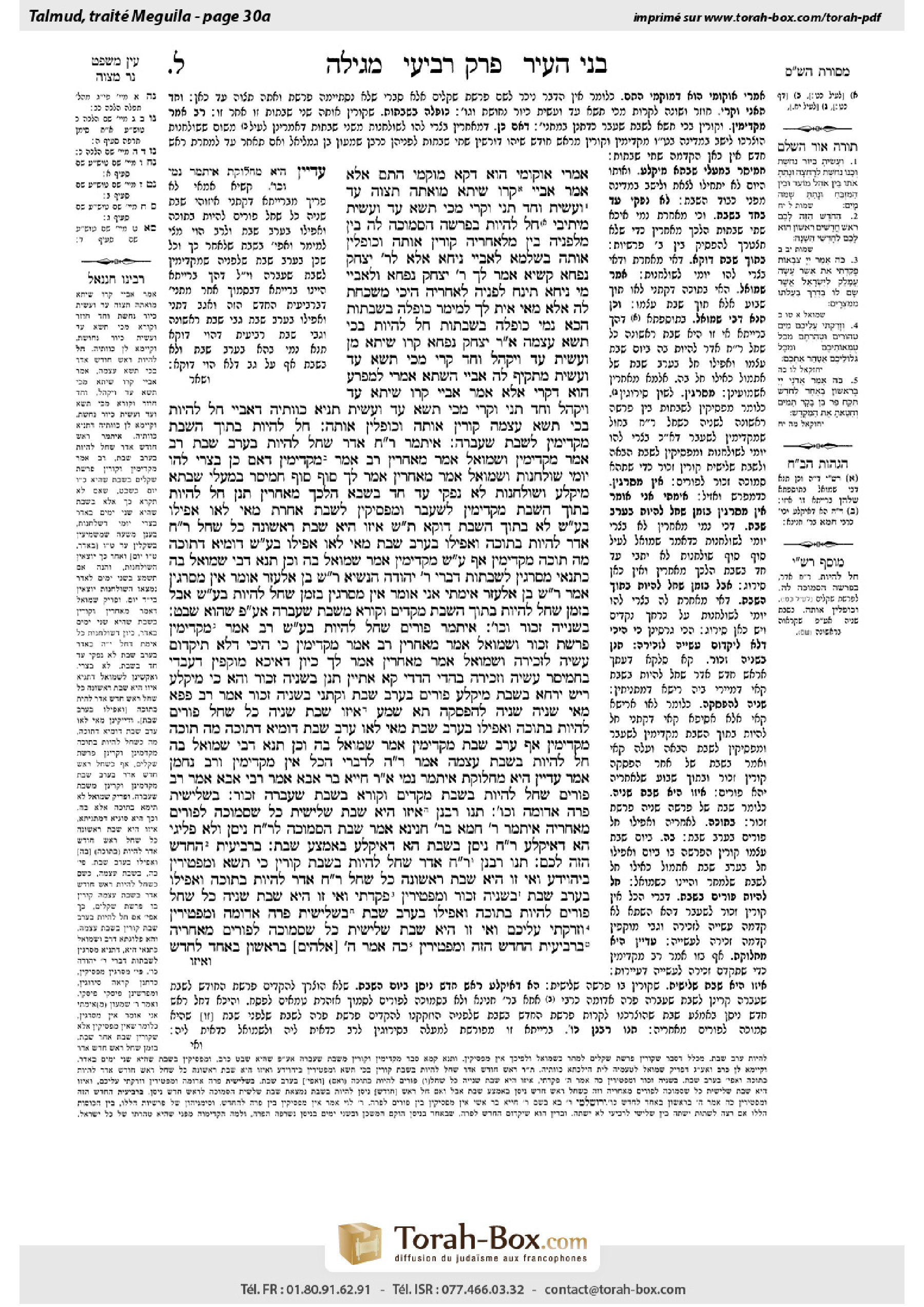
Megillah 30a: Talmud study for Daf Yomi
Daf Yomi is the daily study of one Talmud folio. Explore 37 tractates with scans, Hebrew text, Sefaria English and AI-generated French translations where annotated.
Passage selection and English or AI-generated French translation are available where the scan has annotations. Daf Study is independent of Torah-Box and Sefaria.
Browse Megillah · מגילה · All tractatesMegillah 30a text and translations
This page of Megillah includes the Aramaic text, an English translation and an AI-generated French translation, alongside the scan above.
מגילה ל׳ א · Aramaic and Hebrew text
אָמְרִי: אוֹקוֹמֵי הוּא דְּקָא מוֹקְמִי הָתָם.
אֶלָּא אָמַר אַבָּיֵי: קָרוּ שִׁיתָּא מִ״וְּאַתָּה תְּצַוֶּה״ עַד ״וְעָשִׂיתָ״, וְחַד תָּנֵי וְקָרֵי מִ״כִּי תִשָּׂא״ עַד ״וְעָשִׂיתָ״.
מֵיתִיבִי: חָל לִהְיוֹת בַּפָּרָשָׁה הַסְּמוּכָה לָהּ, בֵּין מִלְּפָנֶיהָ בֵּין מִלְּאַחֲרֶיהָ — קוֹרִין אוֹתָהּ וְכוֹפְלִין אוֹתָהּ.
בִּשְׁלָמָא לְאַבָּיֵי נִיחָא, אֶלָּא לְרַבִּי יִצְחָק נַפָּחָא קַשְׁיָא!
אָמַר לָךְ רַבִּי יִצְחָק נַפָּחָא: וּלְאַבָּיֵי מִי נִיחָא? תִּינַח לְפָנֶיהָ, לְאַחֲרֶיהָ הֵיכִי מַשְׁכַּחַתְּ לַהּ?
אֶלָּא מַאי אִית לָךְ לְמֵימַר: כּוֹפְלָהּ בְּשַׁבָּתוֹת, הָכָא נָמֵי כּוֹפְלָהּ בְּשַׁבָּתוֹת.
חָל לִהְיוֹת בְּ״כִי תִשָּׂא״ עַצְמָהּ, אָמַר רַבִּי יִצְחָק נַפָּחָא: קָרוּ שִׁיתָּא מִן ״וְעָשִׂיתָ״ עַד ״וַיַּקְהֵל״, וְחַד קָרֵי מִ״כִּי תִשָּׂא״ עַד ״וְעָשִׂיתָ״.
מַתְקֵיף לַהּ אַבָּיֵי: הַשְׁתָּא אָמְרִי לְמַפְרֵעַ הוּא דְּקָרֵי! אֶלָּא אָמַר אַבָּיֵי: קָרוּ שִׁיתָּא עַד ״וַיַּקְהֵל״, וְחַד תָּנֵי וְקָרֵי מִ״כִּי תִשָּׂא״ עַד ״וְעָשִׂיתָ״.
תַּנְיָא כְּווֹתֵיהּ דְּאַבָּיֵי: חָל לִהְיוֹת בְּ״כִי תִשָּׂא״ עַצְמָהּ — קוֹרִין אוֹתָהּ וְכוֹפְלִין אוֹתָהּ.
חָל לִהְיוֹת בְּתוֹךְ הַשַּׁבָּת — מַקְדִּימִין לַשַּׁבָּת שֶׁעָבְרָה. אִיתְּמַר: רֹאשׁ חֹדֶשׁ אֲדָר שֶׁחָל לִהְיוֹת בְּעֶרֶב שַׁבָּת, רַב אָמַר: מַקְדִּימִין, וּשְׁמוּאֵל אָמַר: מְאַחֲרִין.
רַב אָמַר מַקְדִּימִין — דְּאִם כֵּן בָּצְרִי לְהוּ יוֹמֵי שׁוּלְחָנוֹת. וּשְׁמוּאֵל אָמַר מְאַחֲרִין — אָמַר לָךְ: סוֹף סוֹף חֲמֵיסַר בְּמַעֲלֵי שַׁבְּתָא מִיקְּלַע, וְשׁוּלְחָנוֹת לָא נָפְקִי עַד חַד בְּשַׁבָּא, הִלְכָּךְ מְאַחֲרִין.
תְּנַן: חָל לִהְיוֹת בְּתוֹךְ הַשַּׁבָּת — מַקְדִּימִין לְשֶׁעָבַר, וּמַפְסִיקִין לְשַׁבָּת אַחֶרֶת. מַאי לָאו אֲפִילּוּ בְּעֶרֶב שַׁבָּת? לֹא, בְּתוֹךְ הַשַּׁבָּת דַּוְקָא.
תָּא שְׁמַע: אֵיזוֹ הִיא שַׁבָּת רִאשׁוֹנָה — כׇּל שֶׁחָל רֹאשׁ חֹדֶשׁ אֲדָר לִהְיוֹת בְּתוֹכָהּ, וַאֲפִילּוּ בְּעֶרֶב שַׁבָּת. מַאי לָאו: אֲפִילּוּ בְּעֶרֶב שַׁבָּת — דּוּמְיָא דְּתוֹכָהּ, מָה תּוֹכָהּ מַקְדִּימִין — אַף עֶרֶב שַׁבָּת מַקְדִּימִין!
אָמַר שְׁמוּאֵל: בָּהּ. וְכֵן תָּנָא דְּבֵי שְׁמוּאֵל: בָּהּ.
כְּתַנָּאֵי: מְסָרְגִין לְשַׁבָּתוֹת, דִּבְרֵי רַבִּי יְהוּדָה הַנָּשִׂיא. רַבִּי שִׁמְעוֹן בֶּן אֶלְעָזָר אוֹמֵר: אֵין מְסָרְגִין. אָמַר רַבִּי שִׁמְעוֹן בֶּן אֶלְעָזָר: אֵימָתַי אֲנִי אוֹמֵר אֵין מְסָרְגִין — בִּזְמַן שֶׁחָל לִהְיוֹת בְּעֶרֶב שַׁבָּת, אֲבָל בִּזְמַן שֶׁחָל לִהְיוֹת בְּתוֹךְ הַשַּׁבָּת — מַקְדִּים וְקוֹרֵא מִשַּׁבָּת שֶׁעָבְרָה, אַף עַל פִּי שֶׁהוּא שְׁבָט.
בִּשְׁנִיָּיה ״זָכוֹר״ וְכוּ׳. אִיתְּמַר: פּוּרִים שֶׁחָל לִהְיוֹת בְּעֶרֶב שַׁבָּת, רַב אָמַר: מַקְדִּימִין פָּרָשַׁת זָכוֹר, וּשְׁמוּאֵל אָמַר: מְאַחֲרִין.
רַב אָמַר מַקְדִּימִין — כִּי הֵיכִי דְּלָא תִּיקְדּוֹם עֲשִׂיָּה לִזְכִירָה. וּשְׁמוּאֵל אָמַר מְאַחֲרִין — אָמַר לָךְ: כֵּיוָן דְּאִיכָּא מוּקָּפִין דְּעָבְדִי בַּחֲמֵיסַר, עֲשִׂיָּה וּזְכִירָה בַּהֲדֵי הֲדָדֵי קָא אָתְיָין.
תְּנַן: בַּשְּׁנִיָּה ״זָכוֹר״. וְהָא כִּי מִיקְּלַע רֵישׁ יַרְחָא בְּשַׁבָּת, מִיקְּלַע פּוּרִים בְּעֶרֶב שַׁבָּת, וְקָתָנֵי בַּשְּׁנִיָּה ״זָכוֹר״! אָמַר רַב פָּפָּא: מַאי שְׁנִיָּה — שְׁנִיָּה לְהַפְסָקָה.
תָּא שְׁמַע: אֵיזוֹ שַׁבָּת שְׁנִיָּה — כׇּל שֶׁחָל פּוּרִים לִהְיוֹת בְּתוֹכָהּ, וַאֲפִילּוּ בְּעֶרֶב שַׁבָּת. מַאי לָאו: עֶרֶב שַׁבָּת — דּוּמְיָא דְּתוֹכָהּ, מָה תּוֹכָהּ מַקְדִּימִין — אַף עֶרֶב שַׁבָּת מַקְדִּימִין!
אָמַר שְׁמוּאֵל: בָּהּ. וְכֵן תָּנָא דְּבֵי שְׁמוּאֵל: בָּהּ.
חָל לִהְיוֹת בְּשַׁבָּת עַצְמָהּ, אָמַר רַב הוּנָא: לְדִבְרֵי הַכֹּל אֵין מַקְדִּימִין. וְרַב נַחְמָן אָמַר: עֲדַיִין הִיא מַחְלוֹקֶת. אִיתְּמַר נָמֵי, אָמַר רַבִּי חִיָּיא בַּר אַבָּא, אָמַר רַבִּי אַבָּא אָמַר רַב: פּוּרִים שֶׁחָל לִהְיוֹת בְּשַׁבָּת — מַקְדִּים וְקוֹרֵא בַּשַּׁבָּת שֶׁעָבְרָה ״זָכוֹר״.
בַּשְּׁלִישִׁית פָּרָה אֲדוּמָּה וְכוּ׳. תָּנוּ רַבָּנַן: אֵיזוֹ הִיא שַׁבָּת שְׁלִישִׁית — כֹּל שֶׁסְּמוּכָה לְפוּרִים מֵאַחֲרֶיהָ. אִיתְּמַר, רַבִּי חָמָא בְּרַבִּי חֲנִינָא אָמַר: שַׁבָּת הַסְּמוּכָה לְרֹאשׁ חֹדֶשׁ נִיסָן.
וְלָא פְּלִיגִי: הָא דְּאִיקְּלַע רֹאשׁ חֹדֶשׁ נִיסָן בְּשַׁבָּת, הָא דְּאִיקְּלַע בְּאֶמְצַע שַׁבָּת.
בָּרְבִיעִית ״הַחֹדֶשׁ הַזֶּה לָכֶם״. תָּנוּ רַבָּנַן: רֹאשׁ חֹדֶשׁ אֲדָר שֶׁחָל לִהְיוֹת בַּשַּׁבָּת — קוֹרִין ״כִּי תִשָּׂא״, וּמַפְטִירִין בִּ״יהוֹיָדָע״. וְאִי זוֹ הִיא שַׁבָּת רִאשׁוֹנָה — כֹּל שֶׁחָל רֹאשׁ חֹדֶשׁ אֲדָר לִהְיוֹת בְּתוֹכָהּ, וַאֲפִילּוּ בְּעֶרֶב שַׁבָּת. בַּשְּׁנִיָּה ״זָכוֹר״, וּמַפְטִירִין ״פָּקַדְתִּי״. וְאִי זוֹ הִיא שַׁבָּת שְׁנִיָּה — כֹּל שֶׁחָל פּוּרִים לִהְיוֹת בְּתוֹכָהּ, וַאֲפִילּוּ בְּעֶרֶב שַׁבָּת.
בַּשְּׁלִישִׁית פָּרָה אֲדוּמָּה, וּמַפְטִירִין ״וְזָרַקְתִּי עֲלֵיכֶם״. וְאֵי זוֹ הִיא שַׁבָּת שְׁלִישִׁית — כֹּל שֶׁסְּמוּכָה לְפוּרִים מֵאַחֲרֶיהָ. בָּרְבִיעִית הַחֹדֶשׁ הַזֶּה, וּמַפְטִירִין ״כֹּה אָמַר ה׳ [אֱלֹהִים] בָּרִאשׁוֹן בְּאֶחָד לַחֹדֶשׁ״.
Megillah 30a · English translation
Since Shekalim is read from the portion in the Torah immediately following the regular weekly Torah reading, people will mistakenly say that they merely extended the regular reading and then halted there, and they will not realize that the last reading was actually for the sake of Shekalim.
Rather, Abaye said: Six people read from “And you shall command” until but not including “And you shall make a copper laver,” which concludes with the portion used for Shekalim. And then one person repeats and reads Shekalim from “When you take the count” until but not including “And you shall make a copper laver.” The repetition of this portion serves to highlight the fact it was read for the sake of Shekalim.
The Gemara raises an objection from a baraita: If the Shabbat on which Shekalim is to be read occurs on the Shabbat on which the portion to be read for the regular weekly reading is adjacent to Shekalim, whether on the Shabbat preceding that Shabbat or following it, then they read and repeat Shekalim.
Granted, according to the opinion of Abaye, it works out well, for the conclusion of the baraita, that we repeat Shekalim, supports his opinion. But according to the opinion of Rabbi Yitzḥak Nappaḥa, it is difficult.
The Gemara answers: Rabbi Yitzḥak Nappaḥa could have said to you: And according to Abaye, does it really work out well? The reference of the baraita to a case where the Shabbat on which Shekalim is read precedes the Shabbat on which that portion will be read as part of the weekly reading works out well, since it can indeed occur. However, with regard to the reference to that Shabbat following the Shabbat on which that portion is read as part of the weekly reading, under what circumstances can this case be found? It never occurs like that.
Rather, perforce, what have you to say? That when the baraita refers to repeating Shekalim when the Shabbat on which Shekalim is read follows the Shabbat on which it is read as the regular weekly reading, it means that one repeats it by reading it on two successive Shabbatot. Similarly, here too, when the baraita refers to repeating Shekalim when the Shabbat on which Shekalim is read precedes the Shabbat on which it is read as the regular weekly reading, it means that one repeats it by reading it on two successive Shabbatot.
The Gemara considers a similar case: If the Shabbat on which Shekalim is to be read occurs on the Shabbat on which the regular portion itself begins with “When you take the count,” what should be done? Rabbi Yitzḥak Nappaḥa said: Six people read from “And you shall make a copper laver” until but not including the portion of “And he assembled” (Exodus 30:17–34:35). This is the entire regular weekly portion of “When you take the count” without the opening passage, which is also the portion of Shekalim. And then one person goes back and reads the portion of Shekalim from “When you take the count” until but not including “And you shall make a copper laver.”
Abaye strongly objects to this: Now people will mistakenly say that they are reading the regular weekly portion out of sequence, and they will not realize that the last reading was actually for the sake of the portion of Shekalim. Rather, Abaye said: Six people read the entire portion of “When you take the count” until but not including the portion of “And he assembled” (Exodus 30:11–34:35), and then one person repeats and reads the portion of Shekalim from “When you take the count” until but not including “And you shall make a copper laver.”
The Gemara notes: It is taught in a baraita in accordance with the opinion of Abaye: If the Shabbat on which Shekalim is to be read occurs on the Shabbat on which the regular portion itself is “When you take the count,” the first part of that portion is read once as part of the weekly reading and then repeated as the portion of Shekalim.
§ The mishna states: If the New Moon of Adar occurs during the middle of the week, the congregation advances the reading of Shekalim to the previous week. With regard to this, an amoraic dispute was stated: With regard to when the New Moon of Adar occurs on Friday, Rav said: The congregation advances the reading of the portion to the previous week. And Shmuel said: They defer the reading of the portion to the following day, and it is read on the coming Shabbat.
The Gemara explains the two opinions: Rav said: They advance the reading to the previous week, as, if one would read the portion only on the following day, there will be less than the required number of days, i.e., two weeks, that the announcement needs to precede the setting up of the money-changing tables on the fifteenth. And Shmuel said: They defer the reading of the portion to the following day. As for Rav’s argument, Shmuel could have said to you: Ultimately, in such a year the fifteenth of Adar also occurs on a Friday, and therefore the money-changing tables will not be brought out until Sunday. Consequently, there will still be a full two weeks between the announcement and the setting of the tables. Therefore, they can defer the reading to the following day.
The Gemara offers various proofs for Rav’s opinion: We learned in the mishna: If the New Moon occurs during the middle of the week, they advance the reading of that portion to the previous Shabbat, and in such a case they interrupt the reading of the four portions on the following Shabbat. The Gemara explains the proof: What; is it not that this is referring even to a case when the New Moon occurs on Friday? This would prove Rav’s opinion. No; it is referring specifically to a case where it occurs during the middle of the week.
Come and hear another proof from a baraita: Which is the first Shabbat of the four Shabbatot on which the special portions are read? The Shabbat of whichever week during which the New Moon of Adar occurs, and this is the case even if it occurs on Friday. The Gemara explains the proof: What, is it not that the baraita teaches that the case when it occurs even on Friday is similar to the case where it occurs during the middle of the week, and just as when it occurs during the middle of the week, they advance the reading to the previous Shabbat, so too, when it occurs on Friday, they advance the reading to the previous Shabbat? This would therefore prove Rav’s opinion.
Shmuel said: The baraita should be emended, and instead of saying: During which the New Moon occurs, it should say: On which the New Moon occurs, i.e., on Shabbat itself. And so the school of Shmuel taught: On which the New Moon occurs.
The Gemara suggests: This dispute between the amora’im is like a dispute between tanna’im, as it is taught in a baraita: With regard to the reading of the four special portions, they interrupt the flow of Shabbatot, i.e., there is a Shabbat in which no special portion is read; this is the statement of Rabbi Yehuda HaNasi. Rabbi Shimon ben Elazar said: They do not interrupt the flow of Shabbatot. Rabbi Shimon ben Elazar said: When do I say that they do not interrupt the flow of Shabbatot? When the New Moon of Adar occurs on Friday, since I hold that in that case Shekalim is read on the following day, and therefore the four portions are read on four consecutive weeks. However, when the New Moon of Adar occurs during the week, one advances and reads Shekalim on the previous Shabbat, although it is still the month of Shevat, and therefore on one of the Shabbatot in Adar there will be no reading. It would appear, then, that Shmuel holds in accordance with the opinion of Rabbi Shimon ben Elazar, whereas Rav holds in accordance with the opinion of Rabbi Yehuda HaNasi.
§ The mishna states: On the second Shabbat of Adar, the Shabbat prior to Purim, they read the portion of “Remember [zakhor] what Amalek did” (Deuteronomy 25:17–19). The portion of Zakhor is associated with Purim because according to tradition, Haman was a descendant of Amalek, and so the victory over him and his supporters was a victory against Amalek. With regard to this, an amoraic dispute was stated: With regard to when Purim occurs on a Friday, Rav said: The congregation advances the reading of the portion of Zakhor to the previous Shabbat. And Shmuel said: They defer it to the Shabbat following Purim.
The Gemara explains the two opinions: Rav said: They advance it to the previous Shabbat, in order that the observance of Purim should not precede the remembrance of the destruction of Amalek, which is achieved through reading the portion of Zakhor. And Shmuel said: They defer its reading. And as for Rav’s argument, Shmuel could have said to you: Since there are the walled cities that observe Purim on the fifteenth, at least with regard to them, the observance and the remembrance come together on the same day, and that is sufficient.
The Gemara offers various proofs for Rav’s opinion: We learned in the mishna: On the second Shabbat they read the portion of Zakhor. The Gemara suggests: Is it not the case that when the New Moon of Adar occurs on Shabbat, Purim occurs on Friday, and yet the mishna teaches: On the second Shabbat they read the portion of Zakhor? This supports Rav’s opinion that in all cases the portion is read before Purim. Rav Pappa said: There is no proof, because one could argue as follows: What is the intention of the mishna when it is referring to the second Shabbat? It could mean the second Shabbat on which a special portion is read, which, if Purim occurs on Friday, occurs only after the interruption of the previous Shabbat, during which no portion was read.
Come and hear another proof from a baraita: Which is the second Shabbat on which a special portion is read? The Shabbat of whichever week during which Purim occurs, and this is the case even if it occurs on Friday. The Gemara explains the proof: What, is it not that the baraita teaches that even if Purim occurs on Friday, the case is similar to the case when it occurs during the middle of the week, and therefore, just as when it occurs during the middle of the week we advance the reading to the previous Shabbat, so too, when it occurs on Friday, we should advance the reading to the previous Shabbat? This baraita would therefore prove Rav’s opinion.
Shmuel said: The baraita should be emended, and instead of saying: During which Purim occurs, it should say: On which Purim occurs, i.e., on Shabbat itself. And so the school of Shmuel taught: On which Purim occurs.
With regard to when Purim occurs on Shabbat itself, Rav Huna said: Everyone agrees, i.e., both Rav and Shmuel, that they do not advance the reading of the portion of Zakhor to the previous Shabbat, but it is read on that Shabbat. And Rav Naḥman said: Even in this case there is still a dispute, for Rav maintains that in all cases the remembrance of the destruction of Amalek, which is achieved through reading the portion of Zakhor, must always precede the observance of Purim. It was also stated that Rabbi Ḥiyya bar Abba said that Rabbi Abba said that Rav said: If Purim occurs on Shabbat, one advances and reads the portion of Zakhor on the previous Shabbat, as Rav Naḥman understood Rav’s opinion.
§ The mishna states: On the third Shabbat, they read the portion of the Red Heifer [Para] (Numbers 19:1–22). The Sages taught in a baraita: Which is the third Shabbat? Whichever Shabbat occurs immediately after Purim. It was also stated: Rabbi Ḥama, son of Rabbi Ḥanina, said: The Shabbat that is immediately before the New Moon of Nisan.
The Gemara comments: And these two statements do not disagree, as they refer to different cases: This statement of Rabbi Ḥama, son of Rabbi Ḥanina, is referring to a case where the New Moon of Nisan occurs on Shabbat itself. In that case, the portion of HaḤodesh is read then, and therefore the portion of Para is read on the preceding Shabbat. And that statement of the baraita is referring to a case where the New Moon of Nisan occurs during the middle of the week. Therefore, HaḤodesh is read on the Shabbat immediately preceding the New Moon, and Para is read on the Shabbat before that one, which is the Shabbat that is adjacent to Purim and after it.
§ The mishna states: On the fourth Shabbat, they read the portion of “This month [haḥodesh] shall be for you” (Exodus 12:1–20). The Sages taught in a baraita: When the New Moon of Adar occurs on Shabbat, they read “When you take the count” as the portion of Shekalim. And they read as the haftara the story involving Jehoiada the priest (II Kings 12:1–27). And which is the first Shabbat? The Shabbat of whichever week during which the New Moon of Adar occurs, and this is the case even if it occurs on Friday. On the second Shabbat, they read the portion of Zakhor, and they read as the haftara of “I remembered that which Amalek did” (I Samuel 15:1–34). And which is the second Shabbat? The Shabbat of whichever week during which Purim occurs, and this is the case even if it occurs on Friday.
On the third Shabbat, they read the portion of the Red Heifer [Para], and they read as the haftara the portion of “Then will I sprinkle clean water upon you” (Ezekiel 36:25–38). And which is the third Shabbat? That which is adjacent to Purim and after it. On the fourth Shabbat, they read the portion of “This month [haḥodesh] shall be for you,” and they read as the haftara the portion of “Thus says the Lord God: In the first month, on the first day of the month” (Ezekiel 45:18–46:18).
Megillah 30a · Traduction française (IA)
Puisque la paracha de Chekalim est lue dans la section de la Torah qui suit immédiatement la lecture hebdomadaire habituelle, les gens risqueraient de croire qu’on a simplement prolongé cette lecture, puis qu’on s’est arrêté là, sans comprendre que la dernière lecture était en réalité faite pour Chekalim.
Abayé dit plutôt : six personnes lisent depuis « Et toi, tu ordonneras » jusqu’à « Et tu feras un bassin de cuivre », sans inclure ce passage, qui conclut la section utilisée pour Chekalim. Puis une personne reprend et lit la section de Chekalim depuis « Quand tu dénombreras » jusqu’à « Et tu feras un bassin de cuivre », sans inclure ce passage. La répétition de cette section souligne qu’elle a été lue pour Chekalim.
La Guemara soulève une objection à partir d’une baraïta : si le Chabbat où l’on doit lire Chekalim tombe le Chabbat où la section prévue pour la lecture hebdomadaire habituelle est adjacente à Chekalim, que ce soit le Chabbat précédent ou le Chabbat suivant, on lit Chekalim et on la répète.
Cela s’accorde bien avec l’opinion d’Abayé, puisque la conclusion de la baraïta, selon laquelle on répète Chekalim, appuie son opinion. Mais cela pose une difficulté selon l’opinion de Rabbi Yitsḥak Nappaḥa.
La Guemara répond : Rabbi Yitsḥak Nappaḥa aurait pu te dire : et selon Abayé, cela s’accorde-t-il vraiment bien ? Le passage de la baraïta qui traite du cas où le Chabbat de Chekalim précède le Chabbat où cette section est lue dans le cadre de la lecture hebdomadaire s’accorde bien, car ce cas peut effectivement se présenter. Mais qu’en est-il du passage qui traite du cas où ce Chabbat suit celui où cette section est lue dans le cadre de la lecture hebdomadaire ? Dans quelles circonstances un tel cas peut-il se présenter ? Cela n’arrive jamais.
Dès lors, que faut-il nécessairement dire ? Lorsque la baraïta parle de répéter Chekalim dans le cas où le Chabbat de Chekalim suit le Chabbat où cette section est lue comme lecture hebdomadaire, cela signifie qu’on la répète en la lisant deux Chabbatot de suite. De même, ici aussi, lorsque la baraïta parle de répéter Chekalim dans le cas où le Chabbat de Chekalim précède le Chabbat où cette section est lue comme lecture hebdomadaire, cela signifie qu’on la répète en la lisant deux Chabbatot de suite.
La Guemara examine un cas similaire : si le Chabbat où l’on doit lire Chekalim tombe le Chabbat où la section hebdomadaire habituelle commence elle-même par « Quand tu dénombreras », que faut-il faire ? Rabbi Yitsḥak Nappaḥa dit : six personnes lisent depuis « Et tu feras un bassin de cuivre » jusqu’à la section « Il rassembla », sans inclure cette dernière (Exode 30:17–34:35). Il s’agit de toute la section hebdomadaire habituelle « Quand tu dénombreras », à l’exception du passage d’ouverture, qui est aussi la section de Chekalim. Puis une personne revient en arrière et lit la section de Chekalim depuis « Quand tu dénombreras » jusqu’à « Et tu feras un bassin de cuivre », sans inclure ce passage.
Abayé s’y oppose vivement : les gens risqueraient alors de croire qu’on lit la section hebdomadaire habituelle dans le désordre, sans comprendre que la dernière lecture était en réalité faite pour la section de Chekalim. Abayé dit plutôt : six personnes lisent toute la section « Quand tu dénombreras » jusqu’à la section « Il rassembla », sans inclure cette dernière (Exode 30:11–34:35), puis une personne reprend et lit la section de Chekalim depuis « Quand tu dénombreras » jusqu’à « Et tu feras un bassin de cuivre », sans inclure ce passage.
La Guemara note : une baraïta enseigne conformément à l’opinion d’Abayé que, si le Chabbat où l’on doit lire Chekalim tombe le Chabbat où la section hebdomadaire habituelle est elle-même « Quand tu dénombreras », la première partie de cette section est lue une fois dans le cadre de la lecture hebdomadaire, puis répétée comme section de Chekalim.
§ La Michna enseigne : si la nouvelle lune d’Adar tombe en milieu de semaine, l’assemblée avance la lecture de Chekalim au Chabbat précédent. À ce sujet, un différend entre amoraïm a été rapporté : lorsque la nouvelle lune d’Adar tombe un vendredi, Rav dit que l’assemblée avance la lecture de cette section au Chabbat précédent. Chemouel dit qu’elle reporte la lecture au lendemain, et qu’on la lit le Chabbat suivant.
La Guemara explique les deux opinions. Rav dit qu’on avance la lecture au Chabbat précédent, car si l’on ne lisait la section que le lendemain, il resterait moins que le nombre de jours requis — deux semaines — entre l’annonce et l’installation des tables des changeurs le quinze. Chemouel dit qu’on reporte la lecture au lendemain. Quant à l’argument de Rav, Chemouel aurait pu te dire : en définitive, cette année-là aussi, le quinze Adar tombe un vendredi ; les tables des changeurs ne seront donc sorties que le dimanche. Ainsi, deux semaines entières sépareront encore l’annonce de l’installation des tables. La lecture peut donc être reportée au lendemain.
La Guemara présente plusieurs preuves en faveur de l’opinion de Rav. Nous avons appris dans la Michna : si la nouvelle lune tombe en milieu de semaine, on avance la lecture de cette section au Chabbat précédent, et, dans ce cas, on interrompt la lecture des quatre sections le Chabbat suivant. La Guemara explique la preuve : cela ne fait-il pas référence même au cas où la nouvelle lune tombe un vendredi ? Cela établirait l’opinion de Rav. Non, cela fait spécifiquement référence au cas où elle tombe en milieu de semaine.
Viens et écoute une autre preuve tirée d’une baraïta : quel est le premier des quatre Chabbatot où l’on lit les sections spéciales ? Le Chabbat de la semaine durant laquelle tombe la nouvelle lune d’Adar, même si elle tombe un vendredi. La Guemara explique la preuve : la baraïta n’enseigne-t-elle pas que le cas où elle tombe un vendredi est analogue à celui où elle tombe en milieu de semaine ? Et de même que, lorsqu’elle tombe en milieu de semaine, on avance la lecture au Chabbat précédent, de même, lorsqu’elle tombe un vendredi, on l’avance au Chabbat précédent. Cela établirait donc l’opinion de Rav.
Chemouel dit : il faut corriger la baraïta et, au lieu de dire « durant laquelle tombe la nouvelle lune », il faut dire « où tombe la nouvelle lune », c’est-à-dire le Chabbat même. L’école de Chemouel enseignait également : « où tombe la nouvelle lune ».
La Guemara suggère que ce différend entre amoraïm correspond à un différend entre tannaïm, comme l’enseigne une baraïta : au sujet de la lecture des quatre sections spéciales, on interrompt la succession des Chabbatot, c’est-à-dire qu’il y a un Chabbat où aucune section spéciale n’est lue. Telle est l’opinion de Rabbi Yehouda HaNassi. Rabbi Chimon ben Elazar dit : on n’interrompt pas la succession des Chabbatot. Rabbi Chimon ben Elazar dit : quand est-ce que je dis qu’on n’interrompt pas la succession des Chabbatot ? Lorsque la nouvelle lune d’Adar tombe un vendredi, car je considère que, dans ce cas, Chekalim est lue le lendemain, et les quatre sections sont donc lues durant quatre semaines consécutives. Mais lorsque la nouvelle lune d’Adar tombe en semaine, on avance la lecture de Chekalim au Chabbat précédent, alors que l’on est encore au mois de Chevat ; par conséquent, l’un des Chabbatot d’Adar ne comporte aucune lecture spéciale. Il semblerait donc que Chemouel soit de l’avis de Rabbi Chimon ben Elazar, tandis que Rav est de l’avis de Rabbi Yehouda HaNassi.
§ La Michna enseigne : le deuxième Chabbat d’Adar, le Chabbat qui précède Pourim, on lit la section « Souviens-toi [zakhor] de ce qu’Amalek a fait » (Deutéronome 25:17–19). La section de Zakhor est associée à Pourim, car, selon la tradition, Haman descendait d’Amalek ; la victoire sur lui et ses partisans fut donc une victoire contre Amalek. À ce sujet, un différend entre amoraïm a été rapporté : lorsque Pourim tombe un vendredi, Rav dit que l’assemblée avance la lecture de la section de Zakhor au Chabbat précédent. Chemouel dit qu’elle la reporte au Chabbat suivant Pourim.
La Guemara explique les deux opinions. Rav dit qu’on avance la lecture au Chabbat précédent afin que la célébration de Pourim ne précède pas le souvenir de la destruction d’Amalek, commémoré par la lecture de la section de Zakhor. Chemouel dit qu’on en reporte la lecture. Quant à l’argument de Rav, Chemouel aurait pu te dire : puisque les villes fortifiées célèbrent Pourim le quinze, la célébration et le souvenir coïncident au moins pour elles le même jour, et cela suffit.
La Guemara présente plusieurs preuves en faveur de l’opinion de Rav. Nous avons appris dans la Michna : le deuxième Chabbat, on lit la section de Zakhor. La Guemara suggère : n’est-ce pas le cas que, lorsque la nouvelle lune d’Adar tombe un Chabbat, Pourim tombe un vendredi, alors que la Michna enseigne : le deuxième Chabbat, on lit la section de Zakhor ? Cela appuie l’opinion de Rav, selon laquelle la section est toujours lue avant Pourim. Rav Pappa dit : cela ne constitue pas une preuve, car on pourrait raisonner ainsi : que signifie, dans la Michna, « le deuxième Chabbat » ? Cela peut désigner le deuxième Chabbat où une section spéciale est lue ; si Pourim tombe un vendredi, ce Chabbat n’arrive qu’après l’interruption du Chabbat précédent, durant lequel aucune section n’a été lue.
Viens et écoute une autre preuve tirée d’une baraïta : quel est le deuxième Chabbat où l’on lit une section spéciale ? Le Chabbat de la semaine durant laquelle tombe Pourim, même si Pourim tombe un vendredi. La Guemara explique la preuve : la baraïta n’enseigne-t-elle pas que le cas où Pourim tombe un vendredi est analogue à celui où Pourim tombe en milieu de semaine ? Par conséquent, de même que, lorsqu’il tombe en milieu de semaine, on avance la lecture au Chabbat précédent, de même, lorsqu’il tombe un vendredi, on devrait avancer la lecture au Chabbat précédent. Cette baraïta établirait donc l’opinion de Rav.
Chemouel dit : il faut corriger la baraïta et, au lieu de dire « durant laquelle tombe Pourim », il faut dire « où tombe Pourim », c’est-à-dire le Chabbat même. L’école de Chemouel enseignait également : « où tombe Pourim ».
Lorsque Pourim tombe le Chabbat même, Rav Houna dit : tous sont d’accord — c’est-à-dire Rav et Chemouel — pour ne pas avancer la lecture de la section de Zakhor au Chabbat précédent ; on la lit ce Chabbat-là. Rav Naḥman dit : même dans ce cas, il y a encore un différend, car Rav soutient que, dans tous les cas, le souvenir de la destruction d’Amalek, commémoré par la lecture de la section de Zakhor, doit toujours précéder la célébration de Pourim. Il a également été rapporté que Rabbi Ḥiyya bar Abba a dit que Rabbi Abba a dit que Rav a dit : si Pourim tombe un Chabbat, on avance la lecture de la section de Zakhor au Chabbat précédent, comme Rav Naḥman interprète l’opinion de Rav.
§ La Michna enseigne : le troisième Chabbat, on lit la section de la vache rousse [Para] (Nombres 19:1–22). Les Sages ont enseigné dans une baraïta : quel est le troisième Chabbat ? Le Chabbat qui suit immédiatement Pourim. Il a également été rapporté que Rabbi Ḥama, fils de Rabbi Ḥanina, a dit : le Chabbat qui précède immédiatement la nouvelle lune de Nissan.
La Guemara remarque que ces deux déclarations ne sont pas contradictoires, car elles concernent des cas différents. La déclaration de Rabbi Ḥama, fils de Rabbi Ḥanina, se rapporte au cas où la nouvelle lune de Nissan tombe le Chabbat même. Dans ce cas, la section de Haḥodesh est lue alors, et celle de Para est donc lue le Chabbat précédent. La déclaration de la baraïta, elle, se rapporte au cas où la nouvelle lune de Nissan tombe en milieu de semaine. Haḥodesh est donc lue le Chabbat qui précède immédiatement la nouvelle lune, et Para est lue le Chabbat précédent, c’est-à-dire le Chabbat qui est adjacent à Pourim et le suit.
§ La Michna enseigne : le quatrième Chabbat, on lit la section « Ce mois-ci [haḥodesh] sera pour vous » (Exode 12:1–20). Les Sages ont enseigné dans une baraïta : lorsque la nouvelle lune d’Adar tombe un Chabbat, on lit « Quand tu dénombreras » comme section de Chekalim. On lit comme haftara le récit concernant le prêtre Yehoyada (II Rois 12:1–27). Et quel est le premier Chabbat ? Le Chabbat de la semaine durant laquelle tombe la nouvelle lune d’Adar, même si elle tombe un vendredi. Le deuxième Chabbat, on lit la section de Zakhor et, comme haftara, « Je me souviens de ce qu’Amalek a fait » (I Samuel 15:1–34). Et quel est le deuxième Chabbat ? Le Chabbat de la semaine durant laquelle tombe Pourim, même si Pourim tombe un vendredi.
Le troisième Chabbat, on lit la section de la vache rousse [Para] et, comme haftara, le passage « Je répandrai sur vous une eau pure » (Ézéchiel 36:25–38). Et quel est le troisième Chabbat ? Celui qui est adjacent à Pourim et qui le suit. Le quatrième Chabbat, on lit la section « Ce mois-ci [haḥodesh] sera pour vous » et, comme haftara, le passage « Ainsi parle le Seigneur Dieu : au premier mois, le premier jour du mois » (Ézéchiel 45:18–46:18).
Traduction française générée par IA à partir de l’édition anglaise de Sefaria. Vérifie toujours un passage avec le texte source.
Text from Sefaria: William Davidson Edition - Vocalized Aramaic (CC BY NC); William Davidson Edition - English (CC BY NC).