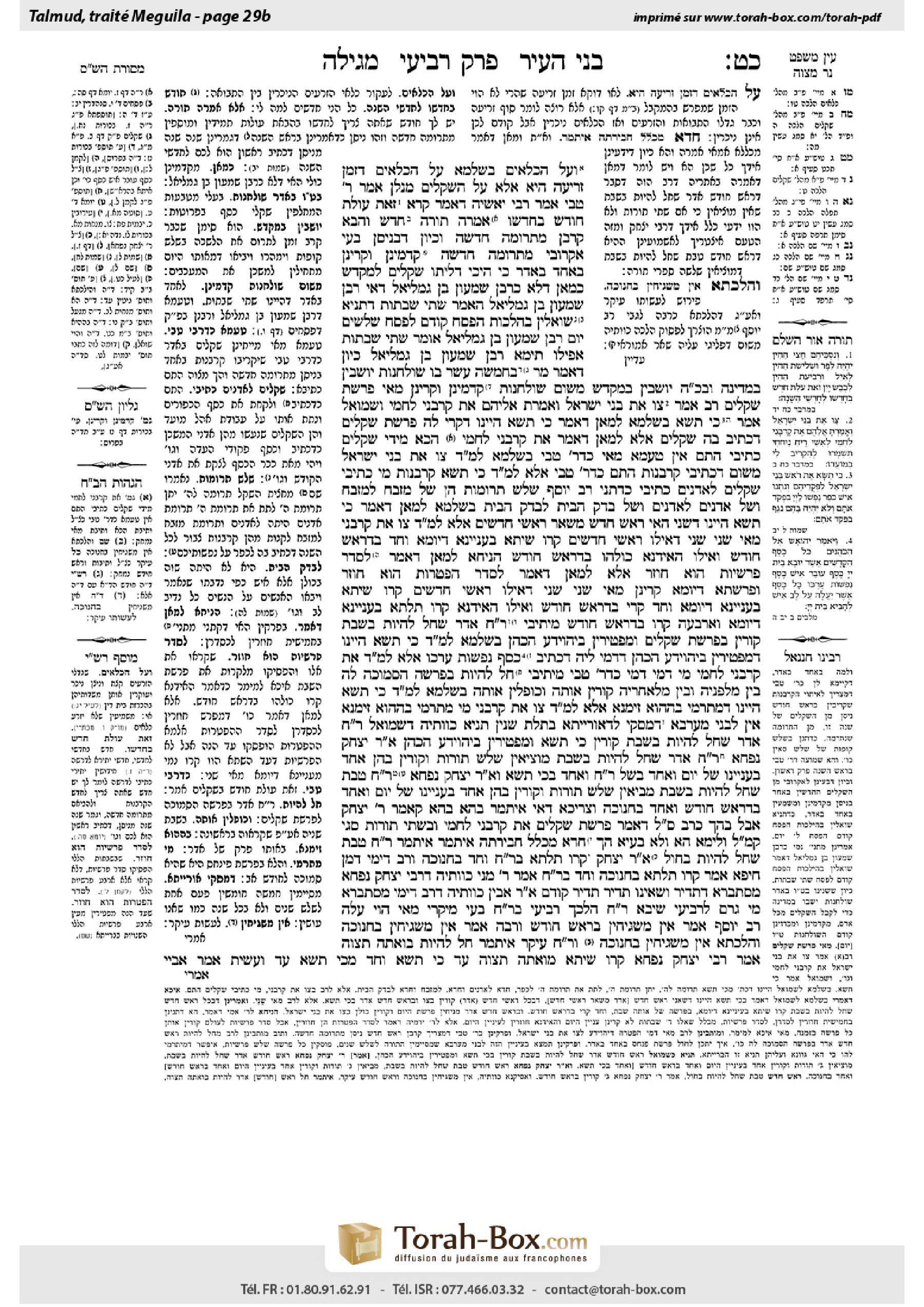
Megillah 29b: Talmud study for Daf Yomi
Daf Yomi is the daily study of one Talmud folio. Explore 37 tractates with scans, Hebrew text, Sefaria English and AI-generated French translations where annotated.
Passage selection and English or AI-generated French translation are available where the scan has annotations. Daf Study is independent of Torah-Box and Sefaria.
Browse Megillah · מגילה · All tractatesMegillah 29b text and translations
This page of Megillah includes the Aramaic text, an English translation and an AI-generated French translation, alongside the scan above.
מגילה כ״ט ב · Aramaic and Hebrew text
וְעַל הַכִּלְאַיִם.
בִּשְׁלָמָא עַל הַכִּלְאַיִם — דִּזְמַן זְרִיעָה הִיא, אֶלָּא עַל הַשְּׁקָלִים מְנָלַן?
אָמַר רַבִּי טָבִי אָמַר רַבִּי יֹאשִׁיָּה, דְּאָמַר קְרָא: ״זֹאת עוֹלַת חוֹדֶשׁ בְּחׇדְשׁוֹ״, אָמְרָה תּוֹרָה: חַדֵּשׁ וְהָבֵא קׇרְבָּן מִתְּרוּמָה חֲדָשָׁה.
וְכֵיוָן דִּבְנִיסָן בָּעֵי אַקְרוֹבֵי מִתְּרוּמָה חֲדָשָׁה, קָדְמִינַן וְקָרֵינַן בְּאֶחָד בַּאֲדָר, כִּי הֵיכִי דְּלַיְתוֹ שְׁקָלִים לַמִּקְדָּשׁ.
כְּמַאן — דְּלָא כְּרַבָּן שִׁמְעוֹן בֶּן גַּמְלִיאֵל. דְּאִי רַבָּן שִׁמְעוֹן בֶּן גַּמְלִיאֵל, הָאָמַר שְׁתֵּי שַׁבָּתוֹת, דְּתַנְיָא: שׁוֹאֲלִין בְּהִלְכוֹת הַפֶּסַח קוֹדֶם לְפֶסַח שְׁלֹשִׁים יוֹם. רַבָּן שִׁמְעוֹן בֶּן גַּמְלִיאֵל אוֹמֵר: שְׁתֵּי שַׁבָּתוֹת.
אֲפִילּוּ תֵּימָא רַבָּן שִׁמְעוֹן בֶּן גַּמְלִיאֵל, כֵּיוָן דְּאָמַר מָר: בַּחֲמִשָּׁה עָשָׂר בּוֹ שׁוּלְחָנוֹת יוֹשְׁבִין בַּמְּדִינָה וּבְעֶשְׂרִים וַחֲמִשָּׁה יוֹשְׁבִין בַּמִּקְדָּשׁ — מִשּׁוּם שׁוּלְחָנוֹת קָדְמִינַן וְקָרֵינַן.
מַאי פָּרָשַׁת שְׁקָלִים? רַב אָמַר: ״צַו אֶת בְּנֵי יִשְׂרָאֵל וְאָמַרְתָּ אֲלֵיהֶם אֶת קׇרְבָּנִי לַחְמִי״. וּשְׁמוּאֵל אָמַר: ״כִּי תִשָּׂא״.
בִּשְׁלָמָא לְמַאן דְּאָמַר ״כִּי תִשָּׂא״, הַיְינוּ דְּקָרֵי לַהּ פָּרָשַׁת שְׁקָלִים — דִּכְתִיב בַּהּ ״שְׁקָלִים״. אֶלָּא לְמַאן דְּאָמַר ״אֶת קׇרְבָּנִי לַחְמִי״, הָכָא מִידֵּי ״שְׁקָלִים״ כְּתִיבִי הָתָם? אִין, טַעְמָא מַאי — כִּדְרַבִּי טָבִי.
בִּשְׁלָמָא לְמַאן דְּאָמַר ״צַו אֶת בְּנֵי יִשְׂרָאֵל״ — מִשּׁוּם דִּכְתִיבִי ״קׇרְבָּנוֹת״ הָתָם, כִּדְרַבִּי טָבִי. אֶלָּא לְמַאן דְּאָמַר ״כִּי תִשָּׂא״, ״קׇרְבָּנוֹת״ מִי כְּתִיבִי? שְׁקָלִים לָאֲדָנִים כְּתִיבִי!
כִּדְתָנֵי רַב יוֹסֵף: שָׁלֹשׁ תְּרוּמוֹת הֵן. שֶׁל מִזְבֵּחַ לַמִּזְבֵּחַ, וְשֶׁל אֲדָנִים לָאֲדָנִים, וְשֶׁל בֶּדֶק הַבַּיִת לְבֶדֶק הַבַּיִת.
בִּשְׁלָמָא לְמַאן דְּאָמַר ״כִּי תִשָּׂא״, הַיְינוּ דְּשָׁנֵי הַאי רֹאשׁ חֹדֶשׁ מִשְּׁאָר רָאשֵׁי חֳדָשִׁים,
אֶלָּא לְמַאן דְּאָמַר ״צַו אֶת קׇרְבָּנִי״, מַאי שָׁנֵי? שָׁנֵי, דְּאִילּוּ רָאשֵׁי חֳדָשִׁים קָרוּ שִׁיתָּא בְּעִנְיָינָא דְיוֹמָא וְחַד בִּדְרֹאשׁ חוֹדֶשׁ, וְאִילּוּ הָאִידָּנָא — כּוּלְּהוּ בִּדְרֹאשׁ חוֹדֶשׁ.
הָנִיחָא לְמַאן דְּאָמַר לְסֵדֶר פָּרָשִׁיּוֹת הוּא חוֹזֵר.
אֶלָּא לְמַאן דְּאָמַר לְסֵדֶר הַפְטָרוֹת הוּא חוֹזֵר, וּפָרַשְׁתָּא דְיוֹמָא קָרֵינַן, מַאי שָׁנֵי?
שָׁנֵי, דְּאִילּוּ רָאשֵׁי חֳדָשִׁים קָרוּ שִׁיתָּא בְּעִנְיָינָא דְיוֹמָא וְחַד קָרֵי בִּדְרֹאשׁ חוֹדֶשׁ, וְאִילּוּ הָאִידָּנָא — קָרוּ תְּלָתָא בְּעִנְיָינָא דְיוֹמָא, וְאַרְבְּעָה קָרוּ בִּדְרֹאשׁ חוֹדֶשׁ.
מֵיתִיבִי: רֹאשׁ חֹדֶשׁ אֲדָר שֶׁחָל לִהְיוֹת בַּשַּׁבָּת קוֹרִין בְּפָרָשַׁת שְׁקָלִים, וּמַפְטִירִין בִּיהוֹיָדָע הַכֹּהֵן. בִּשְׁלָמָא לְמַאן דְּאָמַר ״כִּי תִשָּׂא״, הַיְינוּ דְּמַפְטִירִין בִּיהוֹיָדָע הַכֹּהֵן — דְּדָמֵי לֵיהּ, דִּכְתִיב: ״כֶּסֶף נַפְשׁוֹת עֶרְכּוֹ״,
אֶלָּא לְמַאן דְּאָמַר ״אֶת קׇרְבָּנִי לַחְמִי״, מִי דָּמֵי? דָּמֵי, כִּדְרַבִּי טָבִי.
מֵיתִיבִי: חָל לִהְיוֹת בַּפָּרָשָׁה הַסְּמוּכָה לָהּ, בֵּין מִלְּפָנֶיהָ וּבֵין מִלְּאַחֲרֶיהָ — קוֹרִין אוֹתָהּ וְכוֹפְלִין אוֹתָהּ.
בִּשְׁלָמָא לְמַאן דְּאָמַר ״כִּי תִשָּׂא״ הַיְינוּ דְּמִתְרְמֵי בְּהָהוּא זִימְנָא.
אֶלָּא לְמַאן דְּאָמַר ״צַו ... אֶת קׇרְבָּנִי״, מִי מִתְרְמֵי בְּהָהוּא זִימְנָא? אִין — לִבְנֵי מַעְרְבָא דְּמַסְּקִי לִדְאוֹרָיְיתָא בִּתְלָת שְׁנִין.
תַּנְיָא כְּווֹתֵיהּ דִּשְׁמוּאֵל: רֹאשׁ חֹדֶשׁ אֲדָר שֶׁחָל לִהְיוֹת בְּשַׁבָּת, קוֹרִין ״כִּי תִשָּׂא״ וּמַפְטִירִין בִּיהוֹיָדָע הַכֹּהֵן.
אָמַר רַבִּי יִצְחָק נַפָּחָא: רֹאשׁ חֹדֶשׁ אֲדָר שֶׁחָל לִהְיוֹת בַּשַּׁבָּת — מוֹצִיאִין שָׁלֹשׁ תּוֹרוֹת, וְקוֹרִין בָּהֶן אֶחָד בְּעִנְיָינוֹ שֶׁל יוֹם, וְאֶחָד בְּשֶׁל רֹאשׁ חֹדֶשׁ, וְאֶחָד בְּ״כִי תִשָּׂא״. וְאָמַר רַבִּי יִצְחָק נַפָּחָא: רֹאשׁ חֹדֶשׁ טֵבֵת שֶׁחָל לִהְיוֹת בַּשַּׁבָּת — מְבִיאִין שָׁלֹשׁ תּוֹרוֹת, וְקוֹרִין בָּהֶן אֶחָד בְּעִנְיָינוֹ שֶׁל יוֹם, וְאֶחָד בִּדְרֹאשׁ חוֹדֶשׁ, וְאֶחָד בַּחֲנוּכָּה.
וּצְרִיכָא, דְּאִי אִיתְּמַר בְּהָא — בְּהָא קָאָמַר רַבִּי יִצְחָק, אֲבָל בְּהָךְ — כְּרַב סְבִירָא לֵיהּ, דְּאָמַר פָּרָשַׁת שְׁקָלִים ״אֶת קׇרְבָּנִי לַחְמִי״, וּבִשְׁתֵּי תוֹרוֹת סַגִּי, קָא מַשְׁמַע לַן.
וְלֵימָא הָא וְלָא בָּעֲיָא הָךְ! חֲדָא מִכְּלַל חֲבֶירְתָּהּ אִיתְּמַר.
אִיתְּמַר: רֹאשׁ חֹדֶשׁ טֵבֵת שֶׁחָל לִהְיוֹת בַּחוֹל, אָמַר רַבִּי יִצְחָק: קָרוּ תְּלָתָא בְּרֹאשׁ חֹדֶשׁ, וְחַד בַּחֲנוּכָּה. וְרַב דִּימִי דְּמִן חֵיפָא אֲמַר: קָרוּ תְּלָתָא בַּחֲנוּכָּה, וְחַד בְּרֹאשׁ חֹדֶשׁ.
אָמַר רַבִּי מָנִי: כְּווֹתֵיהּ דְּרַבִּי יִצְחָק נַפָּחָא מִסְתַּבְּרָא, דְּתָדִיר וְשֶׁאֵינוֹ תָּדִיר תָּדִיר קוֹדֵם.
אָמַר רַבִּי אָבִין: כְּווֹתֵיהּ דְּרַב דִּימִי מִסְתַּבְּרָא, מִי גָּרַם לָרְבִיעִי שֶׁיָּבֹא — רֹאשׁ חֹדֶשׁ, הִלְכָּךְ רְבִיעִי בְּרֹאשׁ חֹדֶשׁ בָּעֵי מִיקְרֵי.
מַאי הָוֵי עֲלַהּ? רַב יוֹסֵף אָמַר: אֵין מַשְׁגִּיחִין בְּרֹאשׁ חוֹדֶשׁ, וְרַבָּה אָמַר: אֵין מַשְׁגִּיחִין בַּחֲנוּכָּה, וְהִלְכְתָא: אֵין מַשְׁגִּיחִין בַּחֲנוּכָּה, וְרֹאשׁ חֹדֶשׁ עִיקָּר.
אִיתְּמַר: חָל לִהְיוֹת בִּ״וְאַתָּה תְּצַוֶּה״, אָמַר רַבִּי יִצְחָק נַפָּחָא: קָרוּ שִׁיתָּא מִ״וְּאַתָּה תְּצַוֶּה״ עַד ״כִּי תִשָּׂא״, וְחַד מִ״כִּי תִשָּׂא״ עַד ״וְעָשִׂיתָ״. אָמַר אַבָּיֵי:
Megillah 29b · English translation
And a public announcement is made concerning the need to uproot any instances of diverse kinds that have grown in the fields.
The Gemara asks: Granted, an announcement is made concerning the need to uproot diverse kinds, as the beginning of the month of Adar is a time of sowing. Instances of diverse kinds are already noticeable, and therefore it is a fitting time to deal with the matter. But with regard to the announcement concerning the half-shekels, from where do we derive that it should be made at this point in the year?
Rabbi Tavi said that Rabbi Yoshiyya said: It is as the verse states: “This is the burnt-offering of each New Moon in its renewal throughout the months of the year” (Numbers 28:14). The Torah says: There is a month in which you must begin to renew and bring the daily and additional offering from animals purchased with the new collections of half-shekels collected that year. Each year a collection is made with which to finance the purchase of communal offerings for the following year. Offerings during that year may be purchased only from collections made for that year.
Elsewhere it is derived through a verbal analogy that the yearly cycle begins with the month of Nisan. And since starting from and during the month of Nisan the offerings must be brought from the new collections of half-shekels, it is necessary to make the collection in the preceding month, i.e., in Adar. Therefore, they advance the reading of Shekalim, and they read it on the first of Adar, in order that the people will be reminded to bring the half-shekels to the Temple in good time.
The Gemara asks: In accordance with whose opinion is the mishna taught? It is not in accordance with the opinion of Rabban Shimon ben Gamliel, for if someone would suggest that it is in accordance with the opinion of Rabban Shimon ben Gamliel, one could counter: Didn’t he say that two weeks is a sufficient period of preparation? As it is taught in a baraita: We begin to inquire into the halakhot of Passover thirty days before Passover. Rabban Shimon ben Gamliel says: We begin to inquire only two weeks before Passover. As such, it should be sufficient to announce the collection of half-shekels from two weeks before Nisan, and there should be no need to advance the announcement to the beginning of Adar, as stated in the mishna.
Even if you say that the mishna is in accordance with the opinion of Rabban Shimon ben Gamliel, it is possible that even he agrees that the announcement concerning the collection of the half-shekels should be made on the first of Adar, since the Master said: On the fifteenth of Adar money-changing tables for collecting the half-shekels are set up throughout the country, and on the twenty-fifth of Adar they are set up in the Temple. Because of the possibility to donate the half-shekels at the tables already from the fifteenth, they advance the reading of Shekalim to inform people of that possibility and read it two weeks earlier, on the first of Adar.
§ The Gemara clarifies which passage is read: What is this portion of Shekalim? Rav said: It is the portion of “Command the children of Israel, and say to them: My offering, the provision of My offerings made by fire” (Numbers 28), which details the daily and additional offerings. And Shmuel said: It is the portion of “When you take the count” (Exodus 30:11–16).
Granted, according to the one who said that it is the portion of “When you take the count,” this is the reason that it is called the portion of Shekalim, for the obligation to give half-shekels is written in that portion. However, according to one who said that it is the portion of “My offering, the provision of My offerings,” why should that portion be read? Is there anything written about the half-shekels here? The Gemara answers: Yes. What is the reason that they are collected in Adar? As per the explanation of Rabbi Tavi, the half-shekels are collected to be used for the coming year’s daily and additional offerings. Therefore, reading the portion concerning those offerings will serve well as a reminder for people to donate.
Granted, according to the one who said that it is the portion of “Command the children of Israel: My offering, the provision of My offerings,” it is logical to read that portion, because the offerings that will be purchased with the half-shekels are written there, as per the explanation of Rabbi Tavi. However, according to one who said that it is the portion of “When you take the count,” why should that portion be read? Is anything about the offerings written in that portion? The collection of half-shekels for use in the construction of the sockets of the Tabernacle are the only thing written in that portion. What does that have to do with the collection of half-shekels for the purchase of offerings that is held in the month of Adar?
The Gemara answers: The selection of that portion is in accordance with the explanation of the portion that Rav Yosef taught: The three instances of the word: Contribution, in that portion teach that there were three contributions of half-shekels: The contribution of the altar is for the purchase of communal offerings to be sacrificed on the altar; and the contribution of the sockets is for constructing the sockets; and the contribution of the Temple maintenance is for the Temple maintenance. Therefore, according to Rav Yosef, it is understandable why the portion of “When you take the count” is read. It deals explicitly with the collection of half-shekels.
The Gemara asks further: Granted, according to the one who said that it is the portion of “When you take the count,” this is what is different about this New Moon of Adar and other New Moons when they occur on Shabbat. On the New Moon of Adar, “When you take the count” is read because it describes the collection of half-shekels. On other New Moons, when they occur on Shabbat, the portion of “Command the children of Israel” is read because it mentions the additional offerings brought on Shabbat and the New Moon.
However, according to the one who said that “Command the children of Israel, and say to them: My offering,” what is different about the portion read on the New Moon of Adar and the portion read on other New Moons when they occur on Shabbat, for the same portion is read in all cases? The Gemara answers: They are different: For on other New Moons, when they occur on Shabbat, six people read from the regular weekly portion of the matter of the day and one reads from the portion for the New Moon, whereas now, on the New Moon of Adar, if it occurs on Shabbat, all seven read from the portion of the New Moon.
The Gemara asks: This answer works out well according to the one who said that when the mishna states that on the fifth Shabbat, we resume the regular order of readings. The intention is that one resumes the regular weekly order of Torah portions. This implies that on the previous four Shabbatot, the regular portion was not read at all. Rather, only the special portions delineated in the mishna were read. Therefore, it makes sense to say that all seven people read from the special portion.
However, according to the one who says that the mishna’s intention is that one resumes the regular order of concluding readings from the Prophets [haftarot], and on the previous Shabbatot one also reads from the regular portion of the matter of the day, then the original question stands: What is different about the portion read on the New Moon of Adar and the portion read on other New Moons when they occur on Shabbat?
The Gemara answers: They are different: For whereas on other New Moons, when they occur on Shabbat, six people read from the regular weekly portion of the matter of the day and one reads from the portion for the New Moon, now, on the New Moon of Adar, if it occurs on Shabbat, three people read from the regular weekly portion of the matter of the day and four read from the portion for the New Moon.
The Gemara raises an objection from the Tosefta (Megilla 3:1): When the New Moon of Adar occurs on Shabbat, they read the Torah portion of Shekalim, and they read as the haftara the story involving Jehoiada the priest (II Kings 12:1–17). Granted, according to the one who said that Shekalim is the portion of “When you take the count,” this is the reason that they read as the haftara the story involving Jehoiada the priest: Because it is comparable in content to the Torah reading, as it is written in the story of Jehoiada: “The money of his assessment of persons” (II Kings 12:5), which is referring to his collection of the half-shekels, and the haftara should always contain a theme similar to the Torah reading.
However, according to the one who said that “My offering, the provision of My offerings” is read as the portion of Shekalim, is the haftara comparable to that portion? It is comparable, as per the explanation of Rabbi Tavi: It is appropriate to read the portion about offerings because the collection of half-shekels is for that purpose.
The Gemara raises an objection from a baraita: If the New Moon of Adar occurs on the Shabbat on which the portion to be read for the regular weekly reading is adjacent to the portion read as Shekalim, whether on the Shabbat preceding the Shabbat on which Shekalim will be read as part of the weekly reading or following it, then they read and repeat Shekalim on both Shabbatot, one time as the special portion Shekalim and the other as part of the regular order.
Granted, according to the one who said that the portion of “When you take the count” is read as Shekalim, this is how it is possible: That portion could occur at that time in the yearlong cycle of the order of readings. In the regular order of reading, “When you take the count” is often read during the beginning of Adar.
However, according to the one who said that the portion of “Command the children of Israel, and say to them, My offering” is read as Shekalim, does that portion ever occur at that time of the year? That portion usually occurs much later in the year, in the summer. The Gemara answers: Yes, it sometimes occurs that this portion is read during the beginning of Adar, for the people of the West, i.e., Eretz Yisrael, who complete the cycle of reading the Torah not in one year but in three years.
It is taught in a baraita in accordance with the opinion of Shmuel: When the New Moon of Adar occurs on Shabbat, they read the portion of “When you take the count,” and they read as the haftara the story involving Jehoiada the priest.
§ Rabbi Yitzḥak Nappaḥa said: When the New Moon of Adar occurs on Shabbat, the congregation takes out three Torah scrolls from the ark and reads from them. From the first one, they read the portion of the regular weekly reading of the matter of the day; and from the second one they read the portion for the New Moon; and from the third one they read Shekalim, which begins with “When you take the count.” And Rabbi Yitzḥak Nappaḥa further said: When the New Moon of Tevet, which always falls during Hanukkah, occurs on Shabbat, they bring three Torah scrolls and read from them. From the first one, they read the portion of the regular cycle of reading of the matter of the day; and from the second one, they read the portion for the New Moon; and from the third one, they read the portion for Hanukkah.
The Gemara comments: And it is necessary for Rabbi Yitzḥak Nappaḥa to state the halakha in both cases, as, if it had been stated only with regard to the New Moon of Tevet, one could have mistakenly thought that only with regard to that case does Rabbi Yitzḥak Nappaḥa state that three Torah scrolls are used. But with regard to the New Moon of Adar, one might think that he holds in accordance with the opinion of Rav, who said that the portion of Shekalim is the portion of “My offering, the provision of My offerings,” and two Torah scrolls will therefore suffice, since the same portion is used both for the portion for the New Moon and for the portion of Shekalim. Therefore, he teaches us that three Torah scrolls are used even on the New Moon of Adar.
The Gemara asks: But, based on that logic, let Rabbi Yitzḥak just say the halakha with respect to this case of the New Moon of Adar, and there would be no need to state that case of the New Moon of Tevet. The Gemara answers: Indeed, one was stated from the other by inference, i.e., Rabbi Yitzḥak Nappaḥa stated the halakha explicitly only with regard to the New Moon of Adar, and it was inferred that the same is true of the New Moon of Tevet.
§ An amoraic dispute was stated: When the New Moon of Tevet occurs on a weekday, what Torah portion is read? Rabbi Yitzḥak Nappaḥa said: Three people read from the portion for the New Moon, and one reads from the portion for Hanukkah. And Rav Dimi of Haifa said: Three read from the portion for Hanukkah, and one reads from the portion for the New Moon.
Rabbi Mani said: It stands to reason to rule in accordance with the opinion of Rabbi Yitzḥak Nappaḥa, for it is already an established principle that when a frequent practice and an infrequent practice conflict, the frequent practice takes precedence over the infrequent practice. Since the portion for the New Moon is read more frequently than the portion for Hanukkah, it should be given greater prominence.
Rabbi Avin said: It stands to reason to rule in accordance with the opinion of Rav Dimi, for the following reason: What caused the fourth person to come and read from the Torah? The New Moon, as on the other days of Hanukkah only three people read from the Torah. Therefore, it is only logical that the fourth person should read from the portion for the New Moon.
The Gemara asks: What halakhic conclusion was reached about this matter? Rav Yosef said: We do not concern ourselves with making the portion for the New Moon the primary reading. Rather, three people read from the portion for Hanukkah, and only the fourth reads the portion for the New Moon. And Rabba said: We do not concern ourselves with making the portion for Hanukkah the primary reading. Rather, three people read from the portion for the New Moon, and only the fourth reads the portion for Hanukkah. The Gemara concludes: And the halakha is that we do not concern ourselves with making the portion for Hanukkah the primary reading, and therefore the portion for the New Moon is primary.
§ An amoraic dispute was stated: If the Shabbat on which the portion of Shekalim is to be read occurs on the Shabbat in which the regular weekly portion is “And you shall command” (Exodus 27:20–30:10), what should be done? Rabbi Yitzḥak Nappaḥa said: Six people read from the portion “And you shall command,” until but not including the weekly portion of “When you take the count” (Exodus 27:20–30:10), and one person reads the portion of Shekalim from “When you take the count,” until but not including the verse: “And you shall make a copper laver” (Exodus 30:11–16). Abaye said:
Megillah 29b · Traduction française (IA)
On proclame également la nécessité d’arracher toutes les plantes de différentes espèces qui ont poussé dans les champs.
La Guemara demande : On comprend qu’on proclame la nécessité d’arracher les plantes de différentes espèces, puisque le début du mois d’Adar est une période de semailles. Ces plantes sont déjà visibles ; c’est donc le moment opportun de s’en occuper. Mais, concernant la proclamation relative aux demi-sicles, d’où déduit-on qu’elle doit être faite à ce moment de l’année ?
Rabbi Tavi a dit au nom de Rabbi Yoshiyya : C’est ce qu’indique le verset : « Tel est l’holocauste de chaque nouvelle lune, selon son renouvellement, au cours des mois de l’année » (Nombres 28:14). La Torah dit qu’il y a un mois où l’on doit commencer à renouveler et à apporter l’offrande perpétuelle et les offrandes supplémentaires avec les animaux achetés grâce aux nouvelles collectes de demi-sicles effectuées cette année-là. Chaque année, une collecte est effectuée pour financer l’achat des offrandes communautaires de l’année suivante. Au cours de cette année, on ne peut acheter des offrandes qu’avec les fonds collectés pour cette même année.
Ailleurs, on déduit au moyen d’une analogie verbale que le cycle annuel commence au mois de Nissan. Or, puisque, à partir du mois de Nissan et pendant ce mois, les offrandes doivent être apportées avec les nouvelles collectes de demi-sicles, il faut effectuer la collecte le mois précédent, c’est-à-dire en Adar. On avance donc la lecture de Chekalim et on la lit le premier Adar, afin de rappeler aux gens d’apporter à temps leurs demi-sicles au Temple.
La Guemara demande : Selon l’opinion de qui la Michna a-t-elle été enseignée ? Elle ne suit pas l’opinion de Rabban Shimon ben Gamliel, car si quelqu’un proposait qu’elle soit conforme à l’opinion de Rabban Shimon ben Gamliel, on pourrait objecter : N’a-t-il pas dit que deux semaines suffisent pour se préparer ? Car il est enseigné dans une baraïta : On commence à étudier les halakhot de Pessa’h trente jours avant Pessa’h. Rabban Shimon ben Gamliel dit : On ne commence à les étudier que deux semaines avant Pessa’h. Dès lors, il devrait suffire de proclamer la collecte des demi-sicles deux semaines avant Nissan ; il ne serait donc pas nécessaire d’avancer cette proclamation au début d’Adar, comme l’indique la Michna.
Même si tu dis que la Michna suit l’opinion de Rabban Shimon ben Gamliel, il est possible que même lui convienne que la proclamation relative à la collecte des demi-sicles soit faite le premier Adar, puisque le Maître a dit : Le quinze Adar, des tables de changeurs destinées à la collecte des demi-sicles sont installées dans tout le pays, et le vingt-cinq Adar, elles sont installées dans le Temple. Comme il est possible de donner les demi-sicles à ces tables dès le quinze, on avance la lecture de Chekalim pour en informer les gens et on la lit deux semaines plus tôt, le premier Adar.
§ La Guemara précise quel passage est lu : Quel est ce passage de Chekalim ? Rav dit : C’est le passage « Ordonne aux enfants d’Israël et dis-leur : Mon offrande, l’aliment de mes offrandes consumées par le feu » (Nombres 28), qui détaille l’offrande perpétuelle et les offrandes supplémentaires. Shmuel dit : C’est le passage « Lorsque tu feras le dénombrement » (Exode 30:11–16).
On comprend que, selon celui qui dit qu’il s’agit du passage « Lorsque tu feras le dénombrement », on l’appelle le passage de Chekalim parce que l’obligation de donner des demi-sicles y est écrite. Mais, selon celui qui dit qu’il s’agit du passage « Mon offrande, l’aliment de mes offrandes », pourquoi lire ce passage ? Est-il question des demi-sicles à cet endroit ? La Guemara répond : Oui. Pourquoi les collecte-t-on en Adar ? Comme l’explique Rabbi Tavi, les demi-sicles sont collectés pour servir aux offrandes perpétuelles et supplémentaires de l’année à venir. Il convient donc de lire le passage consacré à ces offrandes afin de rappeler aux gens de faire leur don.
On comprend que, selon celui qui dit qu’il s’agit du passage « Ordonne aux enfants d’Israël : Mon offrande, l’aliment de mes offrandes », il est logique de lire ce passage, car les offrandes qui seront achetées avec les demi-sicles y sont mentionnées, comme l’explique Rabbi Tavi. Mais, selon celui qui dit qu’il s’agit du passage « Lorsque tu feras le dénombrement », pourquoi lire ce passage ? Y est-il question des offrandes ? La seule chose qui y est mentionnée est la collecte de demi-sicles destinée à la construction des socles du Tabernacle. Quel rapport cela a-t-il avec la collecte des demi-sicles effectuée au mois d’Adar pour acheter les offrandes ?
La Guemara répond : Le choix de ce passage suit l’explication du passage enseignée par Rav Yosef : les trois occurrences du mot « contribution » dans ce passage enseignent qu’il y avait trois contributions de demi-sicles : la contribution de l’autel servait à acheter les offrandes communautaires sacrifiées sur l’autel ; la contribution des socles servait à construire les socles ; et la contribution pour l’entretien du Temple servait à son entretien. Selon Rav Yosef, on comprend donc pourquoi on lit le passage « Lorsque tu feras le dénombrement » : il traite explicitement de la collecte des demi-sicles.
La Guemara demande encore : On comprend que, selon celui qui dit qu’il s’agit du passage « Lorsque tu feras le dénombrement », voici ce qui distingue cette nouvelle lune d’Adar des autres nouvelles lunes qui tombent un Chabbat. À la nouvelle lune d’Adar, on lit « Lorsque tu feras le dénombrement », car ce passage décrit la collecte des demi-sicles. Pour les autres nouvelles lunes qui tombent un Chabbat, on lit le passage « Ordonne aux enfants d’Israël », car il mentionne les offrandes supplémentaires apportées le Chabbat et à la nouvelle lune.
Mais, selon celui qui dit que l’on lit « Ordonne aux enfants d’Israël et dis-leur : Mon offrande », qu’est-ce qui distingue le passage lu à la nouvelle lune d’Adar de celui lu lors des autres nouvelles lunes qui tombent un Chabbat, puisque le même passage est lu dans tous les cas ? La Guemara répond : Il y a une différence. Pour les autres nouvelles lunes qui tombent un Chabbat, six personnes lisent le passage hebdomadaire ordinaire correspondant au jour et une personne lit le passage de la nouvelle lune ; tandis que maintenant, à la nouvelle lune d’Adar, si elle tombe un Chabbat, les sept personnes lisent le passage de la nouvelle lune.
La Guemara demande : Cette réponse convient selon celui qui dit que, lorsque la Michna affirme qu’au cinquième Chabbat on reprend l’ordre régulier des lectures, il s’agit de reprendre l’ordre hebdomadaire des sections de la Torah. Cela implique que, pendant les quatre Chabbat précédents, on n’a pas du tout lu la section ordinaire, mais uniquement les passages particuliers énumérés dans la Michna. Il est donc logique de dire que les sept personnes lisent le passage particulier.
Mais, selon celui qui dit que la Michna veut dire qu’on reprend l’ordre régulier des lectures de conclusion tirées des Prophètes [haftarot], et que, les Chabbat précédents, on lit également la section ordinaire correspondant au jour, la question initiale demeure : qu’est-ce qui distingue le passage lu à la nouvelle lune d’Adar de celui lu lors des autres nouvelles lunes qui tombent un Chabbat ?
La Guemara répond : Il y a une différence. Alors que, pour les autres nouvelles lunes qui tombent un Chabbat, six personnes lisent la section hebdomadaire ordinaire correspondant au jour et une personne lit le passage de la nouvelle lune, maintenant, à la nouvelle lune d’Adar, si elle tombe un Chabbat, trois personnes lisent la section hebdomadaire ordinaire correspondant au jour et quatre lisent le passage de la nouvelle lune.
La Guemara soulève une objection tirée de la Tosefta (Megilla 3:1) : Lorsque la nouvelle lune d’Adar tombe un Chabbat, on lit le passage de la Torah de Chekalim et, comme haftara, le récit concernant Yehoyada le prêtre (II Rois 12:1–17). On comprend que, selon celui qui dit que Chekalim est le passage « Lorsque tu feras le dénombrement », on lit comme haftara le récit concernant Yehoyada le prêtre parce que son contenu correspond à la lecture de la Torah : le récit de Yehoyada dit en effet « l’argent de son estimation des personnes » (II Rois 12:5), ce qui désigne la collecte des demi-sicles. Or, la haftara doit toujours porter sur un thème semblable à celui de la lecture de la Torah.
Mais, selon celui qui dit que le passage de Chekalim est « Mon offrande, l’aliment de mes offrandes », la haftara correspond-elle à ce passage ? Oui, elle correspond, comme l’explique Rabbi Tavi : il convient de lire le passage sur les offrandes, puisque la collecte des demi-sicles est destinée à cet usage.
La Guemara soulève une objection tirée d’une baraïta : Si la nouvelle lune d’Adar tombe le Chabbat où la section de la lecture hebdomadaire ordinaire est voisine du passage lu comme Chekalim, que ce soit le Chabbat précédant celui où Chekalim sera lu dans le cadre de la lecture hebdomadaire ou celui qui le suit, on lit Chekalim et on le répète lors des deux Chabbat, une fois comme passage particulier de Chekalim et l’autre fois dans le cadre de l’ordre régulier.
On comprend que, selon celui qui dit que le passage de Chekalim est « Lorsque tu feras le dénombrement », cela soit possible : ce passage peut tomber à cette période du cycle annuel des lectures. Dans l’ordre régulier, « Lorsque tu feras le dénombrement » est souvent lu au début d’Adar.
Mais, selon celui qui dit que le passage de Chekalim est « Ordonne aux enfants d’Israël et dis-leur : Mon offrande », ce passage tombe-t-il jamais à cette période de l’année ? Il tombe généralement bien plus tard dans l’année, en été. La Guemara répond : Oui, il arrive que ce passage soit lu au début d’Adar chez les habitants de l’Ouest, c’est-à-dire en Eretz Israël, qui achèvent le cycle de lecture de la Torah non pas en un an, mais en trois ans.
Il est enseigné dans une baraïta conformément à l’opinion de Shmuel : Lorsque la nouvelle lune d’Adar tombe un Chabbat, on lit le passage « Lorsque tu feras le dénombrement » et, comme haftara, le récit concernant Yehoyada le prêtre.
§ Rabbi Yitzḥak Nappaḥa a dit : Lorsque la nouvelle lune d’Adar tombe un Chabbat, la communauté sort trois rouleaux de Torah de l’arche et lit dans chacun d’eux. Dans le premier, on lit la section de la lecture hebdomadaire ordinaire correspondant au jour ; dans le deuxième, on lit le passage de la nouvelle lune ; et dans le troisième, on lit Chekalim, qui commence par « Lorsque tu feras le dénombrement ». Rabbi Yitzḥak Nappaḥa a également dit : Lorsque la nouvelle lune de Tevet, qui tombe toujours pendant Hanoucca, tombe un Chabbat, on apporte trois rouleaux de Torah et on lit dans chacun d’eux. Dans le premier, on lit la section du cycle régulier correspondant au jour ; dans le deuxième, on lit le passage de la nouvelle lune ; et dans le troisième, on lit le passage de Hanoucca.
La Guemara fait remarquer qu’il était nécessaire que Rabbi Yitzḥak Nappaḥa énonce la halakha pour les deux cas : s’il ne l’avait énoncée que pour la nouvelle lune de Tevet, on aurait pu croire à tort que Rabbi Yitzḥak Nappaḥa ne dit qu’en ce cas qu’on utilise trois rouleaux de Torah. Mais, pour la nouvelle lune d’Adar, on aurait pu penser qu’il suit l’opinion de Rav, qui disait que le passage de Chekalim est « Mon offrande, l’aliment de mes offrandes ». Deux rouleaux de Torah suffiraient alors, puisque le même passage sert à la fois pour la nouvelle lune et pour Chekalim. Il nous enseigne donc que trois rouleaux de Torah sont utilisés même à la nouvelle lune d’Adar.
La Guemara demande : Mais, selon cette logique, Rabbi Yitzḥak aurait simplement pu énoncer la halakha pour le cas de la nouvelle lune d’Adar, sans qu’il soit nécessaire de mentionner celui de la nouvelle lune de Tevet. La Guemara répond : En effet, l’un a été déduit de l’autre : Rabbi Yitzḥak Nappaḥa a explicitement énoncé la halakha uniquement pour la nouvelle lune d’Adar, et l’on en a déduit qu’il en va de même pour la nouvelle lune de Tevet.
§ Une controverse entre amoraïm fut rapportée : Lorsque la nouvelle lune de Tevet tombe un jour de semaine, quel passage de la Torah lit-on ? Rabbi Yitzḥak Nappaḥa dit : Trois personnes lisent le passage de la nouvelle lune et une personne lit le passage de Hanoucca. Rav Dimi de Haïfa dit : Trois personnes lisent le passage de Hanoucca et une personne lit le passage de la nouvelle lune.
Rabbi Mani dit : Il est logique de statuer conformément à l’opinion de Rabbi Yitzḥak Nappaḥa, car il est déjà établi que, lorsqu’une pratique fréquente et une pratique peu fréquente entrent en conflit, la pratique fréquente prévaut sur la pratique peu fréquente. Puisque le passage de la nouvelle lune est lu plus souvent que celui de Hanoucca, il doit recevoir la priorité.
Rabbi Avin dit : Il est logique de statuer conformément à l’opinion de Rav Dimi, pour la raison suivante : Qu’est-ce qui a amené la quatrième personne à venir lire dans la Torah ? La nouvelle lune, car les autres jours de Hanoucca, seules trois personnes lisent dans la Torah. Il est donc logique que la quatrième personne lise le passage de la nouvelle lune.
La Guemara demande : Quelle conclusion halakhique a-t-on retenue à ce sujet ? Rav Yosef dit : Nous ne cherchons pas à donner la priorité au passage de la nouvelle lune. Trois personnes lisent donc le passage de Hanoucca et seule la quatrième lit le passage de la nouvelle lune. Rabba dit : Nous ne cherchons pas à donner la priorité au passage de Hanoucca. Trois personnes lisent donc le passage de la nouvelle lune et seule la quatrième lit le passage de Hanoucca. La Guemara conclut : La halakha est que nous ne cherchons pas à donner la priorité au passage de Hanoucca ; le passage de la nouvelle lune est donc prioritaire.
§ Une controverse entre amoraïm fut rapportée : Si le Chabbat où l’on doit lire le passage de Chekalim tombe le Chabbat où la section hebdomadaire ordinaire est « Et toi, tu ordonneras » (Exode 27:20–30:10), que faut-il faire ? Rabbi Yitzḥak Nappaḥa dit : Six personnes lisent le passage « Et toi, tu ordonneras », jusqu’à, mais sans inclure, le passage hebdomadaire « Lorsque tu feras le dénombrement », et une personne lit le passage de Chekalim, depuis « Lorsque tu feras le dénombrement » jusqu’au verset « Tu feras une cuve de bronze », sans l’inclure (Exode 30:11–16). Abaye dit :
Traduction française générée par IA à partir de l’édition anglaise de Sefaria. Vérifie toujours un passage avec le texte source.
Text from Sefaria: William Davidson Edition - Vocalized Aramaic (CC BY NC); William Davidson Edition - English (CC BY NC).