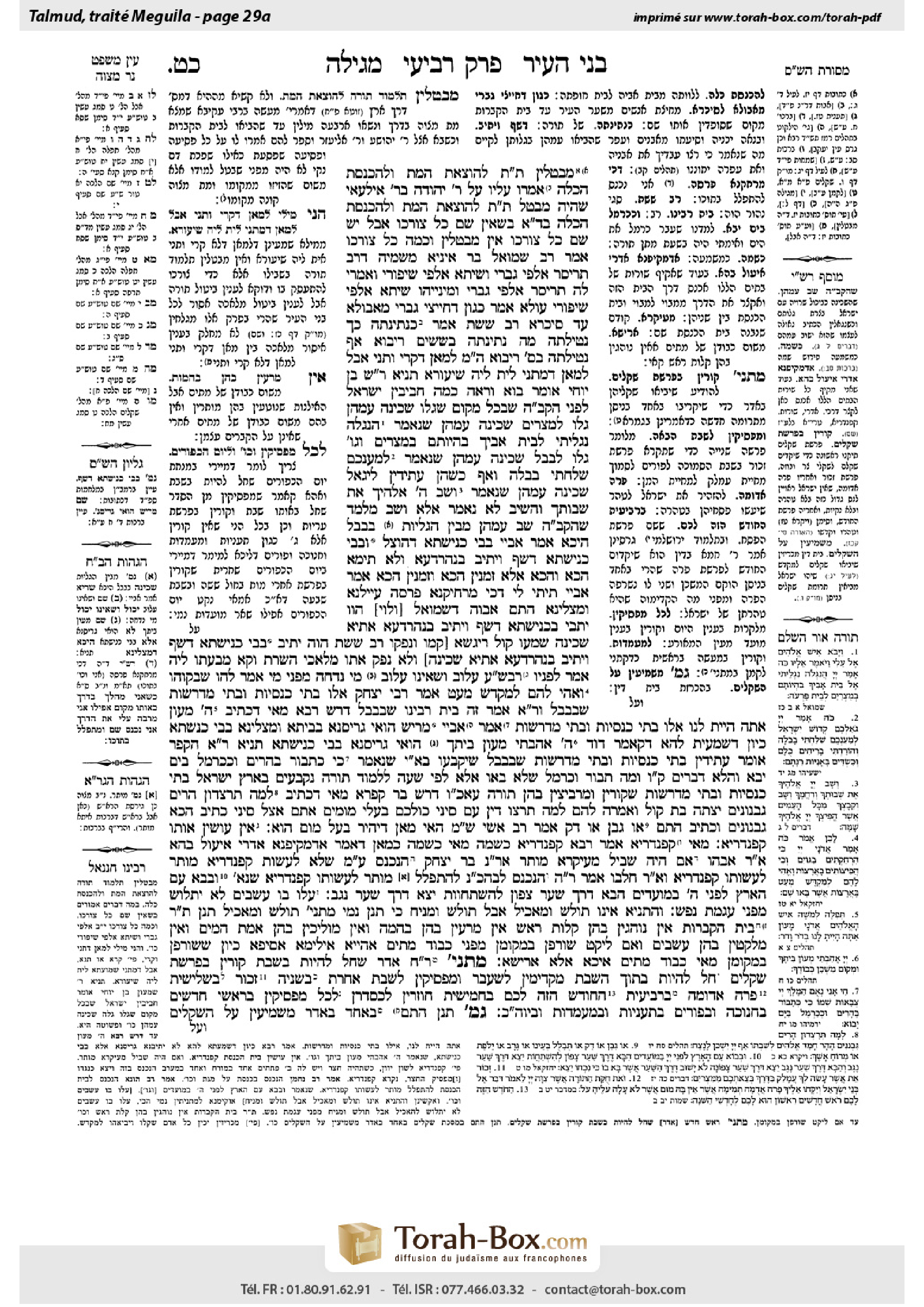
Megillah 29a: Talmud study for Daf Yomi
Daf Yomi is the daily study of one Talmud folio. Explore 37 tractates with scans, Hebrew text, Sefaria English and AI-generated French translations where annotated.
Passage selection and English or AI-generated French translation are available where the scan has annotations. Daf Study is independent of Torah-Box and Sefaria.
Browse Megillah · מגילה · All tractatesMegillah 29a text and translations
This page of Megillah includes the Aramaic text, an English translation and an AI-generated French translation, alongside the scan above.
מגילה כ״ט א · Aramaic and Hebrew text
מְבַטְּלִין תַּלְמוּד תּוֹרָה לְהוֹצָאַת הַמֵּת, וּלְהַכְנָסַת הַכַּלָּה. אָמְרוּ עָלָיו עַל רַבִּי יְהוּדָה בְּרַבִּי אִילְעַאי שֶׁהָיָה מְבַטֵּל תַּלְמוּד תּוֹרָה לְהוֹצָאַת הַמֵּת וּלְהַכְנָסַת הַכַּלָּה. בַּמֶּה דְּבָרִים אֲמוּרִים — בְּשֶׁאֵין שָׁם כׇּל צוֹרְכּוֹ, אֲבָל יֵשׁ שָׁם כׇּל צוֹרְכּוֹ — אֵין מְבַטְּלִין.
וְכַמָּה כׇּל צוֹרְכּוֹ? אָמַר רַב שְׁמוּאֵל בַּר אִינְיָא מִשְּׁמֵיהּ דְּרַב: תְּרֵיסַר אַלְפֵי גַּבְרֵי, וְשִׁיתָּא אַלְפֵי שִׁיפּוּרֵי. וְאָמְרִי לַהּ: תְּרֵיסַר אַלְפֵי גַּבְרֵי, וּמִינַּיְיהוּ שִׁיתָּא אַלְפֵי שִׁיפּוּרֵי. עוּלָּא אָמַר: כְּגוֹן דְּחָיְיצִי גַּבְרֵי מֵאֲבוּלָּא עַד סִיכְרָא.
רַב שֵׁשֶׁת אָמַר: כִּנְתִינָתָהּ כָּךְ נְטִילָתָהּ. מָה נְתִינָתָהּ בְּשִׁשִּׁים רִיבּוֹא, אַף נְטִילָתָהּ בְּשִׁשִּׁים רִיבּוֹא. הָנֵי מִילֵּי לְמַאן דְּקָרֵי וְתָנֵי, אֲבָל לְמַאן דְּמַתְנֵי — לֵית לֵיהּ שִׁיעוּרָא.
תַּנְיָא, רַבִּי שִׁמְעוֹן בֶּן יוֹחַי אוֹמֵר: בּוֹא וּרְאֵה כַּמָּה חֲבִיבִין יִשְׂרָאֵל לִפְנֵי הַקָּדוֹשׁ בָּרוּךְ הוּא, שֶׁבְּכָל מָקוֹם שֶׁגָּלוּ — שְׁכִינָה עִמָּהֶן. גָּלוּ לְמִצְרַיִם — שְׁכִינָה עִמָּהֶן, שֶׁנֶּאֱמַר: ״הַנִּגְלֹה נִגְלֵיתִי לְבֵית אָבִיךָ בִּהְיוֹתָם בְּמִצְרַיִם וְגוֹ׳״. גָּלוּ לְבָבֶל — שְׁכִינָה עִמָּהֶן, שֶׁנֶּאֱמַר: ״לְמַעַנְכֶם שֻׁלַּחְתִּי בָבֶלָה״. וְאַף כְּשֶׁהֵן עֲתִידִין לִיגָּאֵל — שְׁכִינָה עִמָּהֶן, שֶׁנֶּאֱמַר: ״וְשָׁב ה׳ אֱלֹהֶיךָ אֶת שְׁבוּתְךָ״. ״וְהֵשִׁיב״ לֹא נֶאֱמַר, אֶלָּא ״וְשָׁב״. מְלַמֵּד שֶׁהַקָּדוֹשׁ בָּרוּךְ הוּא שָׁב עִמָּהֶן מִבֵּין הַגָּלִיּוֹת.
בְּבָבֶל הֵיכָא? אָמַר אַבָּיֵי: בְּבֵי כְּנִישְׁתָּא דְּהוּצָל, וּבְבֵי כְּנִישְׁתָּא דְּ״שַׁף וִיתֵיב״ בִּנְהַרְדְּעָא. וְלָא תֵּימָא הָכָא וְהָכָא, אֶלָּא זִמְנִין הָכָא וְזִמְנִין הָכָא. אָמַר אַבָּיֵי: תֵּיתֵי לִי, דְּכִי מְרַחַיקְנָא פַּרְסָה, עָיֵילְנָא וּמְצַלֵּינָא הָתָם. אֲבוּהּ דִּשְׁמוּאֵל [וְלֵוִי] הֲווֹ יָתְבִי בִּכְנִישְׁתָּא דְּשַׁף וִיתֵיב בִּנְהַרְדְּעָא. אֲתַאי שְׁכִינָה, שְׁמַעוּ קוֹל רִיגְשָׁא [קָמוּ וּנְפַקוּ.
רַב שֵׁשֶׁת הֲוָה יָתֵיב בְּבֵי כְּנִישְׁתָּא דְּשַׁף וִיתֵיב בִּנְהַרְדְּעָא, אֲתַאי שְׁכִינָה] וְלָא נְפַק. אֲתוֹ מַלְאֲכֵי הַשָּׁרֵת וְקָא מְבַעֲתוּ לֵיהּ. אָמַר לְפָנָיו: רִבּוֹנוֹ שֶׁל עוֹלָם, עָלוּב וְשֶׁאֵינוֹ עָלוּב, מִי נִדְחֶה מִפְּנֵי מִי? אֲמַר לְהוּ: שִׁבְקוּהוּ.
״וָאֱהִי לָהֶם לְמִקְדָּשׁ מְעַט״, אָמַר רַבִּי יִצְחָק: אֵלּוּ בָּתֵּי כְנֵסִיּוֹת וּבָתֵּי מִדְרָשׁוֹת שֶׁבְּבָבֶל. וְרַבִּי אֶלְעָזָר אָמַר: זֶה בֵּית רַבֵּינוּ שֶׁבְּבָבֶל.
דָּרֵשׁ רָבָא, מַאי דִּכְתִיב: ״ה׳ מָעוֹן אַתָּה הָיִיתָ לָּנוּ״, אֵלּוּ בָּתֵּי כְנֵסִיּוֹת וּבָתֵּי מִדְרָשׁוֹת. אָמַר אַבָּיֵי: מֵרֵישׁ הֲוַאי גָּרֵיסְנָא בְּבֵיתָא וּמְצַלֵּינָא בְּבֵי כְנִישְׁתָּא, כֵּיוָן דִּשְׁמַעִית לְהָא דְּקָאָמַר דָּוִד: ״ה׳ אָהַבְתִּי מְעוֹן בֵּיתֶךָ״, הֲוַאי גָּרֵיסְנָא בְּבֵי כְנִישְׁתָּא.
תַּנְיָא, רַבִּי אֶלְעָזָר הַקַּפָּר אוֹמֵר: עֲתִידִין בָּתֵּי כְנֵסִיּוֹת וּבָתֵּי מִדְרָשׁוֹת שֶׁבְּבָבֶל שֶׁיִּקָּבְעוּ בְּאֶרֶץ יִשְׂרָאֵל, שֶׁנֶּאֱמַר: ״כִּי כְּתָבוֹר בֶּהָרִים וּכְכַרְמֶל בַּיָּם יָבֹא״, וַהֲלֹא דְּבָרִים קַל וָחוֹמֶר: וּמָה תָּבוֹר וְכַרְמֶל שֶׁלֹּא בָּאוּ אֶלָּא לְפִי שָׁעָה לִלְמוֹד תּוֹרָה, נִקְבָּעִים בְּאֶרֶץ יִשְׂרָאֵל, בָּתֵּי כְנֵסִיּוֹת וּבָתֵּי מִדְרָשׁוֹת שֶׁקּוֹרִין וּמַרְבִּיצִין בָּהֶן תּוֹרָה — עַל אַחַת כַּמָּה וְכַמָּה.
דָּרֵשׁ בַּר קַפָּרָא, מַאי דִּכְתִיב: ״לָמָּה תְּרַצְּדוּן הָרִים גַּבְנוּנִּים״, יָצְתָה בַּת קוֹל וְאָמְרָה לָהֶם: לָמָּה תִּרְצוּ דִּין עִם סִינַי? כּוּלְּכֶם בַּעֲלֵי מוּמִים אַתֶּם אֵצֶל סִינַי. כְּתִיב הָכָא: ״גַּבְנוּנִים״, וּכְתִיב הָתָם: ״אוֹ גִבֵּן אוֹ דַק״. אָמַר רַב אָשֵׁי: שְׁמַע מִינַּהּ הַאי מַאן דִּיהִיר — בַּעַל מוּם הוּא.
אֵין עוֹשִׂין אוֹתוֹ קַפֶּנְדַּרְיָא מַאי ״קַפֶּנְדַּרְיָא״? אָמַר רָבָא: קַפֶּנְדַּרְיָא כִּשְׁמָהּ. מַאי כִּשְׁמָהּ? כְּמַאן דְּאָמַר: אַדְּמַקֵּיפְנָא אַדָּרֵי, אֵיעוּל בְּהָא.
אָמַר רַבִּי אֲבָהוּ: אִם הָיָה שְׁבִיל מֵעִיקָּרָא — מוּתָּר.
אָמַר רַב נַחְמָן בַּר יִצְחָק: הַנִּכְנָס עַל מְנָת שֶׁלֹּא לַעֲשׂוֹת קַפֶּנְדַּרְיָא — מוּתָּר לַעֲשׂוֹתוֹ קַפֶּנְדַּרְיָא. וְאָמַר רַבִּי חֶלְבּוֹ אָמַר רַב הוּנָא: הַנִּכְנָס לְבֵית הַכְּנֶסֶת לְהִתְפַּלֵּל — מוּתָּר לַעֲשׂוֹתוֹ קַפֶּנְדַּרְיָא, שֶׁנֶּאֱמַר: ״וּבְבֹא עַם הָאָרֶץ לִפְנֵי ה׳ בַּמּוֹעֲדִים הַבָּא דֶּרֶךְ שַׁעַר צָפוֹן לְהִשְׁתַּחֲווֹת יֵצֵא דֶּרֶךְ שַׁעַר נֶגֶב״.
עָלוּ בּוֹ עֲשָׂבִים — לֹא יִתְלוֹשׁ, מִפְּנֵי עׇגְמַת נֶפֶשׁ. וְהָתַנְיָא: אֵינוֹ תּוֹלֵשׁ וּמַאֲכִיל, אֲבָל תּוֹלֵשׁ וּמַנִּיחַ! כִּי תְּנַן נָמֵי מַתְנִיתִין — תּוֹלֵשׁ וּמַאֲכִיל תְּנַן.
תָּנוּ רַבָּנַן: בֵּית הַקְּבָרוֹת, אֵין נוֹהֲגִין בָּהֶן קַלּוּת רֹאשׁ. אֵין מַרְעִין בָּהֶן בְּהֵמָה, וְאֵין מוֹלִיכִין בָּהֶן אַמַּת הַמַּיִם, וְאֵין מְלַקְּטִין בָּהֶן עֲשָׂבִים. וְאִם לִיקֵּט — שׂוֹרְפָן בִּמְקוֹמָן, מִפְּנֵי כְּבוֹד מֵתִים.
אַהֵיָיא? אִילֵּימָא אַסֵּיפָא — כֵּיוָן שֶׁשּׂוֹרְפָן בִּמְקוֹמָן מַאי כְּבוֹד מֵתִים אִיכָּא? אֶלָּא אַרֵישָׁא.
מַתְנִי׳ רֹאשׁ חֹדֶשׁ אֲדָר שֶׁחָל לִהְיוֹת בַּשַּׁבָּת, קוֹרִין בְּפָרָשַׁת שְׁקָלִים. חָל לִהְיוֹת בְּתוֹךְ הַשַּׁבָּת — מַקְדִּימִין לְשֶׁעָבַר, וּמַפְסִיקִין לְשַׁבָּת אַחֶרֶת.
בַּשְּׁנִיָּה ״זָכוֹר״. בַּשְּׁלִישִׁית פָּרָה אֲדוּמָּה. בָּרְבִיעִית ״הַחוֹדֶשׁ הַזֶּה לָכֶם״. בַּחֲמִישִׁית חוֹזְרִין לִכְסִדְרָן.
לַכֹּל מַפְסִיקִין: בְּרָאשֵׁי חֳדָשִׁים, בַּחֲנוּכָּה וּבְפוּרִים, בְּתַעֲנִיּוֹת וּבְמַעֲמָדוֹת, וּבְיוֹם הַכִּפּוּרִים.
גְּמָ׳ תְּנַן הָתָם: בְּאֶחָד בַּאֲדָר מַשְׁמִיעִין עַל הַשְּׁקָלִים,
Megillah 29a · English translation
One interrupts his Torah study to carry out the dead for burial and to escort a bride to her wedding. They said about Rabbi Yehuda, son of Rabbi Elai, that he would interrupt his Torah study to carry out the dead for burial and to escort a bride to her wedding. The Gemara qualifies this ruling: In what case is this statement said? Only where there are not sufficient numbers of other people available to perform these mitzvot and honor the deceased or the bride appropriately. However, when there are sufficient numbers, additional people should not interrupt their Torah study to participate.
The Gemara asks: And how many people are considered sufficient? Rav Shmuel bar Inya said in the name of Rav: Twelve thousand men and another six thousand men to blow horns as a sign of mourning. And some say a different version: Twelve thousand men, among whom are six thousand men with horns. Ulla said: For example, enough to make a procession of people all the way from the town gate [abbula] to the place of burial.
Rav Sheshet said: As the Torah was given, so it should be taken away, i.e., the same honor that was provided when the Torah was given at Mount Sinai should be provided when the Torah is taken through the passing away of a Torah scholar. Just as the Torah was given in the presence of six hundred thousand men, so too its taking should be done in the presence of six hundred thousand men. The Gemara comments: This applies to someone who read the Bible and studied halakhot for himself. But for someone who taught others, there is no limit to the honor that should be shown to him.
§ It is taught in a baraita: Rabbi Shimon ben Yoḥai says: Come and see how beloved the Jewish people are before the Holy One, Blessed be He. As every place they were exiled, the Divine Presence went with them. They were exiled to Egypt, and the Divine Presence went with them, as it is stated: “Did I reveal myself to the house of your father when they were in Egypt?” (I Samuel 2:27). They were exiled to Babylonia, and the Divine Presence went with them, as it is stated: “For your sake I have sent to Babylonia” (Isaiah 43:14). So too, when, in the future, they will be redeemed, the Divine Presence will be with them, as it is stated: “Then the Lord your God will return with your captivity” (Deuteronomy 30:3). It does not state: He will bring back, i.e., He will cause the Jewish people to return, but rather it says: “He will return,” which teaches that the Holy One, Blessed be He, will return together with them from among the various exiles.
The Gemara asks: Where in Babylonia does the Divine Presence reside? Abaye said: In the ancient synagogue of Huzal and in the synagogue that was destroyed and rebuilt in Neharde’a. And do not say that the Divine Presence resided here and there, i.e., in both places simultaneously. Rather, at times it resided here in Huzal and at times there in Neharde’a. Abaye said: I have a blessing coming to me, for whenever I am within a distance of a parasang from one of those synagogues, I go in and pray there, due to the special honor and sanctity attached to them. It was related that the father of Shmuel and Levi were once sitting in the synagogue that was destroyed and rebuilt in Neharde’a. The Divine Presence came and they heard a loud sound, so they arose and left.
It was further related that Rav Sheshet was once sitting in the synagogue that was destroyed and rebuilt in Neharde’a, and the Divine Presence came but he did not go out. The ministering angels came and were frightening him in order to force him to leave. Rav Sheshet turned to God and said before Him: Master of the Universe, if one is wretched and the other is not wretched, who should defer to whom? Shouldn’t the one who is not wretched give way to the one who is? Now I am blind and wretched; why then do you expect me to defer to the angels? God then turned to the angels and said to them: Leave him.
The verse states: “Yet I have been to them as a little sanctuary in the countries where they have come” (Ezekiel 11:16). Rabbi Yitzḥak said: This is referring to the synagogues and study halls in Babylonia. And Rabbi Elazar said: This is referring to the house of our master, i.e., Rav, in Babylonia, from which Torah issues forth to the entire world.
Rava interpreted a verse homiletically: What is the meaning of that which is written: “Lord, You have been our dwelling place in all generations” (Psalms 90:1)? This is referring to the synagogues and study halls. Abaye said: Initially, I used to study Torah in my home and pray in the synagogue. Once I heard and understood that which King David says: “Lord, I love the habitation of Your house” (Psalms 26:8), I would always study Torah in the synagogue, to express my love for the place in which the Divine Presence resides.
It is taught in a baraita: Rabbi Elazar HaKappar says: In the future, the synagogues and the study halls in Babylonia will be transported and reestablished in Eretz Yisrael, as it is stated: “Surely, like Tabor among the mountains, and like Carmel by the sea, so shall he come” (Jeremiah 46:18). There is a tradition that these mountains came to Sinai at the giving of the Torah and demanded that the Torah should be given upon them. And are these matters not inferred through an a fortiori argument: Just as Tabor and Carmel, which came only momentarily to study Torah, were relocated and established in Eretz Yisrael in reward for their actions, all the more so should the synagogues and study halls in Babylonia, in which the Torah is read and disseminated, be relocated to Eretz Yisrael.
Bar Kappara interpreted a verse homiletically: What is the meaning of that which is written: “Why do you look askance [teratzdun], O high-peaked mountains, at the mountain that God has desired for His abode” (Psalms 68:17)? A Divine Voice issued forth and said to all the mountains that came and demanded that the Torah be given upon them: Why do you seek [tirtzu] to enter into a legal dispute [din] with Mount Sinai? You are all blemished in comparison to Mount Sinai, as it is written here: “High-peaked [gavnunnim]” and it is written there, with regard to the blemishes that disqualify a priest: “Or crookbacked [gibben] or a dwarf” (Leviticus 21:20). Rav Ashi said: Learn from this that one who is arrogant is considered blemished. The other mountains arrogantly insisted that the Torah should be given upon them, and they were therefore described as blemished.
§ The mishna teaches that even if a synagogue fell into ruin, it may not be made into a kappendarya. The Gemara asks: What is meant by kappendarya? Rava said: A shortcut, as implied by its name. The Gemara clarifies: What do you mean by adding: As implied by its name? It is like one who said: Instead of going around the entire row of houses [makkifna addari] to get to the other side, thereby lengthening my journey, I will enter this house and walk through it to the other side. The word kappendarya sounds like a contraction of makkifna addari. This is what Rava meant by saying: As implied by its name.
Rabbi Abbahu said: If a public path had initially passed through that location, before the synagogue was built, it is permitted to continue to use it as a shortcut, for the honor due to a synagogue cannot annul the public’s right of access to the path.
Rav Naḥman bar Yitzḥak said: With regard to one who enters a synagogue without intending to make it into a shortcut, when he leaves he is permitted to make it into a shortcut for himself, by leaving through the exit on the other side of the building. And Rabbi Ḥelbo said that Rav Huna said: With regard to one who enters a synagogue to pray, he is permitted to make it into a shortcut for himself by leaving through a different exit, and it is fitting to do so, as it is stated: “And when the people of the land shall come before the Lord in the appointed seasons, he that enters by way of the north gate to bow down shall go forth by the way of the south gate” (Ezekiel 46:9). This indicates that it is a show of respect not to leave through the same entrance through which one came in; it is better to leave through the other side.
§ The mishna teaches: If grass sprang up in a ruined synagogue, although it is not befitting its sanctity, one should not pick it, due to the anguish that it will cause to those who see it. It will remind them of the disrepair of the synagogue and the need to rebuild it. The Gemara asks: But isn’t it taught in a baraita: One may not pick the grass and feed it to one’s animals, but he may pick it and leave it there? The Gemara answers: When we learned the prohibition against picking the grass in the mishna as well, we learned only that it is prohibited to pick it and feed it to one’s animals, but it is permitted to leave it there.
The Sages taught in a baraita: In a cemetery, one may not act with frivolity; one may not graze an animal on the grass growing inside it; and one may not direct a water channel to pass through it; and one may not gather grass inside it to use the grass as feed for one’s animals; and if one gathered grass for that purpose, it should be burnt on the spot, out of respect for the dead.
The Gemara clarifies: With regard to the phrase: Out of respect for the dead, to which clause of the baraita does it refer? If we say it is referring to the last clause, that if one gathered grass that it should be burnt out of respect for the dead, then one could ask: Since the grass is burnt on the spot, and not publicly, what respect for the dead is there in this act? Rather, the phrase must be referring to the first clause of the baraita, and it explains why it is prohibited to act with frivolity.
MISHNA: On four Shabbatot during and surrounding the month of Adar, a Torah portion of seasonal significance is read. When the New Moon of Adar occurs on Shabbat, the congregation reads the portion of Shekalim on that Shabbat. If the New Moon occurs during the middle of the week, they advance the reading of that portion to the previous Shabbat, and, in such a case, they interrupt the reading of the four portions on the following Shabbat, which would be the first Shabbat of the month of Adar, and no additional portion is read on it.
On the second Shabbat, the Shabbat prior to Purim, they read the portion: “Remember what Amalek did” (Deuteronomy 25:17–19), which details the mitzva to remember and destroy the nation of Amalek. On the third Shabbat, they read the portion of the Red Heifer [Para] (Numbers 19:1–22), which details the purification process for one who became ritually impure through contact with a corpse. On the fourth Shabbat, they read the portion: “This month [haḥodesh] shall be for you” (Exodus 12:1–20), which describes the offering of the Paschal lamb. On the fifth Shabbat, they resume the regular weekly order of readings and no special portion is read.
For all special days, the congregation interrupts the regular weekly order of readings, and a special portion relating to the character of the day is read. This applies on the New Moons, on Hanukkah, and on Purim, on fast days, and on the non-priestly watches, and on Yom Kippur.
GEMARA: We learned in a mishna there (Shekalim 1:1): On the first of Adar they make a public announcement concerning the forthcoming collection of half-shekels. The money is used for the communal offerings in the Temple in the coming year.
Megillah 29a · Traduction française (IA)
On interrompt son étude de la Torah pour porter le défunt à son lieu d’inhumation et accompagner une mariée à son mariage. On a dit au sujet de Rabbi Yehouda, fils de Rabbi Ilaï, qu’il interrompait son étude de la Torah pour porter le défunt à son lieu d’inhumation et accompagner une mariée à son mariage. La Guemara précise cette règle : dans quel cas cette déclaration s’applique-t-elle ? Seulement lorsqu’il n’y a pas assez d’autres personnes disponibles pour accomplir ces mitsvot et honorer convenablement le défunt ou la mariée. Toutefois, lorsqu’il y a suffisamment de personnes, les autres ne doivent pas interrompre leur étude de la Torah pour participer.
La Guemara demande : Combien de personnes sont considérées comme suffisantes ? Rav Shmuel bar Inya a dit au nom de Rav : douze mille hommes, auxquels s’ajoutent six mille hommes pour sonner des trompettes en signe de deuil. Certains donnent une autre version : douze mille hommes, parmi lesquels six mille sonnent des trompettes. Oulla a dit : par exemple, un nombre suffisant pour former un cortège allant de la porte de la ville [abbula] jusqu’au lieu de l’inhumation.
Rav Sheshet a dit : De même que la Torah a été donnée, ainsi doit-elle être emportée, c’est-à-dire que l’honneur accordé lors du don de la Torah au mont Sinaï doit être rendu lorsque la Torah est emportée à la suite du décès d’un érudit en Torah. De même que la Torah a été donnée en présence de six cent mille hommes, elle doit aussi être emportée en présence de six cent mille hommes. La Guemara commente : Cela s’applique à celui qui a lu la Bible et étudié des halakhot pour lui-même. Mais pour celui qui a enseigné aux autres, l’honneur qui doit lui être rendu n’a pas de limite.
§ Il est enseigné dans une baraïta : Rabbi Shimon ben Yohaï dit : « Venez voir combien le peuple juif est cher aux yeux du Saint, béni soit-Il. Partout où il a été exilé, la Présence divine l’a accompagné. Il a été exilé en Égypte, et la Présence divine l’a accompagné, comme il est dit : “Me suis-je révélé à la maison de ton père lorsqu’ils étaient en Égypte ?” (I Samuel 2:27). Il a été exilé en Babylonie, et la Présence divine l’a accompagné, comme il est dit : “C’est pour vous que j’ai envoyé [des gens] à Babylone” (Isaïe 43:14). De même, lorsqu’à l’avenir ils seront délivrés, la Présence divine sera avec eux, comme il est dit : “Alors le Seigneur ton Dieu reviendra avec tes captifs” (Deutéronome 30:3). Le verset ne dit pas : “Il les ramènera”, c’est-à-dire qu’Il fera revenir le peuple juif, mais plutôt : “Il reviendra”, ce qui enseigne que le Saint, béni soit-Il, reviendra avec eux de leurs différents lieux d’exil. »
La Guemara demande : Où, en Babylonie, réside la Présence divine ? Abayé a dit : dans l’ancienne synagogue de Huzal et dans la synagogue qui fut détruite puis reconstruite à Nehardea. Et ne dis pas que la Présence divine résidait ici et là, c’est-à-dire dans les deux endroits simultanément. Elle résidait plutôt parfois ici, à Huzal, et parfois là, à Nehardea. Abayé a dit : Je mérite une bénédiction, car chaque fois que je me trouve à moins d’une parasange de l’une de ces synagogues, j’y entre pour prier, en raison de l’honneur et de la sainteté particuliers qui leur sont attachés. Il a été rapporté que le père de Shmuel et Levi étaient un jour assis dans la synagogue qui avait été détruite puis reconstruite à Nehardea. La Présence divine vint et ils entendirent un grand bruit ; ils se levèrent donc et sortirent.
Il a aussi été rapporté que Rav Sheshet était un jour assis dans la synagogue qui avait été détruite puis reconstruite à Nehardea. La Présence divine vint, mais il ne sortit pas. Les anges de service vinrent et l’effrayèrent afin de le contraindre à partir. Rav Sheshet se tourna vers Dieu et Lui dit : « Maître de l’Univers, si l’un est infirme et l’autre ne l’est pas, lequel doit céder le passage à l’autre ? N’est-ce pas celui qui n’est pas infirme qui doit céder le passage à celui qui l’est ? Or, je suis aveugle et infirme ; pourquoi donc attendez-vous de moi que je cède le passage aux anges ? » Dieu se tourna alors vers les anges et leur dit : « Laissez-le. »
Le verset dit : « Pourtant, je leur ai été un petit sanctuaire dans les pays où ils sont allés » (Ézéchiel 11:16). Rabbi Yitzhak a dit : cela désigne les synagogues et les maisons d’étude de Babylonie. Rabbi Elazar a dit : cela désigne la maison de notre maître, c’est-à-dire Rav, en Babylonie, d’où la Torah se répand dans le monde entier.
Rava a interprété un verset de manière homilétique : que signifie ce qui est écrit : « Seigneur, Tu as été pour nous une demeure à travers toutes les générations » (Psaumes 90:1) ? Cela désigne les synagogues et les maisons d’étude. Abayé a dit : Au début, j’étudiais la Torah chez moi et je priais à la synagogue. Lorsque j’ai entendu et compris les paroles du roi David : « Seigneur, j’aime le séjour de Ta maison » (Psaumes 26:8), j’ai toujours étudié la Torah à la synagogue, pour exprimer mon amour pour le lieu où réside la Présence divine.
Il est enseigné dans une baraïta : Rabbi Elazar HaKappar dit : À l’avenir, les synagogues et les maisons d’étude de Babylonie seront transportées et rétablies en Erets Israël, comme il est dit : « Aussi vrai que le Tabor est parmi les montagnes et le Carmel au bord de la mer, ainsi viendra-t-il » (Jérémie 46:18). Selon la tradition, ces montagnes vinrent au Sinaï lors du don de la Torah et demandèrent que la Torah soit donnée sur elles. Ne peut-on pas déduire cela a fortiori ? De même que le Tabor et le Carmel, qui ne vinrent qu’un instant pour étudier la Torah, furent déplacés et établis en Erets Israël en récompense de leurs actes, à plus forte raison les synagogues et les maisons d’étude de Babylonie, où la Torah est lue et diffusée, devraient-elles être déplacées en Erets Israël.
Bar Kappara a interprété un verset de manière homilétique : que signifie ce qui est écrit : « Pourquoi regardez-vous avec envie [teratzdun], montagnes aux cimes élevées, la montagne que Dieu a désirée pour sa demeure » (Psaumes 68:17) ? Une Voix céleste se fit entendre et dit à toutes les montagnes qui étaient venues réclamer que la Torah soit donnée sur elles : « Pourquoi cherchez-vous [tirtzu] à engager un procès [din] contre le mont Sinaï ? Vous êtes toutes défectueuses par comparaison avec le mont Sinaï », comme il est écrit ici : « Aux cimes élevées [gavnunnim] », et comme il est écrit là, à propos des défauts qui rendent un prêtre inapte : « ou bossu [gibben] ou nain » (Lévitique 21:20). Rav Ashi a dit : Apprends de là que celui qui est arrogant est considéré comme défectueux. Les autres montagnes ont insisté avec arrogance pour que la Torah soit donnée sur elles ; elles ont donc été décrites comme défectueuses.
§ La Michna enseigne que même si une synagogue est tombée en ruine, on ne peut pas en faire un raccourci. La Guemara demande : Que signifie kappendarya ? Rava a dit : un raccourci, comme le suggère son nom. La Guemara précise : Que veux-tu dire en ajoutant « comme le suggère son nom » ? C’est comme si quelqu’un disait : « Au lieu de contourner toute la rangée de maisons [makkifna addari] pour arriver de l’autre côté, ce qui allongerait mon trajet, je vais entrer dans cette maison et la traverser pour ressortir de l’autre côté. » Le mot kappendarya semble être une contraction de makkifna addari. Voilà ce que Rava voulait dire en disant : « comme le suggère son nom ».
Rabbi Abbahou a dit : Si un chemin public passait déjà par cet endroit avant la construction de la synagogue, il est permis de continuer à l’utiliser comme raccourci, car l’honneur dû à une synagogue ne peut annuler le droit d’accès du public à ce chemin.
Rav Nahman bar Yitzhak a dit : Celui qui entre dans une synagogue sans avoir l’intention d’en faire un raccourci peut, en sortant, en faire un raccourci pour lui-même en ressortant par la sortie située de l’autre côté du bâtiment. Rabbi Helbo a dit au nom de Rav Houna : Celui qui entre dans une synagogue pour prier peut en faire un raccourci pour lui-même en ressortant par une autre sortie, et il convient d’agir ainsi, comme il est dit : « Lorsque le peuple du pays viendra devant le Seigneur aux temps fixés, celui qui entrera par la porte du nord pour se prosterner sortira par la porte du sud » (Ézéchiel 46:9). Cela indique que ne pas sortir par la même entrée que celle par laquelle on est entré est une marque de respect ; mieux vaut sortir par l’autre côté.
§ La Michna enseigne : Si de l’herbe a poussé dans une synagogue en ruine, bien que cela ne convienne pas à sa sainteté, on ne doit pas l’arracher, à cause de la peine que cela causerait à ceux qui la voient. Cela leur rappellerait l’état délabré de la synagogue et la nécessité de la reconstruire. La Guemara demande : Mais n’est-il pas enseigné dans une baraïta qu’on ne peut pas arracher l’herbe pour la donner à manger à ses animaux, mais qu’on peut l’arracher et la laisser sur place ? La Guemara répond : Lorsque nous avons également appris dans la Michna l’interdiction d’arracher l’herbe, nous avons seulement enseigné qu’il est interdit de l’arracher pour la donner à manger à ses animaux, mais qu’il est permis de l’arracher et de la laisser sur place.
Les Sages ont enseigné dans une baraïta : Dans un cimetière, il est interdit de se comporter avec légèreté ; il est interdit d’y faire paître un animal sur l’herbe qui y pousse ; il est interdit d’y faire passer un canal d’irrigation ; il est interdit d’y arracher de l’herbe pour la donner à manger à ses animaux ; et si quelqu’un en a arraché à cette fin, elle doit être brûlée sur place, par respect pour les morts.
La Guemara précise : À quelle clause de la baraïta se rapporte l’expression « par respect pour les morts » ? Si l’on dit qu’elle se rapporte à la dernière clause, selon laquelle l’herbe arrachée doit être brûlée par respect pour les morts, on peut alors demander : puisque l’herbe est brûlée sur place et non en public, en quoi cet acte témoigne-t-il de respect pour les morts ? L’expression doit donc se rapporter à la première clause de la baraïta et expliquer pourquoi il est interdit de se comporter avec légèreté.
MICHNA : Pendant le mois d’Adar et autour de celui-ci, on lit, au cours de quatre Chabbatot, une section de la Torah en rapport avec la période. Lorsque la nouvelle lune d’Adar tombe un Chabbat, la communauté lit ce jour-là la section des Chekalim. Si la nouvelle lune tombe en milieu de semaine, on avance la lecture de cette section au Chabbat précédent ; dans ce cas, on interrompt la lecture des quatre sections le Chabbat suivant, qui est le premier Chabbat du mois d’Adar, et aucune section supplémentaire n’y est lue.
Le deuxième Chabbat, celui qui précède Pourim, on lit la section : « Souviens-toi de ce qu’Amalek a fait » (Deutéronome 25:17–19), qui détaille la mitsva de se souvenir de la nation d’Amalek et de la détruire. Le troisième Chabbat, on lit la section de la vache rousse [Para] (Nombres 19:1–22), qui décrit le processus de purification de celui qui est devenu rituellement impur par contact avec un cadavre. Le quatrième Chabbat, on lit la section : « Ce mois [haḥodesh] sera pour vous » (Exode 12:1–20), qui décrit l’offrande de l’agneau pascal. Le cinquième Chabbat, on reprend l’ordre habituel des lectures hebdomadaires et on ne lit aucune section particulière.
Pour toutes les occasions particulières, la communauté interrompt l’ordre habituel des lectures hebdomadaires et lit une section spéciale en rapport avec le caractère du jour. Cela s’applique aux nouvelles lunes, à Hanoucca et à Pourim, aux jours de jeûne, aux tours de service des prêtres et au jour de Kippour.
GUEMARA : Nous avons appris dans une Michna de l’ordre de Chekalim (1:1) : Le premier jour d’Adar, on proclame publiquement la collecte prochaine des demi-sicles. Cet argent sert à financer les sacrifices communautaires au Temple durant l’année à venir.
Traduction française générée par IA à partir de l’édition anglaise de Sefaria. Vérifie toujours un passage avec le texte source.
Text from Sefaria: William Davidson Edition - Vocalized Aramaic (CC BY NC); William Davidson Edition - English (CC BY NC).