Megillah 28b: Talmud study for Daf Yomi
Daf Yomi is the daily study of one Talmud folio. Explore 37 tractates with scans, Hebrew text, Sefaria English and AI-generated French translations where annotated.
Passage selection and English or AI-generated French translation are available where the scan has annotations. Daf Study is independent of Torah-Box and Sefaria.
Browse Megillah · מגילה · All tractatesMegillah 28b text and translations
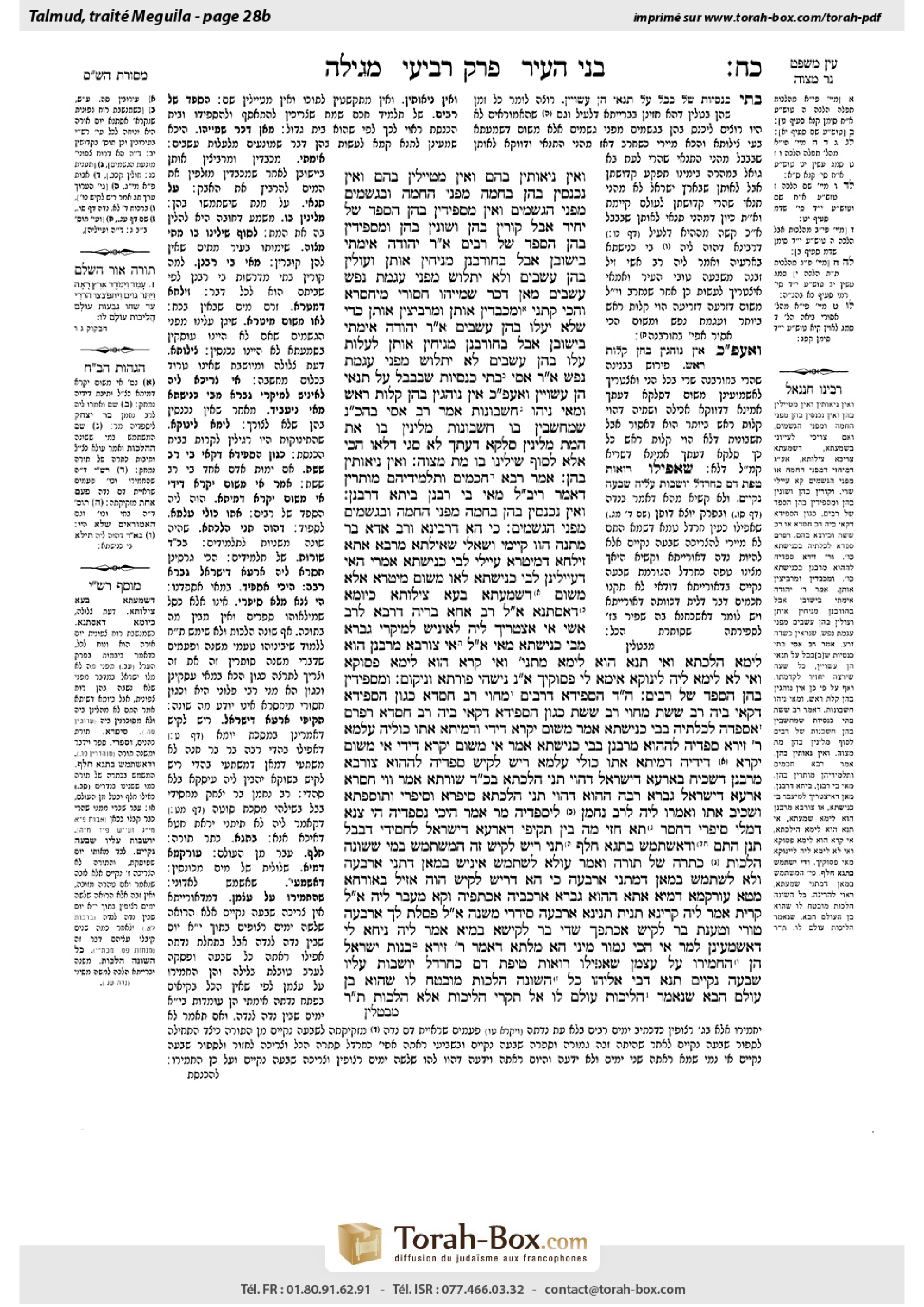
This page of Megillah includes the Aramaic text, an English translation and an AI-generated French translation, alongside the scan above.
מגילה כ״ח ב · Aramaic and Hebrew text
וְאֵין נֵיאוֹתִין בָּהֶם, וְאֵין מְטַיְּילִין בָּהֶם, וְאֵין נִכְנָסִין בָּהֶן בַּחַמָּה מִפְּנֵי הַחַמָּה, וּבַגְּשָׁמִים מִפְּנֵי הַגְּשָׁמִים. וְאֵין מַסְפִּידִין בָּהֶן הֶסְפֵּד שֶׁל יָחִיד. אֲבָל קוֹרִין בָּהֶן, וְשׁוֹנִין בָּהֶן, וּמַסְפִּידִין בָּהֶן הֶסְפֵּד שֶׁל רַבִּים,
אָמַר רַבִּי יְהוּדָה: אֵימָתַי — בְּיִשּׁוּבָן, אֲבָל בְּחוּרְבָּנָן — מַנִּיחִין אוֹתָן וְעוֹלִין בָּהֶן עֲשָׂבִים, וְלֹא יִתְלוֹשׁ מִפְּנֵי עׇגְמַת נֶפֶשׁ.
עֲשָׂבִים מַאן דְּכַר שְׁמַיְיהוּ? חַסּוֹרֵי מִיחַסְּרָא וְהָכִי קָתָנֵי: וּמְכַבְּדִין אוֹתָן וּמַרְבִּיצִין אוֹתָן כְּדֵי שֶׁלֹּא יַעֲלוּ בָּהֶן עֲשָׂבִים. אָמַר רַבִּי יְהוּדָה: אֵימָתַי — בְּיִשּׁוּבָן, אֲבָל בְּחוּרְבָּנָן — מַנִּיחִין אוֹתָן לַעֲלוֹת. עָלוּ בָּהֶן עֲשָׂבִים — לֹא יִתְלוֹשׁ, מִפְּנֵי עׇגְמַת נֶפֶשׁ.
אָמַר רַב אַסִּי: בָּתֵּי כְנֵסִיּוֹת שֶׁבְּבָבֶל, עַל תְּנַאי הֵן עֲשׂוּיִין. וְאַף עַל פִּי כֵן, אֵין נוֹהֲגִין בָּהֶן קַלּוּת רֹאשׁ. וּמַאי נִיהוּ — חֶשְׁבּוֹנוֹת.
אָמַר רַב אַסִּי: בֵּית הַכְּנֶסֶת שֶׁמְּחַשְּׁבִין בּוֹ חֶשְׁבּוֹנוֹת — מְלִינִין בּוֹ אֶת הַמֵּת. מְלִינִין סָלְקָא דַעְתָּךְ? לָא סַגִּי דְּלָאו הָכִי? אֶלָּא, לְסוֹף שֶׁיָּלִינוּ בּוֹ מֵת מִצְוָה.
וְאֵין נֵיאוֹתִין בָּהֶן. אָמַר רָבָא: חֲכָמִים וְתַלְמִידֵיהֶם מוּתָּרִין, דְּאָמַר רַבִּי יְהוֹשֻׁעַ בֶּן לֵוִי: מַאי בֵּי רַבָּנַן — בֵּיתָא דְרַבָּנַן.
וְאֵין נִכְנָסִין בָּהֶן בַּחַמָּה מִפְּנֵי הַחַמָּה וּבַגְּשָׁמִים מִפְּנֵי הַגְּשָׁמִים. כִּי הָא דְּרָבִינָא וְרַב אַדָּא בַּר מַתְנָה הֲווֹ קָיְימִי וְשָׁאֲלִי שְׁאֵילְתָּא מֵרָבָא, אֲתָא זִילְחָא דְמִיטְרָא, עָיְילִי לְבֵי כְנִישְׁתָּא אָמְרִי: הַאי דְּעָיְילִינַן לְבֵי כְנִישְׁתָּא לָאו מִשּׁוּם מִיטְרָא, אֶלָּא מִשּׁוּם דִּשְׁמַעְתָּא בָּעֲיָא צִילּוּתָא כְּיוֹמָא דְאִסְתָּנָא.
אֲמַר לֵיהּ רַב אַחָא בְּרֵיהּ דְּרָבָא לְרַב אָשֵׁי: אִי אִצְטְרִיךְ לֵיהּ לְאִינִישׁ לְמִיקְרֵי גַּבְרָא מִבֵּי כְנִישְׁתָּא, מַאי? אֲמַר לֵיהּ: אִי צוּרְבָּא מֵרַבָּנַן הוּא — לֵימָא הִלְכְתָא, וְאִי תַּנָּא הוּא — לֵימָא מַתְנִיתִין, וְאִי קָרָא הוּא — לֵימָא פְּסוּקָא. וְאִי לָא, לֵימָא לֵיהּ לְיָנוֹקָא: אֵימָא לִי פְּסוּקָיךְ. אִי נָמֵי, נִישְׁהֵי פּוּרְתָּא וְנֵיקוּם.
וּמַסְפִּידִין בָּהֶן הֶסְפֵּד שֶׁל רַבִּים. הֵיכִי דָּמֵי הֶסְפֵּידָא דְרַבִּים? מַחְוֵי רַב חִסְדָּא: כְּגוֹן הֶסְפֵּידָא דְּקָאֵי בֵּיהּ רַב שֵׁשֶׁת. מַחְוֵי רַב שֵׁשֶׁת: כְּגוֹן הֶסְפֵּידָא דְּקָאֵי בֵּיהּ רַב חִסְדָּא.
רַפְרָם אַסְפְּדַהּ לְכַלְּתֵיהּ בְּבֵי כְנִישְׁתָּא, אָמַר: מִשּׁוּם יְקָרָא דִּידִי וּדְמִיתָא אָתוּ כּוּלֵּיהּ עָלְמָא. רַבִּי זֵירָא סַפְדֵיהּ לְהָהוּא מֵרַבָּנַן בְּבֵי כְנִישְׁתָּא, אֲמַר: אִי מִשּׁוּם יְקָרָא דִּידִי, אִי מִשּׁוּם יְקָרָא (דִּידֵיהּ) דְּמִיתָא, אָתוּ כּוּלֵּי עָלְמָא.
רֵישׁ לָקִישׁ סַפְדֵיהּ לְהָהוּא צוּרְבָּא מֵרַבָּנַן דִּשְׁכִיחַ בְּאַרְעָא דְיִשְׂרָאֵל דַּהֲוָה תָּנֵי הִלְכָתָא בְּעֶשְׂרִים וְאַרְבַּע שׁוּרָתָא, אֲמַר: וַוי חָסְרָא אַרְעָא דְיִשְׂרָאֵל גַּבְרָא רַבָּה.
הָהוּא דַּהֲוָה תָּנֵי הִלְכְתָא סִיפְרָא וְסִיפְרֵי וְתוֹסֶפְתָּא וּשְׁכֵיב, אֲתוֹ וַאֲמַרוּ לֵיהּ לְרַב נַחְמָן: לִיסְפְּדֵיהּ מָר! אֲמַר: הֵיכִי נִסְפְּדֵיהּ? הֵי צַנָּא דִּמְלֵי סִיפְרֵי דַּחֲסַר?!
תָּא חֲזִי מָה בֵּין תַּקִּיפֵי דְּאַרְעָא דְיִשְׂרָאֵל לַחֲסִידֵי דְבָבֶל.
תְּנַן הָתָם: וּדְאִשְׁתַּמַּשׁ בְּתָגָא — חָלֵף. תָּנֵי רֵישׁ לָקִישׁ: זֶה הַמִּשְׁתַּמֵּשׁ בְּמִי שֶׁשּׁוֹנֶה הֲלָכוֹת כִּתְרָהּ שֶׁל תּוֹרָה.
וְאָמַר עוּלָּא: לִשְׁתַּמַּשׁ אִינִישׁ בְּמַאן דְּתָנֵי אַרְבְּעָה, וְלָא לִשְׁתַּמַּשׁ בְּמַאן דְּמַתְנֵי אַרְבְּעָה. כִּי הָא דְּרֵישׁ לָקִישׁ הֲוָה אָזֵיל בְּאוֹרְחָא מְטָא עוּרְקְמָא דְמַיָּא, אֲתָא הָהוּא גַּבְרָא אַרְכְּבֵיהּ אַכַּתְפֵּיהּ וְקָא מְעַבַּר לֵיהּ. אֲמַר לֵיהּ: קְרֵית? אֲמַר לֵיהּ: קָרֵינָא. תְּנֵית? תָּנֵינָא אַרְבָּעָה סִידְרֵי מִשְׁנָה. אֲמַר לֵיהּ: פְּסַלְתְּ לָךְ אַרְבְּעָה טוּרֵי וְטָעֲנַתְּ בַּר לָקִישׁ אַכַּתְפָּךְ?! שְׁדִי בַּר לָקִישָׁא בְּמַיָּא!
אֲמַר לֵיהּ: נִיחָא לִי דַּאֲשַׁמְּעֵיהּ לְמָר. אִי הָכִי, גְּמוֹר מִינִּי הָא מִלְּתָא דְּאָמַר רַבִּי זֵירָא: בְּנוֹת יִשְׂרָאֵל הֵן הֶחֱמִירוּ עַל עַצְמָן שֶׁאֲפִילּוּ רוֹאוֹת טִיפַּת דָּם כְּחַרְדָּל יוֹשְׁבוֹת עָלָיו שִׁבְעָה נְקִיִּים.
תָּנָא דְּבֵי אֵלִיָּהוּ: כׇּל הַשּׁוֹנֶה הֲלָכוֹת, מוּבְטָח לוֹ שֶׁהוּא בֶּן עוֹלָם הַבָּא, שֶׁנֶּאֱמַר: ״הֲלִיכוֹת עוֹלָם לוֹ״, אַל תִּקְרֵי ״הֲלִיכוֹת״ אֶלָּא ״הֲלָכוֹת״.
תָּנוּ רַבָּנַן:
Megillah 28b · English translation
and one may not adorn oneself inside them; nor may one wander about inside them; nor may one enter them in the sun for protection from the sun, or in the rain to find shelter from the rain; nor may one offer a eulogy inside them for an individual, which is a private event. However, one may read the Bible inside them, and one may study halakhot inside them, and one may offer a eulogy inside them for a Torah scholar, if the public attends the eulogy.
Rabbi Yehuda said: When does this apply? When the synagogues are occupied by the people using them. But when they are in a state of ruin, they should be left alone so that grass will sprout up inside them. And that grass should not be picked and removed, due to the anguish that it will bring to those who see it. It will remind them of the disrepair of the synagogue and the need to rebuild it.
The Gemara asks: Why did Rabbi Yehuda discuss the halakha about grass? Who mentioned anything about it? The Gemara explains: The text of the baraita is incomplete and is teaching the following: And among the other things that may be done in synagogues, they should also be sure to sweep them and to sprinkle their floors with water, in order that grass not sprout up in them. Rabbi Yehuda said: When does this apply? When the synagogues are occupied by the people using them, but when they are in a state of ruin, they should be left alone so that grass will sprout up inside them. If grass did sprout up, it should not be removed, due to the anguish that this will bring to those who see it.
Rav Asi said: Synagogues in Babylonia are built from the outset with a stipulation that they not have the full sanctity of a synagogue, in order that it be permitted to use them for the community’s general needs. But nevertheless, one should not act inside them with frivolity. The Gemara explains: What is meant by this? One should not make business calculations in a synagogue.
Rav Asi said: With regard to a synagogue in which people make business calculations, they will eventually keep a corpse inside it overnight. The Gemara questions the wording of this dictum: Can it really enter your mind to say that they will ever actually keep a corpse inside it overnight? Could it really be that there will not be any other alternative? Rather, Rav Asi means that as a punishment for acting with frivolity people in the community will die, including those who have no family, and so ultimately they will have to keep a corpse with no one to bury it [met mitzva] overnight in the synagogue.
§ The baraita taught: And one may not adorn oneself inside them. Rava said: The prohibition applies only to laypeople, but Torah scholars and their disciples are permitted to do so, as Rabbi Yehoshua ben Levi said: What is the meaning of the term: Bei of the Sages, which is used to describe a study hall? It is a shortened form of house [beita] of the Sages. In order to facilitate the constant presence of the Torah scholars in the study hall, it is permitted for them to use the hall as though it were their home.
The baraita continued: And nor may one enter them in the sun for protection from the sun, or in the rain to find shelter from the rain. The Gemara explains: This is similar to that case of Ravina and Rav Adda bar Mattana. They were standing and asking a question of Rava, when a shower [zilḥa] of rain began to fall upon them. They all entered the synagogue, saying: Our having entered the synagogue is not due to the rain, that we stay dry; rather, it is due to the fact that the halakha we were discussing requires clarity like the day the north wind [istena] blows and the sky is perfectly clear. Therefore, we are entering the synagogue for the sake of studying Torah, which is certainly permitted.
Rav Aḥa, son of Rava, said to Rav Ashi: If a person needs to summon an individual from inside a synagogue, what should he do, since it is not permitted to enter a synagogue just for that purpose? Rav Ashi said to him: If he is a young Torah scholar, let him recite a halakha upon entering the synagogue; and if he is a tanna who memorizes large numbers of mishnayot, let him recite various mishnayot; and if he is an expert in the Bible, let him recite a verse; and if he is not able to do even this, let him say to a child: Recite for me a verse that you have learned today. Alternatively, he should remain in the synagogue for a short time and only afterward stand up and leave.
The baraita continues: And one may offer a eulogy inside them for a Torah scholar if the public attends the eulogy. The Gemara asks: What are the circumstances of a eulogy for the public? Rav Ḥisda depicted a case: For example, a eulogy for a Torah scholar at which Rav Sheshet is present. Owing to his presence, many people will come. Rav Sheshet himself depicted another case: For example, a eulogy at which Rav Ḥisda is present.
The Gemara offers another example: Rafram once eulogized his daughter-in-law inside a synagogue. He said: Due to my honor and the honor of the deceased, everyone will come to the eulogy. It will consequently be a public event, and it is therefore permitted to hold it in a synagogue. Similarly, Rabbi Zeira once eulogized a certain Sage inside a synagogue. He said: Whether due to my honor, or whether due to the honor of the deceased, everyone will come to the eulogy.
Reish Lakish once eulogized a certain young Torah scholar who was frequently present in Eretz Yisrael and who used to study halakha in the twenty-fourth row of the study hall. He sat so far back because he was not one of the principal scholars. Nevertheless, when he died, Reish Lakish said: Alas, Eretz Yisrael has lost a great man.
In contrast, there was a certain man who used to study halakha, the Sifra, and the Sifrei, and the Tosefta, and he died. People came and said to Rav Naḥman: Let the Master eulogize him. He said to them: How can I eulogize him? Should I say: Alas, a basket filled with books is lost? This would not be true. Although the man studied many areas of Torah, he was not proficient in them.
The Gemara compares the conduct of Reish Lakish in Eretz Yisrael to that of Rav Naḥman in Babylonia. Come and see what the difference is between the harsh scholars of Eretz Yisrael and the saintly ones of Babylonia. Although Reish Lakish was known for his harsh nature, he was still more respectful than Rav Naḥman, who was known for his saintliness.
We learned in a mishna there (Avot 1:13): And one who makes use of the crown [taga] of Torah learning will perish from the world. Reish Lakish taught: This is referring to one who allows himself to be served by one who studies halakhot, which is the crown of the Torah.
And Ulla said: It is better that a person should be served by one who studies four orders of the Mishna, and he should not allow himself to be served by one who teaches to others four orders of the Mishna, as in that case of Reish Lakish. He was traveling along the road when he reached a deep puddle of water. A certain man came and placed him upon his shoulders and began transferring him to the other side. Reish Lakish said to him: Have you read the Bible? He said to him: I have read it. He then asked: Have you studied the Mishna? He answered him: I have studied four orders of the Mishna. Reish Lakish then said to him: You have hewn these four mountains and yet you bear the weight of the son of Lakish upon your shoulders? It is inappropriate for you to carry me; throw the son of Lakish into the water.
The man said to Reish Lakish: It is pleasing for me to serve the Master in this way. Reish Lakish said to him: If so, learn from me this matter that Rabbi Zeira said. In this way you will be considered my disciple, and it will then be appropriate for you to serve me. Jewish women were strict upon themselves in that even if they see a spot of menstrual blood that is only the size of a mustard seed they wait on its account seven clean days before immersing themselves in a ritual bath to purify themselves.
The school of Eliyahu taught: Anyone who studies halakhot every day, he is guaranteed that he is destined for the World-to-Come, as it is stated: “His ways [halikhot] are eternal” (Habakkuk 3:6): Do not read the verse as halikhot [ways]; rather, read it as halakhot. Consequently, the verse indicates that the study of the halakhot brings one to eternal life.
The Sages taught in a baraita:
Megillah 28b · Traduction française (IA)
et on ne doit pas s’y parer ; on ne doit pas non plus s’y promener ; on ne doit pas y entrer quand il fait soleil pour s’en protéger, ni quand il pleut pour s’abriter de la pluie ; on ne doit pas non plus y prononcer l’éloge funèbre d’un particulier, car il s’agit d’un événement privé. En revanche, on peut y lire la Bible, y étudier des halakhot et y prononcer l’éloge funèbre d’un érudit en Torah si le public y assiste.
Rabbi Yehouda a dit : Dans quels cas cela s’applique-t-il ? Lorsque les synagogues sont utilisées par leurs fidèles. Mais lorsqu’elles sont en ruine, il faut les laisser à l’abandon afin que l’herbe y pousse. Il ne faut pas arracher cette herbe, car cela causerait de la peine à ceux qui la verraient. Elle leur rappellerait le délabrement de la synagogue et la nécessité de la reconstruire.
La Guemara demande : Pourquoi Rabbi Yehouda a-t-il parlé de la halakha concernant l’herbe ? Qui en avait fait mention ? La Guemara explique : Le texte de la baraïta est incomplet et enseigne ce qui suit : parmi les autres choses que l’on peut faire dans les synagogues, il faut aussi veiller à les balayer et à arroser leur sol afin que l’herbe n’y pousse pas. Rabbi Yehouda a dit : Dans quels cas cela s’applique-t-il ? Lorsque les synagogues sont utilisées par leurs fidèles ; mais lorsqu’elles sont en ruine, il faut les laisser à l’abandon afin que l’herbe y pousse. Si de l’herbe y a poussé, il ne faut pas l’arracher, car cela causerait de la peine à ceux qui la verraient.
Rav Assi a dit : En Babylonie, les synagogues sont construites dès le départ sous réserve qu’elles n’aient pas toute la sainteté d’une synagogue, afin qu’il soit permis de les utiliser pour les besoins généraux de la communauté. Néanmoins, on ne doit pas s’y comporter avec frivolité. La Guemara explique : Qu’est-ce que cela signifie ? On ne doit pas y faire de calculs commerciaux.
Rav Assi a dit : Dans une synagogue où l’on fait des calculs commerciaux, il arrivera qu’on y garde un cadavre pendant la nuit. La Guemara remet en question la formulation de cet enseignement : Peut-on vraiment imaginer qu’on y garde un cadavre pendant la nuit ? Se pourrait-il qu’il n’existe aucune autre possibilité ? Rav Assi veut plutôt dire qu’en punition de leur comportement frivole, des membres de la communauté mourront, y compris des personnes sans famille ; on devra donc finalement garder pendant la nuit dans la synagogue un cadavre que personne ne pourra enterrer [met mitsva].
§ La baraïta a enseigné : « On ne doit pas s’y parer. » Rava a dit : L’interdiction ne concerne que les gens du commun ; les érudits en Torah et leurs disciples en ont le droit, comme l’a dit Rabbi Yehoshoua ben Lévi : Que signifie le terme Bei des Sages, utilisé pour désigner une maison d’étude ? C’est la forme abrégée de « maison [beita] des Sages ». Pour permettre aux érudits en Torah d’être constamment présents dans la maison d’étude, il leur est permis de l’utiliser comme s’il s’agissait de leur maison.
La baraïta poursuit : « On ne doit pas y entrer quand il fait soleil pour s’en protéger, ni quand il pleut pour s’abriter de la pluie. » La Guemara explique : Cela ressemble au cas de Ravina et de Rav Adda bar Mattana. Ils étaient debout et posaient une question à Rava lorsqu’une averse [zilḥa] se mit à tomber sur eux. Ils entrèrent tous dans la synagogue en disant : « Si nous sommes entrés dans la synagogue, ce n’est pas à cause de la pluie, pour rester au sec ; c’est parce que la halakha dont nous parlions exige une clarté semblable à celle d’un jour où souffle le vent du nord [istena] et où le ciel est parfaitement dégagé. Nous entrons donc dans la synagogue pour étudier la Torah, ce qui est certainement permis. »
Rav Aḥa, fils de Rava, dit à Rav Ashi : Si quelqu’un doit appeler une personne qui se trouve dans une synagogue, que doit-il faire, puisqu’il n’est pas permis d’entrer dans une synagogue dans ce seul but ? Rav Ashi lui répondit : S’il s’agit d’un jeune érudit en Torah, qu’il récite une halakha en entrant dans la synagogue ; s’il s’agit d’un tanna qui mémorise un grand nombre de michnayot, qu’il récite diverses michnayot ; s’il connaît bien la Bible, qu’il récite un verset ; et s’il n’est pas capable de faire même cela, qu’il dise à un enfant : « Récite-moi un verset que tu as appris aujourd’hui. » Autrement, il doit rester un court moment dans la synagogue, puis se lever et sortir.
La baraïta poursuit : « On peut prononcer dans une synagogue l’éloge funèbre d’un érudit en Torah si le public y assiste. » La Guemara demande : Dans quelles circonstances l’éloge funèbre est-il destiné au public ? Rav Ḥisda a décrit un cas : par exemple, celui d’un érudit en Torah auquel Rav Sheshet assiste. Grâce à sa présence, beaucoup de gens viendront. Rav Sheshet lui-même a décrit un autre cas : par exemple, un éloge funèbre auquel Rav Ḥisda assiste.
La Guemara donne un autre exemple : Rafram prononça un jour dans une synagogue l’éloge funèbre de sa belle-fille. Il dit : « Par égard pour moi et pour la défunte, tout le monde viendra à l’éloge funèbre. » Ce sera donc un événement public, et il est par conséquent permis de le tenir dans une synagogue. De même, Rabbi Zeira prononça un jour dans une synagogue l’éloge funèbre d’un certain Sage. Il dit : « Que ce soit par égard pour moi ou pour le défunt, tout le monde viendra à l’éloge funèbre. »
Reish Lakish prononça un jour l’éloge funèbre d’un jeune érudit en Torah qui était souvent présent en Eretz Yisrael et qui étudiait la halakha au vingt-quatrième rang de la maison d’étude. Il était assis si loin à l’arrière parce qu’il ne faisait pas partie des principaux érudits. Pourtant, à sa mort, Reish Lakish dit : « Hélas, Eretz Yisrael a perdu un grand homme. »
À l’inverse, un certain homme étudiait la halakha, le Sifra, le Sifrei et la Tossefta, puis il mourut. Des gens vinrent dire à Rav Naḥman : « Que le Maître prononce son éloge funèbre. » Il leur répondit : « Comment pourrais-je prononcer son éloge funèbre ? Devrais-je dire : “Hélas, un panier rempli de livres a disparu” ? Ce ne serait pas vrai. Bien que cet homme ait étudié de nombreux domaines de la Torah, il ne les maîtrisait pas. »
La Guemara compare la conduite de Reish Lakish en Eretz Yisrael à celle de Rav Naḥman en Babylonie. Voyez quelle différence il y a entre les érudits austères d’Eretz Yisrael et les hommes pieux de Babylonie. Bien que Reish Lakish fût connu pour son caractère austère, il se montra néanmoins plus respectueux que Rav Naḥman, connu pour sa piété.
Nous avons appris dans une Michna, là-bas (Avot 1:13) : « Celui qui se sert de la couronne [taga] de l’étude de la Torah disparaîtra du monde. » Reish Lakish enseignait que cela désigne celui qui se fait servir par quelqu’un qui étudie les halakhot, lesquelles constituent la couronne de la Torah.
Et Oula a dit : Il vaut mieux qu’une personne se fasse servir par quelqu’un qui étudie quatre ordres de la Michna plutôt que par quelqu’un qui enseigne à d’autres quatre ordres de la Michna, comme dans le cas de Reish Lakish. Celui-ci voyageait sur la route lorsqu’il arriva à une profonde flaque d’eau. Un homme vint, le prit sur ses épaules et se mit à le transporter jusqu’à l’autre rive. Reish Lakish lui demanda : « As-tu lu la Bible ? » Il lui répondit : « Je l’ai lue. » Il lui demanda ensuite : « As-tu étudié la Michna ? » Il lui répondit : « J’ai étudié quatre ordres de la Michna. » Reish Lakish lui dit alors : « Tu as taillé ces quatre montagnes, et pourtant tu portes sur tes épaules le poids du fils de Lakish ? Il ne convient pas que tu me portes ; jette le fils de Lakish dans l’eau. »
L’homme dit à Reish Lakish : « Cela me plaît de servir le Maître de cette manière. » Reish Lakish lui dit : « Dans ce cas, apprends de moi cet enseignement de Rabbi Zeira. Ainsi, tu seras considéré comme mon disciple, et il sera alors convenable que tu me serves. » Les femmes juives observaient strictement cette pratique : même si elles voyaient une tache de sang menstruel de la taille d’un grain de moutarde seulement, elles attendaient à cause d’elle sept jours de pureté avant de s’immerger dans un bain rituel pour se purifier.
L’école d’Eliyahou a enseigné : Quiconque étudie des halakhot chaque jour est assuré d’être destiné au Monde futur, comme il est dit : « Ses voies [halikhot] sont éternelles » (Habacuc 3:6). Ne lis pas le verset comme halikhot [voies] ; lis-le plutôt comme halakhot. Par conséquent, le verset indique que l’étude des halakhot conduit à la vie éternelle.
Les Sages ont enseigné dans une baraïta :
Traduction française générée par IA à partir de l’édition anglaise de Sefaria. Vérifie toujours un passage avec le texte source.
Text from Sefaria: William Davidson Edition - Vocalized Aramaic (CC BY NC); William Davidson Edition - English (CC BY NC).