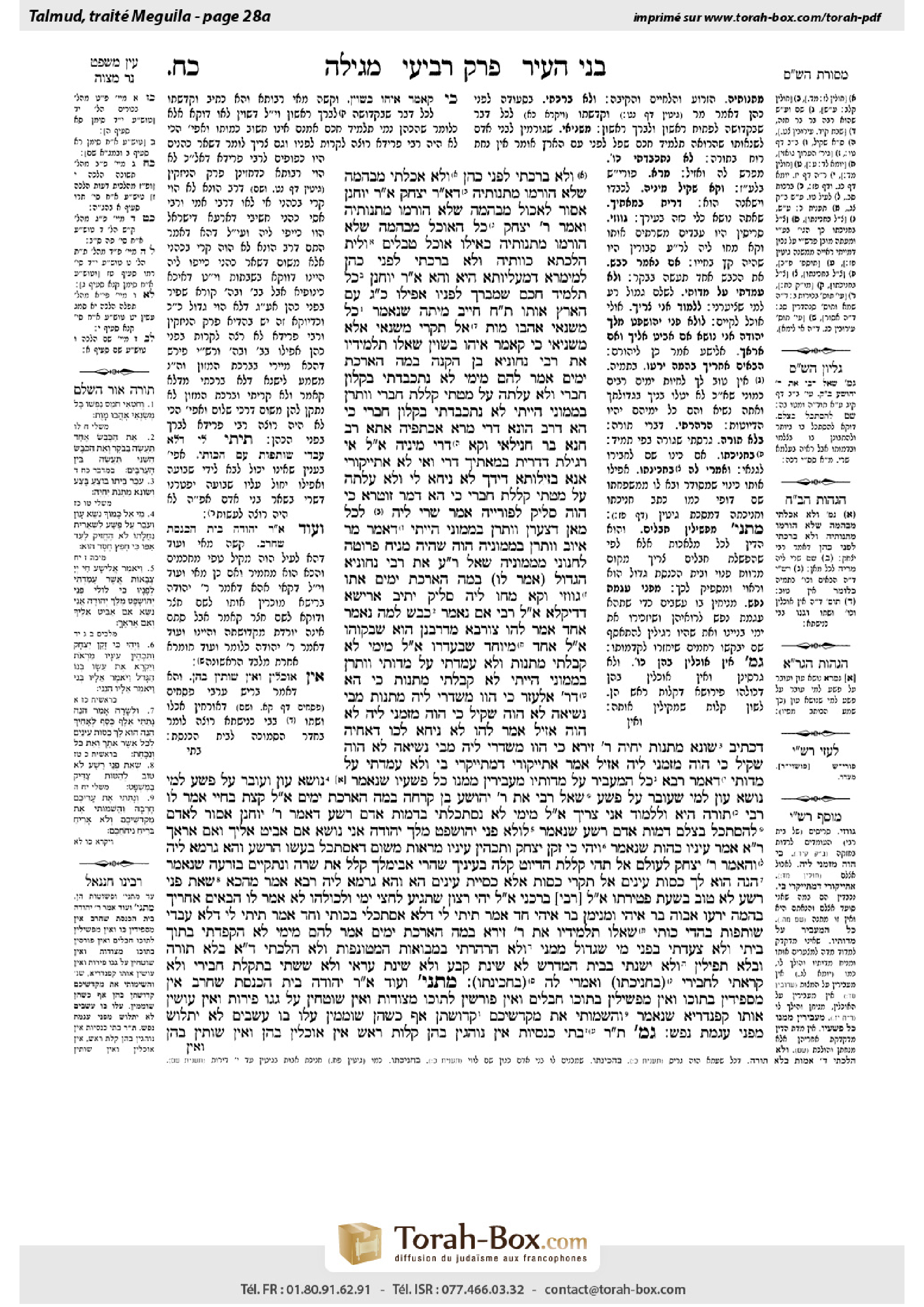
Megillah 28a: Talmud study for Daf Yomi
Daf Yomi is the daily study of one Talmud folio. Explore 37 tractates with scans, Hebrew text, Sefaria English and AI-generated French translations where annotated.
Passage selection and English or AI-generated French translation are available where the scan has annotations. Daf Study is independent of Torah-Box and Sefaria.
Browse Megillah · מגילה · All tractatesMegillah 28a text and translations
This page of Megillah includes the Aramaic text, an English translation and an AI-generated French translation, alongside the scan above.
מגילה כ״ח א · Aramaic and Hebrew text
וְלֹא בֵּרַכְתִּי לִפְנֵי כֹהֵן, וְלֹא אָכַלְתִּי מִבְּהֵמָה שֶׁלֹּא הוּרְמוּ מַתְּנוֹתֶיהָ.
דְּאָמַר רַבִּי יִצְחָק אָמַר רַבִּי יוֹחָנָן: אָסוּר לֶאֱכוֹל מִבְּהֵמָה שֶׁלֹּא הוּרְמוּ מַתְּנוֹתֶיהָ. וְאָמַר רַבִּי יִצְחָק: כׇּל הָאוֹכֵל מִבְּהֵמָה שֶׁלֹּא הוּרְמוּ מַתְּנוֹתֶיהָ, כְּאִילּוּ אוֹכֵל טְבָלִים. וְלֵית הִלְכְתָא כְּווֹתֵיהּ.
וְלֹא בֵּרַכְתִּי לִפְנֵי כֹהֵן,
לְמֵימְרָא דִּמְעַלְּיוּתָא הִיא? וְהָא אָמַר רַבִּי יוֹחָנָן: כׇּל תַּלְמִיד חָכָם שֶׁמְּבָרֵךְ לְפָנָיו, אֲפִילּוּ כֹּהֵן גָּדוֹל עַם הָאָרֶץ — אוֹתוֹ תַּלְמִיד חָכָם חַיָּיב מִיתָה, שֶׁנֶּאֱמַר: ״כׇּל מְשַׂנְאַי אָהֲבוּ מָוֶת״. אַל תִּקְרֵי ״מְשַׂנְאַי״, אֶלָּא ״מַשְׂנִיאַי״.
כִּי קָאָמַר אִיהוּ, בְּשָׁוִין.
שָׁאֲלוּ תַּלְמִידָיו אֶת רַבִּי נְחוּנְיָא בֶּן הַקָּנָה: בַּמֶּה הֶאֱרַכְתָּ יָמִים? אָמַר לָהֶם: מִיָּמַי לֹא נִתְכַּבַּדְתִּי בִּקְלוֹן חֲבֵרִי, וְלֹא עָלְתָה עַל מִטָּתִי קִלְלַת חֲבֵרִי, וּוַתְּרָן בְּמָמוֹנִי הָיִיתִי.
לֹא נִתְכַּבַּדְתִּי בִּקְלוֹן חֲבֵרִי — כִּי הָא דְּרַב הוּנָא דָּרֵי מָרָא אַכַּתְפֵּיהּ. אֲתָא רַב חָנָא בַּר חֲנִילַאי וְקָא דָרֵי מִינֵּיהּ. אֲמַר לֵיהּ: אִי רְגִילַתְּ דְּדָרֵית בְּמָאתָיךְ — דְּרִי, וְאִי לָא, אִתְיַיקּוֹרֵי אֲנָא בְּזִילוּתָא דִּידָךְ לָא נִיחָא לִי.
וְלֹא עָלְתָה עַל מִטָּתִי קִלְלַת חֲבֵרִי — כִּי הָא דְּמַר זוּטְרָא כִּי הֲוָה סָלֵיק לְפוּרְיֵיהּ, אֲמַר: שְׁרֵי לֵיהּ לְכׇל מַאן דְּצַעֲרָן.
וּוַתְּרָן בְּמָמוֹנִי הָיִיתִי — דְּאָמַר מָר: אִיּוֹב וַותְּרָן בְּמָמוֹנֵיהּ הֲוָה, שֶׁהָיָה מַנִּיחַ פְּרוּטָה לַחֶנְוָנִי מִמָּמוֹנֵיהּ.
שָׁאַל רַבִּי עֲקִיבָא אֶת רַבִּי נְחוּנְיָא הַגָּדוֹל (אָמַר לוֹ): בַּמֶּה הֶאֱרַכְתָּ יָמִים? אֲתוֹ גַּוּוֹזֵי וְקָא מָחוּ לֵיהּ. סְלֵיק, יְתֵיב אַרֵישָׁא דְּדִיקְלָא. אֲמַר לֵיהּ, רַבִּי: אִם נֶאֱמַר ״כֶּבֶשׂ״ לָמָּה נֶאֱמַר ״אֶחָד״? אָמַר לְהוּ: צוּרְבָּא מִדְּרַבָּנַן הוּא, שִׁבְקוּהוּ.
אֲמַר לֵיהּ: ״אֶחָד״ — מְיוּחָד שֶׁבְּעֶדְרוֹ.
אֲמַר לֵיהּ: מִיָּמַי לֹא קִבַּלְתִּי מַתָּנוֹת, וְלֹא עָמַדְתִּי עַל מִדּוֹתַי, וּוַתְּרָן בְּמָמוֹנִי הָיִיתִי.
לֹא קִבַּלְתִּי מַתָּנוֹת, כִּי הָא דְּרַבִּי אֶלְעָזָר כִּי הֲווֹ מְשַׁדְּרִי לֵיהּ מַתָּנוֹת מִבֵּי נְשִׂיאָה — לָא הֲוָה שָׁקֵיל. כִּי הֲוָה מְזַמְּנִי לֵיהּ — לָא הֲוָה אָזֵיל, אֲמַר לְהוּ: לָא נִיחָא לְכוּ דְּאֶחְיֶה, דִּכְתִיב: ״שׂוֹנֵא מַתָּנוֹת יִחְיֶה״. רַבִּי זֵירָא כִּי הֲווֹ מְשַׁדְּרִי לֵיהּ מִבֵּי נְשִׂיאָה — לָא הֲוָה שָׁקֵיל. כִּי הֲוָה מְזַמְּנִי לֵיהּ — אָזֵיל. אֲמַר: אִתְיַיקּוֹרֵי דְּמִתְיַיקְּרִי בִּי.
וְלֹא עָמַדְתִּי עַל מִדּוֹתַי — דְּאָמַר רָבָא: כׇּל הַמַּעֲבִיר עַל מִדּוֹתָיו — מַעֲבִירִין מִמֶּנּוּ כׇּל פְּשָׁעָיו, שֶׁנֶּאֱמַר: ״נוֹשֵׂא עָוֹן וְעוֹבֵר עַל פֶּשַׁע״. לְמִי נוֹשֵׂא עָוֹן — לְמִי שֶׁעוֹבֵר עַל פֶּשַׁע.
שָׁאַל רַבִּי אֶת רַבִּי יְהוֹשֻׁעַ בֶּן קׇרְחָה: בַּמָּה הֶאֱרַכְתָּ יָמִים? אָמַר לוֹ: קַצְתָּ בְּחַיַּי? אָמַר לוֹ: רַבִּי, תּוֹרָה הִיא וְלִלְמוֹד אֲנִי צָרִיךְ. אָמַר לוֹ: מִיָּמַי לֹא נִסְתַּכַּלְתִּי בִּדְמוּת אָדָם רָשָׁע. דְּאָמַר רַבִּי יוֹחָנָן: אָסוּר לְאָדָם לְהִסְתַּכֵּל בְּצֶלֶם דְּמוּת אָדָם רָשָׁע, שֶׁנֶּאֱמַר: ״לוּלֵא פְּנֵי יְהוֹשָׁפָט מֶלֶךְ יְהוּדָה אֲנִי נוֹשֵׂא אִם אַבִּיט אֵלֶיךָ וְאִם אֶרְאֶךָּ״.
רַבִּי אֶלְעָזָר אָמַר: עֵינָיו כֵּהוֹת, שֶׁנֶּאֱמַר: ״וַיְהִי כִּי זָקֵן יִצְחָק וַתִּכְהֶיןָ עֵינָיו מֵרְאוֹת״, מִשּׁוּם דְּאִסְתַּכַּל בְּעֵשָׂו הָרָשָׁע.
וְהָא גְּרַמָא לֵיהּ? וְהָאָמַר רַבִּי יִצְחָק: לְעוֹלָם אַל תְּהִי קִלְלַת הֶדְיוֹט קַלָּה בְּעֵינֶיךָ, שֶׁהֲרֵי אֲבִימֶלֶךְ קִלֵּל אֶת שָׂרָה, וְנִתְקַיֵּים בְּזַרְעָהּ, שֶׁנֶּאֱמַר: ״הִנֵּה הוּא לָךְ כְּסוּת עֵינַיִם״: אַל תִּקְרֵי ״כְּסוּת״, אֶלָּא ״כְּסִיַּית עֵינַיִם״!
הָא וְהָא גְּרַמָא לֵיהּ. רָבָא אָמַר, מֵהָכָא: ״שְׂאֵת פְּנֵי רָשָׁע לֹא טוֹב״.
בִּשְׁעַת פְּטִירָתוֹ, אָמַר לוֹ: [רַבִּי] בָּרְכֵנִי! אָמַר לוֹ: יְהִי רָצוֹן שֶׁתַּגִּיעַ לַחֲצִי יָמַי. וּלְכוּלְּהוּ לָא? אָמַר לוֹ: הַבָּאִים אַחֲרֶיךָ — בְּהֵמָה יִרְעוּ?!
אֲבוּהּ בַּר אִיהִי וּמִנְיָמִן בַּר אִיהִי, חַד אָמַר: תֵּיתֵי לִי דְּלָא אִסְתַּכַּלִי בְּגוֹי, וְחַד אָמַר: תֵּיתֵי לִי דְּלָא עֲבַדִי שׁוּתָּפוּת בַּהֲדֵי גּוֹי.
שָׁאֲלוּ תַּלְמִידָיו אֶת רַבִּי זֵירָא: בַּמָּה הֶאֱרַכְתָּ יָמִים? אָמַר לָהֶם: מִיָּמַי לֹא הִקְפַּדְתִּי בְּתוֹךְ בֵּיתִי, וְלֹא צָעַדְתִּי בִּפְנֵי מִי שֶׁגָּדוֹל מִמֶּנִּי, וְלֹא הִרְהַרְתִּי בִּמְבוֹאוֹת הַמְטוּנָּפוֹת, וְלֹא הָלַכְתִּי אַרְבַּע אַמּוֹת בְּלֹא תּוֹרָה וּבְלֹא תְּפִילִּין, וְלֹא יָשַׁנְתִּי בְּבֵית הַמִּדְרָשׁ לֹא שֵׁינַת קֶבַע וְלֹא שֵׁינַת עֲרַאי, וְלֹא שַׂשְׂתִּי בְּתַקָּלַת חֲבֵירִי, וְלֹא קָרָאתִי לַחֲבֵירִי (בַּחֲנִיכָתוֹ), וְאָמְרִי לַהּ: (בַּחֲכִינָתוֹ).
מַתְנִי׳ וְעוֹד אָמַר רַבִּי יְהוּדָה: בֵּית הַכְּנֶסֶת שֶׁחָרַב — אֵין מַסְפִּידִין בְּתוֹכוֹ, וְאֵין מַפְשִׁילִין בְּתוֹכוֹ חֲבָלִים, וְאֵין פּוֹרְשִׂין לְתוֹכוֹ מְצוּדוֹת, וְאֵין שׁוֹטְחִין עַל גַּגּוֹ פֵּירוֹת, וְאֵין עוֹשִׂין אוֹתוֹ קַפֶּנְדַּרְיָא,
שֶׁנֶּאֱמַר: ״וַהֲשִׁמּוֹתִי אֶת מִקְדְּשֵׁיכֶם״ — קְדוּשָּׁתָן אַף כְּשֶׁהֵן שׁוֹמְמִין.
עָלוּ בּוֹ עֲשָׂבִים לֹא יִתְלוֹשׁ, מִפְּנֵי עׇגְמַת נֶפֶשׁ.
גְּמָ׳ תָּנוּ רַבָּנַן: בָּתֵּי כְנֵסִיּוֹת אֵין נוֹהֲגִין בָּהֶן קַלּוּת רֹאשׁ. אֵין אוֹכְלִין בָּהֶן, וְאֵין שׁוֹתִין בָּהֶן,
Megillah 28a · English translation
And I never recited Grace after Meals in the presence of a priest, but rather I gave him the privilege to lead. And I never ate from an animal whose priestly portions, i.e., the foreleg, the jaw, and the maw, had not already been set aside.
Another example of Rabbi Perida’s meticulous behavior is based on that which Rabbi Yitzḥak said that Rabbi Yoḥanan said: It is prohibited to eat meat from an animal whose priestly portions have not been set aside. And Rabbi Yitzḥak said: Anyone who eats meat from an animal whose priestly portions have not been set aside is regarded as if he were eating untithed produce. The Gemara comments: And the halakha is not in accordance with his opinion. Rather, it is permitted to eat meat from such an animal. Nevertheless, Rabbi Perida acted stringently and did not eat from it.
The Gemara considers another of Rabbi Perida’s actions: He said: And I never blessed Grace after Meals in the presence of a priest, but rather I gave him the privilege to lead.
Is this to say that doing so is especially virtuous? But hasn’t Rabbi Yoḥanan said: Any Torah scholar who allows someone else to bless Grace after Meals in his presence, i.e., to lead for him, even if that person is a High Priest who is an ignoramus, then that Torah scholar is liable to receive the death penalty for belittling his own honor? This is as it is stated: “All those who hate me, love death” (Proverbs 8:36). Do not read it as “those who hate Me [mesan’ai],” rather read it as though it said: Those who make Me hated [masni’ai]. The honor due to a Torah scholar is representative of the honor of God in the world. Therefore, by belittling his own honor, he causes others to fail to respect God, which can ultimately develop into hate. If so, why did Rabbi Perida consider his behavior to be so deserving of praise?
The Gemara answers: When Rabbi Perida says this, he was speaking of people of equal stature. He was particular to honor the priesthood only when the priest was also a Torah scholar.
The Gemara discusses the fourth Sage who was blessed with longevity: Rabbi Neḥunya ben HaKana was once asked by his disciples: In the merit of which virtue were you blessed with longevity? He said to them: In all my days, I never attained veneration at the expense of my fellow’s degradation. Nor did my fellow’s curse ever go up with me upon my bed. If ever I offended someone, I made sure to appease him that day. Therefore, when I went to bed I knew that no one had any grievances against me. And I was always openhanded with my money.
The Gemara clarifies the meaning of his statement: Rabbi Neḥunya said: I never attained veneration at the expense of my fellow’s denigration. This is referring to conduct such as that of Rav Huna, who was carrying a hoe over his shoulder as he returned from his work. Rav Ḥana bar Ḥanilai came and, out of respect for his teacher, took the hoe from him to carry it for him. Rav Huna said to him: If you are accustomed to carry such objects in your own city, you may carry it; but if not, then for me to be venerated through your denigration is not pleasing for me.
Rabbi Neḥunya also said: Nor did I ever allow the resentment caused by my fellow’s curse to go up with me upon my bed. This is referring to conduct such as that of Mar Zutra. When he would go to bed at night, he would first say: I forgive anyone who has vexed me.
Lastly, Rabbi Neḥunya said: And I was always openhanded with my money. This is referring to conduct such as that which the Master said: Job was openhanded with his money, as he would always leave at least a peruta of his money with the shopkeeper. He never demanded the change from his transactions.
On a similar occasion, Rabbi Akiva asked Rabbi Neḥunya the Great; he said to him: In the merit of which virtue were you blessed with longevity? Rabbi Neḥunya’s attendants [gavzei] came and started beating Rabbi Akiva, for they felt that he was acting disrespectfully by highlighting Rabbi Neḥunya’s old age. Rabbi Akiva ran away from them, and he climbed up and sat upon the top of a date palm. From there, he said to Rabbi Neḥunya: My teacher, I have a question about the verse concerning the daily offering that states “one lamb” (Numbers 28:4). If it is stated “lamb” in the singular, why is it also stated “one”; isn’t this superfluous? Upon hearing Rabbi Akiva’s scholarly question, Rabbi Neḥunya said to his attendants: He is clearly a young Torah scholar, let him be.
Rabbi Neḥunya then addressed Rabbi Akiva’s questions. With regard to the second question, he said to him: The word “one” teaches that the lamb should be the unique one of its flock, i.e., only the best quality lamb should be used.
With regard to the original question, Rabbi Neḥunya said to him: In all my days I never accepted gifts. Nor was I ever inflexible by exacting a measure of retribution against those who wronged me. And I was always openhanded with my money.
The Gemara explains: I never accepted gifts; this is referring to conduct such as that of Rabbi Elazar. When they would send him gifts from the house of the Nasi, he would not take them, and when they would invite him, he would not go there, as he considered hospitality to be a type of gift. He would say to them: Is it not pleasing to you that I should live, as it is written: “He that hates gifts shall live” (Proverbs 15:27)? In contrast, it was reported about Rabbi Zeira that when they would send him gifts from the house of the Nasi, he would not accept them, but when they would invite him, he would go there. He said: They are honored by my presence; therefore my visiting is not considered like I am taking a gift from them.
He also said: Nor was I ever inflexible in exacting a measure of retribution against those who wronged me. This is referring to conduct such as that which Rava said: Anyone who overlooks exacting a measure of retribution against those who wronged him, all his transgressions are removed from him, as it is stated: “He pardons iniquity and overlooks transgression” (Micah 7:18), which is homiletically read as saying: For whom does He pardon iniquity? For he who overlooks transgressions that others have committed against him.
In a similar incident, Rabbi Yehuda HaNasi once asked Rabbi Yehoshua ben Korḥa: In the merit of which virtue were you blessed with longevity? He said to him: Why do you ask me, are you wearied of my long life? Rabbi Yehuda HaNasi said to him: My teacher, it is Torah and so I must learn it. Rabbi Yehoshua ben Korḥa said to him: In all my days I never gazed at the likeness of a wicked man, as Rabbi Yoḥanan said: It is prohibited for a person to gaze in the image of the likeness of a wicked man, as it is stated that the prophet Elisha said to Jehoram king of Israel: “Were it not that I regard the presence of Jehoshaphat, the king of Judea, I would not look toward you, nor see you” (II Kings 3:14).
Rabbi Elazar said: One who gazes at the likeness of an evil man, his eyes become dim, as it is stated: “And it came to pass, that when Isaac was old, and his eyes were dim so that he could not see” (Genesis 27:1). This happened because he gazed at the wicked Esau.
The Gemara asks: Did this cause Isaac’s blindness? Didn’t Rabbi Yitzḥak say: A curse of an ordinary person should not be lightly regarded in your eyes, because Abimelech cursed Sarah, and although he was not a righteous man, his curse was nevertheless fulfilled, albeit in her descendant. As it is stated that Abimelech said to Sarah with regard to the gift that he gave to Abraham: “Behold, it is for you a covering of the eyes” (Genesis 20:16). Do not read it as “a covering [kesut] of the eyes,” but rather read it as: A blindness [kesiat] of the eyes. Abimelech’s words were a veiled curse for Sarah to suffer from blindness. While she herself did not suffer, the curse was apparently fulfilled in the blindness of her son, Isaac.
According to Rabbi Yitzḥak, Abimelech’s curse was the cause of Isaac’s blindness, and it was not, as Rabbi Elazar suggested, the fact he gazed at Esau. The Gemara explains: Both this and that jointly caused it. Rava said: The prohibition against gazing at the likeness of a wicked person is derived from here: “It is not good to raise the face of the wicked” (Proverbs 18:5).
At the time of Rabbi Yehoshua ben Korḥa’s departure from this world, Rabbi Yehuda HaNasi said to him: My teacher, bless me. He said to him: May it be God’s will that you live to reach to half of my days. When Rabbi Yehuda HaNasi heard this, he asked in astonishment: Are you saying that to the entirety of your days I should not reach? Why? Rabbi Yehoshua ben Korḥa said to him: Shall those who come after you just tend cattle? If you live as long as me, your sons will never be able to succeed you in the position of Nasi. As such, they will never achieve greatness in Torah, and it will be as if they just tended cattle throughout their lives. It is therefore better that your life not be so prolonged, so that they have the opportunity to rise to eminence.
Avuh bar Ihi and Minyamin bar Ihi both spoke on this topic: One of them said: May a blessing come to me for I never gazed at a wicked gentile. And the other one said: May a blessing come to me for I never formed a partnership with a wicked gentile, so as not to have any association with a wicked person.
The Gemara presents a similar incident: Rabbi Zeira was once asked by his disciples: In the merit of which virtue were you blessed with longevity? He said to them: In all my days, I was never angry inside my house with members of my household who acted against my wishes. Nor did I ever walk ahead of someone who was a greater Torah scholar than me. Nor did I ever meditate upon words of Torah in filthy alleyways, as doing so is a disgrace to the Torah. Nor did I ever walk four cubits without meditating on words of Torah or without wearing phylacteries. Nor did I ever sleep in a study hall, neither a deep sleep or a brief nap. Nor did I ever rejoice when my fellow stumbled. Nor did I ever call my fellow by his derogatory nickname [ḥanikhato]. And some say that he said: I never called my fellow by his nickname [ḥakhinato], i.e., even one that is not derogatory.
MISHNA: And Rabbi Yehuda said further: A synagogue that fell into ruin still may not be used for a mundane purpose. Therefore, one may not eulogize in it. And nor may one stretch out and repair ropes in it. The wide expanse of the synagogue would have been particularly suitable for this. And nor may one spread animal traps within it. And nor may one spread out produce upon its roof to dry. And nor may one make it into a shortcut.
The halakha that a synagogue in disrepair still may not be used for mundane purposes is derived from a verse, as it is stated: “And I will bring desolation to your sanctuaries” (Leviticus 26:31). The fact that the word “sanctuaries” appears after the word “desolation” indicates that their sanctity remains upon them even when they are desolate.
However, if grass sprang up of its own accord in the ruined synagogue, although it is not befitting its sanctity, one should not pick it, due to the anguish that it will bring to those who see it. It will remind them of the disrepair of the synagogue and the need to rebuild it.
GEMARA: The Sages taught in a baraita: With regard to synagogues: One may not act inside them with frivolity. Therefore, one may not eat in them; nor may one drink in them;
Megillah 28a · Traduction française (IA)
Et je n’ai jamais récité le Birkat Hamazon en présence d’un prêtre ; je lui cédais plutôt l’honneur de diriger la récitation. Je n’ai jamais non plus mangé de la viande d’un animal dont les parts sacerdotales, c’est-à-dire la patte avant, la mâchoire et la caillette, n’avaient pas encore été prélevées.
Un autre exemple de la minutie de Rabbi Perida repose sur ce que Rabbi Yitzḥak a dit au nom de Rabbi Yoḥanan : il est interdit de manger la viande d’un animal dont les parts sacerdotales n’ont pas été prélevées. Rabbi Yitzḥak a également dit : quiconque mange la viande d’un animal dont les parts sacerdotales n’ont pas été prélevées est considéré comme s’il mangeait des produits non soumis à la dîme. La Guemara commente : la halakha ne suit pas son avis. Il est plutôt permis de manger la viande d’un tel animal. Néanmoins, Rabbi Perida agissait avec rigueur et n’en mangeait pas.
La Guemara examine un autre comportement de Rabbi Perida. Il dit : « Je n’ai jamais récité le Birkat Hamazon en présence d’un prêtre ; je lui cédais plutôt l’honneur de diriger la récitation. »
Cela signifie-t-il qu’agir ainsi est particulièrement méritoire ? Pourtant, Rabbi Yoḥanan n’a-t-il pas dit : tout érudit en Torah qui permet à quelqu’un d’autre de réciter le Birkat Hamazon en sa présence, c’est-à-dire de diriger la récitation à sa place, même si cette personne est un grand prêtre ignorant, mérite la peine de mort pour avoir rabaissé son propre honneur ? Comme il est dit : « Tous ceux qui me haïssent aiment la mort » (Proverbes 8,36). Ne lis pas « ceux qui me haïssent [mesan’ai] », mais lis plutôt comme s’il était écrit : « ceux qui me font haïr [masni’ai] ». L’honneur dû à un érudit en Torah représente l’honneur de Dieu dans le monde. Par conséquent, en rabaissant son propre honneur, il amène les autres à manquer de respect envers Dieu, ce qui peut finir par se transformer en haine. Si tel est le cas, pourquoi Rabbi Perida estimait-il que son comportement méritait tant d’éloges ?
La Guemara répond : lorsque Rabbi Perida dit cela, il parlait de personnes de même rang. Il veillait à honorer la prêtrise uniquement lorsque le prêtre était lui aussi un érudit en Torah.
La Guemara parle du quatrième Sage à qui la longévité fut accordée : Rabbi Neḥunya ben HaKana fut un jour interrogé par ses disciples : « En vertu de quelle qualité t’a-t-on accordé la longévité ? » Il leur répondit : « De toute ma vie, je n’ai jamais obtenu de considération aux dépens de l’humiliation de mon prochain. Jamais non plus la malédiction de mon prochain ne m’a accompagné jusque dans mon lit. Si j’avais offensé quelqu’un, je veillais à me réconcilier avec lui le jour même. Ainsi, lorsque je me couchais, je savais que personne ne m’en voulait. Et j’ai toujours été généreux avec mon argent. »
La Guemara précise le sens de sa déclaration : Rabbi Neḥunya dit : « Je n’ai jamais obtenu de considération aux dépens de l’humiliation de mon prochain. » Cela renvoie à un comportement tel que celui de Rav Huna, qui portait une houe sur l’épaule en revenant de son travail. Rav Ḥana bar Ḥanilai vint et, par respect pour son maître, lui prit la houe afin de la porter pour lui. Rav Huna lui dit : « Si tu as l’habitude de porter de tels objets dans ta ville, tu peux la porter ; mais si ce n’est pas le cas, il ne me convient pas d’être honoré grâce à ton humiliation. »
Rabbi Neḥunya dit également : « Je n’ai jamais laissé le ressentiment causé par la malédiction de mon prochain m’accompagner jusque dans mon lit. » Cela renvoie à un comportement tel que celui de Mar Zutra. Lorsqu’il allait se coucher le soir, il disait d’abord : « Je pardonne à quiconque m’a contrarié. »
Enfin, Rabbi Neḥunya dit : « Et j’ai toujours été généreux avec mon argent. » Cela renvoie à un comportement tel que celui que le Maître a rapporté : Job était généreux avec son argent, car il laissait toujours au moins une perouta de son argent chez le commerçant. Il ne réclamait jamais la monnaie qui lui revenait après ses achats.
À une autre occasion, Rabbi Akiva interrogea Rabbi Neḥunya le Grand : « En vertu de quelle qualité t’a-t-on accordé la longévité ? » Les serviteurs [gavzei] de Rabbi Neḥunya vinrent et se mirent à frapper Rabbi Akiva, car ils estimaient qu’il manquait de respect en soulignant le grand âge de Rabbi Neḥunya. Rabbi Akiva leur échappa, grimpa et s’assit au sommet d’un palmier-dattier. De là, il dit à Rabbi Neḥunya : « Mon maître, j’ai une question sur le verset relatif à l’offrande quotidienne, où il est dit “un agneau” (Nombres 28,4). Puisqu’il est écrit “agneau” au singulier, pourquoi est-il également écrit “un” ? N’est-ce pas superflu ? » Entendant la question érudite de Rabbi Akiva, Rabbi Neḥunya dit à ses serviteurs : « C’est manifestement un jeune érudit en Torah ; laissez-le. »
Rabbi Neḥunya répondit alors aux questions de Rabbi Akiva. Au sujet de la seconde question, il lui dit : « Le mot “un” enseigne que l’agneau doit être l’unique spécimen de son troupeau, c’est-à-dire que seul l’agneau de la meilleure qualité doit être utilisé. »
Au sujet de la question initiale, Rabbi Neḥunya lui dit : « De toute ma vie, je n’ai jamais accepté de cadeaux. Je n’ai pas non plus été inflexible en exigeant une mesure de représailles envers ceux qui m’avaient fait du tort. Et j’ai toujours été généreux avec mon argent. »
La Guemara explique : « Je n’ai jamais accepté de cadeaux » renvoie à un comportement tel que celui de Rabbi Elazar. Lorsqu’on lui envoyait des cadeaux de la maison du Nassi, il ne les acceptait pas ; lorsqu’on l’invitait, il ne s’y rendait pas non plus, car il considérait l’hospitalité comme une forme de cadeau. Il leur disait : « Ne souhaitez-vous pas que je vive, comme il est écrit : “Celui qui hait les cadeaux vivra” (Proverbes 15,27) ? » À l’inverse, on rapporta au sujet de Rabbi Zeira que, lorsqu’on lui envoyait des cadeaux de la maison du Nassi, il ne les acceptait pas, mais que, lorsqu’on l’invitait, il s’y rendait. Il disait : « Ma présence les honore ; par conséquent, ma visite ne revient pas à recevoir un cadeau de leur part. »
Il dit également : « Je n’ai pas non plus été inflexible en exigeant une mesure de représailles envers ceux qui m’avaient fait du tort. » Cela renvoie à un comportement tel que celui que Rava a décrit : quiconque renonce à exiger des représailles envers ceux qui lui ont fait du tort voit toutes ses transgressions effacées, comme il est dit : « Il pardonne l’iniquité et passe sur la transgression » (Michée 7,18), ce qui s’interprète ainsi par homilétique : à qui pardonne-t-il l’iniquité ? À celui qui passe sur les transgressions que d’autres ont commises envers lui.
Dans un épisode semblable, Rabbi Yehuda HaNasi demanda un jour à Rabbi Yehoshua ben Korḥa : « En vertu de quelle qualité t’a-t-on accordé la longévité ? » Celui-ci lui dit : « Pourquoi me poses-tu cette question ? Es-tu las de ma longue vie ? » Rabbi Yehuda HaNasi lui répondit : « Mon maître, c’est de la Torah, et je dois donc l’étudier. » Rabbi Yehoshua ben Korḥa lui dit : « De toute ma vie, je n’ai jamais regardé l’image d’un homme méchant, car Rabbi Yoḥanan a dit : il est interdit à une personne de regarder l’image d’un homme méchant, comme il est rapporté que le prophète Élisée dit à Joram, roi d’Israël : “Si je ne considérais pas la présence de Josaphat, roi de Juda, je ne te regarderais pas et ne te verrais pas” (II Rois 3,14). »
Rabbi Elazar dit : celui qui regarde l’image d’un homme méchant voit ses yeux s’affaiblir, comme il est dit : « Or, il arriva, quand Isaac fut vieux, que ses yeux s’affaiblirent au point qu’il ne pouvait plus voir » (Genèse 27,1). Cela se produisit parce qu’il avait regardé le méchant Ésaü.
La Guemara demande : Est-ce cela qui a rendu Isaac aveugle ? Rabbi Yitzḥak n’a-t-il pas dit : « Il ne faut pas prendre à la légère la malédiction d’une personne ordinaire, car Abimélek maudit Sarah et, bien qu’il ne fût pas un homme juste, sa malédiction s’accomplit néanmoins, quoique chez son descendant. » Comme il est rapporté qu’Abimélek dit à Sarah, au sujet du présent qu’il avait donné à Abraham : « Voici, cela est pour toi un voile sur les yeux » (Genèse 20,16). Ne lis pas « un voile [kesut] sur les yeux », mais lis plutôt : « une cécité [kesiat] des yeux ». Les paroles d’Abimélek étaient une malédiction voilée souhaitant que Sarah souffre de cécité. Elle-même n’en souffrit pas, mais la malédiction fut apparemment accomplie par la cécité de son fils Isaac.
Selon Rabbi Yitzḥak, la malédiction d’Abimélek fut la cause de la cécité d’Isaac, et non, comme Rabbi Elazar l’avait suggéré, le fait qu’il avait regardé Ésaü. La Guemara explique : les deux causes y contribuèrent conjointement. Rava dit : l’interdiction de regarder l’image d’un homme méchant se déduit d’ici : « Il n’est pas bon de favoriser la personne méchante » (Proverbes 18,5).
Au moment où Rabbi Yehoshua ben Korḥa quittait ce monde, Rabbi Yehuda HaNasi lui dit : « Mon maître, bénis-moi. » Il lui répondit : « Puisse être la volonté de Dieu que tu vives jusqu’à la moitié de mes jours. » En entendant cela, Rabbi Yehuda HaNasi demanda avec étonnement : « Veux-tu dire que je n’atteindrai pas la totalité de tes jours ? Pourquoi ? » Rabbi Yehoshua ben Korḥa lui répondit : « Ceux qui viendront après toi ne seraient-ils donc destinés qu’à garder le bétail ? Si tu vivais aussi longtemps que moi, tes fils ne pourraient jamais te succéder dans la fonction de Nassi. Ainsi, ils n’atteindraient jamais la grandeur en Torah, et ce serait comme s’ils avaient gardé le bétail toute leur vie. Il vaut donc mieux que ta vie ne se prolonge pas autant, afin qu’ils aient la possibilité d’accéder à une position éminente. »
Avuh bar Ihi et Minyamin bar Ihi parlèrent tous deux de ce sujet. L’un dit : « Que la bénédiction me revienne, car je n’ai jamais regardé un non-Juif méchant. » L’autre dit : « Que la bénédiction me revienne, car je n’ai jamais formé d’association avec un non-Juif méchant, afin de n’avoir aucun lien avec une personne méchante. »
La Guemara rapporte un épisode semblable : les disciples de Rabbi Zeira lui demandèrent un jour : « En vertu de quelle qualité t’a-t-on accordé la longévité ? » Il leur répondit : « De toute ma vie, je ne me suis jamais mis en colère chez moi contre les membres de mon foyer qui agissaient contre ma volonté. Je n’ai jamais non plus marché devant quelqu’un qui était un érudit en Torah plus éminent que moi. Je n’ai jamais médité sur des paroles de Torah dans des ruelles sales, car cela constitue un affront à la Torah. Je n’ai jamais marché quatre coudées sans méditer sur des paroles de Torah ou sans porter les téfilines. Je n’ai jamais dormi dans une maison d’étude, que ce soit d’un sommeil profond ou d’une courte sieste. Je ne me suis jamais réjoui de la chute de mon prochain. Je n’ai jamais appelé mon prochain par son sobriquet péjoratif [ḥanikhato]. » Et certains disent qu’il déclara : « Je n’ai jamais appelé mon prochain par son sobriquet [ḥakhinato], c’est-à-dire même s’il n’est pas péjoratif. »
MICHNA : Rabbi Yehuda dit encore : une synagogue qui est tombée en ruine ne peut toujours pas être utilisée à des fins profanes. On ne peut donc pas y prononcer d’éloge funèbre. On ne peut pas non plus y étendre et réparer des cordes, une activité à laquelle le vaste espace de la synagogue se prêterait particulièrement. On ne peut pas non plus y installer des pièges pour animaux, étendre des produits sur son toit pour les faire sécher, ni en faire un raccourci.
La halakha selon laquelle une synagogue délabrée ne peut toujours pas être utilisée à des fins profanes est déduite d’un verset, comme il est dit : « Je réduirai vos sanctuaires en désolation » (Lévitique 26,31). Le fait que le mot « sanctuaires » apparaisse après le mot « désolation » indique que leur sainteté demeure même lorsqu’ils sont désolés.
Toutefois, si de l’herbe a poussé spontanément dans la synagogue en ruine, bien que cela ne convienne pas à sa sainteté, il ne faut pas la cueillir, en raison de la peine que cela causerait à ceux qui la verraient. Cela leur rappellerait l’état délabré de la synagogue et la nécessité de la reconstruire.
GUEMARA : Les Sages ont enseigné dans une baraïta : dans les synagogues, on ne doit pas se comporter avec légèreté. On ne doit donc ni y manger ni y boire ;
Traduction française générée par IA à partir de l’édition anglaise de Sefaria. Vérifie toujours un passage avec le texte source.
Text from Sefaria: William Davidson Edition - Vocalized Aramaic (CC BY NC); William Davidson Edition - English (CC BY NC).