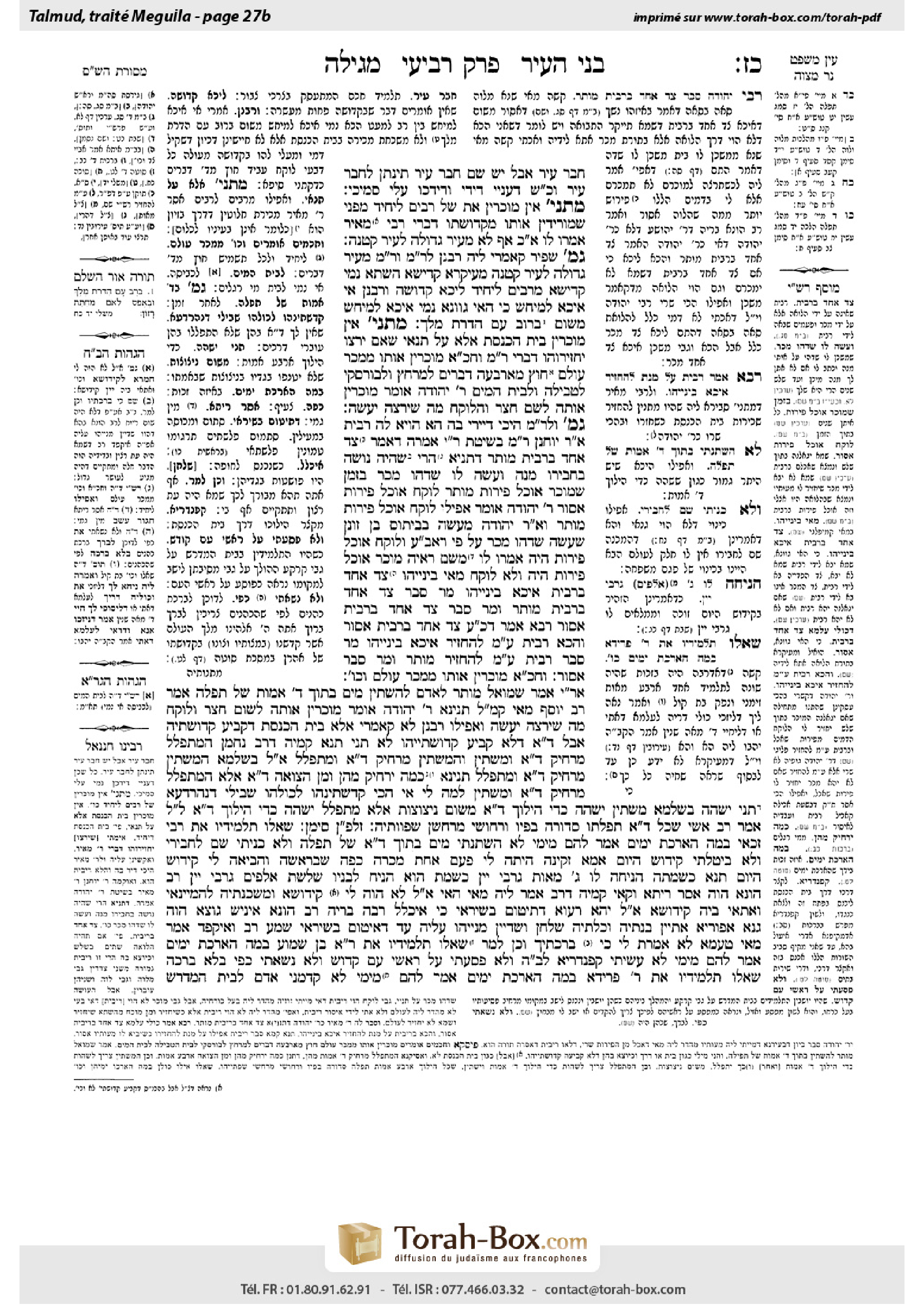
Megillah 27b: Talmud study for Daf Yomi
Daf Yomi is the daily study of one Talmud folio. Explore 37 tractates with scans, Hebrew text, Sefaria English and AI-generated French translations where annotated.
Passage selection and English or AI-generated French translation are available where the scan has annotations. Daf Study is independent of Torah-Box and Sefaria.
Browse Megillah · מגילה · All tractatesMegillah 27b text and translations
This page of Megillah includes the Aramaic text, an English translation and an AI-generated French translation, alongside the scan above.
מגילה כ״ז ב · Aramaic and Hebrew text
חֲבֵר עִיר, אֲבָל יֵשׁ שָׁם חֲבֵר עִיר — תִּינָּתֵן לַחֲבֵר עִיר. וְכׇל שֶׁכֵּן דְּעַנְיֵי דִּידִי וְדִידְכוּ עֲלַי סְמִיכִי.
מַתְנִי׳ אֵין מוֹכְרִין אֶת שֶׁל רַבִּים לְיָחִיד, מִפְּנֵי שֶׁמּוֹרִידִין אוֹתוֹ מִקְּדוּשָּׁתוֹ, דִּבְרֵי רַבִּי מֵאִיר. אָמְרוּ לוֹ: אִם כֵּן אַף לֹא מֵעִיר גְּדוֹלָה לְעִיר קְטַנָּה.
גְּמָ׳ שַׁפִּיר קָאָמְרִי לֵיהּ רַבָּנַן לְרַבִּי מֵאִיר! וְרַבִּי מֵאִיר, מֵעִיר גְּדוֹלָה לְעִיר קְטַנָּה — מֵעִיקָּרָא קַדִּישָׁא, הַשְׁתָּא נָמֵי קַדִּישָׁא. מֵרַבִּים לְיָחִיד לֵיכָּא קְדוּשָּׁה.
וְרַבָּנַן — אִי אִיכָּא לְמֵיחַשׁ, כִּי הַאי גַוְונָא נָמֵי אִיכָּא לְמֵיחַשׁ, מִשּׁוּם ״בְּרוֹב עָם הַדְרַת מֶלֶךְ״.
מַתְנִי׳ אֵין מוֹכְרִין בֵּית הַכְּנֶסֶת אֶלָּא עַל תְּנַאי, שֶׁאִם יִרְצוּ יַחְזִירוּהוּ, דִּבְרֵי רַבִּי מֵאִיר. וַחֲכָמִים אוֹמְרִים: מוֹכְרִין אוֹתוֹ מִמְכַּר עוֹלָם, חוּץ מֵאַרְבָּעָה דְּבָרִים: לְמֶרְחָץ, וּלְבוּרְסְקִי, לִטְבִילָה, וּלְבֵית הַמַּיִם. רַבִּי יְהוּדָה אוֹמֵר: מוֹכְרִין אוֹתָהּ לְשֵׁם חָצֵר, וְהַלּוֹקֵחַ — מַה שֶּׁיִּרְצֶה יַעֲשֶׂה.
גְּמָ׳ וּלְרַבִּי מֵאִיר, הֵיכִי דָּיְירִי בַּהּ? הָא הָוְיָא לַהּ רִבִּית!
אָמַר רַבִּי יוֹחָנָן: רַבִּי מֵאִיר בְּשִׁיטַת רַבִּי יְהוּדָה אֲמָרָהּ, דְּאָמַר: צַד אֶחָד בְּרִבִּית מוּתָּר.
דְּתַנְיָא: הֲרֵי שֶׁהָיָה נוֹשֶׁה בַּחֲבֵירוֹ מָנֶה, וְעָשָׂה לוֹ שָׂדֵהוּ מֶכֶר, בִּזְמַן שֶׁמּוֹכֵר אוֹכֵל פֵּירוֹת — מוּתָּר, לוֹקֵחַ אוֹכֵל פֵּירוֹת — אָסוּר.
רַבִּי יְהוּדָה אוֹמֵר: אֲפִילּוּ לוֹקֵחַ אוֹכֵל פֵּירוֹת — מוּתָּר. וְאָמַר רַבִּי יְהוּדָה: מַעֲשֶׂה בְּבַיְתוֹס בֶּן זוֹנִן שֶׁעָשָׂה שָׂדֵהוּ מֶכֶר עַל פִּי רַבִּי אֶלְעָזָר בֶּן עֲזַרְיָה, וְלוֹקֵחַ אוֹכֵל פֵּירוֹת הָיָה. אָמְרוּ לוֹ: מִשָּׁם רְאָיָה?! מוֹכֵר אוֹכֵל פֵּירוֹת הָיָה וְלֹא לוֹקֵחַ.
מַאי בֵּינַיְיהוּ? צַד אֶחָד בְּרִבִּית אִיכָּא בֵּינַיְיהוּ. מָר סָבַר: צַד אֶחָד בְּרִבִּית מוּתָּר, וּמָר סָבַר: צַד אֶחָד בְּרִבִּית אָסוּר.
רָבָא אָמַר: דְּכוּלֵּי עָלְמָא צַד אֶחָד בְּרִבִּית אָסוּר, וְהָכָא רִבִּית עַל מְנָת לְהַחֲזִיר אִיכָּא בֵּינַיְיהוּ. מָר סָבַר: רִבִּית עַל מְנָת לְהַחֲזִיר מוּתָּר, וּמָר סָבַר: אָסוּר.
וַחֲכָמִים אוֹמְרִים מוֹכְרִין אוֹתוֹ מִמְכַּר עוֹלָם וְכוּ׳. אָמַר רַב יְהוּדָה אָמַר שְׁמוּאֵל: מוּתָּר לָאָדָם לְהַשְׁתִּין מַיִם בְּתוֹךְ אַרְבַּע אַמּוֹת שֶׁל תְּפִלָּה.
אָמַר רַב יוֹסֵף: מַאי קָא מַשְׁמַע לַן? תְּנֵינָא, רַבִּי יְהוּדָה אוֹמֵר: מוֹכְרִין אוֹתָהּ לְשׁוּם חָצֵר, וְלוֹקֵחַ — מַה שֶּׁיִּרְצֶה יַעֲשֶׂה. וַאֲפִילּוּ רַבָּנַן לָא קָאָמְרִי אֶלָּא בֵּית הַכְּנֶסֶת, דִּקְבִיעַ קְדוּשְׁתֵּיהּ. אֲבָל אַרְבַּע אַמּוֹת, דְּלָא קְבִיעַ קְדוּשְׁתַּיְיהוּ — לָא.
תָּנֵי תַּנָּא קַמֵּיהּ דְּרַב נַחְמָן: הַמִּתְפַּלֵּל — מַרְחִיק אַרְבַּע אַמּוֹת וּמַשְׁתִּין, וְהַמַּשְׁתִּין — מַרְחִיק אַרְבַּע אַמּוֹת וּמִתְפַּלֵּל.
אֲמַר לֵיהּ: בִּשְׁלָמָא הַמַּשְׁתִּין מַרְחִיק אַרְבַּע אַמּוֹת וּמִתְפַּלֵּל — תְּנֵינָא: כַּמָּה יַרְחִיק מֵהֶן וּמִן הַצּוֹאָה, אַרְבַּע אַמּוֹת.
אֶלָּא: הַמִּתְפַּלֵּל מַרְחִיק אַרְבַּע אַמּוֹת וּמַשְׁתִּין לְמָה לִי? אִי הָכִי, קַדֵּשְׁתִּינְהוּ לְכוּלְּהוּ שְׁבִילֵי דִנְהַרְדְּעָא. תְּנִי: יִשְׁהֶה.
בִּשְׁלָמָא מַשְׁתִּין יִשְׁהֶה כְּדֵי הִילּוּךְ אַרְבַּע אַמּוֹת, מִשּׁוּם נִיצוֹצוֹת. אֶלָּא: מִתְפַּלֵּל יִשְׁהֶה כְּדֵי הִילּוּךְ אַרְבַּע אַמּוֹת, לְמָה לִי? אָמַר רַב אָשֵׁי: שֶׁכֹּל אַרְבַּע אַמּוֹת תְּפִלָּתוֹ סְדוּרָה בְּפִיו, וְרַחוֹשֵׁי מְרַחֲשָׁן שִׂפְווֹתֵיהּ.
זַלְפָ״ן סִימָן.
שָׁאֲלוּ תַּלְמִידָיו אֶת רַבִּי זַכַּאי: בַּמָּה הֶאֱרַכְתָּ יָמִים? אָמַר לָהֶם: מִיָּמַי לֹא הִשְׁתַּנְתִּי מַיִם בְּתוֹךְ אַרְבַּע אַמּוֹת שֶׁל תְּפִלָּה, וְלֹא כִּנִּיתִי שֵׁם לַחֲבֵירִי, וְלֹא בִּיטַּלְתִּי קִידּוּשׁ הַיּוֹם. אִמָּא זְקֵינָה הָיְתָה לִי, פַּעַם אַחַת מָכְרָה כִּפָּה שֶׁבְּרֹאשָׁהּ וְהֵבִיאָה לִי קִידּוּשׁ הַיּוֹם.
תָּנָא: כְּשֶׁמֵּתָה, הַנִּיחָה לוֹ שְׁלוֹשׁ מֵאוֹת גַּרְבֵי יַיִן. כְּשֶׁמֵּת הוּא, הִנִּיחַ לְבָנָיו שְׁלֹשֶׁת אֲלָפִים גַּרְבֵי יַיִן.
רַב הוּנָא הֲוָה אָסַר רִיתָא וְקָאֵי קַמֵּיהּ דְּרַב, אָמַר לֵיהּ: מַאי הַאי? אֲמַר לֵיהּ: לָא הֲוָה לִי קִידּוּשָׁא, וּמַשְׁכַּנְתֵּיהּ לְהֶמְיָינַאי וְאֵתַאי בֵּיהּ קִידּוּשָׁא. אֲמַר לֵיהּ: יְהֵא רַעֲוָא דְּתִיטּוּם בְּשִׁירָאֵי.
כִּי אִיכַּלַּל רַבָּה בְּרֵיהּ, רַב הוּנָא אִינִישׁ גּוּצָא הֲוָה, גְּנָא אַפּוּרְיָא. אָתְיָין בְּנָתֵיהּ וְכַלָּתֵיהּ שָׁלְחָן וְשָׁדְיָין מָנַיְיהוּ עֲלֵיהּ עַד דְּאִיטּוּם בְּשִׁירָאֵי. שְׁמַע רַב וְאִיקְּפַד, אֲמַר: מַאי טַעְמָא לָא אֲמַרְתְּ לִי כִּי בָּרֵכְתָּיךְ: ״וְכֵן לְמָר״.
שָׁאֲלוּ תַּלְמִידָיו אֶת רַבִּי אֶלְעָזָר בֶּן שַׁמּוּעַ: בַּמָּה הֶאֱרַכְתָּ יָמִים? אָמַר לָהֶם: מִיָּמַי לֹא עָשִׂיתִי קַפֶּנְדַּרְיָא לְבֵית הַכְּנֶסֶת, וְלֹא פָּסַעְתִּי עַל רָאשֵׁי עַם קָדוֹשׁ, וְלֹא נָשָׂאתִי כַּפַּי בְּלֹא בְּרָכָה.
שָׁאֲלוּ תַּלְמִידָיו אֶת רַבִּי פְּרִידָא: בַּמָּה הֶאֱרַכְתָּ יָמִים? אָמַר לָהֶם: מִיָּמַי לֹא קְדָמַנִי אָדָם לְבֵית הַמִּדְרָשׁ,
Megillah 27b · English translation
town scholar supervising the handling of the community’s needs, in the town in which the charity was collected. However, if there is a town scholar there, the money should be given to the town scholar, and he may use it as he sees fit. Since, in this case, the money had been given to Rav Huna, the use of the money should be up to his discretion. Rav Huna added: And all the more so in this instance, as both my poor in my town and your poor in your town rely upon me and my collections of charity. Rav Huna was also in charge of distributing charity for the surrounding area. It was certainly proper to leave the money with him, so that he could distribute it among all those in need.
MISHNA: They may not sell a sacred object belonging to the community to an individual, even if the object will still be used for the same purpose, due to the fact that by doing so they downgrade its degree of sanctity, as an item used by fewer people is considered to have a lower degree of sanctity than one used by many; this is the statement of Rabbi Meir. The Rabbis said to him: If so, by your logic, it should also not be permitted to sell a sacred object from a large town to a small town. However, such a sale is certainly permitted, and therefore it must also be permitted to sell such an object to an individual.
GEMARA: The Gemara asks: The Rabbis are saying well to Rabbi Meir, as they provided a rational argument for their opinion. How could Rabbi Meir counter their claim? The Gemara answers: Rabbi Meir holds that when a sacred object is transferred from a large town to a small town, there is no significant downgrade in the degree of sanctity, as at the outset it was sacred for a community and now too it is sacred for a community. But when it is transferred from a community to an individual, there is a significant downgrade in the degree of sanctity, as there is no longer the degree of sanctity that existed beforehand.
And the Rabbis, how could they respond to Rabbi Meir’s claim? If there is cause to be concerned about the decrease in the number of people who will use the object when it is transferred from a community to an individual, then in a case like this as well, where the object is transferred to a smaller community, there should be cause to be concerned about this due to the principle expressed in the verse: “In the multitude of people is the king’s glory” (Proverbs 14:28). The verse teaches that the larger the assembly involved in a mitzva, the greater the honor to God. However, it is apparent that this principle does not prevent the sale of a synagogue to a smaller community, and therefore it should not prevent the selling of a synagogue to an individual.
MISHNA: They may sell a synagogue only with a stipulation that if the sellers so desire it, the buyers will return it to them; this is the statement of Rabbi Meir. And the Rabbis say: They may sell a synagogue with a permanent sale for any usage, except the following four things, which would be an affront to the synagogue’s previous sanctity: For a bathhouse, where people stand undressed; or for a tannery [burseki], due to the foul smell; for immersion, i.e., to be used as a ritual bath, where people also stand undressed; or for a lavatory. Rabbi Yehuda says: They may sell a synagogue for the generic purpose of serving as a courtyard, and then the buyer may then do with it as he wishes, even if that is one of the above four purposes.
GEMARA: The Gemara asks: But according to Rabbi Meir, how may those who purchased the synagogue live in it? Isn’t living there tantamount to taking interest? If the sellers demand the synagogue’s return, the payment given for it would be returned to the buyers. Accordingly, in a broad view of things, that sum of money may be considered as a loan that was given from the buyers to the sellers, until the synagogue was demanded back. The buyers benefited from giving that loan by being able to live in the synagogue building. However, gaining any benefit from a loan is prohibited as interest.
Rabbi Yoḥanan said: Rabbi Meir stated his opinion in accordance with the opinion of Rabbi Yehuda, who said: Uncertain interest, i.e., a transaction that will not certainly result in a situation of interest, is permitted.
In the case of the mishna, the sale might never be undone, and then there would be no loan to speak of. It should therefore be permitted as a case of uncertain interest, as it is taught in a baraita: If one had a debt of one hundred dinars against his fellow, and the borrower made a conditional sale of his field because he did not have any money to repay the loan, stipulating that if he later comes into the possession of money with which to repay the loan, the field reverts back to his ownership, then as long as the seller of the field consumes the produce of that field, such an arrangement is permitted. If the buyer consumes the produce, the arrangement is prohibited, as if the sale were to be reverted, then the money given for it would be considered a loan from the buyer to the seller, and therefore any benefit the buyer gains due to that loan should be prohibited as interest.
Rabbi Yehuda says: Even if the buyer consumes the produce, it is permitted. Since it is possible that the sale might never be undone, in which case there would be no loan to speak of, it is a case of uncertain interest, which is permitted. And Rabbi Yehuda said: There was an incident involving Baitos ben Zunen, who made a conditional sale of his field in a similar arrangement under the direction of Rabbi Elazar ben Azarya, and the buyer was consuming the produce in accordance with Rabbi Yehuda’s ruling. The Rabbis said to him: Do you seek to bring a proof from there? In that case, it was actually the seller who was consuming the produce and not the buyer.
The Gemara analyses the dispute: What is the practical difference between them? The permissibility of an uncertain interest agreement is the practical difference between them. One Sage, Rabbi Yehuda, holds that uncertain interest is permitted and one Sage, i.e., the Rabbis, holds that uncertain interest is prohibited.
Rava said a different explanation of the dispute: According to everyone, uncertain interest is prohibited, and here it is the question of the permissibility of interest given on the condition that it will be returned that is the practical difference between them. In addition to the arrangement described in the baraita, the parties in this case agreed that the buyer would consume the produce; if the sale would later be reverted, then the buyer would reimburse the seller for the value of the produce. One Sage, Rabbi Yehuda, holds that interest that is given on condition that it will be returned is permitted; this is because even if the sale is reverted and the sale becomes a loan retroactively, the buyer-lender will not benefit from that loan since he reimbursed the seller-borrower for the value of the produce. And one Sage, i.e., the Rabbis, holds that it is prohibited.
§ The mishna states: And the Rabbis say: They may sell a synagogue with a permanent sale. However, it may not be sold if it will be used for activities that would be an affront to the synagogue’s previous sanctity. The Gemara considers a related halakha: Rav Yehuda said that Shmuel said: It is permitted for a person to urinate within four cubits of where one has just offered a prayer, i.e., one may urinate even in the same place as he prays.
Rav Yosef said: What is he teaching us? We already learned this in the mishna: Rabbi Yehuda says: They may sell a synagogue for the generic purpose of serving as a courtyard, and the buyer may then do with it as he wishes, even if he wishes to make it into a lavatory. And even the Rabbis, who disagree with Rabbi Yehuda, say their ruling only with regard to a synagogue whose sanctity is permanent. However, with regard to the four cubits of where one happened to stand in prayer, whose sanctity is not permanent, no, even the Rabbis would be lenient.
A tanna taught a baraita before Rav Naḥman: One who prayed should distance himself four cubits from where he was standing, and only then may he urinate. And one who urinated should distance himself four cubits, and only then may he pray.
Rav Naḥman said to him: Granted, the second clause of the baraita, that one who urinated should distance himself four cubits and only then may he pray, makes sense, as we already learned in a mishna (Berakhot 22b): How far must one distance oneself from urine and excrement? Four cubits.
But the first clause of the baraita, that one who prayed should distance himself four cubits from where he was standing and only then may he urinate, why should I require this? How could there be such a halakha? If that is so, you have sanctified all the streets of the city of Neharde’a, for people have certainly prayed on every one of its streets. According to this halakha, it should be prohibited to urinate everywhere. The Gemara answers: Emend and teach the baraita as saying not that one should distance himself four cubits, but that one should wait the time it takes to walk four cubits.
The Gemara addresses the emended version of the baraita: Granted, its second clause, that one who urinated waits the time it takes to walk four cubits and only then may he pray, makes sense. This is due to the droplets of urine that may still be issuing from him; he should wait until they cease entirely. However, with regard to the first clause, that one who prayed should wait the time it takes to walk four cubits and only then may he urinate, why should I require this? Rav Ashi said: Because for all the time it takes to walk four cubits, his prayer is still arranged in his mouth, and his lips are still articulating them.
§ The Gemara cites a series of Sages who explained the reasons they were blessed with longevity and provides a mnemonic device, indicating the order in which the Sages are cited: Zayin, lamed, peh, nun. Zayin for Rabbi Zakkai; lamed for Rabbi Elazar; peh for Rabbi Perida; nun for Rabbi Neḥunya.
The Gemara presents the first incident: Rabbi Zakkai was once asked by his disciples: In the merit of which virtue were you blessed with longevity? He said to them: In all my days, I never urinated within four cubits of a place that had been used for prayer. Nor did I ever call my fellow by a nickname. And I never neglected the mitzva of sanctifying the day of Shabbat over wine. I was meticulous about this mitzva to the extent that I had an elderly mother, and once, when I did not have wine, she sold the kerchief that was on her head, and from the proceeds she brought me wine upon which to do the mitzva of sanctifying the day.
It was taught concerning Rabbi Zakkai: When his mother died, she left him three hundred barrels of wine. When he died, he left his sons three thousand barrels of wine. Since they were so meticulous in the mitzva of sanctifying the day of Shabbat with wine, God rewarded them with wealth and an abundance of wine.
In a related incident, it once happened that Rav Huna was girded with a piece of straw [rita] and was standing before Rav. Rav said to him: What is this? Why are you dressed in this way? He said to him: I had no wine for sanctifying the day of Shabbat, so I pawned my belt [hemyanai], and with the proceeds I brought wine for sanctifying the day. Rav said to him: May it be God’s will that you be enveloped in silk [shira’ei] in reward for such dedication.
When Rabba, his son, was married, Rav Huna, who was a short man, was lying on his bed, and owing to his diminutive size he went unnoticed. His daughters and daughters-in-law came into the room and removed and threw their silk garments upon him until he was entirely enveloped in silk. With this, Rav’s blessing was fulfilled to the letter. When Rav heard about this, he became angry with Rav Huna, and said: What is the reason that when I blessed you, you did not respond in kind and say to me: And likewise to the Master? Had you done so, I would have also benefitted from the blessing.
The Gemara discusses the second occasion where a Sage explained his longevity: Rabbi Elazar ben Shammua was once asked by his disciples: In the merit of which virtue were you blessed with longevity? He said to them: In all my days, I never made a shortcut through a synagogue. Nor did I ever stride over the heads of the sacred people, i.e., I never stepped over people sitting in the study hall in order to reach my place, so as not to appear scornful of them. And I never raised my hands in the Priestly Benediction without reciting a blessing beforehand.
On the third occasion, Rabbi Perida was once asked by his disciples: In the merit of which virtue were you blessed with longevity? He said to them: In all my days, no person ever arrived before me to the study hall, as I was always the first to arrive.
Megillah 27b · Traduction française (IA)
un érudit de la ville chargé de superviser la gestion des besoins de la communauté, dans la ville où la tsédaka avait été recueillie. Toutefois, s’il y a un érudit de la ville sur place, l’argent doit lui être remis, et il peut en disposer comme il l’entend. Puisque, dans ce cas, l’argent avait été remis à Rav Houna, il devait pouvoir en disposer à sa guise. Rav Houna ajouta : À plus forte raison dans cette situation, car les pauvres de ma ville comme les tiens, dans ta ville, dépendent de moi et des collectes de tsédaka que j’organise. Rav Houna était également chargé de distribuer la tsédaka dans la région alentour. Il convenait donc assurément de lui laisser l’argent, afin qu’il puisse le répartir entre tous ceux qui étaient dans le besoin.
MICHNA : On ne peut pas vendre à un particulier un objet sacré appartenant à la communauté, même si l’objet continuera à servir au même usage, car ce faisant, on abaisse son degré de sainteté : un objet utilisé par moins de personnes est considéré comme ayant un degré de sainteté inférieur à celui d’un objet utilisé par beaucoup. Telle est l’opinion de Rabbi Meïr. Les Sages lui dirent : Si tel est ton raisonnement, il devrait également être interdit de vendre un objet sacré d’une grande ville à une petite ville. Or, une telle vente est assurément permise ; il doit donc être également permis de vendre un tel objet à un particulier.
GUEMARA : La Guemara demande : Les Sages répondent bien à Rabbi Meïr, puisqu’ils ont avancé un argument rationnel en faveur de leur opinion. Comment Rabbi Meïr peut-il réfuter leur argument ? La Guemara répond : Rabbi Meïr estime que lorsqu’un objet sacré est transféré d’une grande ville à une petite ville, son degré de sainteté ne diminue pas de façon notable, car au départ il était sacré pour une communauté, et à présent encore, il est sacré pour une communauté. Mais lorsqu’il est transféré d’une communauté à un particulier, son degré de sainteté diminue de façon notable, puisqu’il ne conserve plus le degré de sainteté qu’il avait auparavant.
Et comment les Sages pourraient-ils répondre à l’argument de Rabbi Meïr ? S’il y a lieu de craindre que le nombre de personnes utilisant l’objet diminue lorsqu’il est transféré d’une communauté à un particulier, alors il devrait également y avoir lieu de le craindre dans un cas comme celui-ci, où l’objet est transféré à une communauté plus petite, en vertu du principe exprimé dans le verset : « La gloire du roi est dans la multitude du peuple » (Proverbes 14, 28). Ce verset enseigne que plus l’assemblée qui accomplit une mitsva est grande, plus l’honneur rendu à Dieu est grand. Pourtant, il est manifeste que ce principe n’empêche pas la vente d’une synagogue à une communauté plus petite ; il ne devrait donc pas davantage empêcher la vente d’une synagogue à un particulier.
MICHNA : On ne peut vendre une synagogue qu’à la condition que, si les vendeurs le souhaitent, les acheteurs la leur rendent. Telle est l’opinion de Rabbi Meïr. Les Sages disent : On peut vendre une synagogue définitivement pour tout usage, sauf pour les quatre usages suivants, qui constitueraient un affront à sa sainteté antérieure : un établissement de bains, où les gens se tiennent dévêtus ; une tannerie [burseki], à cause de la mauvaise odeur ; un lieu d’immersion, c’est-à-dire un mikvé, où les gens se tiennent également dévêtus ; ou des latrines. Rabbi Yehouda dit : On peut vendre une synagogue pour en faire une cour, sans autre précision ; l’acheteur peut ensuite en faire ce qu’il veut, même l’un des quatre usages susmentionnés.
GUEMARA : La Guemara demande : Mais, selon Rabbi Meïr, comment les acheteurs de la synagogue peuvent-ils y habiter ? N’est-ce pas assimilable à percevoir des intérêts ? Si les vendeurs réclament la synagogue, le prix versé pour celle-ci serait rendu aux acheteurs. Ainsi, dans une perspective générale, cette somme d’argent peut être considérée comme un prêt consenti par les acheteurs aux vendeurs, jusqu’à ce que la synagogue soit réclamée. Les acheteurs tirent profit de ce prêt en pouvant habiter le bâtiment de la synagogue. Or, tout avantage tiré d’un prêt est interdit en tant qu’intérêt.
Rabbi Yoḥanan dit : Rabbi Meïr a énoncé son opinion conformément à celle de Rabbi Yehouda, qui dit : Un intérêt incertain, c’est-à-dire une transaction qui ne conduira pas nécessairement à une situation d’intérêt, est permis.
Dans le cas de la Michna, il se peut que la vente ne soit jamais annulée ; il n’y aurait alors aucun prêt à proprement parler. Elle devrait donc être permise en tant que cas d’intérêt incertain, comme l’enseigne une baraïta : Si quelqu’un détient une créance de cent dinars sur son prochain et que l’emprunteur lui vend son champ sous condition, parce qu’il n’a pas d’argent pour rembourser le prêt, en stipulant que si, par la suite, il obtient l’argent nécessaire au remboursement, le champ lui reviendra, alors un tel arrangement est permis tant que le vendeur du champ en consomme les récoltes. Si c’est l’acheteur qui en consomme les récoltes, l’arrangement est interdit : si la vente venait à être annulée, l’argent versé pour le champ serait considéré comme un prêt de l’acheteur au vendeur ; tout avantage que l’acheteur en tire devrait donc être interdit en tant qu’intérêt.
Rabbi Yehouda dit : Même si l’acheteur consomme les récoltes, cela est permis. Puisqu’il se peut que la vente ne soit jamais annulée, auquel cas il n’y aurait aucun prêt à proprement parler, c’est un cas d’intérêt incertain, qui est permis. Et Rabbi Yehouda dit : Un événement s’est produit avec Baitos ben Zunen, qui avait vendu son champ sous condition dans un arrangement semblable, sur les conseils de Rabbi Elazar ben Azarya, et l’acheteur en consommait les récoltes conformément à la décision de Rabbi Yehouda. Les Sages lui dirent : Prétends-tu apporter une preuve de là ? Dans ce cas, c’était en réalité le vendeur, et non l’acheteur, qui consommait les récoltes.
La Guemara analyse la controverse : Quelle est leur divergence pratique ? La permission de conclure un accord comportant un intérêt incertain constitue leur divergence pratique. L’un des Sages, Rabbi Yehouda, estime qu’un intérêt incertain est permis, tandis que l’autre Sage, c’est-à-dire les Sages, estime qu’il est interdit.
Rava donna une autre explication de la controverse : Tous estiment qu’un intérêt incertain est interdit. La divergence pratique porte ici sur la permission d’un intérêt accordé à condition qu’il soit restitué. Outre l’arrangement décrit dans la baraïta, les parties avaient convenu dans ce cas que l’acheteur consommerait les récoltes ; si la vente était ensuite annulée, l’acheteur rembourserait au vendeur la valeur des récoltes. Un Sage, Rabbi Yehouda, estime qu’un intérêt accordé à condition d’être restitué est permis. En effet, même si la vente est annulée et qu’elle est rétroactivement considérée comme un prêt, l’acheteur-prêteur ne tirera aucun profit de ce prêt, puisqu’il aura remboursé au vendeur-emprunteur la valeur des récoltes. L’autre Sage, c’est-à-dire les Sages, estime que cela est interdit.
§ La Michna enseigne : Les Sages disent qu’on peut vendre une synagogue définitivement. Toutefois, on ne peut pas la vendre si elle doit servir à des activités qui constitueraient un affront à sa sainteté antérieure. La Guemara examine une halakha apparentée : Rav Yehouda a dit au nom de Shmouel : Il est permis à une personne d’uriner à moins de quatre coudées de l’endroit où elle vient de prier, c’est-à-dire qu’elle peut uriner même à l’endroit où elle prie.
Rav Yossef dit : Que nous enseigne-t-il ? Nous l’avons déjà appris dans la Michna : Rabbi Yehouda dit qu’on peut vendre une synagogue pour en faire une cour, sans autre précision, et que l’acheteur peut ensuite en faire ce qu’il veut, même des latrines. Et même les Sages, qui ne sont pas d’accord avec Rabbi Yehouda, ne donnent cette décision que pour une synagogue dont la sainteté est permanente. En revanche, s’agissant des quatre coudées de l’endroit où quelqu’un s’est trouvé par hasard en prière, dont la sainteté n’est pas permanente, non, même les Sages seraient indulgents.
Un tanna enseigna une baraïta devant Rav Naḥman : Celui qui a prié doit s’éloigner de quatre coudées de l’endroit où il se tenait, et ce n’est qu’ensuite qu’il peut uriner. Et celui qui a uriné doit s’éloigner de quatre coudées, et ce n’est qu’ensuite qu’il peut prier.
Rav Naḥman lui dit : Certes, la seconde partie de la baraïta, qui enseigne que celui qui a uriné doit s’éloigner de quatre coudées avant de prier, est logique, puisque nous avons déjà appris dans une Michna (Berakhot 22b) : De quelle distance faut-il s’éloigner de l’urine et des excréments ? De quatre coudées.
Mais pourquoi exiger ce qu’enseigne la première partie de la baraïta, à savoir que celui qui a prié doit s’éloigner de quatre coudées de l’endroit où il se tenait avant d’uriner ? Comment une telle halakha pourrait-elle exister ? Dans ce cas, vous auriez sanctifié toutes les rues de la ville de Neharde’a, car les gens ont certainement prié dans chacune d’elles. Selon cette halakha, il serait interdit d’uriner partout. La Guemara répond : Corrigez la baraïta et enseignez non pas qu’il faut s’éloigner de quatre coudées, mais qu’il faut attendre le temps nécessaire pour parcourir quatre coudées.
La Guemara examine la version corrigée de la baraïta : Certes, sa seconde partie, qui enseigne que celui qui a uriné doit attendre le temps nécessaire pour parcourir quatre coudées avant de prier, est logique. Cela s’explique par les gouttes d’urine qui peuvent encore s’écouler de lui ; il doit attendre qu’elles cessent complètement. Mais pourquoi exiger, dans la première partie, que celui qui a prié attende le temps nécessaire pour parcourir quatre coudées avant d’uriner ? Rav Ashi dit : Parce que, pendant tout le temps nécessaire pour parcourir quatre coudées, sa prière reste en bouche, et ses lèvres continuent à l’articuler.
§ La Guemara cite une série de Sages qui expliquèrent les raisons pour lesquelles ils avaient été bénis d’une longue vie, et fournit un moyen mnémotechnique indiquant l’ordre dans lequel les Sages sont cités : zayin, lamed, pé, noun. Zayin renvoie à Rabbi Zakkaï ; lamed, à Rabbi Elazar ; pé, à Rabbi Perida ; noun, à Rabbi Neḥounya.
La Guemara rapporte le premier récit : Un jour, les disciples de Rabbi Zakkaï lui demandèrent : Grâce à quelle vertu avez-vous été béni d’une longue vie ? Il leur répondit : De toute ma vie, je n’ai jamais uriné à moins de quatre coudées d’un endroit où l’on avait prié. Je n’ai jamais non plus donné de sobriquet à mon prochain. Et je n’ai jamais négligé la mitsva de sanctifier le jour du Chabbat sur le vin. J’ai été si scrupuleux dans l’accomplissement de cette mitsva que j’avais une mère âgée et qu’un jour, comme je n’avais pas de vin, elle vendit le fichu qu’elle portait sur la tête et, avec l’argent obtenu, m’apporta du vin pour accomplir la mitsva de sanctification du jour.
On enseigna au sujet de Rabbi Zakkaï : À sa mort, sa mère lui laissa trois cents tonneaux de vin. À sa mort à lui, il laissa à ses fils trois mille tonneaux de vin. Comme ils observaient avec tant de scrupule la mitsva de sanctifier le jour du Chabbat avec du vin, Dieu les récompensa par la richesse et une abondance de vin.
À ce propos, un jour, Rav Houna portait une pièce de paille [rita] en guise de ceinture et se tenait devant Rav. Rav lui dit : Qu’est-ce que c’est ? Pourquoi es-tu ainsi vêtu ? Il lui répondit : Je n’avais pas de vin pour sanctifier le jour du Chabbat ; j’ai donc mis en gage ma ceinture [hemyanai] et, avec l’argent obtenu, j’ai acheté du vin pour sanctifier le jour. Rav lui dit : Puisse-t-il être la volonté de Dieu que tu sois enveloppé de soie [shira’ei], en récompense d’un tel dévouement.
Lorsque Rabba, son fils, se maria, Rav Houna, qui était de petite taille, était allongé sur son lit et, à cause de sa petite stature, on ne le remarqua pas. Ses filles et ses belles-filles entrèrent dans la pièce, ôtèrent leurs vêtements de soie et les jetèrent sur lui, jusqu’à ce qu’il en soit entièrement enveloppé. Ainsi, la bénédiction de Rav se réalisa à la lettre. Lorsque Rav l’apprit, il se mit en colère contre Rav Houna et lui dit : Pourquoi, lorsque je t’ai béni, ne m’as-tu pas répondu en retour : « Et de même pour le Maître » ? Si tu l’avais fait, moi aussi j’aurais bénéficié de la bénédiction.
La Guemara aborde la deuxième occasion où un Sage expliqua sa longue vie : Un jour, les disciples de Rabbi Elazar ben Shammoua lui demandèrent : Grâce à quelle vertu avez-vous été béni d’une longue vie ? Il leur répondit : De toute ma vie, je n’ai jamais pris de raccourci en traversant une synagogue. Je n’ai jamais non plus enjambé les têtes des personnes saintes, c’est-à-dire que je n’ai jamais enjambé les personnes assises dans la salle d’étude pour rejoindre ma place, afin de ne pas donner l’impression que je les méprisais. Et je n’ai jamais levé les mains pour la bénédiction sacerdotale sans avoir auparavant récité la bénédiction.
À la troisième occasion, les disciples de Rabbi Perida lui demandèrent un jour : Grâce à quelle vertu avez-vous été béni d’une longue vie ? Il leur répondit : De toute ma vie, personne n’est jamais arrivé au beit midrash avant moi, car j’étais toujours le premier à arriver.
Traduction française générée par IA à partir de l’édition anglaise de Sefaria. Vérifie toujours un passage avec le texte source.
Text from Sefaria: William Davidson Edition - Vocalized Aramaic (CC BY NC); William Davidson Edition - English (CC BY NC).