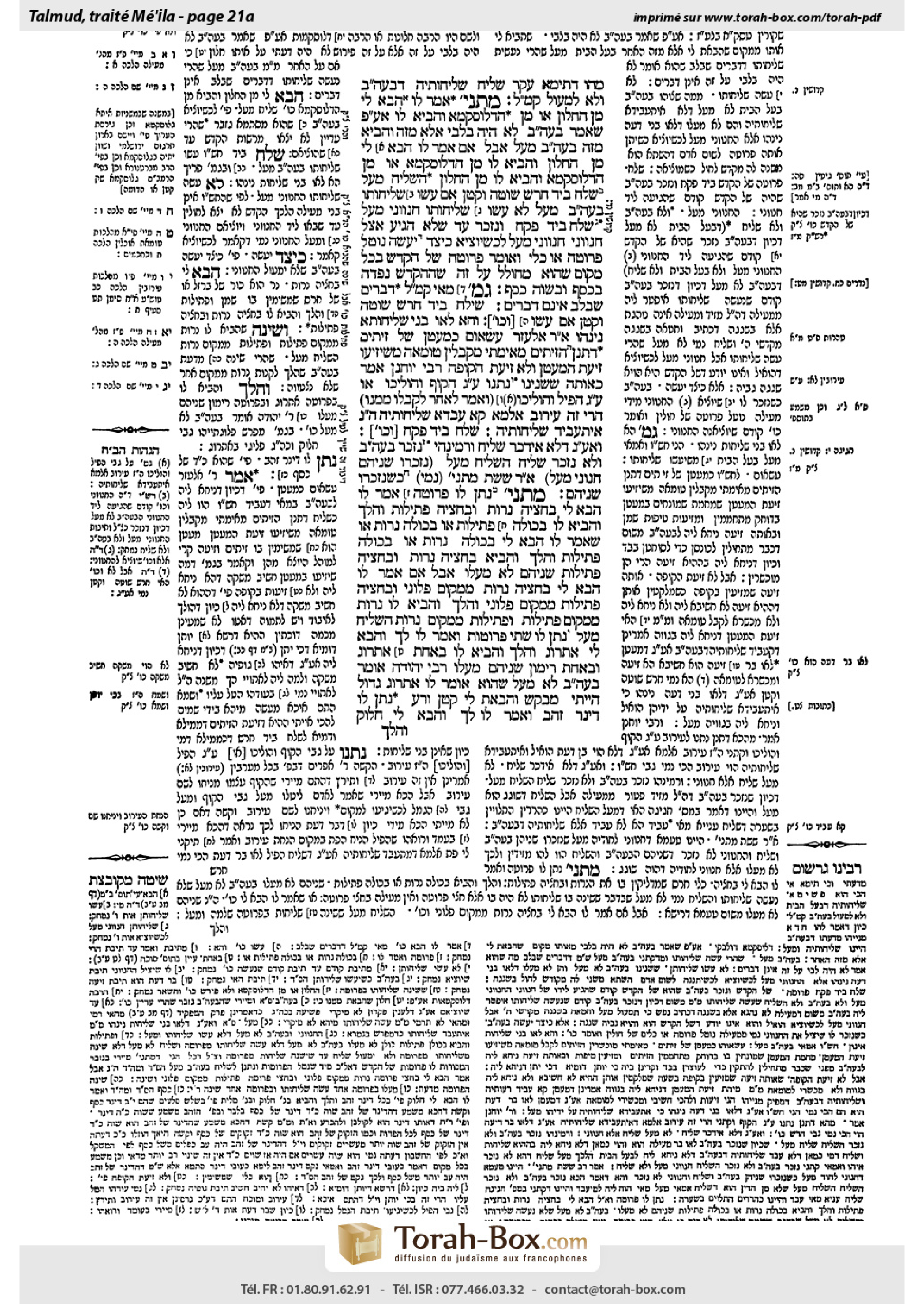
Meilah 21a: Talmud study for Daf Yomi
Daf Yomi is the daily study of one Talmud folio. Explore 37 tractates with scans, Hebrew text, Sefaria English and AI-generated French translations where annotated.
Passage selection and English or AI-generated French translation are available where the scan has annotations. Daf Study is independent of Torah-Box and Sefaria.
Browse Meilah · מעילה · All tractatesMeilah 21a text and translations
This page of Meilah includes the Aramaic text, an English translation and an AI-generated French translation, alongside the scan above.
מעילה כ״א א · Aramaic and Hebrew text
מַהוּ דְּתֵימָא: עָקַר שָׁלִיחַ שְׁלִיחוּתֵיהּ דְּבַעַל הַבַּיִת, וְלָא לִמְעוֹל – קָא מַשְׁמַע לַן.
מַתְנִי׳ אָמַר לוֹ: ״הָבֵא לִי מִן הַחַלּוֹן אוֹ מִן הַדְּלוֹסְקָמָא״, וְהֵבִיא לוֹ. אַף עַל פִּי שֶׁאָמַר בַּעַל הַבַּיִת: ״לֹא הָיָה בְּלִבִּי אֶלָּא מִזֶּה״, וְהֵבִיא מִזֶּה – בַּעַל הַבַּיִת מָעַל. אֲבָל אִם אָמַר לוֹ: ״הָבֵא לִי מִן הַחַלּוֹן״, וְהֵבִיא לוֹ מִן הַדְּלוֹסְקָמָא, אוֹ ״מִן הַדְּלוֹסְקָמָא״, וְהֵבִיא לוֹ מִן הַחַלּוֹן – הַשָּׁלִיחַ מָעַל.
שִׁלַּח בְּיַד חֵרֵשׁ שׁוֹטֶה וְקָטָן, אִם עָשׂוּ שְׁלִיחוּתוֹ – בַּעַל הַבַּיִת מָעַל, לֹא עָשׂוּ שְׁלִיחוּתוֹ – חֶנְווֹנִי מֵעַל.
שִׁלַּח בְּיַד פִּקֵּחַ, וְנִזְכַּר עַד שֶׁלֹּא הִגִּיעַ אֵצֶל חֶנְווֹנִי – חֶנְווֹנִי מָעַל לִכְשֶׁיּוֹצִיא.
כֵּיצַד יַעֲשֶׂה? נוֹטֵל פְּרוּטָה אוֹ כְלִי, וְאוֹמֵר: ״פְּרוּטָה שֶׁל הֶקְדֵּשׁ בְּכׇל מָקוֹם שֶׁהוּא מְחוּלָּל עַל זֶה״, שֶׁהַהֶקְדֵּשׁ נִפְדֶּה בְּכֶסֶף וּבְשָׁוֶה כֶּסֶף.
גְּמָ׳ מַאי קָא מַשְׁמַע לַן? דְּבָרִים שֶׁבַּלֵּב אֵינָם דְּבָרִים.
שִׁילַּח בְּיַד חֵרֵשׁ שׁוֹטֶה וְקָטָן, אִם עָשׂוּ [וְכוּ׳]. וְהָא לָאו בְּנֵי שְׁלִיחוּתָא נִינְהוּ!
אָמַר רַבִּי אֶלְעָזָר: עֲשָׂאוּם כְּמַעֲטָן שֶׁל זֵיתִים,
דִּתְנַן: הַזֵּיתִים, מֵאֵימָתַי מְקַבְּלִין טוּמְאָה? מִשֶּׁיַּזִּיעוּ זֵיעַת הַמַּעֲטָן, וְלֹא זֵיעַת הַקּוּפָּה.
רַבִּי יוֹחָנָן אָמַר: כְּאוֹתָהּ שֶׁשָּׁנִינוּ, נְתָנוֹ עַל גַּבֵּי הַקּוֹף וְהוֹלִיכוֹ, אוֹ עַל גַּבֵּי הַפִּיל וְהוֹלִיכוֹ, וְאָמַר לְאַחֵר לְקַבְּלוֹ מִמֶּנּוּ – הֲרֵי זֶה עֵירוּב. אַלְמָא קָא עָבְדָא שְׁלִיחוּתֵיהּ. הָכִי נָמֵי, אִיתְעֲבִיד שְׁלִיחוּתֵיהּ.
שִׁלַּח בְּיַד פִּקֵּחַ וְכוּ׳. וְאַף עַל גַּב דְּלָא אִידְּכַר שָׁלִיחַ. וּרְמִינְהִי: נִזְכַּר בַּעַל הַבַּיִת וְלֹא נִזְכַּר שָׁלִיחַ – הַשָּׁלִיחַ מָעַל, נִזְכְּרוּ שְׁנֵיהֶם – חֶנְוָנִי מָעַל!
אָמַר רַב שֵׁשֶׁת: מַתְנִיתִין נָמֵי, כְּשֶׁנִּזְכְּרוּ שְׁנֵיהֶם.
מַתְנִי׳ נָתַן לוֹ פְּרוּטָה, אָמַר לוֹ: ״הָבֵא לִי בְּחֶצְיָהּ נֵרוֹת וּבְחֶצְיָהּ פְּתִילוֹת״ וְהָלַךְ וְהֵבִיא לוֹ בְּכוּלָּהּ פְּתִילוֹת אוֹ בְּכוּלָּהּ נֵרוֹת, אוֹ שֶׁאָמַר לוֹ: ״הָבֵא לִי בְּכוּלָּהּ נֵרוֹת״, אוֹ ״בְּכוּלָּהּ פְּתִילוֹת״, וְהָלַךְ וְהֵבִיא בְּחֶצְיָהּ נֵרוֹת וּבְחֶצְיָהּ פְּתִילוֹת – שְׁנֵיהֶם לֹא מָעֲלוּ.
אֲבָל אִם אָמַר לוֹ: ״הָבֵא לִי בְּחֶצְיָהּ נֵרוֹת מִמָּקוֹם פְּלוֹנִי וּבְחֶצְיָהּ פְּתִילוֹת מִמָּקוֹם פְּלוֹנִי״, וְהָלַךְ וְהֵבִיא לוֹ נֵרוֹת מִמְּקוֹם פְּתִילוֹת, וּפְתִילוֹת מִמְּקוֹם נֵרוֹת – הַשָּׁלִיחַ מָעַל.
נָתַן לוֹ שְׁתֵּי פְרוּטוֹת, וְאָמַר לוֹ: ״לֵךְ וְהָבֵא לִי אֶתְרוֹג״, וְהָלַךְ וְהֵבִיא לוֹ בְּאַחַת אֶתְרוֹג וּבְאַחַת רִימּוֹן – שְׁנֵיהֶם מָעֲלוּ. רַבִּי יְהוּדָה אוֹמֵר: בַּעַל הַבַּיִת לֹא מָעַל, שֶׁהוּא אוֹמֵר לוֹ: אֶתְרוֹג גָּדוֹל הָיִיתִי מְבַקֵּשׁ, וְהֵבֵאתָ לִי קָטָן וְרַע.
נָתַן לוֹ דִּינַר זָהָב, וְאָמַר לוֹ: לֵךְ וְהָבֵא לִי חָלוּק,
Meilah 21a · English translation
Rav Sheshet adds that it is necessary for the mishna to teach this halakha, lest you say that the agent has uprooted the agency of the homeowner by adding to his instructions, and therefore the homeowner is not liable for the prohibition of misuse even for the first piece of meat. Consequently, the mishna teaches us that the homeowner is also liable.
MISHNA: If the homeowner said to the agent: Bring me this item or this money from the window in the wall or from the chest [hadeluskema], and the agent obeyed and brought it to him from the place that he instructed him, even though the homeowner said: In my heart, my desire was only that he should bring me the item from that other place, and as he brought it from this place he did not fulfill my instructions, nevertheless the homeowner is liable for misuse if the item or money is consecrated, as the agent did in fact fulfill his instructions. But if the homeowner said to the agent: Bring me this item or this money from the window in the wall, and the agent brought it to him from the chest; or if the homeowner said to the agent: Bring me this item or this money from the chest, and the agent brought it to him from the window, the agent is liable for misuse.
In a case where the homeowner sent consecrated money in the hand of a deaf-mute, an imbecile, or a minor, who lack halakhic competence and cannot be commissioned as agents, in order to purchase an item from a storekeeper, if they performed his agency, the homeowner is liable for misuse, as his instructions were fulfilled. If they did not perform his agency but purchased a different item from the storekeeper, the storekeeper is liable for misuse.
If the homeowner sent the money in the hand of a halakhically competent person and the homeowner remembered that the money was consecrated before the agent reached the storekeeper, the storekeeper is liable for misuse when he spends the money for his personal use. The homeowner is exempt from liability for misuse, because once he remembers that the money is consecrated his misuse is no longer unwitting, and one is liable to bring an offering for misuse only for unwitting misuse of consecrated property.
What shall the homeowner do in a case where he remembers that the money is consecrated, in order to prevent the storekeeper from liability for misuse? He takes one peruta or a vessel and says: The consecrated peruta, wherever it may be, is desacralized with this peruta or vessel. The peruta is thereby desacralized, as a consecrated item is desacralized with money and with an item that has the equivalent value of money. The result is that the storekeeper spends non-sacred money.
GEMARA: The mishna teaches that if the agent did as instructed by the homeowner, even if the homeowner claimed that he had another desire, it is the homeowner who is liable for misuse. The Gemara asks: What is the mishna teaching us? The Gemara answers: It is teaching that unspoken matters that remain in the heart are not significant matters. Therefore it is the homeowner who is liable, not the agent, despite the fact that the agent did not do what the homeowner desired.
§ The mishna teaches: In a case where the homeowner sent consecrated money in the hand of a deaf-mute, an imbecile, or a minor, who lack halakhic competence and cannot be commissioned as agents, in order to purchase an item from a storekeeper, if they performed his agency, the homeowner is liable for misuse, as his instructions were fulfilled. The Gemara raises a difficulty: But they cannot be involved in agency. Since these groups of people lack halakhic competence, they cannot be agents; if so, how can the homeowner be liable for misuse?
Rabbi Elazar says in explanation: The Sages rendered these individuals halakhically like a vat [kema’atan] of olives with regard to ritual impurity. Since it is beneficial for the homeowner when the moisture of the olives, i.e., liquid that seeps from the olives, leaks into a vat, as explained below, it is considered as though the homeowner had intent for the moisture to be there. Similarly, with regard to these categories of people, since it suits the homeowner when they do what he requested it is considered as though they acted with his intent.
As we learned in a mishna (Teharot 9:1): When do the olives become susceptible to ritual impurity? From when they exude moisture. This is referring specifically to the moisture that emerges into the vat, but not the moisture that emerges into the basket. The moisture that comes into the vat softens the olives and is beneficial to the olive oil production, as it renders them easier to press. For this reason it is considered as though the homeowner has intent for the moisture to be there, and that moisture therefore renders the olives it touches susceptible to ritual impurity. By contrast, moisture in the basket serves no purpose, as it trickles out through holes in the basket. Consequently, it is not there with the intent of the homeowner and does not render the olives susceptible to ritual impurity.
Rabbi Yoḥanan says: This case of a deaf-mute, imbecile or minor, is like that which we learned in a baraita with regard to placing food for a joining of Shabbat boundaries, i.e., an eiruv: If one placed the food of the eiruv on a monkey, and the monkey brought it to the place where he wanted the eiruv deposited, or if he placed it on a trained elephant, and the elephant brought it to the proper location, and he told another person to receive it from the animal, it is a valid eiruv. Evidently, the agency is performed by the monkey or elephant, despite the fact that they are unfit to serve as agents. So too, in the case of the deaf-mute, imbecile, or minor, the agency is performed despite the fact that they cannot be involved in agency.
§ The mishna teaches: If the homeowner sent the money in the hand of a halakhically competent person and the homeowner remembered that the money was consecrated before the agent reached the storekeeper, the storekeeper is liable for misuse when he spends the money for his personal use. This indicates that the storekeeper is liable even though the agent did not remember, but the homeowner alone remembered. And the Gemara raises a contradiction from a baraita: If the homeowner remembered that the money was consecrated, but the agent did not remember, the agent is liable for misuse. If they both remembered that the money is consecrated, the storekeeper is liable for misuse.
Rav Sheshet said in resolution of this contradiction: The mishna is also referring to a case where both the agent and the agent remembered that the money was consecrated, and for this reason the storekeeper alone is liable for misuse.
MISHNA: If the homeowner gave the agent one consecrated peruta and said to him: Bring me lamps [nerot] with one-half of it and wicks with one-half of it, and the agent went and brought him wicks with the entire peruta, or lamps with the entire peruta; or in a case where the homeowner said to the agent: Bring me lamps with the entire peruta or wicks with the entire peruta, and the agent went and brought him lamps with one-half of it and wicks with one-half of it, both of them are not liable for misuse of the peruta. In both cases, the homeowner is exempt because his instructions were fulfilled only with regard to half of a peruta, and the agent is exempt as he spent only half of a peruta on his own initiative.
But if the homeowner said to the agent: Bring me lamps from such and such place with one-half of the peruta and wicks from such and such place with one-half of the peruta, and the agent went and brought him lamps from the place that he designated for wicks, and wicks from the place that he designated for lamps, the agent is liable for misuse, as he deviated from the homeowner’s instructions by the sum of an entire peruta.
If the homeowner gave the agent two consecrated perutot, and said to him: Go and bring me an etrog, and he went and brought him an etrog with one peruta and a pomegranate with one peruta, both of them are liable for misuse. The homeowner is liable because his agency was performed with the sum of one peruta, and the agent is liable because he deviated from the homeowner’s instructions with one peruta. Rabbi Yehuda says: The homeowner is not liable for misuse, as he can say to the agent: I was seeking a large etrog worth two perutot, and you brought me a small, inferior etrog worth one peruta.
If the homeowner gave the agent a consecrated gold dinar, which is worth twenty-five silver dinars, as four silver dinars constitute a sela; and said to the agent: Go and bring me a robe,
Meilah 21a · Traduction française (IA)
Rav Sheshet ajoute qu’il est nécessaire que la Michna enseigne cette halakha, de peur que l’on ne dise que l’agent a annulé le mandat du propriétaire en ajoutant à ses instructions, et que le propriétaire n’est donc pas passible de l’interdit de détournement, même pour le premier morceau de viande. La Michna nous enseigne donc que le propriétaire est lui aussi passible.
MICHNA : Si le propriétaire dit à l’agent : « Apporte-moi cet objet ou cet argent de la fenêtre dans le mur ou du coffre [hadeluskema] », et que l’agent lui obéit et le lui apporte de l’endroit indiqué, le propriétaire est néanmoins passible de détournement si l’objet ou l’argent est consacré, même s’il affirme : « Dans mon cœur, je voulais seulement qu’il m’apporte l’objet de cet autre endroit » et estime que, puisqu’il l’a apporté de cet endroit-ci, l’agent n’a pas exécuté ses instructions. En effet, l’agent a bel et bien exécuté ses instructions. Mais si le propriétaire dit à l’agent : « Apporte-moi cet objet ou cet argent de la fenêtre dans le mur », et que l’agent le lui apporte du coffre ; ou si le propriétaire lui dit : « Apporte-moi cet objet ou cet argent du coffre », et que l’agent le lui apporte de la fenêtre, l’agent est passible de détournement.
Si le propriétaire envoie de l’argent consacré par l’intermédiaire d’un sourd-muet, d’un déficient mental ou d’un mineur, qui ne possèdent pas la compétence halakhique et ne peuvent être mandatés comme agents, afin d’acheter un objet chez un commerçant, et que ceux-ci exécutent sa mission, le propriétaire est passible de détournement, puisque ses instructions ont été exécutées. S’ils n’exécutent pas sa mission, mais achètent un autre objet chez le commerçant, c’est le commerçant qui est passible de détournement.
Si le propriétaire envoie l’argent par l’intermédiaire d’une personne ayant la compétence halakhique et se souvient que l’argent est consacré avant que l’agent n’arrive chez le commerçant, le commerçant est passible de détournement lorsqu’il dépense l’argent pour son usage personnel. Le propriétaire n’est pas passible, car dès qu’il se souvient que l’argent est consacré, son détournement n’est plus involontaire ; or, on n’est tenu d’apporter une offrande pour détournement que lorsque l’on a détourné involontairement un bien consacré.
Que doit faire le propriétaire, s’il se souvient que l’argent est consacré, pour empêcher que le commerçant ne soit passible de détournement ? Il prend une pérouta ou un objet et dit : « La pérouta consacrée, où qu’elle se trouve, est désacralisée par cette pérouta ou cet objet. » La pérouta est ainsi désacralisée, car un objet consacré peut être désacralisé au moyen d’argent ou d’un objet ayant une valeur équivalente à celle de l’argent. Le commerçant dépense donc de l’argent non consacré.
GUEMARA : La Michna enseigne que si l’agent a agi conformément aux instructions du propriétaire, même si celui-ci prétendait avoir souhaité autre chose, c’est le propriétaire qui est passible de détournement. La Guemara demande : Que nous enseigne la Michna ? La Guemara répond : Elle enseigne que les intentions non exprimées, qui restent dans le cœur, ne comptent pas. C’est donc le propriétaire qui est passible, et non l’agent, bien que celui-ci n’ait pas fait ce que souhaitait le propriétaire.
§ La Michna enseigne : Si le propriétaire envoie de l’argent consacré par l’intermédiaire d’un sourd-muet, d’un déficient mental ou d’un mineur, qui ne possèdent pas la compétence halakhique et ne peuvent être mandatés comme agents, afin d’acheter un objet chez un commerçant, et que ceux-ci exécutent sa mission, le propriétaire est passible de détournement, puisque ses instructions ont été exécutées. La Guemara soulève une difficulté : Mais ils ne peuvent pas agir comme agents. Puisque ces personnes ne possèdent pas la compétence halakhique, elles ne peuvent être des agents ; comment le propriétaire peut-il donc être passible de détournement ?
Rabbi Elazar explique : Les Sages ont conféré à ces personnes, du point de vue halakhique, le statut d’une cuve [kema’atan] d’olives en matière d’impureté rituelle. Puisqu’il est avantageux pour le propriétaire que l’humidité des olives, c’est-à-dire le liquide qui suinte des olives, s’écoule dans une cuve, comme cela sera expliqué plus loin, on considère que le propriétaire avait l’intention que cette humidité s’y trouve. De même, pour ces catégories de personnes, puisqu’il convient au propriétaire qu’elles fassent ce qu’il leur a demandé, on considère qu’elles ont agi selon son intention.
Comme nous l’avons appris dans une Michna (Teharot 9:1) : À partir de quand les olives deviennent-elles susceptibles de contracter l’impureté rituelle ? À partir du moment où elles exsudent de l’humidité. Cela concerne précisément l’humidité qui s’écoule dans la cuve, mais non celle qui s’écoule dans le panier. L’humidité qui arrive dans la cuve ramollit les olives et favorise la production d’huile d’olive, car elle les rend plus faciles à presser. Pour cette raison, on considère que le propriétaire a l’intention que cette humidité s’y trouve ; cette humidité rend donc les olives qu’elle touche susceptibles de contracter l’impureté rituelle. En revanche, l’humidité dans le panier ne sert à rien, car elle s’écoule par les trous du panier. Elle ne s’y trouve donc pas selon l’intention du propriétaire et ne rend pas les olives susceptibles de contracter l’impureté rituelle.
Rabbi Yoḥanan dit : Le cas du sourd-muet, du déficient mental ou du mineur est semblable à celui que nous avons appris dans une baraïta à propos du dépôt de nourriture pour un érouv de תחומין, c’est-à-dire un érouv : Si quelqu’un place la nourriture de l’érouv sur un singe et que celui-ci l’apporte à l’endroit où il voulait que l’érouv soit déposé, ou s’il la place sur un éléphant dressé et que celui-ci l’apporte à l’endroit voulu, puis demande à une autre personne de la recevoir de l’animal, l’érouv est valide. Il ressort de là que la mission est exécutée par le singe ou l’éléphant, bien qu’ils ne puissent pas servir d’agents. De même, dans le cas du sourd-muet, du déficient mental ou du mineur, la mission est exécutée bien qu’ils ne puissent agir comme agents.
§ La Michna enseigne : Si le propriétaire envoie l’argent par l’intermédiaire d’une personne ayant la compétence halakhique et se souvient que l’argent est consacré avant que l’agent n’arrive chez le commerçant, le commerçant est passible de détournement lorsqu’il dépense l’argent pour son usage personnel. Cela indique que le commerçant est passible même si l’agent ne s’en est pas souvenu et que seul le propriétaire s’en est souvenu. La Guemara soulève une contradiction à partir d’une baraïta : Si le propriétaire s’est souvenu que l’argent était consacré, mais que l’agent ne s’en est pas souvenu, l’agent est passible de détournement. Si tous deux se sont souvenus que l’argent était consacré, le commerçant est passible de détournement.
Rav Sheshet résout cette contradiction : la Michna parle également d’un cas où le propriétaire et l’agent se sont tous deux souvenus que l’argent était consacré ; c’est pourquoi le commerçant seul est passible de détournement.
MICHNA : Si le propriétaire donne à l’agent une pérouta consacrée et lui dit : « Apporte-moi des lampes [nerot] pour la moitié de cette somme et des mèches pour l’autre moitié », et que l’agent va lui apporter des mèches pour la pérouta entière ou des lampes pour la pérouta entière ; ou si le propriétaire dit à l’agent : « Apporte-moi des lampes pour la pérouta entière ou des mèches pour la pérouta entière », et que l’agent va lui apporter des lampes pour la moitié de la somme et des mèches pour l’autre moitié, aucun des deux n’est passible de détournement de la pérouta. Dans les deux cas, le propriétaire est exonéré, car ses instructions n’ont été exécutées que pour la moitié d’une pérouta, et l’agent est exonéré, car il n’a dépensé de son propre chef que la moitié d’une pérouta.
Mais si le propriétaire dit à l’agent : « Apporte-moi des lampes de tel endroit pour la moitié de la pérouta et des mèches de tel endroit pour l’autre moitié », et que l’agent lui apporte des lampes de l’endroit qu’il avait indiqué pour les mèches et des mèches de l’endroit qu’il avait indiqué pour les lampes, l’agent est passible de détournement, car il a dérogé aux instructions du propriétaire pour une somme équivalant à une pérouta entière.
Si le propriétaire donne à l’agent deux péroutot consacrées et lui dit : « Va me chercher un étrog », et que l’agent lui achète un étrog avec une pérouta et une grenade avec l’autre, tous deux sont passibles de détournement. Le propriétaire est passible, car sa mission a été exécutée à concurrence d’une pérouta, et l’agent est passible, car il a dérogé aux instructions du propriétaire à concurrence d’une pérouta. Rabbi Yehouda dit : Le propriétaire n’est pas passible de détournement, car il peut dire à l’agent : « Je cherchais un grand étrog valant deux péroutot, et tu m’as apporté un petit étrog de qualité inférieure, valant une pérouta. »
Si le propriétaire donne à l’agent un dinar d’or consacré, qui vaut vingt-cinq dinars d’argent, puisque quatre dinars d’argent constituent un séla, et lui dit : « Va me chercher une robe »,
Traduction française générée par IA à partir de l’édition anglaise de Sefaria. Vérifie toujours un passage avec le texte source.
Text from Sefaria: William Davidson Edition - Vocalized Aramaic (CC BY NC); William Davidson Edition - English (CC BY NC).