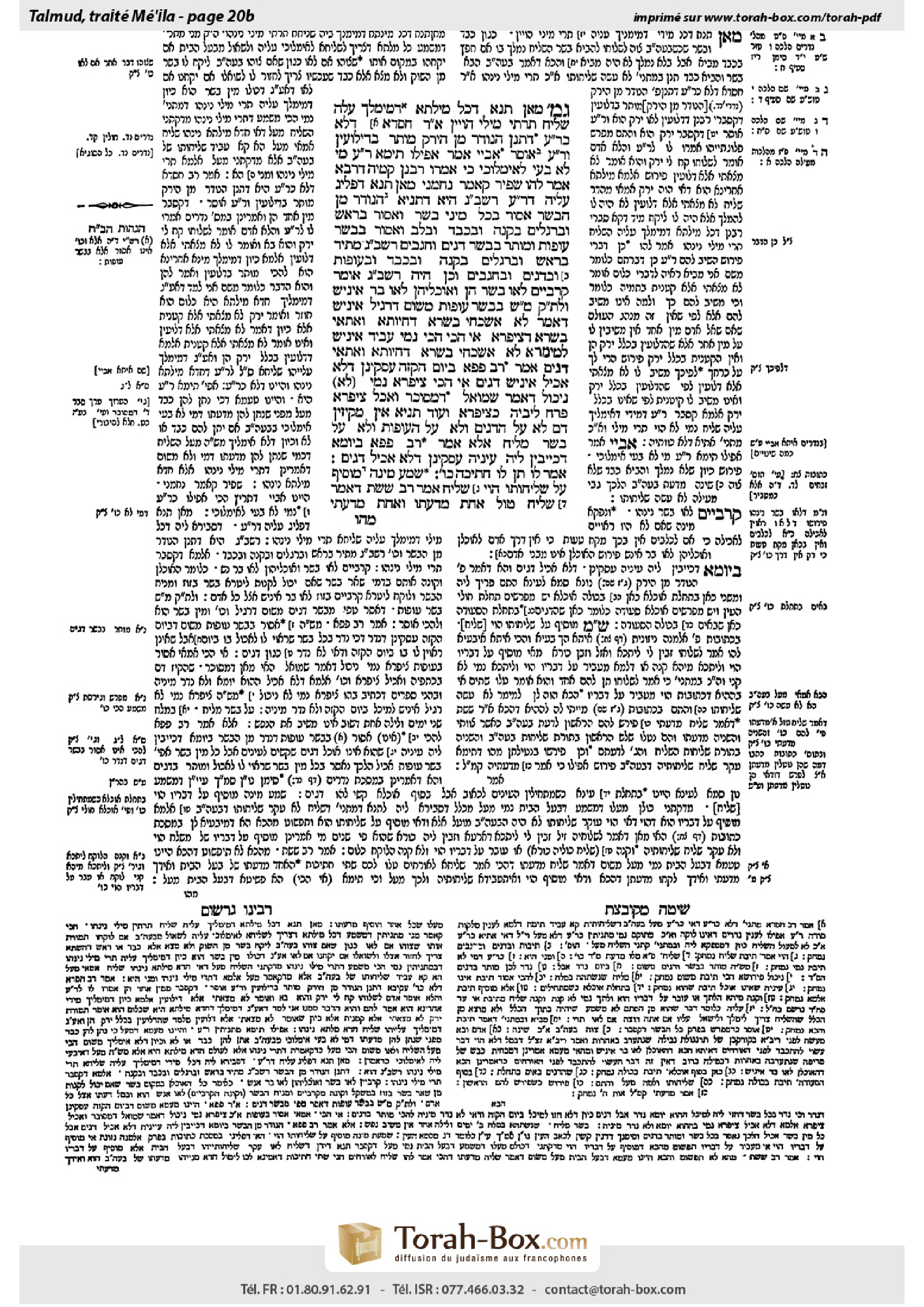
Meilah 20b: Talmud study for Daf Yomi
Daf Yomi is the daily study of one Talmud folio. Explore 37 tractates with scans, Hebrew text, Sefaria English and AI-generated French translations where annotated.
Passage selection and English or AI-generated French translation are available where the scan has annotations. Daf Study is independent of Torah-Box and Sefaria.
Browse Meilah · מעילה · All tractatesMeilah 20b text and translations
This page of Meilah includes the Aramaic text, an English translation and an AI-generated French translation, alongside the scan above.
מעילה כ׳ ב · Aramaic and Hebrew text
גְּמָ׳ מַאן תַּנָּא דְּכׇל מִילְּתָא דְּמִימְּלַךְ עֲלַהּ שָׁלִיחַ תַּרְתֵּי מִילֵּי הָוְיָין?
אָמַר רַב חִסְדָּא: דְּלָא כְּרַבִּי עֲקִיבָא, דִּתְנַן: הַנּוֹדֵר מִן הַיָּרָק – מוּתָּר בְּדִילּוּעִין, וְרַבִּי עֲקִיבָא אוֹסֵר.
אַבָּיֵי אָמַר: אֲפִילּוּ תֵּימָא רַבִּי עֲקִיבָא, מִי לָא בָּעֵי לְאִימְּלוֹכֵי? כִּי אֲמַרוּ רַבָּנַן קַמֵּיהּ דְּרָבָא, אֲמַר לְהוּ: שַׁפִּיר קָאָמַר נַחְמָנִי!
מַאן תַּנָּא דִּפְלִיג עֲלֵיהּ דְּרַבִּי עֲקִיבָא? רַבָּן שִׁמְעוֹן בֶּן גַּמְלִיאֵל הִיא, דְּתַנְיָא: הַנּוֹדֵר מִן הַבָּשָׂר – אָסוּר בְּכׇל מִינֵי בָּשָׂר, וְאָסוּר בָּרֹאשׁ וּבָרַגְלַיִם, בַּקָּנֶה וּבַכָּבֵד וּבַלֵּב. וְאָסוּר בִּבְשַׂר עוֹפוֹת, וּמוּתָּר בִּבְשַׂר דָּגִים וַחֲגָבִים. רַבָּן שִׁמְעוֹן בֶּן גַּמְלִיאֵל מַתִּיר בָּרֹאשׁ וּבָרַגְלַיִם, בַּקָּנֶה וּבַכָּבֵד, וּבָעוֹפוֹת וּבַדָּגִים וּבַחֲגָבִים.
וְכֵן הָיָה רַבָּן שִׁמְעוֹן בֶּן גַּמְלִיאֵל אוֹמֵר: קְרָבַיִים לָאו בָּשָׂר הֵן, וְאוֹכְלֵיהֶן לָאו בַּר אִינִישׁ.
וּלְתַנָּא קַמָּא, מַאי שְׁנָא בִּבְשַׂר עוֹפוֹת? מִשּׁוּם דִּרְגִיל אִינִישׁ דְּאָמַר: לָא אַשְׁכַּחִי בִּשְׂרָא דְּחֵיוְתָא, וַאֲתַאי בִּשְׂרָא דְצִיפְּרָא. אִי הָכִי, הָכִי נָמֵי עֲבִיד אִינִישׁ לְמֵימְרָא: לָא אַשְׁכַּחִי בִּשְׂרָא דְּחֵיוְתָא, וַאֲתַאי דָּגִים!
אָמַר רַב פָּפָּא: בְּיוֹם הַקָּזָה עָסְקִינַן, דְּלָא אָכֵיל אִינִישׁ דָּגִים.
אִי הָכִי, צִיפְּרָא נָמֵי לָא נֵיכוֹל, דְּאָמַר שְׁמוּאֵל: דִּמְסוֹכַר וְאָכֵל צִיפְּרָא – פָּרַח לִיבֵּיהּ כְּצִיפְּרָא! וְעוֹד, תַּנְיָא: אֵין מַקִּיזִין דָּם לֹא עַל הַדָּגִים, וְלֹא עַל הָעוֹפוֹת, וְלֹא עַל בָּשָׂר מָלִיחַ.
אֶלָּא אָמַר רַב פָּפָּא: בְּיוֹמָא דְּכָיְיבִין לֵיהּ עֵינֵיהּ עָסְקִינַן, דְּלָא אָכֵיל דָּגִים.
אָמַר לוֹ: תֵּן לוֹ חֲתִיכָה כּוּ׳. שְׁמַע מִינַּהּ: מוֹסִיף עַל שְׁלִיחוּתוֹ – הָוֵי שָׁלִיחַ!
אָמַר רַב שֵׁשֶׁת: דְּאָמַר שָׁלִיחַ: טוֹל אַחַת מִדַּעְתּוֹ וְאַחַת מִדַּעְתִּי.
Meilah 20b · English translation
GEMARA: The mishna teaches that an agent is considered to have diverged from the instructions of the homeowner if he gives each of the guests liver instead of meat or vice versa. This indicates that meat and liver are considered two different types of items, as giving one in place of the other would normally be done only after consultation with the homeowner. The Gemara asks: Who is the tanna who taught this halakha, that any case involving an item about which the agent would normally consult whether to give it or to give another item in its stead is considered to involve two separate items with regard to the prohibition of misuse?
Rav Ḥisda said that this is not in accordance with the opinion of Rabbi Akiva. As we learned in a mishna (Nedarim 54a): In the case of one who takes a vow that vegetables are prohibited to him, without specifying which types of vegetable, he is permitted to eat gourds, as people do not typically include gourds in the category of vegetables; but Rabbi Akiva deems it prohibited for him to eat gourds. Rabbi Akiva maintains that as an agent would consult the homeowner before buying gourds instead of vegetables, they are in the same category. He reasons that if they were not both in the same category, the agent would not even bother consulting the homeowner if he would prefer gourds instead. Therefore, Rabbi Akiva maintains that any item about which the agent would ask is included in the same category as the item he specified, and they are not two separate items.
Abaye said: You may even say that the mishna is in accordance with the opinion of Rabbi Akiva, as doesn’t Rabbi Akiva concede that the agent needs to consult the one who appointed him? Since the agent failed to consult him, and he acted on his own when he gave liver instead of meat, he is not considered to have performed his agency. Consequently, he is liable for misuse. In other words, the ruling of the mishna is not due to the fact that meat and liver are considered two different types of items, but because the agent failed to perform his agency. When the Rabbis said this halakha before Rava, he said to them: Naḥmani, i.e., Abaye, is saying well.
The Gemara asks: Who is the tanna who disagrees with the opinion of Rabbi Akiva in the mishna in tractate Nedarim? The Gemara answers that it is Rabban Shimon ben Gamliel, as it is taught in a baraita: With regard to one who takes a vow that meat is forbidden to him, he is prohibited from eating all types of meat, and is prohibited from eating meat of the head, of the feet, of the windpipe, of the liver, and of the heart, despite the fact that people do not typically eat meat from those parts of the body. And it is prohibited for him to eat meat of birds, as that too is popularly called meat. But it is permitted for him to eat the meat of fish and grasshoppers, as their flesh is not called meat. Rabban Shimon ben Gamliel permits him to eat meat of the head, of the feet, of the windpipe, of the liver, of the heart, of birds, and needless to say also of fish and of grasshoppers.
And Rabban Shimon ben Gamliel would likewise say: Innards are not considered meat, and one who eats them is not a person, i.e., innards are unfit for human consumption. It can be inferred from here that Rabban Shimon ben Gamliel disagrees with Rabbi Akiva and maintains that although an agent who fails to find meat would consult the one who appointed him and then replace the meat with liver, the liver is not considered meat with regard to vows.
With regard to the above baraita, the Gemara asks: And according to the opinion of the first tanna, what is different about meat of birds that he considers it in the same category as regular meat? It must be because a person normally says, when he cannot find meat and returns to the one who appointed him: I did not find meat of animals but I brought meat of birds instead. The Gemara asks: If so, then also with regard to fish a person is apt to say: I did not find meat of an animal, but I brought fish instead. Why, then, is fish considered a separate category?
Rav Pappa said: We are dealing with the day of one’s bloodletting, as a person in that condition does not eat fish. Since it was accepted at the time that eating fish after bloodletting is harmful, the agent would never consider buying fish instead of meat, and would not even consult with the one who appointed him as to whether or not to purchase fish.
The Gemara asks: If so, he would not eat birds either, as Shmuel said: With regard to one who lets blood and eats the meat of a bird, his heart rate accelerates and flies like a bird. Clearly, bird meat is also deleterious for one’s health after bloodletting. And furthermore it is taught in a baraita: One does not let blood before eating fish, nor before eating birds, nor before eating salted meat.
Rather, Rav Pappa said: We are dealing with a case which occurred on a day that his eyes hurt him, as people do not eat fish on that day, since fish are harmful to the eyes. Therefore, the agent would neither purchase fish nor consult with the homeowner whether to do so.
§ The mishna teaches: If the homeowner said to the agent: Give him meat, a piece for each guest, and the agent says: Each of you take two pieces, and each of the guests took three pieces, all of them are liable for misuse. The Gemara suggests: One can learn from the mishna that if an agent adds to his agency he is still considered an agent, and therefore the one who appointed him is also liable, as the agent did not uproot his instructions entirely.
Rav Sheshet said that this inference is not necessarily correct, because the mishna can be explained as referring specifically to a case where the agent said to the guests: Take one piece of meat in accordance with the intent of the homeowner and one piece in accordance with my intent.
Meilah 20b · Traduction française (IA)
GUEMARA : La Michna enseigne qu’un mandataire est considéré comme s’étant écarté des instructions du propriétaire s’il donne à chacun des invités du foie au lieu de viande, ou inversement. Cela indique que la viande et le foie sont considérés comme deux catégories distinctes, car, normalement, on ne donnerait l’un à la place de l’autre qu’après avoir consulté le propriétaire. La Guemara demande : Quel est le tanna qui a enseigné cette halakha, selon laquelle, dans tout cas où le mandataire consulterait normalement le propriétaire pour savoir s’il doit donner un produit ou le remplacer par un autre, les deux produits sont considérés comme distincts au regard de l’interdiction de détournement ?
Rav Ḥisda dit que cela ne correspond pas à l’opinion de Rabbi Akiva. En effet, nous avons appris dans une Michna (Nedarim 54a) : Celui qui fait le vœu de s’interdire les légumes, sans préciser lesquels, peut manger des courges, car les gens ne rangent généralement pas les courges dans la catégorie des légumes ; mais Rabbi Akiva lui interdit d’en manger. Selon Rabbi Akiva, puisque le mandataire consulterait le propriétaire avant d’acheter des courges à la place de légumes, les deux relèvent de la même catégorie. Il estime que, s’ils ne relevaient pas de la même catégorie, le mandataire ne prendrait même pas la peine de demander au propriétaire s’il préfère des courges à la place. Par conséquent, Rabbi Akiva considère que tout produit au sujet duquel le mandataire poserait la question relève de la même catégorie que le produit demandé ; les deux ne constituent donc pas des produits distincts.
Abayé dit : On peut même soutenir que la Michna est conforme à l’opinion de Rabbi Akiva, car celui-ci ne reconnaît-il pas que le mandataire doit consulter celui qui l’a mandaté ? Puisque le mandataire ne l’a pas consulté et qu’il a agi de son propre chef en donnant du foie à la place de la viande, il n’est pas considéré comme ayant exécuté son mandat. Il est donc passible de détournement. Autrement dit, la décision de la Michna ne tient pas au fait que la viande et le foie sont considérés comme deux catégories distinctes, mais au fait que le mandataire n’a pas exécuté son mandat. Lorsque les rabbins enseignèrent cette halakha devant Rava, celui-ci leur dit : « Naḥmani », c’est-à-dire Abayé, « parle bien ».
La Guemara demande : Quel est le tanna qui conteste l’opinion de Rabbi Akiva dans la Michna du traité Nedarim ? La Guemara répond qu’il s’agit de Rabban Shimon ben Gamliel, comme l’enseigne une baraïta : Celui qui fait le vœu de s’interdire la viande ne peut manger aucune sorte de viande ; il lui est également interdit de manger la viande de la tête, des pieds, de la trachée, du foie et du cœur, bien que les gens ne mangent généralement pas ces parties du corps. Il lui est aussi interdit de manger de la viande d’oiseau, car celle-ci est également couramment appelée « viande ». En revanche, il peut manger la chair des poissons et des sauterelles, car leur chair n’est pas appelée « viande ». Rabban Shimon ben Gamliel lui permet de manger la viande de la tête, des pieds, de la trachée, du foie, du cœur et des oiseaux, et, à plus forte raison, celle des poissons et des sauterelles.
Rabban Shimon ben Gamliel disait également : « Les abats ne sont pas considérés comme de la viande, et celui qui en mange n’est pas une personne », c’est-à-dire que les abats ne conviennent pas à la consommation humaine. On peut en déduire que Rabban Shimon ben Gamliel conteste l’opinion de Rabbi Akiva et considère que, même si un mandataire qui ne trouve pas de viande consulterait celui qui l’a mandaté avant de la remplacer par du foie, le foie n’est pas considéré comme de la viande en matière de vœux.
À propos de la baraïta citée plus haut, la Guemara demande : Selon le premier tanna, en quoi la viande d’oiseau se distingue-t-elle pour qu’il la considère comme relevant de la même catégorie que la viande ordinaire ? C’est nécessairement parce qu’une personne dit habituellement, lorsqu’elle ne trouve pas de viande et retourne auprès de celui qui l’a mandatée : « Je n’ai pas trouvé de viande animale, mais j’ai apporté de la viande d’oiseau à la place. » La Guemara demande : Si tel est le cas, une personne serait également susceptible de dire, à propos des poissons : « Je n’ai pas trouvé de viande animale, mais j’ai apporté des poissons à la place. » Pourquoi, alors, les poissons sont-ils considérés comme relevant d’une catégorie distincte ?
Rav Pappa dit : Nous parlons du jour où la personne se fait saigner, car, dans cet état, elle ne mange pas de poisson. À l’époque, on tenait pour admis que manger du poisson après une saignée était nocif ; le mandataire n’envisagerait donc jamais d’acheter du poisson à la place de la viande et ne consulterait même pas celui qui l’a mandaté pour savoir s’il devait en acheter.
La Guemara demande : Si tel est le cas, il ne mangerait pas non plus d’oiseaux, car Shmuel a dit : « Celui qui se fait saigner et mange de la viande d’oiseau voit son cœur s’accélérer et s’envoler comme un oiseau. » Il est donc clair que la viande d’oiseau est elle aussi nocive pour la santé après une saignée. De plus, une baraïta enseigne : « On ne se fait pas saigner avant d’avoir mangé du poisson, des oiseaux ou de la viande salée. »
Rav Pappa dit plutôt : Nous parlons d’un cas où, ce jour-là, la personne avait mal aux yeux, car les gens ne mangent pas de poisson ce jour-là, le poisson étant nocif pour les yeux. Le mandataire n’aurait donc ni acheté de poisson ni consulté le propriétaire pour savoir s’il devait en acheter.
§ La Michna enseigne : Si le propriétaire dit au mandataire : « Donne-lui de la viande, un morceau pour chaque invité », et que le mandataire dit : « Prenez deux morceaux chacun », puis que chacun des invités en prend trois, tous sont passibles de détournement. La Guemara suggère : On peut déduire de la Michna que si un mandataire ajoute quelque chose à son mandat, il reste considéré comme mandataire ; par conséquent, celui qui l’a mandaté est lui aussi passible, puisque le mandataire n’a pas entièrement écarté ses instructions.
Rav Sheshet dit que cette déduction n’est pas nécessairement juste, car on peut expliquer que la Michna vise précisément le cas où le mandataire a dit aux invités : « Prenez un morceau de viande conformément à l’intention du propriétaire et un morceau conformément à mon intention. »
Traduction française générée par IA à partir de l’édition anglaise de Sefaria. Vérifie toujours un passage avec le texte source.
Text from Sefaria: William Davidson Edition - Vocalized Aramaic (CC BY NC); William Davidson Edition - English (CC BY NC).