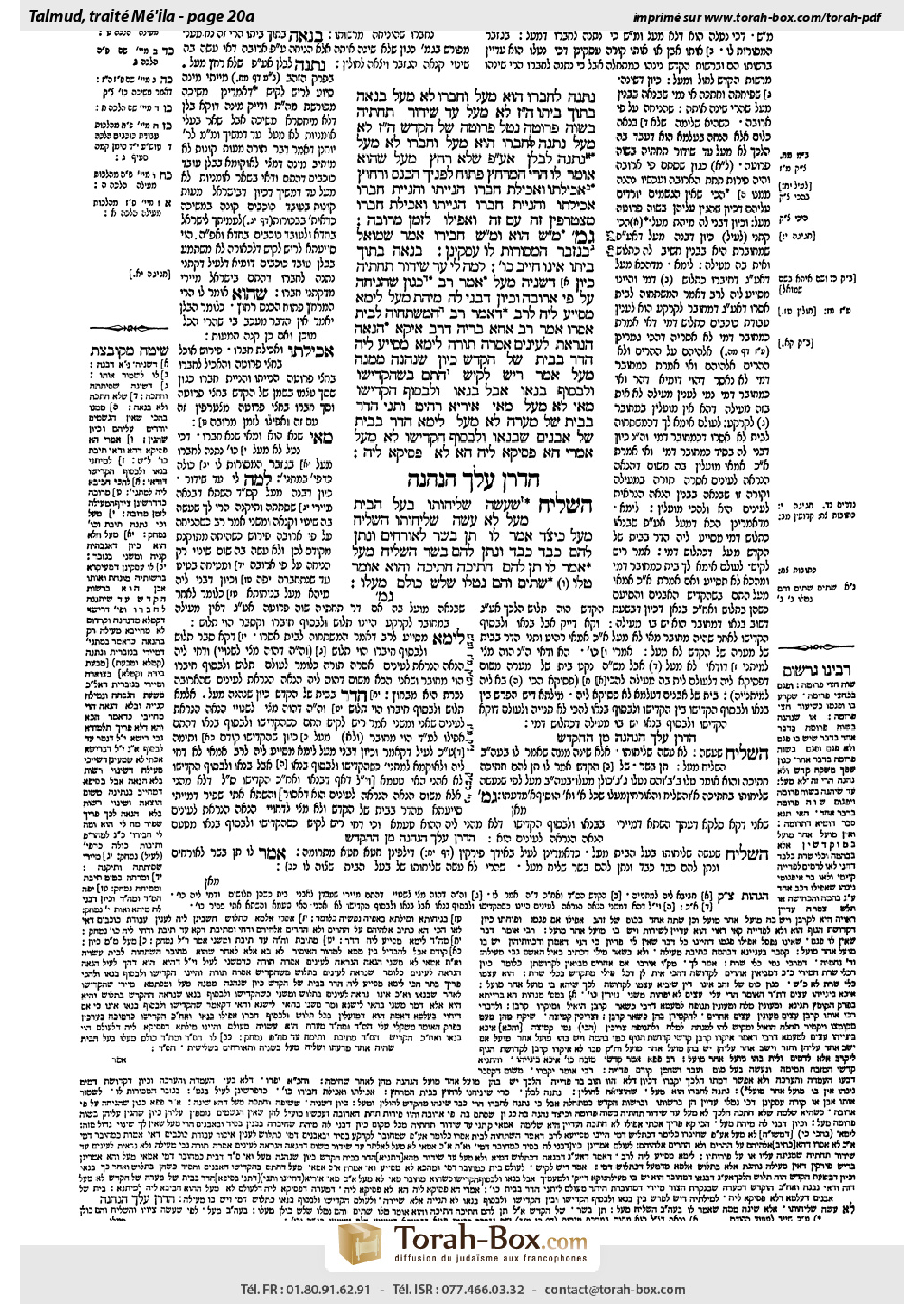
Meilah 20a: Talmud study for Daf Yomi
Daf Yomi is the daily study of one Talmud folio. Explore 37 tractates with scans, Hebrew text, Sefaria English and AI-generated French translations where annotated.
Passage selection and English or AI-generated French translation are available where the scan has annotations. Daf Study is independent of Torah-Box and Sefaria.
Browse Meilah · מעילה · All tractatesMeilah 20a text and translations
This page of Meilah includes the Aramaic text, an English translation and an AI-generated French translation, alongside the scan above.
מעילה כ׳ א · Aramaic and Hebrew text
נְתָנָהּ לַחֲבֵרוֹ – הוּא מָעַל, וַחֲבֵרוֹ לֹא מָעַל. בְּנָאָהּ בְּתוֹךְ בֵּיתוֹ – הֲרֵי זֶה לֹא מָעַל, עַד שֶׁיָּדוּר תַּחְתֶּיהָ בְּשָׁוֶה פְּרוּטָה.
נָטַל פְּרוּטָה שֶׁל הֶקְדֵּשׁ – הֲרֵי זֶה לֹא מָעַל. נְתָנָהּ לַחֲבֵרוֹ – הוּא מָעַל, וַחֲבֵרוֹ לֹא מָעַל. נְתָנָהּ לְבַלָּן, אַף עַל פִּי שֶׁלֹּא רָחַץ מָעַל, שֶׁהוּא אוֹמֵר לוֹ: הֲרֵי הַמֶּרְחָץ פָּתוּחַ לְפָנֶיךָ, הִכָּנֵס וּרְחוֹץ.
אֲכִילָתוֹ וַאֲכִילַת חֲבֵרוֹ, הֲנָיָיתוֹ וַהֲנָיַית חֲבֵרוֹ, אֲכִילָתוֹ וַהֲנָיַית חֲבֵרוֹ, הֲנָיָיתוֹ וַאֲכִילַת חֲבֵרוֹ – מִצְטָרְפִין זֶה עִם זֶה, וַאֲפִילּוּ לִזְמַן מְרוּבֶּה.
גְּמָ׳ מַאי שְׁנָא הוּא, וּמַאי שְׁנָא חֲבֵירוֹ?! אָמַר שְׁמוּאֵל: בְּגִזְבָּר, הַמְּסוּרוֹת לוֹ, עָסְקִינַן.
בְּנָאָהּ בְּתוֹךְ בֵּיתוֹ – אֵינוֹ חַיָּיב כּוּ׳. לְמָה לִי עַד שֶׁיָּדוּר תַּחְתֶּיהָ? כֵּיוָן דְּשַׁנְּיַהּ – מָעַל! אָמַר רַב: כְּגוֹן שֶׁהִנִּיחָהּ עַל פִּי אֲרוּבָּה.
וְכֵיוָן דְּבָנֵי לַהּ, מִיהַת מָעַל. לֵימָא מְסַיַּיע לֵיהּ לְרַב, דְּאָמַר רַב: הַמִּשְׁתַּחֲוֶה לְבַיִת – אֲסָרוֹ.
אָמַר רַב אַחָא בְּרֵיהּ דְּרַב אִיקָא: הֲנָאָה הַנִּרְאֵת לָעֵינַיִם אָסְרָה תּוֹרָה.
לֵימָא מְסַיַּיע לֵיהּ: הַדָּר בְּבַיִת שֶׁל הֶקְדֵּשׁ, כֵּיוָן שֶׁנֶּהֱנָה מִמֶּנָּה – מָעַל. אָמַר רֵישׁ לָקִישׁ: הָתָם בְּשֶׁהִקְדִּישׁוֹ וּלְבַסּוֹף בְּנָאוֹ.
אֲבָל בְּנָאוֹ וּלְבַסּוֹף הִקְדִּישׁוֹ, מַאי – לֹא מָעַל? מַאי אִירְיָא רָהֵיט וְתָנֵי הַדָּר בְּבַיִת שֶׁל מְעָרָה – לֹא מָעַל. לֵימָא הַדָּר בְּבַיִת שֶׁל אֲבָנִים שֶׁבְּנָאוֹ וּלְבַסּוֹף הִקְדִּישׁוֹ – לֹא מָעַל!
אָמְרִי: הָא פְּסִיקָא לֵיהּ., הָא לָא פְּסִיקָא לֵיהּ.
הֲדַרַן עֲלָךְ הַנֶּהֱנֶה
הַשָּׁלִיחַ שֶׁעָשָׂה שְׁלִיחוּתוֹ – בַּעַל הַבַּיִת מָעַל. לֹא עָשָׂה שְׁלִיחוּתוֹ – הַשָּׁלִיחַ מָעַל.
כֵּיצַד? אָמַר לוֹ: ״תֵּן בָּשָׂר לָאוֹרְחִים״, וְנָתַן לָהֶם כָּבֵד; ״כָּבֵד״, וְנָתַן לָהֶם בָּשָׂר – הַשָּׁלִיחַ מָעַל. אָמַר לוֹ: ״תֵּן לָהֶם חֲתִיכָה חֲתִיכָה״, וְהוּא אוֹמֵר: טְלוּ שְׁתַּיִם! וְהֵם נָטְלוּ שָׁלֹשׁ – כּוּלָּם מָעֲלוּ.
Meilah 20a · English translation
If he gave the stone or the beam to another, he is liable for its misuse and the other person is not liable for its misuse. If he built the stone or the beam into his house, he is not liable for its misuse until he resides beneath it and derives benefit equal to the value of one peruta from it.
If one took for his use a consecrated peruta, that person is not liable for its misuse. If he gave the peruta to another, he is liable for its misuse and the other person is not liable for its misuse. If he gave the peruta to a bathhouse attendant [levallan], although he did not bathe, he is liable for misuse of the peruta. The reason is that at the moment he receives the peruta, the attendant in effect says to the owner of the peruta: The bathhouse is open before you, enter and bathe. The benefit derived from that availability is worth one peruta.
One’s consumption of half of a peruta of consecrated food and another’s consumption of half of a peruta of consecrated food that the first person fed him; and likewise one’s benefit of half of a peruta derived from a consecrated item and another’s benefit of half of a peruta derived from a consecrated item that the first person provided him; and similarly one’s consumption and another’s benefit derived or one’s benefit derived and another’s consumption, all these join together to constitute the requisite measure of one peruta for liability for misuse, and that is the halakha even if much time has passed between these various acts of consumption and deriving of benefit.
GEMARA: The mishna teaches that if one takes a stone or a beam belonging to the Temple treasury, he is not liable for misuse, but if he gives it to another he is liable for misuse. The Gemara asks: What is different with regard to him retaining possession of the item, and what is different with regard to him giving it to another, that he is rendered liable when he gives it to another? Shmuel said: We are dealing with a treasurer [begizbar] of the Temple, to whom the consecrated property is given. Since all the consecrated property is meant to be in his possession and charge, he is not guilty of misuse, provided that he does not transfer it to another.
§ The mishna teaches: If he built the stone or the beam into his house, he is not liable for its misuse until he resides beneath it and derives benefit equal to the value of one peruta from it. The Gemara asks: Why do I need the mishna to state that the individual is not liable until he resides beneath it? That is not precise, as once he has changed it, by chiseling it for the purpose of fitting it into the structure, he has already committed misuse. Rav says: In this instance, the individual in question did not change the item in order to build with it. Rather, this is referring to a case where he placed it upon a window. Since mere placement does not constitute a change, there is no misuse until he lives beneath it.
The Gemara notes: And nevertheless, once he built it and subsequently derived benefit from it, in any event he has committed misuse. Although the halakha is that misuse does not apply to items that are attached to the ground, this does not apply to an item built into a structure. Let us say that this statement supports the opinion of Rav, as Rav said: With regard to one who prostrates himself to a house in an act of idolatry, he renders the house prohibited. The house assumes the status of a worshipped item, from which one may not derive benefit. Notwithstanding the halakha that an item attached to the ground does not become prohibited as an object of idolatry, the house does not assume the status of an item attached to the ground, since it is built of materials that were earlier detached from the ground.
Rav Aḥa, son of Rav Ika, said: The mishna does not necessarily support the opinion of Rav. It can be claimed that the item is subject to misuse even if one maintains that a detached item which becomes attached gains the status of an attached item, in accordance with the opinion that if someone worships a house, he does not render it prohibited. Nevertheless, in the case of the stone or beam the individual is liable for misuse, due to another principle: With regard to misuse, the Torah prohibited all benefit that appears readily to the eyes, e.g., one who uses consecrated property as building materials. It makes no difference that the item is now attached to the ground.
The Gemara suggests another proof for Rav’s opinion that an item which was previously detached and then becomes attached to the ground retains the status of a detached item. Let us say that a baraita supports the opinion of Rav: With regard to one who resides in a house consecrated to the Temple treasury, once he derives benefit from the house he has committed misuse. Evidently, the built house is considered detached, which is why it is subject to misuse. Reish Lakish said: This baraita does not support the opinion of Rav either. There, the baraita is speaking of a case where he consecrated the detached building materials and ultimately built the house. Since the items were detached when he consecrated them, the prohibition of misuse applies even if they were subsequently attached to the ground.
In light of Reish Lakish’s interpretation, the Gemara objects: But if he built the house and ultimately sanctified it when it was attached to the ground, what is the halakha? Evidently, he has not committed misuse. If so, why does the tanna of the baraita run specifically to teach the subsequent case: With regard to one who resides in a consecrated house of a cave, i.e., a domicile that has always been attached and was not built from detached components, he has not committed misuse, as an attached item is not subject to misuse. Why does the baraita mention this very different case? Let the baraita say simply: With regard to one who resides in a stone house, which he built and ultimately sanctified, he has not committed misuse.
The Gemara explains: One can say that although the tanna could have taught the case of the built house instead of a cave, he preferred to mention a cave, as this case of the cave is conclusive for him. Under all circumstances, one who lives in a consecrated cave is exempt from misuse, because the cave was always attached to the ground. By contrast, that case of the built house is not conclusive for him, as a consecrated house is not always exempt from misuse. If the house is built from previously consecrated materials, one who lives within it is liable for misuse.
MISHNA: With regard to an agent who performed his agency properly, if he was tasked to make use of a particular item, and the one who appointed him forgot that it was a consecrated item, the homeowner, who appointed him, is liable for misuse of the consecrated item, as the agent acted on his behalf. Contrary to other cases of agency, where the guiding principle is that there is no agency in the performance of a transgression, and the agent is liable, in this case there is agency, and the homeowner is liable for the action of the agent. But if he did not perform his agency properly, the agent is liable for misuse of the consecrated item, as once the agent deviates from his agency, he ceases to be an agent, and his actions are attributable to him.
How so? If the homeowner said to the agent: Give meat to the guests, and he gave them liver; or if he said: Give them liver, and he gave them meat, the agent is liable for misuse of the consecrated item, as he deviated from his agency. If the homeowner said to the agent: Give them meat, a piece for this guest and a piece for that guest, and the agent says: Each of you take two pieces, and each of the guests took three pieces, all of them are liable for misuse. The homeowner is liable for their consumption of the first piece of meat, as with regard to that piece his instructions were fulfilled. The agent is liable for the second piece, which he added to the instructions of the homeowner. Finally, the guests are liable for the third piece, which they took at their own initiative beyond the instructions of the agent.
Meilah 20a · Traduction française (IA)
S’il a donné la pierre ou la poutre à une autre personne, il est responsable de son usage illicite, tandis que l’autre personne n’en est pas responsable. S’il a incorporé la pierre ou la poutre à sa maison, il n’est pas responsable de son usage illicite tant qu’il n’a pas habité dessous et tiré de cet objet un bénéfice d’une valeur d’une pérouta.
Si quelqu’un a pris pour son usage une pérouta consacrée, il n’est pas responsable de son usage illicite. S’il a donné la pérouta à une autre personne, il est responsable de son usage illicite, tandis que l’autre personne n’en est pas responsable. S’il a donné la pérouta à un employé des bains publics [levallan], il est responsable de son usage illicite, même s’il ne s’est pas baigné. En effet, au moment où l’employé reçoit la pérouta, il dit en quelque sorte à son propriétaire : « Les bains publics sont à votre disposition ; entrez et baignez-vous. » Le bénéfice découlant de cette mise à disposition vaut une pérouta.
La consommation par une personne d’aliments consacrés d’une valeur d’une demi-pérouta et celle, par une autre personne, d’aliments consacrés d’une valeur d’une demi-pérouta que la première lui a fait manger ; de même, le bénéfice d’une valeur d’une demi-pérouta tiré par une personne d’un objet consacré et celui d’une valeur d’une demi-pérouta tiré par une autre personne d’un objet consacré que la première lui a procuré ; et pareillement, la consommation par l’une et le bénéfice tiré par l’autre, ou le bénéfice tiré par l’une et la consommation par l’autre : tous ces actes s’additionnent pour atteindre la mesure requise d’une pérouta et engager la responsabilité pour usage illicite. Il en va ainsi même si beaucoup de temps s’est écoulé entre ces divers actes de consommation et de jouissance.
GUEMARA : La Michna enseigne que celui qui prend une pierre ou une poutre appartenant au Trésor du Temple n’est pas responsable de son usage illicite, mais que, s’il la donne à une autre personne, il en est responsable. La Guemara demande : Quelle différence y a-t-il entre le fait qu’il garde l’objet et le fait qu’il le donne à une autre personne, pour qu’il soit tenu responsable lorsqu’il le lui donne ? Chmouel dit : Il s’agit d’un trésorier [begizbar] du Temple, auquel sont confiés les biens consacrés. Puisque tous ces biens sont destinés à être sous sa garde et en sa possession, il ne commet pas d’usage illicite, à condition de ne pas les transférer à une autre personne.
§ La Michna enseigne : S’il a incorporé la pierre ou la poutre à sa maison, il n’est pas responsable de son usage illicite tant qu’il n’a pas habité dessous et tiré de cet objet un bénéfice d’une valeur d’une pérouta. La Guemara demande : Pourquoi la Michna doit-elle préciser que la personne n’est pas responsable tant qu’elle n’a pas habité dessous ? Cette formulation manque de précision, car dès qu’elle l’a modifiée en la taillant pour l’ajuster à la construction, elle a déjà commis un usage illicite. Rav dit : Dans ce cas, la personne en question ne l’a pas modifiée en vue de construire avec. Il s’agit plutôt d’un cas où elle l’a posée sur une fenêtre. Comme le simple fait de la poser ne constitue pas une modification, il n’y a pas d’usage illicite tant qu’elle n’habite pas dessous.
La Guemara relève : Néanmoins, dès lors qu’il l’a incorporée à la construction et qu’il en a ensuite tiré un bénéfice, il a, de toute façon, commis un usage illicite. Bien que, selon la halakha, l’usage illicite ne s’applique pas aux objets attachés au sol, cela ne vaut pas pour un objet incorporé à une structure. Disons que cela confirme l’opinion de Rav, car Rav a dit : Celui qui se prosterne devant une maison dans le cadre d’un acte d’idolâtrie la rend interdite. La maison acquiert alors le statut d’un objet adoré, dont il est interdit de tirer bénéfice. Malgré la halakha selon laquelle un objet attaché au sol ne devient pas interdit en tant qu’objet d’idolâtrie, la maison n’acquiert pas le statut d’un objet attaché au sol, puisqu’elle est construite avec des matériaux qui étaient auparavant détachés du sol.
Rav Aḥa, fils de Rav Ika, dit : La Michna ne confirme pas nécessairement l’opinion de Rav. On peut soutenir que l’objet est passible d’usage illicite même si l’on estime qu’un objet détaché qui devient ensuite attaché acquiert le statut d’un objet attaché, conformément à l’opinion selon laquelle celui qui adore une maison ne la rend pas interdite. Néanmoins, dans le cas de la pierre ou de la poutre, la personne est responsable de son usage illicite en vertu d’un autre principe : en matière d’usage illicite, la Torah interdit tout bénéfice évident, par exemple l’utilisation de biens consacrés comme matériaux de construction. Le fait que l’objet soit désormais attaché au sol ne change rien.
La Guemara propose une autre preuve en faveur de l’opinion de Rav, selon laquelle un objet auparavant détaché qui est ensuite attaché au sol conserve le statut d’objet détaché. Disons qu’une baraïta confirme l’opinion de Rav : celui qui habite dans une maison consacrée au Trésor du Temple commet un usage illicite dès qu’il en tire un bénéfice. Il ressort de là que la maison construite est considérée comme un objet détaché, ce qui explique qu’elle soit passible d’usage illicite. Rech Lakich dit : Cette baraïta non plus ne confirme pas l’opinion de Rav. Elle parle d’un cas où la personne a consacré des matériaux de construction alors qu’ils étaient détachés, puis a construit la maison. Puisque les matériaux étaient détachés lorsqu’elle les a consacrés, l’interdiction d’usage illicite s’applique même s’ils ont ensuite été attachés au sol.
À la lumière de l’interprétation de Rech Lakich, la Guemara objecte : Mais si la personne a construit la maison, puis l’a consacrée alors qu’elle était attachée au sol, quelle est la halakha ? Il ressort qu’elle n’a pas commis d’usage illicite. Dans ce cas, pourquoi le tanna de la baraïta s’empresse-t-il d’enseigner précisément le cas suivant : celui qui habite dans une maison consacrée creusée dans une grotte, c’est-à-dire un lieu d’habitation qui a toujours été attaché au sol et n’a pas été construit à partir d’éléments détachés, ne commet pas d’usage illicite, puisque les objets attachés au sol n’y sont pas passibles ? Pourquoi la baraïta mentionne-t-elle ce cas si différent ? Qu’elle dise simplement : celui qui habite dans une maison de pierre qu’il a construite puis consacrée ne commet pas d’usage illicite.
La Guemara explique : On peut dire que, bien que le tanna aurait pu enseigner le cas d’une maison construite plutôt que celui d’une grotte, il a préféré mentionner une grotte, car ce cas est concluant. En toute circonstance, celui qui habite dans une grotte consacrée ne commet pas d’usage illicite, puisque la grotte a toujours été attachée au sol. En revanche, le cas de la maison construite n’est pas concluant, car une maison consacrée n’est pas toujours exonérée d’usage illicite. Si la maison a été construite avec des matériaux consacrés auparavant, celui qui y habite est responsable de leur usage illicite.
MICHNA : Lorsqu’un mandataire exécute correctement la mission qui lui a été confiée, si on lui avait demandé d’utiliser un objet précis et que la personne qui l’a mandaté a oublié qu’il s’agissait d’un objet consacré, le propriétaire qui l’a mandaté est responsable de l’usage illicite de l’objet consacré, car le mandataire a agi pour son compte. Contrairement aux autres cas de mandat, où le principe directeur est qu’il n’y a pas de mandat pour l’accomplissement d’une transgression et que le mandataire est responsable, dans ce cas le mandat s’applique et le propriétaire est responsable de l’acte du mandataire. Mais si le mandataire n’a pas exécuté correctement sa mission, il est responsable de l’usage illicite de l’objet consacré, car dès qu’il s’écarte de sa mission, il cesse d’être mandataire et ses actes lui sont imputés.
Comment cela ? Si le propriétaire a dit au mandataire : « Donne de la viande aux invités », et que celui-ci leur a donné du foie ; ou s’il lui a dit : « Donne-leur du foie », et qu’il leur a donné de la viande, le mandataire est responsable de l’usage illicite de l’objet consacré, car il s’est écarté de sa mission. Si le propriétaire a dit au mandataire : « Donne-leur de la viande, un morceau à cet invité et un morceau à cet autre invité », et que le mandataire leur dit : « Prenez-en chacun deux morceaux », puis que chacun des invités en prend trois, tous sont responsables de l’usage illicite. Le propriétaire est responsable de leur consommation du premier morceau de viande, puisque ses instructions ont été respectées pour ce morceau. Le mandataire est responsable du deuxième morceau, qu’il a ajouté aux instructions du propriétaire. Enfin, les invités sont responsables du troisième morceau, qu’ils ont pris de leur propre initiative, au-delà des instructions du mandataire.
Traduction française générée par IA à partir de l’édition anglaise de Sefaria. Vérifie toujours un passage avec le texte source.
Text from Sefaria: William Davidson Edition - Vocalized Aramaic (CC BY NC); William Davidson Edition - English (CC BY NC).