Meilah 19b: Talmud study for Daf Yomi
Daf Yomi is the daily study of one Talmud folio. Explore 37 tractates with scans, Hebrew text, Sefaria English and AI-generated French translations where annotated.
Passage selection and English or AI-generated French translation are available where the scan has annotations. Daf Study is independent of Torah-Box and Sefaria.
Browse Meilah · מעילה · All tractatesMeilah 19b text and translations
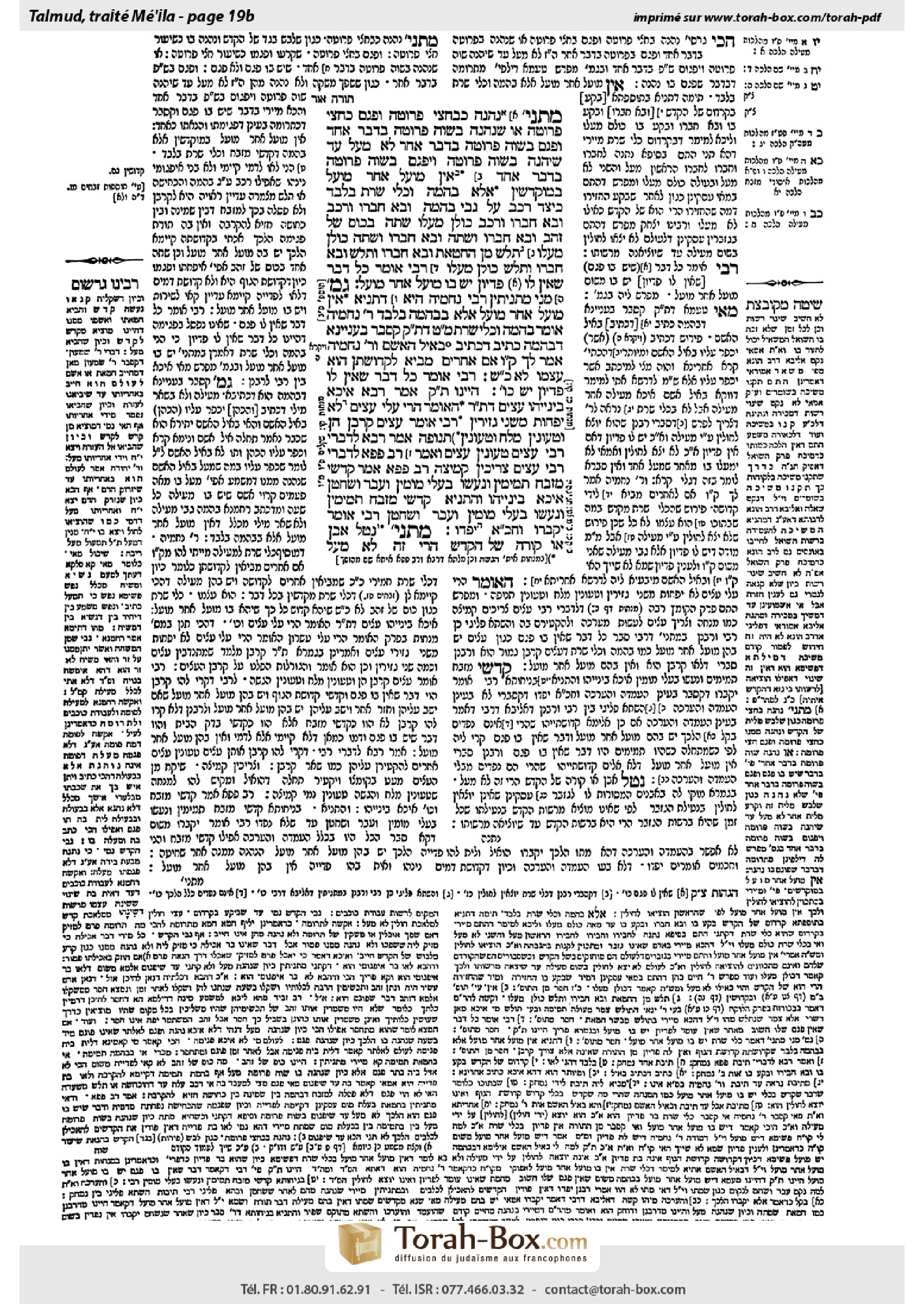
This page of Meilah includes the Aramaic text, an English translation and an AI-generated French translation, alongside the scan above.
מעילה י״ט ב · Aramaic and Hebrew text
מַתְנִי׳ נֶהֱנָה כְּבַחֲצִי פְרוּטָה וּפָגַם כַּחֲצִי פְרוּטָה, אוֹ שֶׁנֶּהֱנָה בְּשָׁוֶה פְּרוּטָה בְּדָבָר אֶחָד וּפָגַם בְּשָׁוֶה פְּרוּטָה בְּדָבָר אַחֵר – לֹא מָעַל, עֵד שֶׁיֵּהָנֶה בְּשָׁוֶה פְּרוּטָה וְיִפְגֹּם בְּשָׁוֶה פְּרוּטָה בְּדָבָר אֶחָד.
אֵין מוֹעֵל אַחַר מוֹעֵל בְּמוּקְדָּשִׁין אֶלָּא בְּהֵמָה וּכְלִי שָׁרֵת בִּלְבַד. כֵּיצַד? רָכַב עַל גַּבֵּי בְּהֵמָה, וּבָא חֲבֵרוֹ וְרָכַב, וּבָא חֲבֵרוֹ וְרָכַב – כּוּלָּן מָעֲלוּ. שָׁתָה בְּכוֹס שֶׁל זָהָב, וּבָא חֲבֵרוֹ וְשָׁתָה, וּבָא חֲבֵרוֹ וְשָׁתָה – כּוּלָּן מָעֲלוּ. תָּלַשׁ מִן הַחַטָּאת, וּבָא חֲבֵרוֹ וְתָלַשׁ, וּבָא חֲבֵרוֹ וְתָלַשׁ – כּוּלָּן מָעֲלוּ. רַבִּי אוֹמֵר: כׇּל דָּבָר שֶׁאֵין לוֹ פִּדְיוֹן – יֵשׁ בּוֹ מוֹעֵל אַחַר מוֹעֵל.
גְּמָ׳ מַנִּי? מַתְנִיתִין רַבִּי נְחֶמְיָה, הִיא: דְּתַנְיָא אֵין מוֹעֵל אַחַר מוֹעֵל אֶלָּא בִּבְהֵמָה בִּלְבַד. רַבִּי נְחֶמְיָה אוֹמֵר: בְּהֵמָה וּכְלִי שָׁרֵת.
מַאי טַעְמָא דְּתַנָּא קַמָּא? קָסָבַר: בְּעִנְיָינָא דִבְהֵמָה כְּתִיב, דִּכְתִיב בְּאֵיל הָאָשָׁם.
וְרַבִּי נְחֶמְיָה, אָמַר לָךְ: קַל וָחוֹמֶר: אִם אֲחֵרִים מֵבִיא לִקְדוּשָּׁתָן, הוּא עַצְמוֹ – לֹא כׇּל שֶׁכֵּן!
רַבִּי אוֹמֵר: כׇּל דָּבָר שֶׁאֵין לוֹ פִּדְיוֹן, יֵשׁ כּוּ׳. הַיְינוּ תַּנָּא קַמָּא! אָמַר רָבָא: אִיכָּא בֵּינַיְיהוּ עֵצִים.
דְּתָנוּ רַבָּנַן: הָאוֹמֵר ״הֲרֵי עָלַי עֵצִים״ – לֹא יִפְחוֹת מִשְּׁנֵי גְזִירִין. רַבִּי אוֹמֵר: עֵצִים – קׇרְבָּן הֵן, וּטְעוּנִין מֶלַח, וּטְעוּנִין תְּנוּפָה.
אָמַר רָבָא: לְדִבְרֵי רַבִּי, עֵצִים טְעוּנִין עֵצִים. וְאָמַר רַב פָּפָּא: לְדִבְרֵי רַבִּי, עֵצִים צְרִיכִין קְמִיצָה.
רַב פָּפָּא אָמַר: קׇדְשֵׁי מִזְבֵּחַ תְּמִימִין וְנַעֲשׂוּ בַּעֲלֵי מוּמִין וְעָבַר וּשְׁחָטָן אִיכָּא בֵּינַיְיהוּ.
וְהָתַנְיָא: קׇדְשֵׁי מִזְבֵּחַ תְּמִימִין, וְנַעֲשׂוּ בַּעֲלֵי מוּמִין, וְעָבַר וּשְׁחָטָן, רַבִּי אוֹמֵר: יִקָּבְרוּ,
וַחֲכָמִים אוֹמְרִים: יִפָּדוּ.
מַתְנִי׳ נָטַל אֶבֶן אוֹ קוֹרָה שֶׁל הֶקְדֵּשׁ – הֲרֵי זֶה לֹא מָעַל.
Meilah 19b · English translation
MISHNA: If one derived benefit equal to half of a peruta from a consecrated item and caused it half of a peruta of damage, or if he derived benefit equal to the value of one peruta from a consecrated item that has the potential to be damaged and caused damage of the value of one peruta to another consecrated item but derived no benefit from it, he is exempt. The reason is that one is not liable for misuse until he derives benefit of the value of one peruta from a consecrated item and causes damage of the value of one peruta to one, i.e., the same item.
One is liable for misuse after misuse in consecrated items only in the case of an animal and in the case of service vessels.How so? If one rode upon a sacrificial animal, and another person came and rode upon that animal, and yet another came and rode upon it as well, all of them are liable for misuse of the animal. In the case of service vessels, if one drank from a gold cup, and another came and drank from that cup, and yet another individual came and drank from it, all of them are liable for misuse of the cup. If one removed wool from a sin offering, and another came and removed wool from that animal, and yet another person came and removed wool from it, all of them are liable for misuse of the animal. Rabbi Yehuda HaNasi says: With regard to any consecrated item that is not subject to redemption, there is liability for misuse after misuse with regard to it.
GEMARA: According to the mishna, one can be liable for misuse after misuse only in the case of an animal or service vessels. The Gemara inquires: Whose opinion is expressed in the mishna? It is the opinion of Rabbi Neḥemya, as it is taught in a baraita (Tosefta 2:6): One is liable for misuse after misuse only in the case of an animal alone. Since an animal designated for sacrifice is not awaiting redemption or sale, its sanctity is not compromised when someone misuses it. It is therefore susceptible to repeated misuse. But with regard to service vessels, as according to the first tanna of the baraita they may be redeemed, their sanctity is compromised after they are misused even once, and they are no longer subject to misuse. Rabbi Neḥemya says: One is liable for misuse both in the case of an animal and in the case of service vessels.
The Gemara asks: What is the reason of the first tanna in the baraita, who rules that service vessels are not susceptible to repeated misuse? The Gemara answers that he holds that the halakha of misuse is written with regard to the case of an animal. As it is written: “If anyone commits a misuse, and sins through error, in the sacred items of the Lord, then he shall bring his guilt offering to the Lord…and the priest shall make atonement for him with the ram of the guilt offering, and he shall be forgiven” (Leviticus 5:15–16). It is derived from here that the liability for repeated misuse applies only to an animal.
And Rabbi Neḥemya could have said to you, in response, the following a fortiori inference: If a service vessel brings other materials placed in them to their state of sanctity, thereby rendering those materials susceptible to misuse after misuse, all the more so is it not clear that the vessel itself should be susceptible to misuse after misuse.
§ The mishna teaches that Rabbi Yehuda HaNasi says: With regard to any consecrated item that is not subject to redemption, there is liability for misuse after misuse. The Gemara raises a difficulty: This opinion is the same as that of the first tanna. Why is this ruling presented as a dissenting opinion? Rava said: There is a difference between them in the case of donated wood. The first tanna maintains that wood does not have the status of an item consecrated as an offering; rather, it has the status of an item consecrated for Temple maintenance, and is therefore not subject to repeated misuse. By contrast, Rabbi Yehuda HaNasi holds that wood has the status of items consecrated as an offering, which is not subject to damage and is therefore subject to repeated misuse.
As the Sages taught in a baraita: With regard to one who says, in the form of a vow: It is incumbent upon me to bring wood to the Temple, he must not bring fewer than two logs for the arrangement on the altar. Rabbi Yehuda HaNasi says: Wood is considered an offering, as it is placed upon the altar, and therefore it requires salt, and it requires waving, like a meal offering.
Rava says: According to the statement of Rabbi Yehuda HaNasi, wood donated in this manner requires more wood as an accompaniment, so that the donated sacrificial wood is sacrificed in the same manner as other donated offerings. And Rav Pappa further says: According to the statement of Rabbi Yehuda HaNasi, wood donated in this manner requires the removal of a handful. Similar to the rite of a meal offering, a portion of the wood must be removed and burned first.
Rav Pappa said that there is another difference between the opinion of the first tanna and that of Rabbi Yehuda HaNasi. If there were unblemished animals consecrated for the altar, and they became blemished and were disqualified from being sacrificed as offerings, and someone transgressed and slaughtered them before they were redeemed, in this case there is a difference between the opinion of the first tanna and that of Rabbi Yehuda HaNasi.
And indeed, it is taught in a baraita that Rabbi Yehuda HaNasi and the Rabbis engage in a dispute in that case: If there were unblemished animals consecrated for the altar, and they became blemished, and someone transgressed and slaughtered them, Rabbi Yehuda HaNasi says: The consecrated animals may no longer be redeemed, as it is written: “He shall stand the animal before the priest. And the priest shall value it” (Leviticus 27:11–12). A dead animal cannot be stood before the priest, and therefore the animal carcasses must be buried.
But the Rabbis say: The animals should be redeemed. Since Rabbi Yehuda HaNasi maintains the animals may not be redeemed, this indicates that they have inherent sanctity, and therefore they are subject to repeated misuse. By contrast, the first tanna, like the Rabbis, holds that their sanctity is a function of their value, and consequently they are not subject to repeated misuse.
MISHNA: In a case where one took for his use a consecrated stone or a beam, that person is not liable for its misuse.
Meilah 19b · Traduction française (IA)
Michna : Si quelqu’un tire d’un objet consacré un profit équivalant à une demi-perouta et lui cause un dommage équivalant à une demi-perouta, ou s’il tire d’un objet consacré susceptible d’être endommagé un profit équivalant à une perouta et cause à un autre objet consacré un dommage d’une valeur d’une perouta sans en tirer de profit, il est exempt. En effet, on n’est passible de détournement d’un objet consacré que si l’on tire d’un objet consacré un profit d’une valeur d’une perouta et qu’on cause à ce même objet un dommage d’une valeur d’une perouta.
On n’est passible de détournements répétés d’objets consacrés que dans le cas d’un animal et de vases de service. Comment cela ? Si quelqu’un monte un animal offert en sacrifice, qu’un autre vient ensuite le monter, puis qu’un troisième vient à son tour le monter, ils sont tous passibles de détournement de cet animal. Dans le cas des vases de service, si quelqu’un boit dans une coupe en or, qu’un autre vient ensuite boire dans cette coupe, puis qu’un troisième vient à son tour y boire, ils sont tous passibles de détournement de cette coupe. Si quelqu’un arrache de la laine à un sacrifice expiatoire, qu’un autre vient ensuite en arracher à cet animal, puis qu’un troisième vient à son tour en arracher, ils sont tous passibles de détournement de cet animal. Rabbi Yehuda HaNasi dit : Tout objet consacré qui ne peut pas être racheté est passible de détournements répétés.
Guemara : Selon la Michna, on n’est passible de détournements répétés que dans le cas d’un animal ou de vases de service. La Guemara demande : De qui la Michna exprime-t-elle l’opinion ? De Rabbi Neḥemya, comme l’enseigne une baraïta (Tossefta 2:6) : On n’est passible de détournements répétés que dans le cas d’un animal. Puisqu’un animal destiné au sacrifice n’est pas destiné au rachat ou à la vente, sa sainteté n’est pas altérée lorsqu’on en détourne l’usage. Il peut donc faire l’objet de détournements répétés. En revanche, les vases de service peuvent être rachetés, selon le premier tanna de la baraïta ; leur sainteté est donc altérée dès le premier détournement et ils ne peuvent plus faire l’objet de détournements. Rabbi Neḥemya dit : On est passible de détournement aussi bien dans le cas d’un animal que dans celui de vases de service.
La Guemara demande : Pour quelle raison le premier tanna de la baraïta estime-t-il que les vases de service ne peuvent pas faire l’objet de détournements répétés ? La Guemara répond qu’il considère que la halakha du détournement est énoncée à propos d’un animal. Car il est écrit : « Si quelqu’un commet un détournement et pèche par erreur à l’égard des choses saintes de l’Éternel, il apportera son sacrifice de culpabilité à l’Éternel… et le prêtre fera expiation pour lui avec le bélier du sacrifice de culpabilité, et il lui sera pardonné » (Lévitique 5:15–16). On en déduit que la responsabilité pour des détournements répétés ne s’applique qu’à un animal.
Et Rabbi Neḥemya aurait pu te répondre par le raisonnement a fortiori suivant : si un vase de service confère leur statut sacré aux autres matières qu’on y dépose, rendant ainsi ces matières susceptibles de détournements répétés, à plus forte raison le vase lui-même devrait-il pouvoir faire l’objet de détournements répétés.
§ La Michna enseigne que Rabbi Yehuda HaNasi dit : Tout objet consacré qui ne peut pas être racheté est passible de détournements répétés. La Guemara soulève une difficulté : cette opinion est identique à celle du premier tanna. Pourquoi cette décision est-elle présentée comme une opinion divergente ? Rava dit : Ils divergent au sujet du bois donné en offrande. Le premier tanna soutient que le bois n’a pas le statut d’un objet consacré comme offrande, mais celui d’un objet consacré à l’entretien du Temple ; il ne peut donc pas faire l’objet de détournements répétés. Rabbi Yehuda HaNasi, en revanche, considère que le bois a le statut des objets consacrés comme offrande, lesquels ne sont pas susceptibles d’être endommagés et peuvent donc faire l’objet de détournements répétés.
Car les Sages ont enseigné dans une baraïta : Celui qui fait un vœu en disant : « Je m’engage à apporter du bois au Temple » ne doit pas en apporter moins de deux bûches pour le bûcher de l’autel. Rabbi Yehuda HaNasi dit : Le bois est considéré comme une offrande, puisqu’il est placé sur l’autel ; il requiert donc du sel et une présentation avec balancement, comme une offrande végétale.
Rava dit : Selon Rabbi Yehuda HaNasi, le bois offert de cette manière requiert du bois supplémentaire pour l’accompagner, afin que ce bois sacrificiel offert soit sacrifié de la même manière que les autres offrandes volontaires. Rav Pappa dit en outre : Selon Rabbi Yehuda HaNasi, le bois offert de cette manière requiert le prélèvement d’une poignée. Comme dans le rite d’une offrande végétale, une partie du bois doit être prélevée et brûlée en premier.
Rav Pappa dit qu’il existe une autre différence entre l’opinion du premier tanna et celle de Rabbi Yehuda HaNasi. Si des animaux sans défaut consacrés à l’autel ont ensuite présenté un défaut les disqualifiant comme offrandes, et que quelqu’un a transgressé en les égorgeant avant leur rachat, le premier tanna et Rabbi Yehuda HaNasi sont en désaccord dans ce cas.
Et effectivement, une baraïta enseigne que Rabbi Yehuda HaNasi et les Rabbins sont en désaccord dans ce cas : si des animaux sans défaut consacrés à l’autel ont ensuite présenté un défaut et que quelqu’un a transgressé en les égorgeant, Rabbi Yehuda HaNasi dit : Les animaux consacrés ne peuvent plus être rachetés, car il est écrit : « Il présentera l’animal devant le prêtre, et le prêtre l’estimera » (Lévitique 27:11–12). Un animal mort ne peut pas être présenté devant le prêtre ; les carcasses doivent donc être enterrées.
Mais les Rabbins disent que les animaux doivent être rachetés. Puisque Rabbi Yehuda HaNasi soutient que les animaux ne peuvent pas être rachetés, cela indique qu’ils ont une sainteté intrinsèque et qu’ils peuvent donc faire l’objet de détournements répétés. À l’inverse, le premier tanna, comme les Rabbins, considère que leur sainteté dépend de leur valeur ; par conséquent, ils ne peuvent pas faire l’objet de détournements répétés.
Michna : Si quelqu’un prend pour son usage une pierre ou une poutre consacrée, il n’est pas passible de détournement.
Traduction française générée par IA à partir de l’édition anglaise de Sefaria. Vérifie toujours un passage avec le texte source.
Text from Sefaria: William Davidson Edition - Vocalized Aramaic (CC BY NC); William Davidson Edition - English (CC BY NC).