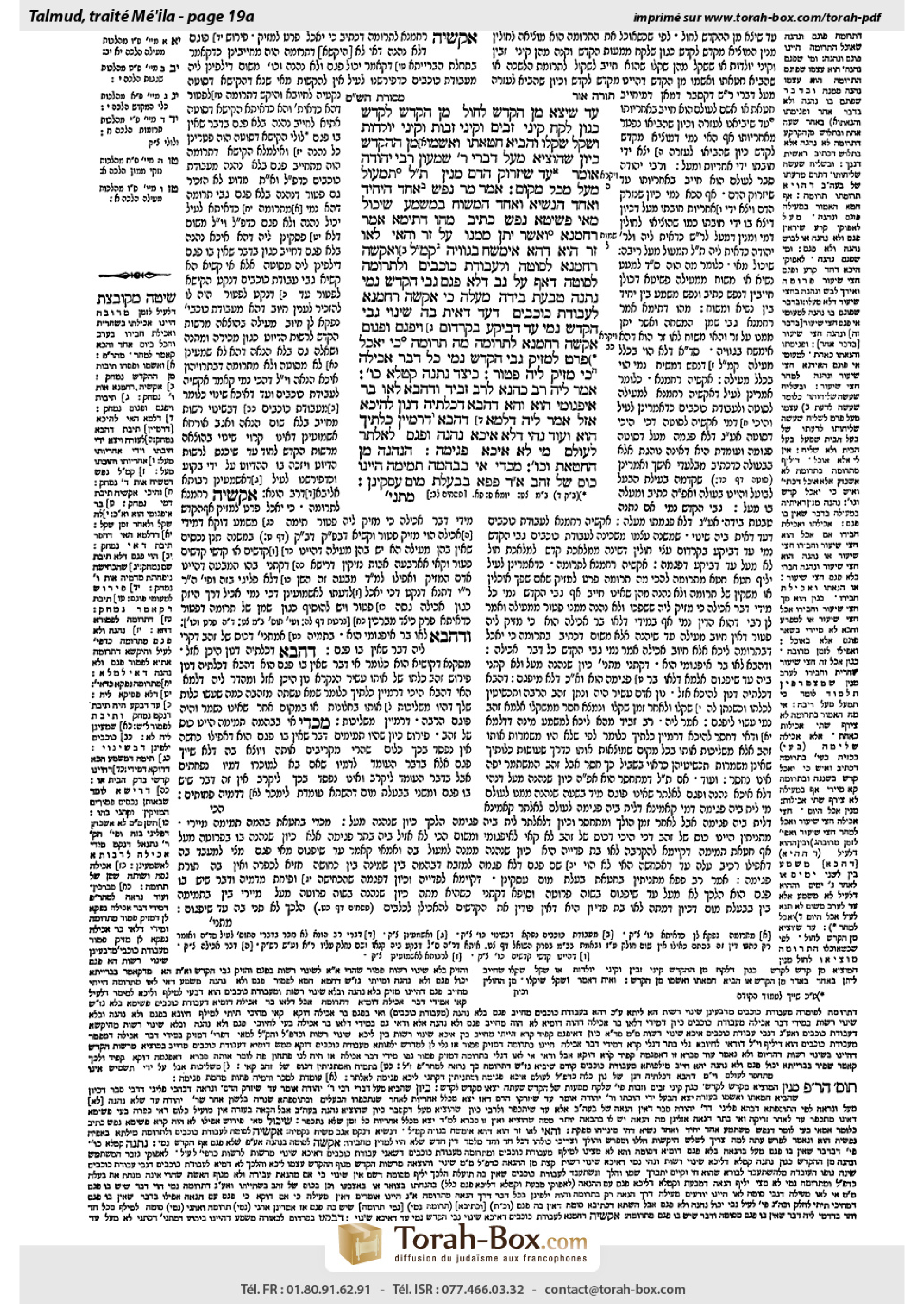
Meilah 19a: Talmud study for Daf Yomi
Daf Yomi is the daily study of one Talmud folio. Explore 37 tractates with scans, Hebrew text, Sefaria English and AI-generated French translations where annotated.
Passage selection and English or AI-generated French translation are available where the scan has annotations. Daf Study is independent of Torah-Box and Sefaria.
Browse Meilah · מעילה · All tractatesMeilah 19a text and translations
This page of Meilah includes the Aramaic text, an English translation and an AI-generated French translation, alongside the scan above.
מעילה י״ט א · Aramaic and Hebrew text
– עֵד שֶׁיֵּצֵא מִן הַקֹּדֶשׁ לַחוֹל.
מִן הַקֹּדֶשׁ לַקֹּדֶשׁ, כְּגוֹן: לָקַח קִינֵּי זָבִים, וְקִינֵּי זָבוֹת, וְקִינֵּי יוֹלְדוֹת,
וְשָׁקַל שִׁקְלוֹ, וְהֵבִיא חַטָּאתוֹ וַאֲשָׁמוֹ מִן הַהֶקְדֵּשׁ – כֵּיוָן שֶׁהוֹצִיא – מָעַל, דִּבְרֵי רַבִּי שִׁמְעוֹן. רַבִּי יְהוּדָה אוֹמֵר: עַד שֶׁיִּזְרוֹק הַדָּם. מִנַּיִן? תַּלְמוּד לוֹמַר: ״תִּמְעֹל מַעַל״ – מִכׇּל מָקוֹם.
אָמַר מָר: ״נֶפֶשׁ״ – אֶחָד הַיָּחִיד וְאֶחָד הַנָּשִׂיא וְאֶחָד הַמָּשׁוּחַ בַּמַּשְׁמָע. שֶׁיָּכוֹל, מַאי? פְּשִׁיטָא, ״נֶפֶשׁ״ כְּתִיב!
מַהוּ דְּתֵימָא, אָמַר רַחֲמָנָא ״וַאֲשֶׁר יִתֵּן מִמֶּנּוּ עַל זָר״, וְהַאי לָאו ״זָר״ הוּא, דְּהָא אִימְּשַׁח בְּגַוֵּויהּ, קָא מַשְׁמַע לַן.
וְאַקְּשַׁהּ רַחֲמָנָא לְסוֹטָה, וְלַעֲבוֹדָה זָרָה, וְלִתְרוּמָה. לְסוֹטָה, דְּאַף עַל גַּב דְּלֹא פָּגַם, גַּבֵּי הֶקְדֵּשׁ נָמֵי, נָתְנָה טַבַּעַת בְּיָדָהּ – מָעֲלָה.
כִּי אַקְּשַׁהּ רַחֲמָנָא לַעֲבוֹדָה זָרָה, דְּעַד דְּאִית בַּהּ שִׁינּוּי, גַּבֵּי הֶקְדֵּשׁ נָמֵי, עַד דְּבִיקַּע בְּקַרְדּוֹם, וְיִפְגֹּם וּפָגוּם.
אַקְּשַׁהּ רַחֲמָנָא לִתְרוּמָה: מָה תְּרוּמָה, ״כִּי יֹאכַל״ – פְּרָט לְמַזִּיק, גַּבֵּי הֶקְדֵּשׁ נָמֵי – כֹּל דְּבַר אֲכִילָה, כִּי מַזֵּיק לֵיהּ – פָּטוּר.
כֵּיצַד? נָתְנָה קַטְלָא כּוּ׳. אֲמַר לֵיהּ רַב כָּהֲנָא לְרַב זְבִיד: וְדַהֲבָא לָאו בַּר אִיפְּגוֹמֵי הוּא? וְהָא דַּהֲבָא דְּכַלְּתֵיהּ דְּנוּן, לְהֵיכָא אֲזַל?
אֲמַר לֵיהּ: דִּלְמָא, דַּהֲבָא דְּרָמְיָין כַּלָּתָיךְ הוּא. וְעוֹד: נְהִי דְּלָא אִיכָּא נֶהֱנָה וּפָגַם לְאַלְתַּר, לְעוֹלָם מִי לָא אִיכָּא פְּגִימָה?
הַנֶּהֱנֶה מִן הַחַטָּאת וְכוּ׳. מִכְּדֵי אִי בִּבְהֵמָה תְּמִימָה, הַיְינוּ כּוֹס שֶׁל זָהָב! אָמַר רַב פָּפָּא: בְּבַעֲלַת מוּם עָסְקִינַן.
Meilah 19a · English translation
a non-priest who partakes of teruma is not liable until the teruma leaves from the domain of the sacred to the domain of the non-sacred, as one who partakes of teruma becomes its owner, the same should apply to misuse.
But in fact one is also liable for misuse if he moves an item from the domain of the sacred to the domain of the sacred for another purpose, such as if he spent funds from the Temple treasury and acquired bird nests, i.e., pairs of birds, pigeons or doves, for zavim (see Leviticus 15:13–15), or the bird nests for zavot (see Leviticus 15:28–30), or the bird nests for women after childbirth (see Leviticus 12:6–8). Although the individual is using the money of the Temple treasury for a sacred purpose, nevertheless, since these obligatory offerings should be purchased with private funds, he commits misuse by deriving personal benefit from sacred funds.
And similarly, with regard to one who contributed his shekel, or brought his sin offering or his guilt offering from consecrated property, once he spends the funds he has committed misuse. This is the statement of Rabbi Shimon. Rabbi Yehuda says: He is not liable until the priest sprinkles the blood of the offerings, through which he achieves atonement, at which point he has derived his benefit from the consecrated property. The baraita returns to its question: From where is it derived that such use is also categorized as misuse? The verse states: “If anyone commits a misuse.” The inclusive language of the verse teaches that he is liable in any case.
The Gemara analyzes the beginning of the baraita. The Master said above: The verse states: “If anyone commits a misuse” (Leviticus 5:15). All people are included in this halakha, whether the guilty person is the common individual, and whether he is the king, and whether he is the anointed High Priest. The Gemara asks: What else might one have thought? It is obvious that the king and the High Priest are included, as it is written: “Anyone.”
The Gemara explains that the statement of the baraita is necessary, lest you say that these individuals are excluded from the halakha of misuse because the Merciful One states with regard to the anointing oil: “Or whosoever puts any of it upon a stranger, he shall be cut off from his people” (Exodus 30:33). And with regard to the anointing oil, this distinguished person, i.e., the High Priest or the king, is not considered a “stranger,” as he is anointed with it. Therefore, the baraita teaches us that even a High Priest and a king are included in the prohibition of misuse.
§ The Gemara summarizes the derivations with regard to the halakha of misuse. The Merciful One compared the halakha of misuse to the case of a sota, and to idol worship, and to teruma, in order to teach several basic principles. Misuse is compared to a sota, in the verse: “If any man’s wife goes aside, and acts unfaithfully against him” (Numbers 5:12), as here one is liable for committing adultery even though the adulteress did not damage her body through her actions. With regard to consecrated property as well, even without causing damage, as in the case in which a woman placed a consecrated gold ring on her hand, i.e., her finger, she has thereby become liable for misuse.
When the Merciful One compared misuse to idol worship, in the verse: “And they broke faith with the God of their fathers” (I Chronicles 5:25), this teaches that one is not liable for idol worship until there is a change effected by his act, as the idolater changes his worship of God for worship of idols. With regard to consecrated property as well, if the item is susceptible to damage, a person does not become liable for misuse until the act of misuse changes the item from being available for use for sacred purposes to being available for use only for non-sacred purposes, as in a case where he chops non-sacred wood with a consecrated ax and concurrently damages the ax, as the consecrated property is thereby damaged.
Finally, the Merciful One compared misuse to the partaking of teruma by a non-priest, through the verbal analogy of the words “sin” and “sin” (see 18b). What is the halakha with regard to teruma? The verse states: “And if a man eats of the sacred item through error, then he shall add its fifth part upon it” (Leviticus 22:14). This excludes one who causes damage to the teruma without partaking of it, e.g., by spilling it on the ground. Such a person is exempt from the payment of the additional one-fifth. With regard to consecrated property as well, in the case of any consecrated edible item, or some other item, when one damages it without deriving benefit from the damaging act, he is exempt with regard to misuse.
§ The mishna teaches: How is one liable for misuse of an item that is not subject to damage? For example, if a woman placed a consecrated gold chain around her neck. Rav Kahana said to Rav Zevid: And is it correct that gold is not subject to damage? But where did the gold of the daughter-in-law of the wealthy man Nun go? When Nun married off his son, he gave the bride many golden items of jewelry, which deteriorated over time. Evidently, gold is also subject to damage.
Rav Zevid said to Rav Kahana: Perhaps the gold of Nun’s daughter-in-law suffered the fate of the gold that your daughters-in-law cast aside. Like your daughters-in-law, Nun’s daughter-in-law treated her gold carelessly, which is why it deteriorated. And furthermore, granted that gold does not have the status of an item that is damaged immediately [le’altar] when someone derives benefit from it, but even so, does gold never sustain damage? Even gold deteriorates slowly and suffers measurable damage over long periods of time.
§ The mishna further teaches: One who derives benefit from a sin offering or from other items of the most sacred order, as in the case of one who detaches its wool while the animal is alive, is not liable for misuse unless he causes damage of the value of one peruta. The Gemara asks: Now, if the ruling of the mishna is stated with regard to an unblemished domesticated animal, which is fit for sacrifice, this case is the same as that of a consecrated gold cup, which is not subject to damage. Since the animal remains fit as an offering even after wool has been detached from it, why is it subject to misuse only if it is damaged? Rav Pappa said: We are dealing with a blemished animal. Since it is unfit for sacrifice, it will be sold by the Temple treasury, and therefore the removal of wool reduces its sale price. Consequently, it is subject to misuse only if such use causes it damage.
Meilah 19a · Traduction française (IA)
Un non-prêtre qui consomme de la terouma n’est passible que lorsque celle-ci passe du domaine du sacré au domaine du profane. En effet, celui qui consomme de la terouma en devient propriétaire ; il devrait donc en aller de même en matière de détournement d’un bien sacré.
Or, en réalité, on est également passible de détournement lorsqu’on affecte un bien à un autre usage sacré, par exemple si quelqu’un dépense des fonds du Trésor du Temple pour acheter des nids d’oiseaux, c’est-à-dire des paires de pigeons ou de tourterelles, destinés aux zavim (voir Lévitique 15, 13-15), aux zavot (voir Lévitique 15, 28-30) ou aux femmes après l’accouchement (voir Lévitique 12, 6-8). Bien que cette personne emploie l’argent du Trésor du Temple à une fin sacrée, elle commet néanmoins un détournement, puisque ces offrandes obligatoires doivent être achetées avec des fonds privés ; elle tire ainsi un bénéfice personnel de fonds sacrés.
De même, celui qui a apporté son demi-sicle, ou qui a présenté son sacrifice expiatoire ou son sacrifice de culpabilité avec des biens consacrés, commet un détournement dès qu’il dépense les fonds. Telle est la déclaration de Rabbi Shimon. Rabbi Yehouda dit : Il n’est passible que lorsque le prêtre asperge le sang des sacrifices, par lequel il obtient l’expiation ; c’est alors qu’il a tiré bénéfice des biens consacrés. La baraïta revient à sa question : d’où déduit-on qu’un tel usage est également considéré comme un détournement ? Le verset dit : « Si quelqu’un commet un détournement. » La formulation inclusive du verset enseigne qu’il est passible dans tous les cas.
La Guemara analyse le début de la baraïta. Le Maître a dit plus haut : le verset dit : « Si quelqu’un commet un détournement » (Lévitique 5, 15). Toutes les personnes sont incluses dans cette halakha : le particulier, le roi et le grand prêtre oint. La Guemara demande : Qu’aurait-on pu penser d’autre ? Il est évident que le roi et le grand prêtre sont inclus, puisqu’il est écrit : « Quiconque. »
La Guemara explique que la déclaration de la baraïta est nécessaire, de peur que tu ne dises que ces personnes sont exclues de la halakha du détournement, car le Miséricordieux dit au sujet de l’huile d’onction : « Quiconque en met sur un étranger sera retranché de son peuple » (Exode 30, 33). Or, en ce qui concerne l’huile d’onction, cette personne éminente, c’est-à-dire le grand prêtre ou le roi, n’est pas considérée comme un « étranger », puisqu’elle en est ointe. La baraïta nous enseigne donc que même un grand prêtre et un roi sont inclus dans l’interdiction de détourner un bien sacré.
§ La Guemara récapitule les déductions concernant la halakha du détournement d’un bien sacré. Le Miséricordieux a comparé cette halakha au cas de la sota, à l’idolâtrie et à la terouma, afin d’enseigner plusieurs principes fondamentaux. Le détournement est comparé au cas de la sota dans le verset : « Si la femme de quelqu’un s’écarte et lui devient infidèle » (Nombres 5, 12) : ici, on est passible d’adultère même si l’adultère n’a pas causé de dommage à son corps par ses actes. De même, en ce qui concerne les biens consacrés, on est passible même sans causer de dommage : ainsi, une femme qui met à son doigt une bague en or consacrée devient passible de détournement.
Lorsque le Miséricordieux a comparé le détournement à l’idolâtrie, dans le verset : « Ils furent infidèles au Dieu de leurs pères » (I Chroniques 5, 25), cela enseigne qu’on n’est passible d’idolâtrie que si son acte entraîne un changement, comme lorsque l’idolâtre abandonne le culte de Dieu pour celui des idoles. De même, en ce qui concerne les biens consacrés, si l’objet peut subir un dommage, on n’est passible de détournement que lorsque l’acte fait passer l’objet d’un état où il peut être utilisé à des fins sacrées à un état où il ne peut plus être utilisé qu’à des fins profanes, comme dans le cas où quelqu’un coupe du bois profane avec une hache consacrée et endommage en même temps cette hache, de sorte que le bien consacré est détérioré.
Enfin, le Miséricordieux a comparé le détournement à la consommation de terouma par un non-prêtre, au moyen de l’analogie verbale entre les mots « faute » et « faute » (voir 18b). Quelle est la halakha concernant la terouma ? Le verset dit : « Si un homme mange par inadvertance une chose consacrée, il en ajoutera un cinquième » (Lévitique 22, 14). Cela exclut celui qui endommage la terouma sans la consommer, par exemple en la renversant par terre. Une telle personne est dispensée du paiement du cinquième supplémentaire. De même, en ce qui concerne les biens consacrés, celui qui endommage un aliment consacré ou tout autre objet sans tirer bénéfice de cet acte n’est pas passible de détournement.
§ La Michna enseigne : Comment est-on passible de détournement concernant un objet qui ne peut subir de dommage ? Par exemple, si une femme place autour de son cou une chaîne en or consacrée. Rav Kahana dit à Rav Zevid : Est-il exact que l’or ne peut subir de dommage ? Mais qu’est-il advenu de l’or de la bru du riche Nun ? Lorsque Nun maria son fils, il offrit à la mariée de nombreux bijoux en or, qui se détériorèrent avec le temps. Il ressort donc que l’or aussi peut subir un dommage.
Rav Zevid dit à Rav Kahana : Peut-être l’or de la bru de Nun a-t-il connu le même sort que l’or dont tes belles-filles se sont débarrassées. Comme tes belles-filles, la bru de Nun a traité son or avec négligence, ce qui explique sa détérioration. Et de plus, il est vrai que l’or n’est pas considéré comme un objet qui subit un dommage immédiatement [le’altar] lorsqu’on en tire bénéfice ; mais peut-on pour autant dire que l’or ne subit jamais de dommage ? Même l’or se détériore lentement et subit un dommage mesurable sur de longues périodes.
§ La Michna enseigne également : Celui qui tire bénéfice d’un sacrifice expiatoire ou d’autres objets de très haute sainteté, par exemple en enlevant la laine de l’animal de son vivant, n’est passible de détournement que s’il cause un dommage d’une valeur d’une perouta. La Guemara demande : Si cette décision de la Michna concerne un animal domestique sans défaut, apte au sacrifice, ce cas est identique à celui d’une coupe en or consacrée, qui ne peut subir de dommage. Puisque l’animal reste apte au sacrifice même après qu’on lui a enlevé de la laine, pourquoi n’est-on passible de détournement que s’il est endommagé ? Rav Pappa dit : Nous parlons d’un animal présentant un défaut. Puisqu’il est impropre au sacrifice, le Trésor du Temple le vendra ; le retrait de la laine diminue donc son prix de vente. Par conséquent, on n’est passible de détournement que si cet usage lui cause un dommage.
Traduction française générée par IA à partir de l’édition anglaise de Sefaria. Vérifie toujours un passage avec le texte source.
Text from Sefaria: William Davidson Edition - Vocalized Aramaic (CC BY NC); William Davidson Edition - English (CC BY NC).