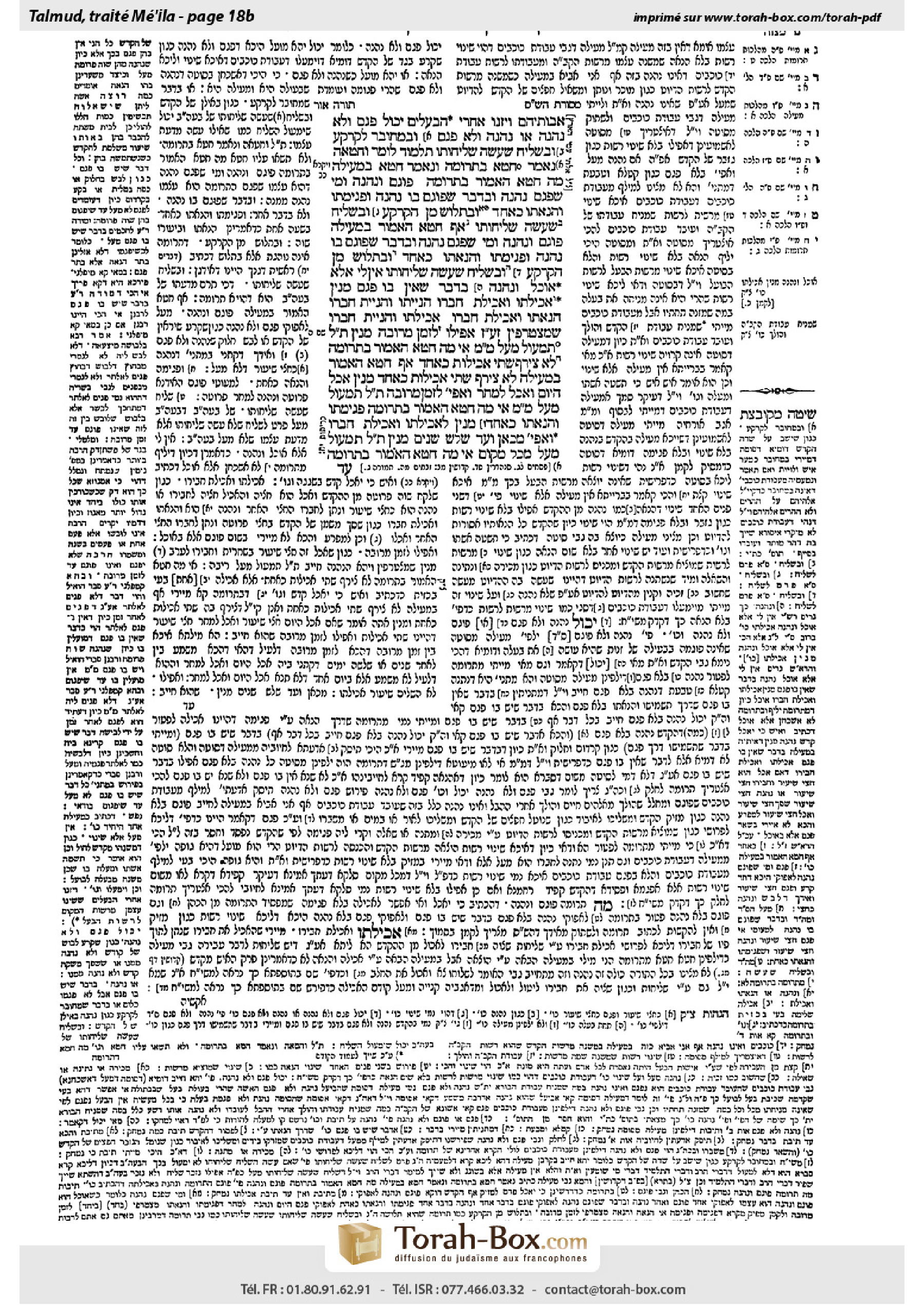
Meilah 18b: Talmud study for Daf Yomi
Daf Yomi is the daily study of one Talmud folio. Explore 37 tractates with scans, Hebrew text, Sefaria English and AI-generated French translations where annotated.
Passage selection and English or AI-generated French translation are available where the scan has annotations. Daf Study is independent of Torah-Box and Sefaria.
Browse Meilah · מעילה · All tractatesMeilah 18b text and translations
This page of Meilah includes the Aramaic text, an English translation and an AI-generated French translation, alongside the scan above.
מעילה י״ח ב · Aramaic and Hebrew text
אֲבֹתֵיהֶם וַיִּזְנוּ אַחֲרֵי הַבְּעָלִים״.
יָכוֹל פָּגַם וְלֹא נֶהֱנָה, אוֹ נֶהֱנָה וְלֹא פָּגַם,
וּבִמְחוּבָּר לַקַּרְקַע, וּבְשָׁלִיחַ שֶׁעָשָׂה שְׁלִיחוּתוֹ?
תַּלְמוּד לוֹמַר ״וְחָטְאָה״. נֶאֱמַר: ״חֵטְא״ בִּתְרוּמָה, וְנֶאֱמַר: ״חֵטְא״ בִּמְעִילָה.
מָה ״חֵטְא״ הָאָמוּר בִּתְרוּמָה, פּוֹגֵם וְנֶהֱנֶה, וּמִי שֶׁפָּגַם נֶהֱנֶה, וּבַדָּבָר שֶׁפּוֹגֵם בּוֹ נֶהֱנֶה, וּפְגִימָתוֹ וַהֲנָאָתוֹ כְּאֶחָד, וּבְתָלוּשׁ מִן הַקַּרְקַע, וּבְשָׁלִיחַ שֶׁעָשָׂה שְׁלִיחוּתוֹ –
אַף ״חֵטְא״ הָאָמוּר בִּמְעִילָה, פּוֹגֵם וְנֶהֱנֶה, וּמִי שֶׁפָּגַם נֶהֱנֶה, וּבַדָּבָר שֶׁפּוֹגֵם בּוֹ נֶהֱנֶה, וּפְגִימָתוֹ וַהֲנָאָתוֹ כְּאֶחָד, וּבְתָלוּשׁ מִן הַקַּרְקַע, וּבְשָׁלִיחַ שֶׁעָשָׂה שְׁלִיחוּתוֹ.
אֵין לִי אֶלָּא אוֹכֵל, וְנֶהֱנֶה בְּדָבָר שֶׁאֵין בּוֹ פְּגָם, מִנַּיִן?
אֲכִילָתוֹ וַאֲכִילַת חֲבֵרוֹ, הֲנָיָיתוֹ וַהֲנָיַית חֲבֵרוֹ, הֲנָאָתוֹ וַאֲכִילַת חֲבֵרוֹ, אֲכִילָתוֹ וַהֲנָיַית חֲבֵרוֹ שֶׁמִּצְטָרְפִין זֶה עִם זֶה, אֲפִילּוּ לִזְמַן מְרוּבֶּה, מִנַּיִן?
תַּלְמוּד לוֹמַר: ״תִּמְעֹל מַעַל״ – מִכׇּל מָקוֹם.
אִי מָה ״חֵטְא״ הָאָמוּר בִּתְרוּמָה – לֹא צֵירַף שְׁתֵּי אֲכִילוֹת כְּאֶחָד, אַף ״חֵטְא״ הָאָמוּר בִּמְעִילָה – לֹא צֵירַף שְׁתֵּי אֲכִילוֹת כְּאַחַד. מִנַּיִן אָכַל הַיּוֹם וְאָכַל לְמָחָר, וַאֲפִילּוּ לִזְמַן מְרוּבֶּה? תַּלְמוּד לוֹמַר: ״תִּמְעֹל מַעַל״ – מִכׇּל מָקוֹם.
אִי מָה ״חֵטְא״ הָאָמוּר בִּתְרוּמָה – פְּגִימָתוֹ וַהֲנָאָתוֹ כְּאֶחָד, מִנַּיִן לַאֲכִילָתוֹ וַאֲכִילַת חֲבֵרוֹ? וַאֲפִילּוּ מִכָּאן וְעַד שָׁלֹשׁ שָׁנִים, מִנַּיִן? תַּלְמוּד לוֹמַר: ״תִּמְעֹל מַעַל״ – מִכׇּל מָקוֹם.
אִי מָה ״חֵטְא״ הָאָמוּר בִּתְרוּמָה
Meilah 18b · English translation
their fathers, and went astray after the gods of the peoples of the land, whom God destroyed before them” (I Chronicles 5:25). Likewise, one who misuses consecrated property deviates from the purpose for which the particular item was meant to be used.
The baraita continues: One might have thought that the comparison between misuse and idol worship teaches that one is liable for misuse even if he damaged the consecrated item but did not derive benefit from it, as that is the halakha with regard to idol worship, where one changes worship of God to idol worship without deriving benefit. Or, in light of the comparison between misuse and suspected adultery, it might have been thought that one would be liable for misuse if he derived benefit from the consecrated item but did not damage it, just as the adulteress derives benefit from the illicit act of intercourse without suffering any physical damage.
And perhaps one should be liable for misuse of an item attached to the ground. And in the case of an agent who committed misuse while he performed his assigned agency, it might be thought that the agent himself, rather than the one who appointed him, should be liable for the misuse.
The halakha in these cases is derived from the fact that the verse states: “If anyone commits a misuse, and sins through error, in the sacred items of the Lord” (Leviticus 5:15). The word “sin” is stated with regard to teruma, in the verse: “And you shall bear no sin by reason of it, as you have set apart from it its best” (Numbers 18:32); and “sin” is also stated with regard to misuse of consecrated property. Several halakhot are derived from this verbal analogy.
The baraita elaborates: Just as with regard to the word “sin” stated with regard to teruma, when someone sins by partaking of forbidden teruma, it is a circumstance in which one damages and derives benefit, and the one who damaged the teruma is the same person who derived benefit; and with regard to teruma, one is liable only if he derives benefit from the same item that he damages; and he is liable in the case of teruma only if his damage and his benefit occur simultaneously; and the status of teruma applies only to an item detached from the ground; and the status of teruma takes effect in the case of an agent who performed his assigned agency in designating an item teruma, the same applies to misuse.
The baraita further explains: So too, the word “sin” stated with regard to misuse applies specifically when the individual both damages and derives benefit from consecrated items; and when the one who damaged also derived benefit from it himself; and he derives benefit from the same item that he damages; and his damage and his deriving benefit occur simultaneously; and misuse applies only to an item detached from the ground; and misuse is committed by the one appointing the agent in the case of an agent who performed his assigned agency.
The baraita continues: From the verbal analogy I have derived only that one is liable for misuse if he eats consecrated items when he is not permitted to do so, similar to the case of teruma. But with regard to one who derives benefit from an item that does not have the potential to be damaged, from where do I derive that this also constitutes misuse?
Similarly, if one eats from a consecrated item and gives to another person to eat, where there is his consumption and another’s consumption; or if he derives benefit and gives to another to derive benefit, where there is his deriving benefit and another’s deriving benefit; and likewise his deriving benefit and another’s consumption; and his consumption and another’s deriving benefit; the halakha is that in all these cases, benefit and consumption combine with one another, even over a long period of time on the same day, to amount to the value of one peruta that effects liability for misuse. From where is this halakha derived?
The verse states: “If anyone commits a misuse.” This general and inclusive clause teaches that one is liable for misusing one peruta worth of consecrated property in any case, i.e., even if he gave it to another and one of them ate while the other derived benefit, and even if it took some time on that day to use the value of one peruta.
The baraita further states: If there is a comparison between teruma and misuse, one can claim as follows: Just as in the case of the word “sin” that is stated with regard to teruma, the Torah does not combine two distinct acts of consumption as one prohibited act, so too, perhaps with regard to the word “sin” that is stated with regard to misuse, the Torah does not combine two acts of consumption as one. From where is it derived that if one ate half of the minimum amount of an olive-bulk today and ate another half tomorrow, even if much time has passed, the distinct acts of misuse combine and are considered one act, which means that the one who did so is liable for misuse? The verse states: “If anyone commits a misuse.” The inclusive language of the verse teaches that he is liable in any case.
The baraita continues: If there is a comparison between teruma and misuse, one can claim as follows: Just as in the case of the word “sin” that is stated with regard to teruma, the damage to the teruma and the individual’s deriving benefit from the teruma occur simultaneously, the same should apply to misuse of consecrated items. From where is it derived that one is liable for misuse for his consumption and another’s consumption, when each person alone has eaten less than the value of one peruta, and even if the two acts of consumption are separated in time from now until three years later; from where is it derived that the instances of misuse combine? The verse states: “If anyone commits a misuse.” The inclusive language of the verse teaches that he is liable in any case.
The baraita continues: If it is derived from the verbal analogy that there are several halakhot common to both teruma and committing misuse, one can claim as follows: Just as in the case of the word “sin” that is stated with regard to teruma,
Meilah 18b · Traduction française (IA)
leurs pères, et se prostituèrent en suivant les dieux des peuples du pays, que Dieu avait détruits devant eux » (I Chroniques 5:25). De même, celui qui détourne un bien consacré s’écarte de l’usage auquel cet objet particulier était destiné.
La baraïta poursuit : On aurait pu penser que la comparaison entre le détournement et le culte idolâtre enseigne que l’on est passible de détournement même si l’on a endommagé l’objet consacré sans en tirer profit, puisque telle est la halakha concernant le culte idolâtre : on abandonne le culte de Dieu pour celui des idoles sans en tirer profit. Ou bien, à la lumière de la comparaison entre le détournement et la femme soupçonnée d’adultère, on aurait pu penser que l’on est passible de détournement si l’on a tiré profit de l’objet consacré sans l’endommager, de même que l’adultère tire profit de l’acte sexuel illicite sans subir de dommage physique.
Et peut-être devrait-on être passible de détournement pour un objet fixé au sol. Dans le cas d’un agent qui a commis un détournement en accomplissant la mission qui lui avait été confiée, on aurait pu penser que c’est l’agent lui-même, et non celui qui l’a mandaté, qui est passible du détournement.
La halakha dans ces cas se déduit du fait que le verset dit : « Si quelqu’un commet un détournement et pèche par inadvertance au sujet des choses saintes de l’Éternel » (Lévitique 5:15). Le mot « péché » est employé au sujet de la terouma dans le verset : « Vous ne porterez pas de faute à cause d’elle, lorsque vous en aurez prélevé le meilleur » (Nombres 18:32) ; et le mot « péché » est également employé au sujet du détournement de biens consacrés. Plusieurs halakhot sont déduites de cette analogie verbale.
La baraïta développe : De même que, dans le cas du mot « péché » employé au sujet de la terouma, lorsqu’une personne pèche en consommant de la terouma interdite, elle endommage le bien et en tire profit, et la personne qui endommage la terouma est celle-là même qui en tire profit ; de même, concernant la terouma, on n’est passible que si l’on tire profit du même bien que celui que l’on endommage, et seulement si le dommage et le profit ont lieu simultanément. En outre, le statut de terouma ne s’applique qu’à un objet détaché du sol, et il prend effet lorsqu’un agent accomplit la mission qui lui a été confiée en désignant un objet comme terouma. Il en va de même pour le détournement.
La baraïta explique encore : De même, le mot « péché » employé au sujet du détournement s’applique spécifiquement lorsque la personne endommage des biens consacrés et en tire profit, lorsque celui qui les a endommagés en a lui-même tiré profit, lorsqu’elle tire profit du même objet que celui qu’elle endommage, et lorsque le dommage et le profit ont lieu simultanément. Le détournement ne s’applique qu’à un objet détaché du sol. Enfin, lorsque l’agent a accompli la mission qui lui avait été confiée, c’est celui qui l’a mandaté qui commet le détournement.
La baraïta poursuit : De l’analogie verbale, je n’ai déduit que l’on est passible de détournement si l’on mange des biens consacrés alors qu’on n’en a pas le droit, comme dans le cas de la terouma. Mais d’où déduis-je que constitue également un détournement le fait de tirer profit d’un objet qui ne peut pas être endommagé ?
De même, si quelqu’un mange d’un objet consacré et en donne à manger à une autre personne, il y a sa propre consommation et celle d’autrui ; ou s’il en tire profit et donne à une autre personne de quoi en tirer profit, il y a son propre profit et celui d’autrui ; de même, son profit et la consommation d’autrui, ou sa consommation et le profit d’autrui : dans tous ces cas, le profit et la consommation s’additionnent, même s’ils s’étalent sur une longue période au cours d’une même journée, jusqu’à atteindre la valeur d’une perouta, seuil qui entraîne la responsabilité pour détournement. D’où déduit-on cette halakha ?
Le verset dit : « Si quelqu’un commet un détournement. » Cette formulation générale et inclusive enseigne que l’on est passible de détournement dès lors que l’on a utilisé des biens consacrés d’une valeur d’une perouta, dans tous les cas, même si l’on en a donné à autrui et que l’un l’a consommé tandis que l’autre en a tiré profit, et même s’il a fallu un certain temps, au cours de cette journée, pour utiliser l’équivalent d’une perouta.
La baraïta poursuit : Si l’on compare la terouma au détournement, on peut avancer l’argument suivant : de même que, dans le cas du mot « péché » employé au sujet de la terouma, la Torah ne réunit pas deux actes de consommation distincts en un seul acte interdit, peut-être en va-t-il de même pour le mot « péché » employé au sujet du détournement : la Torah ne réunit pas deux actes de consommation. D’où déduit-on que si quelqu’un a mangé aujourd’hui une demi-mesure minimale d’un olive, puis l’autre moitié le lendemain, les deux actes distincts de détournement s’additionnent et sont considérés comme un seul acte, même si beaucoup de temps s’est écoulé, de sorte que la personne est passible de détournement ? Le verset dit : « Si quelqu’un commet un détournement. » La formulation inclusive du verset enseigne qu’il est passible dans tous les cas.
La baraïta poursuit : Si l’on compare la terouma au détournement, on peut avancer l’argument suivant : de même que, dans le cas du mot « péché » employé au sujet de la terouma, le dommage causé à la terouma et le profit que la personne en tire ont lieu simultanément, il devrait en être de même pour le détournement de biens consacrés. D’où déduit-on que l’on est passible de détournement pour sa propre consommation et celle d’autrui, alors que chacun, pris séparément, a consommé une quantité d’une valeur inférieure à une perouta, même si les deux actes de consommation sont espacés dans le temps, de maintenant jusqu’à trois ans plus tard ? D’où déduit-on que ces cas de détournement s’additionnent ? Le verset dit : « Si quelqu’un commet un détournement. » La formulation inclusive du verset enseigne qu’il est passible dans tous les cas.
La baraïta poursuit : Si l’on déduit de l’analogie verbale que plusieurs halakhot sont communes à la terouma et au détournement, on peut avancer l’argument suivant : de même que, dans le cas du mot « péché » employé au sujet de la terouma,
Traduction française générée par IA à partir de l’édition anglaise de Sefaria. Vérifie toujours un passage avec le texte source.
Text from Sefaria: William Davidson Edition - Vocalized Aramaic (CC BY NC); William Davidson Edition - English (CC BY NC).