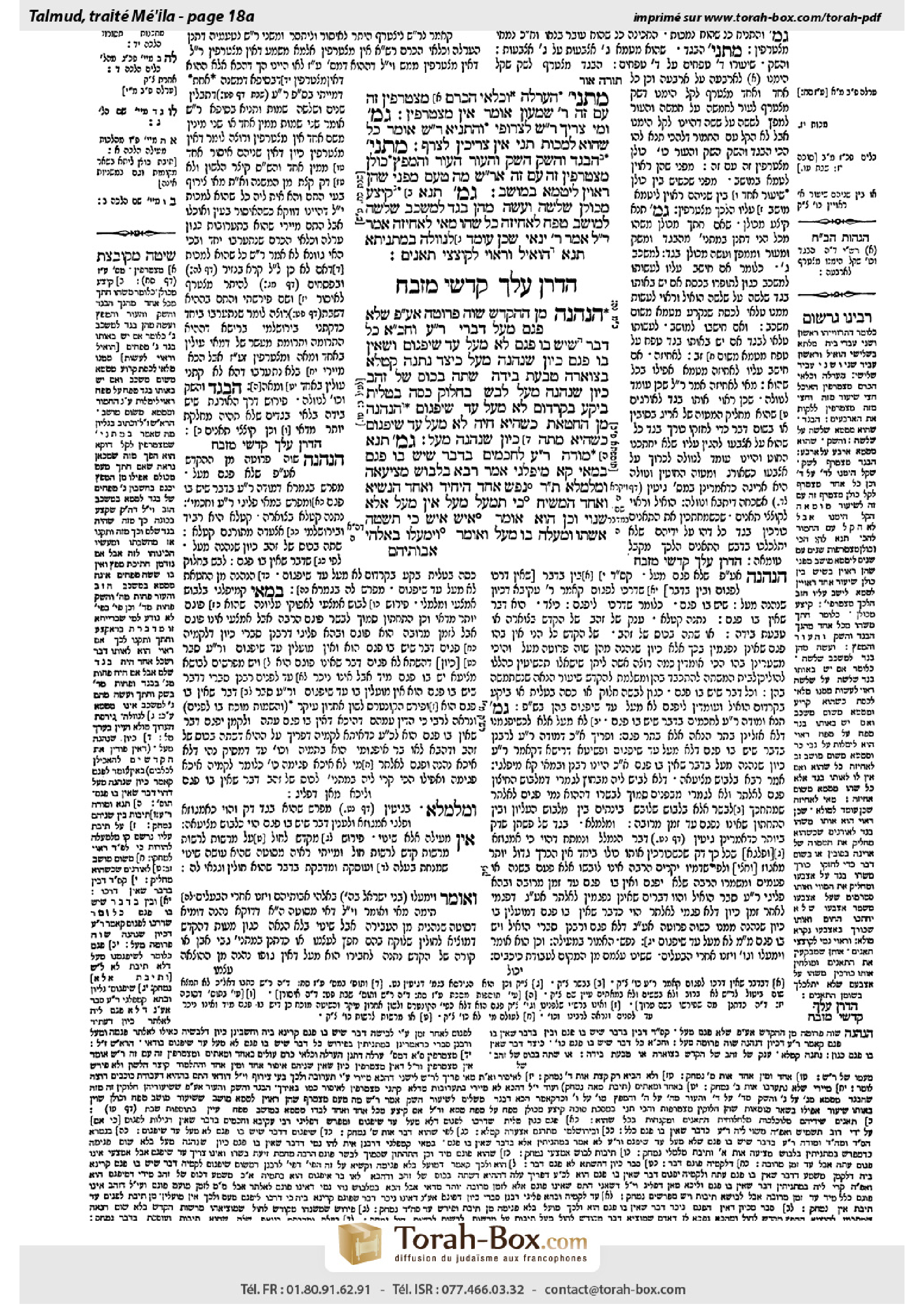
Meilah 18a: Talmud study for Daf Yomi
Daf Yomi is the daily study of one Talmud folio. Explore 37 tractates with scans, Hebrew text, Sefaria English and AI-generated French translations where annotated.
Passage selection and English or AI-generated French translation are available where the scan has annotations. Daf Study is independent of Torah-Box and Sefaria.
Browse Meilah · מעילה · All tractatesMeilah 18a text and translations
This page of Meilah includes the Aramaic text, an English translation and an AI-generated French translation, alongside the scan above.
מעילה י״ח א · Aramaic and Hebrew text
מַתְנִי׳ הָעׇרְלָה וְכִלְאֵי הַכֶּרֶם – מִצְטָרְפִין זֶה עִם זֶה. רַבִּי שִׁמְעוֹן אוֹמֵר: אֵין מִצְטָרְפִין.
גְּמָ׳ וּמִי צָרִיךְ רַבִּי שִׁמְעוֹן לְצָרוֹפֵי? וְהָתַנְיָא, רַבִּי שִׁמְעוֹן אוֹמֵר: כׇּל שֶׁהוּא לְמַכּוֹת? תְּנִי: אֵין צְרִיכִין לְצָרֵף.
מַתְנִי׳ הַבֶּגֶד וְהַשַּׂק, הַשַּׂק וְהָעוֹר, הָעוֹר וְהַמַּפָּץ – כּוּלָּן מִצְטָרְפִין זֶה עִם זֶה.
אָמַר רַבִּי שִׁמְעוֹן: מָה טַעַם? מִפְּנֵי שֶׁהֵן רְאוּיִן לִיטָּמֵא בְּמוֹשָׁב.
גְּמָ׳ תָּנָא: קִיצַּע מִכּוּלָּן שְׁלֹשָׁה, וְעָשָׂה מֵהֶן בֶּגֶד לְמִשְׁכָּב – שְׁלֹשָׁה, לְמוֹשָׁב – טֶפַח, לַאֲחִיזָה – כׇּל שֶׁהוּ.
מַאי לַאֲחִיזָה? אָמַר רֵישׁ לָקִישׁ, אָמַר רַבִּי יַנַּאי: שֶׁכֵּן עוֹמֵד לְנַוְולָה. בְּמַתְנִיתָא תָּנָא: הוֹאִיל וְרָאוּי לְקוֹצְצֵי תְאֵנִים.
הַדְרָן עֲלָךְ קׇדְשֵׁי מִזְבֵּחַ
הַנֶּהֱנֶה מִן הַהֶקְדֵּשׁ שָׁוֶה פְּרוּטָה, אַף עַל פִּי שֶׁלֹּא פָּגַם – מָעַל, דִּבְרֵי רַבִּי עֲקִיבָא. וַחֲכָמִים אוֹמְרִים: כׇּל דָּבָר שֶׁיֵּשׁ בּוֹ פְּגָם – לֹא מָעַל, עַד שֶׁיִּפְגּוֹם. וְשֶׁאֵין בּוֹ פְּגָם, כֵּיוָן שֶׁנֶּהֱנָה – מָעַל.
כֵּיצַד? נָתְנָה קַטְלָא בְּצַוָּארָהּ, טַבַּעַת בְּיָדָהּ, שָׁתָה בְּכוֹס שֶׁל זָהָב, כֵּיוָן שֶׁנֶּהֱנָה – מָעַל. לָבַשׁ בְּחָלוּק, כִּסָּה בְּטַלִּית, בִּיקַּע בְּקַרְדּוֹם – לֹא מָעַל עַד שֶׁיִּפְגּוֹם.
הַנֶּהֱנֶה מִן הַחַטָּאת, כְּשֶׁהִיא חַיָּה – לֹא מָעַל, עַד שֶׁיִּפְגּוֹם. כְּשֶׁהִיא מֵתָה, כֵּיוָן שֶׁנֶּהֱנָה – מָעַל.
גְּמָ׳: תָּנָא: מוֹדֶה רַבִּי עֲקִיבָא לַחֲכָמִים בְּדָבָר שֶׁיֵּשׁ בּוֹ פְּגָם. בְּמַאי קָא מִיפַּלְגִי?!
אָמַר רָבָא: בִּלְבוּשׁ מְצִיעָאָה, וּמַלְמְלָא.
תָּנוּ רַבָּנַן: ״נֶפֶשׁ״ – אֶחָד הַיָּחִיד, וְאֶחָד הַנָּשִׂיא, וְאֶחָד הַמָּשִׁיחַ.
״כִּי תִמְעֹל מַעַל״, אֵין ״מַעַל״ אֶלָּא שִׁנּוּי, וְכֵן הוּא אוֹמֵר: ״אִישׁ אִישׁ כִּי תִשְׂטֶה אִשְׁתּוֹ וּמָעֲלָה בוֹ מַעַל״, וְאוֹמֵר: ״וַיִּמְעֲלוּ בֵּאלֹהֵי
Meilah 18a · English translation
MISHNA: The fruit of a tree during the first three years after its planting [orla] (see Leviticus 19:23), and diverse kinds,i.e., grain sown in a vineyard (see Deuteronomy 22:9) join together to constitute the requisite measure to prohibit a mixture that they are mixed into. This applies when the volume of the permitted produce is less than two hundred times the prohibited produce. Rabbi Shimon says: They do not join together.
GEMARA: The Gemara asks: And according to Rabbi Shimon, do the two half-measures need to join together, in order for one who eats them to be liable? But isn’t it taught in a baraita that Rabbi Shimon says: One who eats any measure of a prohibited food is liable to receive lashes, as the Sages stated the measure of an olive-bulk only with regard to the requirement to bring an offering? The Gemara answers: The wording of the mishna is not precise and must be emended, to teach that Rabbi Shimon says: They do not need to join together, as one is flogged even for less than the minimum measure.
MISHNA: A garment must be at least three by three handbreadths in order to become a primary source of ritual impurity, by means of ritual impurity imparted by the treading of a zav. A sack made from goats’ hair must be at least four by four handbreadths, while an animal hide must be five by five, and a mat six by six. The garment and the sack, the sack and the hide, and the hide and the mat all join together to constitute the requisite measure to become ritually impure in accordance with the material of the greater measure.
Rabbi Shimon said: What is the reason that they join together, despite the fact that their requisite measures are not equal? Because all the component materials are fit to become ritually impure through the ritual impurity imparted to a seat upon which a zav sits, as they can each be used to patch a saddle or saddlecloth. Since the measure of all these materials is equal in the case of a zav, they join together for other forms of ritual impurity as well.
GEMARA: A Sage taught in a baraita: In a case where one cut from each of the materials listed in the mishna, i.e., the garment, the sack, the hide, and the mat, a piece of less than three by three handbreadths, and sewed them together, thereby fashioning a garment from them; if he formed the garment for lying upon it, then the minimum measure for it to become a primary source of ritual impurity is three handbreadths. If he intended it for sitting, the minimum measure is one handbreadth. If he intended to use it for holding, it becomes impure in any measure.
The Gemara asks: What is the reason for the halakha in the case where one intended to use it for holding? Why is this cloth classified as a garment? Reish Lakish says that Rabbi Yannai says: It is considered a garment because it stands to be used as protection for the hands when weaving [lenavla], so that the weaver does not cut his fingers when straightening the threads. It was taught in a baraita: It is considered a garment since it is suited for fig cutters to place the material on their hands, to prevent them from getting dirty.
MISHNA: One who derives benefit equal to the value of one peruta from a consecrated item, even though he did not damage it, is liable for its misuse; this is the statement of Rabbi Akiva. And the Rabbis say: With regard to any consecrated item that has the potential to be damaged, one is not liable for misuse until he causes it one peruta of damage; and with regard to an item that does not have the potential to be damaged, once he derives benefit from it he is liable for misuse.
The mishna elaborates: How so? If a woman placed a consecrated gold chain [ketala] around her neck, or a gold ring on her hand, i.e., her finger, or if one drank from a consecrated gold cup, since they are not damaged through use, once he derives benefit equal to the value of one peruta from them, he is liable for misuse. If one wore a consecrated robe, covered himself with a consecrated garment, or chopped wood with a consecrated ax, he is not liable for misuse until he causes them one peruta of damage.
One who derives benefit from a sin offering while it is alive is not liable for misuse until he causes it one peruta of damage. When it is dead, once he derives benefit equal to the value of one peruta from it, he is liable for misuse.
GEMARA: The Sages taught in a baraita: Rabbi Akiva concedes to the Rabbis in the case of an item that has the potential to be damaged through its use that one is liable for misuse only if he causes one peruta of damage. The Gemara asks: Since this is apparently exactly the same as the opinion of the Rabbis, with regard to what do Rabbi Akiva and the Rabbis disagree?
Rava said: With regard to outer garments such as coats, which are exposed to the weather and other elements, and garments worn touching the skin, which can be damaged by perspiration, Rabbi Akiva and the Rabbis agree that one is liable for misuse only when the garments are damaged at least by the value of one peruta. They disagree in the case of a middle garment, i.e., that which is neither an outer garment nor one that is worn against the body. And they also disagree in the case of a garment made of malmala, very thin fabric; since this garment is expensive, one who wears it would be very careful not to let it be damaged, and consequently it is not subject to measurable depreciation each time it is worn. In these cases, Rabbi Akiva holds that one is liable for misuse if he derives benefit equal to the value of one peruta even though the garments were not depreciated by one peruta, whereas the Rabbis maintain that as there is cumulative depreciation, one is liable for misuse only when he causes one peruta of damage.
§ The Sages taught in a baraita: With regard to misuse of consecrated property, the verse states: “If anyone commits a misuse, and sins through error, in the sacred items of the Lord” (Leviticus 5:15). It is derived from the general term “anyone” that this halakha applies whether the guilty person is a common individual, and whether he is the king, and whether he is the anointed High Priest. Although in other contexts they have obligations to bring different offerings, these individuals have a uniform liability with regard to the sin of misuse.
The baraita further interprets the verse: “If anyone commits a misuse [ma’al], and sins” (Leviticus 5:15). The term ma’al means nothing other than deviation from the norm. And similarly, the verse states with regard to a woman suspected of adultery: “If any man’s wife goes aside, and acts unfaithfully [ma’al] against him” (Numbers 5:12). And it states with regard to idol worship: “And they broke faith [vayimalu] with the God of
Meilah 18a · Traduction française (IA)
MICHNA : Les fruits d’un arbre pendant les trois premières années suivant sa plantation [orla] (voir Lévitique 19:23) et les espèces mélangées, c’est-à-dire des céréales semées dans une vigne (voir Deutéronome 22:9), s’additionnent pour atteindre la mesure requise afin d’interdire le mélange dans lequel ils sont mêlés. Cela s’applique lorsque le volume des produits permis est inférieur à deux cents fois celui des produits interdits. Rabbi Chimon dit : Ils ne s’additionnent pas.
GUEMARA : La Guemara demande : Selon Rabbi Chimon, les deux demi-mesures doivent-elles s’additionner pour que celui qui les mange soit passible ? Mais n’est-il pas enseigné dans une baraïta que Rabbi Chimon dit : Celui qui mange quelque quantité que ce soit d’un aliment interdit est passible de flagellation, car les Sages n’ont fixé la mesure d’un volume d’olive que pour déterminer l’obligation d’apporter un sacrifice ? La Guemara répond : La formulation de la Michna manque de précision et doit être corrigée. Il faut enseigner que Rabbi Chimon dit qu’elles n’ont pas besoin de s’additionner, puisqu’on est passible de flagellation même pour une quantité inférieure à la mesure minimale.
MICHNA : Un vêtement doit mesurer au moins trois sur trois téfaḥim pour devenir une source primaire d’impureté rituelle sous l’effet de l’impureté transmise par le piétinement d’un zav. Un sac en poil de chèvre doit mesurer au moins quatre sur quatre téfaḥim, une peau d’animal cinq sur cinq, et une natte six sur six. Le vêtement et le sac, le sac et la peau, ainsi que la peau et la natte s’additionnent pour atteindre la mesure requise afin de devenir rituellement impurs, selon la matière correspondant à la plus grande mesure.
Rabbi Chimon dit : Pour quelle raison s’additionnent-ils, alors que les mesures requises ne sont pas égales ? Parce que toutes ces matières peuvent devenir rituellement impures en servant de siège à un zav, puisqu’elles peuvent chacune servir à réparer une selle ou un tapis de selle. Puisque, dans le cas d’un zav, la mesure est la même pour toutes ces matières, elles s’additionnent également pour les autres formes d’impureté rituelle.
GUEMARA : Un Sage enseigna dans une baraïta : Si quelqu’un a découpé dans chacune des matières énumérées dans la Michna — le vêtement, le sac, la peau et la natte — un morceau de moins de trois sur trois téfaḥim, puis les a cousus ensemble pour en confectionner un vêtement, alors, s’il l’a conçu pour qu’on s’y couche, la mesure minimale pour qu’il devienne une source primaire d’impureté rituelle est de trois téfaḥim. S’il l’a destiné à ce qu’on s’y assoie, la mesure minimale est d’un téfaḥ. S’il l’a destiné à servir de contenant, il devient impur quelle que soit sa mesure.
La Guemara demande : Quelle est la raison de la halakha dans le cas où on l’a destiné à servir de contenant ? Pourquoi ce tissu est-il considéré comme un vêtement ? Rech Lakich dit au nom de Rabbi Yannai : Il est considéré comme un vêtement parce qu’il est destiné à protéger les mains lorsqu’on tisse [lenavla], afin que le tisserand ne se coupe pas les doigts en redressant les fils. Il a été enseigné dans une baraïta : Il est considéré comme un vêtement parce qu’il convient aux cueilleurs de figues, qui le placent sur leurs mains pour éviter de les salir.
MICHNA : Celui qui tire d’un objet consacré un avantage d’une valeur d’une perouta, même sans l’avoir endommagé, est passible pour usage illicite ; telle est l’opinion de Rabbi Akiva. Les Sages disent : Pour tout objet consacré susceptible d’être endommagé, on n’est passible pour usage illicite que lorsqu’on lui a causé un dommage d’une perouta ; quant à un objet qui n’est pas susceptible d’être endommagé, on est passible pour usage illicite dès qu’on en tire un avantage.
La Michna précise : Comment cela ? Si une femme a placé autour de son cou une chaîne en or consacrée [ketala], ou un anneau en or consacré à son doigt, ou si quelqu’un a bu dans une coupe en or consacrée, comme ces objets ne sont pas endommagés par l’usage, on est passible pour usage illicite dès qu’on en tire un avantage d’une valeur d’une perouta. Si quelqu’un a porté une robe consacrée, s’est couvert d’un vêtement consacré ou a coupé du bois avec une hache consacrée, il n’est passible pour usage illicite que lorsqu’il leur a causé un dommage d’une perouta.
Celui qui tire un avantage d’un sacrifice expiatoire vivant n’est passible pour usage illicite que lorsqu’il lui a causé un dommage d’une perouta. Lorsqu’il est mort, on est passible pour usage illicite dès qu’on en tire un avantage d’une valeur d’une perouta.
GUEMARA : Les Sages enseignèrent dans une baraïta : Rabbi Akiva concède aux Sages que, dans le cas d’un objet susceptible d’être endommagé par son usage, on n’est passible pour usage illicite que si l’on a causé un dommage d’une perouta. La Guemara demande : Puisque cela semble être exactement la même opinion que celle des Sages, sur quoi Rabbi Akiva et les Sages sont-ils en désaccord ?
Rava dit : Concernant les vêtements d’extérieur, tels que les manteaux, exposés aux intempéries et aux autres éléments, ainsi que les vêtements portés à même la peau, susceptibles d’être endommagés par la transpiration, Rabbi Akiva et les Sages conviennent qu’on n’est passible pour usage illicite que si les vêtements ont subi un dommage d’au moins une perouta. Ils sont en désaccord au sujet d’un vêtement intermédiaire, c’est-à-dire qui n’est ni un vêtement d’extérieur ni un vêtement porté contre le corps. Ils sont également en désaccord au sujet d’un vêtement en malmala, une étoffe très fine ; comme ce vêtement est coûteux, celui qui le porte veille avec grand soin à ne pas l’endommager, et il ne subit donc pas de dépréciation mesurable à chaque port. Dans ces cas, Rabbi Akiva estime qu’on est passible pour usage illicite si l’on tire un avantage d’une valeur d’une perouta, même si les vêtements n’ont pas été dépréciés d’une perouta ; les Sages, eux, soutiennent que, puisque la dépréciation est cumulative, on n’est passible pour usage illicite que lorsqu’on a causé un dommage d’une perouta.
§ Les Sages enseignèrent dans une baraïta : Concernant l’usage illicite d’un bien consacré, le verset dit : « Si quelqu’un commet un usage illicite et pèche par inadvertance au sujet des choses sacrées de l’Éternel » (Lévitique 5:15). On déduit du terme général « quelqu’un » que cette halakha s’applique, que le coupable soit un simple particulier, le roi ou le grand prêtre oint. Bien que, dans d’autres contextes, ils soient tenus d’apporter des sacrifices différents, ces personnes sont soumises à la même responsabilité concernant le péché d’usage illicite.
La baraïta interprète en outre le verset : « Si quelqu’un commet un usage illicite [ma’al] et pèche » (Lévitique 5:15). Le terme ma’al ne signifie rien d’autre qu’un écart par rapport à la norme. De même, le verset dit au sujet d’une femme soupçonnée d’adultère : « Si la femme d’un homme s’écarte et lui devient infidèle [ma’al] » (Nombres 5:12). Et il est dit au sujet du culte des idoles : « Et ils ont rompu leur fidélité [vayimalu] envers le Dieu de
Traduction française générée par IA à partir de l’édition anglaise de Sefaria. Vérifie toujours un passage avec le texte source.
Text from Sefaria: William Davidson Edition - Vocalized Aramaic (CC BY NC); William Davidson Edition - English (CC BY NC).