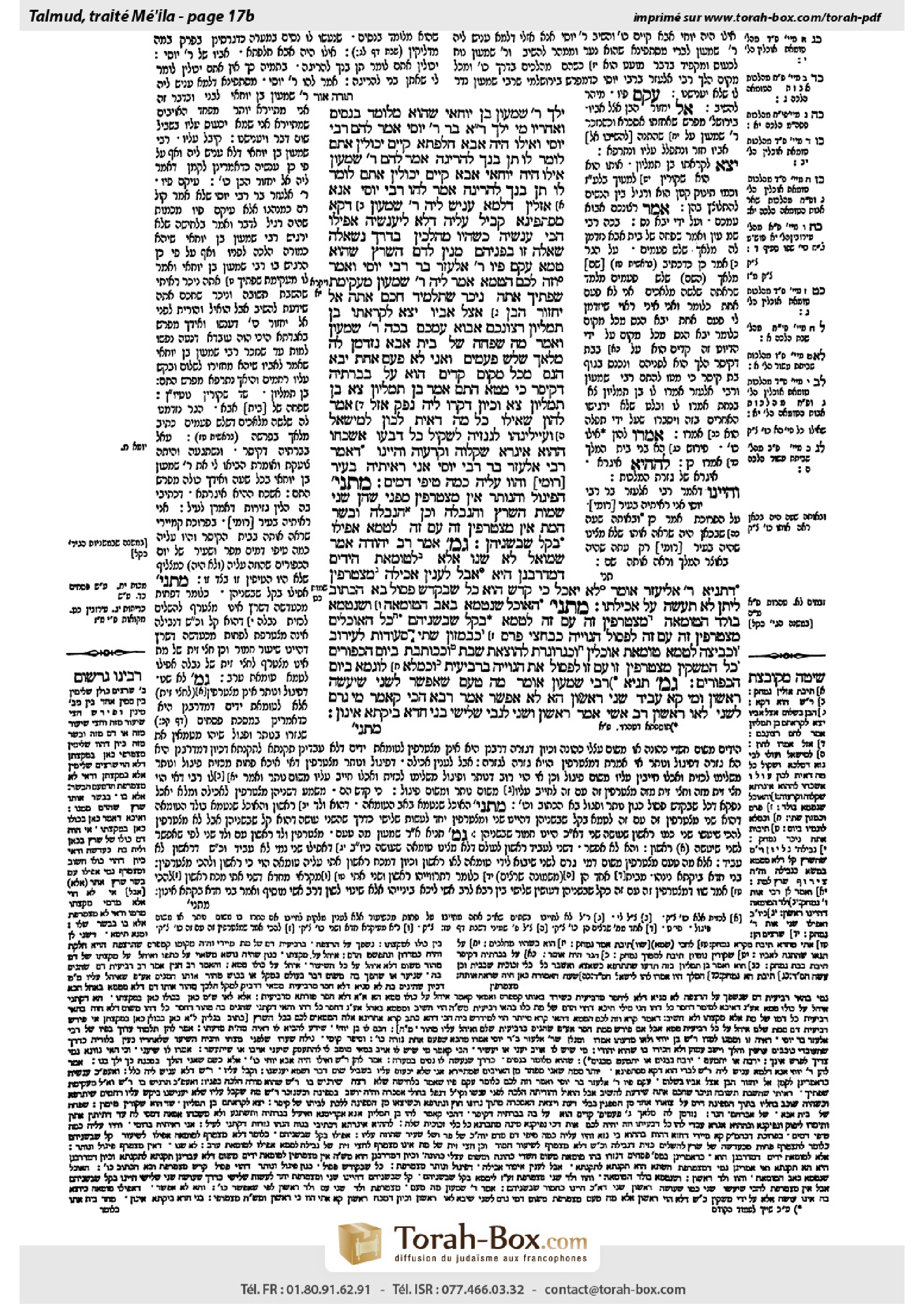
Meilah 17b: Talmud study for Daf Yomi
Daf Yomi is the daily study of one Talmud folio. Explore 37 tractates with scans, Hebrew text, Sefaria English and AI-generated French translations where annotated.
Passage selection and English or AI-generated French translation are available where the scan has annotations. Daf Study is independent of Torah-Box and Sefaria.
Browse Meilah · מעילה · All tractatesMeilah 17b text and translations
This page of Meilah includes the Aramaic text, an English translation and an AI-generated French translation, alongside the scan above.
מעילה י״ז ב · Aramaic and Hebrew text
יֵלֵךְ רַבִּי שִׁמְעוֹן בֶּן יוֹחַאי, שֶׁהוּא מְלוּמָּד בְּנִסִּים. וְאַחֲרָיו מִי יֵלֵךְ? רַבִּי אֶלְעָזָר בַּר רַבִּי יוֹסֵי.
אָמַר לָהֶם רַבִּי יוֹסֵי: וְאִילּוּ הָיָה אַבָּא חֲלַפְתָּא קַיָּים, יְכוֹלִין אַתֶּם לוֹמַר לוֹ: תֵּן בִּנְךָ לַהֲרִיגָה? אָמַר לָהֶם ר׳ שִׁמְעוֹן: אִילּוּ הָיָה יוֹחַאי אַבָּא קַיָּים, יְכוֹלִין אַתֶּם לוֹמַר לוֹ: תֵּן בִּנְךָ לַהֲרִיגָה?
אֲמַר לְהוּ רַבִּי יוֹסֵי: אֲנָא אָזְלִין, דִּלְמָא עָנֵישׁ לֵיהּ רַבִּי שִׁמְעוֹן, דְּקָא מִסְתְּפֵינָא. קַבֵּיל עֲלֵיהּ דְּלָא לִיעְנְשֵׁיהּ. אֲפִילּוּ הָכִי, עַנְשֵׁיהּ.
כְּשֶׁהָיוּ מְהַלְּכִין בַּדֶּרֶךְ, נִשְׁאֲלָה שְׁאֵלָה זוֹ בִּפְנֵיהֶם: מִנַּיִן לְדַם הַשֶּׁרֶץ שֶׁהוּא טָמֵא? עִקֵּם פִּיו רַבִּי אֶלְעָזָר בַּר רַבִּי יוֹסֵי, וְאָמַר: ״וְזֶה לָכֶם הַטָּמֵא״. אֲמַר לֵיהּ רַבִּי שִׁמְעוֹן: מֵעֲקִימַת שְׂפָתֶיךָ אַתָּה נִיכָּר שֶׁתַּלְמִיד חָכָם אַתָּה, אַל יַחְזוֹר הַבֵּן אֵצֶל אָבִיו.
יָצָא לִקְרָאתוֹ בֶּן תְּמַלְיוֹן: רְצוֹנְכֶם אָבוֹא עִמָּכֶם? בָּכָה רַבִּי שִׁמְעוֹן וְאָמַר: מַה שִּׁפְחָה שֶׁל בֵּית אַבָּא, נִזְדַּמֵּן לָהּ מַלְאָךְ שָׁלֹשׁ פְּעָמִים. וַאֲנִי, לֹא פַּעַם אַחַת? יָבֹא הַנֵּס מִכׇּל מָקוֹם.
קְדֵים הוּא, עַל בִּבְרַתֵּיהּ דְּקֵיסָר. כִּי מְטָא הָתָם, אָמַר: בֶּן תְּמַלְיוֹן, צֵא! בֶּן תְּמַלְיוֹן, צֵא! וְכֵיוָן דִּקְרוֹ לֵיהּ, נְפַק אֲזַל. אֲמַר לְהוֹן: שְׁאִילוּ כׇּל מָה דְּאִית לְכוֹן לְמִישְׁאַל. וְעַיְּילִינְהוּ לְגִנְזֵיהּ לִשְׁקוֹל כֹּל דְּבָעוּ. אַשְׁכַּחוּ הָהוּא אִיגְּרָא, שַׁקְלוּהָ וּקְרָעוּהָ.
וְהַיְינוּ דְּאָמַר רַבִּי אֶלְעָזָר בַּר רַבִּי יוֹסֵי: אֲנִי רְאִיתִיהָ בָּעִיר רוֹמִי, וַהֲווֹ עָלֶיהָ כַּמָּה טִיפֵּי דָמִים.
מַתְנִי׳ הַפִּיגּוּל וְהַנּוֹתָר – אֵין מִצְטָרְפִין, מִפְּנֵי שֶׁהֵן שְׁנֵי שֵׁמוֹת. הַשֶּׁרֶץ וְהַנְּבֵלָה, וְכֵן הַנְּבֵלָה וּבְשַׂר הַמֵּת – אֵין מִצְטָרְפִין זֶה עִם זֶה לְטַמֵּא, אֲפִילּוּ בַּקַּל שֶׁבִּשְׁנֵיהֶן.
גְּמָ׳ אָמַר רַב יְהוּדָה אָמַר שְׁמוּאֵל: לֹא שָׁנוּ אֶלָּא לְטוּמְאַת הַיָּדַיִם, דְּמִדְּרַבָּנַן הִיא. אֲבָל לְעִנְיַן אֲכִילָה – מִצְטָרְפִין. דְּתַנְיָא, רַבִּי אֱלִיעֶזֶר אוֹמֵר: ״לֹא יֵאָכֵל כִּי קֹדֶשׁ הוּא״ – כֹּל שֶׁבַּקֹּדֶשׁ פָּסוּל, בָּא הַכָּתוּב לִיתֵּן לֹא תַעֲשֶׂה עַל אֲכִילָתוֹ.
מַתְנִי׳ הָאוֹכֶל שֶׁנִּטְמָא בְּאַב הַטּוּמְאָה, וְשֶׁנִּטְמָא בִּוְלַד הַטּוּמְאָה – מִצְטָרְפִין זֶה עִם זֶה לְטַמֵּא בַּקַּל שֶׁבִּשְׁנֵיהֶם. כׇּל הָאוֹכָלִים מִצְטָרְפִין זֶה עִם זֶה לִפְסוֹל הַגְּוִיָּיה כְּבַחֲצִי פְרָס.
כְּבִמְזוֹן שְׁתֵּי סְעוּדוֹת לְעֵירוּב, וּכְבֵיצָה לְטַמֵּא טוּמְאַת אוֹכָלִין, וְכִגְרוֹגֶרֶת לְהוֹצָאַת שַׁבָּת, וּכְכוֹתֶבֶת בְּיוֹם הַכִּפּוּרִים. כׇּל הַמַּשְׁקִין מִצְטָרְפִין זוֹ עִם זוֹ לִפְסוֹל אֶת הַגְּוִיָּיה בִּרְבִיעִית, וְכִמְלֹא לוּגְמָא בְּיוֹם הַכִּפּוּרִים.
גְּמָ׳ תַּנְיָא, רַבִּי שִׁמְעוֹן אוֹמֵר: מָה טַעַם? שֶׁאֶפְשָׁר לַשֵּׁנִי שֶׁיֵּעָשֶׂה רִאשׁוֹן. וּמִי קָא עָבֵיד שֵׁנִי רִאשׁוֹן? הָא לָא אֶפְשָׁר!
אָמַר רָבָא, הָכִי קָאָמַר: מִי גָּרַם לַשֵּׁנִי? לָאו רִאשׁוֹן?! רַב אָשֵׁי אָמַר: רִאשׁוֹן וְשֵׁנִי, לְגַבֵּי שְׁלִישִׁי – בְּנֵי חֲדָא בִּיקְתָּא אִינּוּן.
Meilah 17b · English translation
Let Rabbi Shimon ben Yoḥai go to Rome, as he is accustomed to experiencing miracles. And who shall go after him, i.e., with him? Rabbi Elazar bar Rabbi Yosei.
When Rabbi Yosei, Rabbi Elazar’s father, heard this suggestion, he said to the Sages: But if Abba Ḥalafta, my father, were alive, would you be able to say to him: Give your son to be killed? If so, how can you ask me to send my son to Rome, where he is likely to be killed? Rabbi Shimon said to the Sages: If Yoḥai, my father, were alive, would you be able to say to him: Give your son to be killed? Nevertheless, I am prepared to risk my life and go to Rome, and if so, Rabbi Elazar bar Rabbi Yosei should accompany me.
Upon hearing this, Rabbi Yosei said to the Sages: If so, I will go in place of my son. I do not want him to go with Rabbi Shimon ben Yoḥai, as this is what I fear: My son Elazar is young and quick to answer, and I am concerned lest Rabbi Shimon, who is hot-tempered, will become angry with him and punish him. Rabbi Shimon accepted upon himself that he would not punish Rabbi Elazar. The Gemara notes that even so, Rabbi Shimon did punish him while they were on their journey.
Why did Rabbi Shimon end up punishing Rabbi Elazar? When they were walking on the road, this following question was asked before them: From where is it derived with regard to blood of a creeping animal that it is impure? Rabbi Elazar bar Rabbi Yosei twisted his mouth to whisper and said: It is derived from the verse: “And these are they that are impure for you among the creeping animals” (Leviticus 11:29). Although Rabbi Elazar tried to whisper so that Rabbi Shimon would not hear, Rabbi Shimon said to him: From the twisting of your mouth and your answer it is clear that you are a Torah scholar. Nevertheless, it is prohibited for a student to issue a ruling of halakha in the presence of his teacher. Therefore, I curse you that the son will not return from this journey to his father.
The Gemara continues the story: As they were journeying, a demon named ben Temalyon emerged to greet them. He said to them: Do you wish that I will join you and come with you in order to help nullify this decree? When he saw that a demon was coming to help save the Jewish people, Rabbi Shimon cried and said: What, even for a maidservant of my father’s home, Hagar the Egyptian, who was Abraham’s handmaid, an angel was made available to appear to her three times to help her. Each of the three mentions of “and the angel of the Lord said unto her” (Genesis 16:9–11) in the story of Hagar is understood as a reference to a different angel. But I apparently do not deserve assistance from an angel even one time, but only help from a demon. In any case, let the miracle come and save the Jewish people, even if only through a demon.
The demon ben Temalyon went before them and ascended into the emperor’s daughter and possessed her. When Rabbi Shimon ben Yoḥai arrived there, the emperor’s palace, he said: Ben Temalyon, emerge! Ben Temalyon, emerge! And once Rabbi Shimon called to him, ben Temalyon emerged and left the emperor’s daughter, and she was cured. When the emperor saw that Rabbi Shimon had cured his daughter, he said to them: Ask from me any reward that you want to ask. And he took them up to his treasury to take whatever they wanted. They found that letter there that contained the decrees against the Jewish people, and they took it and tore it up, and thereby nullified the decrees.
The Gemara adds: And this is the background for that which Rabbi Elazar bar Rabbi Yosei said (Yoma 57a): I saw the Curtain of the Sanctuary in the city of Rome, and on the Curtain were several drops of blood from the bull and the goat of Yom Kippur. When the emperor took them into his treasury Rabbi Elazar saw the Temple vessels that the Romans had captured when they conquered Jerusalem, including the Curtain.
MISHNA: Sacrificial meat that is piggul and sacrificial meat that is notar do not join together to constitute the requisite measure of an olive-bulk, due to the fact that they belong to two separate categories of prohibition. The flesh of the carcass of the creeping animal and the flesh of the animal carcass, and likewise the flesh of the animal carcass and the flesh of the corpse, do not join together to transmit ritual impurity, not even for the more lenient of the two impurities, i.e., the impurity that requires the greater measure.
GEMARA: Rav Yehuda says that Shmuel says: The mishna taught that piggul and notar do not join together only with regard to the ritual impurity of the hands if one touched them, which is by rabbinic law. But with regard to the matter of eating, they do join together. As it is taught in a baraita that Rabbi Eliezer says: The verse states with regard to leftover sacrificial food from meat and bread: “It shall not be eaten because it is sacred” (Exodus 29:34). This teaches with regard to anything sacred that has been disqualified for whatever reason, that the verse comes to apply a prohibition with regard to its consumption.
MISHNA: The food that became ritually impure through contact with a primary source of ritual impurity, thereby assuming first-degree ritual impurity, and the food that became ritually impure through contact with a secondary source of ritual impurity, thereby assuming second-degree ritual impurity, join together to constitute the requisite measure of an egg-bulk to transmit impurity in accordance with the more lenient of the two, i.e., second-degree ritual impurity. All the ritually impure foods join together to constitute the requisite measure to disqualify the body [hageviyya] of one who eats half of a half-loaf-bulk [peras] of the impure foods from partaking of teruma.
Likewise, all foods join together to constitute the requisite measure of food sufficient for two meals, to establish a joining of Shabbat boundaries; and to form the requisite measure of an egg-bulk, to render an item impure with the ritual impurity of food; and to form the measure of a dried fig-bulk, which establishes liability for carrying out food on Shabbat; and to form the volume of a large date, which establishes liability for eating on Yom Kippur. All the liquids join together to constitute the requisite measure to disqualify the body of one who drinks a quarter-log of ritually impure liquid from partaking of teruma; and to constitute the measure of a cheekful, which establishes liability for drinking on Yom Kippur.
GEMARA: It is taught in a baraita that Rabbi Shimon says: What is the reason that food with first-degree ritual impurity joins together with food that has second-degree ritual impurity? The reason is that it is possible for the food with second-degree impurity to render another food impure with first-degree impurity. The Gemara asks: But can a food with second-degree impurity render another food impure with first-degree impurity? That is not possible. If food impure with second-degree impurity touches other food, it renders that food impure with third-degree impurity, not first-degree impurity.
Rava said that this is what Rabbi Shimon is saying: What caused that food to become impure with second-degree impurity? Is it not that it was touched by food with first-degree impurity? Since they share a common source, they join together. Rav Ashi similarly said: Food impure with first-degree impurity and food impure with second-degree impurity, with regard to food impure with third-degree impurity, are considered like members of one house, i.e., they both lead to third-degree impurity, either directly or indirectly, and for this reason they join together.
Meilah 17b · Traduction française (IA)
Que Rabbi Shimon ben Yoḥai se rende à Rome, puisqu’il a l’habitude de voir des miracles se produire. Et qui ira après lui, c’est-à-dire avec lui ? Rabbi Elazar bar Rabbi Yosei.
Lorsque Rabbi Yosei, le père de Rabbi Elazar, entendit cette proposition, il dit aux Sages : « Mais si Abba Ḥalafta, mon père, était vivant, pourriez-vous lui dire : “Donne ton fils pour qu’il soit tué” ? Si tel est le cas, comment pouvez-vous me demander d’envoyer mon fils à Rome, où il risque d’être tué ? » Rabbi Shimon dit aux Sages : « Si Yoḥai, mon père, était vivant, pourriez-vous lui dire : “Donne ton fils pour qu’il soit tué” ? Néanmoins, je suis prêt à risquer ma vie et à aller à Rome ; dans ce cas, Rabbi Elazar bar Rabbi Yosei devrait m’accompagner. »
En entendant cela, Rabbi Yosei dit aux Sages : « Si tel est le cas, j’irai à la place de mon fils. Je ne veux pas qu’il parte avec Rabbi Shimon ben Yoḥai, car voici ce que je crains : mon fils Elazar est jeune et prompt à répondre, et je crains que Rabbi Shimon, qui est irascible, ne se mette en colère contre lui et ne le punisse. » Rabbi Shimon s’engagea à ne pas punir Rabbi Elazar. La Guemara note que, malgré cela, Rabbi Shimon le punit alors qu’ils étaient en chemin.
Pourquoi Rabbi Shimon finit-il par punir Rabbi Elazar ? Alors qu’ils marchaient sur la route, on leur posa la question suivante : d’où sait-on que le sang d’un animal rampant est impur ? Rabbi Elazar bar Rabbi Yosei fit une moue pour chuchoter et dit : « Cela se déduit du verset : “Et voici ceux qui sont impurs pour vous parmi les animaux rampants” (Lévitique 11, 29). » Bien que Rabbi Elazar ait essayé de chuchoter afin que Rabbi Shimon ne l’entende pas, Rabbi Shimon lui dit : « À la moue que tu as faite et à ta réponse, il est évident que tu es un érudit en Torah. Néanmoins, il est interdit à un élève de trancher la halakha en présence de son maître. C’est pourquoi je te maudis : que le fils ne revienne pas de ce voyage auprès de son père. »
La Guemara poursuit le récit : tandis qu’ils étaient en route, un démon nommé ben Temalyon vint à leur rencontre. Il leur dit : « Voulez-vous que je me joigne à vous et vous accompagne afin de vous aider à annuler ce décret ? » Voyant qu’un démon venait aider à sauver le peuple juif, Rabbi Shimon pleura et dit : « Quoi ! Même pour une servante de la maison de mon père, Hagar l’Égyptienne, qui était la servante d’Abraham, un ange fut envoyé pour lui apparaître trois fois afin de l’aider. Chacune des trois occurrences de “Et l’ange de l’Éternel lui dit” (Genèse 16, 9-11), dans le récit de Hagar, est comprise comme faisant référence à un ange différent. Mais, semble-t-il, je ne mérite pas de recevoir l’aide d’un ange, ne serait-ce qu’une seule fois ; je n’ai droit qu’à l’aide d’un démon. Quoi qu’il en soit, que le miracle vienne sauver le peuple juif, même si ce n’est que par l’intermédiaire d’un démon. »
Le démon ben Temalyon les précéda, pénétra dans la fille de l’empereur et la posséda. Lorsque Rabbi Shimon ben Yoḥai arriva là-bas, au palais de l’empereur, il dit : « Ben Temalyon, sors ! Ben Temalyon, sors ! » Dès que Rabbi Shimon l’eut appelé, ben Temalyon sortit de la fille de l’empereur, qui fut guérie. Voyant que Rabbi Shimon avait guéri sa fille, l’empereur leur dit : « Demandez-moi la récompense que vous voulez. » Puis il les conduisit dans son trésor pour qu’ils prennent tout ce qu’ils voulaient. Ils y trouvèrent la lettre contenant les décrets contre le peuple juif ; ils la prirent et la déchirèrent, annulant ainsi les décrets.
La Guemara ajoute que c’est là l’explication de ce que Rabbi Elazar bar Rabbi Yosei a dit (Yoma 57a) : « J’ai vu le rideau du Sanctuaire dans la ville de Rome, et plusieurs gouttes de sang du taureau et du bouc de Yom Kippour se trouvaient sur le rideau. » Lorsque l’empereur les conduisit dans son trésor, Rabbi Elazar vit les ustensiles du Temple que les Romains avaient capturés lors de la conquête de Jérusalem, dont le rideau.
MICHNA : La viande sacrificielle qui est piggul et la viande sacrificielle qui est notar ne s’additionnent pas pour atteindre la mesure requise du volume d’une olive, car elles relèvent de deux catégories d’interdits distinctes. La chair d’un reptile mort et celle d’une carcasse animale, de même que la chair d’une carcasse animale et celle d’un cadavre humain, ne s’additionnent pas pour transmettre l’impureté rituelle, même selon la plus clémente des deux catégories d’impureté, c’est-à-dire celle qui exige la plus grande quantité.
GUEMARA : Rav Yehouda dit au nom de Shmuel : La Michna enseigne que piggul et notar ne s’additionnent pas uniquement en ce qui concerne l’impureté rituelle des mains résultant de leur contact, laquelle relève de la loi rabbinique. En revanche, ils s’additionnent pour ce qui est de la consommation. Car il est enseigné dans une baraïta que Rabbi Eliezer dit : Le verset dit, au sujet des restes de viande et de pain sacrificiels : « On ne le mangera pas, car il est sacré » (Exode 29, 34). Cela enseigne que, pour tout élément sacré invalidé pour quelque raison que ce soit, le verset vient appliquer une interdiction de consommation.
MICHNA : L’aliment devenu rituellement impur au contact d’une source primaire d’impureté rituelle, et ayant ainsi acquis le premier degré d’impureté rituelle, et l’aliment devenu rituellement impur au contact d’une source secondaire d’impureté rituelle, et ayant ainsi acquis le deuxième degré d’impureté rituelle, s’additionnent pour atteindre la mesure requise du volume d’un œuf et transmettre l’impureté selon le degré le plus faible des deux, c’est-à-dire le deuxième degré d’impureté rituelle. Tous les aliments rituellement impurs s’additionnent pour atteindre la mesure requise afin de disqualifier le corps [hageviyya] de celui qui consomme le volume d’un demi-pain [peras] de ces aliments impurs, et l’empêcher ainsi de consommer de la terouma.
De même, tous les aliments s’additionnent pour atteindre la quantité suffisante pour deux repas, nécessaire à l’établissement d’un érouv des limites du Chabbat ; le volume d’un œuf, nécessaire pour qu’un aliment contracte l’impureté rituelle des aliments ; le volume d’une figue sèche, qui établit la responsabilité pour le transport d’aliments pendant Chabbat ; et le volume d’une grosse datte, qui établit la responsabilité pour la consommation pendant Yom Kippour. Tous les liquides s’additionnent pour atteindre la mesure requise afin de disqualifier le corps de celui qui boit un quart de log de liquide rituellement impur, et l’empêcher ainsi de consommer de la terouma ; ils s’additionnent également pour atteindre la mesure d’une pleine joue, qui établit la responsabilité pour la consommation de boisson pendant Yom Kippour.
GUEMARA : Il est enseigné dans une baraïta que Rabbi Shimon dit : Pourquoi un aliment frappé du premier degré d’impureté rituelle s’additionne-t-il à un aliment frappé du deuxième degré d’impureté rituelle ? Parce que l’aliment frappé du deuxième degré d’impureté peut rendre un autre aliment impur au premier degré. La Guemara demande : Mais un aliment frappé du deuxième degré d’impureté peut-il rendre un autre aliment impur au premier degré ? Cela est impossible. Si un aliment impur au deuxième degré touche un autre aliment, il le rend impur au troisième degré, et non au premier degré.
Rava dit que voici ce que Rabbi Shimon veut dire : Qu’est-ce qui a rendu cet aliment impur au deuxième degré ? N’est-ce pas le contact avec un aliment frappé du premier degré d’impureté ? Puisqu’ils ont une origine commune, ils s’additionnent. Rav Ashi dit de même : Pour ce qui est de rendre un aliment impur au troisième degré, un aliment impur au premier degré et un aliment impur au deuxième degré sont considérés comme les membres d’une même maison, c’est-à-dire qu’ils conduisent tous deux au troisième degré d’impureté, directement ou indirectement ; c’est pourquoi ils s’additionnent.
Traduction française générée par IA à partir de l’édition anglaise de Sefaria. Vérifie toujours un passage avec le texte source.
Text from Sefaria: William Davidson Edition - Vocalized Aramaic (CC BY NC); William Davidson Edition - English (CC BY NC).