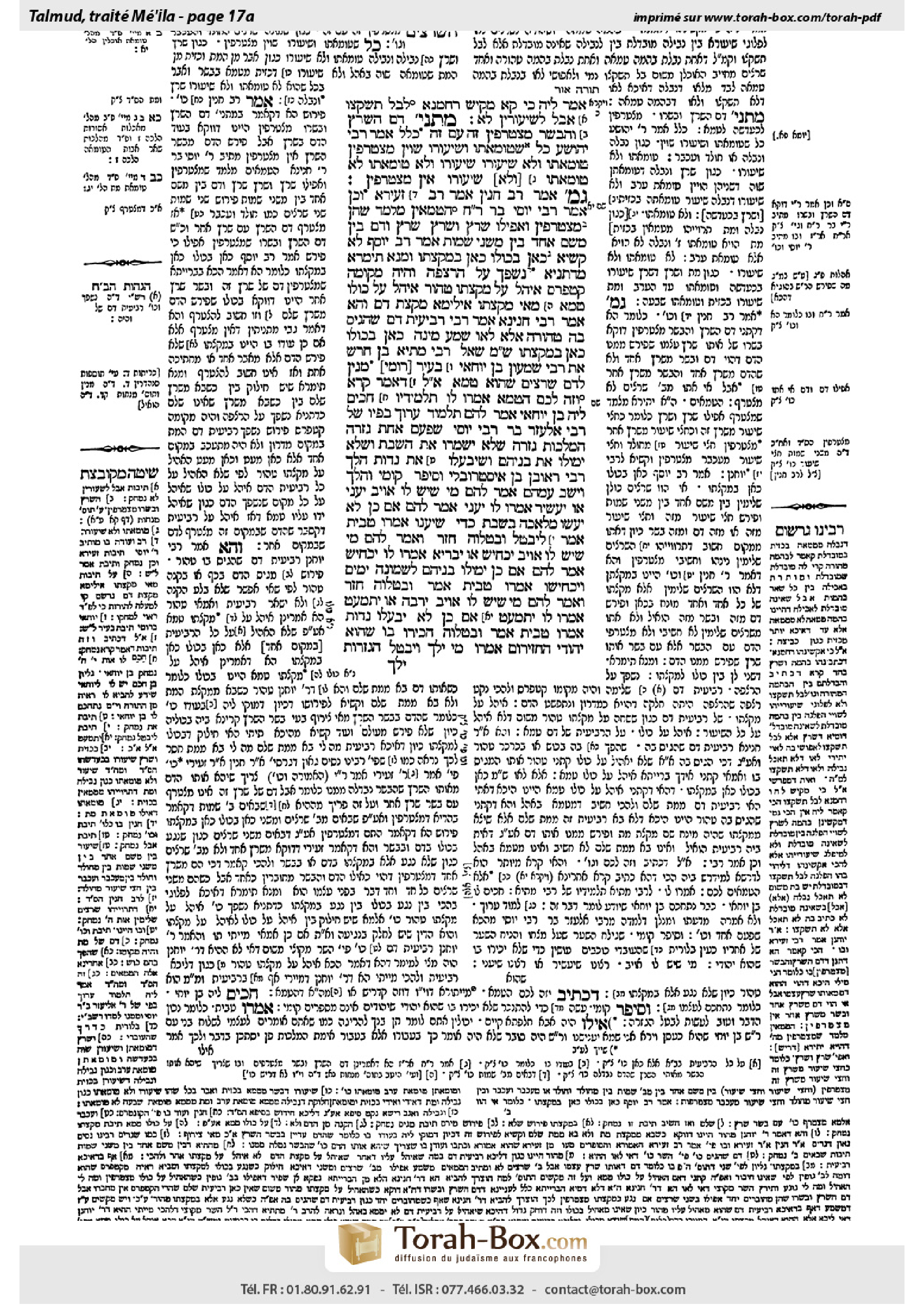
Meilah 17a: Talmud study for Daf Yomi
Daf Yomi is the daily study of one Talmud folio. Explore 37 tractates with scans, Hebrew text, Sefaria English and AI-generated French translations where annotated.
Passage selection and English or AI-generated French translation are available where the scan has annotations. Daf Study is independent of Torah-Box and Sefaria.
Browse Meilah · מעילה · All tractatesMeilah 17a text and translations
This page of Meilah includes the Aramaic text, an English translation and an AI-generated French translation, alongside the scan above.
מעילה י״ז א · Aramaic and Hebrew text
אֲמַר לֵיהּ: כִּי קָא מַקֵּישׁ רַחֲמָנָא – לְבַל תְּשַׁקְּצוּ, אֲבָל לְשִׁיעוּרִין – לָא.
מַתְנִי׳ דַּם הַשֶּׁרֶץ וְהַבָּשָׂר – מִצְטָרְפִין זֶה עִם זֶה. כְּלָל אָמַר רַבִּי יְהוֹשֻׁעַ: כֹּל שֶׁטּוּמְאָתוֹ וְשִׁיעוּרוֹ שָׁוִין – מִצְטָרְפִין.
טוּמְאָתוֹ וְלֹא שִׁיעוּרוֹ, שִׁיעוּרוֹ וְלֹא טוּמְאָתוֹ, לֹא טוּמְאָתוֹ [וְלֹא] שִׁיעוּרוֹ – אֵין מִצְטָרְפִין.
גְּמָ׳ אָמַר רַב חָנִין אָמַר רַב זְעֵירָא,
וְכֵן אָמַר רַבִּי יוֹסֵי בַּר רַבִּי חֲנִינָא: ״הַטְּמֵאִין״ – מְלַמֵּד שֶׁהֵן מִצְטָרְפִין, וַאֲפִילּוּ שֶׁרֶץ וָשֶׁרֶץ, שֶׁרֶץ וָדָם, בֵּין מִשֵּׁם אֶחָד, בֵּין מִשְּׁנֵי שֵׁמוֹת!
אָמַר רַב יוֹסֵף: לָא קַשְׁיָא, כָּאן – בְּכוּלּוֹ. כָּאן – בְּמִקְצָתוֹ.
וּמְנָא תֵּימְרָא? מִדְּתַנְיָא: נִשְׁפַּךְ עַל הָרִצְפָּה וְהָיָה מְקוֹמָהּ קָטַפְרֵס, אִיהֵל עַל מִקְצָתוֹ – טָהוֹר, אִיהֵל עַל כּוּלּוֹ – טָמֵא.
מַאי ״מִקְצָתוֹ״? אִילֵּימָא מִקְצָת דָּם, וְהָא אָמַר רַבִּי חֲנִינָא אָמַר רַבִּי: רְבִיעִית דָּם שֶׁהֵגִיס בָּהּ – טְהוֹרָה!
אֶלָּא לָאו שְׁמַע מִינַּהּ: כָּאן – בְּכוּלּוֹ, כָּאן – בְּמִקְצָתוֹ? שְׁמַע מִינַּהּ.
שָׁאַל רַבִּי מַתְיָא בֶּן חָרָשׁ אֶת רַבִּי שִׁמְעוֹן בֶּן יוֹחַאי בָּעִיר רוֹמִי: מִנַּיִן לְדַם שְׁרָצִים שֶׁהוּא טָמֵא? אֲמַר לֵיהּ: דְּאָמַר קְרָא: ״וְזֶה לָכֶם הַטָּמֵא״.
אָמְרוּ לוֹ תַּלְמִידָיו: חֲכֵים לֵיהּ בֶּן יוֹחַאי. אָמַר לָהֶם: תַּלְמוּד עָרוּךְ בְּפִיו שֶׁל רַבִּי אֶלְעָזָר בַּר רַבִּי יוֹסֵי. שֶׁפַּעַם אַחַת גָּזְרָה הַמַּלְכוּת גְּזֵרָה שֶׁלֹּא יִשְׁמְרוּ אֶת הַשַּׁבָּת, וְשֶׁלֹּא יָמוּלוּ אֶת בְּנֵיהֶם, וְשֶׁיִּבְעֲלוּ אֶת נִדּוֹת.
הָלַךְ רַבִּי רְאוּבֵן בֶּן אִיסְטְרוֹבָּלִי, וְסִיפֵּר קוֹמֵי, וְהָלַךְ וְיָשַׁב עִמָּהֶם. אָמַר לָהֶם: מִי שֶׁיֵּשׁ לוֹ אוֹיֵב, יַעֲנִי אוֹ יַעֲשִׁיר? אָמְרוּ לוֹ: יַעֲנִי. אָמַר לָהֶם: אִם כֵּן, לֹא יַעֲשׂוּ מְלָאכָה בַּשַּׁבָּת, כְּדֵי שֶׁיַּעֲנוּ! אָמְרוּ: טָבֵית אָמַר, לִיבְטַל, וּבִטְּלוּהָ.
חָזַר וְאָמַר לָהֶם: מִי שֶׁיֵּשׁ לוֹ אוֹיֵב, יַכְחִישׁ אוֹ יַבְרִיא? אָמְרוּ לוֹ: יַכְחִישׁ. אָמַר לָהֶם: אִם כֵּן, יָמוּלוּ בְּנֵיהֶם לִשְׁמוֹנָה יָמִים וְיַכְחִישׁוּ. אָמְרוּ: טָבֵית אָמַר, וּבִטְּלוּהָ.
חָזַר וְאָמַר לָהֶם: מִי שֶׁיֵּשׁ לוֹ אוֹיֵב, יִרְבֶּה אוֹ יִתְמַעֵט? אָמְרוּ לוֹ: יִתְמַעֵט. אִם כֵּן, לֹא יִבְעֲלוּ נִדּוֹת. אָמְרוּ: טָבֵית אָמַר, וּבִטְּלוּהָ.
הִכִּירוּ בּוֹ שֶׁהוּא יְהוּדִי, הֶחֱזִירוּם. אָמְרוּ: מִי יֵלֵךְ וִיבַטֵּל הַגְּזֵרוֹת?
Meilah 17a · English translation
Rava said to Rav Adda bar Ahava: When the Merciful One juxtaposes kosher and non-kosher animals to creeping animals, this is referring to the prohibition of: “You shall not make your souls detestable” (Leviticus 20:25), teaching that they are all included in that prohibition. But with regard to measures the Torah does not juxtapose those animals to creeping animals. For this reason there is no difference between the measure of impurity of carcasses of kosher animals and non-kosher animals.
MISHNA: The blood of one of the eight creeping animals listed in the Torah and their flesh join together to constitute the lentil-bulk measure to impart impurity. Rabbi Yehoshua stated a principle: With regard to any items whose impurity, in terms of degree and duration, and measure to impart impurity, are equal, e.g., two halves of an olive-bulk from two corpses or two animal carcasses or two halves of a lentil-bulk from two creeping animals, they join together to constitute the requisite measure.
Rabbi Yehoshua continued: By contrast, with regard to items whose impurity is equal but their measure is not equal, e.g., a creeping animal and an animal carcass, each of which renders one impure until the evening, but the measure of a creeping animal is a lentil-bulk, whereas that of an animal carcass is an olive-bulk; or items whose measure is equal but whose impurity is not equal, e.g., a corpse and an animal carcass, with regard to which the measure of each is an olive-bulk, but the duration of the impurity imparted by a corpse is one week and the duration of the impurity imparted by an animal carcass is until the evening; or items that are equal neither in terms of their impurity nor in terms of their measure, they do not join together to constitute the requisite measure.
GEMARA: The mishna teaches that the blood of one of the eight creeping animals listed in the Torah and the flesh of those animals join together to constitute the lentil-bulk measure required to impart impurity. Rav Ḥanin says that Rav Zeira says: The blood and flesh join together only if the blood is from the same animal as the flesh, but not if it is from a different animal.
And similarly, Rabbi Yosei bar Rabbi Ḥanina says, in rejection of Rav Zeira’s statement: It is taught in a baraita: The verse states: “These are the impure [hateme’in] to you among all that creep; whoever touches them when they are dead, shall be impure until the evening” (Leviticus 11:31). This plural form of “hateme’in” teaches that they join together to impart ritual impurity. And this applies even to the flesh of a creeping animal and the flesh of another creeping animal, or the flesh of a creeping animal and the blood of another creeping animal, whether they are from one category, i.e., one type of creeping animal, or from two categories of creeping animal.
Rav Yosef says: This is not difficult. Here, the baraita is referring to a case where the half-measure of flesh and the half-measure of blood both came from an entire animal, and therefore the two half-measures combine, due to the significance of an entire animal. There, in the statement of Rav Zeira, he is speaking of a case where the half-measure of flesh and the half-measure of blood each come from part of an animal.
And from where do you say that there is a distinction between a case where the flesh and blood come from an entire animal and a case where they come from part of an animal? From that which is taught in a baraita: In a case where one quarter-log of blood from a corpse was spilled on the floor, and its place was a slope [ketafres], so that the blood trickles down, and someone leaned over so that he covered part of it, he remains ritually pure. If he covered all of it, he is rendered impure.
The Gemara clarifies the halakha: What does the phrase: Part of it, mean in this context? If we say that it is referring to part of the one quarter-log of blood, whereas if it is a full quarter-log then he is impure, that is difficult: But doesn’t Rabbi Ḥanina say that Rabbi Yehuda HaNasi says: If there was exactly one quarter-log of blood in a pot that one stirred without touching the blood, he remains pure, despite the fact that his body must have overshadowed all the blood at the time, and would therefore have had the status of a tent over it. The reason is that some of the blood must have been absorbed into the spoon with which he stirred, and therefore there no longer remains an entire connected quarter-log. This shows that the entire quarter-log must be together, as one unit, in order to impart impurity.
Rather, isn’t it correct to conclude from this baraita that there is a distinction between a case where the blood came from an entire corpse, and where it came from part of a corpse? In other words, if the blood came from one body it need not be together as a single unit, whereas if it came from more than one body, it must all be joined together, as in the case mentioned by Rabbi Yehuda HaNasi. Similarly, with regard to the statements of Rav Zeira and the baraita, here the baraita is referring to a situation where the half-measure of flesh and the half-measure of blood came from an entire animal, and due to the significance of an entire animal the two half-measures combine. There, Rav Zeira is referring to a case where the half-measure of flesh and the half-measure of blood come from part of the animal. The Gemara notes that one should indeed conclude from it that this is the correct distinction.
§ The Gemara relates that Rabbi Matya ben Ḥarash asked Rabbi Shimon ben Yoḥai in the city of Rome: From where is it derived with regard to the blood of creeping animals that it is impure? Rabbi Shimon ben Yoḥai said to him: It is derived from the fact that the verse states: “And these are they that are impure for you among the creeping animals” (Leviticus 11:29). Since a similar phrase already appears in Leviticus 11:31, it is derived from here that the blood of creeping animals is impure.
Rabbi Matya ben Ḥarash’s students said to him in amazement: How wise is Rabbi Shimon ben Yoḥai! Rabbi Matya ben Ḥarash said to them: This source is not his own, as it is a set tradition in the mouth of Rabbi Elazar bar Rabbi Yosei, and Rabbi Shimon ben Yoḥai learned it from him. Rabbi Matya ben Ḥarash provided the background for this claim. As, on one occasion the gentile monarchy issued a decree that the Jewish people may not observe Shabbat, and that they may not circumcise their sons, and that they must engage in intercourse with their wives when they are menstruating.
Rabbi Reuven ben Isterobeli went and cut his hair in a komei hairstyle,which was common only among the gentiles, and he went and sat with the gentiles when they were discussing these three decrees. He said to them: One who has an enemy, does he want his enemy to become poor or to become rich? They said to him: He wants his enemy to become poor. Rabbi Reuven ben Isterobeli said to them: If so, with regard to the Jewish people as well, isn’t it better that they will not perform labor on Shabbat in order that they will become poor? The gentiles said: That is a good claim that he said; let us nullify our decree. And they indeed nullified it.
Again Rabbi Reuven ben Isterobeli spoke to them and said: One who has an enemy, does he want his enemy to become weak or to become healthy? They said to him: He wants his enemy to become weak. Rabbi Reuven ben Isterobeli said to them: If so, with regard to the Jewish people as well, isn’t it better that they circumcise their sons after eight days and thereby cause them to become weak? The gentiles said: That is a good claim that he said, and they nullified their decree.
Once again Rabbi Reuven ben Isterobeli spoke to them and said: One who has an enemy, does he want his enemy to multiply or to decrease? They said to him: He wants his enemy to decrease. Rabbi Reuven ben Isterobeli said to them: If so, with regard to the Jewish people as well, isn’t it better that they do not engage in intercourse with their wives when they are menstruating? The gentiles said: That is a good claim that he said, and they nullified their decree.
A short time later they recognized that Rabbi Reuven ben Isterobeli was a Jew, and they realized that he had fooled them to the advantage of the Jewish people. They therefore arose and reinstated all of their decrees. The Sages then said: Who will go and nullify these decrees?
Meilah 17a · Traduction française (IA)
Rava dit à Rav Adda bar Ahava : Lorsque le Miséricordieux rapproche les animaux purs et impurs des animaux rampants, cela concerne l’interdiction : « Vous ne rendrez pas vos personnes détestables » (Lévitique 20:25), ce qui enseigne qu’ils sont tous inclus dans cette interdiction. Mais, en ce qui concerne les mesures, la Torah ne rapproche pas ces animaux des animaux rampants. C’est pourquoi il n’y a pas de différence entre la mesure d’impureté des carcasses d’animaux purs et celle des carcasses d’animaux impurs.
Michna : Le sang de l’un des huit animaux rampants énumérés dans la Torah et leur chair s’associent pour constituer la mesure d’une lentille requise pour transmettre l’impureté. Rabbi Yehoshua a énoncé un principe : tous les éléments dont l’impureté est identique quant à son degré et à sa durée, et dont la mesure requise pour transmettre l’impureté est égale — par exemple, deux demi-volumes d’olive provenant de deux cadavres ou de deux carcasses animales, ou deux demi-volumes de lentille provenant de deux animaux rampants — s’associent pour constituer la mesure requise.
Rabbi Yehoshua poursuivit : En revanche, des éléments dont l’impureté est identique, mais dont la mesure diffère — par exemple, un animal rampant et une carcasse animale, qui rendent chacun impur jusqu’au soir, mais dont la mesure est d’un volume de lentille pour l’animal rampant et d’un volume d’olive pour la carcasse animale —, ou des éléments dont la mesure est identique, mais dont l’impureté diffère — par exemple, un cadavre et une carcasse animale, dont la mesure est dans les deux cas d’un volume d’olive, mais dont l’impureté dure une semaine pour le cadavre et jusqu’au soir pour la carcasse animale —, ou des éléments qui diffèrent à la fois par leur impureté et par leur mesure, ne s’associent pas pour constituer la mesure requise.
Guemara : La Michna enseigne que le sang de l’un des huit animaux rampants énumérés dans la Torah et leur chair s’associent pour constituer la mesure d’un volume de lentille requise pour transmettre l’impureté. Rav Ḥanin rapporte au nom de Rav Zeira : le sang et la chair ne s’associent que si le sang provient du même animal que la chair, mais pas s’ils proviennent d’animaux différents.
De même, Rabbi Yosei bar Rabbi Ḥanina contredit la déclaration de Rav Zeira : une baraïta enseigne que le verset dit : « Voici ceux qui sont impurs [hateme’in] pour vous parmi tous les animaux rampants ; quiconque les touche lorsqu’ils sont morts sera impur jusqu’au soir » (Lévitique 11:31). La forme plurielle « hateme’in » enseigne qu’ils s’associent pour transmettre l’impureté rituelle. Cela s’applique même à la chair d’un animal rampant et à la chair d’un autre animal rampant, ou à la chair d’un animal rampant et au sang d’un autre animal rampant, qu’ils appartiennent à une seule catégorie, c’est-à-dire à un seul type d’animal rampant, ou à deux catégories d’animaux rampants.
Rav Yosef dit : Il n’y a pas de difficulté. Ici, la baraïta parle d’un cas où la demi-mesure de chair et la demi-mesure de sang proviennent toutes deux d’un animal entier ; les deux demi-mesures s’associent donc en raison de l’importance d’un animal entier. Là, dans la déclaration de Rav Zeira, il s’agit d’un cas où la demi-mesure de chair et la demi-mesure de sang proviennent chacune d’une partie d’un animal.
Et d’où déduis-tu qu’il y a une distinction entre le cas où la chair et le sang proviennent d’un animal entier et celui où ils proviennent d’une partie d’un animal ? De ce qui est enseigné dans une baraïta : si un quart de log de sang provenant d’un cadavre s’est répandu sur le sol, à un endroit en pente [ketafres], de sorte que le sang s’écoule vers le bas, et qu’une personne s’est penchée de manière à en recouvrir une partie, elle reste rituellement pure. Si elle l’a entièrement recouvert, elle devient impure.
La Guemara précise la halakha : que signifie ici l’expression « une partie de celui-ci » ? Si l’on dit qu’elle désigne une partie du quart de log de sang et que, si le quart de log est entier, la personne devient impure, cela pose une difficulté. Rabbi Ḥanina ne rapporte-t-il pas que Rabbi Yehuda HaNasi enseigne : si exactement un quart de log de sang se trouvait dans une marmite que l’on a remuée sans toucher le sang, la personne reste pure, bien que son corps ait nécessairement surplombé tout le sang à ce moment-là et ait donc eu le statut d’une tente au-dessus de lui ? En effet, une partie du sang a nécessairement été absorbée par la cuillère avec laquelle elle a remué ; il ne reste donc plus un quart de log entier et continu. Cela montre que, pour transmettre l’impureté, tout le quart de log doit être réuni en une seule unité.
Ne faut-il donc pas conclure de cette baraïta qu’il y a une distinction entre le cas où le sang provient d’un cadavre entier et celui où il provient d’une partie d’un cadavre ? Autrement dit, si le sang provient d’un seul corps, il n’a pas besoin d’être réuni en une seule unité, tandis que s’il provient de plusieurs corps, il doit être entièrement rassemblé, comme dans le cas mentionné par Rabbi Yehuda HaNasi. De même, pour les déclarations de Rav Zeira et la baraïta, ici, la baraïta parle d’un cas où la demi-mesure de chair et la demi-mesure de sang proviennent d’un animal entier ; en raison de l’importance d’un animal entier, les deux demi-mesures s’associent. Là, Rav Zeira parle d’un cas où la demi-mesure de chair et la demi-mesure de sang proviennent d’une partie de l’animal. La Guemara relève qu’il faut effectivement en conclure que cette distinction est correcte.
§ La Guemara rapporte que Rabbi Matya ben Ḥarash demanda à Rabbi Shimon ben Yoḥai, dans la ville de Rome : D’où déduit-on que le sang des animaux rampants est impur ? Rabbi Shimon ben Yoḥai lui répondit : On le déduit du fait que le verset dit : « Voici ceux qui sont impurs pour vous parmi les animaux rampants » (Lévitique 11:29). Puisqu’une formulation semblable apparaît déjà en Lévitique 11:31, on déduit de ce verset que le sang des animaux rampants est impur.
Les élèves de Rabbi Matya ben Ḥarash lui dirent avec étonnement : Comme Rabbi Shimon ben Yoḥai est sage ! Rabbi Matya ben Ḥarash leur dit : Cette source ne vient pas de lui ; c’est une tradition bien établie dans la bouche de Rabbi Elazar bar Rabbi Yosei, que Rabbi Shimon ben Yoḥai a apprise de lui. Rabbi Matya ben Ḥarash expliqua le contexte de cette affirmation. En effet, un jour, le pouvoir païen décréta que le peuple juif ne devait pas observer le Chabbat, ne devait pas circoncire ses fils et devait avoir des relations sexuelles avec ses femmes lorsqu’elles étaient menstruées.
Rabbi Reuven ben Isterobeli alla se faire couper les cheveux selon la coiffure komei, qui n’était courante que chez les païens, puis il s’assit avec eux tandis qu’ils discutaient de ces trois décrets. Il leur dit : Quand quelqu’un a un ennemi, souhaite-t-il que celui-ci s’appauvrisse ou s’enrichisse ? Ils lui répondirent : Il souhaite que son ennemi s’appauvrisse. Rabbi Reuven ben Isterobeli leur dit : Dans ce cas, pour le peuple juif aussi, ne vaut-il pas mieux qu’il ne travaille pas le Chabbat, afin qu’il s’appauvrisse ? Les païens dirent : C’est un bon argument ; annulons notre décret. Et ils l’annulèrent effectivement.
Rabbi Reuven ben Isterobeli leur parla de nouveau et leur dit : Quand quelqu’un a un ennemi, souhaite-t-il que celui-ci s’affaiblisse ou soit en bonne santé ? Ils lui répondirent : Il souhaite que son ennemi s’affaiblisse. Rabbi Reuven ben Isterobeli leur dit : Dans ce cas, pour le peuple juif aussi, ne vaut-il pas mieux qu’il circoncise ses fils au bout de huit jours et les affaiblisse ainsi ? Les païens dirent : C’est un bon argument ; ils annulèrent leur décret.
Une nouvelle fois, Rabbi Reuven ben Isterobeli leur parla et leur dit : Quand quelqu’un a un ennemi, souhaite-t-il que celui-ci se multiplie ou diminue ? Ils lui répondirent : Il souhaite que son ennemi diminue. Rabbi Reuven ben Isterobeli leur dit : Dans ce cas, pour le peuple juif aussi, ne vaut-il pas mieux qu’il n’ait pas de relations sexuelles avec ses femmes lorsqu’elles sont menstruées ? Les païens dirent : C’est un bon argument ; ils annulèrent leur décret.
Peu après, ils reconnurent que Rabbi Reuven ben Isterobeli était juif et comprirent qu’il les avait trompés au profit du peuple juif. Ils se levèrent donc et rétablirent tous leurs décrets. Les Sages dirent alors : Qui ira annuler ces décrets ?
Traduction française générée par IA à partir de l’édition anglaise de Sefaria. Vérifie toujours un passage avec le texte source.
Text from Sefaria: William Davidson Edition - Vocalized Aramaic (CC BY NC); William Davidson Edition - English (CC BY NC).