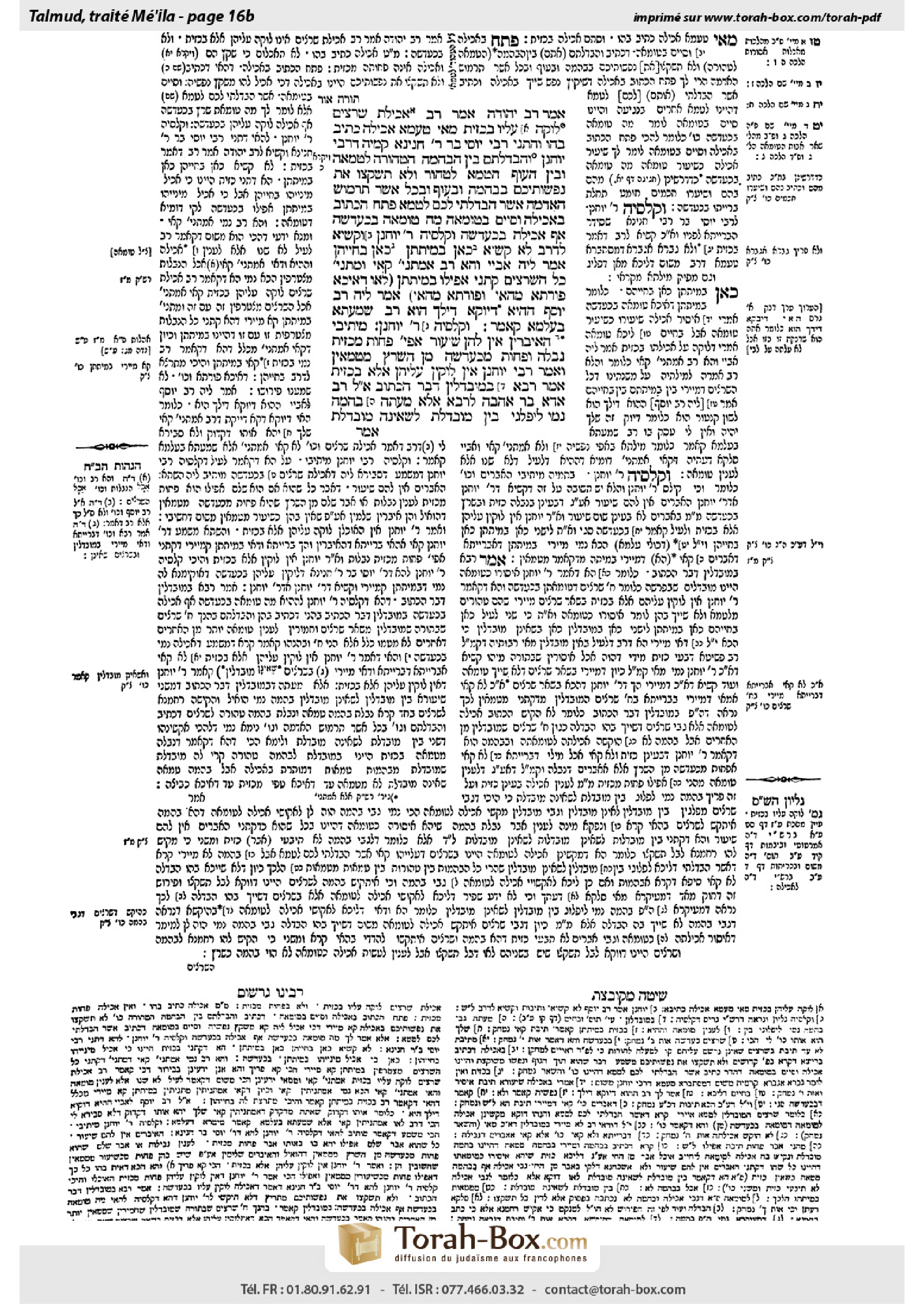
Meilah 16b: Talmud study for Daf Yomi
Daf Yomi is the daily study of one Talmud folio. Explore 37 tractates with scans, Hebrew text, Sefaria English and AI-generated French translations where annotated.
Passage selection and English or AI-generated French translation are available where the scan has annotations. Daf Study is independent of Torah-Box and Sefaria.
Browse Meilah · מעילה · All tractatesMeilah 16b text and translations
This page of Meilah includes the Aramaic text, an English translation and an AI-generated French translation, alongside the scan above.
מעילה י״ו ב · Aramaic and Hebrew text
אָמַר רַב יְהוּדָה, אָמַר רַב: אֲכִילַת שְׁרָצִים – לוֹקֶה עָלָיו בִּכְזַיִת. מַאי טַעְמָא? ׳אֲכִילָה׳ כְּתִיב בְּהוּ.
וְהָתָנֵי רַבִּי יוֹסֵי בַּר רַבִּי חֲנִינָא קַמֵּיהּ דְּרַבִּי יוֹחָנָן: ״וְהִבְדַּלְתֶּם בֵּין הַבְּהֵמָה הַטְּהֹרָה לַטְּמֵאָה וּבֵין הָעוֹף הַטָּמֵא לַטָּהֹר וְלֹא תְשַׁקְּצוּ אֶת נַפְשֹׁתֵיכֶם בַּבְּהֵמָה וּבָעוֹף וּבְכֹל אֲשֶׁר תִּרְמֹשׂ הָאֲדָמָה אֲשֶׁר הִבְדַּלְתִּי לָכֶם לְטַמֵּא״ – פָּתַח הַכָּתוּב בַּאֲכִילָה, וְסִיֵּים בְּטוּמְאָה.
מָה טוּמְאָה בְּכַעֲדָשָׁה, אַף אֲכִילָה בְּכַעֲדָשָׁה. וְקַלְּסֵיהּ רַבִּי יוֹחָנָן, וְקַשְׁיָא לִדְרַב!
לָא קַשְׁיָא: כָּאן – בְּמִיתָתָן, כָּאן – בְּחַיֵּיהֶן.
אֲמַר לֵיהּ אַבָּיֵי: וְהָא רַב אַמַּתְנִיתִין קָאֵי, וּמַתְנִיתִין ״כׇּל הַשְּׁרָצִים״ קָתָנֵי, אֲפִילּוּ בְּמִיתָתָן. לָאו דְּאִיכָּא פּוּרְתָּא מֵהַאי וּפוּרְתָּא מֵהַאי? אֲמַר לֵיהּ רַב יוֹסֵף: הָהִיא דִּיּוּקָא דִּילָךְ הוּא. רַב – שְׁמַעְתָּא בְּעָלְמָא קָאָמַר.
וְקַלְּסֵיהּ רַבִּי יוֹחָנָן. מֵיתִיבִי: הָאֵיבָרִין – אֵין לָהֶן שִׁיעוּר, אֲפִילּוּ פָּחוֹת מִכְּזַיִת נְבֵלָה וּפָחוֹת מִכַּעֲדָשָׁה מִן הַשֶּׁרֶץ – מְטַמְּאִין. וְאָמַר רַבִּי יוֹחָנָן: אֵין לוֹקִין עֲלֵיהֶן אֶלָּא בִּכְזַיִת!
אָמַר רָבָא: בְּמוּבְדָּלִין דִּבֵּר הַכָּתוּב.
אֲמַר לֵיהּ רַב אַדָּא בַּר אַהֲבָה לְרָבָא: אֶלָּא מֵעַתָּה, בְּהֵמָה נָמֵי, לִיפְלְגִי בֵּין מוּבְדֶּלֶת לְשֶׁאֵינָהּ מוּבְדֶּלֶת.
Meilah 16b · English translation
§ Rav Yehuda says that Rav says: With regard to eating creeping animals, one is flogged for eating an olive-bulk of them. What is the reason? It is because the term “eating” is written in the Torah with regard to them. The verse states: “And every creeping thing that swarms upon the earth is a detestable thing; it shall not be eaten” (Leviticus 11:41). The term “eating” is invariably referring to consuming an olive-bulk.
The Gemara raises a difficulty. But didn’t Rabbi Yosei bar Rabbi Ḥanina teach the following baraita before Rabbi Yoḥanan: The verse states: “You shall separate between the kosher animal and the non-kosher, and between the non-kosher bird and the kosher; and you shall not make your souls detestable by animal, or by bird, or by anything that swarms on the ground, which I have set apart for you as impure” (Leviticus 20:25). The verse opens with eating creeping animals, in the phrase “You shall not make your souls detestable,” and it ends with the ritual impurity of creeping animals: “Which I have set apart for you as impure.”
The baraita explains: This teaches that just as the carcass of a creeping animal imparts ritual impurity through contact when it is the volume of a lentil-bulk, so too, one is liable for the prohibition of eating a creeping animal when it is the volume of a lentil-bulk. And Rabbi Yoḥanan praised [vekilseih] Rabbi Yosei bar Rabbi Ḥanina for citing this baraita. And this poses a difficulty to the opinion of Rav, who maintains that one is flogged only if he eats an olive-bulk of creeping animals.
The Gemara answers: This is not difficult. Here, the baraita is referring to eating creeping animals when they are dead, at which stage they impart ritual impurity and one is liable for eating a lentil-bulk. By contrast, there, Rav is speaking about eating creeping animals when they are alive, which do not yet impart ritual impurity. For this reason one is flogged only if he eats an olive-bulk.
Abaye said to Rav Yosef: But in his statement Rav was referring to the mishna, and the mishna teaches: And all the creeping animals join together to constitute the requisite olive-bulk measure to render one who consumes it liable to receive lashes. This indicates that this halakha applies even when they are dead. Is the mishna not referring to a case where there is a bit of this live creeping animal and a bit of that carcass of a creeping animal, which together combine to amount to an olive-bulk? Rav Yosef said to Abaye: This deductive inference, that Rav is referring to the mishna, is yours. But in fact Rav was merely saying a halakha unconnected to the mishna. Therefore, there is no proof that Rav was speaking about the carcasses of creeping animals.
The Gemara stated: And Rabbi Yoḥanan praised Rabbi Yosei bar Rabbi Ḥanina for citing the baraita that rules that one is liable for violating the prohibition of eating a creeping animal by the amount of a lentil-bulk. The Gemara raises an objection from a mishna (Oholot 1:7): The whole limbs of impure bodies have no minimum measure with regard to imparting ritual impurity. Even if the limbs were less than an olive-bulk of a carcass or less than a lentil-bulk of a creeping animal, they impart ritual impurity. And Rabbi Yoḥanan says: This mishna is referring to the halakhot of ritual impurity; but with regard to the minimum measure which renders one liable for consumption, one is flogged for eating them only if they amount to an olive-bulk.
Rava says in resolution of the apparent contradiction between Rabbi Yoḥanan’s statements: When Rabbi Yoḥanan said that one is flogged for eating even a lentil-bulk of a creeping animal, he was referring only to those eight creeping animals of which the verse speaks, which are separated from all other creeping animals. The Torah (Leviticus 11:29–32) lists eight types of creeping animals, and Rabbi Yoḥanan was referring specifically to those eight. He maintains that one is flogged for eating a lentil-bulk of such creatures, whereas in the case of other creeping animals one is flogged only for eating an olive-bulk of them.
Rav Adda bar Ahava said to Rava: If that is so, that there is a difference in the measure of liability for consumption between various types of creeping animals, the same should also apply with regard to an animal. Since the Torah in Leviticus 20:25 juxtaposes both kosher animals and non-kosher animals to creeping animals, one can say that an analogous difference should apply here as well: Let the halakha distinguish between flesh from the carcass of kosher animals, which is separated from other types in that it is permitted in consumption by the Torah, and flesh from the carcass of a non-kosher animal, which is not separated, i.e., which is not permitted by the Torah. Consequently, if the carcass of a kosher animal imparts ritual impurity by the amount of an olive-bulk of flesh, the measure of flesh from the carcass of a non-kosher animal that imparts ritual impurity should be larger, i.e., an egg-bulk.
Meilah 16b · Traduction française (IA)
§ Rav Yehouda dit au nom de Rav : Pour la consommation d’animaux rampants, on est passible de flagellation dès qu’on en mange le volume d’une olive. Pour quelle raison ? Parce que le terme « manger » est employé à leur sujet dans la Torah. Le verset dit : « Et tout animal rampant qui grouille sur la terre est une chose détestable ; on n’en mangera pas » (Lévitique 11:41). Le terme « manger » désigne toujours la consommation d’un volume égal à celui d’une olive.
La Guemara soulève une difficulté. Mais Rabbi Yossei bar Rabbi Ḥanina n’a-t-il pas enseigné la baraïta suivante devant Rabbi Yoḥanan ? Le verset dit : « Vous distinguerez entre l’animal pur et l’animal impur, entre l’oiseau impur et l’oiseau pur ; vous ne rendrez pas vos personnes détestables par un animal, un oiseau ou quoi que ce soit qui rampe sur le sol, que J’ai distingué pour vous comme impur » (Lévitique 20:25). Le verset commence par parler de la consommation d’animaux rampants, dans les mots « vous ne rendrez pas vos personnes détestables », et s’achève sur l’impureté rituelle des animaux rampants : « que J’ai distingué pour vous comme impur ».
La baraïta explique : cela enseigne que, de même que la carcasse d’un animal rampant transmet l’impureté rituelle par contact lorsqu’elle atteint le volume d’une lentille, de même, on est passible de l’interdit de consommer un animal rampant dès qu’on en mange le volume d’une lentille. Rabbi Yoḥanan félicita [vekilseih] Rabbi Yossei bar Rabbi Ḥanina d’avoir cité cette baraïta. Cela pose une difficulté à l’opinion de Rav, qui soutient qu’on n’est passible de flagellation que si l’on mange le volume d’une olive d’animaux rampants.
La Guemara répond : il n’y a pas de difficulté. Ici, la baraïta parle de la consommation d’animaux rampants morts, qui transmettent alors l’impureté rituelle et pour lesquels on est passible dès qu’on en consomme le volume d’une lentille. En revanche, là, Rav parle de la consommation d’animaux rampants vivants, qui ne transmettent pas encore l’impureté rituelle. C’est pourquoi on n’est passible de flagellation que si l’on en mange le volume d’une olive.
Abayé dit à Rav Yossef : Pourtant, dans sa déclaration, Rav faisait référence à la Michna, qui enseigne : tous les animaux rampants s’additionnent pour atteindre le volume requis d’une olive, qui rend passible de flagellation celui qui en consomme. Cela indique que cette halakha s’applique même lorsqu’ils sont morts. La Michna ne parle-t-elle pas d’un cas où l’on a un morceau de cet animal rampant vivant et un morceau de la carcasse d’un autre animal rampant, qui s’additionnent pour atteindre le volume d’une olive ? Rav Yossef dit à Abayé : Cette déduction, selon laquelle Rav fait référence à la Michna, est la tienne. En réalité, Rav énonçait simplement une halakha sans rapport avec la Michna. Il n’y a donc aucune preuve que Rav parlait des carcasses d’animaux rampants.
La Guemara a dit que Rabbi Yoḥanan avait félicité Rabbi Yossei bar Rabbi Ḥanina d’avoir cité la baraïta selon laquelle on est passible de l’interdit de consommer un animal rampant dès qu’on en consomme le volume d’une lentille. La Guemara soulève une objection à partir d’une Michna (Oholot 1:7) : les membres entiers de corps impurs n’ont pas de mesure minimale pour transmettre l’impureté rituelle. Même si les membres ont un volume inférieur à celui d’une olive pour une carcasse ou à celui d’une lentille pour un animal rampant, ils transmettent l’impureté rituelle. Or Rabbi Yoḥanan dit : cette Michna concerne les lois de l’impureté rituelle ; mais, pour ce qui est de la mesure minimale qui rend passible pour la consommation, on n’est passible de flagellation que si l’on en mange le volume d’une olive.
Rava résout ainsi la contradiction apparente entre les déclarations de Rabbi Yoḥanan : lorsque Rabbi Yoḥanan a dit qu’on est passible de flagellation pour avoir consommé même le volume d’une lentille d’un animal rampant, il ne parlait que des huit animaux rampants mentionnés dans le verset, qui sont distingués de tous les autres animaux rampants. La Torah (Lévitique 11:29–32) énumère huit espèces d’animaux rampants, et Rabbi Yoḥanan faisait spécifiquement référence à ces huit. Il soutient qu’on est passible de flagellation pour avoir consommé le volume d’une lentille de ces créatures, tandis que, dans le cas des autres animaux rampants, on n’est passible de flagellation que si l’on en mange le volume d’une olive.
Rav Adda bar Ahava dit à Rava : S’il en est ainsi, et que la mesure de responsabilité pour la consommation diffère selon les types d’animaux rampants, cela devrait également s’appliquer aux animaux. Puisque la Torah, en Lévitique 20:25, met en parallèle les animaux purs et impurs avec les animaux rampants, on peut dire qu’une distinction analogue devrait aussi s’appliquer ici : que la halakha distingue la chair de la carcasse d’animaux purs, qui se distingue des autres types en ce que la Torah en autorise la consommation, et la chair de la carcasse d’un animal impur, qui ne se distingue pas, c’est-à-dire que la Torah n’en autorise pas la consommation. Par conséquent, si la carcasse d’un animal pur transmet l’impureté rituelle à partir d’un volume de chair égal à celui d’une olive, la quantité de chair de la carcasse d’un animal impur nécessaire pour transmettre l’impureté rituelle devrait être plus grande, à savoir le volume d’un œuf.
Traduction française générée par IA à partir de l’édition anglaise de Sefaria. Vérifie toujours un passage avec le texte source.
Text from Sefaria: William Davidson Edition - Vocalized Aramaic (CC BY NC); William Davidson Edition - English (CC BY NC).