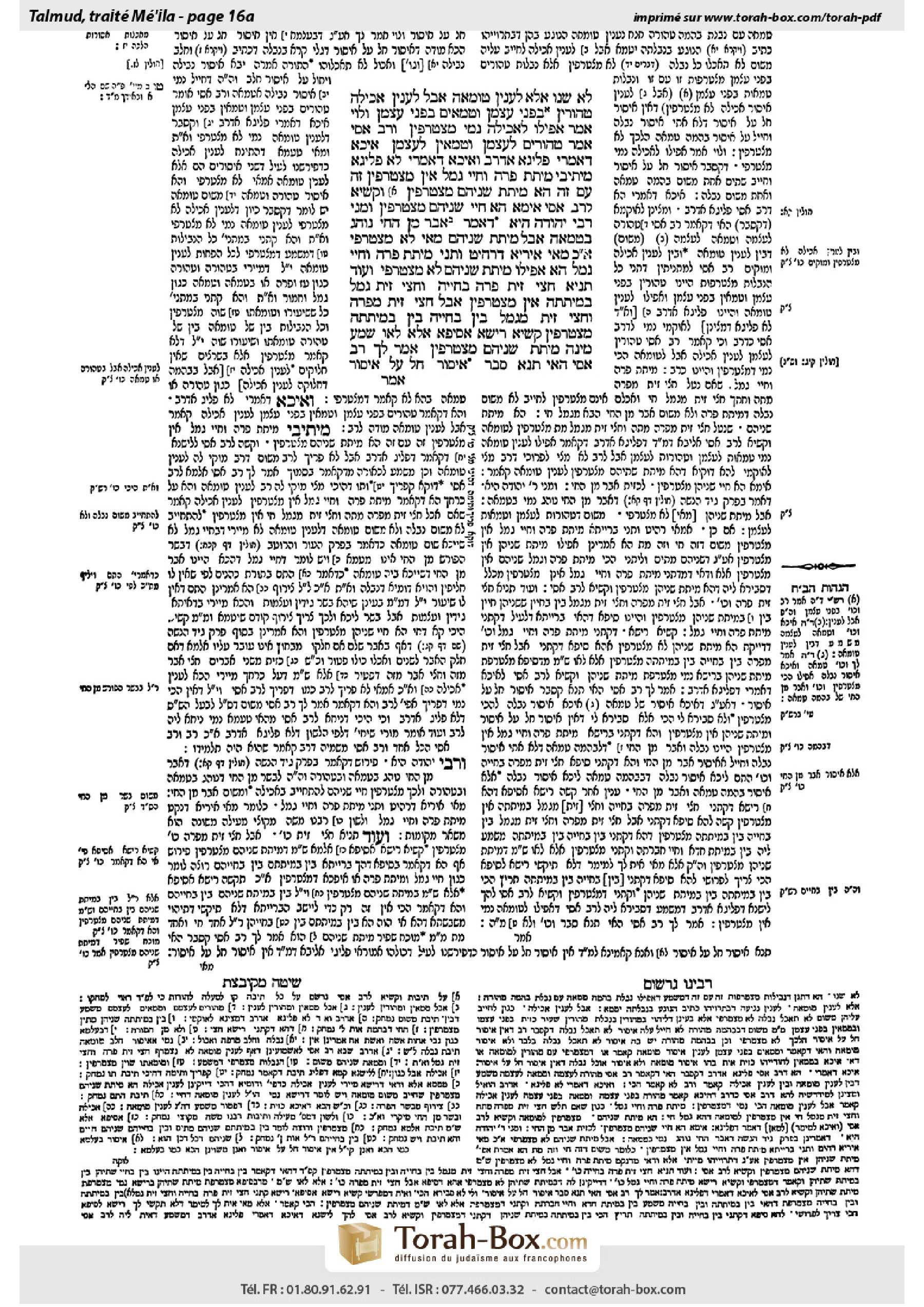
Meilah 16a: Talmud study for Daf Yomi
Daf Yomi is the daily study of one Talmud folio. Explore 37 tractates with scans, Hebrew text, Sefaria English and AI-generated French translations where annotated.
Passage selection and English or AI-generated French translation are available where the scan has annotations. Daf Study is independent of Torah-Box and Sefaria.
Browse Meilah · מעילה · All tractatesMeilah 16a text and translations
This page of Meilah includes the Aramaic text, an English translation and an AI-generated French translation, alongside the scan above.
מעילה י״ו א · Aramaic and Hebrew text
לֹא שָׁנוּ אֶלָּא לְעִנְיַן טוּמְאָה, אֲבָל לְעִנְיַן אֲכִילָה – טְהוֹרִין בִּפְנֵי עַצְמָן, וּטְמֵאִים בִּפְנֵי עַצְמָן. וְלֵוִי אָמַר: אֲפִילּוּ לַאֲכִילָה נָמֵי מִצְטָרְפִין.
וְרַב אַסִּי אָמַר: טְהוֹרִים לְעַצְמָן וּטְמֵאִין לְעַצְמָן. אִיכָּא דְאָמְרִי: פְּלִיגָא אַדְּרַב, וְאִיכָּא דְאָמְרִי: לָא פְּלִיגָא.
מֵיתִיבִי: מִיתַת פָּרָה, וְחַיֵּי גָמָל – אֵין מִצְטָרְפִין זֶה עִם זֶה. הָא מִיתַת שְׁנֵיהֶם – מִצְטָרְפִין, וְקַשְׁיָא לְרַב אַסִּי!
אֵימָא: הָא חַיֵּי שְׁנֵיהֶם – מִצְטָרְפִין, וּמַנִּי – רַבִּי יְהוּדָה הִיא, דְּאָמַר: אֵבֶר מִן הַחַי נוֹהֵג בַּטְּמֵאָה.
אֲבָל מִיתַת שְׁנֵיהֶם, מַאי? לָא מִצְטָרְפִי? אִם כֵּן, מַאי אִירְיָא דְּרָהֵיט וְתָנֵי ״מִיתַת פָּרָה וְחַיֵּי גָמָל״, הָא אֲפִילּוּ מִיתַת שְׁנֵיהֶם לָא מִצְטָרְפִי!
וְעוֹד, תַּנְיָא: חֲצִי זַיִת פָּרָה בְּחַיֶּיהָ וַחֲצִי זַיִת גָּמָל בְּמִיתָתָהּ – אֵין מִצְטָרְפִין. אֲבָל חֲצִי זַיִת מִפָּרָה וַחֲצִי זַיִת מִגָּמָל, בֵּין בְּחַיֶּיהָ בֵּין בְּמִיתָתָהּ – מִצְטָרְפִין. קַשְׁיָא רֵישָׁא אַסֵּיפָא! אֶלָּא לָאו שְׁמַע מִינַּהּ: מִיתַת שְׁנֵיהֶם – מִצְטָרְפִין!?
אָמַר לְךָ רַב אַסִּי: הַאי תַּנָּא סָבַר אִיסּוּר חָל עַל אִיסּוּר.
Meilah 16a · English translation
The mishna taught that all carcasses join together, which indicates that carcasses of non-kosher animals join together with carcasses of kosher animals, only with regard to ritual impurity. But with regard to the prohibition of eating animal carcasses, kosher animal carcasses are distinct, i.e., they join together only with other kosher animals, and non-kosher animal carcasses are likewise distinct. And Levi says: Even with regard to the prohibition of eating animal carcasses, kosher and non-kosher carcasses join together.
And Rav Asi says: Kosher animal carcasses are distinct, and non-kosher animal carcasses are distinct. Since Rav Asi did not specify whether he is referring only to eating or also to ritual impurity, there are those who say that Rav Asi disagrees with the opinion of Rav, i.e., he interprets the mishna as referring to all carcasses of a similar kind, that is, from kosher animals on the one hand, and from non-kosher animals on the other hand. And there are those who say that Rav Asi does not disagree with the opinion of Rav, and concedes that kosher and non-kosher animal carcasses join together with regard to ritual impurity.
The Gemara raises an objection against the first explanation of the opinion of Rav Asi from a baraita: With regard to half an olive-bulk from the carcass of a dead cow and half an olive-bulk from the flesh of a live camel, they do not join together with one another. It can be inferred from here that if both of them are dead, they do join together. Rav can explain this baraita as referring to ritual impurity, but this poses a difficulty to Rav Asi.
The Gemara answers: One should say that the correct inference from the baraita is not that if both of them, the cow and the camel, are dead, then they join together. Rather, one should infer that if both of them are alive, they join together. And who is the tanna of the baraita? It is Rabbi Yehuda, who said: The prohibition of eating a limb from a living animal applies even to the limb of a non-kosher animal.
The Gemara raises a difficulty with this answer. But in that case, what is the halakha if both of them, the cow and the camel, are dead? Do they not join together? If so, why does the tanna run specifically to an extreme case and teach: Half an olive-bulk from the carcass of a dead cow and half an olive-bulk from the flesh of a live camel? After all, even if both of them are dead, they do not join together.
And furthermore, it is taught in a baraita: Half an olive-bulk from the flesh of a cow when it is alive and half an olive-bulk from the carcass of a camel when it is dead do not join together; but half an olive-bulk from a cow and half an olive-bulk from a camel, whether alive or dead, do join together. The first clause in the baraita is difficult as it is apparently contradicted by the latter clause. Rather, isn’t it correct to conclude from the baraita that if there is half an olive-bulk from each of the two of them when they are dead, they join together?
The Gemara answers: Rav Asi could have said to you that this tanna holds that a prohibition takes effect even where another prohibition already exists. He maintains that the prohibition of eating an animal carcass takes effect even with regard to the flesh of a non-kosher animal, which is already prohibited, and for this reason the two half olive-bulks join together, as the same prohibition against eating an animal carcass applies to both. By contrast, Rav Asi himself maintains that a prohibition does not take effect where another prohibition already exists, and therefore this baraita does not pose a difficulty to his opinion that the two do not combine.
Meilah 16a · Traduction française (IA)
La Michna a enseigné que toutes les carcasses se combinent, ce qui indique que les carcasses d’animaux non cachères se combinent avec celles d’animaux cachères uniquement en matière d’impureté rituelle. En revanche, s’agissant de l’interdiction de consommer des carcasses, celles des animaux cachères sont distinctes, c’est-à-dire qu’elles ne se combinent qu’avec celles d’autres animaux cachères ; celles des animaux non cachères sont elles aussi distinctes. Levi dit : même s’agissant de l’interdiction de consommer des carcasses, celles des animaux cachères et non cachères se combinent.
Rav Asi dit : les carcasses d’animaux cachères sont distinctes, et celles d’animaux non cachères le sont également. Comme Rav Asi n’a pas précisé s’il parle uniquement de la consommation ou aussi de l’impureté rituelle, certains disent qu’il est en désaccord avec Rav : il interprète la Michna comme concernant toutes les carcasses de même catégorie, celles d’animaux cachères d’une part et celles d’animaux non cachères d’autre part. D’autres disent que Rav Asi n’est pas en désaccord avec Rav et admet que les carcasses d’animaux cachères et non cachères se combinent en matière d’impureté rituelle.
La Guemara soulève une objection contre la première explication de l’opinion de Rav Asi à partir d’une baraïta : une demi-olive de la carcasse d’une vache morte et une demi-olive de la chair d’un chameau vivant ne se combinent pas. On peut en déduire que, si les deux animaux sont morts, leurs carcasses se combinent. Rav peut expliquer que cette baraïta concerne l’impureté rituelle, mais cela pose une difficulté à Rav Asi.
La Guemara répond : il faut dire que la conclusion correcte à tirer de la baraïta n’est pas que, si les deux animaux, la vache et le chameau, sont morts, ils se combinent. Il faut plutôt en déduire que, s’ils sont tous deux vivants, ils se combinent. Et qui est le tanna de cette baraïta ? C’est Rabbi Yehouda, qui a dit : l’interdiction de consommer un membre d’un animal vivant s’applique même au membre d’un animal non cachère.
La Guemara soulève une difficulté à propos de cette réponse. Mais alors, quelle est la halakha si les deux animaux, la vache et le chameau, sont morts ? Ne se combinent-ils pas ? Si oui, pourquoi le tanna choisit-il un cas extrême pour enseigner : « Une demi-olive de la carcasse d’une vache morte et une demi-olive de la chair d’un chameau vivant » ? Après tout, même si les deux animaux sont morts, leurs carcasses ne se combinent pas.
De plus, il est enseigné dans une baraïta : une demi-olive de la chair d’une vache vivante et une demi-olive de la carcasse d’un chameau mort ne se combinent pas ; en revanche, une demi-olive de vache et une demi-olive de chameau se combinent, qu’ils soient vivants ou morts. La première proposition de la baraïta pose problème, car elle semble contredire la suivante. Ne faut-il pas plutôt conclure de la baraïta que, s’il y a une demi-olive de chacun des deux animaux lorsqu’ils sont morts, elles se combinent ?
La Guemara répond : Rav Asi aurait pu te dire que ce tanna considère qu’une interdiction prend effet même lorsqu’une autre interdiction existe déjà. Il soutient que l’interdiction de consommer une carcasse prend effet même sur la chair d’un animal non cachère, déjà interdite, et que, pour cette raison, les deux demi-olives se combinent, puisque la même interdiction de consommer une carcasse s’applique aux deux. Rav Asi lui-même, en revanche, considère qu’une interdiction ne prend pas effet lorsqu’une autre interdiction existe déjà. Cette baraïta ne pose donc pas de difficulté à son opinion selon laquelle les deux ne se combinent pas.
Traduction française générée par IA à partir de l’édition anglaise de Sefaria. Vérifie toujours un passage avec le texte source.
Text from Sefaria: William Davidson Edition - Vocalized Aramaic (CC BY NC); William Davidson Edition - English (CC BY NC).