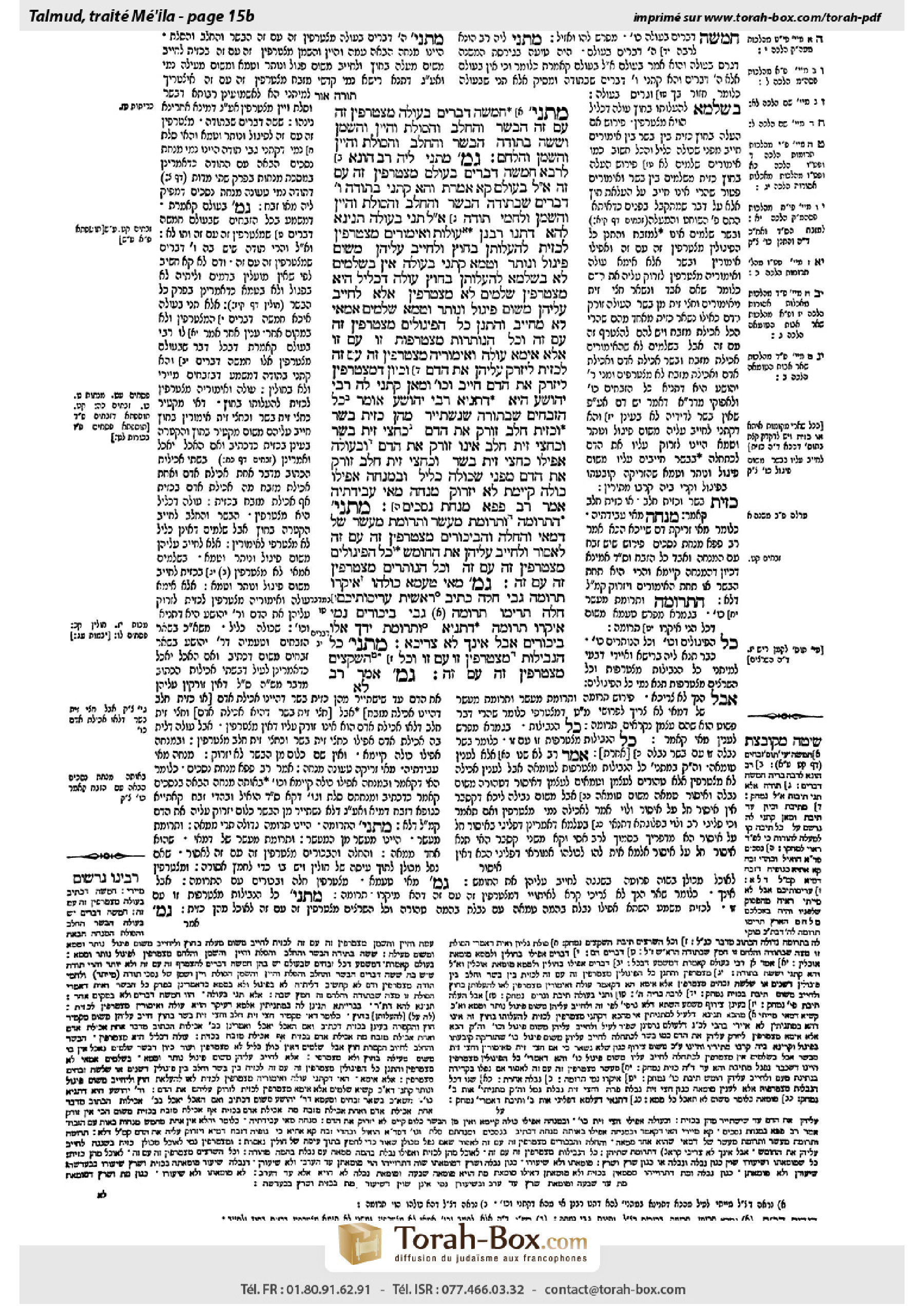
Meilah 15b: Talmud study for Daf Yomi
Daf Yomi is the daily study of one Talmud folio. Explore 37 tractates with scans, Hebrew text, Sefaria English and AI-generated French translations where annotated.
Passage selection and English or AI-generated French translation are available where the scan has annotations. Daf Study is independent of Torah-Box and Sefaria.
Browse Meilah · מעילה · All tractatesMeilah 15b text and translations
This page of Meilah includes the Aramaic text, an English translation and an AI-generated French translation, alongside the scan above.
מעילה י״ה ב · Aramaic and Hebrew text
מַתְנִי׳ חֲמִשָּׁה דְּבָרִים בָּעוֹלָה מִצְטָרְפִין זֶה עִם זֶה: הַבָּשָׂר, וְהַחֵלֶב, וְהַסּוֹלֶת, וְהַיַּיִן, וְהַשֶּׁמֶן. וְשִׁשָּׁה בַּתּוֹדָה: הַבָּשָׂר, וְהַחֵלֶב, וְהַסּוֹלֶת, וְהַיַּיִן, וְהַשֶּׁמֶן וְהַלֶּחֶם.
גְּמָ׳ מַתְנֵי לֵיהּ רַב הוּנָא לְרָבָא: ״חֲמִשָּׁה דְּבָרִים בָּעוֹלָם מִצְטָרְפִין זֶה עִם זֶה״. אָמַר לֵיהּ: ״בָּעוֹלָם״ קָא אָמְרַתְּ? וְהָא קָתָנֵי בַּתּוֹדָה ״שִׁשָּׁה דְּבָרִים שֶׁבַּתּוֹדָה – הַבָּשָׂר וְהַחֵלֶב וְהַסּוֹלֶת וְהַיַּיִן וְהַשֶּׁמֶן וְלַחְמֵי תוֹדָה״! אֲמַר לֵיהּ: תְּנִי ״בָּעוֹלָה״.
תְּנֵינָא לְהָא דְּתָנוּ רַבָּנַן: עוֹלוֹת וְאֵימוּרִים מִצְטָרְפִין לִכְזַיִת לְהַעֲלוֹתָן בַּחוּץ, וּלְחַיֵּיב עֲלֵיהֶן מִשּׁוּם פִּיגּוּל וְנוֹתָר וְטָמֵא.
קָתָנֵי: בְּעוֹלָה – אִין, בִּשְׁלָמִים – לָא. בִּשְׁלָמָא לְהַעֲלוֹתָן בַּחוּץ, עוֹלָה דְּכָלִיל הִיא – מִצְטָרְפִין, שְׁלָמִים – לָא מִצְטָרְפִין. אֶלָּא לְחַיֵּיב עֲלֵיהֶן מִשּׁוּם פִּיגּוּל וְנוֹתָר וְטָמֵא, שְׁלָמִים אַמַּאי לָא מְחַיֵּיב?
וְהָתְנַן: כׇּל הַפִּיגּוּלִים מִצְטָרְפִין זֶה עִם זֶה, וְכׇל הַנּוֹתָרוֹת מִצְטָרְפוֹת זוֹ עִם זוֹ!
אֶלָּא אֵימָא: עוֹלָה וְאֵימוּרֶיהָ מִצְטָרְפִין זֶה עִם זֶה לִכְזַיִת לִיזְרֹק עֲלֵיהֶן אֶת הַדָּם.
וְכֵיוָן דְּמִצְטָרְפִין לִיזְרֹק אֶת הַדָּם – חַיָּיב וְכוּ׳.
וּמַאן קָתָנֵי לַהּ? רַבִּי יְהוֹשֻׁעַ הִיא, דְּתַנְיָא: רַבִּי יְהוֹשֻׁעַ אוֹמֵר: כׇּל הַזְּבָחִים שֶׁבַּתּוֹרָה שֶׁנִּשְׁתַּיֵּיר מֵהֶן כְּזַיִת בָּשָׂר וּכְזַיִת חֵלֶב – זוֹרֵק אֶת הַדָּם, כַּחֲצִי זַיִת בָּשָׂר וְכַחֲצִי זַיִת חֵלֶב – אֵינוֹ זוֹרֵק אֶת הַדָּם.
וּבָעוֹלָה, אֲפִילּוּ כַּחֲצִי זַיִת בָּשָׂר וְכַחֲצִי זַיִת חֵלֶב – זוֹרֵק אֶת הַדָּם, מִפְּנֵי שֶׁכּוּלָּהּ כָּלִיל. וּבַמִּנְחָה, אֲפִילּוּ כּוּלָּהּ קַיֶּימֶת – לֹא יִזְרוֹק.
מִנְחָה מַאי עֲבִידְתַּיהּ? אָמַר רַב פָּפָּא: מִנְחַת נְסָכִים.
מַתְנִי׳ הַתְּרוּמָה, וּתְרוּמַת מַעֲשֵׂר, וּתְרוּמַת מַעֲשֵׂר שֶׁל דְּמַאי, וְהַחַלָּה, וְהַבִּיכּוּרִים – מִצְטָרְפִין זֶה עִם זֶה לֶאֱסוֹר וּלְחַיֵּיב עֲלֵיהֶן אֶת הַחוֹמֶשׁ. כׇּל הַפִּיגּוּלִים – מִצְטָרְפִין זֶה עִם זֶה. וְכׇל הַנּוֹתָרִים – מִצְטָרְפִין זֶה עִם זֶה.
גְּמָ׳ מַאי טַעְמָא? כּוּלְּהוּ אִיקְּרוּ ״תְּרוּמָה״. גַּבֵּי חַלָּה כְּתִיב: ״רֵאשִׁית עֲרִסֹתֵכֶם חַלָּה תָּרִימוּ תְרוּמָה״,
גַּבֵּי בִּיכּוּרִים נָמֵי אִיקְּרוּ ״תְּרוּמָה״, דְּתַנְיָא: ״וּתְרוּמַת יָדֶךָ״ – אֵלּוּ בִּיכּוּרִים, אֲבָל אִינָךְ – לָא צְרִיכָא.
מַתְנִי׳ כׇּל הַנְּבֵילוֹת – מִצְטָרְפִין זוֹ עִם זוֹ. וְכׇל הַשְּׁקָצִים – מִצְטָרְפִין זֶה עִם זֶה.
גְּמָ׳ אָמַר רַב:
Meilah 15b · English translation
MISHNA: Five items in the burnt offering and the accompanying meal offering and libation join together to constitute the one peruta measure with regard to liability for misuse, and the olive-bulk measure with regard to liability for piggul, notar, and partaking of sacrificial foods while ritually impure. They are: The flesh; the fat of the burnt offering that is sacrificed on the altar; the fine flour of the accompanying meal offering; the wine of the accompanying libation; and the oil of the accompanying meal offering. And there are six items in the thanks offering that join together: The flesh, the fat, the fine flour, the wine, the oil, and the loaves accompanying the thanks offering.
GEMARA: The mishna teaches that five items in the burnt offering [ba’ola] join together. Rav Huna taught Rava the mishna as follows: Five items in the world [ba’olam] join together. Rava said to Rav Huna: Did you say: In the world, i.e., that there are only five items in the world of offerings that join together? But isn’t it taught in the mishna with regard to a thanks offering that there are six items in the thanks offering that join together: The flesh, the fat, the fine flour, the wine, the oil, and the loaves accompanying the thanks offering? Rav Huna said to Rava: One should teach in the mishna: Five items in the burnt offering [ba’ola] join together, not: Five items in the world.
§ The mishna teaches that the flesh and the fat join together. The Gemara notes that we already learned this, as the Sages taught explicitly in a baraita (Tosefta 1:28): The meat of burnt offerings and their sacrificial portions join together to constitute the amount of an olive-bulk that renders one liable for sacrificing them outside the courtyard, and to render one liable for eating them due to piggul, notar, and partaking of them while ritually impure.
The Gemara notes that the baraita teaches that with regard to a burnt offering, yes, this halakha applies, whereas with regard to a peace offering, it does not apply. The Gemara raises a difficulty: Granted, with regard to sacrificing them outside the courtyard, it stands to reason that in the case of a burnt offering, which is entirely consumed upon the altar, everything joins together, whereas with regard to peace offerings, whose meat is not burned on the altar, the meat and sacrificial portions do not join together. But with regard to rendering one liable for piggul, and notar, and partaking of them while ritually impure, in the case of a peace offering as well, why is he not rendered liable?
The Gemara elaborates: But didn’t we learn in the mishna below: All the pieces of sacrificial meat that are piggul join together with one another to constitute the olive-bulk measure for liability, and all pieces of sacrificial meat that are notar join together with one another to constitute the olive-bulk measure for liability? The mishna indicates that this is the halakha with regard to all types of offerings.
The Gemara answers: Rather, say that the baraita should read as follows: The meat of a burnt offering and its sacrificial portions join together to constitute an olive-bulk in order to permit one to sprinkle the blood for them. If the meat of the burnt offering was lost after it was slaughtered and only an olive-bulk of the meat and sacrificial portions remain, they combine to permit the sprinkling of the blood.
The Gemara further explains: And since they join together to constitute an olive-bulk with regard to sprinkling the blood, once that blood has been sprinkled they join together to constitute the minimum amount of an olive-bulk to render one liable for eating them due to piggul, notar, and partaking of them while ritually impure. By contrast, in the case of a peace offering, the meat and the sacrificial portions do not join together for sprinkling, and as the sprinkling is not valid, they do not subsequently join together to constitute an olive-bulk to render one liable for eating them due to piggul, notar, and partaking of them while ritually impure.
The Gemara adds: And who is the tanna who teaches this baraita? It is Rabbi Yehoshua, as it is taught in a baraita that Rabbi Yehoshua says: With regard to all the offerings in the Torah from which there remains an olive-bulk of meat that is fit to be eaten, or an olive-bulk of fat that is fit to be sacrificed on the altar, one sprinkles the blood. If all that remains is half an olive-bulk of meat and half an olive-bulk of fat, one may not sprinkle the blood. Since the meat and fat serve different functions, as the fat is burned on the altar while the meat is eaten by the priests, they do not combine to form the minimum amount that must remain in order to sprinkle the blood.
But with regard to a burnt offering, even if all that was left was half an olive-bulk of meat and half an olive-bulk of fat, one sprinkles the blood, because it is all consumed upon the altar. Since both the meat and the fat are sacrificed on the altar, they combine. And in the case of a meal offering, even if all of it remains, one may not sprinkle the blood.
With regard to the last statement, the Gemara asks: What is the relevance of a meal offering to this baraita? A meal offering does not require blood to be sprinkled on the altar. Rav Pappa said: The meal offering under discussion is the meal offering brought with the libations that accompany animal offerings. The baraita is teaching that if none of the meat of the animal remains, even if all of the accompanying meal offering is intact, the blood of the animal may not be sprinkled.
MISHNA: Teruma, and teruma of the tithe, and teruma of the tithe of doubtfully tithed produce [demai], and ḥalla, and first fruits all join together with one another to constitute the requisite measure to prohibit a mixture with non-sacred produce, and to form the requisite measure of an olive-bulk that serves to render one obligated for their consumption in payment of an additional one-fifth over and above the principal. All the pieces of sacrificial meat that are piggul join together with one another to constitute the olive-bulk measure for liability, and all sacrificial meat that is notar joins together with one another to constitute the olive-bulk measure for liability.
GEMARA: The Gemara asks: What is the reason that all of the foods listed in the mishna join together? The Gemara answers: The reason is that all of them are called teruma in the Torah. The Gemara elaborates: With regard to ḥalla it is written: “Of the first of your dough you shall set apart ḥalla for a teruma; like teruma of the threshing floor, so shall you set it apart” (Numbers 15:20).
With regard to first fruits, they are also called teruma, as it is taught in a baraita that discusses foods that may not be eaten outside Jerusalem: The verse states: “You cannot eat within your gates the tithe of your grain or of your wine or of your oil or the firstlings of your herd or of your flock, or any of your vows that you vow, or your freewill offerings, or the offering of your hand” (Deuteronomy 12:17). “And the offering of your hand”; these are first fruits. But with regard to the other items listed in the mishna, i.e., teruma, teruma of the tithe, and teruma of the tithe of demai, it is not necessary to explain why they join together or to cite a verse, as it is clear that they are called teruma.
MISHNA: All animal carcasses, whose consumption is prohibited and which transmit impurity through contact with them and through carrying, join together with one another to constitute the requisite olive-bulk measure. And all repugnant creatures join together with one another to constitute the requisite olive-bulk measure to render one who consumes it liable to receive lashes. The eight creeping animals enumerated in the Torah join together to constitute the measure of a lentil-bulk, which transmits impurity through contact, and to render one who consumes it liable to receive lashes.
GEMARA: The mishna teaches that all animal carcasses, whose consumption is prohibited and which transmit impurity through contact and through carrying, join together to constitute the requisite olive-bulk measure. Rav says:
Meilah 15b · Traduction française (IA)
MICHNA : Cinq éléments de l’holocauste, de l’offrande de farine qui l’accompagne et de la libation s’additionnent pour atteindre la mesure d’une perouta requise pour engager la responsabilité en matière de détournement, et la mesure d’un olive requise pour engager la responsabilité en matière de piggul, de notar et de consommation d’aliments consacrés en état d’impureté rituelle. Ce sont : la chair ; la graisse de l’holocauste offerte sur l’autel ; la farine fine de l’offrande de farine qui l’accompagne ; le vin de la libation qui l’accompagne ; et l’huile de l’offrande de farine qui l’accompagne. Six éléments de l’offrande de reconnaissance s’additionnent : la chair, la graisse, la farine fine, le vin, l’huile et les pains qui accompagnent l’offrande de reconnaissance.
GUEMARA : La Michna enseigne que cinq éléments de l’holocauste [ba’ola] s’additionnent. Rav Houna enseigna à Rava la Michna ainsi : cinq éléments du monde [ba’olam] s’additionnent. Rava dit à Rav Houna : « As-tu dit “du monde”, c’est-à-dire qu’il n’existe que cinq éléments, dans le monde des offrandes, qui s’additionnent ? Pourtant, la Michna enseigne au sujet de l’offrande de reconnaissance que six éléments de cette offrande s’additionnent : la chair, la graisse, la farine fine, le vin, l’huile et les pains qui l’accompagnent. » Rav Houna dit à Rava : « Il faut enseigner dans la Michna : “Cinq éléments de l’holocauste [ba’ola] s’additionnent”, et non : “cinq éléments du monde”. »
§ La Michna enseigne que la chair et la graisse s’additionnent. La Guemara relève que nous l’avons déjà appris, car les Sages l’ont explicitement enseigné dans une baraïta (Tossefta 1:28) : la viande des holocaustes et leurs portions sacrificielles s’additionnent pour atteindre la mesure d’un olive qui rend passible celui qui les offre à l’extérieur de la cour, ainsi que celui qui les consomme en raison du piggul, du notar ou en état d’impureté rituelle.
La Guemara relève que la baraïta enseigne que cette halakha s’applique à l’holocauste, mais non à l’offrande de paix. La Guemara soulève une difficulté : certes, en ce qui concerne le fait de les offrir à l’extérieur de la cour, il est logique que, dans le cas d’un holocauste, entièrement consumé sur l’autel, tout s’additionne, tandis que, dans le cas des offrandes de paix, dont la viande n’est pas brûlée sur l’autel, la viande et les portions sacrificielles ne s’additionnent pas. Mais, pour rendre quelqu’un passible en raison du piggul, du notar ou de leur consommation en état d’impureté rituelle, pourquoi ne le serait-il pas également dans le cas d’une offrande de paix ?
La Guemara développe : n’avons-nous pas appris dans la Michna plus loin que tous les morceaux de viande sacrificielle qui sont piggul s’additionnent entre eux pour atteindre la mesure d’un olive requise pour engager la responsabilité, et que tous les morceaux de viande sacrificielle qui sont notar s’additionnent entre eux pour atteindre la mesure d’un olive requise pour engager la responsabilité ? La Michna indique que cette halakha s’applique à tous les types d’offrandes.
La Guemara répond : il faut plutôt dire que la baraïta devrait être formulée ainsi : la viande d’un holocauste et ses portions sacrificielles s’additionnent pour atteindre la mesure d’un olive afin de permettre l’aspersion du sang en leur faveur. Si la viande de l’holocauste a été perdue après l’abattage et qu’il ne reste qu’une mesure d’un olive de viande et de portions sacrificielles, elles s’additionnent et permettent l’aspersion du sang.
La Guemara explique en outre : puisqu’elles s’additionnent pour atteindre la mesure d’un olive en vue de l’aspersion du sang, une fois le sang aspergé, elles s’additionnent pour atteindre la mesure minimale d’un olive requise pour rendre quelqu’un passible s’il les consomme en raison du piggul, du notar ou en état d’impureté rituelle. En revanche, dans le cas d’une offrande de paix, la viande et les portions sacrificielles ne s’additionnent pas pour l’aspersion ; celle-ci n’étant donc pas valide, elles ne s’additionnent pas ensuite pour atteindre la mesure d’un olive requise pour rendre quelqu’un passible s’il les consomme en raison du piggul, du notar ou en état d’impureté rituelle.
La Guemara ajoute : qui est le tanna qui enseigne cette baraïta ? C’est Rabbi Yehochoua, comme l’enseigne une baraïta où Rabbi Yehochoua dit : pour toutes les offrandes de la Torah dont il reste une mesure d’un olive de viande propre à la consommation, ou une mesure d’un olive de graisse propre à être offerte sur l’autel, on asperge le sang. S’il ne reste qu’une demi-mesure d’un olive de viande et une demi-mesure d’un olive de graisse, on ne peut pas asperger le sang. Comme la viande et la graisse ont des fonctions différentes — la graisse est brûlée sur l’autel, tandis que la viande est consommée par les prêtres —, elles ne s’additionnent pas pour former la quantité minimale qui doit rester afin que le sang puisse être aspergé.
Mais, dans le cas d’un holocauste, même s’il ne reste qu’une demi-mesure d’un olive de viande et une demi-mesure d’un olive de graisse, on asperge le sang, car tout est consumé sur l’autel. Puisque la viande et la graisse sont toutes deux offertes sur l’autel, elles s’additionnent. Et dans le cas d’une offrande de farine, même si elle est entièrement présente, on ne peut pas asperger le sang.
À propos de cette dernière affirmation, la Guemara demande : quel rapport une offrande de farine a-t-elle avec cette baraïta ? Une offrande de farine ne nécessite pas l’aspersion de sang sur l’autel. Rav Pappa dit : l’offrande de farine dont il est question est celle qui accompagne les libations apportées avec les offrandes animales. La baraïta enseigne que si aucune viande de l’animal ne subsiste, même si toute l’offrande de farine qui l’accompagne est présente, on ne peut pas asperger le sang de l’animal.
MICHNA : La terouma, la terouma de la première dîme, la terouma de la première dîme de produits dont le statut de la dîme est douteux [demai], la ḥalla et les prémices s’additionnent entre elles pour atteindre la mesure requise afin d’interdire un mélange avec des produits profanes, ainsi que la mesure d’un olive qui oblige, pour leur consommation, à payer un cinquième supplémentaire en plus du principal. Tous les morceaux de viande sacrificielle qui sont piggul s’additionnent entre eux pour atteindre la mesure d’un olive requise pour engager la responsabilité, et tous les morceaux de viande sacrificielle qui sont notar s’additionnent entre eux pour atteindre la mesure d’un olive requise pour engager la responsabilité.
GUEMARA : La Guemara demande : pour quelle raison tous les aliments énumérés dans la Michna s’additionnent-ils ? La Guemara répond : parce qu’ils sont tous appelés terouma dans la Torah. La Guemara développe : au sujet de la ḥalla, il est écrit : « Vous prélèverez une ḥalla sur les prémices de votre pâte, en offrande de terouma ; comme la terouma de l’aire de battage, vous la prélèverez » (Nombres 15:20).
Les prémices sont également appelés terouma, comme l’enseigne une baraïta qui traite des aliments dont la consommation est interdite hors de Jérusalem : le verset dit : « Tu ne pourras pas manger dans tes portes la dîme de ton blé, de ton vin ou de ton huile, ni les premiers-nés de ton gros ou de ton petit bétail, ni aucune de tes offrandes votives que tu auras vouées, ni tes offrandes volontaires, ni les prélèvements de ta main » (Deutéronome 12:17). « Les prélèvements de ta main » désigne les prémices. Quant aux autres éléments énumérés dans la Michna, à savoir la terouma, la terouma de la première dîme et la terouma de la première dîme de demai, il n’est pas nécessaire d’expliquer pourquoi ils s’additionnent ni de citer un verset, car il est évident qu’ils sont appelés terouma.
MICHNA : Toutes les carcasses d’animaux, dont la consommation est interdite et qui transmettent l’impureté par contact et par portage, s’additionnent entre elles pour atteindre la mesure requise d’un olive. Toutes les créatures répugnantes s’additionnent entre elles pour atteindre la mesure requise d’un olive, qui rend passible de flagellation celui qui en consomme. Les huit animaux rampants énumérés dans la Torah s’additionnent pour atteindre la mesure d’une lentille, qui transmet l’impureté par contact et rend passible de flagellation celui qui en consomme.
GUEMARA : La Michna enseigne que toutes les carcasses d’animaux, dont la consommation est interdite et qui transmettent l’impureté par contact et par portage, s’additionnent entre elles pour atteindre la mesure requise d’un olive. Rav dit :
Traduction française générée par IA à partir de l’édition anglaise de Sefaria. Vérifie toujours un passage avec le texte source.
Text from Sefaria: William Davidson Edition - Vocalized Aramaic (CC BY NC); William Davidson Edition - English (CC BY NC).