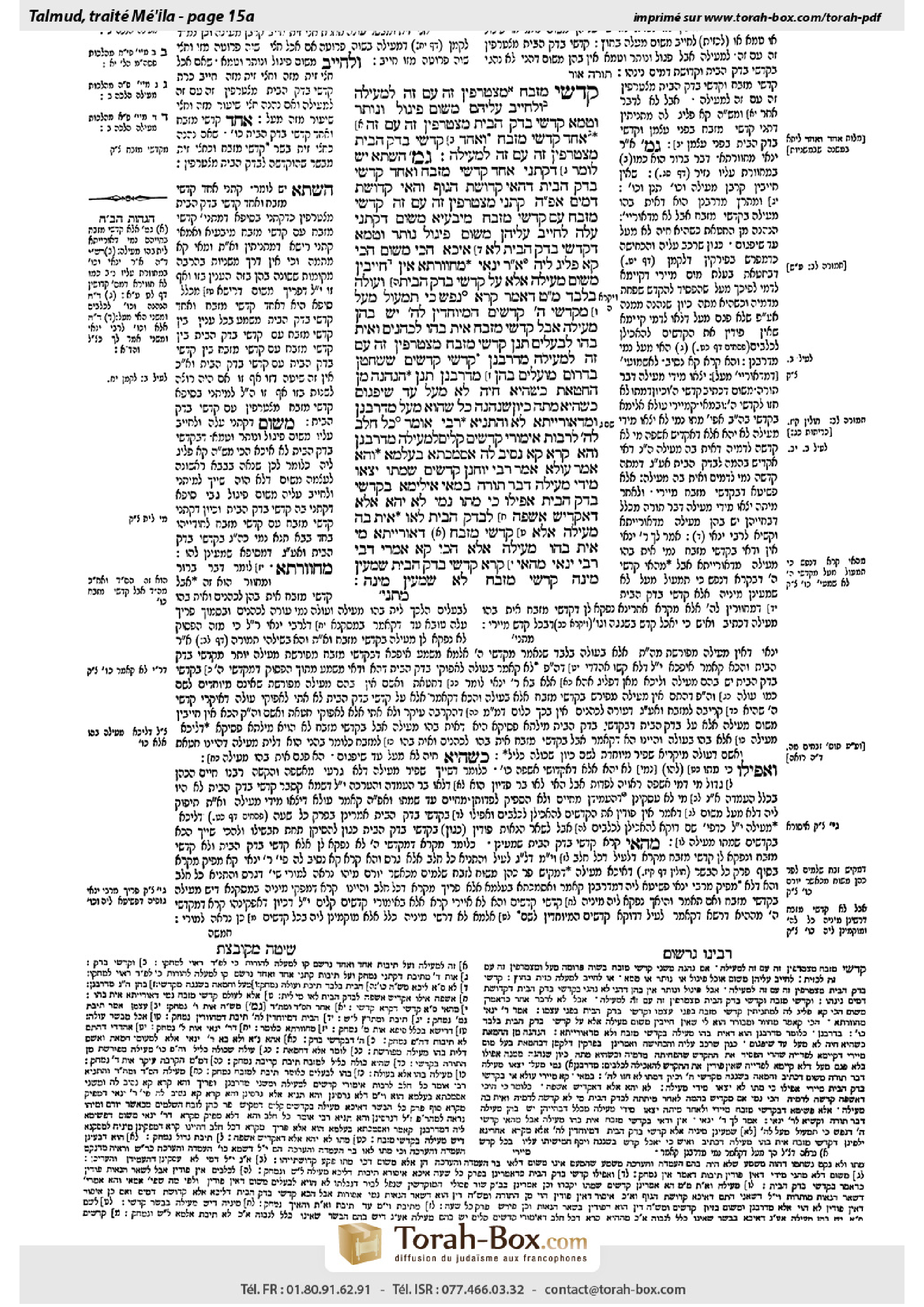
Meilah 15a: Talmud study for Daf Yomi
Daf Yomi is the daily study of one Talmud folio. Explore 37 tractates with scans, Hebrew text, Sefaria English and AI-generated French translations where annotated.
Passage selection and English or AI-generated French translation are available where the scan has annotations. Daf Study is independent of Torah-Box and Sefaria.
Browse Meilah · מעילה · All tractatesMeilah 15a text and translations
This page of Meilah includes the Aramaic text, an English translation and an AI-generated French translation, alongside the scan above.
מעילה י״ה א · Aramaic and Hebrew text
קׇדְשֵׁי מִזְבֵּחַ, מִצְטָרְפִין זֶה עִם זֶה לִמְעִילָה וּלְחַיֵּיב עֲלֵיהֶם מִשּׁוּם פִּיגּוּל וְנוֹתָר וְטָמֵא. קׇדְשֵׁי בֶּדֶק הַבַּיִת מִצְטָרְפִין זֶה עִם זֶה. אֶחָד קׇדְשֵׁי מִזְבֵּחַ וְאֶחָד קׇדְשֵׁי בֶּדֶק הַבַּיִת מִצְטָרְפִין זֶה עִם זֶה לִמְעִילָה.
גְּמָ׳ הַשְׁתָּא יֵשׁ לוֹמַר דְּקָתָנֵי: ״אֶחָד קׇדְשֵׁי מִזְבֵּחַ וְאֶחָד קׇדְשֵׁי בֶּדֶק הַבַּיִת״ דְּהַאי קְדוּשַּׁת הַגּוּף וְהַאי קְדוּשַּׁת דָּמִים, אֲפִילּוּ הָכִי קָתָנֵי: ״מִצְטָרְפִין זֶה עִם זֶה״. ״קׇדְשֵׁי מִזְבֵּחַ עִם קׇדְשֵׁי מִזְבֵּחַ״ מִיבַּעְיָא?
מִשּׁוּם דְּקָתָנֵי עֲלַהּ ״לְחַיֵּיב עֲלֵיהֶן מִשּׁוּם פִּיגּוּל נוֹתָר וְטָמֵא״, דְּקׇדְשֵׁי בֶּדֶק הַבַּיִת לָא אִיכָּא הָכִי, מִשּׁוּם הָכִי קָא פְּלִיג לֵיהּ.
אָמַר רַבִּי יַנַּאי: מְחַוַּורְתָּא, אֵין חַיָּיבִין מִשּׁוּם מְעִילָה אֶלָּא עַל קׇדְשֵׁי בֶּדֶק הַבַּיִת וְעוֹלָה בִּלְבַד. מַאי טַעְמָא? דְּאָמַר קְרָא: ״נֶפֶשׁ כִּי תִּמְעֹל מַעַל מִקׇּדְשֵׁי ה׳״,
קֳדָשִׁים הַמְיוּחָדִין לַה׳ – יֵשׁ בָּהֶן מְעִילָה. אֲבָל קׇדְשֵׁי מִזְבֵּחַ – אִית בְּהוּ לַכֹּהֲנִים, וְאִית בְּהוּ לַבְּעָלִים.
תְּנַן: קׇדְשֵׁי מִזְבֵּחַ מִצְטָרְפִין זֶה עִם זֶה לִמְעִילָה! מִדְּרַבָּנַן.
קׇדְשֵׁי קָדָשִׁים שֶׁשְּׁחָטָן בַּדָּרוֹם – מוֹעֲלִים בָּהֶן! מִדְּרַבָּנַן.
תְּנַן: הַנֶּהֱנֶה מִן הַחַטָּאת כְּשֶׁהִיא חַיָּה – לֹא מָעַל עַד שֶׁיִּפְגּוֹם. כְּשֶׁהִיא מֵתָה, כֵּיוָן שֶׁנֶּהֱנָה כׇּל שֶׁהוּא – מָעַל! מִדְּרַבָּנַן.
וּמִדְּאוֹרָיְיתָא לָא? וְהָתַנְיָא, רַבִּי אוֹמֵר: ״כׇּל חֵלֶב לַה׳״ – לְרַבּוֹת אֵימוּרֵי קָדָשִׁים קַלִּים לִמְעִילָה!
מִדְּרַבָּנַן. וְהָא קְרָא קָא נָסֵיב לַהּ! אַסְמַכְתָּא בְּעָלְמָא.
וְהָא אָמַר עוּלָּא, אָמַר רַבִּי יוֹחָנָן: קָדָשִׁים שֶׁמֵּתוּ – יָצְאוּ מִידֵי מְעִילָה דְּבַר תּוֹרָה. בְּמַאי? אִילֵימָא בְּקׇדְשֵׁי בֶּדֶק הַבַּיִת, אֲפִילּוּ כִּי מֵתוּ נָמֵי, לָא יְהֵא אֶלָּא דְּאַקְדֵּישׁ אַשְׁפָּה לְבֶדֶק הַבַּיִת, לָאו אִית בַּהּ מְעִילָה?
אֶלָּא קׇדְשֵׁי מִזְבֵּחַ, דְּאוֹרָיְיתָא! מִי אִית בְּהוּ מְעִילָה?
אֶלָּא הָכִי קָא אָמְרִי דְּבֵי רַבִּי יַנַּאי: מֵהַאי קְרָא קׇדְשֵׁי בֶּדֶק הַבַּיִת שָׁמְעִין מִינַּהּ, קׇדְשֵׁי מִזְבֵּחַ לָא שָׁמְעִין מִינַּהּ.
Meilah 15a · English translation
MISHNA: All items consecrated to be sacrificed on the altar join together to constitute the measure with regard to liability for misuse of consecrated property, which is deriving benefit equivalent to one peruta. And they join together to constitute an olive-bulk, which is the measure that renders one liable due to violation of the prohibitions of piggul, or notar, or partaking of the item while ritually impure. All items consecrated for Temple maintenance join together to constitute the measure with regard to liability for misuse. Both items consecrated to be sacrificed on the altar and items consecrated for Temple maintenance join together to constitute the measure with regard to liability for misuse.
GEMARA: The Gemara asks: Now that one says that the mishna teaches in the latter clause: Both items consecrated to be sacrificed on the altar and items consecrated for Temple maintenance join together, which is a case where this one, i.e., items consecrated for the altar, have inherent sanctity and that one, i.e., items consecrated for Temple maintenance, have sanctity that inheres in its value, and even so the mishna teaches that they join together for misuse, if so, is it necessary for the mishna to teach in the first clause that items consecrated to be sacrificed on the altar join together with other items consecrated to be sacrificed on the altar?
The Gemara answers: It is necessary for the tanna to teach the first clause, because he teaches with regard to that case: They join together to render one liable due to violation of the prohibitions of piggul, or notar, or of partaking of the item while ritually impure. With regard to these matters, only items consecrated to be sacrificed on the altar join together, not items consecrated for Temple maintenance, as these halakhot do not apply to items consecrated for Temple maintenance. The concepts of piggul, notar, and ritual impurity are relevant only to items consecrated to be sacrificed on the altar. It is due to that reason that the tanna divides the first clause from the latter clause.
§ The mishna teaches that items consecrated for Temple maintenance are subject to the halakhot of misuse. Rabbi Yannai said: It is clear that one is liable for misuse by Torah law only for items consecrated for Temple maintenance and a burnt offering alone. What is the reason? The reason is that the verse states: “If anyone commit a misuse, and sin through error, in the sacred items of the Lord, then he shall bring his guilt offering to the Lord, a ram without blemish out of the flock, according to your valuation in silver by shekels, after the shekel of the Sanctuary, for a guilt offering” (Leviticus 5:15).
Rabbi Yannai explains that it is derived from this verse that only those consecrated items that are uniquely for the Lord are subject to the halakhot of misuse; but with regard to items consecrated to be sacrificed on the altar, e.g., guilt offerings or sin offerings, as they have a portion that belongs to the priests and other items such as peace offerings also have a portion that belongs to the owners, they are not uniquely for the Lord, and therefore the halakhot of misuse do not apply.
The Gemara raises a difficulty with regard to the statement of Rabbi Yannai. We learned in the mishna: All items consecrated to be sacrificed on the altar join together to constitute the measure with regard to liability for misuse, which is deriving benefit worth one peruta. Evidently, one is liable for misusing all items consecrated to be sacrificed on the altar, not merely burnt offerings. The Gemara answers that the mishna is referring to a prohibition that applies by rabbinic law.
The Gemara raises a further difficulty with the statement of Rabbi Yannai, from another mishna (2a): In the case of offerings of the most sacred order that were disqualified before their blood was sprinkled on the altar, e.g., if one slaughtered them in the south of the Temple courtyard, rather than in the north as required, one is liable for misusing them. Offerings of the most sacred order include sin offerings and guilt offerings, not merely burnt offerings. Once again, the Gemara answers that the mishna is referring to a prohibition by rabbinic law.
The Gemara raises yet another difficulty with regard to the statement of Rabbi Yannai. We learned in a mishna (18a): One who derives benefit from a blemished sin offering while it is alive has not violated the prohibition of misuse until he causes one peruta worth of depletion of its value. Since the blemished animal will be redeemed, one lessens its value by removing wool from it. But when it is dead it will not be redeemed, which means that it cannot be devalued, and therefore once he derives one peruta worth of benefit from a dead sin offering he is liable for misuse. The Gemara again answers that the mishna is referring to a prohibition by rabbinic law.
The Gemara asks: And by Torah law is there no liability for misuse of items consecrated for sacrifice on the altar? But isn’t it taught in a baraita that Rabbi Yehuda HaNasi says: The verse states at the conclusion of the passage discussing the sacrifice of a peace offering: “And the priest shall make them smoke upon the altar, it is the food of the offering made by fire, for a pleasing aroma; all the fat is the Lord’s” (Leviticus 3:16). The term “all” serves to include the portions of offerings of lesser sanctity as subject to the halakhot of misuse. This is a source from the Torah for the halakha that one is liable for misuse of items consecrated for sacrifice on the altar.
The Gemara again answers that the mishna is referring to a prohibition by rabbinic law. The Gemara raises a difficulty: But the tanna cites a verse as the source for this halakha, which indicates that it applies by Torah law. The Gemara answers: The verse is a mere support, but it is not the actual source for the halakha.
The Gemara raises a difficulty: But didn’t Ulla say that Rabbi Yoḥanan said: Sacrificial animals that died without being sacrificed are excluded from the potential of misuse by Torah law? The Gemara clarifies the objection: To what is Rabbi Yoḥanan referring? If we say that he is referring to items consecrated for Temple maintenance, then even when they are dead they are also subject to the halakhot of misuse, as even if you say that this can be considered only like a case where one consecrated a garbage heap to the Temple maintenance, isn’t that also subject to the halakhot of misuse of consecrated property?
Rather, Rabbi Yoḥanan must be referring to dead animals that had been consecrated for sacrifice on the altar, and he is teaching that once they die they are no longer subject to the halakhot of misuse by Torah law. This indicates that while they are alive they are subject to the halakhot of misuse by Torah law. The Gemara states the difficulty: According to Rabbi Yannai, are animals consecrated for sacrifice on the altar subject to the halakhot of misuse by Torah law?
Rather, the Gemara rejects the previous version of Rabbi Yannai’s opinion, and states that in fact he maintains that animals consecrated for sacrifice on the altar are subject to the halakhot of misuse by Torah law. As the school of Rabbi Yannai says as follows: From this verse: “If anyone commit a misuse, and sin through error, in the sacred items of the Lord” (Leviticus 5:15), we learn that items consecrated for Temple maintenance are subject to the halakhot of misuse. But we do not learn from this verse that animals consecrated for the altar are subject to the halakhot of misuse. Instead, that halakha is derived from the verse: “And if a man eat of the sacred items through error” (Leviticus 22:14), which is referring to all sacred items, or from the verse (Leviticus 3:16): “All the fat is the Lord’s.”
Meilah 15a · Traduction française (IA)
MICHNA : Tous les éléments consacrés à être offerts sur l’autel s’additionnent pour atteindre la mesure qui engage la responsabilité pour détournement d’un bien consacré, à savoir un bénéfice équivalant à une pérouta. Ils s’additionnent également pour atteindre le volume d’une olive, mesure qui engage la responsabilité en cas de transgression des interdictions de piggoul, de notar ou de consommation de l’élément en état d’impureté rituelle. Tous les éléments consacrés à l’entretien du Temple s’additionnent pour atteindre la mesure qui engage la responsabilité pour détournement. Les éléments consacrés à être offerts sur l’autel et ceux consacrés à l’entretien du Temple s’additionnent également pour atteindre la mesure qui engage la responsabilité pour détournement.
GUEMARA : La Guemara demande : Puisque, dans sa dernière partie, la Michna enseigne que les éléments consacrés à être offerts sur l’autel et ceux consacrés à l’entretien du Temple s’additionnent — alors que les premiers ont une sainteté intrinsèque, tandis que, pour les seconds, la sainteté porte sur leur valeur — et qu’elle enseigne malgré tout qu’ils s’additionnent en matière de détournement, était-il nécessaire que la première partie enseigne que les éléments consacrés à être offerts sur l’autel s’additionnent entre eux ?
La Guemara répond : Il était nécessaire que le tanna enseigne la première partie, car il y enseigne que les éléments s’additionnent pour engager la responsabilité en cas de transgression des interdictions de piggoul, de notar ou de consommation de l’élément en état d’impureté rituelle. Pour ces questions, seuls les éléments consacrés à être offerts sur l’autel s’additionnent, et non ceux consacrés à l’entretien du Temple, car ces halakhot ne s’appliquent pas à ces derniers. Les notions de piggoul, de notar et d’impureté rituelle ne concernent que les éléments consacrés à être offerts sur l’autel. C’est pour cette raison que le tanna distingue la première partie de la dernière.
§ La Michna enseigne que les éléments consacrés à l’entretien du Temple sont soumis aux halakhot du détournement. Rabbi Yannai dit : il est évident que, selon la Torah, on n’est passible de détournement que pour les éléments consacrés à l’entretien du Temple et pour un holocauste. Pour quelle raison ? Parce que le verset dit : « Si quelqu’un commet un détournement et pèche par inadvertance au sujet des choses saintes de l’Éternel, il apportera à l’Éternel, en sacrifice de culpabilité, un bélier sans défaut pris dans le troupeau, selon ton estimation en sicles d’argent, d’après le sicle du sanctuaire, pour un sacrifice de culpabilité » (Lévitique 5,15).
Rabbi Yannai explique que ce verset enseigne que seuls les éléments consacrés qui sont exclusivement destinés à l’Éternel sont soumis aux halakhot du détournement. En revanche, les éléments consacrés à être offerts sur l’autel, par exemple les sacrifices de culpabilité ou les sacrifices expiatoires, comportent une part revenant aux prêtres, tandis que d’autres offrandes, comme les sacrifices de paix, comportent aussi une part revenant à leurs propriétaires. Ils ne sont donc pas exclusivement destinés à l’Éternel et, par conséquent, les halakhot du détournement ne s’appliquent pas à eux.
La Guemara soulève une difficulté au sujet de la déclaration de Rabbi Yannai. Nous avons appris dans la Michna : tous les éléments consacrés à être offerts sur l’autel s’additionnent pour atteindre la mesure qui engage la responsabilité pour détournement, à savoir un bénéfice d’une valeur d’une pérouta. Il est donc manifeste que l’on est passible de détournement pour tous les éléments consacrés à être offerts sur l’autel, et pas seulement pour les holocaustes. La Guemara répond que la Michna parle d’une interdiction d’ordre rabbinique.
La Guemara soulève une autre difficulté au sujet de la déclaration de Rabbi Yannai, à partir d’une autre Michna (2a) : dans le cas d’offrandes de sainteté supérieure qui ont été invalidées avant que leur sang soit aspergé sur l’autel — par exemple, si elles ont été abattues au sud du parvis du Temple plutôt qu’au nord, comme cela est requis — on est passible de détournement. Les offrandes de sainteté supérieure comprennent les sacrifices expiatoires et les sacrifices de culpabilité, et pas seulement les holocaustes. Une fois encore, la Guemara répond que la Michna parle d’une interdiction d’ordre rabbinique.
La Guemara soulève encore une difficulté au sujet de la déclaration de Rabbi Yannai. Nous avons appris dans une Michna (18a) : celui qui tire profit d’un sacrifice expiatoire atteint d’un défaut alors qu’il est vivant n’a pas transgressé l’interdiction de détournement tant qu’il n’a pas diminué sa valeur d’une pérouta. Puisque l’animal atteint d’un défaut sera racheté, on en diminue la valeur en lui retirant de la laine. Mais une fois mort, il ne sera pas racheté, ce qui signifie que sa valeur ne peut pas être diminuée ; par conséquent, dès qu’on tire d’un sacrifice expiatoire mort un bénéfice d’une valeur d’une pérouta, on est passible de détournement. La Guemara répond de nouveau que la Michna parle d’une interdiction d’ordre rabbinique.
La Guemara demande : Selon la Torah, n’est-on donc pas passible de détournement pour les éléments consacrés à être offerts sur l’autel ? Pourtant, une baraïta enseigne que Rabbi Yehouda HaNassi dit : le verset, à la fin du passage traitant du sacrifice de paix, dit : « Le prêtre les fera fumer sur l’autel ; c’est la nourriture de l’offrande consumée par le feu, d’odeur agréable ; toute la graisse appartient à l’Éternel » (Lévitique 3,16). Le terme « toute » inclut les parts des offrandes de sainteté moindre dans les halakhot du détournement. C’est là une source tirée de la Torah pour la halakha selon laquelle on est passible de détournement pour les éléments consacrés à être offerts sur l’autel.
La Guemara répond de nouveau que la Michna parle d’une interdiction d’ordre rabbinique. La Guemara soulève une difficulté : pourtant, le tanna cite un verset comme source de cette halakha, ce qui indique qu’elle s’applique selon la Torah. La Guemara répond : le verset n’est qu’un appui, et non la source effective de cette halakha.
La Guemara soulève une difficulté : Ulla n’a-t-il pas dit que Rabbi Yoḥanan a dit : les animaux sacrificiels morts sans avoir été offerts sont exclus, selon la Torah, du régime du détournement ? La Guemara précise l’objection : à quoi Rabbi Yoḥanan fait-il référence ? Si l’on dit qu’il fait référence aux éléments consacrés à l’entretien du Temple, alors même morts, ceux-ci restent soumis aux halakhot du détournement. Car même si l’on considère qu’il s’agit seulement d’un cas où l’on aurait consacré un tas d’ordures à l’entretien du Temple, celui-ci n’est-il pas lui aussi soumis aux halakhot du détournement d’un bien consacré ?
Rabbi Yoḥanan doit donc faire référence aux animaux morts qui avaient été consacrés à être offerts sur l’autel, et il enseigne qu’une fois morts, ils ne sont plus soumis, selon la Torah, aux halakhot du détournement. Cela indique que tant qu’ils sont vivants, ils y sont soumis selon la Torah. La Guemara énonce la difficulté : selon Rabbi Yannai, les animaux consacrés à être offerts sur l’autel sont-ils soumis, selon la Torah, aux halakhot du détournement ?
La Guemara rejette donc la formulation précédente de l’opinion de Rabbi Yannai et affirme qu’en réalité, il soutient que les animaux consacrés à être offerts sur l’autel sont soumis, selon la Torah, aux halakhot du détournement. En effet, l’école de Rabbi Yannai enseigne ce qui suit : nous apprenons de ce verset : « Si quelqu’un commet un détournement et pèche par inadvertance au sujet des choses saintes de l’Éternel » (Lévitique 5,15), que les éléments consacrés à l’entretien du Temple sont soumis aux halakhot du détournement. Mais nous n’apprenons pas de ce verset que les animaux consacrés à l’autel y sont soumis. Cette halakha est plutôt déduite du verset : « Si quelqu’un mange par inadvertance des choses saintes » (Lévitique 22,14), qui se rapporte à toutes les choses saintes, ou du verset (Lévitique 3,16) : « Toute la graisse appartient à l’Éternel ».
Traduction française générée par IA à partir de l’édition anglaise de Sefaria. Vérifie toujours un passage avec le texte source.
Text from Sefaria: William Davidson Edition - Vocalized Aramaic (CC BY NC); William Davidson Edition - English (CC BY NC).