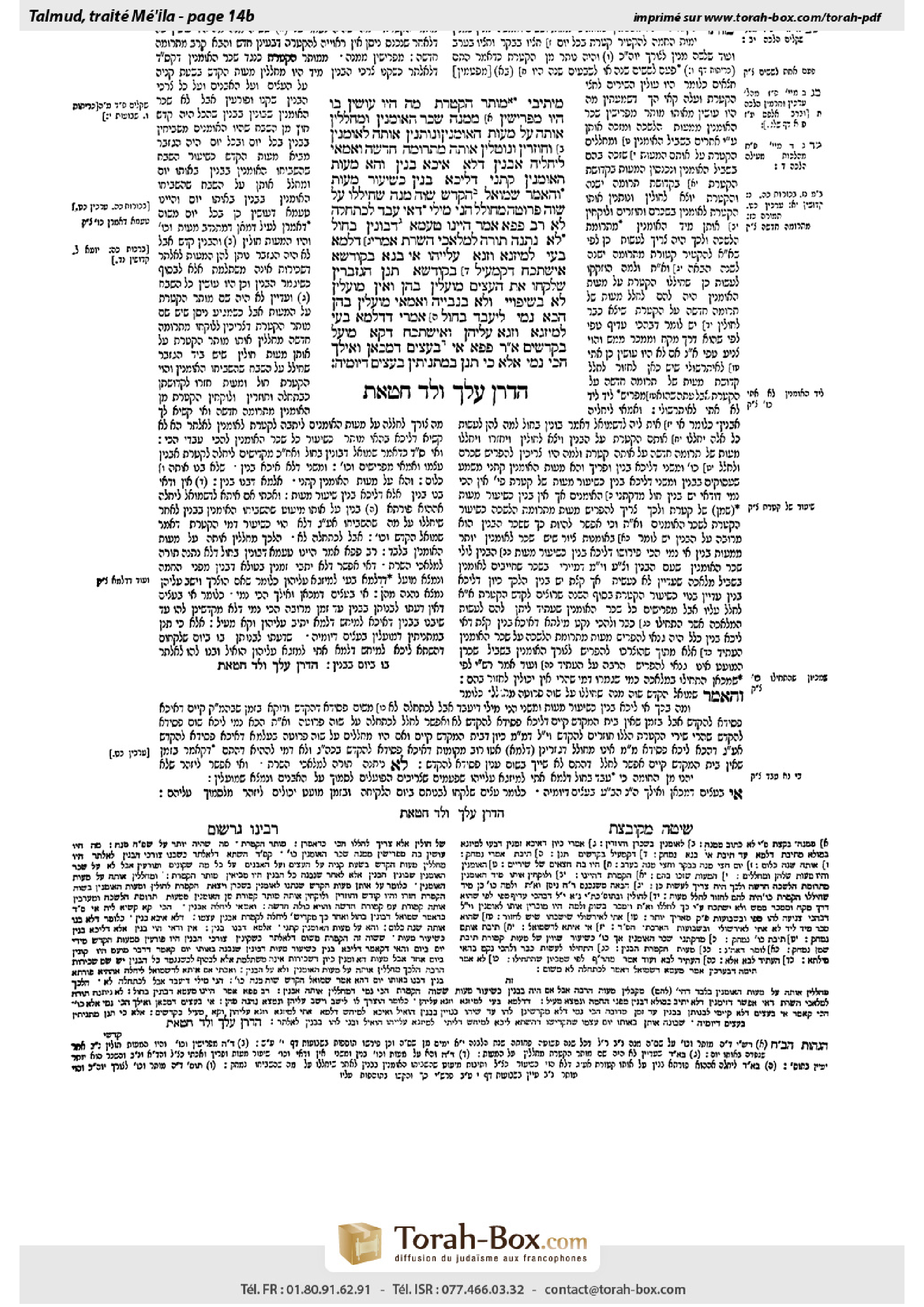
Meilah 14b: Talmud study for Daf Yomi
Daf Yomi is the daily study of one Talmud folio. Explore 37 tractates with scans, Hebrew text, Sefaria English and AI-generated French translations where annotated.
Passage selection and English or AI-generated French translation are available where the scan has annotations. Daf Study is independent of Torah-Box and Sefaria.
Browse Meilah · מעילה · All tractatesMeilah 14b text and translations
This page of Meilah includes the Aramaic text, an English translation and an AI-generated French translation, alongside the scan above.
מעילה י״ד ב · Aramaic and Hebrew text
מֵיתִיבִי: מוֹתַר הַקְּטֹרֶת מָה הָיוּ עוֹשִׂין בּוֹ? הָיוּ מַפְרִישִׁין מִמֶּנָּה שְׂכַר הָאוּמָּנִין.
וּמְחַלְּלִין אוֹתָהּ עַל מְעוֹת הָאוּמָּנִין, וְנוֹתְנִין אוֹתָהּ לָאוּמָּנִין, וְחוֹזְרִין וְנוֹטְלִין אוֹתָהּ מִתְּרוּמָה חֲדָשָׁה.
וְאַמַּאי? לַיחֲלַיהּ אַבִּנְיָן!
דְּלָא אִיכָּא בִּנְיָן. וְהָא ״מְעוֹת הָאוּמָּנִין״ קָתָנֵי! דְּלֵיכָּא בִּנְיָן כְּשִׁיעוּר מָעוֹת.
וְהָאָמַר שְׁמוּאֵל: הֶקְדֵּשׁ שָׁוֶה מָנֶה שֶׁחִילְּלוֹ עַל שָׁוֶה פְּרוּטָה – מְחוּלָּל! הָנֵי מִילֵּי דְּאִי עֲבַד, לְכַתְּחִלָּה – לָא.
רַב פָּפָּא אָמַר: הַיְינוּ טַעְמָא דְּבוֹנִין בַּחוֹל – לֹא נִתְּנָה תּוֹרָה לְמַלְאֲכֵי הַשָּׁרֵת, אִמְרֵי דִּלְמָא בָּעֵי לְמִיזְגָּא, וּזְגָא עֲלַיְיהוּ. אִי בְּנָא בְּקוּדְשָׁא – אִישְׁתְּכַח דְּקָמָעֵיל בְּקוּדְשָׁא.
תְּנַן: הַגִּזְבָּרִין שֶׁלָּקְחוּ אֶת הָעֵצִים – מוֹעֲלִין בָּהֶן, וְאֵין מוֹעֲלִין לֹא בַּשִּׁיפּוּיי וְלֹא בַּנְּבִיָּיה.
וְאַמַּאי מוֹעֲלִין בָּהֶן? הָכָא נָמֵי לֶיעְבַּד בַּחוֹל, אָמְרִי דְּדִלְמָא בָּעֵי לְמִיזְגָּא, וּזְגָא עֲלֵיהֶן, וְאִישְׁתְּכַח דְּקָא מוֹעֵל בְּקָדָשִׁים!
אָמַר רַב פָּפָּא: אִי בְּעֵצִים דְּמִכָּאן וְאֵילָךְ, הָכִי נָמֵי. אֶלָּא כִּי תְּנַן בְּמַתְנִיתִין, בְּעֵצִים דְּיוֹמֵיהּ.
הַדְרָן עֲלָךְ וְלַד חַטָּאת
Meilah 14b · English translation
The Gemara raises an objection from a mishna (Shekalim 4:5): With regard to the incense left over from the previous year, which could no longer be used, what would they do with it in order to render it usable again? The Temple treasurers would set aside an amount of it equal to the value of the wages of the artisans who worked in the Temple.
And they would then desacralize that incense by transferring its sanctity to non-sacred money in the amount owed to the artisans. And they would subsequently give the incense to the artisans as their wages. And finally, they would return and buy back the incense from the artisans with funds from the new collection of shekels, so that the incense would now be considered to have been acquired from the shekels of the current year.
The Gemara explains its objection: But why was this procedure necessary according to Shmuel, who maintains that one builds the structures in the Temple with non-sacred materials? Let them desacralize the leftover incense by transferring its sanctity to the completed, non-sacred structure, thereby consecrating it with the sanctity of the incense. After the leftover incense is desacralized, it can be given to the artisans as wages and the Temple treasurers can buy it back with funds from the new collection.
The Gemara explains: The mishna is referring to a situation where there is currently no ongoing construction in the Temple, and therefore there is no structure to which they can transfer the sanctity of the leftover incense. The Gemara raises a difficulty: But the mishna teaches: The wages of the artisans, which indicates that construction is taking place in the Temple. The Gemara responds: Although there is indeed ongoing construction, the mishna in Shekalim is referring to a case where there is no construction equaling the amount of the value of the leftover incense. Therefore, it is not possible to transfer the sanctity of the leftover incense to the construction.
The Gemara raises a further difficulty: But doesn’t Shmuel say with regard to consecrated property worth one hundred dinars that if the Temple treasurer redeemed it for an object worth only one peruta, it is redeemed, despite the fact that the redemption was performed with an item that was not worth the full value of the consecrated property? The Gemara answers: This statement of Shmuel applies to a case where one did so, i.e., it applies only after the fact, but the Temple treasurer should not act in this manner ab initio.
Rav Pappa said: This is the reason that one builds the structures in the Temple with non-sacred materials and afterward consecrates those materials upon completion: It is because the Torah was not given to the ministering angels, who do not tire and do not have physical needs, but rather to human beings. Therefore, the Sages said that perhaps an artisan will want to rest and sit on the stones being used in the construction, and he might in fact sit on them. And if he builds with consecrated materials, it will be found that he misused consecrated property. Consequently, it is preferable for one to build with non-sacred materials, and the structure should be consecrated only upon completion.
The Gemara raises an objection to this reasoning from that which we learned in the mishna: In the case of the Temple treasurers who purchased non-sacred logs to use for repairs in the Temple, one is liable for misusing the wood itself, but he is not liable for misusing the sawdust, nor is he liable for misusing the leaves that fall from the log.
But why should this be a situation where one could be liable for misusing the wood? Here too, let him work with non-sacred logs and consecrate them only after they have been fixed in the structure. After all, in this case too one can apply the above reasoning that the Sages said that perhaps he will want to rest and sit on the logs he is working with, and he might sit on them, and it will be found that he misused consecrated items.
Rav Pappa said that if the mishna were referring to logs that the Temple treasurers acquired for use in construction from this point forward, then indeed they should not be consecrated until they are fixed in the structure. But when we learned in the mishna that one is liable for misuse of the wood, the tanna was referring to logs acquired for use on that same day. Since they are meant to be used immediately, there is no concern that one might sit on them.
Meilah 14b · Traduction française (IA)
La Guemara soulève une objection à partir d’une Michna (Shekalim 4:5) : que faisait-on de l’encens restant de l’année précédente, qui ne pouvait plus être utilisé, pour le rendre à nouveau utilisable ? Les trésoriers du Temple en mettaient de côté une quantité correspondant à la valeur du salaire des artisans qui travaillaient au Temple.
Ils désacralisaient ensuite cet encens en transférant sa sainteté à de l’argent profane, pour un montant égal à la somme due aux artisans. Puis ils donnaient l’encens aux artisans en guise de salaire. Enfin, ils rachetaient l’encens aux artisans avec les fonds de la nouvelle collecte des sicles, de sorte qu’il soit désormais considéré comme ayant été acquis avec les sicles de l’année en cours.
La Guemara explique l’objection : mais pourquoi cette procédure était-elle nécessaire selon Shmuel, qui soutient que les bâtiments du Temple sont construits avec des matériaux profanes ? Qu’ils désacralisent l’encens restant en transférant sa sainteté au bâtiment achevé et profane, le consacrant ainsi avec la sainteté de l’encens. Une fois l’encens restant désacralisé, il peut être donné aux artisans en guise de salaire, et les trésoriers du Temple peuvent le racheter avec les fonds de la nouvelle collecte.
La Guemara explique : la Michna parle d’une situation où aucun chantier n’est en cours au Temple ; il n’y a donc aucun bâtiment auquel transférer la sainteté de l’encens restant. La Guemara soulève une difficulté : mais la Michna enseigne : « le salaire des artisans », ce qui indique que des travaux sont en cours au Temple. La Guemara répond : bien que des travaux soient effectivement en cours, la Michna de Shekalim parle d’un cas où leur valeur n’égale pas celle de l’encens restant. Il est donc impossible de transférer la sainteté de l’encens restant aux travaux.
La Guemara soulève une autre difficulté : Shmuel ne dit-il pas, à propos d’un bien consacré valant cent dinars, que si le trésorier du Temple l’a racheté contre un objet ne valant qu’une perouta, il est racheté, bien que le rachat ait été effectué au moyen d’un objet d’une valeur inférieure à celle du bien consacré ? La Guemara répond : cette déclaration de Shmuel s’applique au cas où quelqu’un a agi ainsi, c’est-à-dire qu’elle ne vaut qu’a posteriori ; le trésorier du Temple ne doit pas agir de cette manière a priori.
Rav Pappa dit : voici pourquoi les bâtiments du Temple sont construits avec des matériaux profanes, puis ces matériaux sont consacrés une fois les travaux achevés : la Torah n’a pas été donnée aux anges du service, qui ne se fatiguent pas et n’ont pas de besoins physiques, mais aux êtres humains. Les Sages ont donc dit qu’un artisan pourrait vouloir se reposer et s’asseoir sur les pierres utilisées pour la construction, et qu’il pourrait effectivement le faire. S’il construit avec des matériaux consacrés, il se trouvera alors qu’il a fait un usage profane d’un bien consacré. Il vaut donc mieux construire avec des matériaux profanes et ne consacrer le bâtiment qu’une fois les travaux achevés.
La Guemara soulève une objection à ce raisonnement à partir de ce que nous avons appris dans la Michna : dans le cas des trésoriers du Temple qui ont acheté des poutres profanes pour effectuer des réparations au Temple, on est passible d’un sacrifice pour usage profane du bois lui-même, mais on ne l’est ni pour la sciure ni pour les feuilles qui tombent de la poutre.
Mais pourquoi pourrait-on être passible d’un sacrifice pour usage profane du bois ? Ici aussi, qu’ils travaillent avec des poutres profanes et ne les consacrent qu’une fois fixées dans le bâtiment. Après tout, dans ce cas également, on peut appliquer le raisonnement précédent : les Sages ont dit qu’un artisan pourrait vouloir se reposer et s’asseoir sur les poutres sur lesquelles il travaille, qu’il pourrait effectivement le faire, et qu’il se trouverait alors avoir fait un usage profane d’objets consacrés.
Rav Pappa dit que si la Michna parlait de poutres acquises par les trésoriers du Temple pour les travaux de construction à partir de ce moment-là, elles ne devraient effectivement être consacrées qu’une fois fixées dans le bâtiment. Mais lorsque nous avons appris dans la Michna qu’on est passible d’un sacrifice pour usage profane du bois, le tanna parlait de poutres acquises pour être utilisées le jour même. Puisqu’elles sont destinées à être utilisées immédiatement, il n’y a pas lieu de craindre que quelqu’un s’assoie dessus.
Traduction française générée par IA à partir de l’édition anglaise de Sefaria. Vérifie toujours un passage avec le texte source.
Text from Sefaria: William Davidson Edition - Vocalized Aramaic (CC BY NC); William Davidson Edition - English (CC BY NC).