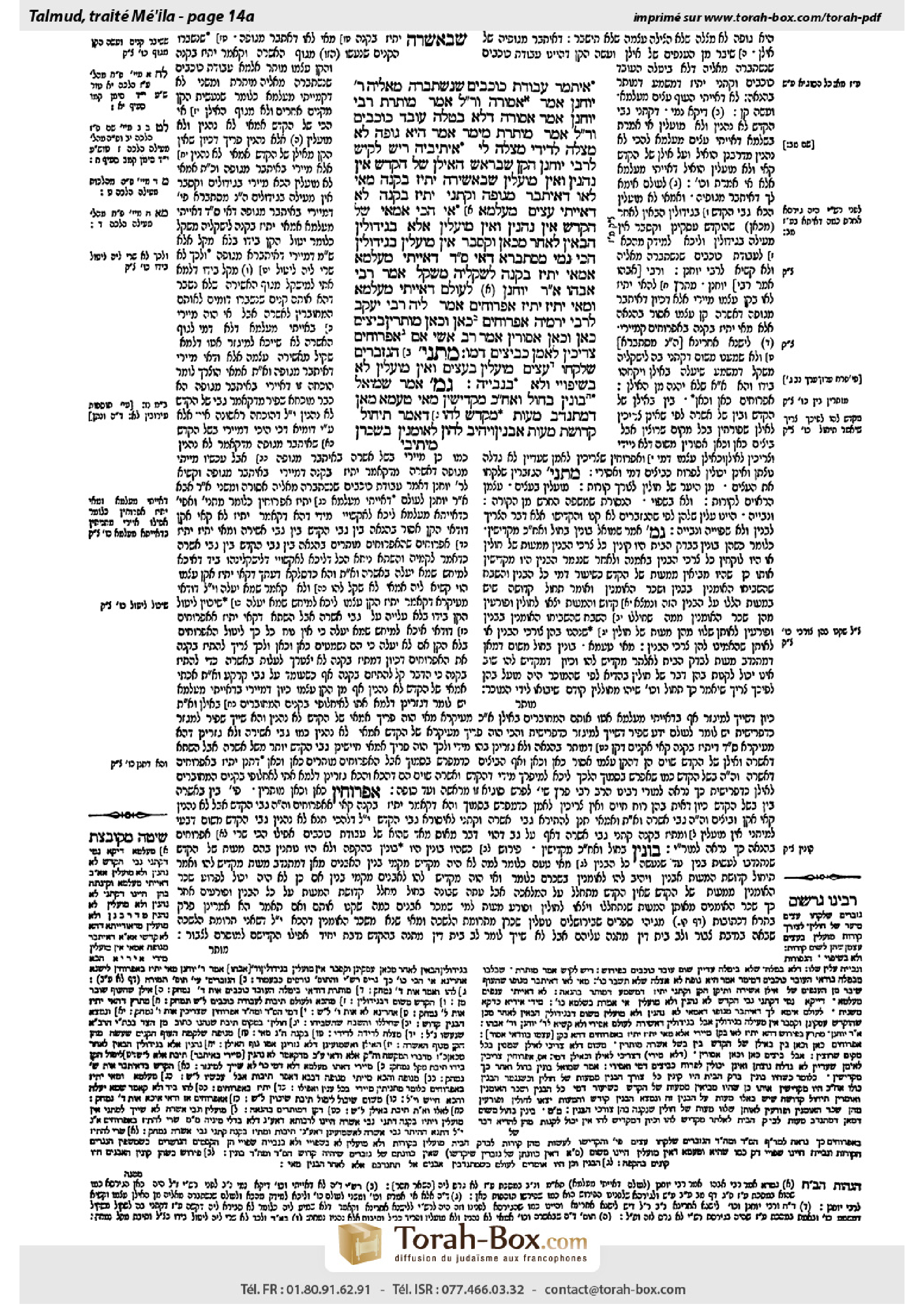
Meilah 14a: Talmud study for Daf Yomi
Daf Yomi is the daily study of one Talmud folio. Explore 37 tractates with scans, Hebrew text, Sefaria English and AI-generated French translations where annotated.
Passage selection and English or AI-generated French translation are available where the scan has annotations. Daf Study is independent of Torah-Box and Sefaria.
Browse Meilah · מעילה · All tractatesMeilah 14a text and translations
This page of Meilah includes the Aramaic text, an English translation and an AI-generated French translation, alongside the scan above.
מעילה י״ד א · Aramaic and Hebrew text
גְּמָ׳ אִיתְּמַר, עֲבוֹדָה זָרָה שֶׁנִּשְׁתַּבְּרָה מֵאֵלֶיהָ. רַבִּי יוֹחָנָן אָמַר: אֲסוּרָה. וְרֵישׁ לָקִישׁ אָמַר: מוּתֶּרֶת.
רַבִּי יוֹחָנָן אָמַר אֲסוּרָה – דְּלָא בַּטְּלַהּ גּוֹי. וְרֵישׁ לָקִישׁ אָמַר מוּתֶּרֶת – מֵימָר אָמַר: הִיא גּוּפַהּ לָא מַצְּלָה, לְדִידִי מַצְּלָה לִי?
אֵיתִיבֵיהּ רֵישׁ לָקִישׁ לְרַבִּי יוֹחָנָן: הַקֵּן שֶׁבְּרֹאשׁ הָאִילָן שֶׁל הֶקְדֵּשׁ – אֵין נֶהֱנִין וְאֵין מוֹעֲלִין. שֶׁבָּאֲשֵׁירָה יַתִּיז בְּקָנֶה.
מַאי לָאו דְּאִיתְּבַר מִגּוּפַהּ, וְקָתָנֵי, יַתִּיז בְּקָנֶה? לָא, דְּאַיְיתִי עֵצִים מֵעָלְמָא.
אִי הָכִי, אַמַּאי שֶׁל הֶקְדֵּשׁ אֵין נֶהֱנִין וְאֵין מוֹעֲלִין?
אֶלָּא, בְּגִידּוּלִין הַבָּאִין לְאַחַר מִכָּאן, וְקָסָבַר אֵין מוֹעֲלִין בְּגִידּוּלִין.
הָכִי נָמֵי מִסְתַּבְּרָא, דְּאִי סָלְקָא דַעְתָּךְ דְּאַיְיתִי מֵעָלְמָא, אַמַּאי יַתִּיז בְּקָנֶה? לִשְׁקְלֵיהּ מִשְׁקָל!
אָמַר רַבִּי אֲבָהוּ, אָמַר רַבִּי יוֹחָנָן: לְעוֹלָם דְּאַיְיתִי מֵעָלְמָא, וּמַאי ״יַתִּיז״? יַתִּיז אֶפְרוֹחִים.
אֲמַר לֵיהּ: רַבִּי יַעֲקֹב לְרַבִּי יִרְמְיָה אֶפְרוֹחִים כָּאן וְכָאן – מוּתָּרִין. בֵּיצִים, כָּאן וְכָאן – אֲסוּרִין. אָמַר רַב אָשֵׁי: אִם אֶפְרוֹחִים צְרִיכִין לְאִמָּן – כְּבֵיצִים דָּמוּ.
מַתְנִי׳ הַגִּזְבָּרִים שֶׁלָּקְחוּ עֵצִים – מוֹעֲלִין בָּעֵצִים, וְאֵין מוֹעֲלִין לֹא בַּשִּׁיפּוּיי וְלֹא בַּנְּבִיָּיה.
גְּמָ׳ אָמַר שְׁמוּאֵל: בּוֹנִין בַּחוֹל וְאַחַר כָּךְ מַקְדִּישִׁין.
מַאי טַעְמָא? מַאן דְּמִתְנַדֵּב מָעוֹת מַקְדֵּשׁ לְהוּ, דְּאָמַר: ״תֵּיחוּל קְדוּשַּׁת מָעוֹת אַבִּנְיָן״,
וִיהֵיב לְהוֹן לְאוּמָּנִין בִּשְׂכָרָן.
Meilah 14a · English translation
GEMARA: Connected with the mishna’s discussion of idol worship it was stated: In the case of an object of idol worship that broke by itself, Rabbi Yoḥanan says: It is prohibited to derive benefit from it, as the fact that it is broken does not constitute nullification, and Reish Lakish says: It is permitted to derive benefit from it.
The Gemara clarifies their opinions: Rabbi Yoḥanan says it is prohibited, as a gentile did not nullify the object of idol worship, and its status is nullified only if a gentile broke it with the intention of nullifying it. And Reish Lakish says it is permitted, as it can be presumed that its gentile owner, upon seeing that it was broken, would have nullified it, saying to himself: If the object of idol worship could not even save itself from destruction, will it save me from harm?
Reish Lakish raised an objection to Rabbi Yoḥanan from the mishna: With regard to the bird’s nest that is atop the consecrated tree, one may not derive benefit from it ab initio, but if he derived benefit from it he is not liable for its misuse. In order to acquire a bird’s nest that is atop the tree worshipped as idolatry one should dislodge the nest by striking it with a pole.
Reish Lakish analyzes the second halakha: What, is it not referring to a case where the nest was built from branches that broke off from the worshipped tree itself, and yet the mishna teaches: One should dislodge it by striking it with a pole? This indicates that branches that are broken off are permitted, despite the fact that they were not broken off by a gentile. Rabbi Yoḥanan responds: No, there is no proof from the mishna, as it is referring to a case where the bird brought branches from elsewhere, not from the worshipped tree itself.
Reish Lakish rejects this answer: If so, why does the mishna teach in the parallel case of a consecrated tree, where presumably the nest was likewise built of branches brought from elsewhere, that one may not derive benefit from it ab initio, but if one derived benefit from it he is not liable for its misuse? If the nest was built from non-sacred material, why is one not permitted to derive benefit from it ab initio?
The Gemara answers: Rather, the mishna must be discussing cases where the nest was constructed from branches that came from the tree in which it was built, and it is referring to growths of consecrated property that came afterward, i.e., after the property was consecrated. And the tanna of the mishna holds one is not liable for misusing growths of consecrated property, but it is prohibited to derive benefit from them ab initio.
The Gemara adds: This, too, stands to reason, that the mishna is referring to a case where the nest was built of branches from the tree in which it is located, as, if it enters your mind that the mishna is referring to a case where the bird brought the branches from elsewhere, why, in the case of the tree worshipped as idolatry, must one dislodge it from its place by striking it with a pole? Let him take it directly without using a pole.
Rabbi Abbahu said that Rabbi Yoḥanan said in response to this question: Actually, the mishna is referring to a case where the bird brought the branches from elsewhere, and what is the meaning of the clause: One should dislodge? It does not mean he should dislodge the nest with a pole, but rather he should dislodge the chicks that are in the nest. Since it is difficult to take the chicks without climbing the tree, as they can move, there is more of a concern in this case that he might climb the tree, in which case he would be deriving benefit from it, which is prohibited.
Rabbi Ya’akov said to Rabbi Yirmeya: With regard to chicks that can fly away and are not confined to this specific tree, both here and there, i.e., both in the case of a consecrated tree and in the case of a worshipped tree, it is permitted to derive benefit from them. But with regard to eggs, both here and there, it is prohibited to derive benefit from them, as they are dependent on the prohibited tree. Rav Ashi further says: If the chicks are young and still need their mother to survive they are considered like eggs, i.e., they have the same status as eggs and it is prohibited to derive benefit from them.
MISHNA: In the case of the Temple treasurers who purchased non-sacred logs to use for repairs in the Temple, one is liable for misusing the wood itself, but one is not liable for misusing the sawdust, nor is he liable for the leaves [baneviyya] that fall from the log, as the treasurers purchased for the Temple only those materials fit for use in its construction.
GEMARA: Shmuel says that the method of construction in the Temple, for repairs or improvements, is as follows: One builds the structures in the Temple with non-sacred materials, and afterward consecrates those materials upon completion of the work.
The Gemara asks: What is the reason that one does not consecrate the materials immediately? One who donates money for Temple maintenance consecrates the money and it is therefore subject to the halakha of misuse of consecrated property. Consequently, one may not use this money to purchase items for Temple maintenance, as the supplier would be liable for misuse as soon as he received the money as payment. The only way to use donations for Temple maintenance is if the Temple treasurer said that the sanctity of this money which was consecrated by the donor shall take effect on the completed structure, rather than on the construction materials or the wages of the artisans during the construction.
Therefore, once the construction is completed, the sanctity is transferred from the money to the structure, and then the money is non-sacred. And at that point, the Temple treasurers give the money to the artisans and the suppliers as their wages.
Meilah 14a · Traduction française (IA)
GUEMARA : En lien avec la discussion de la Michna sur le culte idolâtre, il a été enseigné : au sujet d’un objet idolâtre qui s’est brisé de lui-même, Rabbi Yoḥanan dit qu’il est interdit d’en tirer profit, car le fait qu’il soit brisé ne constitue pas une annulation ; Reish Lakish, quant à lui, dit qu’il est permis d’en tirer profit.
La Guemara précise leurs avis : Rabbi Yoḥanan dit qu’il est interdit d’en tirer profit, car un non-Juif n’a pas annulé l’objet idolâtre ; son statut n’est annulé que si un non-Juif l’a brisé dans l’intention de l’annuler. Reish Lakish dit qu’il est permis d’en tirer profit, car on peut présumer que son propriétaire non juif, en voyant qu’il était brisé, l’aurait annulé en se disant : « Si cet objet idolâtre n’a même pas pu se sauver de la destruction, me sauvera-t-il du malheur ? »
Reish Lakish soulève une objection contre Rabbi Yoḥanan à partir de la Michna : au sujet du nid d’oiseau qui se trouve sur un arbre consacré, il est interdit d’en tirer profit a priori, mais celui qui en a tiré profit n’est pas responsable d’un usage illicite. Pour prendre un nid d’oiseau situé sur un arbre voué au culte idolâtre, il faut déloger le nid en le frappant avec une perche.
Reish Lakish analyse la seconde halakha : n’est-il pas question d’un cas où le nid a été construit avec des branches qui se sont détachées de l’arbre voué au culte lui-même, et pourtant la Michna enseigne qu’il faut déloger le nid en le frappant avec une perche ? Cela indique que les branches qui se sont détachées sont permises, bien qu’elles n’aient pas été détachées par un non-Juif. Rabbi Yoḥanan répond : non, on ne peut tirer aucune preuve de la Michna, car elle traite d’un cas où l’oiseau a apporté des branches d’ailleurs, et non de l’arbre voué au culte lui-même.
Reish Lakish rejette cette réponse : dans ce cas, pourquoi la Michna enseigne-t-elle, dans le cas parallèle de l’arbre consacré — où le nid a sans doute également été construit avec des branches apportées d’ailleurs —, qu’il est interdit d’en tirer profit a priori, mais que celui qui en a tiré profit n’est pas responsable d’un usage illicite ? Si le nid a été construit avec des matériaux profanes, pourquoi est-il interdit d’en tirer profit a priori ?
La Guemara répond : la Michna doit plutôt traiter de cas où le nid a été construit avec des branches provenant de l’arbre sur lequel il se trouve ; elle parle de pousses de biens consacrés apparues après la consécration. Le tanna de la Michna considère qu’on n’est pas responsable d’un usage illicite des pousses d’un bien consacré, mais qu’il est interdit d’en tirer profit a priori.
La Guemara ajoute : il est également logique que la Michna traite d’un cas où le nid a été construit avec des branches provenant de l’arbre sur lequel il se trouve. En effet, si l’on supposait que la Michna traite d’un cas où l’oiseau a apporté les branches d’ailleurs, pourquoi, dans le cas de l’arbre voué au culte idolâtre, faudrait-il déloger le nid en le frappant avec une perche ? Qu’on le prenne directement, sans utiliser de perche.
Rabbi Abbahu dit au nom de Rabbi Yoḥanan, en réponse à cette question : en réalité, la Michna traite d’un cas où l’oiseau a apporté les branches d’ailleurs. Que signifie alors la clause « il faut déloger » ? Elle ne signifie pas qu’il faut déloger le nid avec une perche, mais qu’il faut déloger les oisillons qui s’y trouvent. Comme il est difficile de prendre les oisillons sans grimper à l’arbre, puisqu’ils peuvent se déplacer, on craint davantage dans ce cas que la personne ne grimpe à l’arbre, auquel cas elle en tirerait profit, ce qui est interdit.
Rabbi Ya’akov dit à Rabbi Yirmeya : au sujet des oisillons qui peuvent s’envoler et ne sont pas confinés à cet arbre précis, dans les deux cas — celui d’un arbre consacré et celui d’un arbre voué au culte idolâtre —, il est permis d’en tirer profit. En revanche, au sujet des œufs, dans les deux cas, il est interdit d’en tirer profit, car ils dépendent de l’arbre interdit. Rav Ashi ajoute : si les oisillons sont encore petits et ont besoin de leur mère pour survivre, ils sont considérés comme des œufs, c’est-à-dire qu’ils ont le même statut que des œufs et qu’il est interdit d’en tirer profit.
MICHNA : Dans le cas de trésoriers du Temple qui ont acheté des poutres profanes pour effectuer des réparations dans le Temple, on est responsable d’un usage illicite du bois lui-même, mais pas de la sciure ni des feuilles [baneviyya] qui tombent de la poutre, car les trésoriers n’ont acheté pour le Temple que des matériaux adaptés à sa construction.
GUEMARA : Shmuel dit que la méthode de construction dans le Temple, pour les réparations ou les améliorations, est la suivante : on construit les structures du Temple avec des matériaux profanes, puis on les consacre une fois les travaux achevés.
La Guemara demande : pourquoi ne consacre-t-on pas les matériaux immédiatement ? Celui qui fait don d’argent pour l’entretien du Temple consacre cet argent, qui est donc soumis à la halakha relative à l’usage illicite d’un bien consacré. Par conséquent, on ne peut pas utiliser cet argent pour acheter des matériaux destinés à l’entretien du Temple, car le fournisseur serait responsable d’un usage illicite dès qu’il recevrait l’argent en paiement. Le seul moyen d’utiliser les dons pour l’entretien du Temple est que le trésorier du Temple déclare que la sainteté de cet argent, consacré par le donateur, prendra effet sur la structure achevée, plutôt que sur les matériaux de construction ou sur les salaires des artisans pendant les travaux.
Par conséquent, une fois la construction achevée, la sainteté est transférée de l’argent à la structure, et l’argent devient alors profane. À ce moment-là, les trésoriers du Temple remettent l’argent aux artisans et aux fournisseurs à titre de rémunération.
Traduction française générée par IA à partir de l’édition anglaise de Sefaria. Vérifie toujours un passage avec le texte source.
Text from Sefaria: William Davidson Edition - Vocalized Aramaic (CC BY NC); William Davidson Edition - English (CC BY NC).