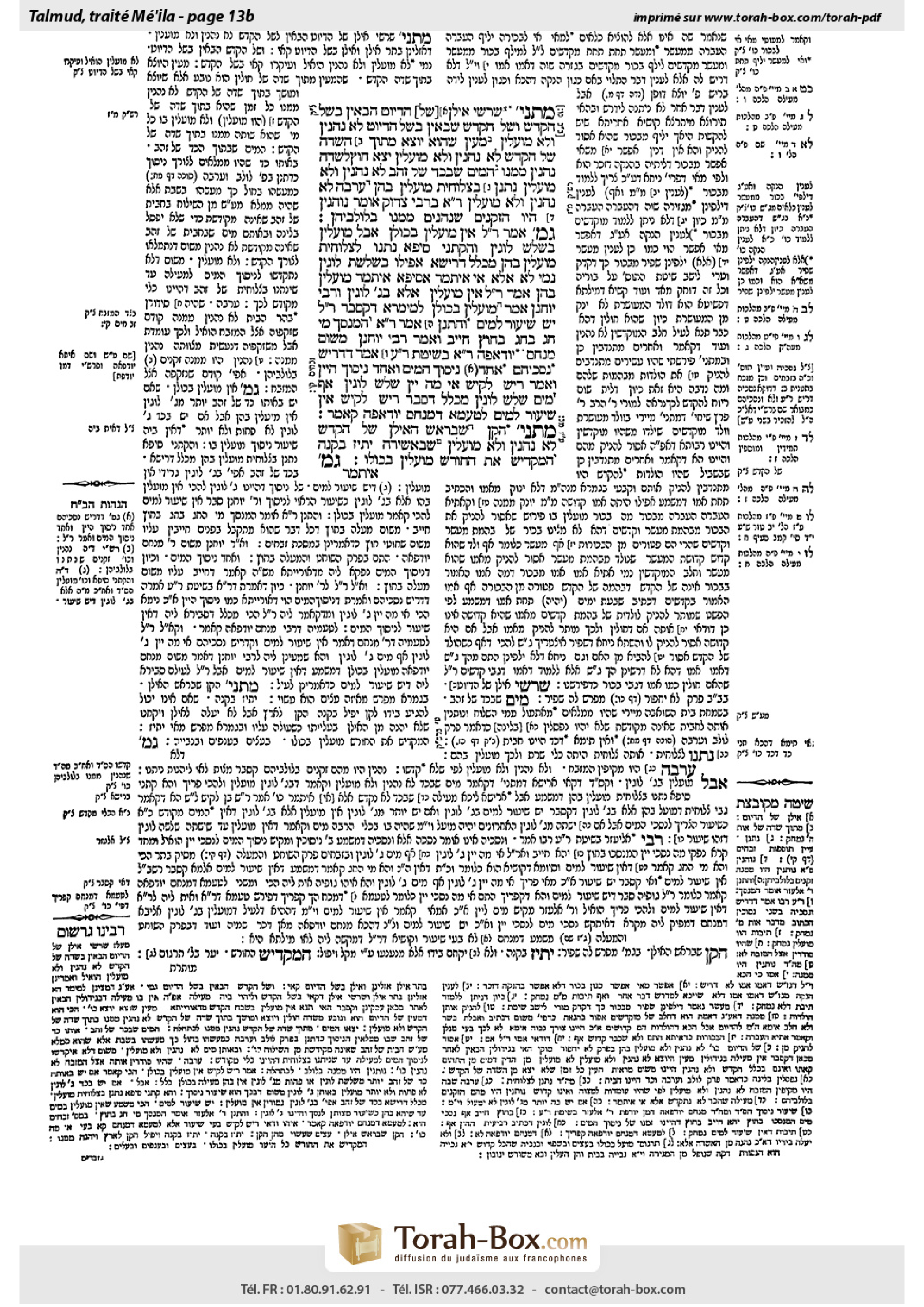
Meilah 13b: Talmud study for Daf Yomi
Daf Yomi is the daily study of one Talmud folio. Explore 37 tractates with scans, Hebrew text, Sefaria English and AI-generated French translations where annotated.
Passage selection and English or AI-generated French translation are available where the scan has annotations. Daf Study is independent of Torah-Box and Sefaria.
Browse Meilah · מעילה · All tractatesMeilah 13b text and translations
This page of Meilah includes the Aramaic text, an English translation and an AI-generated French translation, alongside the scan above.
מעילה י״ג ב · Aramaic and Hebrew text
מַתְנִי׳ שׇׁרְשֵׁי אִילָן שֶׁל הֶדְיוֹט הַבָּאִין בְּשֶׁל הֶקְדֵּשׁ, וְשֶׁל הֶקְדֵּשׁ שֶׁבָּאִין בְּשֶׁל הֶדְיוֹט – לֹא נֶהֱנִין וְלֹא מוֹעֲלִין. מַעְיָן שֶׁהוּא יוֹצֵא מִתּוֹךְ הַשָּׂדֶה שֶׁל הֶקְדֵּשׁ – לֹא נֶהֱנִין וְלֹא מוֹעֲלִין. יָצָא חוּץ לַשָּׂדֶה – נֶהֱנִין מִמֶּנּוּ.
הַמַּיִם שֶׁבַּכַּד שֶׁל זָהָב – לֹא נֶהֱנִין וְלֹא מוֹעֲלִין. נְתָנָן בִּצְלוֹחִית – מוֹעֲלִין בָּהֶן.
עֲרָבָה – לֹא נֶהֱנִין וְלֹא מוֹעֲלִין. רַבִּי אֶלְעָזָר בְּרַבִּי צָדוֹק אוֹמֵר: נוֹהֲגִין הָיוּ הַזְּקֵנִים שֶׁנֶּהֱנִים מִמֶּנּוּ בְּלוּלְבֵיהֶן.
גְּמָ׳ אָמַר רֵישׁ לָקִישׁ: אֵין מוֹעֲלִין בְּכוּלָּן, אֲבָל מוֹעֲלִין בְּשָׁלֹשׁ לוּגִּין.
וְהָקָתָנֵי סֵיפָא: ״נְתָנוֹ לִצְלוֹחִית – מוֹעֲלִין בָּהֶן״, מִכְּלָל דְּרֵישָׁא אֲפִילּוּ בִּשְׁלֹשֶׁת לוּגִּין נָמֵי לָא!
אֶלָּא אִי אִיתְּמַר אַסֵּיפָא אִיתְּמַר. מוֹעֲלִין בָּהֶן, אָמַר רֵישׁ לָקִישׁ: אֵין מוֹעֲלִין אֶלָּא בִּשְׁלֹשָׁה לוּגִּין.
וְרַבִּי יוֹחָנָן אָמַר – מוֹעֲלִין בְּכוּלָּן. לְמֵימְרָא דְקָסָבַר רֵישׁ לָקִישׁ: יֵשׁ שִׁיעוּר לַמַּיִם, וְהָתְנַן, אָמַר רַבִּי אֱלִיעֶזֶר: הַמְנַסֵּךְ מֵי חַג, בֶּחָג בַּחוּץ – חַיָּיב.
וְאָמַר רַבִּי יוֹחָנָן מִשּׁוּם מְנַחֵם יוֹדָאפָה: רַבִּי אֶלְעָזָר בְּשִׁיטַת רַבִּי עֲקִיבָא אָמַר, דְּדָרֵישׁ ״נִסְכֵּיהֶם״ – אֶחָד נִיסּוּךְ הַמַּיִם, וְאֶחָד נִיסּוּךְ הַיַּיִן.
וְאָמַר רֵישׁ לָקִישׁ: אִי מָה יַיִן שָׁלֹשׁ לוּגִּין, אַף מַיִם שָׁלֹשׁ לוּגִּין! מִכְּלָל דְּסָבַר רֵישׁ לָקִישׁ אֵין שִׁיעוּר לַמַּיִם! לְטַעְמָא דִּמְנַחֵם יוֹדָאפָה, קָאָמַר.
מַתְנִי׳ הַקֵּן שֶׁבְּרֹאשׁ הָאִילָן שֶׁל הֶקְדֵּשׁ – לָא נֶהֱנִין וְלֹא מוֹעֲלִין. שֶׁבָּאֲשֵׁירָה – יַתִּיז בְּקָנֶה. הַמַּקְדִּישׁ אֶת הַחוֹרֶשׁ – מוֹעֲלִין בְּכוּלּוֹ.
Meilah 13b · English translation
MISHNA: With regard to the roots of the non-sacred tree of an ordinary person that enter into consecrated land, and the roots of a consecrated tree that enter into the non-sacred land of an ordinary person, one may not derive benefit from them ab initio, but if he derived benefit from them he is not liable for their misuse. With regard to water of a spring that flows in a non-sacred field but which emerges from that field and flows into a consecrated field, when it is in the consecrated field one may not derive benefit from it ab initio, but if one derived benefit from it he is not liable for its misuse. Once the spring emerges outside the consecrated field one may derive benefit from the water.
With regard to the water that was drawn from the Siloam pool into the golden jug, which was not consecrated as a service vessel, to bring it to the altar for libation on the festival of Sukkot, one may not derive benefit from the water ab initio, as it was drawn for use in the Temple service. But if one derived benefit from it he is not liable for its misuse, since it was not consecrated in a service vessel. Once one places the water from the jug for libation into the flask, which is a service vessel, the water is consecrated and he is liable for misusing the water.
With regard to the willow branches that are placed on the sides of the altar on the festival of Sukkot, before their placement one may not derive benefit from them ab initio, but if he derived benefit from them he is not liable for their misuse. After their placement their mitzva has been fulfilled, and therefore at that time one may derive benefit from the willow branches ab initio. Rabbi Elazar, son of Rabbi Tzadok, says: The elders were accustomed to derive benefit from the willow branches even before their placement on the sides of the altar, by cutting small branches for use in their lulav, in fulfillment of the mitzva of the four species.
GEMARA: Reish Lakish says: When the mishna teaches that one is not liable for misusing the water in the golden jug awaiting use as a libation, it means that one is not liable for misuse of all of the water in the jug, if it contained more than three log. But one is liable for misusing the three log required for the libation.
The Gemara raises a difficulty: But the latter clause of the mishna teaches that once one placed the water from the jug into the flask he is liable for misusing the water. One can conclude by inference that in the case addressed in the first clause of the mishna, where the water is still in the jug, one is not liable for misuse in all circumstances, even if the jug contains only the requisite three log. This apparently contradicts the statement of Reish Lakish.
The Gemara answers: Rather, if a qualification was stated in this matter it was stated with regard to the latter clause of the mishna, which teaches that once the water is placed in the flask one is liable for misusing the water. The qualification is as follows: Reish Lakish says one is liable for its misuse only if the flask contains exactly three log of water, which is the requisite amount for the mitzva. But if there is more than three log one is not liable for misusing any of the water, as it is not consecrated at all.
And Rabbi Yoḥanan disagrees and says: Even if the flask contained more than three log of water, one is liable for misusing any of the water. He maintains there is no fixed measure for water used in the libation, and therefore all the water is consecrated for the mitzva. The Gemara asks: Is this to say that Reish Lakish holds there is a maximum measure for the water used in the libation? But didn’t we learn in a mishna (Zevaḥim 110b) that deals with liability for sacrificing outside the Temple that Rabbi Eliezer, or Rabbi Elazar, says: One who pours, as a libation, water consecrated for the libation of the festival of Sukkot, during the Festival, outside the courtyard, is liable to receive karet just as though he sacrificed outside the Temple.
The Gemara continues: And Rabbi Yoḥanan says in the name of Rabbi Menaḥem Yodafa: Rabbi Elazar says that halakha in accordance with the opinion of Rabbi Akiva, his teacher, who interprets a verse dealing with the offerings of the festival of Sukkot: “Beside the daily burnt offering, its meal offering, and its libations” (Numbers 29:31), as follows: The plural form indicates that the verse is speaking of two types of libations: One is the water libation, unique to the festival of Sukkot, and the other one is the wine libation, which always accompanies the daily offering.
And Reish Lakish said to Rabbi Yoḥanan: If Rabbi Elazar derives the obligation for the water libation through the derivation taught by Rabbi Akiva, and that is why he rules that one who pours it as a libation outside the courtyard is liable, then he should equate the libations of wine and water, as follows: Just as with regard to wine the measure for the mitzva is three log, so too here, in the case of water, the measure for the mitzva should be three log. One may conclude by inference from this statement that Reish Lakish himself holds there is no measure for the water used in the libation. The Gemara answers: Actually, Reish Lakish maintains that there is a measure for the water, but he stated his question according to the explanation of Rabbi Menaḥem Yodafa, cited by Rabbi Yoḥanan.
MISHNA: With regard to a bird’s nest that is atop the consecrated tree, one may not derive benefit from it ab initio, but if one derived benefit from it he is not liable for its misuse. In order to acquire a bird’s nest that is atop a tree worshipped as idolatry, from which one may not derive benefit even by climbing it, one should dislodge the nest from its place by striking it with a pole. In the case of one who consecrates his forest, one is liable for misusing everything in the entire forest.
Meilah 13b · Traduction française (IA)
MICHNA : Concernant les racines d’un arbre profane appartenant à un particulier, qui pénètrent dans un terrain consacré, et les racines d’un arbre consacré, qui pénètrent dans le terrain profane d’un particulier, il est interdit a priori d’en tirer profit ; mais si quelqu’un en a tiré profit, il n’est pas passible pour leur détournement. Concernant l’eau d’une source qui coule dans un champ profane, mais qui en sort et s’écoule dans un champ consacré, il est interdit a priori d’en tirer profit lorsqu’elle se trouve dans le champ consacré ; mais si quelqu’un en a tiré profit, il n’est pas passible pour son détournement. Dès que la source sort du champ consacré, il est permis de tirer profit de son eau.
Concernant l’eau puisée dans le bassin de Siloé au moyen d’une aiguière d’or, qui n’avait pas été consacrée comme ustensile de service, afin de l’apporter à l’autel pour la libation de la fête de Soukkot, il est interdit a priori d’en tirer profit, puisqu’elle a été puisée pour le service du Temple. Mais si quelqu’un en a tiré profit, il n’est pas passible pour son détournement, car elle n’a pas été consacrée dans un ustensile de service. Une fois que l’on verse l’eau de l’aiguière dans la fiole, qui est un ustensile de service, pour la libation, l’eau est consacrée et l’on est passible pour son détournement.
Concernant les branches de saule que l’on place sur les côtés de l’autel lors de la fête de Soukkot, il est interdit a priori d’en tirer profit avant leur mise en place ; mais si quelqu’un en a tiré profit, il n’est pas passible pour leur détournement. Après leur mise en place, leur mitsva est accomplie ; il est donc alors permis a priori de tirer profit des branches de saule. Rabbi Elazar, fils de Rabbi Tsadok, dit : Les anciens avaient coutume de tirer profit des branches de saule même avant de les placer sur les côtés de l’autel, en en coupant de petites branches pour leur loulav, afin d’accomplir la mitsva des quatre espèces.
GUEMARA : Rech Lakich dit : Lorsque la Michna enseigne que l’on n’est pas passible pour le détournement de l’eau contenue dans l’aiguière d’or en attente d’être utilisée comme libation, cela signifie que l’on n’est pas passible pour le détournement de toute l’eau de l’aiguière si celle-ci contient plus de trois log. Mais on est passible pour le détournement des trois log requis pour la libation.
La Guemara soulève une difficulté : Mais la dernière partie de la Michna enseigne qu’une fois que l’on a versé l’eau de l’aiguière dans la fiole, on est passible pour le détournement de l’eau. On peut en déduire que, dans le cas évoqué dans la première partie de la Michna, où l’eau se trouve encore dans l’aiguière, on n’est en aucun cas passible pour son détournement, même si l’aiguière contient seulement les trois log requis. Cela semble contredire l’affirmation de Rech Lakich.
La Guemara répond : En réalité, si une précision a été formulée à ce sujet, elle porte sur la dernière partie de la Michna, qui enseigne qu’une fois l’eau versée dans la fiole, on est passible pour son détournement. Cette précision est la suivante : Rech Lakich dit que l’on n’est passible pour son détournement que si la fiole contient exactement trois log d’eau, quantité requise pour la mitsva. Mais si elle en contient plus de trois log, on n’est passible pour le détournement d’aucune partie de l’eau, car celle-ci n’est pas du tout consacrée.
Et Rabbi Yo’hanan n’est pas d’accord et dit : Même si la fiole contenait plus de trois log d’eau, on est passible pour le détournement de toute l’eau. Il soutient qu’il n’y a pas de mesure fixe pour l’eau utilisée dans la libation ; toute l’eau est donc consacrée à la mitsva. La Guemara demande : Faut-il en conclure que Rech Lakich estime qu’il existe une mesure maximale pour l’eau utilisée dans la libation ? Mais n’avons-nous pas appris dans une Michna (Zéva’him 110b), qui traite de la responsabilité pour un sacrifice offert à l’extérieur du Temple, que Rabbi Eliezer, ou Rabbi Elazar, dit : Celui qui verse en libation, à l’extérieur de la cour et pendant la fête, de l’eau consacrée pour la libation de la fête de Soukkot est passible de karet, comme s’il avait offert un sacrifice à l’extérieur du Temple ?
La Guemara poursuit : Et Rabbi Yo’hanan dit au nom de Rabbi Mena’hem Yodafa : Rabbi Elazar dit que la halakha est conforme à l’opinion de Rabbi Akiva, son maître, qui interprète ainsi un verset relatif aux offrandes de la fête de Soukkot : « Outre l’holocauste quotidien, son offrande de céréales et ses libations » (Nombres 29:31) : la forme plurielle indique que le verset parle de deux sortes de libations. L’une est la libation d’eau, propre à la fête de Soukkot, et l’autre est la libation de vin, qui accompagne toujours l’offrande quotidienne.
Et Rech Lakich dit à Rabbi Yo’hanan : Si Rabbi Elazar déduit l’obligation de la libation d’eau au moyen de l’interprétation enseignée par Rabbi Akiva, et si c’est pour cette raison qu’il statue que celui qui verse cette eau en libation à l’extérieur de la cour est passible, alors il devrait assimiler les libations de vin et d’eau comme suit : de même que, pour le vin, la mesure requise pour la mitsva est de trois log, de même, pour l’eau, la mesure requise pour la mitsva devrait être de trois log. On peut déduire de cette déclaration que Rech Lakich lui-même estime qu’il n’y a pas de mesure pour l’eau utilisée dans la libation. La Guemara répond : En réalité, Rech Lakich soutient qu’il existe une mesure pour l’eau ; mais il a formulé sa question selon l’explication de Rabbi Mena’hem Yodafa, citée par Rabbi Yo’hanan.
MICHNA : Concernant un nid d’oiseau situé au sommet d’un arbre consacré, il est interdit a priori d’en tirer profit ; mais si quelqu’un en a tiré profit, il n’est pas passible pour son détournement. Pour s’emparer d’un nid d’oiseau situé au sommet d’un arbre voué à l’idolâtrie, dont il est interdit de tirer profit même en y grimpant, on doit déloger le nid en le frappant avec une perche. Si quelqu’un consacre sa forêt, on est passible pour le détournement de tout ce qui s’y trouve.
Traduction française générée par IA à partir de l’édition anglaise de Sefaria. Vérifie toujours un passage avec le texte source.
Text from Sefaria: William Davidson Edition - Vocalized Aramaic (CC BY NC); William Davidson Edition - English (CC BY NC).