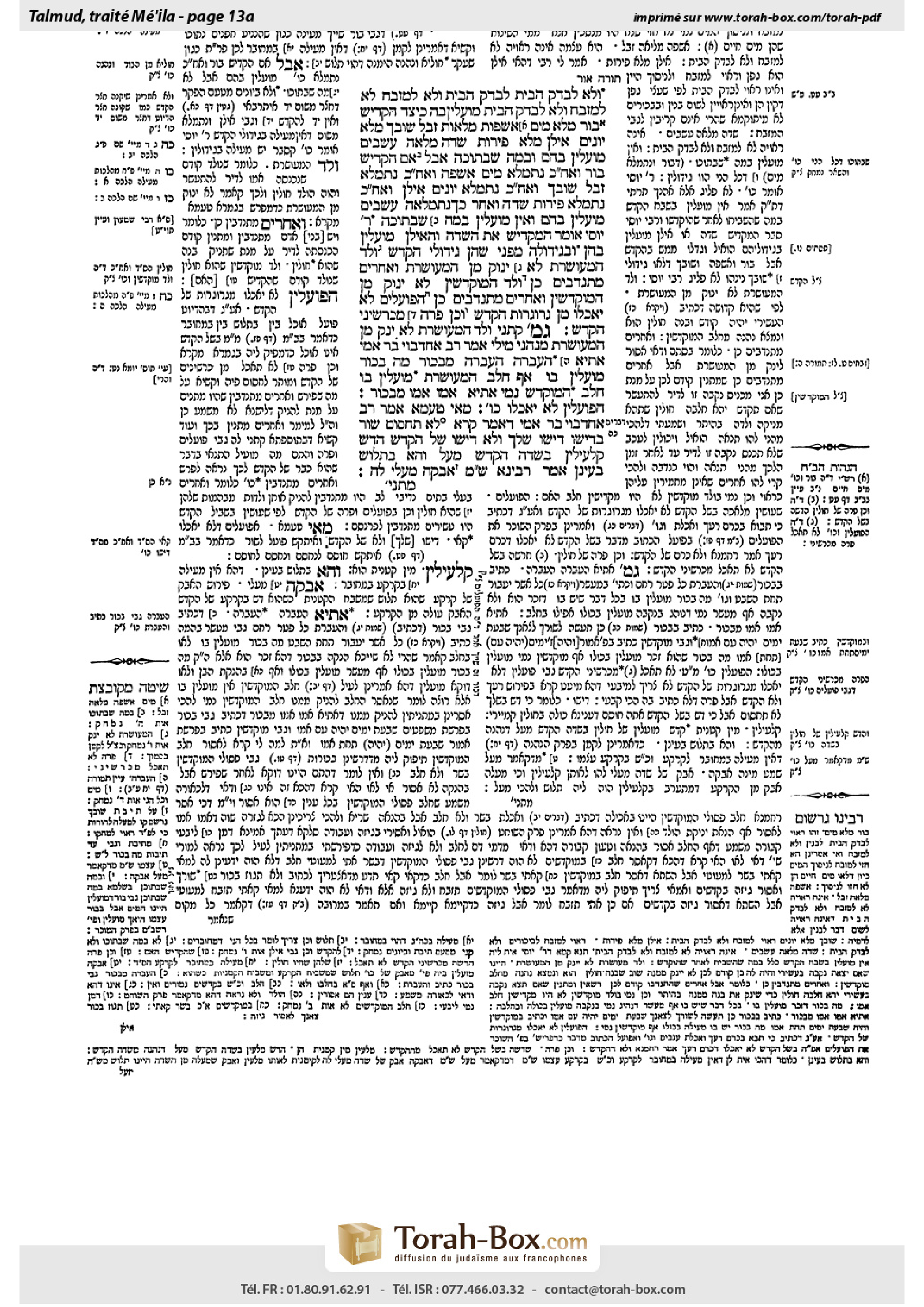
Meilah 13a: Talmud study for Daf Yomi
Daf Yomi is the daily study of one Talmud folio. Explore 37 tractates with scans, Hebrew text, Sefaria English and AI-generated French translations where annotated.
Passage selection and English or AI-generated French translation are available where the scan has annotations. Daf Study is independent of Torah-Box and Sefaria.
Browse Meilah · מעילה · All tractatesMeilah 13a text and translations
This page of Meilah includes the Aramaic text, an English translation and an AI-generated French translation, alongside the scan above.
מעילה י״ג א · Aramaic and Hebrew text
וְלֹא לְבֶדֶק הַבַּיִת, לְבֶדֶק הַבַּיִת וְלֹא לַמִּזְבֵּחַ, לֹא לַמִּזְבֵּחַ וְלֹא לְבֶדֶק הַבַּיִת – מוֹעֲלִין בָּהּ. כֵּיצַד?
הִקְדִּישׁ בּוֹר מָלֵא מַיִם, אַשְׁפּוֹת מְלֵאוֹת זֶבֶל, שׁוֹבָךְ מָלֵא יוֹנִים,
אִילָן מָלֵא פֵּירוֹת, שָׂדֶה מְלֵאָה עֲשָׂבִים –
מוֹעֲלִין בָּהֶם וּבְמַה שֶּׁבְּתוֹכָהּ.
אֲבָל אִם הִקְדִּישׁ בּוֹר וְאַחַר כָּךְ נִתְמַלֵּא מַיִם, אַשְׁפָּה וְאַחַר כָּךְ נִתְמַלָּא זֶבֶל, שׁוֹבָךְ וְאַחַר כָּךְ נִתְמַלֵּא יוֹנִים, אִילָן וְאַחַר כָּךְ נִתְמַלֵּא פֵּירוֹת, שָׂדֶה וְאַחַר כָּךְ נִתְמַלְּאָה עֲשָׂבִים – מוֹעֲלִין בָּהֶם, וְאֵין מוֹעֲלִין בְּמַה שֶּׁבְּתוֹכָהּ.
רַבִּי יוֹסֵי אוֹמֵר: הַמַּקְדִּישׁ אֶת הַשָּׂדֶה וְהָאִילָן – מוֹעֲלִין בָּהֶן וּבְגִידּוּלָהּ, מִפְּנֵי שֶׁהֵן גִּידּוּלֵי הֶקְדֵּשׁ.
וְלַד הַמְעוּשֶּׂרֶת – לֹא יִנַק מִן הַמְעוּשֶּׂרֶת, וַאֲחֵרִים מִתְנַדְּבִים כֵּן. וְלַד הַמּוּקְדָּשִׁין – לֹא יִנַק מִן הַמּוּקְדָּשִׁין, וַאֲחֵרִים מִתְנַדְּבִים כֵּן.
הַפּוֹעֲלִים לֹא יֹאכְלוּ מִן גְּרוֹגְרוֹת הֶקְדֵּשׁ. וְכֵן פָּרָה מִכַּרְשִׁינֵי הֶקְדֵּשׁ.
גְּמָ׳ קָתָנֵי: וְלַד הַמְעוּשֶּׂרֶת לֹא יִנַק מִן הַמְעוּשֶּׂרֶת. מְנָהָנֵי מִילֵּי?
אָמַר רַב אַחָדְבוּי בַּר אַמֵּי: אָתְיָא ״הַעֲבָרָה״ ״הַעֲבָרָה״ מִבְּכוֹר, מָה בְּכוֹר מוֹעֲלִין בּוֹ – אַף חֲלֵב הַמְעוּשֶּׂרֶת מוֹעֲלִין בּוֹ.
חֲלֵב הַמּוּקְדָּשׁ נָמֵי, אָתְיָא ״אִמּוֹ״ ״אִמּוֹ״ מִבְּכוֹר.
הַפּוֹעֲלִין לֹא יֹאכְלוּ כּוּ׳. מַאי טַעְמָא? אָמַר רַב אַחָדְבוּי בַּר אַמֵּי דְּאָמַר קְרָא: ״לֹא תַחְסֹם שׁוֹר בְּדִישׁוֹ״, ״דִּישׁוֹ״ – שֶׁלְּךָ, וְלֹא דִּישׁוֹ שֶׁל הֶקְדֵּשׁ.
הַדָּשׁ קַלְעִילִין בִּשְׂדֵה הֶקְדֵּשׁ – מָעַל. וְהָא בְּתָלוּשׁ בָּעִינַן! אָמַר רָבִינָא: שְׁמַע מִינַּהּ אַבְקַהּ מְעַלֵּי לַהּ.
Meilah 13a · English translation
but is not fit for Temple maintenance, or if it is fit for Temple maintenance but not for sacrifice on the altar, or fit neither for the altar nor for Temple maintenance, nevertheless one is liable for misusing it. The mishna clarifies each of these categories: Fit for Temple maintenance but not for sacrifice on the altar, how so?
In a case where one consecrated a cistern full of water, the water is not fit for sacrifice on the altar, as only water from the Siloam pool is used for the altar. Nevertheless, it is fit for Temple maintenance, e.g., to knead clay with it for use in reinforcing the walls of the Temple. What is the case of an item fit neither for the altar nor for Temple maintenance? If one consecrated garbage dumps full of manure, the place and its contents are fit neither for the altar nor for Temple maintenance. Rather, they are sold and the money received from the sale is donated to the Temple. What is the case of an item fit for sacrifice on the altar but not fit for Temple maintenance? If one consecrated a dovecote full of pigeons, the pigeons are fit for the altar while the dovecote is not fit even for Temple maintenance.
Or if one consecrated a tree full of fruit, as the fruit is fit for the altar whereas the tree is not fit even for Temple maintenance. For example, grapes are fit for the altar as wine, but the vines are not fit for Temple maintenance, as they are too flimsy for construction. Another case where the consecrated item is fit for neither the altar nor Temple maintenance is a field full of grass.
In all those cases, one is liable for misusing both them and that which is within them, as those that are unfit for use in the Temple will be sold and their money will be used for the altar or for Temple maintenance.
But if one consecrated an empty cistern and it was subsequently filled with water, or if one consecrated an empty garbage dump and it was subsequently filled with manure, or an empty dovecote and it was subsequently filled with pigeons, or a tree without fruit and it was subsequently filled with fruit, or an empty field and it was subsequently filled with grass; in all these cases one is liable for misusing them but one is not liable for misusing that which is within them. There is no misuse with regard to enhancements that developed in consecrated property.
Rabbi Yosei disagrees in two of the above cases and says: In the case of one who consecrates the empty field in which grass grew or the empty tree on which fruit grew, he is liable for misusing both them and their growth, because these are growths of consecrated property, despite the fact that they grew there only after the property was consecrated.
Apropos the growths of consecrated property, the mishna states that an offspring born to a tithed animal before it was tithed may not be given to suckle from the tithed mother, as it is a non-sacred animal that may not be allowed to derive benefit from consecrated property. And there are others who stipulate in this manner, i.e., that the consecration does not apply to the milk. The same is true of the offspring of sacrificial animals born to them before their consecration; they may not suckle from the sacrificial animal. And in this case as well, there are others who stipulate in this manner, i.e., to enable the offspring to suckle.
The laborers, who are generally permitted to eat the food of their employer, may not eat from consecrated dried figs, if they work with Temple produce. Rather, they can buy food with the money they are paid. And likewise, a cow working with consecrated property, e.g., threshing Temple produce, may not eat from consecrated vetch [mikarshinei].
GEMARA: The mishna teaches that an offspring born to a tithed animal before it was tithed may not suckle from the tithed mother, and the same applies to the offspring of a sacrificial animal. The Gemara asks: From where are these matters derived?
Rav Aḥadvoi bar Ami said: It is derived through a verbal analogy of the expressions “passing” and “passing,” from the case of a firstborn offering. With regard to animal tithe the verse states: “Whatsoever passes under the rod” (Leviticus 27:32), and with regard to the firstborn offering it is stated: “And you shall cause to pass all that opens the womb, to the Lord” (Exodus 13:12). Just as in the case of the firstborn offering one is liable for misusing all of it, as it is a male and does not have milk, so too, with regard to the milk of a tithed animal one is liable for misusing all of it, i.e., all of it is forbidden, including its milk, as it is part of the tithed animal. Therefore, the offspring may not suckle from the mother.
The other halakha, that the milk of a sacrificial animal is prohibited, is also derived through a verbal analogy, specifically the terms “its mother” and “its mother,” from the case of a firstborn offering. With regard to sacrificial animals the verse states: “When a bullock, or a sheep, or a goat, is born, it shall be seven days under its mother” (Leviticus 22:27), and in the case of the firstborn offering it is stated: “Seven days it shall be with its mother” (Exodus 22:29). Just as one is liable for misusing all of a firstborn offering, so too, one is liable for misusing the milk of a sacrificial animal, i.e., the milk is forbidden, as it is part of the sacrificial animal. Consequently, its offspring may not suckle from the mother.
§ The mishna teaches that the laborers of Temple produce may not eat from consecrated dried figs, and likewise a cow may not eat from consecrated vetch. The Gemara does not ask about the source of the halakha of a laborer, as the verse clearly states in this regard: “When you come into your neighbor’s vineyard” (Deuteronomy 23:25), which does not include a vineyard belonging to the Temple; but the Gemara does ask about the case of the cow: What is the reason for the ruling with regard to a cow? Rav Aḥadvoi bar Ami said: As the verse states: “Do not muzzle the ox during its treading” (Deuteronomy 25:4). The term “its treading” teaches that this prohibition applies to muzzling an ox when it is treading your non-sacred field, and not when it is treading a consecrated field. Since the consecrated produce is prohibited, one must muzzle the ox.
The Gemara discusses a similar case: One who threshes his non-sacred kalilin, a type of legume, in a consecrated field is liable for misuse of consecrated items. The Gemara raises a difficulty: But in order for one to be liable for misuse, we require the consecrated item from which one derives benefit to be detached from the ground, whereas the field is the ground itself. Ravina said: Conclude from it that the field’s dust is beneficial for kalilin, and therefore he misuses the detached dust of the consecrated field when he threshes it.
Meilah 13a · Traduction française (IA)
mais qu’elle ne convienne pas à l’entretien du Temple, ou si elle convient à l’entretien du Temple mais pas aux sacrifices sur l’autel, ou si elle ne convient ni à l’autel ni à l’entretien du Temple, on est néanmoins passible d’en avoir fait un usage profane. La Michna précise chacune de ces catégories : que signifie « convenir à l’entretien du Temple mais pas aux sacrifices sur l’autel » ?
C’est le cas de celui qui a consacré une citerne pleine d’eau : l’eau ne convient pas aux sacrifices sur l’autel, car seule l’eau du bassin de Siloé est utilisée sur l’autel. Elle convient néanmoins à l’entretien du Temple, par exemple pour pétrir de l’argile destinée à renforcer les murs du Temple. Quel est le cas d’un objet qui ne convient ni à l’autel ni à l’entretien du Temple ? Si quelqu’un a consacré des décharges pleines de fumier, le lieu et son contenu ne conviennent ni à l’autel ni à l’entretien du Temple. Ils sont plutôt vendus, et l’argent obtenu de la vente est donné au Temple. Quel est le cas d’un objet qui convient aux sacrifices sur l’autel mais pas à l’entretien du Temple ? Si quelqu’un a consacré un pigeonnier rempli de pigeons, les pigeons conviennent à l’autel, tandis que le pigeonnier ne convient même pas à l’entretien du Temple.
Ou encore, si quelqu’un a consacré un arbre couvert de fruits, car les fruits conviennent à l’autel, alors que l’arbre ne convient même pas à l’entretien du Temple. Par exemple, les raisins conviennent à l’autel sous forme de vin, mais les vignes ne conviennent pas à l’entretien du Temple, car elles sont trop fragiles pour la construction. Un autre cas d’objet consacré qui ne convient ni à l’autel ni à l’entretien du Temple est celui d’un champ couvert d’herbe.
Dans tous ces cas, on est passible d’avoir fait un usage profane tant de ces objets que de ce qu’ils contiennent, car les éléments qui ne conviennent pas à un usage dans le Temple seront vendus et l’argent obtenu servira à l’autel ou à l’entretien du Temple.
Mais si quelqu’un a consacré une citerne vide qui s’est ensuite remplie d’eau, ou une décharge vide qui s’est ensuite remplie de fumier, ou un pigeonnier vide qui s’est ensuite rempli de pigeons, ou un arbre sans fruits qui s’est ensuite couvert de fruits, ou un champ vide qui s’est ensuite couvert d’herbe, dans tous ces cas, on est passible d’avoir fait un usage profane de ces biens, mais on n’est pas passible d’avoir fait un usage profane de ce qui s’y trouve. Il n’y a pas d’usage profane concernant les accroissements apparus dans un bien consacré.
Rabbi Yosei est en désaccord dans deux des cas précédents et dit : dans le cas de celui qui consacre un champ vide où pousse de l’herbe, ou un arbre sans fruits sur lequel poussent des fruits, il est passible d’avoir fait un usage profane tant de ces biens que de ce qui y a poussé, car il s’agit de pousses d’un bien consacré, bien qu’elles n’y aient poussé qu’après la consécration du bien.
À propos des accroissements d’un bien consacré, la Michna enseigne qu’un petit né d’un animal soumis à la dîme avant que celui-ci ne soit soumis à la dîme ne peut pas téter de sa mère, elle-même soumise à la dîme, car c’est un animal profane qui ne peut tirer profit d’un bien consacré. Certains prennent aussi une condition en ce sens, c’est-à-dire que la consécration ne s’applique pas au lait. Il en va de même des petits nés d’animaux sacrificiels avant leur consécration : ils ne peuvent pas téter de l’animal sacrificiel. Dans ce cas aussi, certains prennent une condition en ce sens, c’est-à-dire afin de permettre au petit de téter.
Les ouvriers, qui sont généralement autorisés à manger la nourriture de leur employeur, ne peuvent pas manger de figues sèches consacrées lorsqu’ils travaillent avec des produits du Temple. Ils peuvent plutôt acheter de la nourriture avec l’argent qu’ils reçoivent en paiement. De même, une vache qui travaille avec un bien consacré, par exemple en battant des produits du Temple, ne peut pas manger de vesce consacrée [mikarshinei].
GUEMARA : La Michna enseigne qu’un petit né d’un animal soumis à la dîme avant que celui-ci ne soit soumis à la dîme ne peut pas téter de sa mère, elle-même soumise à la dîme, et qu’il en va de même du petit d’un animal sacrificiel. La Guemara demande : d’où tire-t-on ces règles ?
Rav Aḥadvoi bar Ami dit : On les déduit au moyen d’une analogie verbale entre les expressions « passer » et « passer », à partir du cas de l’offrande du premier-né. À propos de la dîme animale, le verset dit : « Tout ce qui passe sous la verge » (Lévitique 27:32), et à propos de l’offrande du premier-né, il est dit : « Tu feras passer à l’Éternel tout premier-né du sein maternel » (Exode 13:12). De même que, dans le cas de l’offrande du premier-né, on est passible d’avoir fait un usage profane de la totalité de l’animal, puisqu’il s’agit d’un mâle qui n’a pas de lait, de même, en ce qui concerne le lait d’un animal soumis à la dîme, on est passible d’avoir fait un usage profane de la totalité, c’est-à-dire que tout est interdit, y compris son lait, puisqu’il fait partie de l’animal soumis à la dîme. Le petit ne peut donc pas téter de sa mère.
L’autre halakha, selon laquelle le lait d’un animal sacrificiel est interdit, est elle aussi déduite au moyen d’une analogie verbale, précisément entre les expressions « sa mère » et « sa mère », à partir du cas de l’offrande du premier-né. À propos des animaux sacrificiels, le verset dit : « Lorsqu’un taureau, un agneau ou un chevreau naîtra, il restera sept jours auprès de sa mère » (Lévitique 22:27), et, dans le cas de l’offrande du premier-né, il est dit : « Il restera sept jours auprès de sa mère » (Exode 22:29). De même qu’on est passible d’avoir fait un usage profane de la totalité de l’offrande du premier-né, de même, on est passible d’avoir fait un usage profane du lait d’un animal sacrificiel, c’est-à-dire que le lait est interdit puisqu’il fait partie de l’animal sacrificiel. Par conséquent, son petit ne peut pas téter de sa mère.
§ La Michna enseigne que les ouvriers travaillant avec des produits du Temple ne peuvent pas manger de figues sèches consacrées, et qu’une vache ne peut pas non plus manger de vesce consacrée. La Guemara ne demande pas quelle est la source de la halakha concernant l’ouvrier, car le verset dit clairement à ce sujet : « Lorsque tu entreras dans la vigne de ton prochain » (Deutéronome 23:25), ce qui n’inclut pas une vigne appartenant au Temple. En revanche, la Guemara demande, au sujet de la vache : quelle est la raison de cette décision ? Rav Aḥadvoi bar Ami dit : le verset dit : « Tu ne muselleras pas le bœuf pendant qu’il foule le grain » (Deutéronome 25:4). L’expression « pendant qu’il foule le grain » enseigne que cette interdiction s’applique lorsqu’on muselle un bœuf qui foule son champ profane, et non lorsqu’il foule un champ consacré. Puisque les produits consacrés sont interdits, il faut museler le bœuf.
La Guemara examine un cas similaire : celui qui bat ses kalilin profanes, une sorte de légumineuse, dans un champ consacré est passible d’avoir fait un usage profane de biens consacrés. La Guemara soulève une difficulté : or, pour être passible d’avoir fait un usage profane, il faut que l’objet consacré dont on tire profit soit détaché du sol, alors que le champ constitue le sol lui-même. Ravina dit : déduis-en que la poussière du champ est bénéfique aux kalilin ; ainsi, lorsqu’il les bat, il fait un usage profane de la poussière détachée du champ consacré.
Traduction française générée par IA à partir de l’édition anglaise de Sefaria. Vérifie toujours un passage avec le texte source.
Text from Sefaria: William Davidson Edition - Vocalized Aramaic (CC BY NC); William Davidson Edition - English (CC BY NC).