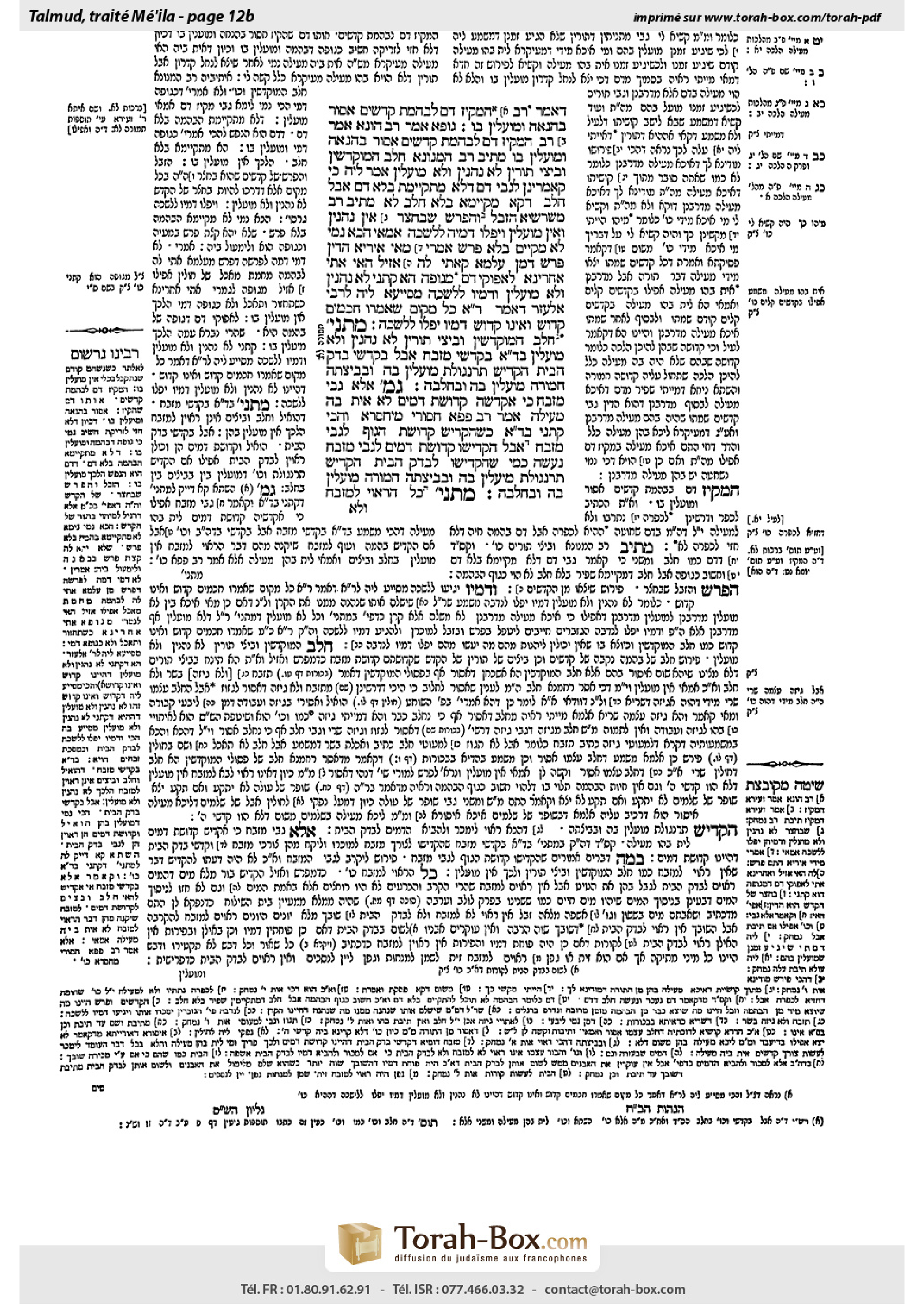
Meilah 12b: Talmud study for Daf Yomi
Daf Yomi is the daily study of one Talmud folio. Explore 37 tractates with scans, Hebrew text, Sefaria English and AI-generated French translations where annotated.
Passage selection and English or AI-generated French translation are available where the scan has annotations. Daf Study is independent of Torah-Box and Sefaria.
Browse Meilah · מעילה · All tractatesMeilah 12b text and translations
This page of Meilah includes the Aramaic text, an English translation and an AI-generated French translation, alongside the scan above.
מעילה י״ב ב · Aramaic and Hebrew text
דְּאָמַר רַב: הַמַּקִּיז דָּם לְבֶהֱמַת קָדָשִׁים, אָסוּר בַּהֲנָאָה, וּמוֹעֲלִין בּוֹ.
גּוּפָא. אָמַר רַב הוּנָא, אָמַר רַב: הַמַּקִּיז דָּם לְבֶהֱמַת קָדָשִׁים – אָסוּר בַּהֲנָאָה, וּמוֹעֲלִין בּוֹ. מֵתִיב רַב הַמְנוּנָא חֲלֵב הַמּוּקְדָּשִׁין, וּבֵיצֵי תוֹרִין – לֹא נֶהֱנִין וְלֹא מוֹעֲלִין!
אֲמַר לֵיהּ: כִּי קָאָמְרִינַן, לְגַבֵּי דָּם, דְּלֹא מִתְקַיֶּימֶת בְּלָא דָּם. אֲבָל חֵלֶב, דְּקָא מִקַּיְימָא בְּלֹא חֵלֶב – לָא.
מֵתִיב רַב מְשַׁרְשְׁיָא: הַזֶּבֶל וְהַפֶּרֶשׁ שֶׁבֶּחָצֵר – אֵין נֶהֱנִין וְאֵין מוֹעֲלִין. וְיִפְּלוּ דָּמֶיהָ לַלִּשְׁכָּה.
אַמַּאי? הָכָא נָמֵי, לָא מְקַיֵּים בְּלֹא פֶּרֶשׁ! אָמְרִי: מַאי אִירְיָא, הָדֵין פֶּרֶשׁ דְּמִן עָלְמָא קָאָתֵי לַהּ, אָזֵיל הַאי – אָתֵי אַחֲרִינָא. לְאַפּוֹקֵי דָּם, מִגּוּפַהּ.
הָא קָתָנֵי לֹא נֶהֱנִין וְלֹא מוֹעֲלִין וְדָמָיו לַלִּשְׁכָּה. מְסַיְּיעָא לֵיהּ לְרַבִּי אֶלְעָזָר, דְּאָמַר רַבִּי אֶלְעָזָר: כׇּל מָקוֹם שֶׁאָמְרוּ חֲכָמִים קָדוֹשׁ וְאֵינוֹ קָדוֹשׁ – דָּמָיו יִפְּלוּ לַלִּשְׁכָּה.
מַתְנִי׳ חֲלֵב הַמּוּקְדָּשִׁין וּבֵיצֵי תוֹרִין – לֹא נֶהֱנִין וְלֹא מוֹעֲלִין.
בַּמֶּה דְּבָרִים אֲמוּרִים – בְּקׇדְשֵׁי מִזְבֵּחַ. אֲבָל בְּקׇדְשֵׁי בֶּדֶק הַבַּיִת, הִקְדִּישׁ תַּרְנְגוֹלֶת – מוֹעֲלִין בָּהּ וּבְבֵיצָתָהּ, חֲמוֹרָה – מוֹעֲלִין בָּהּ וּבַחֲלָבָהּ.
גְּמָ׳ אֶלָּא גַּבֵּי מִזְבֵּחַ, כִּי אַקְדְּשַׁהּ קְדוּשַּׁת דָּמִים, לָא אִית בַּהּ מְעִילָה?
אָמַר רַב פָּפָּא: חַסּוֹרֵי מִיחַסְּרָא וְהָכִי קָתָנֵי: בַּמֶּה דְּבָרִים אֲמוּרִים – כְּשֶׁהִקְדִּישׁ קְדוּשַּׁת הַגּוּף לְגַבֵּי מִזְבֵּחַ, אֲבָל הִקְדִּישׁוֹ קְדוּשַּׁת דָּמִים לְגַבֵּי מִזְבֵּחַ – נַעֲשָׂה כְּמִי שֶׁהִקְדִּישׁוֹ לְבֶדֶק הַבַּיִת. הִקְדִּישׁ תַּרְנְגוֹלֶת – מוֹעֲלִין בָּהּ וּבְבֵיצָתָהּ, חֲמוֹרָה – מוֹעֲלִין בָּהּ וּבַחֲלָבָהּ.
מַתְנִי׳, כׇּל הָרָאוּי לַמִּזְבֵּחַ
Meilah 12b · English translation
As Rav said: In a case of one who lets blood from a live sacrificial animal, deriving benefit from that blood is prohibited and one is liable for misusing it by Torah law. Since there is a stage when there is a prohibition of misuse by Torah law, one can understand the halakha that one is liable by rabbinic law for misusing the blood ultimately, when it descended to the Kidron Valley. This is not comparable to doves whose time of fitness for sacrifice has not arrived, as they are initially not subject to misuse by Torah law.
§ The Gemara analyzes the matter itself. Rav Huna says that Rav says: In a case of one who lets blood from a sacrificial animal, deriving benefit from that blood is prohibited and one is liable for misusing it. Rav Hamnuna raises an objection to the opinion of Rav from the mishna below: With regard to the milk of animals consecrated to be sacrificed and the eggs of doves consecrated to be sacrificed, one may not derive benefit from them ab initio, but if one derived benefit from them he is not liable for their misuse, despite the fact that one is liable for misuse of the animals and doves themselves. Apparently, the products of a consecrated item do not share its status with regard to the halakha of misuse. Why doesn’t this principle apply to blood as well?
Rav said to Rav Hamnuna in response: When we said the products of a consecrated item are also subject to the halakha of misuse that was only with regard to blood, as the animal cannot exist without blood and therefore the blood is considered like the animal itself. But in the case of milk, since the animal can exist without milk, the milk is not considered like the animal itself.
Rav Mesharshiyya raises an objection to this suggestion from a baraita: One may not derive benefit from the dried manure and the fresh dung of offerings of the most sacred order found in the Temple courtyard ab initio, but if one derived benefit from them he is not liable for misusing them; and the money received from their sale will be allocated for the treasury chamber of the Temple.
In light of the suggested distinction between blood and milk, the Gemara asks: Why is the dung not subject to the halakhot of misuse? Here too, the animal cannot exist without dung, and therefore the dung should be subject to the halakhot of misuse like blood. The Sages say in response: How can you compare the two cases? In the case of this dung that comes to the animal from an external source, i.e., the food that it ate, this food goes out of the body in the form of dung and that other food comes into the body and takes its place. This description serves to exclude blood, which is part of the animal’s body and is not replaced from an external source.
The Gemara notes: The baraita teaches that one may not derive benefit from the manure and dung ab initio, but if one derived benefit from them he is not liable for misuse, and the money received from their sale will be allocated for the treasury chamber of the Temple. This supports the opinion of Rabbi Elazar, as Rabbi Elazar said: Wherever the Sages said an item is consecrated and not consecrated, as in this case where one may not derive benefit but he is not liable for misuse either, the money received from its sale is allocated for the treasury chamber of the Temple.
MISHNA: With regard to the milk of sacrificial animals and the eggs of sacrificial doves, one may not derive benefit from them ab initio, but if one derived benefit from them after the fact he is not liable for their misuse.
In what case is this statement, that if one derived benefit from the eggs or milk of sacrificial animals, he is not liable for their misuse, said? It is stated in the case of sacrificial animals offered on the altar, as their eggs and milk are not brought to the altar and therefore they are considered distinct from the offerings themselves. But this is not the halakha in the case of animals that are not sacrificed and are consecrated only for Temple maintenance. For example, if one consecrated a hen he is liable for misusing it and for misusing its egg; if one consecrated a donkey he is liable for misusing it and for misusing its milk, as the animal and its milk, and likewise the hen and its eggs, are both consecrated for Temple maintenance and are deemed a single unit.
GEMARA: The mishna teaches that if one derived benefit from the eggs or milk of consecrated animals sacrificed on the altar he is not liable for their misuse. The Gemara asks: But does that mean that in a case of an item that is suitable to be sacrificed on the altar, if he consecrated it with a sanctity that inheres in its value, i.e., to sell it and use the money to buy an offering rather than sacrifice the animal itself, then its eggs or milk are not subject to the halakhot of misuse? Since he does not intend to sacrifice the animal itself, why shouldn’t the prohibition of misuse apply to its milk or its eggs?
Rav Pappa said: The wording of the mishna is incomplete and this is what it is teaching: In what case is this statement, that the milk and eggs of a consecrated animal sacrificed on the altar are not subject to misuse, said? It is said when he consecrated the animal with inherent sanctity to be sacrificed on the altar. But if he consecrated it with a sanctity that inheres in its value, i.e., to sell it and use the money to buy an offering to be sacrificed on the altar, then it is considered as though he consecrated it for the Temple maintenance and it is subject to misuse. Therefore, if one consecrated a hen to sell it and use the money to buy an offering he is liable for misusing it and for misusing its egg; if one consecrated a donkey he is liable for misusing it and for misusing its milk.
MISHNA: With regard to any consecrated item that is fit for sacrifice on the altar
Meilah 12b · Traduction française (IA)
Comme l’a dit Rav : lorsqu’on prélève du sang d’un animal consacré vivant, il est interdit d’en tirer profit et l’on est passible, selon la Torah, pour en avoir fait un usage profane. Puisqu’il existe un stade où l’interdiction d’usage profane est d’ordre toranique, on peut comprendre la halakha selon laquelle on est passible, selon la loi rabbinique, pour l’usage profane du sang lorsqu’il a fini par descendre dans la vallée du Cédron. Ce cas n’est pas comparable à celui des colombes qui ne sont pas encore aptes au sacrifice, car elles ne sont dès le départ pas soumises à l’interdiction d’usage profane selon la Torah.
§ La Guemara examine le sujet lui-même. Rav Houna dit au nom de Rav : lorsqu’on prélève du sang d’un animal consacré, il est interdit d’en tirer profit et l’on est passible pour en avoir fait un usage profane. Rav Hamnouna soulève une objection à l’avis de Rav à partir de la Michna suivante : concernant le lait des animaux consacrés en vue d’être sacrifiés et les œufs des colombes consacrées en vue d’être sacrifiées, il est interdit d’en tirer profit a priori, mais celui qui en a tiré profit n’est pas passible pour en avoir fait un usage profane, alors qu’il est passible pour l’usage profane des animaux et des colombes eux-mêmes. Il apparaît donc que les produits d’un bien consacré ne partagent pas son statut au regard de la halakha de l’usage profane. Pourquoi ce principe ne s’appliquerait-il pas également au sang ?
Rav répondit à Rav Hamnouna : lorsque nous avons dit que les produits d’un bien consacré sont eux aussi soumis à la halakha de l’usage profane, cela ne concernait que le sang, car l’animal ne peut vivre sans sang ; celui-ci est donc considéré comme l’animal lui-même. En revanche, pour le lait, puisque l’animal peut vivre sans lait, celui-ci n’est pas considéré comme l’animal lui-même.
Rav Mesharshiyya soulève une objection à cette distinction à partir d’une baraïta : il est interdit a priori de tirer profit du fumier sec et des déjections fraîches des offrandes de très haute sainteté trouvées dans la cour du Temple, mais celui qui en a tiré profit n’est pas passible pour en avoir fait un usage profane ; l’argent reçu de leur vente sera affecté à la chambre du trésor du Temple.
À la lumière de la distinction proposée entre le sang et le lait, la Guemara demande : pourquoi les déjections ne sont-elles pas soumises aux lois de l’usage profane ? Ici aussi, l’animal ne peut vivre sans déjections ; celles-ci devraient donc être soumises aux lois de l’usage profane, comme le sang. Les Sages répondent : comment comparer les deux cas ? Ces déjections proviennent de l’extérieur de l’animal, c’est-à-dire de la nourriture qu’il a mangée ; cette nourriture quitte le corps sous forme de déjections, tandis qu’une autre nourriture entre dans le corps et prend sa place. Cette description permet d’exclure le sang, qui fait partie du corps de l’animal et n’est pas remplacé par un apport extérieur.
La Guemara relève que la baraïta enseigne qu’il est interdit a priori de tirer profit du fumier et des déjections, mais que celui qui en a tiré profit n’est pas passible pour en avoir fait un usage profane, et que l’argent reçu de leur vente sera affecté à la chambre du trésor du Temple. Cela appuie l’avis de Rabbi Elazar, car Rabbi Elazar a dit : partout où les Sages ont déclaré qu’un élément est consacré et non consacré, comme dans le cas présent où il est interdit d’en tirer profit sans que l’on soit passible pour en avoir fait un usage profane, l’argent reçu de sa vente est affecté à la chambre du trésor du Temple.
MICHNA : Concernant le lait des animaux destinés au sacrifice et les œufs des colombes destinées au sacrifice, il est interdit d’en tirer profit a priori, mais celui qui en a tiré profit après coup n’est pas passible pour en avoir fait un usage profane.
Dans quel cas affirme-t-on que celui qui a tiré profit des œufs ou du lait d’animaux consacrés n’est pas passible pour en avoir fait un usage profane ? Cela concerne les animaux offerts sur l’autel, car leurs œufs et leur lait ne sont pas apportés sur l’autel et sont donc considérés comme distincts des offrandes elles-mêmes. Mais telle n’est pas la halakha pour les animaux qui ne sont pas sacrifiés et qui sont consacrés uniquement à l’entretien du Temple. Par exemple, si quelqu’un consacre une poule, il est passible pour en avoir fait un usage profane et pour avoir fait un usage profane de son œuf ; s’il consacre un âne, il est passible pour en avoir fait un usage profane et pour avoir fait un usage profane de son lait, car l’animal et son lait, de même que la poule et ses œufs, sont tous deux consacrés à l’entretien du Temple et sont considérés comme une seule unité.
GUEMARA : La Michna enseigne que celui qui a tiré profit des œufs ou du lait d’animaux consacrés destinés à être sacrifiés sur l’autel n’est pas passible pour en avoir fait un usage profane. La Guemara demande : Cela signifie-t-il que, lorsqu’un élément est apte à être sacrifié sur l’autel et que quelqu’un le consacre d’une sainteté portant sur sa valeur, c’est-à-dire afin de le vendre et d’utiliser l’argent pour acheter une offrande plutôt que de sacrifier l’animal lui-même, ses œufs ou son lait ne sont pas soumis aux lois de l’usage profane ? Puisqu’il n’a pas l’intention de sacrifier l’animal lui-même, pourquoi l’interdiction d’usage profane ne s’appliquerait-elle pas à son lait ou à ses œufs ?
Rav Pappa dit : la formulation de la Michna est incomplète ; voici ce qu’elle enseigne : dans quel cas affirme-t-on que le lait et les œufs d’un animal consacré destiné à être sacrifié sur l’autel ne sont pas soumis à l’interdiction d’usage profane ? Cela concerne le cas où l’animal a été consacré d’une sainteté intrinsèque en vue d’être sacrifié sur l’autel. Mais si quelqu’un l’a consacré d’une sainteté portant sur sa valeur, c’est-à-dire afin de le vendre et d’utiliser l’argent pour acheter une offrande destinée à être sacrifiée sur l’autel, on considère alors qu’il l’a consacré à l’entretien du Temple, et il est soumis aux lois de l’usage profane. Par conséquent, si quelqu’un consacre une poule afin de la vendre et d’utiliser l’argent pour acheter une offrande, il est passible pour avoir fait un usage profane de celle-ci et de son œuf ; s’il consacre un âne, il est passible pour avoir fait un usage profane de celui-ci et de son lait.
MICHNA : Concernant tout élément consacré qui est apte à être sacrifié sur l’autel
Traduction française générée par IA à partir de l’édition anglaise de Sefaria. Vérifie toujours un passage avec le texte source.
Text from Sefaria: William Davidson Edition - Vocalized Aramaic (CC BY NC); William Davidson Edition - English (CC BY NC).