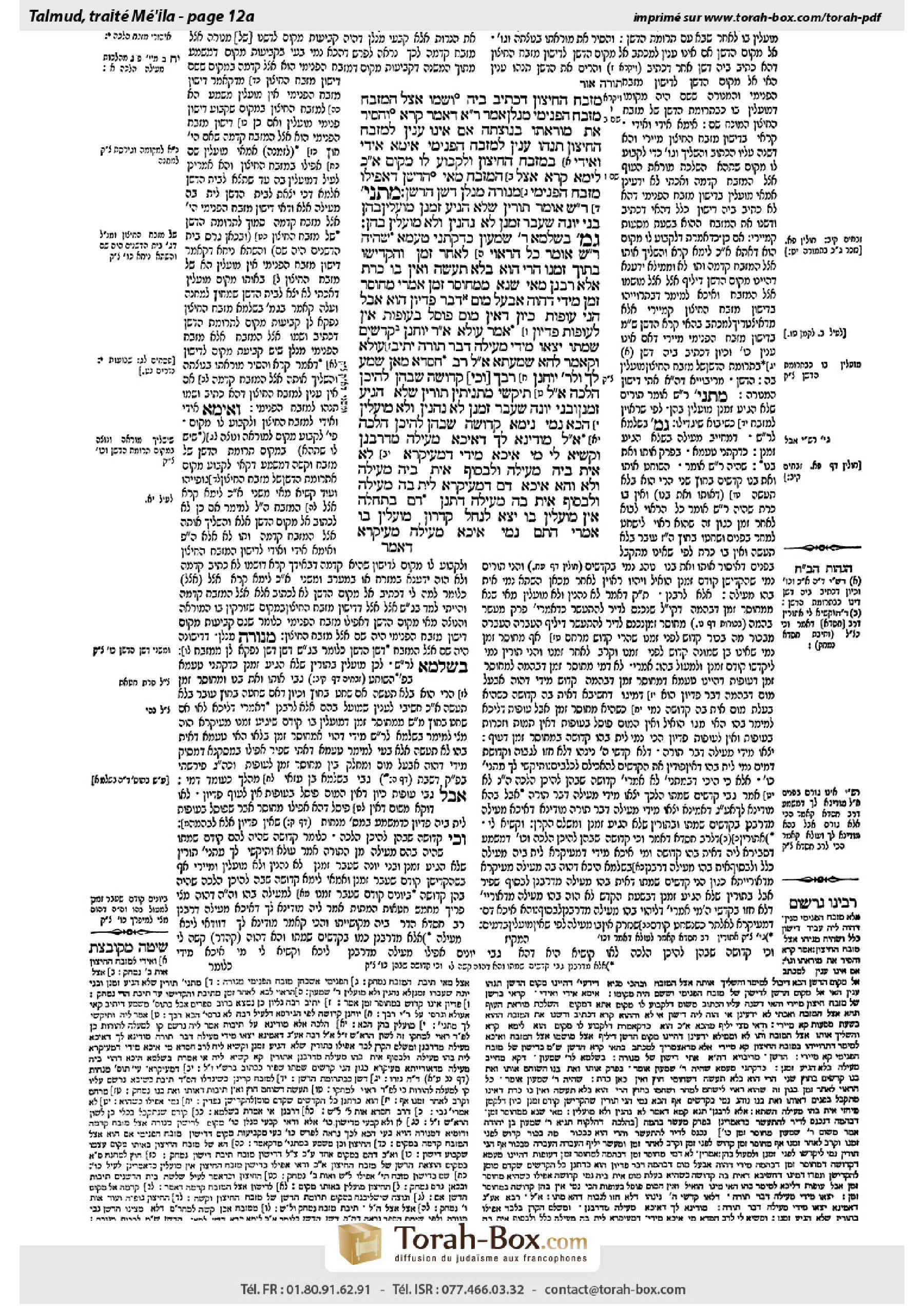
Meilah 12a: Talmud study for Daf Yomi
Daf Yomi is the daily study of one Talmud folio. Explore 37 tractates with scans, Hebrew text, Sefaria English and AI-generated French translations where annotated.
Passage selection and English or AI-generated French translation are available where the scan has annotations. Daf Study is independent of Torah-Box and Sefaria.
Browse Meilah · מעילה · All tractatesMeilah 12a text and translations
This page of Meilah includes the Aramaic text, an English translation and an AI-generated French translation, alongside the scan above.
מעילה י״ב א · Aramaic and Hebrew text
מִזְבֵּחַ הַחִיצוֹן, דִּכְתִיב בֵּיהּ: ״וְשָׂמוֹ אֵצֶל הַמִּזְבֵּחַ״. מִזְבֵּחַ הַפְּנִימִי מְנָלַן?
אָמַר רַבִּי אֶלְעָזָר: דְּאָמַר קְרָא: ״וְהֵסִיר אֶת מֻרְאָתוֹ בְּנֹצָתָהּ״ – אִם אֵינוֹ עִנְיָן לְמִזְבֵּחַ הַחִיצוֹן, תְּנֵהוּ עִנְיָן לְמִזְבֵּחַ הַפְּנִימִי.
אֵימָא: אִידֵּי וְאִידֵּי בְּמִזְבֵּחַ הַחִיצוֹן, וְלִקְבּוֹעַ לוֹ מָקוֹם!
אִם כֵּן, לֵימָא קְרָא: ״אֵצֶל הַמִּזְבֵּחַ״. מַאי ״הַדָּשֶׁן״? דַּאֲפִילּוּ מִזְבֵּחַ הַפְּנִימִי.
מְנוֹרָה מְנָלַן? ״דָּשֶׁן״, ״הַדָּשֶׁן״.
מַתְנִי׳ רַבִּי שִׁמְעוֹן אוֹמֵר תּוֹרִין שֶׁלֹּא הִגִּיעַ זְמַנָּן – מוֹעֲלִין בָּהֶן, בְּנֵי יוֹנָה שֶׁעָבַר זְמַנָּן – לֹא נֶהֱנִין וְלֹא מוֹעֲלִין בָּהֶן.
גְּמָ׳ בִּשְׁלָמָא רַבִּי שִׁמְעוֹן, כִּדְקָתָנֵי טַעְמָא: שֶׁהָיָה רַבִּי שִׁמְעוֹן אוֹמֵר, כׇּל הָרָאוּי לְאַחַר זְמַן, וְהִקְדִּישׁוֹ בְּתוֹךְ זְמַנּוֹ – הֲרֵי הוּא בְּלֹא תַעֲשֶׂה, וְאֵין בּוֹ כָּרֵת.
אֶלָּא רַבָּנַן: מַאי שְׁנָא מִמְּחוּסַּר זְמַן?
אָמְרִי: מְחוּסַּר זְמַן – מִידֵּי דְּהָוֵה אַבַּעַל מוּם, דְּבַר פִּדְיוֹן הוּא. אֲבָל הָנֵי עוֹפוֹת, כֵּיוָן דְּאֵין מוּם פּוֹסֵל בְּעוֹפוֹת – אֵין לָעוֹפוֹת פִּדְיוֹן.
אָמַר עוּלָּא, אָמַר רַבִּי יוֹחָנָן: קָדָשִׁים שֶׁמֵּתוּ, יָצְאוּ מִידֵי מְעִילָה דְּבַר תּוֹרָה.
יָתֵיב עוּלָּא וְקָאָמַר לְהָא שְׁמַעְתָּא, אֲמַר לֵיהּ רַב חִסְדָּא: מַאן שָׁמַע לָךְ וּלְרַבִּי יוֹחָנָן רַבָּךְ?! וְכִי קְדוּשָּׁה שֶׁבָּהֶן לְהֵיכָן הָלְכָה?!
אֲמַר לֵיהּ: תִּיקְשֵׁי מַתְנִיתִין: ״תּוֹרִין שֶׁלֹּא הִגִּיעַ זְמַנָּן וּבְנֵי יוֹנָה שֶׁעָבַר זְמַנָּן – לֹא נֶהֱנִין וְלֹא מוֹעֲלִין״, הָכָא נָמֵי נֵימָא: קְדוּשָּׁה שֶׁבָּהֶן לְהֵיכָן הָלְכָה?!
אֲמַר לֵיהּ: מוֹדֵינָא לָךְ דְּאִיכָּא מְעִילָה מִדְּרַבָּנַן. וְקַשְׁיָא לִי: מִי אִיכָּא מִידֵּי דְּמֵעִיקָּרָא לָא אִית בֵּיהּ מְעִילָה, וּלְבַסּוֹף אִית בֵּיהּ מְעִילָה?
וְלָא? וְהָא אִיכָּא דָּם, דְּמֵעִיקָּרָא לֵית בַּהּ מְעִילָה, וּלְבַסּוֹף אִית בַּהּ מְעִילָה, דִּתְנַן: דָּם, בַּתְּחִלָּה – אֵין מוֹעֲלִין בּוֹ, יָצָא לְנַחַל קִדְרוֹן – מוֹעֲלִין בּוֹ!
אָמְרִי: הָתָם נָמֵי אִיכָּא מְעִילָה מֵעִיקָּרָא,
Meilah 12a · English translation
that the ashes of the external altar are subject to misuse, as it is written in the context of those ashes: “And he shall put it beside the altar” (Leviticus 6:3). This teaches that these ashes must be interred, despite the fact that their mitzva has been performed by its removal, and therefore they are subject to misuse. But from where do we derive that the ashes of the inner altar are also subject to misuse?
Rabbi Elazar said in response: It is derived from the fact that the verse states with regard to a bird sacrificed as a burnt offering: “And he shall take away its crop with its feathers, and cast it beside the altar on the east part, in the place of the ashes” (Leviticus 1:16), referring to the location for the placement of the removed ashes. If this verse is not needed for the matter of the external altar, as that halakha is already derived from the phrase: “And he shall put them beside the altar” (Leviticus 6:3), apply it to the matter of the ashes of the inner altar, teaching that these ashes must also be placed there.
The Gemara questions this conclusion: One can say that this and that, i.e., both verses cited above, are stated with regard to the ashes that are on the external altar, and the additional verse is necessary to fix its place, i.e., that it should be put on the east part, which is mentioned only in Leviticus 1:16. If so, there is no source for the placement of the ashes of the inner altar.
The Gemara answers: If so, that both verses are referring to the external altar, and the sole purpose of Leviticus 1:16 is to fix its place, let that verse merely state: “And he shall take away its crop with its feathers and cast it beside the altar,” and it would be understood that the two verses are referring to the same place, as the identical phrase “beside the altar” appears in the other verse. What is the reason for the additional phrase “in the place of the ashes”? It teaches that even the ashes of the inner altar are placed there.
The Gemara asks: From where do we derive that the ashes of the Candelabrum are also placed to the east of the altar? The Gemara answers: It is derived from the definite article in: “The ashes,” as the verse could have said “ashes” and instead it said “the ashes.” This addition serves to include the ashes of the Candelabrum.
MISHNA: The previous mishna teaches that one may not derive benefit from doves whose time of fitness for sacrifice has not arrived and from pigeons whose time of fitness for sacrifice has passed, but one who derived benefit from them is not liable for their misuse. Rabbi Shimon disagrees with this ruling and says: With regard to doves whose time of fitness for sacrifice has not arrived, one is liable for misusing them. With regard to pigeons whose time of fitness for sacrifice has passed, one may not derive benefit ab initio, but if one derived benefit from them he is not liable for their misuse.
GEMARA: This and the preceding mishna indicate that the Rabbis and Rabbi Shimon disagree as to whether or not doves whose time of fitness for sacrifice has not arrived are subject to misuse. The Gemara clarifies their opinions: Granted, one can understand the opinion of Rabbi Shimon, as he himself teaches his reason in a mishna (Zevaḥim 112b). As Rabbi Shimon would say: In the case of any sacrificial animal that is fit to be sacrificed after the passage of time, e.g., doves that will be fit for sacrifice when they mature, if one consecrated it before its time of fitness and slaughtered it outside the Temple courtyard, that person is in violation of a prohibition but there is no liability to receive karet for it.
But according to the opinion of the Rabbis, who hold that doves whose time of fitness for sacrifice has not arrived are not subject to misuse, in what way is this case different from an animal whose time has not yet arrived, and yet it can be consecrated? An animal whose time has not yet arrived enters the pen to be tithed together with the other animals (see Bekhorot 56a). Why is the case of the young doves any different?
The Rabbis would say in response that the cases are not comparable. An animal whose time has not yet arrived can indeed be consecrated, just as is the halakha with regard to a blemished animal, which can be consecrated, although only to the degree that it is subject to redemption. But in the case of these birds, since a blemish does not render birds unfit, there is no possibility of redemption for blemished birds. Therefore, one cannot compare the case of animal, which is subject to redemption, to the case of a bird whose time has not yet arrived.
§ Ulla says that Rabbi Yoḥanan says: Sacrificial animals that died without being sacrificed are excluded from the halakhot of misuse by Torah law. This is because they are no longer fit to be sacrificed, and therefore are no longer in the category of: “The sacred items of the Lord” (Leviticus 5:15). They cannot be redeemed either, since one may not redeem sacrificial animals merely in order to feed them to the dogs.
The Gemara relates that Ulla was sitting in the study hall and he recited this halakha in the name of Rabbi Yoḥanan. Rav Ḥisda said to him: Who will listen to you and Rabbi Yoḥanan, your teacher, with regard to this opinion, that such offerings are not subject to the halakhot of misuse by Torah law? After all, to where has the sanctity that was inherent in them until they died gone?
Ulla said to Rav Ḥisda: According to your reasoning, the mishna itself should present a difficulty, as it teaches: With regard to doves whose time of fitness for sacrifice has not arrived, as they are too young, and pigeons whose time of fitness for sacrifice has passed, as they are too old, one may not derive benefit from them ab initio, but if one derived benefit from them he is not liable for their misuse. Here too, one can say: To where has the sanctity that was inherent in the pigeons whose time of fitness for sacrifice has passed gone? Why are they no longer subject to the halakhot of misuse?
Rav Ḥisda said to Ulla in response: I agree that both the sacrificial animals that died and the pigeons whose time of fitness for sacrifice has passed are not subject to the halakhot of misuse by Torah law. I also concede to you that in the case of sacrificial animals that died and doves whose time of fitness for sacrifice has not arrived there is a prohibition of misuse of consecrated property by rabbinic law. Accordingly, I am no longer troubled by the question of where the sanctity has gone. But there is another matter that is difficult for me: Is there anything where initially, when it was consecrated, it is not subject to the halakhot of misuse, and ultimately it is subject to the halakhot of misuse by rabbinic law, such as these doves whose time of fitness for sacrifice has not arrived?
The Gemara asks: And is it so that there is no instance of an item that is initially not subject to the halakhot of misuse, and in the end is subject to the halakhot of misuse? But there is the case of blood, which initially is not subject to the halakhot of misuse, and ultimately it is subject to the halakhot of misuse. As we learned in the mishna (11a): With regard to blood, at its outset, before it is sprinkled on the altar, one is not liable for misusing it, but once it emerges via the canal that runs through the Temple to the Kidron Valley at the foot of the Temple Mount, one is liable for misusing it.
The Sages say in response: This is not a proof, as there too, in the case of blood it is subject to the halakhot of misuse initially.
Meilah 12a · Traduction française (IA)
que les cendres de l’autel extérieur sont soumises aux lois du détournement des biens consacrés, comme il est écrit à leur sujet : « Il le déposera à côté de l’autel » (Lévitique 6,3). Cela enseigne que ces cendres doivent être enterrées, bien que la mitsva ait été accomplie par leur enlèvement ; elles sont donc soumises aux lois du détournement. Mais d’où déduisons-nous que les cendres de l’autel intérieur y sont également soumises ?
Rabbi Elazar répondit : on le déduit de ce que dit le verset à propos d’un oiseau offert en holocauste : « Il en détachera le jabot avec ses plumes et le jettera à côté de l’autel, du côté oriental, à l’endroit des cendres » (Lévitique 1,16), qui désigne l’endroit où doivent être déposées les cendres enlevées. Si ce verset n’est pas nécessaire pour l’autel extérieur, puisque cette halakha se déduit déjà de l’expression : « Il les déposera à côté de l’autel » (Lévitique 6,3), appliquons-le aux cendres de l’autel intérieur : il enseigne que celles-ci doivent elles aussi y être déposées.
La Guemara remet cette conclusion en question : on pourrait dire que ces deux versets, c’est-à-dire les deux versets cités plus haut, parlent des cendres qui se trouvent sur l’autel extérieur, et que le verset supplémentaire est nécessaire pour en fixer l’emplacement, à savoir qu’elles doivent être déposées du côté oriental, mentionné uniquement en Lévitique 1,16. Si tel est le cas, il n’existe aucune source concernant le dépôt des cendres de l’autel intérieur.
La Guemara répond : si les deux versets concernent l’autel extérieur et que Lévitique 1,16 sert uniquement à en fixer l’emplacement, que ce verset dise simplement : « Il en détachera le jabot avec ses plumes et le jettera à côté de l’autel » ; on comprendrait alors que les deux versets désignent le même endroit, puisque l’autre verset emploie la même expression, « à côté de l’autel ». Pourquoi ajouter l’expression « à l’endroit des cendres » ? Elle enseigne que même les cendres de l’autel intérieur doivent y être déposées.
La Guemara demande : d’où déduisons-nous que les cendres de la Ménora doivent elles aussi être déposées à l’est de l’autel ? La Guemara répond : on le déduit de l’article défini dans l’expression « les cendres », car le verset aurait pu dire « des cendres », mais il dit « les cendres ». Cet ajout inclut les cendres de la Ménora.
MICHNA : La Michna précédente enseigne qu’il est interdit de tirer profit des colombes qui n’ont pas encore atteint l’âge où elles sont aptes à être offertes, ni des pigeons qui ont dépassé cet âge ; toutefois, celui qui en a tiré profit n’est pas passible pour détournement des biens consacrés. Rabbi Shimon conteste cette décision et dit : pour les colombes qui n’ont pas encore atteint l’âge où elles sont aptes à être offertes, on est passible pour détournement des biens consacrés. Quant aux pigeons qui ont dépassé cet âge, il est interdit d’en tirer profit a priori, mais celui qui en a tiré profit n’est pas passible pour détournement des biens consacrés.
GUEMARA : Cette Michna et la précédente indiquent que les Sages et Rabbi Shimon sont en désaccord sur la question de savoir si les colombes qui n’ont pas encore atteint l’âge où elles sont aptes à être offertes sont soumises aux lois du détournement des biens consacrés. La Guemara précise leurs opinions : on comprend celle de Rabbi Shimon, puisqu’il expose lui-même sa raison dans une Michna (Zévaḥim 112b). En effet, Rabbi Shimon disait : dans le cas de tout animal destiné à être offert qui deviendra apte à l’être avec le temps, par exemple des colombes qui seront aptes à être offertes lorsqu’elles auront grandi, si quelqu’un l’a consacré avant qu’il soit apte et l’a abattu hors de la cour du Temple, il transgresse une interdiction, mais n’encourt pas la peine de retranchement.
Mais selon l’opinion des Sages, qui considèrent que les colombes qui n’ont pas encore atteint l’âge où elles sont aptes à être offertes ne sont pas soumises aux lois du détournement des biens consacrés, en quoi ce cas diffère-t-il de celui d’un animal dont le moment n’est pas encore venu, mais qui peut néanmoins être consacré ? Un animal dont le moment n’est pas encore venu entre dans l’enclos pour être soumis à la dîme avec les autres animaux (voir Bekhorot 56a). En quoi le cas des jeunes colombes est-il différent ?
Les Sages répondraient que ces cas ne sont pas comparables. Un animal dont le moment n’est pas encore venu peut effectivement être consacré, comme le prévoit la halakha pour un animal présentant un défaut, qui peut être consacré, mais seulement dans la mesure où il peut être racheté. Or, dans le cas de ces oiseaux, un défaut ne les rendant pas inaptes, les oiseaux présentant un défaut ne peuvent pas être rachetés. On ne peut donc pas comparer le cas d’un animal, qui peut être racheté, à celui d’un oiseau qui n’a pas encore atteint l’âge où il est apte à être offert.
§ Oula dit au nom de Rabbi Yoḥanan : les animaux consacrés qui sont morts sans avoir été offerts sont exclus, selon la Torah, des lois du détournement des biens consacrés. En effet, ils ne sont plus aptes à être offerts et ne relèvent donc plus de la catégorie des « choses consacrées à l’Éternel » (Lévitique 5,15). Ils ne peuvent pas non plus être rachetés, car il est interdit de racheter des animaux consacrés dans le seul but de les donner à manger aux chiens.
La Guemara rapporte qu’Oula était assis à la maison d’étude et enseignait cette halakha au nom de Rabbi Yoḥanan. Rav Ḥisda lui dit : « Qui prêtera foi à toi et à Rabbi Yoḥanan, ton maître, quand vous soutenez cette opinion, selon laquelle de telles offrandes ne sont pas soumises, selon la Torah, aux lois du détournement des biens consacrés ? Après tout, qu’est devenue la sainteté qui était inhérente à ces offrandes jusqu’à leur mort ? »
Oula dit à Rav Ḥisda : « Selon ton raisonnement, la Michna elle-même devrait poser une difficulté, car elle enseigne : pour les colombes qui n’ont pas encore atteint l’âge où elles sont aptes à être offertes, parce qu’elles sont trop jeunes, et pour les pigeons qui ont dépassé cet âge, parce qu’ils sont trop vieux, il est interdit de tirer profit a priori, mais celui qui en a tiré profit n’est pas passible pour détournement des biens consacrés. Ici aussi, on pourrait demander : qu’est devenue la sainteté des pigeons qui ont dépassé l’âge où ils étaient aptes à être offerts ? Pourquoi ne sont-ils plus soumis aux lois du détournement ? »
Rav Ḥisda répondit à Oula : « Je reconnais que les animaux consacrés qui sont morts et les pigeons qui ont dépassé l’âge où ils étaient aptes à être offerts ne sont pas soumis, selon la Torah, aux lois du détournement des biens consacrés. Je te concède aussi que, dans le cas des animaux consacrés qui sont morts et des colombes qui n’ont pas encore atteint l’âge où elles sont aptes à être offertes, le détournement de biens consacrés est interdit par décret rabbinique. Ainsi, je ne suis plus troublé par la question de savoir ce qu’est devenue la sainteté. Mais une autre difficulté se pose à moi : existe-t-il un cas où, au départ, au moment de la consécration, un objet n’est pas soumis aux lois du détournement, mais où, par la suite, il y est soumis selon le droit rabbinique, comme ces colombes qui n’ont pas encore atteint l’âge où elles sont aptes à être offertes ? »
La Guemara demande : est-il vrai qu’il n’existe aucun cas d’objet qui, au départ, n’est pas soumis aux lois du détournement, mais qui y est soumis par la suite ? Il y a pourtant le cas du sang : au départ, il n’est pas soumis aux lois du détournement, mais par la suite, il y est soumis. En effet, nous avons appris dans la Michna (11a) : s’agissant du sang, au début, avant qu’il soit aspergé sur l’autel, on n’est pas passible pour en avoir détourné l’usage ; mais lorsqu’il sort par le canal qui traverse le Temple jusqu’à la vallée du Cédron, au pied du mont du Temple, on est passible pour en avoir détourné l’usage.
Les Sages répondent : cela ne constitue pas une preuve, car, là aussi, dans le cas du sang, il est soumis aux lois du détournement dès le départ.
Traduction française générée par IA à partir de l’édition anglaise de Sefaria. Vérifie toujours un passage avec le texte source.
Text from Sefaria: William Davidson Edition - Vocalized Aramaic (CC BY NC); William Davidson Edition - English (CC BY NC).