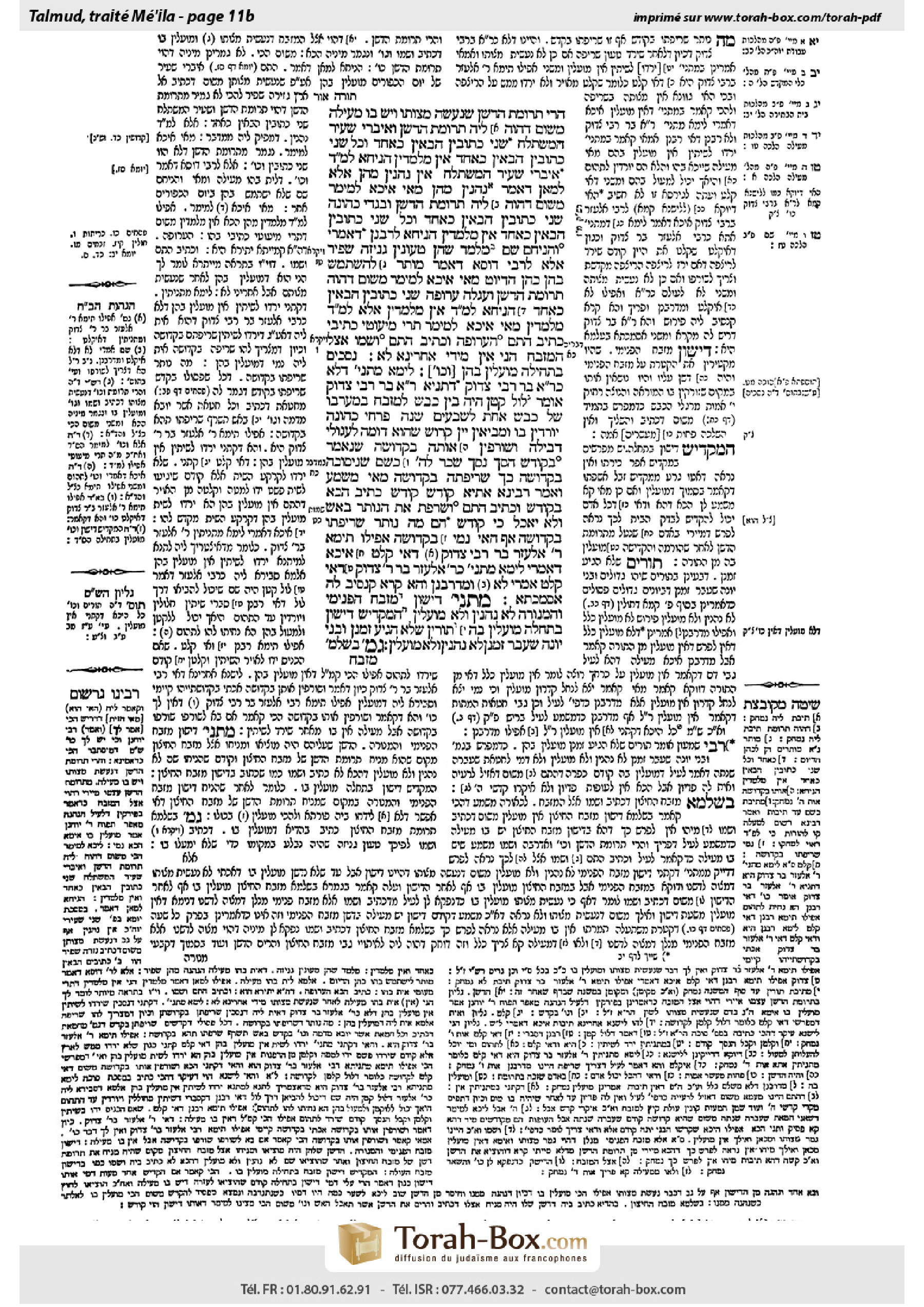
Meilah 11b: Talmud study for Daf Yomi
Daf Yomi is the daily study of one Talmud folio. Explore 37 tractates with scans, Hebrew text, Sefaria English and AI-generated French translations where annotated.
Passage selection and English or AI-generated French translation are available where the scan has annotations. Daf Study is independent of Torah-Box and Sefaria.
Browse Meilah · מעילה · All tractatesMeilah 11b text and translations
This page of Meilah includes the Aramaic text, an English translation and an AI-generated French translation, alongside the scan above.
מעילה י״א ב · Aramaic and Hebrew text
הֲרֵי תְּרוּמַת הַדֶּשֶׁן, שֶׁנַּעֲשָׂה מִצְוָתוֹ, וְיֵשׁ בּוֹ מְעִילָה!
מִשּׁוּם דְּהָוֵה לֵיהּ תְּרוּמַת הַדֶּשֶׁן וְאֵיבְרֵי שָׂעִיר הַמִּשְׁתַּלֵּחַ שְׁנֵי כְּתוּבִין הַבָּאִין כְּאֶחָד, וְכׇל שְׁנֵי כְתוּבִין הַבָּאִין כְּאֶחָד – אֵין מְלַמְּדִין.
הָנִיחָא לְמַאן דְּאָמַר אֵיבְרֵי שָׂעִיר הַמִּשְׁתַּלֵּחַ – אֵין נֶהֱנִין מֵהֶן, אֶלָּא לְמַאן דְּאָמַר נֶהֱנִין מֵהֶן, מַאי אִיכָּא לְמֵימַר?!
מִשּׁוּם דְּהָוֵה לֵיהּ תְּרוּמַת הַדֶּשֶׁן וּבִגְדֵי כְהוּנָּה שְׁנֵי כְתוּבִין הַבָּאִין כְּאֶחָד, וְכׇל שְׁנֵי כְתוּבִין הַבָּאִין כְּאֶחָד – אֵין מְלַמְּדִין.
הָנִיחָא לְרַבָּנַן דְּאָמְרִי: ״וְהִנִּיחָם שָׁם״ – מְלַמֵּד שֶׁהֵן טְעוּנִין גְּנִיזָה, שַׁפִּיר.
אֶלָּא לְרַבִּי דּוֹסָא, דְּאָמַר: מוּתָּר לְהִשְׁתַּמֵּשׁ בָּהֶן כֹּהֵן הֶדְיוֹט, מַאי אִיכָּא לְמֵימַר?
מִשּׁוּם דְּהָוֵה תְּרוּמַת הַדֶּשֶׁן וְעֶגְלָה עֲרוּפָה שְׁנֵי כְתוּבִין הַבָּאִין כְּאֶחָד.
הָנִיחָא לְמַאן דְּאָמַר אֵין מְלַמְּדִין, אֶלָּא לְמַאן דְּאָמַר מְלַמְּדִין, מַאי אִיכָּא לְמֵימַר?
תְּרֵי מִיעוּטֵי כְּתִיבִי. כְּתִיב הָתָם: ״הָעֲרוּפָה״,
וּכְתִיב הָתָם ״וְשָׂמוֹ אֵצֶל הַמִּזְבֵּחַ״, הָנֵי – אִין, מִידֵּי אַחֲרִינָא – לָא.
נְסָכִים בַּתְּחִילָּה מוֹעֲלִין בָּהֶן [וְכוּ׳]. לֵימָא מַתְנִיתִין דְּלָא כְּרַבִּי אֶלְעָזָר בַּר רַבִּי צָדוֹק,
דְּתַנְיָא, רַבִּי אֶלְעָזָר בַּר רַבִּי צָדוֹק אוֹמֵר: לוּל קָטָן הָיָה בֵּין כֶּבֶשׁ לַמִּזְבֵּחַ, בְּמַעֲרָבוֹ שֶׁל כֶּבֶשׁ. אַחַת לְשִׁבְעִים שָׁנָה פִּרְחֵי כְהוּנָּה יוֹרְדִין בּוֹ, וּמְבִיאִין יַיִן קָרוּשׁ, שֶׁהוּא דּוֹמֶה לְעִגּוּלֵי דְבֵילָה, וְשׂוֹרְפִין אוֹתָהּ בִּקְדוּשָּׁה. שֶׁנֶּאֱמַר: ״בַּקֹּדֶשׁ הַסֵּךְ נֶסֶךְ שֵׁכָר לַה׳״ – כְּשֵׁם שֶׁנִּיסּוּכָהּ בִּקְדוּשָּׁה, כָּךְ שְׂרֵיפָתָהּ בִּקְדוּשָּׁה.
מַאי מַשְׁמַע? וְאָמַר רָבִינָא: אַתְיָא ״קֹדֶשׁ״ ״קֹדֶשׁ״. כְּתִיב הָכָא: ״בַּקֹּדֶשׁ״, וּכְתִיב הָתָם: ״וְשָׂרַפְתָּ אֶת הַנּוֹתָר בָּאֵשׁ וְלֹא יֹאכַל כִּי קֹדֶשׁ הֵם״,
מָה נוֹתָר – שְׂרֵיפָתוֹ בִּקְדוּשָּׁה, אַף הַאי נָמֵי בִּקְדוּשָּׁה!
אֲפִילּוּ תֵּימָא רַבִּי אֶלְעָזָר בַּר רַבִּי צָדוֹק, דְּאִי קְלַט.
אִיכָּא דְאָמְרִי: לֵימָא מַתְנִיתִין כְּרַבִּי אֶלְעָזָר בַּר רַבִּי צָדוֹק, דְּאִי קְלַט?
אָמְרִי: לָא, וּמִדְּרַבָּנַן. וְהָא קְרָא קָנָסֵיב לַהּ? אַסְמַכְתָּא.
מַתְנִי׳ דִּישּׁוּן מִזְבֵּחַ הַפְּנִימִי, וְהַמְּנוֹרָה – לֹא נֶהֱנִין וְלֹא מוֹעֲלִין. הַמַּקְדִּישׁ דִּישּׁוּן בַּתְּחִלָּה – מוֹעֲלִין בָּהּ. תּוֹרִין שֶׁלֹּא הִגִּיעַ זְמַנָּן, וּבְנֵי יוֹנָה שֶׁעָבַר זְמַנָּן – לֹא נֶהֱנִין וְלֹא מוֹעֲלִין.
גְּמָ׳ בִּשְׁלָמָא
Meilah 11b · English translation
But there is the instance of the removal of the ashes of offerings burned on the altar, whose mitzva has been performed and nevertheless it is still subject to misuse of consecrated property.
The Gemara answers: The removal of the ashes cannot serve as a model for other halakhot whose mitzva has been performed, because the mitzva of the removal of the ashes and the limbs of the scapegoat of Yom Kippur after it was pushed off the cliff are both subject to the prohibition of misuse even after their mitzva has been performed. Consequently, they are two verses that come as one, i.e., they are two cases that share a unique halakha not found elsewhere. And there is a principle: Any two verses that come as one do not teach their common aspect to apply to other cases.
The Gemara objects: This works out well according to the one who said that one may not derive benefit from the limbs of the scapegoat, as this is a second verse indicating that an item can be subject to the halakha of misuse even after its mitzva has been performed. But according to the one who said that one may derive benefit from the limbs of the scapegoat, and they are not subject to the halakha of misuse, what can be said to explain why it is not possible to derive this halakha from the removal of the ashes? According to that opinion, this is not a case of two verses that come as one.
The Gemara explains: Even according to that opinion, the removal of the ashes cannot serve as a model for other halakhot whose mitzva has been performed, because the mitzva of the removal of the ashes and the priestly vestments, the four white garments worn by the High Priest on Yom Kippur, are both subject to the halakha of misuse of consecrated property even after their mitzva has been performed. Consequently, they are two verses that come as one, and any two verses that come as one do not teach their common aspect.
The Gemara raises a further difficulty: This works out well according to the opinion of the Rabbis, who say that the verse: “And he shall take off the linen garments, which he wore when he went into the sacred place, and shall leave them there” (Leviticus 16:23), teaches that the four white garments worn by the High Priest on Yom Kippur are unfit for further use, and they require interment. According to their opinion, the answer given by the Gemara works out well.
But according to the opinion of Rabbi Dosa, who said that these priestly vestments, which are the same as those required by an ordinary priest throughout the year, are permitted for use by an ordinary priest and do not require interment, which means that misuse of consecrated property does not apply to them, what can be said to explain why it is not possible to derive the halakha from the removal of the ashes, since it is a lone instance and therefore should serve as a general source for other cases?
The Gemara responds: Even so, the removal of the ashes cannot serve as a model for other halakhot whose mitzva has been performed, because the cases of the removal of the ashes and the heifer whose neck is broken, a ritual performed in certain cases of murder where the perpetrator is not identified, are two verses that come as one that do not teach their common aspect, as they are both subject to the halakha of misuse of consecrated property even after their mitzva has been performed.
The Gemara challenges this reply: This answer works out well according to the one who says that two verses that come as one do not teach their common aspect to other cases, but according to the one who said that two verses that come as one do teach their common aspect to other cases, what is there to say?
The Gemara explains: Two exclusions are written in these two cases, which indicate that this halakha applies only to them. There, with regard to the heifer whose neck is broken, it is written: “The one whose neck was broken” (Deuteronomy 21:6), and the definite article indicates that this halakha should not be extended to other cases.
And there, with regard to the removal of ashes, it is written: “And he shall put it next to the altar” (Leviticus 6:3), indicating that it alone is subject to the prohibition of misuse despite the fact that this is after the fulfillment of its mitzva. The verse emphasizes that this halakha applies to “it,” the ashes, but not to anything else. It is derived from these exclusions that specifically in the case of these, yes, there is misuse after the fulfillment of the mitzva, but with regard to other matters there is no misuse after fulfillment of the mitzva.
§ The mishna teaches: With regard to libations, at their outset, from the moment they were consecrated, one is liable for misusing them, but once they have descended to the drainpipes built into the altar one is no longer liable for their misuse. The Gemara suggests: Let us say that the mishna is not in accordance with the opinion of Rabbi Elazar bar Rabbi Tzadok.
As it is taught in a baraita that Rabbi Elazar bar Rabbi Tzadok says: There was a small gap between the ramp and the altar west of the ramp. Once in seventy years young priests would descend there to the drainpipes built into the altar and bring out from there the congealed wine left over from the libations that had accumulated over time, which resembled round cakes of dried and pressed figs. And they would burn it in sanctity in the Temple courtyard, as it is stated: “In sanctity shall you pour a libation of strong drink to the Lord” (Numbers 28:7). This teaches that just as its pouring is in sanctity, so too, its burning must be in sanctity.
Before addressing the issue of whether or not the mishna is in accordance with the opinion of Rabbi Elazar bar Rabbi Tzadok, the Gemara first analyzes the derivation stated at the end of the baraita: From where is this halakha of burning inferred? After all, the verse it cites is referring to pouring, not burning. Ravina said: It is derived by means of a verbal analogy between an expression of sanctity written with regard to libations and sanctity written with regard to leftover offerings. It is written here, with regard to libations: “In sanctity shall you pour a libation” (Numbers 28:7), and it is written there, with regard to leftover offerings: “You shall burn the leftovers in fire; they are not to be eaten, because it is sanctified” (Exodus 29:34).
This teaches that just as the burning of leftover offerings must be in sanctity, so too, the burning of these congealed libations must also be in sanctity. After the Gemara has clarified the baraita itself, it returns to the issue of whether or not the mishna here is in accordance with the opinion of Rabbi Elazar bar Rabbi Tzadok. It is clear from the baraita that he maintains that even after the libations descend into the drainpipes that are built into the altar, they retain their sanctity and are therefore burned, which apparently contradicts the opinion of the mishna.
The Gemara rejects this claim: You may even say that the mishna is in accordance with the opinion of Rabbi Elazar bar Rabbi Tzadok, as it can be claimed that the mishna is referring to the specific case where some of the libations were collected in the space between the ramp and the altar and did not reach the bottom of the drainpipes. In such a situation, the libations are not subject to misuse and there is no requirement of burning, even according to the opinion of Rabbi Elazar bar Rabbi Tzadok. By contrast, the tanna of the mishna agrees that libations that reached the bottom of the drainpipes are thereby consecrated, and therefore they are subject to misuse and there is a requirement of burning.
There are those who say a different version of this discussion. Let us say that the mishna is in accordance with the opinion of Rabbi Elazar bar Rabbi Tzadok, and it is referring to the specific case where some of the libations were collected in the space between the ramp and the altar and did not reach the bottom of the drainpipes. In such an instance the libations are not subject to misuse and there is no requirement of burning. One can infer that libations that reached the bottom of the drainpipes are thereby consecrated, and are subject to misuse and must be burned.
The Gemara rejects this claim. The Sages say in response: No; this is not the correct explanation. Rather, Rabbi Elazar bar Rabbi Tzadok concedes that even libations that reached the bottom of the drainpipes are not subject to misuse, as by Torah law they are not consecrated. And his ruling that they must be burned applies by rabbinic law. The Gemara raises a difficulty: But Rabbi Elazar bar Tzadok cites a verse in support of this halakha that the libations are burned, which indicates that it applies by Torah law. The Gemara answers: The verse is a mere support, not an actual source for the halakha, and therefore its citation does not prove that this prohibition applies by Torah law.
MISHNA: With regard to the removal of ash from the inner altar to the place where the ashes lifted from the outer altar are deposited, and similarly with regard to the wicks of the Candelabrum, one may not derive benefit from them ab initio; but if one derived benefit from them he is not liable for their misuse. In the case of one who consecrates anew the ash that has been removed, he is liable for misusing it. With regard to doves whose time of fitness for sacrifice has not arrived, as they are too young, and pigeons whose time of fitness for sacrifice has passed, as they are too old, one may not derive benefit from them ab initio; but if one derived benefit from them he is not liable for their misuse.
GEMARA: The mishna teaches that the ashes of the inner altar are not subject to misuse once they have been moved to the place where the ashes lifted from the outer altar are deposited. The Gemara asks: Granted
Meilah 11b · Traduction française (IA)
Mais il y a le cas de l’enlèvement des cendres des offrandes brûlées sur l’autel : leur mitsva a été accomplie, et pourtant elles restent soumises à l’interdit de profaner des biens consacrés.
La Guemara répond : L’enlèvement des cendres ne peut servir de modèle à d’autres halakhot dont la mitsva a été accomplie, car l’enlèvement des cendres et les membres du bouc émissaire de Yom Kippour, après que celui-ci a été précipité du haut de la falaise, sont tous deux soumis à l’interdit de profaner des biens consacrés, même après l’accomplissement de leur mitsva. Par conséquent, ce sont deux versets qui viennent enseigner une même règle, c’est-à-dire deux cas auxquels s’applique une halakha particulière, qui ne se retrouve pas ailleurs. Or, il existe un principe : deux versets qui viennent enseigner une même règle n’enseignent pas leur point commun pour l’appliquer à d’autres cas.
La Guemara objecte : Cela convient selon celui qui dit qu’il est interdit de tirer profit des membres du bouc émissaire, car il s’agit d’un deuxième verset indiquant qu’un objet peut être soumis à la halakha de profanation des biens consacrés même après l’accomplissement de sa mitsva. Mais selon celui qui dit qu’on peut tirer profit des membres du bouc émissaire et qu’ils ne sont pas soumis à cette halakha, que peut-on répondre pour expliquer pourquoi il est impossible de déduire cette halakha de l’enlèvement des cendres ? Selon cet avis, il ne s’agit pas de deux versets qui viennent enseigner une même règle.
La Guemara explique : Même selon cet avis, l’enlèvement des cendres ne peut servir de modèle à d’autres halakhot dont la mitsva a été accomplie, car l’enlèvement des cendres et les vêtements sacerdotaux — les quatre vêtements blancs portés par le Grand Prêtre à Yom Kippour — sont tous deux soumis à la halakha de profanation des biens consacrés, même après l’accomplissement de leur mitsva. Par conséquent, ce sont deux versets qui viennent enseigner une même règle, et deux versets qui viennent enseigner une même règle n’enseignent pas leur point commun.
La Guemara soulève une autre difficulté : Cela convient selon l’avis des Rabbins, qui disent que le verset « Il ôtera les vêtements de lin qu’il portait lorsqu’il entrait dans le lieu saint, et les déposera là » (Lévitique 16:23) enseigne que les quatre vêtements blancs portés par le Grand Prêtre à Yom Kippour ne peuvent plus être utilisés et doivent être enterrés. Selon leur avis, la réponse donnée par la Guemara convient.
Mais selon l’avis de Rabbi Dossa, qui dit que ces vêtements sacerdotaux, identiques à ceux que le prêtre ordinaire doit porter toute l’année, peuvent être utilisés par un prêtre ordinaire et n’ont pas besoin d’être enterrés — ce qui signifie qu’ils ne sont pas soumis à l’interdit de profaner des biens consacrés —, que peut-on répondre pour expliquer pourquoi il est impossible de déduire cette halakha de l’enlèvement des cendres, puisqu’il s’agit d’un cas unique qui devrait donc servir de source générale pour les autres cas ?
La Guemara répond : Malgré tout, l’enlèvement des cendres ne peut servir de modèle à d’autres halakhot dont la mitsva a été accomplie, car les cas de l’enlèvement des cendres et de la génisse dont on brise la nuque — rituel accompli dans certains cas de meurtre lorsque l’auteur n’a pas été identifié — constituent deux versets qui viennent enseigner une même règle et n’enseignent pas leur point commun, puisqu’ils sont tous deux soumis à la halakha de profanation des biens consacrés, même après l’accomplissement de leur mitsva.
La Guemara conteste cette réponse : Cet argument convient selon celui qui dit que deux versets qui viennent enseigner une même règle n’enseignent pas leur point commun pour l’appliquer à d’autres cas ; mais selon celui qui dit qu’ils l’enseignent pour l’appliquer à d’autres cas, que peut-on répondre ?
La Guemara explique : Deux exclusions sont écrites dans ces deux cas, indiquant que cette halakha ne s’applique qu’à eux. À propos de la génisse dont on brise la nuque, il est écrit : « Celle dont on a brisé la nuque » (Deutéronome 21:6), et l’article défini indique que cette halakha ne doit pas être étendue à d’autres cas.
Et à propos de l’enlèvement des cendres, il est écrit : « Il la déposera à côté de l’autel » (Lévitique 6:3), ce qui indique que seule cette chose est soumise à l’interdit de profaner des biens consacrés, bien que sa mitsva ait été accomplie. Le verset souligne que cette halakha s’applique à « elle », c’est-à-dire aux cendres, mais à rien d’autre. On déduit de ces exclusions que, précisément dans ces cas, oui, il y a profanation après l’accomplissement de la mitsva ; mais pour les autres choses, il n’y a pas de profanation après l’accomplissement de la mitsva.
§ La Michna enseigne : En ce qui concerne les libations, on est passible de profanation dès le moment où elles ont été consacrées ; mais, une fois qu’elles sont descendues dans les conduits d’évacuation aménagés dans l’autel, on n’est plus passible d’avoir profané ces biens consacrés. La Guemara suggère : Disons que la Michna n’est pas conforme à l’avis de Rabbi Elazar bar Rabbi Tsadok.
Car il est enseigné dans une baraïta que Rabbi Elazar bar Rabbi Tsadok dit : Il y avait un petit espace entre la rampe et l’autel, à l’ouest de la rampe. Une fois tous les soixante-dix ans, de jeunes prêtres y descendaient jusqu’aux conduits d’évacuation aménagés dans l’autel et en sortaient le vin figé, resté des libations et accumulé au fil du temps, qui ressemblait à des galettes rondes de figues séchées et pressées. Ils le brûlaient dans la sainteté, dans la cour du Temple, ainsi qu’il est dit : « Tu verseras une libation de boisson forte au Seigneur, dans la sainteté » (Nombres 28:7). Cela enseigne que, de même que le versement se fait dans la sainteté, de même sa combustion doit se faire dans la sainteté.
Avant d’aborder la question de savoir si la Michna est ou non conforme à l’avis de Rabbi Elazar bar Rabbi Tsadok, la Guemara analyse d’abord la déduction énoncée à la fin de la baraïta : d’où déduit-on cette halakha concernant la combustion ? Après tout, le verset cité parle de versement, et non de combustion. Ravina dit : On la déduit par une analogie verbale entre une expression de sainteté écrite à propos des libations et une expression de sainteté écrite à propos des restes d’offrandes. Il est écrit ici, à propos des libations : « Tu verseras une libation dans la sainteté » (Nombres 28:7), et il est écrit là, à propos des restes d’offrandes : « Tu brûleras les restes par le feu ; ils ne seront pas mangés, car ils sont consacrés » (Exode 29:34).
Cela enseigne que, de même que la combustion des restes d’offrandes doit se faire dans la sainteté, de même la combustion de ces libations figées doit également se faire dans la sainteté. Après avoir clarifié la baraïta elle-même, la Guemara revient à la question de savoir si la Michna est ou non conforme à l’avis de Rabbi Elazar bar Rabbi Tsadok. Il ressort clairement de la baraïta qu’il soutient que, même après être descendues dans les conduits d’évacuation aménagés dans l’autel, les libations gardent leur sainteté et doivent donc être brûlées, ce qui semble contredire l’avis de la Michna.
La Guemara rejette cette affirmation : On peut même dire que la Michna est conforme à l’avis de Rabbi Elazar bar Rabbi Tsadok, car on peut soutenir qu’elle se réfère au cas précis où une partie des libations s’est accumulée dans l’espace entre la rampe et l’autel et n’a pas atteint le fond des conduits d’évacuation. Dans une telle situation, les libations ne sont pas soumises à l’interdit de profaner des biens consacrés et il n’est pas nécessaire de les brûler, même selon l’avis de Rabbi Elazar bar Rabbi Tsadok. En revanche, le tanna de la Michna convient que les libations qui ont atteint le fond des conduits d’évacuation sont alors consacrées ; elles sont donc soumises à l’interdit de profaner des biens consacrés et doivent être brûlées.
Certains rapportent une autre version de cette discussion. Disons que la Michna est conforme à l’avis de Rabbi Elazar bar Rabbi Tsadok et qu’elle se réfère au cas précis où une partie des libations s’est accumulée dans l’espace entre la rampe et l’autel sans atteindre le fond des conduits d’évacuation. Dans un tel cas, les libations ne sont pas soumises à l’interdit de profaner des biens consacrés et il n’est pas nécessaire de les brûler. On peut en déduire que les libations qui ont atteint le fond des conduits d’évacuation sont alors consacrées, soumises à l’interdit de profaner des biens consacrés et doivent être brûlées.
La Guemara rejette cette affirmation. Les Sages répondent : Non, ce n’est pas la bonne explication. Rabbi Elazar bar Rabbi Tsadok reconnaît plutôt que même les libations qui ont atteint le fond des conduits d’évacuation ne sont pas soumises à l’interdit de profaner des biens consacrés, car elles ne sont pas consacrées selon la loi de la Torah. Sa décision selon laquelle elles doivent être brûlées relève de la loi rabbinique. La Guemara soulève une difficulté : Mais Rabbi Elazar bar Rabbi Tsadok cite un verset à l’appui de cette halakha selon laquelle les libations sont brûlées, ce qui indique qu’elle relève de la loi de la Torah. La Guemara répond : Le verset n’est qu’un appui, et non la véritable source de la halakha ; le fait qu’il soit cité ne prouve donc pas que cet interdit relève de la loi de la Torah.
MICHNA : En ce qui concerne les cendres de l’autel intérieur, lorsqu’on les transporte à l’endroit où l’on dépose les cendres retirées de l’autel extérieur, et de même les mèches de la Menora, on ne peut pas en tirer profit a priori ; mais si l’on en a tiré profit, on n’est pas passible d’avoir profané des biens consacrés. Celui qui consacre à nouveau les cendres qui ont été enlevées est passible d’avoir profané des biens consacrés. En ce qui concerne les colombes dont l’âge ne leur permet pas encore d’être offertes en sacrifice, parce qu’elles sont trop jeunes, et les pigeons dont l’âge ne leur permet plus d’être offerts en sacrifice, parce qu’ils sont trop vieux, on ne peut pas en tirer profit a priori ; mais si l’on en a tiré profit, on n’est pas passible d’avoir profané des biens consacrés.
GUEMARA : La Michna enseigne que les cendres de l’autel intérieur ne sont pas soumises à l’interdit de profaner des biens consacrés une fois qu’elles ont été transportées à l’endroit où l’on dépose les cendres retirées de l’autel extérieur. La Guemara demande : Certes
Traduction française générée par IA à partir de l’édition anglaise de Sefaria. Vérifie toujours un passage avec le texte source.
Text from Sefaria: William Davidson Edition - Vocalized Aramaic (CC BY NC); William Davidson Edition - English (CC BY NC).